oil dipstick HUMMER H3 2010 Owners Manual
[x] Cancel search | Manufacturer: HUMMER, Model Year: 2010, Model line: H3, Model: HUMMER H3 2010Pages: 410, PDF Size: 2.24 MB
Page 273 of 410

Vehicle Care 10-7
A. Windshield Washer FluidReservoir. See “Adding Washer
Fluid” under Washer Fluid
on
page 10‑25.
B. Engine Coolant Recovery Tank. See Engine Coolant
on
page 10‑19.
C. Engine Air Cleaner/Filter
on
page 10‑17.
D. Power Steering Fluid Reservoir. See Power Steering Fluid
on
page 10‑24.
E. Automatic Transmission Fluid Dipstick (If Equipped). See
“Checking the Fluid Level” under
Automatic Transmission Fluid
on
page 10‑12.
F. Engine Oil Fill Cap. See “When
to Add Engine Oil” underEngine
Oil on page 10‑9. G. Radiator Pressure Cap. See
Cooling System on page 10‑18.
H. Remote Negative (−) Terminal (GND). See Jump Starting
on
page 10‑86.
I. Engine Oil Dipstick. See “Checking Engine Oil” under
Engine Oil on page 10‑9.
J. Positive (+) Battery Terminal. See Jump Starting
on
page 10‑86.
K. Brake Fluid Reservoir. See “Brake Fluid” under
Brakes on page 10‑26.
L. Engine Compartment Fuse
Block on page 10‑39.
M. Battery on page 10‑28.
N. Hydraulic Clutch Fluid Reservoir (If Equipped). See Hydraulic
Clutch on page 10‑16.
Page 275 of 410
Vehicle Care 10-9
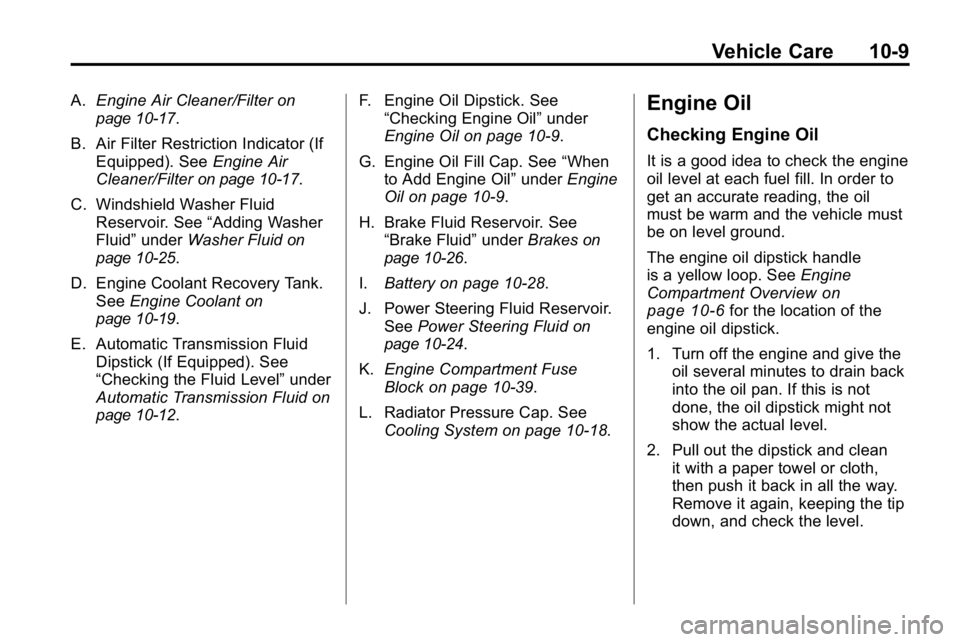
A.Engine Air Cleaner/Filteron
page 10‑17.
B. Air Filter Restriction Indicator (If Equipped). See Engine Air
Cleaner/Filter
on page 10‑17.
C. Windshield Washer Fluid Reservoir. See “Adding Washer
Fluid” under Washer Fluid
on
page 10‑25.
D. Engine Coolant Recovery Tank. See Engine Coolant
on
page 10‑19.
E. Automatic Transmission Fluid Dipstick (If Equipped). See
“Checking the Fluid Level” under
Automatic Transmission Fluid
on
page 10‑12. F. Engine Oil Dipstick. See
“Checking Engine Oil” under
Engine Oil on page 10‑9.
G. Engine Oil Fill Cap. See “When
to Add Engine Oil” underEngine
Oil on page 10‑9.
H. Brake Fluid Reservoir. See “Brake Fluid” underBrakes
on
page 10‑26.
I. Battery on page 10‑28.
J. Power Steering Fluid Reservoir. See Power Steering Fluid
on
page 10‑24.
K. Engine Compartment Fuse
Block on page 10‑39.
L. Radiator Pressure Cap. See Cooling System on page 10‑18.
Engine Oil
Checking Engine Oil
It is a good idea to check the engine
oil level at each fuel fill. In order to
get an accurate reading, the oil
must be warm and the vehicle must
be on level ground.
The engine oil dipstick handle
is a yellow loop. See Engine
Compartment Overview
on
page 10‑6for the location of the
engine oil dipstick.
1. Turn off the engine and give the oil several minutes to drain back
into the oil pan. If this is not
done, the oil dipstick might not
show the actual level.
2. Pull out the dipstick and clean it with a paper towel or cloth,
then push it back in all the way.
Remove it again, keeping the tip
down, and check the level.
Page 276 of 410
10-10 Vehicle Care
When to Add Engine Oil
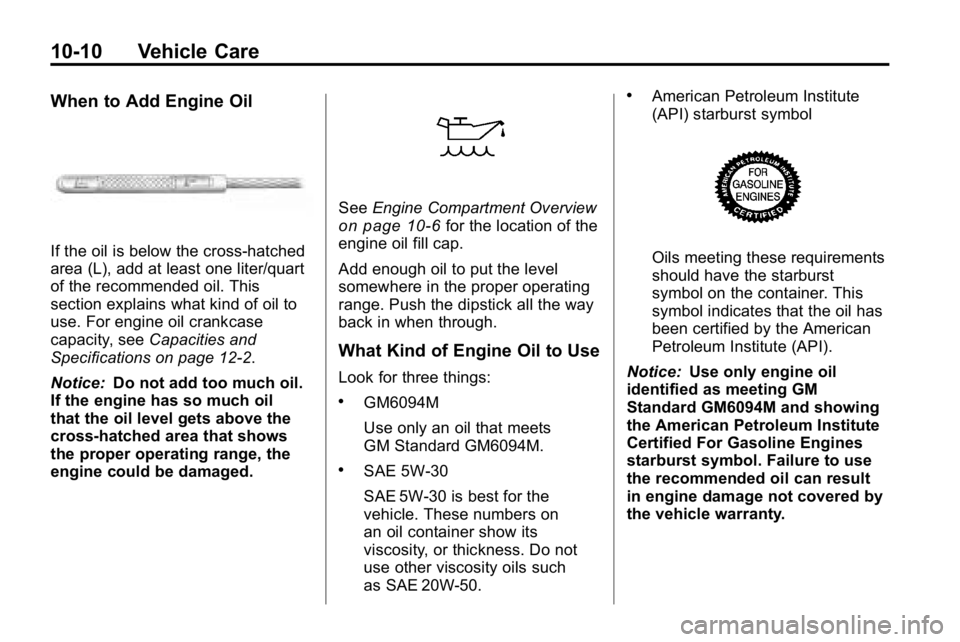
If the oil is below the cross-hatched
area (L), add at least one liter/quart
of the recommended oil. This
section explains what kind of oil to
use. For engine oil crankcase
capacity, seeCapacities and
Specifications on page 12‑2.
Notice: Do not add too much oil.
If the engine has so much oil
that the oil level gets above the
cross-hatched area that shows
the proper operating range, the
engine could be damaged.
See Engine Compartment Overviewon page 10‑6for the location of the
engine oil fill cap.
Add enough oil to put the level
somewhere in the proper operating
range. Push the dipstick all the way
back in when through.
What Kind of Engine Oil to Use
Look for three things:
.GM6094M
Use only an oil that meets
GM Standard GM6094M.
.SAE 5W-30
SAE 5W-30 is best for the
vehicle. These numbers on
an oil container show its
viscosity, or thickness. Do not
use other viscosity oils such
as SAE 20W-50.
.American Petroleum Institute
(API) starburst symbol
Oils meeting these requirements
should have the starburst
symbol on the container. This
symbol indicates that the oil has
been certified by the American
Petroleum Institute (API).
Notice: Use only engine oil
identified as meeting GM
Standard GM6094M and showing
the American Petroleum Institute
Certified For Gasoline Engines
starburst symbol. Failure to use
the recommended oil can result
in engine damage not covered by
the vehicle warranty.
Page 278 of 410
10-12 Vehicle Care
After changing the engine oil, reset
the system:
1. Turn the ignition key to ON/RUNwith the engine off.
2. Press and release the stem in the lower center of the
instrument cluster until the OIL
LIFE message is displayed.
3. Once the alternating “Oil Life”
and “Reset” messages appear,
press and hold the stem until
several beeps sound. This
confirms that the oil life system
has been reset.
4. Turn the key to LOCK/OFF.
If the “Change Oil” message
comes on again and stays on for
30 seconds at the next ignition
cycle, it did not reset. The system
needs to be reset again.What to Do with Used Oil
Used engine oil contains certain
elements that can be unhealthy for
your skin and could even cause
cancer. Do not let used oil stay on
your skin for very long. Clean your
skin and nails with soap and water,
or a good hand cleaner. Wash or
properly dispose of clothing or rags
containing used engine oil. See the
manufacturer's warnings about the
use and disposal of oil products.
Used oil can be a threat to the
environment. If you change your
own oil, be sure to drain all the oil
from the filter before disposal. Never
dispose of oil by putting it in the
trash, pouring it on the ground, into
sewers, or into streams or bodies of
water. Recycle it by taking it to a
place that collects used oil.
Automatic Transmission
Fluid
When to Check and Change
Automatic Transmission Fluid
A good time to check the automatic
transmission fluid level is when the
engine oil is changed.
Change the fluid and filter at the
intervals listed in Scheduled
Maintenance
on page 11‑2, and be
sure to use the transmission fluid
listed in Recommended Fluids and
Lubricants on page 11‑8.
How to Check Automatic
Transmission Fluid
Because this operation can be a
little difficult, you may choose to
have this done at the dealer service
department.
If adding it yourself, be sure to
follow all the instructions here,
or there could be a false reading on
the dipstick.
Page 281 of 410
Vehicle Care 10-15
Notice:Use of the incorrect
automatic transmission fluid
may damage the vehicle, and the
damages may not be covered by
the vehicle's warranty. Always
use the automatic transmission
fluid listed in Recommended
Fluids and Lubricants
on
page 11‑8.
.After adding fluid, recheck the
fluid level as described under
“How to Check Automatic
Transmission Fluid,” earlier in
this section.
.When the correct fluid level is
obtained, push the dipstick back
in all the way; then flip the
handle down to lock the dipstick
in place.
Manual Transmission
Fluid
When to Check
A good time to check the manual
transmission fluid is when the
engine oil is changed. However, the
fluid in the manual transmission
does not require changing.
How to Check
Because this operation can be a
little difficult, you may choose to
have this done at your HUMMER
dealer service department.
If doing it yourself, be sure to follow
all the instructions here, or there
could be a false reading.
Notice: Too much or too
little fluid can damage the
transmission. Too little fluid
could cause the transmission
to overheat. Be sure to get an
accurate reading if checking the
transmission fluid. To check the fluid:
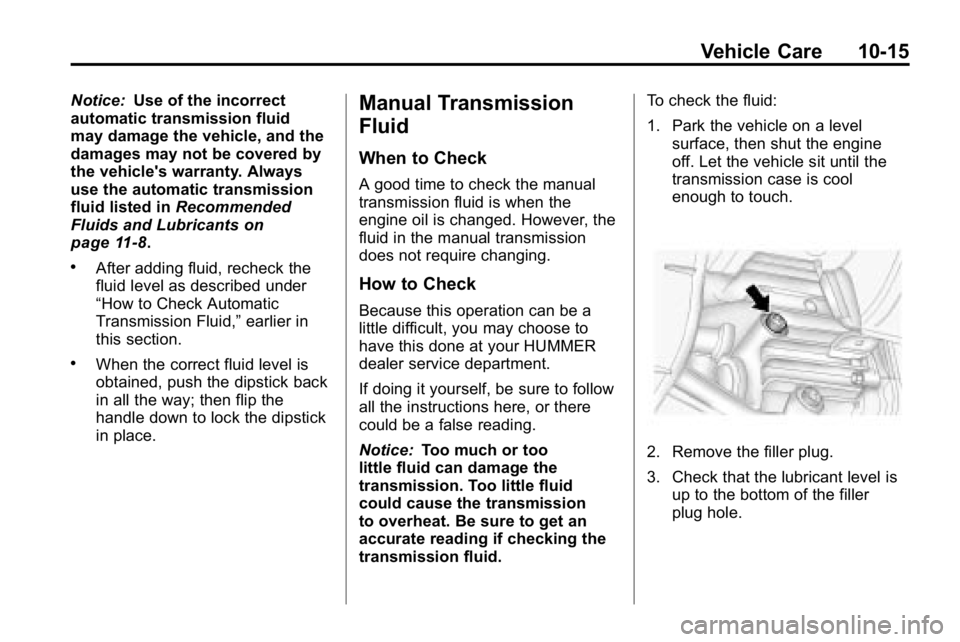
1. Park the vehicle on a level
surface, then shut the engine
off. Let the vehicle sit until the
transmission case is cool
enough to touch.
2. Remove the filler plug.
3. Check that the lubricant level isup to the bottom of the filler
plug hole.