warning light Hyundai Accent 2003 User Guide
[x] Cancel search | Manufacturer: HYUNDAI, Model Year: 2003, Model line: Accent, Model: Hyundai Accent 2003Pages: 186, PDF Size: 11.36 MB
Page 48 of 186
FEATURES OF YOUR HYUNDAI 1- 35
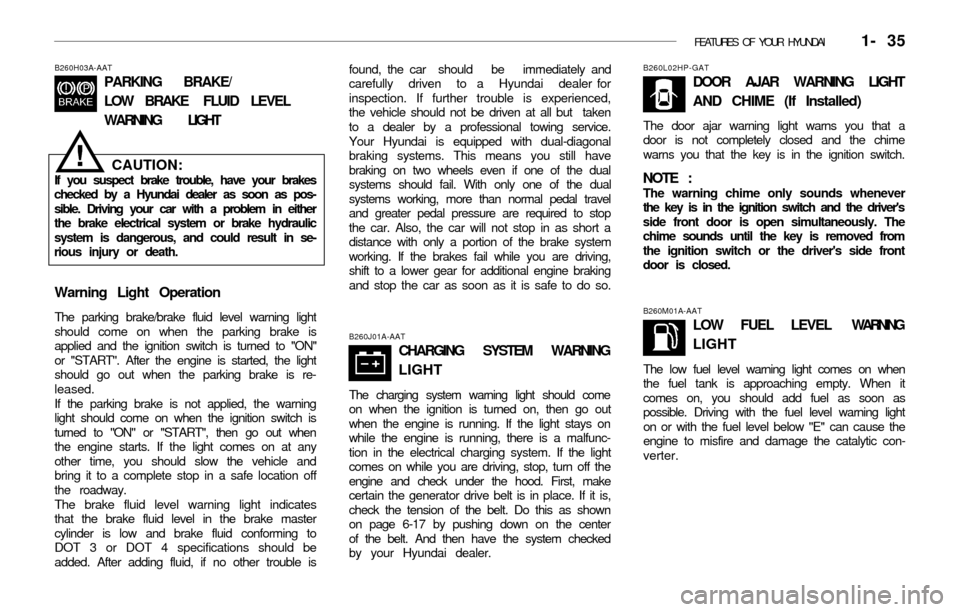
B260H03A-AAT
PARKING BRAKE/
LOW BRAKE FLUID LEVEL
WARNING LIGHT
CAUTION:
If you suspect brake trouble, have your brakes
checked by a Hyundai dealer as soon as pos-
sible. Driving your car with a problem in either
the brake electrical system or brake hydraulic
system is dangerous, and could result in se-
rious injury or death.
Warning Light Operation
The parking brake/brake fluid level warning light
should come on when the parking brake is
applied and the ignition switch is turned to "ON"
or "START". After the engine is started, the light
should go out when the parking brake is re-
leased.
If the parking brake is not applied, the warning
light should come on when the ignition switch is
turned to "ON" or "START", then go out when
the engine starts. If the light comes on at any
other time, you should slow the vehicle and
bring it to a complete stop in a safe location off
the roadway.
The brake fluid level warning light indicates
that the brake fluid level in the brake master
cylinder is low and brake fluid conforming to
DOT 3 or DOT 4 specifications should be
added. After adding fluid, if no other trouble is
!
B260J01A-AAT
CHARGING SYSTEM WARNING
LIGHT
The charging system warning light should come
on when the ignition is turned on, then go out
when the engine is running. If the light stays on
while the engine is running, there is a malfunc-
tion in the electrical charging system. If the light
comes on while you are driving, stop, turn off the
engine and check under the hood. First, make
certain the generator drive belt is in place. If it is,
check the tension of the belt. Do this as shown
on page 6-17 by pushing down on the center
of the belt. And then have the system checked
by your Hyundai dealer.
B260M01A-AAT
LOW FUEL LEVEL WARNING
LIGHT
The low fuel level warning light comes on when
the fuel tank is approaching empty. When it
comes on, you should add fuel as soon as
possible. Driving with the fuel level warning light
on or with the fuel level below "E" can cause the
engine to misfire and damage the catalytic con-
verter. found, the car should be immediately and
carefully driven to a Hyundai dealer for
inspection. If further trouble is experienced,
the vehicle should not be driven at all but taken
to a dealer by a professional towing service.
Your Hyundai is equipped with dual-diagonal
braking systems. This means you still have
braking on two wheels even if one of the dual
systems should fail. With only one of the dual
systems working, more than normal pedal travel
and greater pedal pressure are required to stop
the car. Also, the car will not stop in as short a
distance with only a portion of the brake system
working. If the brakes fail while you are driving,
shift to a lower gear for additional engine braking
and stop the car as soon as it is safe to do so.
B260L02HP-GAT
DOOR AJAR WARNING LIGHT
AND CHIME (If Installed)
The door ajar warning light warns you that a
door is not completely closed and the chime
warns you that the key is in the ignition switch.
NOTE :The warning chime only sounds whenever
the key is in the ignition switch and the driver's
side front door is open simultaneously. The
chime sounds until the key is removed from
the ignition switch or the driver's side front
door is closed.
Page 49 of 186
1- 36 FEATURES OF YOUR HYUNDAI
B270A01A-AAT
BRAKE PAD WEAR WARNING
SOUND
The front disc brake pads have wear indicators
that should make a high-pitched squealing or
scraping noise when new pads are needed. The
sound may come and go or be heard all the time
when the vehicle is moving. It may also be
heard when the brake pedal is pushed down
firmly. Expensive rotor damage will result if the
worn pads are not replaced. See your Hyundai
dealer immediately.
B900A01A-AAT
LIGHTS ON WARNING SOUND
The warning chime sounds when the tail lights
are on and the driver side door is open. This
prevents the battery from discharging by
warning you when the car is left with the tail
lights on. The chime sounds until the tail lights
are turned off.
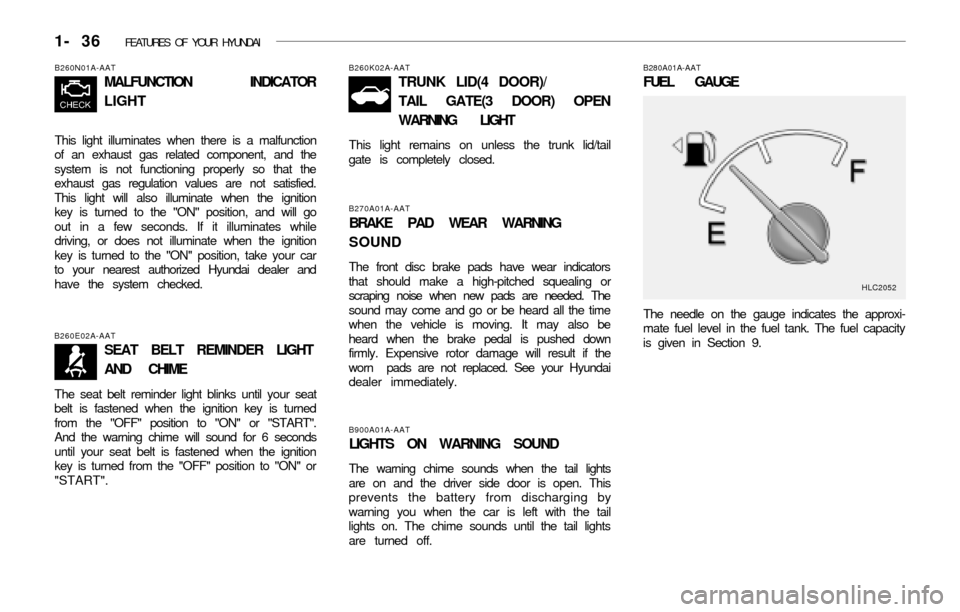
B280A01A-AAT
FUEL GAUGE
The needle on the gauge indicates the approxi-
mate fuel level in the fuel tank. The fuel capacity
is given in Section 9.
HLC2052
B260E02A-AAT
SEAT BELT REMINDER LIGHT
AND CHIME
The seat belt reminder light blinks until your seat
belt is fastened when the ignition key is turned
from the "OFF" position to "ON" or "START".
And the warning chime will sound for 6 seconds
until your seat belt is fastened when the ignition
key is turned from the "OFF" position to "ON" or
"START".
B260N01A-AAT
MALFUNCTION INDICATOR
LIGHT
This light illuminates when there is a malfunction
of an exhaust gas related component, and the
system is not functioning properly so that the
exhaust gas regulation values are not satisfied.
This light will also illuminate when the ignition
key is turned to the "ON" position, and will go
out in a few seconds. If it illuminates while
driving, or does not illuminate when the ignition
key is turned to the "ON" position, take your car
to your nearest authorized Hyundai dealer and
have the system checked.
B260K02A-AAT
TRUNK LID(4 DOOR)/
TAIL GATE(3 DOOR) OPEN
WARNING LIGHT
This light remains on unless the trunk lid/tail
gate is completely closed.
Page 56 of 186
FEATURES OF YOUR HYUNDAI 1- 43
B380A01HP-AAT
REAR WINDOW DEFROSTER
SWITCH (If Installed)
The rear window defroster is turned on by
pushing in the switch. To turn the defroster off,
push the switch a second time. The rear
window defroster automatically turns itself off
after about 20 minutes. To restart the defrost-
er cycle, push in the switch again after it has
turned itself off.
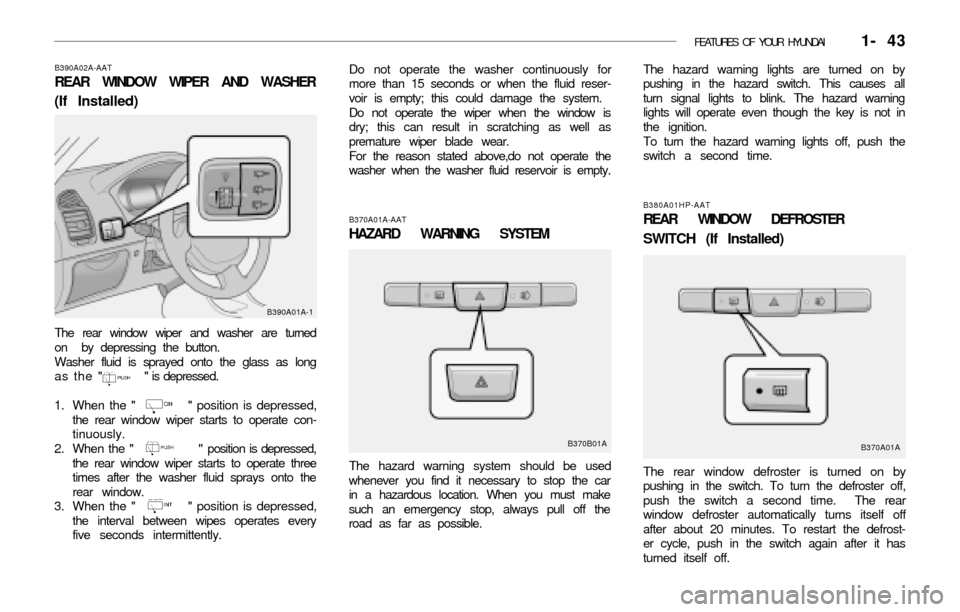
B370A01A-AAT
HAZARD WARNING SYSTEM
The hazard warning system should be used
whenever you find it necessary to stop the car
in a hazardous location. When you must make
such an emergency stop, always pull off the
road as far as possible.Do not operate the washer continuously for
more than 15 seconds or when the fluid reser-
voir is empty; this could damage the system.
Do not operate the wiper when the window is
dry; this can result in scratching as well as
premature wiper blade wear.
For the reason stated above,do not operate the
washer when the washer fluid reservoir is empty.
B390A02A-AAT
REAR WINDOW WIPER AND WASHER
(If Installed)
B390A01A-1
The rear window wiper and washer are turned
on by depressing the button.
Washer fluid is sprayed onto the glass as long
as the " " is depressed.
1. When the " " position is depressed,
the rear window wiper starts to operate con-
tinuously.
2. When the " " position is depressed,
the rear window wiper starts to operate three
times after the washer fluid sprays onto the
rear window.
3. When the " " position is depressed,
the interval between wipes operates every
five seconds intermittently.
B370B01A
The hazard warning lights are turned on by
pushing in the hazard switch. This causes all
turn signal lights to blink. The hazard warning
lights will operate even though the key is not in
the ignition.
To turn the hazard warning lights off, push the
switch a second time.
B370A01A
Page 60 of 186
FEATURES OF YOUR HYUNDAI 1- 47
oON
In the "ON" position, the light stays on at all
times.
o OFF
In the "OFF" position, the light stays off at all
times even though a door is open.
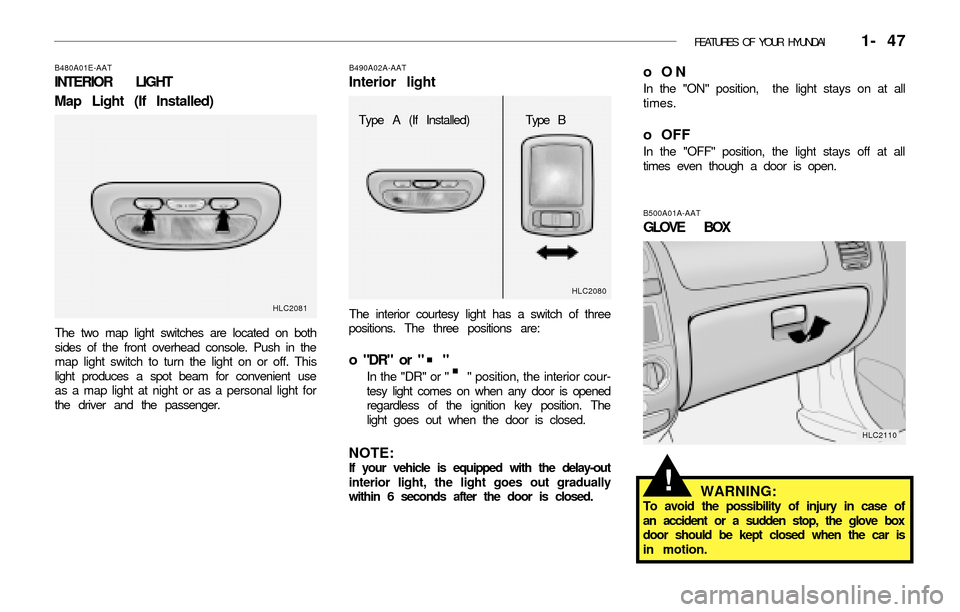
The interior courtesy light has a switch of three
positions. The three positions are:
o "DR" or "·"
In the "DR" or "·" position, the interior cour-
tesy light comes on when any door is opened
regardless of the ignition key position. The
light goes out when the door is closed.
NOTE:If your vehicle is equipped with the delay-out
interior light, the light goes out gradually
within 6 seconds after the door is closed.
B490A02A-AAT
Interior light
HLC2080
Type A (If Installed)Type B
B480A01E-AAT
INTERIOR LIGHT
Map Light (If Installed)
The two map light switches are located on both
sides of the front overhead console. Push in the
map light switch to turn the light on or off. This
light produces a spot beam for convenient use
as a map light at night or as a personal light for
the driver and the passenger.
HLC2081
HLC2110 B500A01A-AAT
GLOVE BOX
WARNING:
To avoid the possibility of injury in case of
an accident or a sudden stop, the glove box
door should be kept closed when the car is
in motion.
!
Page 63 of 186
1- 50 FEATURES OF YOUR HYUNDAI
B510D01HP-GAT
OUTSIDE REAR VIEW MIRROR HEAT-
ER (If Installed)
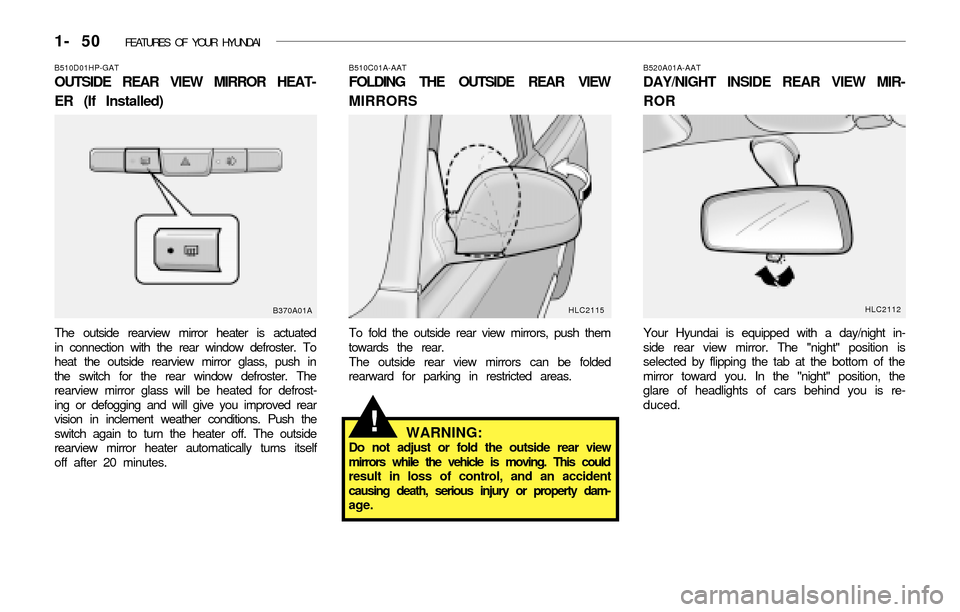
The outside rearview mirror heater is actuated
in connection with the rear window defroster. To
heat the outside rearview mirror glass, push in
the switch for the rear window defroster. The
rearview mirror glass will be heated for defrost-
ing or defogging and will give you improved rear
vision in inclement weather conditions. Push the
switch again to turn the heater off. The outside
rearview mirror heater automatically turns itself
off after 20 minutes.
B370A01AB510C01A-AAT
FOLDING THE OUTSIDE REAR VIEW
MIRRORS
To fold the outside rear view mirrors, push them
towards the rear.
The outside rear view mirrors can be folded
rearward for parking in restricted areas.
B520A01A-AAT
DAY/NIGHT INSIDE REAR VIEW MIR-
ROR
Your Hyundai is equipped with a day/night in-
side rear view mirror. The "night" position is
selected by flipping the tab at the bottom of the
mirror toward you. In the "night" position, the
glare of headlights of cars behind you is re-
duced.
HLC2115
WARNING:Do not adjust or fold the outside rear view
mirrors while the vehicle is moving. This could
result in loss of control, and an accident
causing death, serious injury or property dam-
age.
!
HLC2112
Page 66 of 186
FEATURES OF YOUR HYUNDAI 1- 53
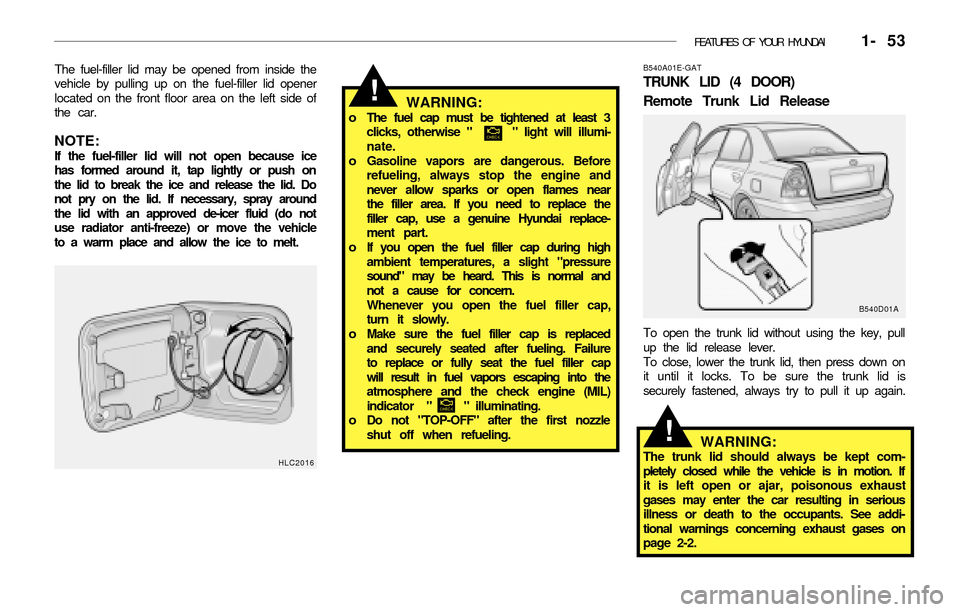
The fuel-filler lid may be opened from inside the
vehicle by pulling up on the fuel-filler lid opener
located on the front floor area on the left side of
the car.
NOTE:If the fuel-filler lid will not open because ice
has formed around it, tap lightly or push on
the lid to break the ice and release the lid. Do
not pry on the lid. If necessary, spray around
the lid with an approved de-icer fluid (do not
use radiator anti-freeze) or move the vehicle
to a warm place and allow the ice to melt.
WARNING:o The fuel cap must be tightened at least 3
clicks, otherwise " " light will illumi-
nate.
o Gasoline vapors are dangerous. Before
refueling, always stop the engine and
never allow sparks or open flames near
the filler area. If you need to replace the
filler cap, use a genuine Hyundai replace-
ment part.
o If you open the fuel filler cap during high
ambient temperatures, a slight "pressure
sound" may be heard. This is normal and
not a cause for concern.
Whenever you open the fuel filler cap,
turn it slowly.
o Make sure the fuel filler cap is replaced
and securely seated after fueling. Failure
to replace or fully seat the fuel filler cap
will result in fuel vapors escaping into the
atmosphere and the check engine (MIL)
indicator " " illuminating.
o Do not "TOP-OFF" after the first nozzle
shut off when refueling.
HLC2016
B540A01E-GAT
TRUNK LID (4 DOOR)
Remote Trunk Lid Release
B540D01A
To open the trunk lid without using the key, pull
up the lid release lever.
To close, lower the trunk lid, then press down on
it until it locks. To be sure the trunk lid is
securely fastened, always try to pull it up again.
WARNING:The trunk lid should always be kept com-
pletely closed while the vehicle is in motion. If
it is left open or ajar, poisonous exhaust
gases may enter the car resulting in serious
illness or death to the occupants. See addi-
tional warnings concerning exhaust gases on
page 2-2.
!
!
Page 67 of 186
1- 54 FEATURES OF YOUR HYUNDAI
B540C01A-AAT
To Unlock Using the Key.
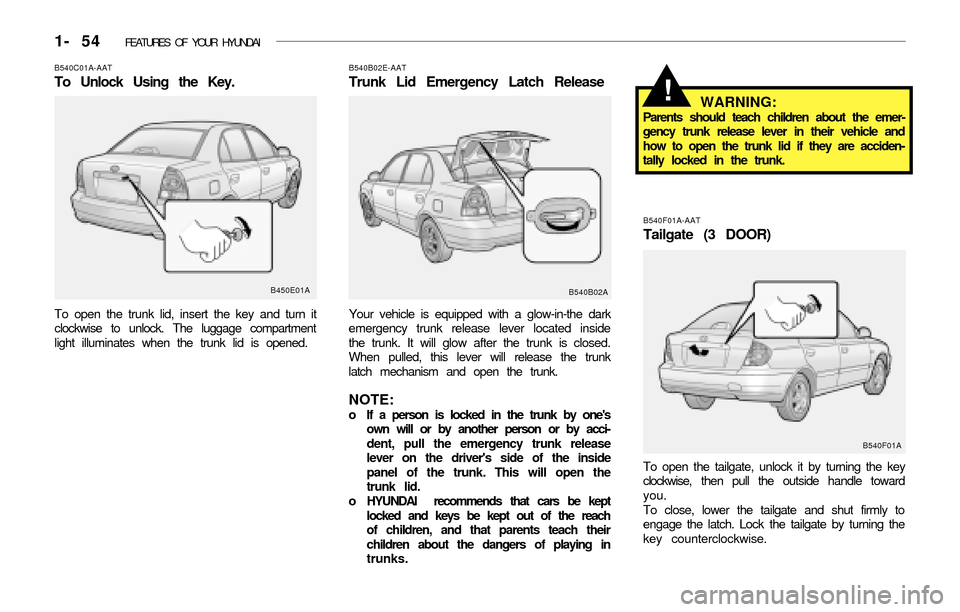
To open the trunk lid, insert the key and turn it
clockwise to unlock. The luggage compartment
light illuminates when the trunk lid is opened.
B450E01AB540F01A-AAT
Tailgate (3 DOOR)
To open the tailgate, unlock it by turning the key
clockwise, then pull the outside handle toward
you.
To close, lower the tailgate and shut firmly to
engage the latch. Lock the tailgate by turning the
key counterclockwise.
B540B02E-AAT
Trunk Lid Emergency Latch Release
Your vehicle is equipped with a glow-in-the dark
emergency trunk release lever located inside
the trunk. It will glow after the trunk is closed.
When pulled, this lever will release the trunk
latch mechanism and open the trunk.
NOTE:o If a person is locked in the trunk by one's
own will or by another person or by acci-
dent, pull the emergency trunk release
lever on the driver's side of the inside
panel of the trunk. This will open the
trunk lid.
o HYUNDAI recommends that cars be kept
locked and keys be kept out of the reach
of children, and that parents teach their
children about the dangers of playing in
trunks.
WARNING:Parents should teach children about the emer-
gency trunk release lever in their vehicle and
how to open the trunk lid if they are acciden-
tally locked in the trunk.
B540B02A
!
B540F01A
Page 99 of 186
DRIVING YOUR HYUNDAI 2- 3
C020A01A-AATBEFORE STARTING THE ENGINE
Before you start the engine, you should always:
1. Look around the vehicle to be sure there are
no flat tires, puddles of oil or water or other
indications of possible trouble.
2. After entering the car, check to be sure the
parking brake is engaged.
3. Check that all windows, and lights are clean.
4. Check that the interior and exterior mirrors
are clean and in position.
5. Check your seat, seatback and headrest to
be sure they are in their proper positions.
6. Lock all the doors.
7. Fasten your seat belt and be sure that all
other occupants have fastened theirs.
8. Turn off all lights and accessories that are
not needed.
9. When you turn the ignition switch to "ON",
check that all appropriate warning lights are
operating and that you have sufficient fuel.
10. Check the operation of warning lights and all
bulbs when key is in the "ON" position.
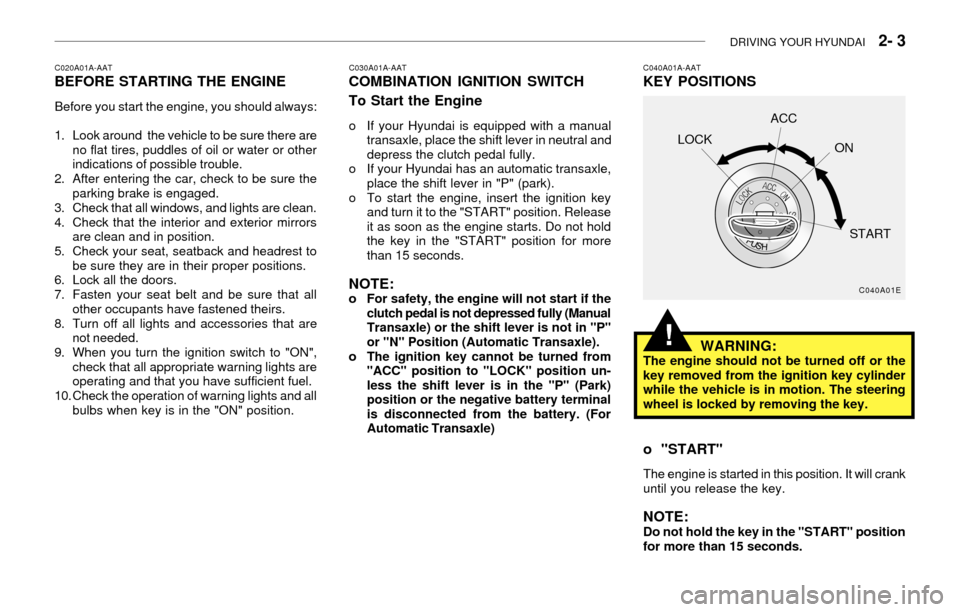
C030A01A-AATCOMBINATION IGNITION SWITCH
To Start the Engine
o If your Hyundai is equipped with a manual
transaxle, place the shift lever in neutral and
depress the clutch pedal fully.
o If your Hyundai has an automatic transaxle,
place the shift lever in "P" (park).
o To start the engine, insert the ignition key
and turn it to the "START" position. Release
it as soon as the engine starts. Do not hold
the key in the "START" position for more
than 15 seconds.
NOTE:o For safety, the engine will not start if the
clutch pedal is not depressed fully (Manual
Transaxle) or the shift lever is not in "P"
or "N" Position (Automatic Transaxle).
o The ignition key cannot be turned from
"ACC" position to "LOCK" position un-
less the shift lever is in the "P" (Park)
position or the negative battery terminal
is disconnected from the battery. (For
Automatic Transaxle)
C040A01A-AATKEY POSITIONS
C040A01E
LOCKACC
ON
START
WARNING:The engine should not be turned off or the
key removed from the ignition key cylinder
while the vehicle is in motion. The steering
wheel is locked by removing the key.
o "START"
The engine is started in this position. It will crank
until you release the key.
NOTE:Do not hold the key in the "START" position
for more than 15 seconds.
!
Page 101 of 186
DRIVING YOUR HYUNDAI 2- 5
The starter should not be operated for more
than 15 seconds at a time. Wait 15-30 sec-
onds between starting attempts to protect
the starter from overheating.C050B01A-AATNormal Conditions:
The Starting Procedure:
1. Insert key, and fasten the seat belt.
2. Depress the clutch pedal fully and place the
gearshift lever (manual transaxle) in neutral
or the selector lever (automatic transaxle) in
"P" (park) position.
3. After turning the ignition key to the "ON"
position, make certain all warning lights and
gauges are functioning properly before start-
ing the engine.
WARNING:Be sure that the clutch is fully depressed
when starting a manual transaxle vehicle.
Your manual transaxle equipped vehicle will
not start unless the clutch pedal is fully
depressed. On a manual transaxle equipped
vehicle that can be started without depress-
ing the clutch, there is the potential to cause
damage to the vehicle or injury to someone
inside or outside the vehicle as a result of
the forward or backward movement of the
vehicle that will occur if the clutch is not
depressed when the vehicle is started.
!
4. Turn the ignition key to the "Start" position
and release it when the engine starts.
After the engine has started, allow the engine
to run for 10 to 20 seconds prior to placing
the vehicle in gear.
C070A02A-AAT
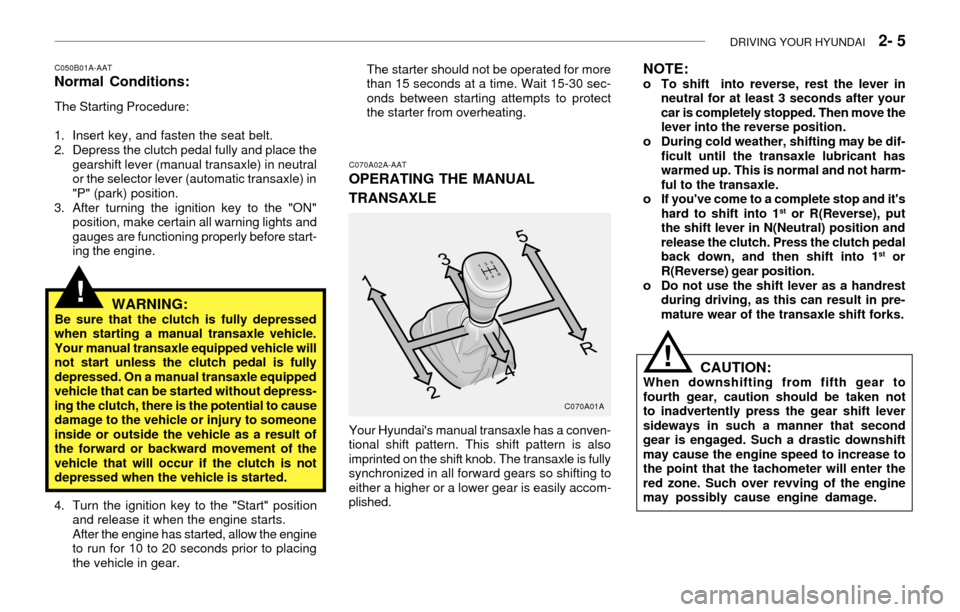
OPERATING THE MANUAL
TRANSAXLE
Your Hyundai's manual transaxle has a conven-
tional shift pattern. This shift pattern is also
imprinted on the shift knob. The transaxle is fully
synchronized in all forward gears so shifting to
either a higher or a lower gear is easily accom-
plished.
C070A01A
NOTE:o To shift into reverse, rest the lever in
neutral for at least 3 seconds after your
car is completely stopped. Then move the
lever into the reverse position.
o During cold weather, shifting may be dif-
ficult until the transaxle lubricant has
warmed up. This is normal and not harm-
ful to the transaxle.
o If you've come to a complete stop and it's
hard to shift into 1
st or R(Reverse), put
the shift lever in N(Neutral) position and
release the clutch. Press the clutch pedal
back down, and then shift into 1
st or
R(Reverse) gear position.
o Do not use the shift lever as a handrest
during driving, as this can result in pre-
mature wear of the transaxle shift forks.
CAUTION:When downshifting from fifth gear to
fourth gear, caution should be taken not
to inadvertently press the gear shift lever
sideways in such a manner that second
gear is engaged. Such a drastic downshift
may cause the engine speed to increase to
the point that the tachometer will enter the
red zone. Such over revving of the engine
may possibly cause engine damage.
!
Page 106 of 186
2- 10 DRIVING YOUR HYUNDAI
C130A01A-AATGOOD BRAKING PRACTICES
WARNING:
Nothing should be carried on top of the shelf
panel behind the rear seat. If there were an
accident or a sudden stop, such objects
could move forward and cause damage to
the vehicle or injure the occupants.
!
o After being parked, check to be sure the
parking brake is not engaged and that the
parking brake indicator light is out before
driving away.
o Driving through water may get the brakes
wet. They can also get wet when the car is
washed. Wet brakes can be dangerous! Your
car will not stop as quickly if the brakes are
wet. Wet brakes may cause the car to pull to
one side. To dry the brakes, apply the brakes
lightly until the braking action returns to nor-
mal, taking care to keep the car under con-
trol at all times. If the braking action does not
return to normal, stop as soon as it is safe to
do so and call your Hyundai dealer for assis-
tance.
o Don't coast down hills with the car out of
gear. This is extremely hazardous. Keep the
car in gear at all times, use the brakes to
slow down, then shift to a lower gear so that
engine braking will help you maintain a safe
speed.o Don't "ride" the brake pedal. Resting your
foot on the brake pedal while driving can be
dangerous because it can result in the brakes
overheating and losing their effectiveness. It
also increases the wear of the brake compo-
nents.
o If a tire goes flat while you are driving, apply
the brakes gently and keep the car pointed
straight ahead while you slow down. When
you are moving slowly enough for it to be
safe to do so, pull off the road and stop in a
safe place.
o If your car is equipped with an automatic
transaxle, don't let your car creep forward.
To avoid creeping forward, keep your foot on
the brake pedal when the car is stopped.
o Use caution when parking on a hill. Engage
the parking brake and place the gear selec-
tor lever in "P" (automatic transaxle) or in
first or reverse gear (manual transaxle). If
your car is facing downhill, turn the front
wheels into the curb to help keep the car
from rolling. If your car is facing uphill, turn
the front wheels away from the curb to help
keep the car from rolling. If there is no curb
or if it is required by other conditions to keep
the car from rolling, block the wheels.
o Under some conditions your parking brake
can freeze in the engaged position. This is
most likely to happen when there is an accu-
mulation of snow or ice around or near the
rear brakes or if the brakes are wet. If there
is a risk that the parking brake may freeze,apply it only temporarily while you put the
gear selector lever in "P" (automatic) or in
first or reverse gear (manual transaxle) and
block the rear wheels so the car cannot roll.
Then release the parking brake.
o Do not hold the vehicle on the upgrade with
the accelerator pedal. This can cause the
transmission to overheat. Always use the
brake pedal or parking brake.C120A02A-AAT
ANTI-LOCK BRAKE SYSTEM
(If Installed)
The Anti-Lock Brake System (ABS) is designed
to prevent wheel lock-up during sudden braking
or on hazardous road surfaces. The ABS con-
trol module monitors the wheel speed and con-
trols the pressure applied to each brake. Thus,
in emergency situations or on slick roads, ABS
will increase vehicle control during braking.
NOTE:During ABS operation, a slight pulsation
may be felt in the brake pedal when the
brakes are applied. Also, a noise may be
heard in the engine compartment while brak-
ing. These conditions are normal and indi-
cate that the anti-lock brake system is func-
tioning properly.