warning light Hyundai Accent 2003 Owner's Guide
[x] Cancel search | Manufacturer: HYUNDAI, Model Year: 2003, Model line: Accent, Model: Hyundai Accent 2003Pages: 186, PDF Size: 11.36 MB
Page 107 of 186
DRIVING YOUR HYUNDAI 2- 11
WARNING:ABS will not prevent accidents due to
improper or dangerous driving maneu-
vers. Even though vehicle control is im-
proved during emergency braking, always
maintain a safe distance between you and
objects ahead. Vehicle speeds should al-
ways be reduced during extreme road
conditions.
The braking distance for cars equipped
with an anti-lock braking system may be
longer than for those without it in the
following road conditions.
o Driving on rough, gravel or snow-cov-
ered roads.
o Driving with tire chains installed.
o Driving on roads where the road surface
is pitted or has different surface height.
These roads should be driven at reduced
speeds. The safety features of an ABS
equipped vehicle should not be tested by
high speed driving or cornering. This could
endanger the safety of yourself or others.
!
C140A01A-AATDRIVING FOR ECONOMY
You can save fuel and get more miles from your
car if you follow these suggestions:
o Drive smoothly. Accelerate at a moderate
rate. Don't make "jack-rabbit" starts or full-
throttle shifts and maintain a steady cruising
speed. Don't race between stoplights. Try to
adjust your speed to that of the other traffic
so you don't have to change speeds unnec-
essarily. Avoid heavy traffic whenever possi-
ble. Always maintain a safe distance from
other vehicles so you can avoid unneces-
sary braking. This also reduces brake wear.
o Drive at a moderate speed. The faster you
drive, the more fuel your car uses. Driving at
a moderate speed, especially on the high-
way, is one of the most effective ways to
reduce fuel consumption.
o Don't "ride" the brake or clutch pedal. This
can increase fuel consumption and also in-
crease wear on these components. In addi-
tion, driving with your foot resting on the
brake pedal may cause the brakes to over-
heat, which reduces their effectiveness and
may lead to more serious consequences.
o Take care of your tires. Keep them inflated to
the recommended pressure. Incorrect infla-
tion, either too much or too little, results in
unnecessary tire wear. Check the tire pres-
sures at least once a month.o Be sure that the wheels are aligned correct-
ly. Improper alignment can result from hitting
curbs or driving too fast over irregular surfac-
es. Poor alignment causes faster tire wear
and may also result in other problems as well
as greater fuel consumption.
o Keep your car in good condition. For better
fuel economy and reduced maintenance
costs, maintain your car in accordance with
the maintenance schedule in Section 5. If
you drive your car in severe conditions, more
frequent maintenance is required (see Sec-
tion 5 for details).
o Keep your car clean. For maximum service,
your Hyundai should be kept clean and free
of corrosive materials. It is especially impor-
tant that mud, dirt, ice, etc. not be allowed to
accumulate on the underside of the car. This
extra weight can result in increased fuel
consumption and also contribute to corro-
sion.
o Travel lightly. Don't carry unnecessary weight
in your car. Weight reduces fuel economy.
o Don't let the engine idle longer than neces-
sary. If you are waiting (and not in traffic),
turn off your engine and restart only when
you're ready to go.
o Remember, your Hyundai does not require
extended warm-up. As soon as the engine is
running smoothly, you can drive away. In
very cold weather, however, give your en-
gine a slightly longer warm-up period.
Page 112 of 186
3- 2 WHAT TO DO IN AN EMERGENCY
!
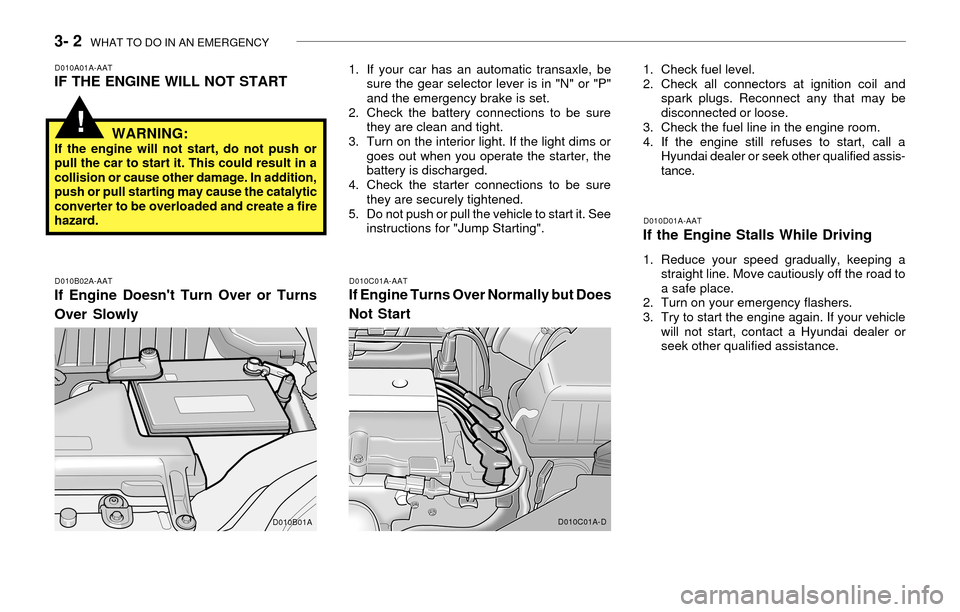
D010B02A-AAT
If Engine Doesn't Turn Over or Turns
Over Slowly
D010A01A-AATIF THE ENGINE WILL NOT START
D010C01A-AATIf Engine Turns Over Normally but Does
Not Start
1. Check fuel level.
2. Check all connectors at ignition coil and
spark plugs. Reconnect any that may be
disconnected or loose.
3. Check the fuel line in the engine room.
4. If the engine still refuses to start, call a
Hyundai dealer or seek other qualified assis-
tance.
D010D01A-AAT
If the Engine Stalls While Driving
1. Reduce your speed gradually, keeping a
straight line. Move cautiously off the road to
a safe place.
2. Turn on your emergency flashers.
3. Try to start the engine again. If your vehicle
will not start, contact a Hyundai dealer or
seek other qualified assistance.
WARNING:If the engine will not start, do not push or
pull the car to start it. This could result in a
collision or cause other damage. In addition,
push or pull starting may cause the catalytic
converter to be overloaded and create a fire
hazard.
D010B01AD010C01A-D
1. If your car has an automatic transaxle, be
sure the gear selector lever is in "N" or "P"
and the emergency brake is set.
2. Check the battery connections to be sure
they are clean and tight.
3. Turn on the interior light. If the light dims or
goes out when you operate the starter, the
battery is discharged.
4. Check the starter connections to be sure
they are securely tightened.
5. Do not push or pull the vehicle to start it. See
instructions for "Jump Starting".
Page 113 of 186
WHAT TO DO IN AN EMERGENCY 3- 3
D020A02A-AATJUMP STARTING
WARNING:
The gas produced by the battery during the
jump-start operation is highly explosive. If
these instructions are not followed exactly,
serious personal injury and damage to the
vehicle may occur! If you are not sure how to
follow this procedure, seek qualified assis-
tance. Automobile batteries contain sulfuric
acid. This is poisonous and highly corrosive.
When jump starting, wear protective glasses
and be careful not to get acid on yourself,
your clothing or on the car.Discharged
battery
Booster
battery
HLC4001
!
o If you should accidentally get acid on your
skin or in your eyes, immediately remove
any contaminated clothing and flush the area
with clear water for at least 15 minutes. Then
promptly obtain medical attention. If you must
be transported to an emergency facility, con-
tinue to apply water to the affected area with
a sponge or cloth.
o The gas produced by the battery during the
jump-start operation is highly explosive. Do
not smoke or allow a spark or open flame in
the vicinity.
o The battery being used to provide the jump
start must be 12-volt. If you cannot deter-
mine that it is a 12-volt battery, do not at-
tempt to use it for the jump start.
o To jump start a car with a discharged battery,
follow this procedure exactly:
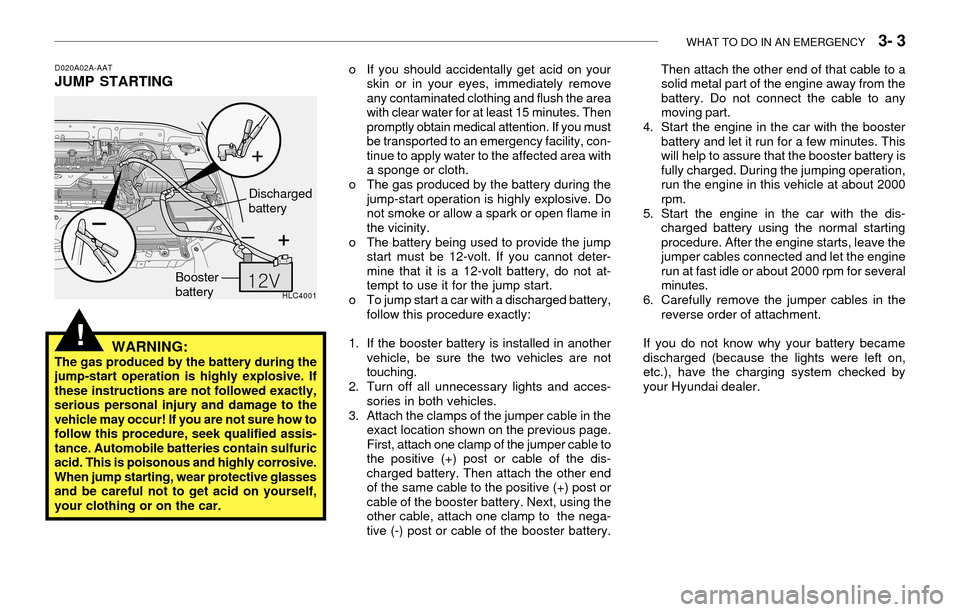
1. If the booster battery is installed in another
vehicle, be sure the two vehicles are not
touching.
2. Turn off all unnecessary lights and acces-
sories in both vehicles.
3. Attach the clamps of the jumper cable in the
exact location shown on the previous page.
First, attach one clamp of the jumper cable to
the positive (+) post or cable of the dis-
charged battery. Then attach the other end
of the same cable to the positive (+) post or
cable of the booster battery. Next, using the
other cable, attach one clamp to the nega-
tive (-) post or cable of the booster battery.Then attach the other end of that cable to a
solid metal part of the engine away from the
battery. Do not connect the cable to any
moving part.
4. Start the engine in the car with the booster
battery and let it run for a few minutes. This
will help to assure that the booster battery is
fully charged. During the jumping operation,
run the engine in this vehicle at about 2000
rpm.
5. Start the engine in the car with the dis-
charged battery using the normal starting
procedure. After the engine starts, leave the
jumper cables connected and let the engine
run at fast idle or about 2000 rpm for several
minutes.
6. Carefully remove the jumper cables in the
reverse order of attachment.
If you do not know why your battery became
discharged (because the lights were left on,
etc.), have the charging system checked by
your Hyundai dealer.
Page 119 of 186
WHAT TO DO IN AN EMERGENCY 3- 9
WARNING:Wheels and wheel covers may have sharp
edges. Handle them carefully to avoid pos-
sible severe injury.
Before putting the wheel into place, be sure
that there is nothing on the hub or wheel
(such as mud, tar, gravel, etc.) that interferes
with the wheel fitting solidly against the hub.
If there is, remove it. If there is not good
contact on the mounting surface between
the wheel and hub, the wheel nuts could
loosen and cause the loss of a wheel. Loss
of a wheel may result in loss of control of the
vehicle. This may cause serious injury or
death.
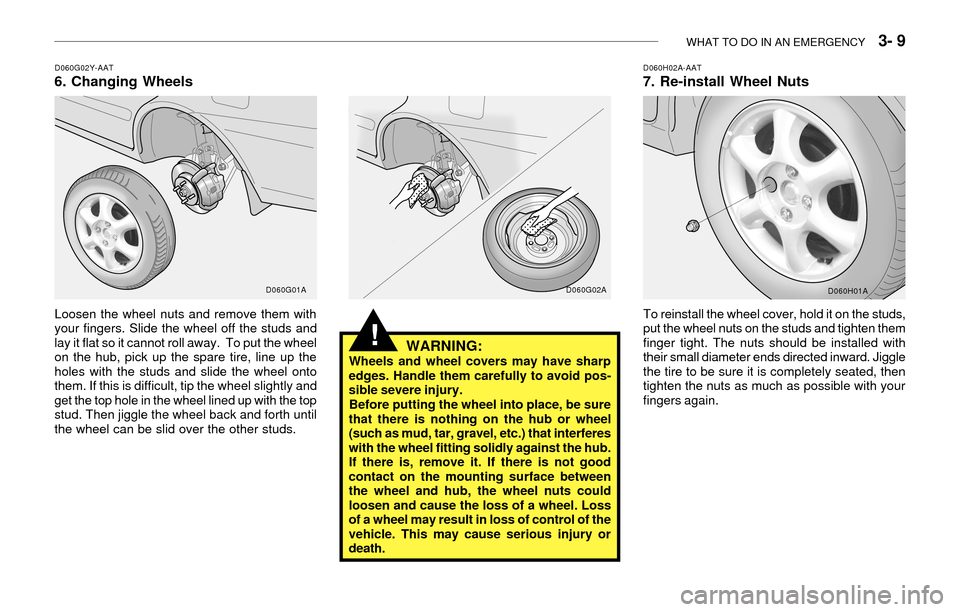
D060G02Y-AAT6. Changing Wheels
Loosen the wheel nuts and remove them with
your fingers. Slide the wheel off the studs and
lay it flat so it cannot roll away. To put the wheel
on the hub, pick up the spare tire, line up the
holes with the studs and slide the wheel onto
them. If this is difficult, tip the wheel slightly and
get the top hole in the wheel lined up with the top
stud. Then jiggle the wheel back and forth until
the wheel can be slid over the other studs.
D060H02A-AAT7. Re-install Wheel Nuts
To reinstall the wheel cover, hold it on the studs,
put the wheel nuts on the studs and tighten them
finger tight. The nuts should be installed with
their small diameter ends directed inward. Jiggle
the tire to be sure it is completely seated, then
tighten the nuts as much as possible with your
fingers again.
D060G02A
!
D060H01A D060G01A
Page 155 of 186
DO-IT-YOURSELF MAINTENANCE 6- 19
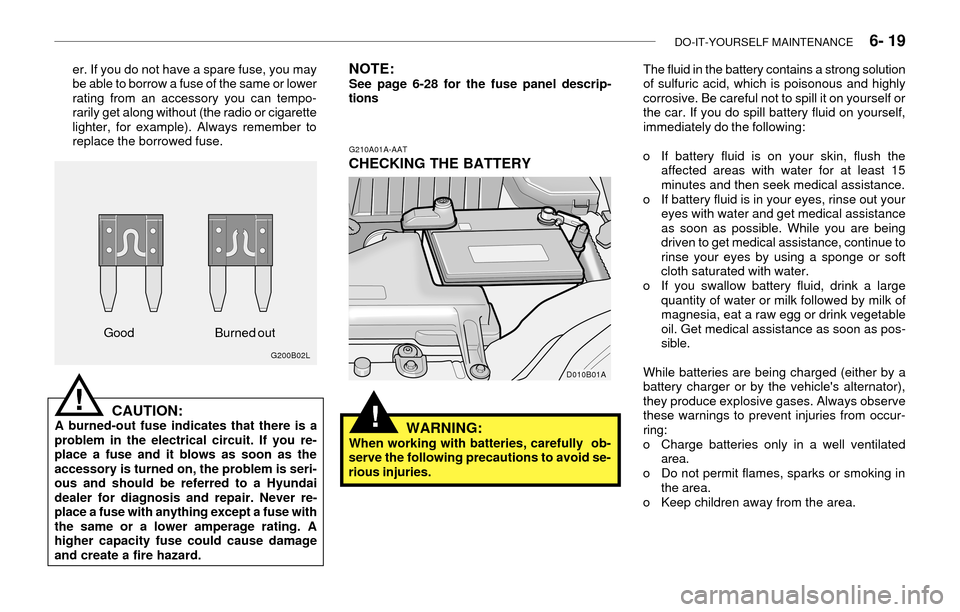
er. If you do not have a spare fuse, you may
be able to borrow a fuse of the same or lower
rating from an accessory you can tempo-
rarily get along without (the radio or cigarette
lighter, for example). Always remember to
replace the borrowed fuse.
CAUTION:A burned-out fuse indicates that there is a
problem in the electrical circuit. If you re-
place a fuse and it blows as soon as the
accessory is turned on, the problem is seri-
ous and should be referred to a Hyundai
dealer for diagnosis and repair. Never re-
place a fuse with anything except a fuse with
the same or a lower amperage rating. A
higher capacity fuse could cause damage
and create a fire hazard.
G200B02L
!
GoodBurned out
G210A01A-AAT
CHECKING THE BATTERY
WARNING:
When working with batteries, carefully ob-
serve the following precautions to avoid se-
rious injuries.
!
The fluid in the battery contains a strong solution
of sulfuric acid, which is poisonous and highly
corrosive. Be careful not to spill it on yourself or
the car. If you do spill battery fluid on yourself,
immediately do the following:
o If battery fluid is on your skin, flush the
affected areas with water for at least 15
minutes and then seek medical assistance.
o If battery fluid is in your eyes, rinse out your
eyes with water and get medical assistance
as soon as possible. While you are being
driven to get medical assistance, continue to
rinse your eyes by using a sponge or soft
cloth saturated with water.
o If you swallow battery fluid, drink a large
quantity of water or milk followed by milk of
magnesia, eat a raw egg or drink vegetable
oil. Get medical assistance as soon as pos-
sible.
While batteries are being charged (either by a
battery charger or by the vehicle's alternator),
they produce explosive gases. Always observe
these warnings to prevent injuries from occur-
ring:
o Charge batteries only in a well ventilated
area.
o Do not permit flames, sparks or smoking in
the area.
o Keep children away from the area.NOTE:See page 6-28 for the fuse panel descrip-
tions
D010B01A
Page 156 of 186
6- 20 DO-IT-YOURSELF MAINTENANCE
G220A01A-AATCHECKING ELECTRIC COOLING
FANSG230A03A-AATPOWER STEERING FLUID LEVEL
G220B01A-AATChecking Engine Cooling Fan
The engine cooling fan should come on auto-
matically if the engine coolant temperature is
high.
WARNING:The radiator fan is controlled by engine cool-
ant temperature and may sometimes operate
even when the engine is not running. Use
extreme caution when working near the
blades of the cooling fan, so that you are not
injured by a rotating fan blade. As the cool-
ant temperature decreases the fan will auto-
matically shut off. This is a normal condition.
!
G220C01A-AATChecking Condenser Cooling Fan
The condenser cooling fan should come on
automatically whenever the air conditioner is in
operation.
HLC5006
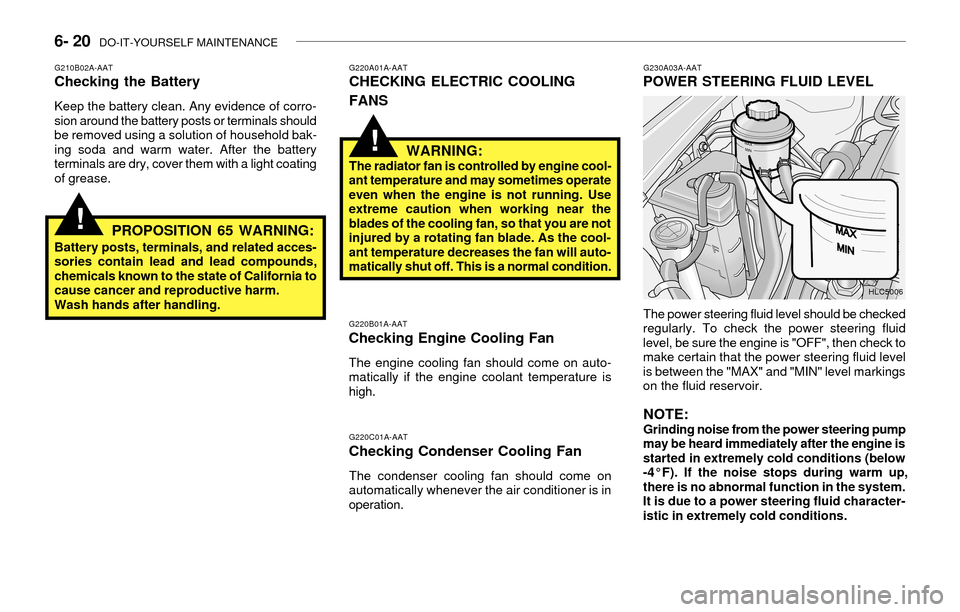
The power steering fluid level should be checked
regularly. To check the power steering fluid
level, be sure the engine is "OFF", then check to
make certain that the power steering fluid level
is between the "MAX" and "MIN" level markings
on the fluid reservoir.
NOTE:Grinding noise from the power steering pump
may be heard immediately after the engine is
started in extremely cold conditions (below
-4°F). If the noise stops during warm up,
there is no abnormal function in the system.
It is due to a power steering fluid character-
istic in extremely cold conditions.
G210B02A-AATChecking the Battery
Keep the battery clean. Any evidence of corro-
sion around the battery posts or terminals should
be removed using a solution of household bak-
ing soda and warm water. After the battery
terminals are dry, cover them with a light coating
of grease.
PROPOSITION 65 WARNING:
Battery posts, terminals, and related acces-
sories contain lead and lead compounds,
chemicals known to the state of California to
cause cancer and reproductive harm.
Wash hands after handling.
!
Page 157 of 186
DO-IT-YOURSELF MAINTENANCE 6- 21
G240A01A-AATPOWER STEERING HOSES
It is suggested that you check the power steer-
ing hose connections for fluid leakage at those
intervals specified in the vehicle maintenance
schedule in Section 5.
The power steering hoses should be replaced if
there is severe surface cracking, pulling, scuff-
ing or worn spots. Deterioration of the hose
could cause premature failure.
Recommended Fluid
Use PSF-3 type fluid
NOTE:Do not start the engine when the power
steering oil reservoir is empty.
G250A01A-AAT
FOR MORE INFORMATION ABOUT
YOUR HYUNDAI
If you desire additional information about main-
taining and servicing your Hyundai, you may
purchase a factory Shop Manual at your Hyundai
dealer's parts department. This is the same
manual used by dealership technicians and while
it is highly technical it can be useful in obtaining
a better understanding of your car and how it
works.
G290A04A-AATHEADLIGHT AIMING ADJUSTMENT
Before performing aiming adjustment, make sure
of the following.
1. Keep all tires inflated to the correct pressure.
2. Place the vehicle on level ground and press
the front bumper & rear bumper down sever-
al times. Place vehicle at a distance of 118
in. (3m) from the test wall.
3. See that the vehicle is unloaded (except for
full levels of coolant, engine oil and fuel, and
spare tire, jack, and tools). Have the driver or
equivalent weight placed in driver's seat.
4. Clean the headlight lenses and turn on the
headlights (Low beam).5. Open the hood.
6. Draw the vertical line (through the center of
each headlight) and the horizontal line
(through the center of each headlight) on the
aiming screen.
And then, draw the parallel line at 0.8 in.(21
mm) place under the horizontal line.
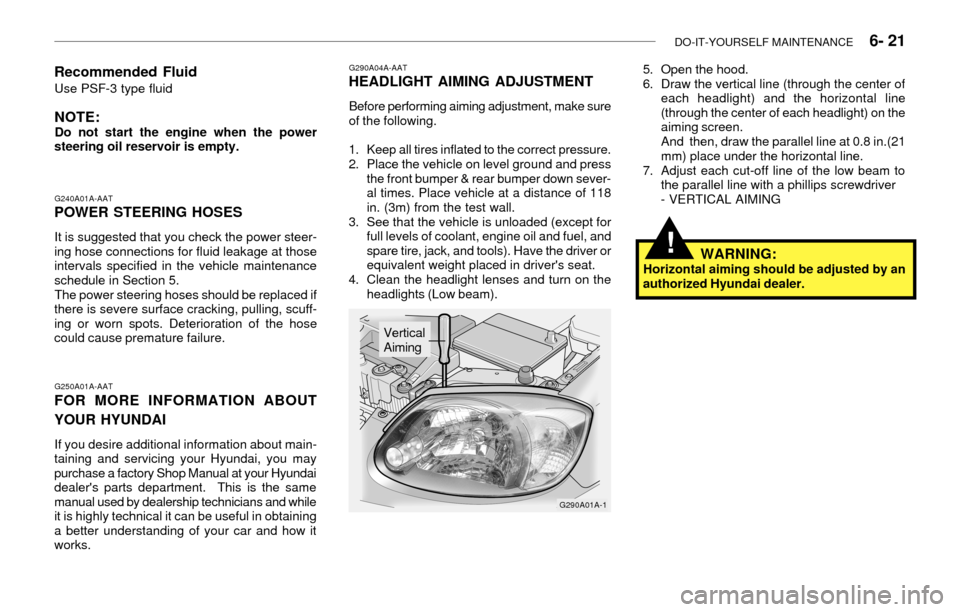
7. Adjust each cut-off line of the low beam to
the parallel line with a phillips screwdriver
- VERTICAL AIMING
G290A01A-1
Vertical
Aiming
WARNING:Horizontal aiming should be adjusted by an
authorized Hyundai dealer.
!
Page 160 of 186
6- 24 DO-IT-YOURSELF MAINTENANCE
!WARNING:The halogen bulb contains gas under pres-
sure and if impacted could shatter, resulting
in flying fragments. Always wear eye protec-
tion when servicing the bulb. Protect the
bulb against abrasions or scratches and
against liquids when lighted. Turn the bulb
on only when installed in a headlight. Re-
place the headlight if damaged or cracked.
Keep the bulb out of the reach of children
and dispose of the used bulb with care.
G270B01A-GAT
Front Turn Signal light / Position Light
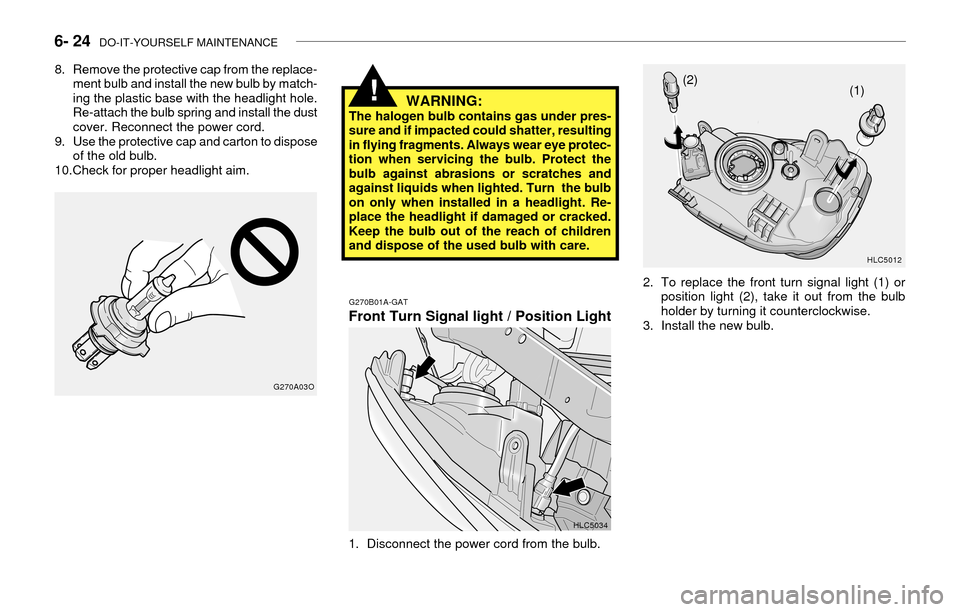
1. Disconnect the power cord from the bulb.
HLC5034HLC5012
(1) (2)
2. To replace the front turn signal light (1) or
position light (2), take it out from the bulb
holder by turning it counterclockwise.
3. Install the new bulb. 8. Remove the protective cap from the replace-
ment bulb and install the new bulb by match-
ing the plastic base with the headlight hole.
Re-attach the bulb spring and install the dust
cover. Reconnect the power cord.
9. Use the protective cap and carton to dispose
of the old bulb.
10.Check for proper headlight aim.
G270A03O
Page 165 of 186
DO-IT-YOURSELF MAINTENANCE 6- 29
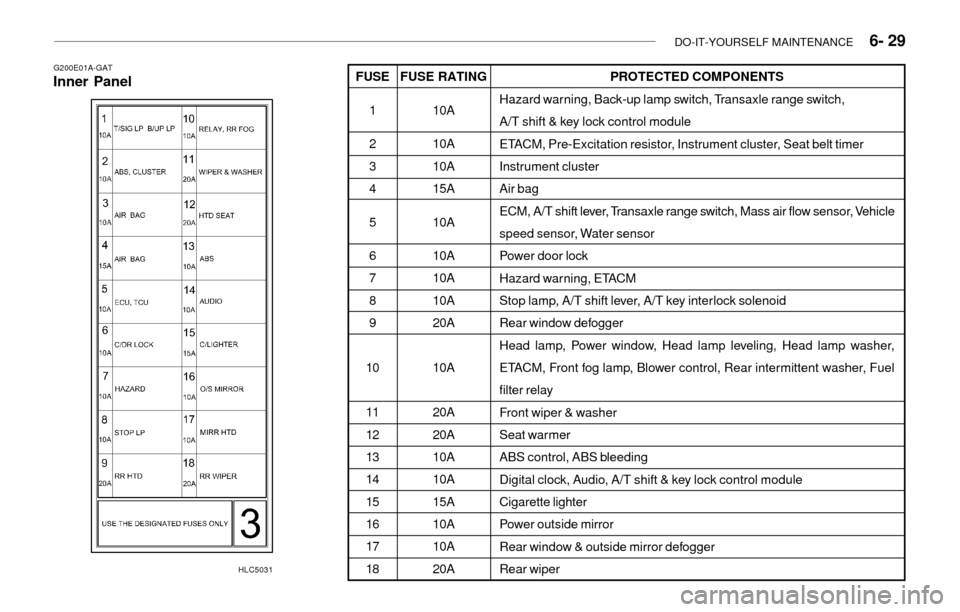
G200E01A-GATInner Panel
HLC5031
PROTECTED COMPONENTS
Hazard warning, Back-up lamp switch, Transaxle range switch,
A/T shift & key lock control module
ETACM, Pre-Excitation resistor, Instrument cluster, Seat belt timer
Instrument cluster
Air bag
ECM, A/T shift lever, Transaxle range switch, Mass air flow sensor, Vehicle
speed sensor, Water sensor
Power door lock
Hazard warning, ETACM
Stop lamp, A/T shift lever, A/T key interlock solenoid
Rear window defogger
Head lamp, Power window, Head lamp leveling, Head lamp washer,
ETACM, Front fog lamp, Blower control, Rear intermittent washer, Fuel
filter relay
Front wiper & washer
Seat warmer
ABS control, ABS bleeding
Digital clock, Audio, A/T shift & key lock control module
Cigarette lighter
Power outside mirror
Rear window & outside mirror defogger
Rear wiperFUSE RATING
10A
10A
10A
15A
10A
10A
10A
10A
20A
10A
20A
20A
10A
10A
15A
10A
10A
20A FUSE
1
2
3
4
5
6
7
8
9
10
11
12
13
14
15
16
17
18
Page 183 of 186
INDEX 10- 3
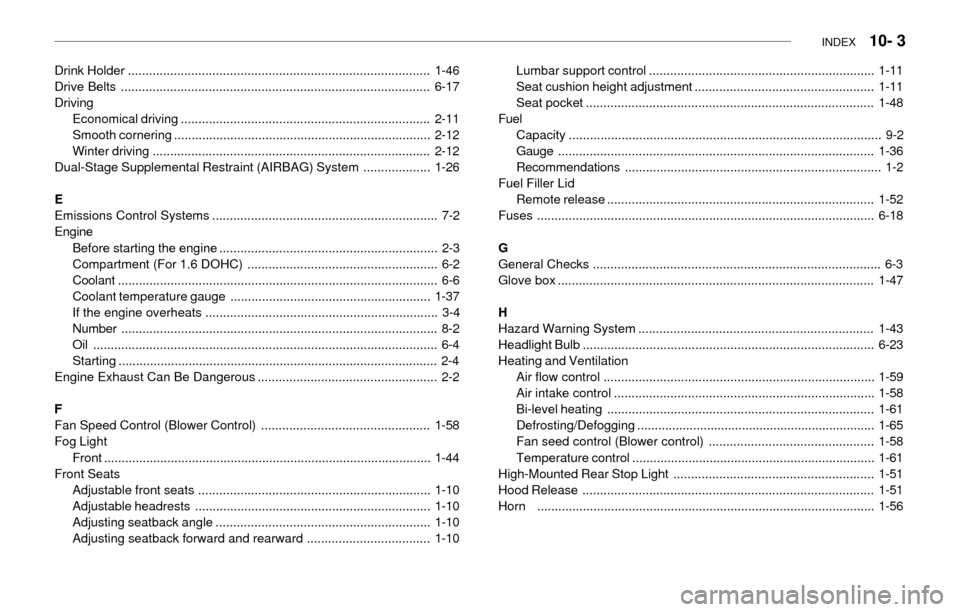
Drink Holder ......................................................................................1-46
Drive Belts ........................................................................................6-17
Driving
Economical driving .......................................................................2-11
Smooth cornering .........................................................................2-12
Winter driving ...............................................................................2-12
Dual-Stage Supplemental Restraint (AIRBAG) System ...................1-26
E
Emissions Control Systems ................................................................ 7-2
Engine
Before starting the engine .............................................................. 2-3
Compartment (For 1.6 DOHC) ...................................................... 6-2
Coolant........................................................................................... 6-6
Coolant temperature gauge .........................................................1-37
If the engine overheats .................................................................. 3-4
Number.......................................................................................... 8-2
Oil .................................................................................................. 6-4
Starting ........................................................................................... 2-4
Engine Exhaust Can Be Dangerous ................................................... 2-2
F
Fan Speed Control (Blower Control) ................................................1-58
Fog Light
Front .............................................................................................1-44
Front Seats
Adjustable front seats ..................................................................1-10
Adjustable headrests ...................................................................1-10
Adjusting seatback angle .............................................................1-10
Adjusting seatback forward and rearward ...................................1-10Lumbar support control ................................................................1-11
Seat cushion height adjustment ...................................................1-11
Seat pocket ..................................................................................1-48
Fuel
Capacity ......................................................................................... 9-2
Gauge..........................................................................................1-36
Recommendations......................................................................... 1-2
Fuel Filler Lid
Remote release ............................................................................1-52
Fuses ................................................................................................6-18
G
General Checks .................................................................................. 6-3
Glove box ..........................................................................................1-47
H
Hazard Warning System ...................................................................1-43
Headlight Bulb ...................................................................................6-23
Heating and Ventilation
Air flow control .............................................................................1-59
Air intake control ..........................................................................1-58
Bi-level heating ............................................................................1-61
Defrosting/Defogging ....................................................................1-65
Fan seed control (Blower control) ...............................................1-58
Temperature control .....................................................................1-61
High-Mounted Rear Stop Light .........................................................1-51
Hood Release ...................................................................................1-51
Horn ................................................................................................1-56