key Hyundai Accent 2003 Owner's Guide
[x] Cancel search | Manufacturer: HYUNDAI, Model Year: 2003, Model line: Accent, Model: Hyundai Accent 2003Pages: 186, PDF Size: 11.36 MB
Page 101 of 186
DRIVING YOUR HYUNDAI 2- 5
The starter should not be operated for more
than 15 seconds at a time. Wait 15-30 sec-
onds between starting attempts to protect
the starter from overheating.C050B01A-AATNormal Conditions:
The Starting Procedure:
1. Insert key, and fasten the seat belt.
2. Depress the clutch pedal fully and place the
gearshift lever (manual transaxle) in neutral
or the selector lever (automatic transaxle) in
"P" (park) position.
3. After turning the ignition key to the "ON"
position, make certain all warning lights and
gauges are functioning properly before start-
ing the engine.
WARNING:Be sure that the clutch is fully depressed
when starting a manual transaxle vehicle.
Your manual transaxle equipped vehicle will
not start unless the clutch pedal is fully
depressed. On a manual transaxle equipped
vehicle that can be started without depress-
ing the clutch, there is the potential to cause
damage to the vehicle or injury to someone
inside or outside the vehicle as a result of
the forward or backward movement of the
vehicle that will occur if the clutch is not
depressed when the vehicle is started.
!
4. Turn the ignition key to the "Start" position
and release it when the engine starts.
After the engine has started, allow the engine
to run for 10 to 20 seconds prior to placing
the vehicle in gear.
C070A02A-AAT
OPERATING THE MANUAL
TRANSAXLE
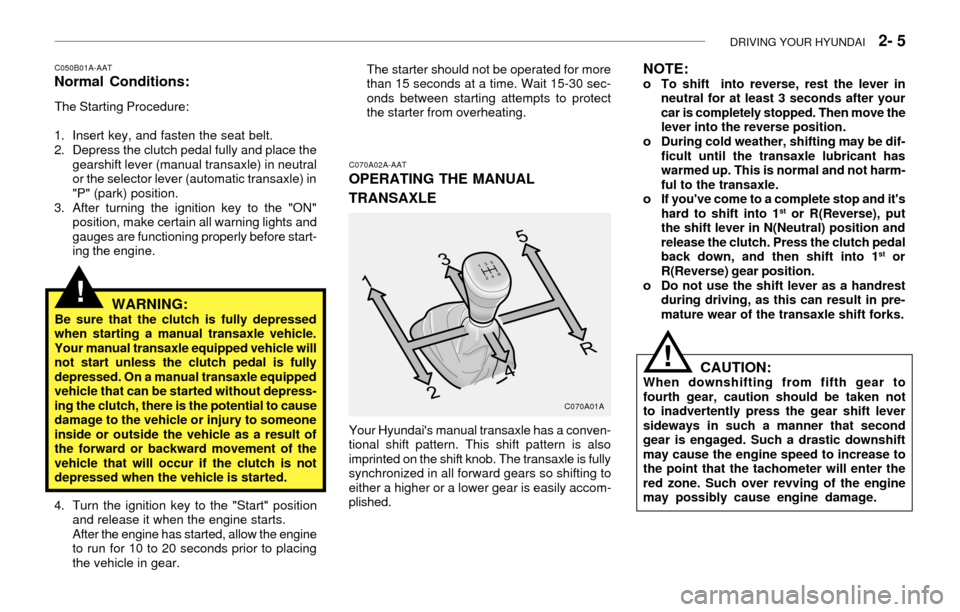
Your Hyundai's manual transaxle has a conven-
tional shift pattern. This shift pattern is also
imprinted on the shift knob. The transaxle is fully
synchronized in all forward gears so shifting to
either a higher or a lower gear is easily accom-
plished.
C070A01A
NOTE:o To shift into reverse, rest the lever in
neutral for at least 3 seconds after your
car is completely stopped. Then move the
lever into the reverse position.
o During cold weather, shifting may be dif-
ficult until the transaxle lubricant has
warmed up. This is normal and not harm-
ful to the transaxle.
o If you've come to a complete stop and it's
hard to shift into 1
st or R(Reverse), put
the shift lever in N(Neutral) position and
release the clutch. Press the clutch pedal
back down, and then shift into 1
st or
R(Reverse) gear position.
o Do not use the shift lever as a handrest
during driving, as this can result in pre-
mature wear of the transaxle shift forks.
CAUTION:When downshifting from fifth gear to
fourth gear, caution should be taken not
to inadvertently press the gear shift lever
sideways in such a manner that second
gear is engaged. Such a drastic downshift
may cause the engine speed to increase to
the point that the tachometer will enter the
red zone. Such over revving of the engine
may possibly cause engine damage.
!
Page 104 of 186
2- 8 DRIVING YOUR HYUNDAI
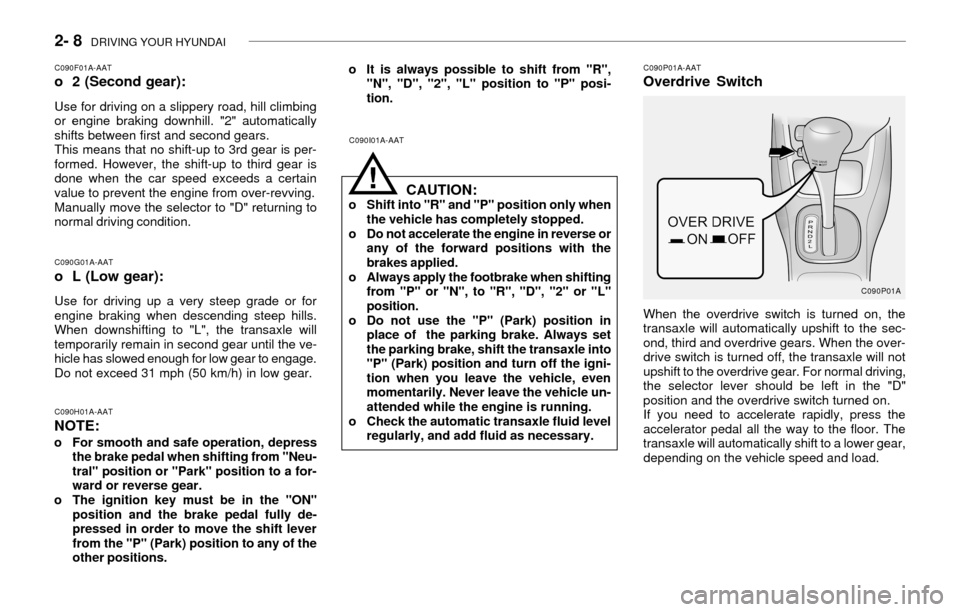
C090P01A-AATOverdrive Switch
When the overdrive switch is turned on, the
transaxle will automatically upshift to the sec-
ond, third and overdrive gears. When the over-
drive switch is turned off, the transaxle will not
upshift to the overdrive gear. For normal driving,
the selector lever should be left in the "D"
position and the overdrive switch turned on.
If you need to accelerate rapidly, press the
accelerator pedal all the way to the floor. The
transaxle will automatically shift to a lower gear,
depending on the vehicle speed and load.
C090G01A-AAT
o L (Low gear):
Use for driving up a very steep grade or for
engine braking when descending steep hills.
When downshifting to "L", the transaxle will
temporarily remain in second gear until the ve-
hicle has slowed enough for low gear to engage.
Do not exceed 31 mph (50 km/h) in low gear.
C090I01A-AAT C090F01A-AAT
o 2 (Second gear):
Use for driving on a slippery road, hill climbing
or engine braking downhill. "2" automatically
shifts between first and second gears.
This means that no shift-up to 3rd gear is per-
formed. However, the shift-up to third gear is
done when the car speed exceeds a certain
value to prevent the engine from over-revving.
Manually move the selector to "D" returning to
normal driving condition.
C090H01A-AATNOTE:
o For smooth and safe operation, depress
the brake pedal when shifting from "Neu-
tral" position or "Park" position to a for-
ward or reverse gear.
o The ignition key must be in the "ON"
position and the brake pedal fully de-
pressed in order to move the shift lever
from the "P" (Park) position to any of the
other positions.o It is always possible to shift from "R",
"N", "D", "2", "L" position to "P" posi-
tion.
CAUTION:o Shift into "R" and "P" position only when
the vehicle has completely stopped.
o Do not accelerate the engine in reverse or
any of the forward positions with the
brakes applied.
o Always apply the footbrake when shifting
from "P" or "N", to "R", "D", "2" or "L"
position.
o Do not use the "P" (Park) position in
place of the parking brake. Always set
the parking brake, shift the transaxle into
"P" (Park) position and turn off the igni-
tion when you leave the vehicle, even
momentarily. Never leave the vehicle un-
attended while the engine is running.
o Check the automatic transaxle fluid level
regularly, and add fluid as necessary.
!
C090P01A
Page 105 of 186
DRIVING YOUR HYUNDAI 2- 9
o Turn the overdrive switch on for good fuel
economy and smooth driving. If engine brak-
ing is needed in the "D" range or if repeated
upshifting and downshifting between the 3rd
and 4th gear is needed when climbing a
gentle slope, it is recommended that the
overdrive switch be turned off. Turn the over-
drive switch back on immediately afterward.C090N02A-AATGood Driving Practices
o Never move the gear selector lever from "P"
or "N" to any other position with the acceler-
ator pedal depressed.
o Never move the gear selector lever into "P"
when the vehicle is in motion.
o Be sure the car is completely stopped before
you attempt to shift into "R".
o Never take the car out of gear and coast
down a hill. This may be extremely hazard-
ous. Always leave the car in gear when
moving.
o Do not "ride" the brakes. This can cause
them to overheat and malfunction. Instead,
when you are driving down a long hill, slow
down and shift to a lower gear. When you do
this, engine braking will help slow the car.
o Slow down before shifting to a lower gear.
Otherwise, the lower gear may not be en-
gaged.
o Always use the parking brake. Do not de-
pend on placing the transaxle in "P" to keep
the car from moving.
o Exercise extreme caution when driving on a
slippery surface. Be especially careful when
braking, accelerating or shifting gears. On a
slippery surface, an abrupt change in vehicle
speed can cause the drive wheels to lose
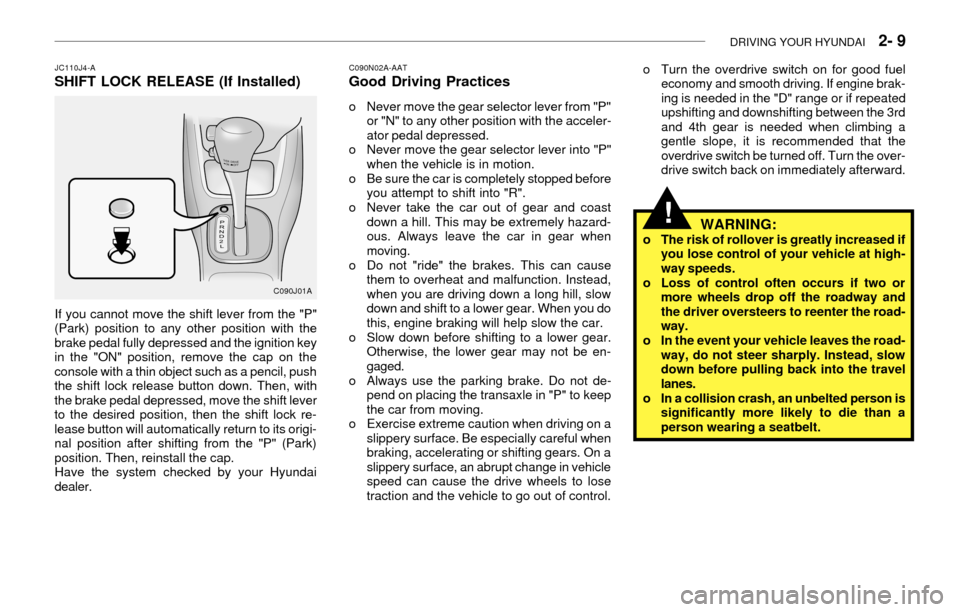
traction and the vehicle to go out of control. If you cannot move the shift lever from the "P"
(Park) position to any other position with the
brake pedal fully depressed and the ignition key
in the "ON" position, remove the cap on the
console with a thin object such as a pencil, push
the shift lock release button down. Then, with
the brake pedal depressed, move the shift lever
to the desired position, then the shift lock re-
lease button will automatically return to its origi-
nal position after shifting from the "P" (Park)
position. Then, reinstall the cap.
Have the system checked by your Hyundai
dealer.
JC110J4-ASHIFT LOCK RELEASE (If Installed)
C090J01A
WARNING:o The risk of rollover is greatly increased if
you lose control of your vehicle at high-
way speeds.
o Loss of control often occurs if two or
more wheels drop off the roadway and
the driver oversteers to reenter the road-
way.
o In the event your vehicle leaves the road-
way, do not steer sharply. Instead, slow
down before pulling back into the travel
lanes.
o In a collision crash, an unbelted person is
significantly more likely to die than a
person wearing a seatbelt.
!
Page 109 of 186
DRIVING YOUR HYUNDAI 2- 13
C160H01A-AAT
Use Approved Anti-Freeze in Window
Washer System
To keep the water in the window washer system
from freezing, add an approved anti-freeze so-
lution in accordance with instructions on the
container. Window washer anti-freeze is avail-
able from Hyundai dealers and most auto parts
outlets. Do not use engine coolant or other types
of anti-freeze as these may damage the finish.
C160F01A-AATCheck Spark Plugs and Ignition
System
Inspect your spark plugs as described in Sec-
tion 6 and replace them if necessary. Also
check all ignition wiring and components to be
sure they are not cracked, worn or damaged in
any way.
C160G01A-AAT
To Keep Locks from Freezing
To keep the locks from freezing, squirt an ap-
proved de-icer fluid or glycerine into the key
opening. If a lock is covered with ice, squirt it
with an approved de-icing fluid to remove the
ice. If the lock is frozen internally, you may be
able to thaw it out by using a heated key. Handle
the heated key with care to avoid burning the
fingers.
C160I01A-AATDon't Let Your Parking Brake Freeze
Under some conditions your parking brake can
freeze in the engaged position. This is most
likely to happen when there is an accumulation
of snow or ice around or near the rear brakes or
if the brakes are wet. If you think the parking
brake may freeze, apply it only temporarily while
you put the gear selector lever in "P" (automatic)
or in first or reverse gear (manual transaxle) and
block the rear wheels so the car cannot roll.
Then release the parking brake.
C160K01A-AATCarry Emergency Equipment
Depending on the severity of the weather where
you drive your car, you should carry appropriate
emergency equipment. Some of the items you
may want to carry include tire chains, tow straps
or chains, flashlight, emergency flares, sand, a
shovel, jumper cables, a window scraper, gloves,
ground cloth, coveralls, a blanket, etc.
C160J01A-AAT
Don't Let Ice and Snow Accumulate
Underneath
Under some conditions, snow and ice can build
up under the fenders and interfere with the
steering. When driving in severe winter condi-
tions where this may happen, you should peri-
odically check underneath the car to be sure the
movement of the front wheels and the steering
components is not obstructed.
C170A01A-AAT
HIGHER SPEED MOTORING
Pre-Trip Inspections
1. Tires:
Adjust the tire inflation pressures for highway
driving. Low tire inflation pressures will result in
overheating and possible failure of the tires.
Avoid using worn or damaged tires which may
result in reduced traction or tire failure.
NOTE:Never exceed the maximum tire inflation pres-
sure shown on the tires.
2. Fuel, engine coolant and engine oil:
High speed travel consumes 1.5 times more fuel
than urban motoring. Do not forget to check both
engine coolant and engine oil.
3. Drive belt:
A loose or damaged drive belt may result in
overheating of the engine.
Page 111 of 186
3. WHAT TO DO IN AN EMERGENCY
If the Engine Will Not Start ............................................................ 3-2
Jump Starting ................................................................................. 3-3
If the Engine Overheats ................................................................. 3-4
Spare Tire ....................................................................................... 3-4
If You Have a Flat Tire .................................................................. 3-5
If Your Car Must Be Towed ......................................................... 3-10
Emergency Towing ....................................................................... 3-12
If You Lose Your Keys ................................................................ 3-12
3
Page 121 of 186
WHAT TO DO IN AN EMERGENCY 3- 11
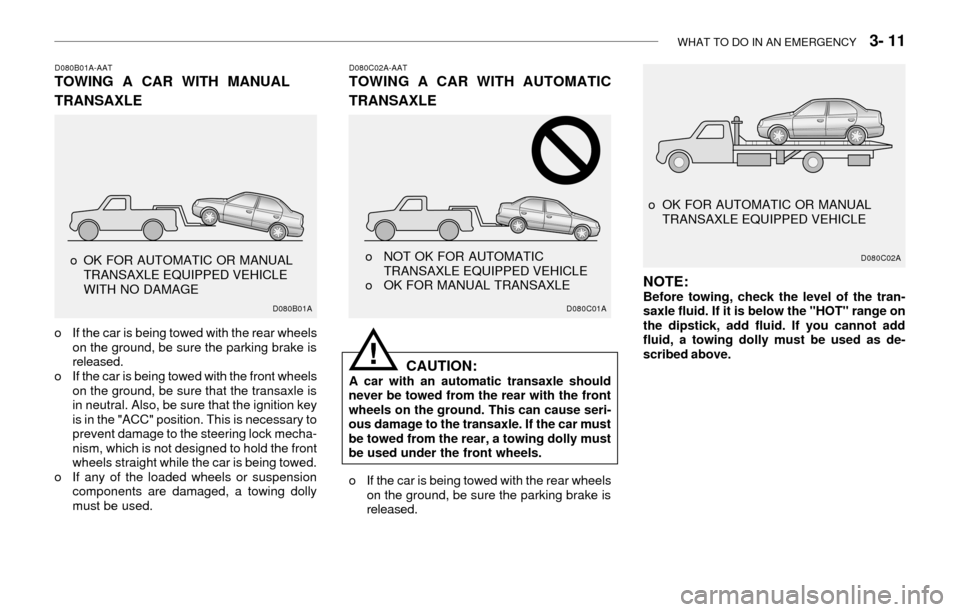
NOTE:Before towing, check the level of the tran-
saxle fluid. If it is below the "HOT" range on
the dipstick, add fluid. If you cannot add
fluid, a towing dolly must be used as de-
scribed above.
D080B01A-AATTOWING A CAR WITH MANUAL
TRANSAXLE
o If the car is being towed with the rear wheels
on the ground, be sure the parking brake is
released.
o If the car is being towed with the front wheels
on the ground, be sure that the transaxle is
in neutral. Also, be sure that the ignition key
is in the "ACC" position. This is necessary to
prevent damage to the steering lock mecha-
nism, which is not designed to hold the front
wheels straight while the car is being towed.
o If any of the loaded wheels or suspension
components are damaged, a towing dolly
must be used.
D080C02A-AATTOWING A CAR WITH AUTOMATIC
TRANSAXLE
CAUTION:
A car with an automatic transaxle should
never be towed from the rear with the front
wheels on the ground. This can cause seri-
ous damage to the transaxle. If the car must
be towed from the rear, a towing dolly must
be used under the front wheels.
D080B01A
o OK FOR AUTOMATIC OR MANUAL
TRANSAXLE EQUIPPED VEHICLE
WITH NO DAMAGE o NOT OK FOR AUTOMATIC
TRANSAXLE EQUIPPED VEHICLE
o OK FOR MANUAL TRANSAXLE
D080C01A
o If the car is being towed with the rear wheels
on the ground, be sure the parking brake is
released.
!
D080C02A
o OK FOR AUTOMATIC OR MANUAL
TRANSAXLE EQUIPPED VEHICLE
Page 122 of 186
3- 12 WHAT TO DO IN AN EMERGENCY
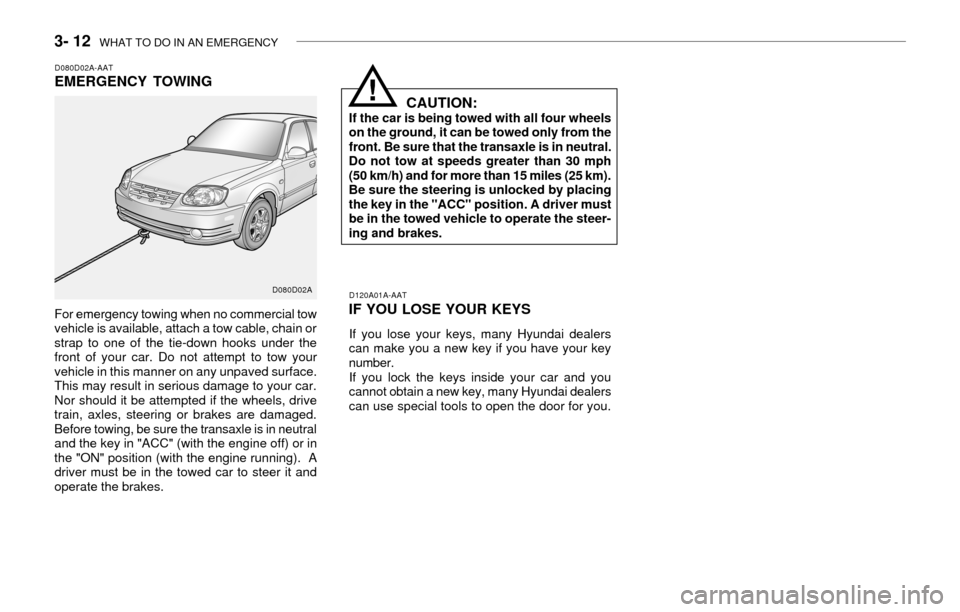
D080D02A-AATEMERGENCY TOWING
For emergency towing when no commercial tow
vehicle is available, attach a tow cable, chain or
strap to one of the tie-down hooks under the
front of your car. Do not attempt to tow your
vehicle in this manner on any unpaved surface.
This may result in serious damage to your car.
Nor should it be attempted if the wheels, drive
train, axles, steering or brakes are damaged.
Before towing, be sure the transaxle is in neutral
and the key in "ACC" (with the engine off) or in
the "ON" position (with the engine running). A
driver must be in the towed car to steer it and
operate the brakes.
D120A01A-AAT
IF YOU LOSE YOUR KEYS
If you lose your keys, many Hyundai dealers
can make you a new key if you have your key
number.
If you lock the keys inside your car and you
cannot obtain a new key, many Hyundai dealers
can use special tools to open the door for you.
CAUTION:If the car is being towed with all four wheels
on the ground, it can be towed only from the
front. Be sure that the transaxle is in neutral.
Do not tow at speeds greater than 30 mph
(50 km/h) and for more than 15 miles (25 km).
Be sure the steering is unlocked by placing
the key in the "ACC" position. A driver must
be in the towed vehicle to operate the steer-
ing and brakes.
D080D02A
!
Page 165 of 186
DO-IT-YOURSELF MAINTENANCE 6- 29
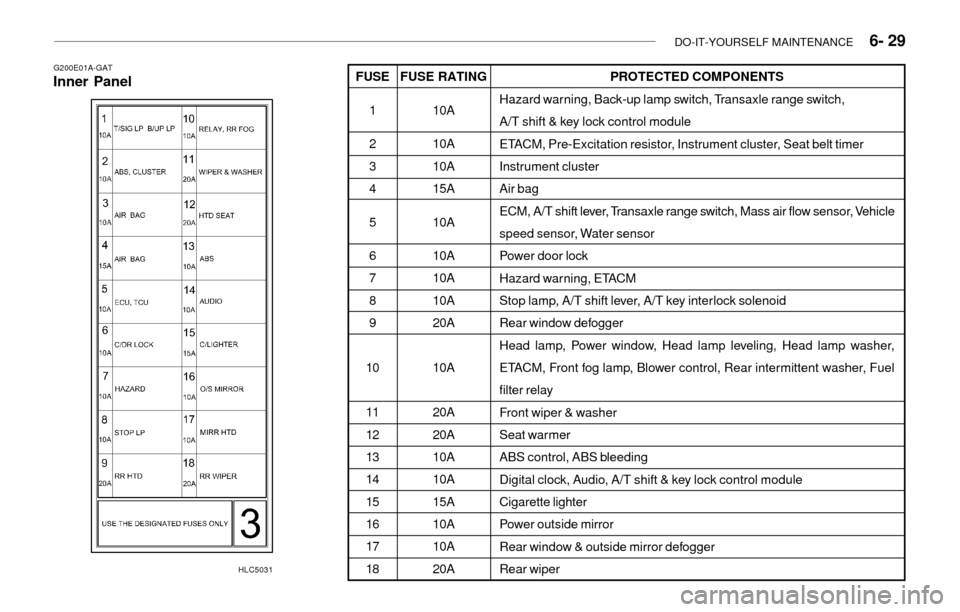
G200E01A-GATInner Panel
HLC5031
PROTECTED COMPONENTS
Hazard warning, Back-up lamp switch, Transaxle range switch,
A/T shift & key lock control module
ETACM, Pre-Excitation resistor, Instrument cluster, Seat belt timer
Instrument cluster
Air bag
ECM, A/T shift lever, Transaxle range switch, Mass air flow sensor, Vehicle
speed sensor, Water sensor
Power door lock
Hazard warning, ETACM
Stop lamp, A/T shift lever, A/T key interlock solenoid
Rear window defogger
Head lamp, Power window, Head lamp leveling, Head lamp washer,
ETACM, Front fog lamp, Blower control, Rear intermittent washer, Fuel
filter relay
Front wiper & washer
Seat warmer
ABS control, ABS bleeding
Digital clock, Audio, A/T shift & key lock control module
Cigarette lighter
Power outside mirror
Rear window & outside mirror defogger
Rear wiperFUSE RATING
10A
10A
10A
15A
10A
10A
10A
10A
20A
10A
20A
20A
10A
10A
15A
10A
10A
20A FUSE
1
2
3
4
5
6
7
8
9
10
11
12
13
14
15
16
17
18
Page 182 of 186
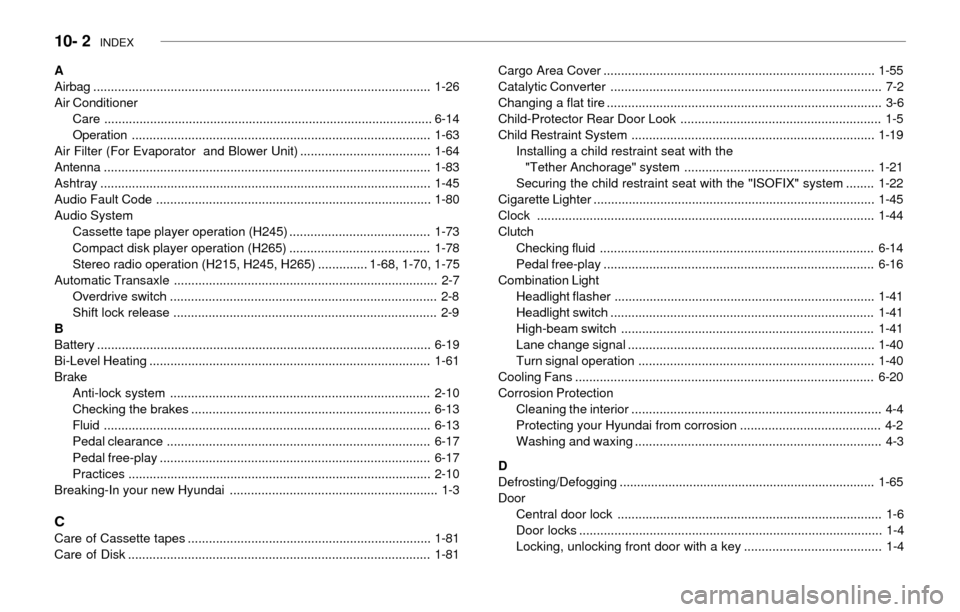
10- 2 INDEX
Cargo Area Cover .............................................................................1-55
Catalytic Converter ............................................................................. 7-2
Changing a flat tire .............................................................................. 3-6
Child-Protector Rear Door Look ......................................................... 1-5
Child Restraint System .....................................................................1-19
Installing a child restraint seat with the
"Tether Anchorage" system ......................................................1-21
Securing the child restraint seat with the "ISOFIX" system ........1-22
Cigarette Lighter ................................................................................1-45
Clock ................................................................................................1-44
Clutch
Checking fluid ..............................................................................6-14
Pedal free-play .............................................................................6-16
Combination Light
Headlight flasher ..........................................................................1-41
Headlight switch ...........................................................................1-41
High-beam switch ........................................................................1-41
Lane change signal ......................................................................1-40
Turn signal operation ...................................................................1-40
Cooling Fans .....................................................................................6-20
Corrosion Protection
Cleaning the interior ....................................................................... 4-4
Protecting your Hyundai from corrosion ........................................ 4-2
Washing and waxing ...................................................................... 4-3
D
Defrosting/Defogging .........................................................................1-65
Door
Central door lock ........................................................................... 1-6
Door locks ...................................................................................... 1-4
Locking, unlocking front door with a key ....................................... 1-4 A
Airbag................................................................................................1-26
Air Conditioner
Care .............................................................................................6-14
Operation.....................................................................................1-63
Air Filter (For Evaporator and Blower Unit) .....................................1-64
Antenna.............................................................................................1-83
Ashtray ..............................................................................................1-45
Audio Fault Code ..............................................................................1-80
Audio System
Cassette tape player operation (H245) ........................................1-73
Compact disk player operation (H265) ........................................1-78
Stereo radio operation (H215, H245, H265) .............. 1-68, 1-70, 1-75
Automatic Transaxle ........................................................................... 2-7
Overdrive switch ............................................................................ 2-8
Shift lock release ........................................................................... 2-9
B
Battery ...............................................................................................6-19
Bi-Level Heating ................................................................................1-61
Brake
Anti-lock system ..........................................................................2-10
Checking the brakes ....................................................................6-13
Fluid.............................................................................................6-13
Pedal clearance ...........................................................................6-17
Pedal free-play .............................................................................6-17
Practices ......................................................................................2-10
Breaking-In your new Hyundai ........................................................... 1-3
C
Care of Cassette tapes .....................................................................1-81
Care of Disk ......................................................................................1-81
Page 184 of 186
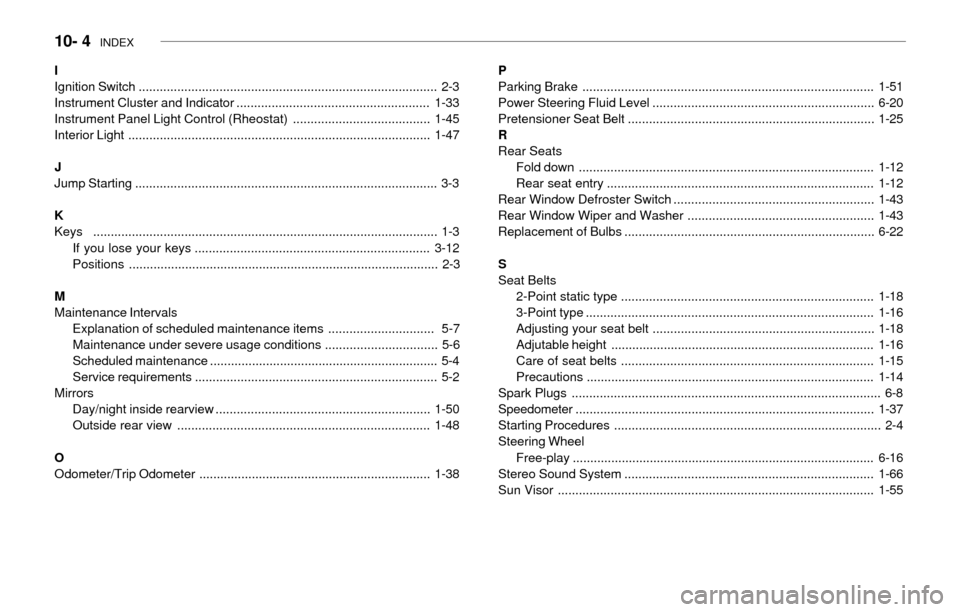
10- 4 INDEX
P
Parking Brake ...................................................................................1-51
Power Steering Fluid Level ...............................................................6-20
Pretensioner Seat Belt ......................................................................1-25
R
Rear Seats
Fold down ....................................................................................1-12
Rear seat entry ............................................................................1-12
Rear Window Defroster Switch .........................................................1-43
Rear Window Wiper and Washer .....................................................1-43
Replacement of Bulbs .......................................................................6-22
S
Seat Belts
2-Point static type ........................................................................1-18
3-Point type ..................................................................................1-16
Adjusting your seat belt ...............................................................1-18
Adjutable height ...........................................................................1-16
Care of seat belts ........................................................................1-15
Precautions ..................................................................................1-14
Spark Plugs ........................................................................................ 6-8
Speedometer.....................................................................................1-37
Starting Procedures ............................................................................ 2-4
Steering Wheel
Free-play ......................................................................................6-16
Stereo Sound System .......................................................................1-66
Sun Visor ..........................................................................................1-55 I
Ignition Switch ..................................................................................... 2-3
Instrument Cluster and Indicator .......................................................1-33
Instrument Panel Light Control (Rheostat) .......................................1-45
Interior Light ......................................................................................1-47
J
Jump Starting ...................................................................................... 3-3
K
Keys .................................................................................................. 1-3
If you lose your keys ...................................................................3-12
Positions ........................................................................................ 2-3
M
Maintenance Intervals
Explanation of scheduled maintenance items .............................. 5-7
Maintenance under severe usage conditions ................................ 5-6
Scheduled maintenance ................................................................. 5-4
Service requirements ..................................................................... 5-2
Mirrors
Day/night inside rearview .............................................................1-50
Outside rear view ........................................................................1-48
O
Odometer/Trip Odometer ..................................................................1-38