water pump Hyundai Accent 2003 Owner's Manual
[x] Cancel search | Manufacturer: HYUNDAI, Model Year: 2003, Model line: Accent, Model: Hyundai Accent 2003Pages: 186, PDF Size: 11.36 MB
Page 50 of 186
FEATURES OF YOUR HYUNDAI 1- 37
B330A02A-AAT
TACHOMETER (If Installed)
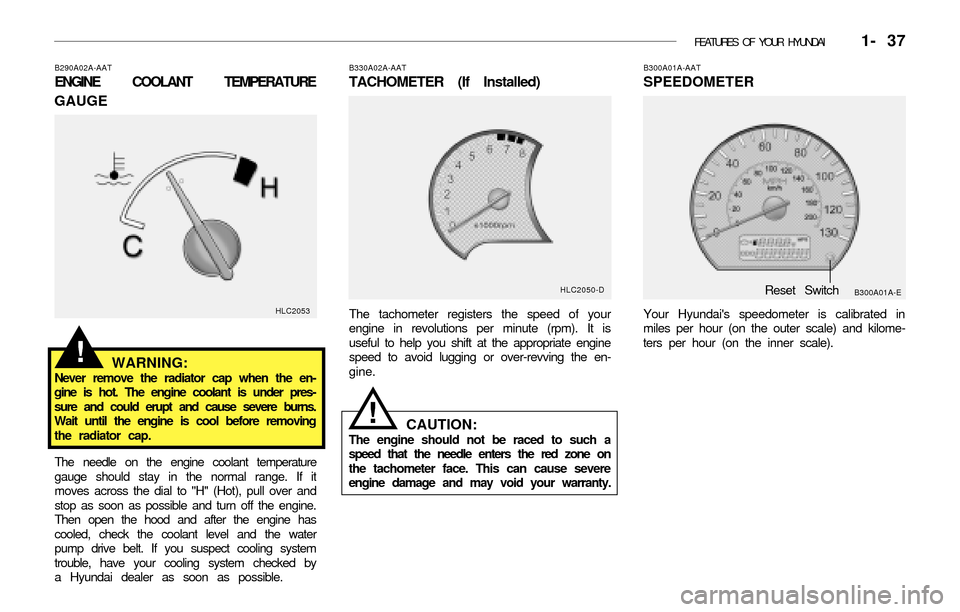
The tachometer registers the speed of your
engine in revolutions per minute (rpm). It is
useful to help you shift at the appropriate engine
speed to avoid lugging or over-revving the en-
gine.
B290A02A-AAT
ENGINE COOLANT TEMPERATURE
GAUGE
WARNING:
Never remove the radiator cap when the en-
gine is hot. The engine coolant is under pres-
sure and could erupt and cause severe burns.
Wait until the engine is cool before removing
the radiator cap.
B300A01A-AAT
SPEEDOMETER
Your Hyundai's speedometer is calibrated in
miles per hour (on the outer scale) and kilome-
ters per hour (on the inner scale).HLC2053
The needle on the engine coolant temperature
gauge should stay in the normal range. If it
moves across the dial to "H" (Hot), pull over and
stop as soon as possible and turn off the engine.
Then open the hood and after the engine has
cooled, check the coolant level and the water
pump drive belt. If you suspect cooling system
trouble, have your cooling system checked by
a Hyundai dealer as soon as possible.
!
B300A01A-E HLC2050-DReset Switch
CAUTION:The engine should not be raced to such a
speed that the needle enters the red zone on
the tachometer face. This can cause severe
engine damage and may void your warranty.
!
Page 108 of 186
2- 12 DRIVING YOUR HYUNDAI
C160A01A-AAT
WINTER DRIVING
The more severe weather conditions of winter
result in greater wear and other problems. To
minimize the problems of winter driving, you
should follow these suggestions:
C160B01A-AATSnowy or Icy Conditions
To drive your vehicle in deep snow, it may be
necessary to use snow tires or to install tire
chains on your tires. If snow tires are needed, it
is necessary to select tires equivalent in size
and type to the original equipment tires. Failure
to do so may adversely affect the safety and
handling of your car. Furthermore, speeding,
rapid acceleration, sudden brake applications,
and sharp turns are potentially very hazardous
practices.
During deceleration, use engine braking to the
fullest extent. Sudden brake applications on
snowy or icy roads may cause skids to occur.
You need to keep sufficient distance between
the vehicle in operation in front and your vehicle.
Also, apply the brake gently. It should be noted
that installing tire chains on the tire will provide
a greater driving force, but will not prevent side
skids.
NOTE:Tire chains are not legal in all states. Check
state laws before fitting tire chains.
C160D01A-AATCheck Battery and Cables
Winter puts additional burdens on the battery
system. Visually inspect the battery and cables
as described in Section 6. The level of charge in
your battery can be checked by your Hyundai
dealer or a service station.
C160E01A-AAT
Change to "Winter Weight" Oil if
Necessary
In some climates it is recommended that a lower
viscosity "winter weight" oil be used during cold
weather. See Section 9 for recommendations. If
you aren't sure what weight oil you should use,
consult your Hyundai dealer.
C160C01A-AATUse High Quality Ethylene Glycol
Coolant
Your Hyundai is delivered with high quality eth-
ylene glycol coolant in the cooling system. It is
the only type of coolant that should be used
because it helps prevent corrosion in the cooling
system, lubricates the water pump and prevents
freezing. Be sure to replace or replenish your
coolant in accordance with the maintenance
schedule in Section 5. Before winter, have your
coolant tested to assure that its freezing point is
sufficient for the temperatures anticipated dur-
ing the winter. o Don't "lug" or "over-rev" the engine. Lugging
is driving too slowly in too high a gear result-
ing in the engine bucking. If this happens,
shift to a lower gear. Over-revving is racing
the engine beyond its safe limit. This can be
avoided by shifting at the recommended
speeds.
o Use your air conditioning sparingly. The air
conditioning system is operated by engine
power so your fuel economy is reduced
when you use it.
C150A01A-AAT
SMOOTH CORNERING
Avoid braking or gear changing in corners, es-
pecially when roads are wet. Ideally, corners
should always be taken under gentle accelera-
tion. If you follow these suggestions, tire wear
will be held to a minimum.
Page 114 of 186
3- 4 WHAT TO DO IN AN EMERGENCY
WARNING:While the engine is running, keep hands,
long hair and clothing away from moving
parts such as the fan and drive belts to
prevent injury.
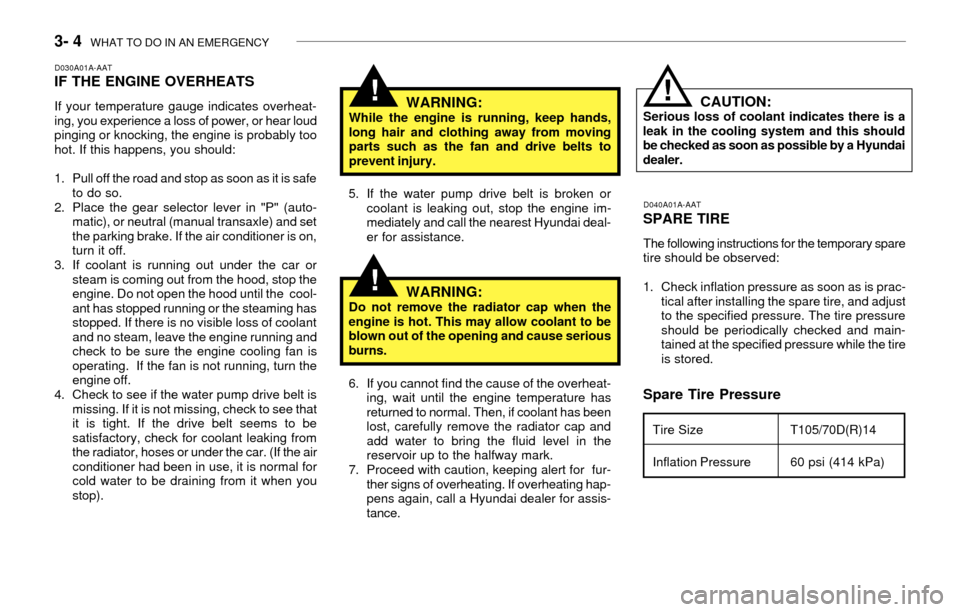
Spare Tire Pressure
D040A01A-AAT
SPARE TIRE
The following instructions for the temporary spare
tire should be observed:
1. Check inflation pressure as soon as is prac-
tical after installing the spare tire, and adjust
to the specified pressure. The tire pressure
should be periodically checked and main-
tained at the specified pressure while the tire
is stored.
D030A01A-AATIF THE ENGINE OVERHEATS
If your temperature gauge indicates overheat-
ing, you experience a loss of power, or hear loud
pinging or knocking, the engine is probably too
hot. If this happens, you should:
1. Pull off the road and stop as soon as it is safe
to do so.
2. Place the gear selector lever in "P" (auto-
matic), or neutral (manual transaxle) and set
the parking brake. If the air conditioner is on,
turn it off.
3. If coolant is running out under the car or
steam is coming out from the hood, stop the
engine. Do not open the hood until the cool-
ant has stopped running or the steaming has
stopped. If there is no visible loss of coolant
and no steam, leave the engine running and
check to be sure the engine cooling fan is
operating. If the fan is not running, turn the
engine off.
4. Check to see if the water pump drive belt is
missing. If it is not missing, check to see that
it is tight. If the drive belt seems to be
satisfactory, check for coolant leaking from
the radiator, hoses or under the car. (If the air
conditioner had been in use, it is normal for
cold water to be draining from it when you
stop).5. If the water pump drive belt is broken or
coolant is leaking out, stop the engine im-
mediately and call the nearest Hyundai deal-
er for assistance.
WARNING:Do not remove the radiator cap when the
engine is hot. This may allow coolant to be
blown out of the opening and cause serious
burns.
6. If you cannot find the cause of the overheat-
ing, wait until the engine temperature has
returned to normal. Then, if coolant has been
lost, carefully remove the radiator cap and
add water to bring the fluid level in the
reservoir up to the halfway mark.
7. Proceed with caution, keeping alert for fur-
ther signs of overheating. If overheating hap-
pens again, call a Hyundai dealer for assis-
tance.
CAUTION:Serious loss of coolant indicates there is a
leak in the cooling system and this should
be checked as soon as possible by a Hyundai
dealer.
!
!
!
Tire Size
Inflation PressureT105/70D(R)14
60 psi (414 kPa)
Page 132 of 186
VEHICLE MAINTENANCE REQUIREMENTS 5- 5
GENERAL ITEMS
DRIVE BELT (WATER PUMP, ALTERNATOR AND A/CON)
COOLANT
TIMING BELT
MANUAL TRANSAXLE OIL
AUTOMATIC TRANSAXLE FLUID
BRAKE FLUID
BRAKE HOSES AND LINES
REAR BRAKE DRUMS/LININGS, PARKING BRAKE
BRAKE PADS, CALIPERS AND ROTORS
EXHAUST PIPE AND MUFFLER
SUSPENSION MOUNTING BOLTS
STEERING GEAR BOX, LINKAGE & BOOTS/LOWER ARM
BALL JOINT
POWER STEERING PUMP, BELT AND HOSES
DRIVESHAFTS AND BOOTS
AIR CONDITIONING REFRIGERANT
AIR FILTER (For Evaporator and Blower unit) 1
2
3
4
5
6
7
8
9
10
11
12
13
14
15
16 No.DESCRIPTIONMILES X 1000
KILOMETERS X 1000
MONTHS7.5
12
615
24
12
I
I
I
I
I
I
I
I22.5
36
1830
48
24
I
I
I
I
I
I
I
I
I
I
I
I
I
I37.5
60
3045
72
36
I
I
I
I
I
I
I
I52.5
84
4260
96
48
I
R*
2
I
I
I
I
I
I
I
I
I
I
I
I67.5
108
5475
120
60
I
I
I
I
I
I
I
I82.5
132
6690
144
72
I
I
I
I
I
I
I
I
I
I
I
I
I
I97.5
156
78105
168
84
R
I
I
I
I
I
I
I112.5
180
90120
192
96
I
R*
2
I
I
I
I
I
I
I
I
I
I
I
I127.5
204
102135
216
108
I
I
I
I
I
I
I
I142.5
228
114150
240
120
I
I
I
I
I
I
I
I
I
I
I
I
I
I
See Note *
3
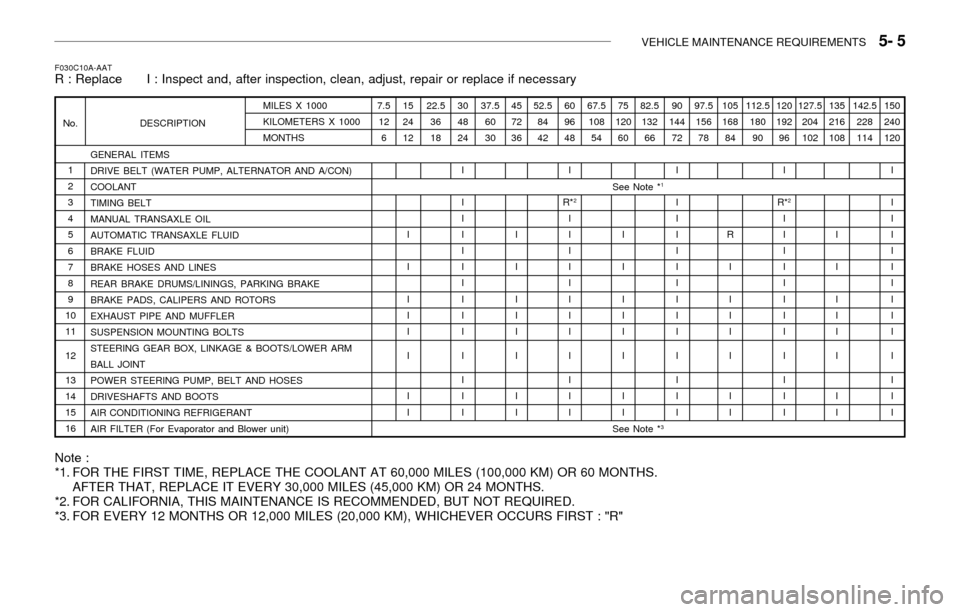
Note :
*1. FOR THE FIRST TIME, REPLACE THE COOLANT AT 60,000 MILES (100,000 KM) OR 60 MONTHS.
AFTER THAT, REPLACE IT EVERY 30,000 MILES (45,000 KM) OR 24 MONTHS.
*2. FOR CALIFORNIA, THIS MAINTENANCE IS RECOMMENDED, BUT NOT REQUIRED.
*3. FOR EVERY 12 MONTHS OR 12,000 MILES (20,000 KM), WHICHEVER OCCURS FIRST : "R"
F030C10A-AATR : Replace I : Inspect and, after inspection, clean, adjust, repair or replace if necessary
See Note *1
Page 146 of 186
6- 10 DO-IT-YOURSELF MAINTENANCE
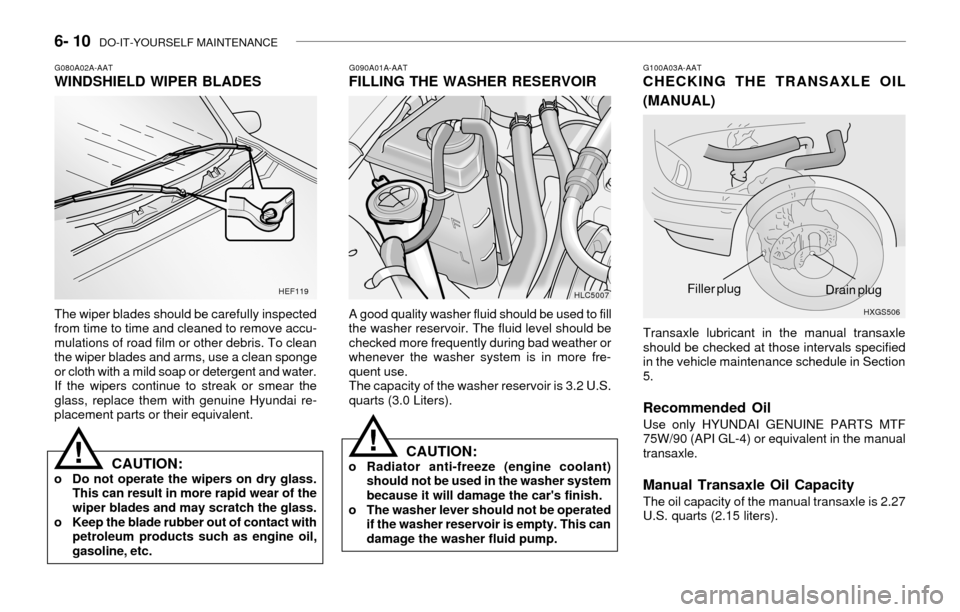
G090A01A-AATFILLING THE WASHER RESERVOIR
A good quality washer fluid should be used to fill
the washer reservoir. The fluid level should be
checked more frequently during bad weather or
whenever the washer system is in more fre-
quent use.
The capacity of the washer reservoir is 3.2 U.S.
quarts (3.0 Liters).
CAUTION:o Radiator anti-freeze (engine coolant)
should not be used in the washer system
because it will damage the car's finish.
o The washer lever should not be operated
if the washer reservoir is empty. This can
damage the washer fluid pump.
!
G100A03A-AATCHECKING THE TRANSAXLE OIL
(MANUAL)
Transaxle lubricant in the manual transaxle
should be checked at those intervals specified
in the vehicle maintenance schedule in Section
5.
Recommended OilUse only HYUNDAI GENUINE PARTS MTF
75W/90 (API GL-4) or equivalent in the manual
transaxle.
Manual Transaxle Oil Capacity
The oil capacity of the manual transaxle is 2.27
U.S. quarts (2.15 liters).
HXGS506
Drain plug Filler plug
G080A02A-AATWINDSHIELD WIPER BLADES
The wiper blades should be carefully inspected
from time to time and cleaned to remove accu-
mulations of road film or other debris. To clean
the wiper blades and arms, use a clean sponge
or cloth with a mild soap or detergent and water.
If the wipers continue to streak or smear the
glass, replace them with genuine Hyundai re-
placement parts or their equivalent.
HEF119
CAUTION:o Do not operate the wipers on dry glass.
This can result in more rapid wear of the
wiper blades and may scratch the glass.
o Keep the blade rubber out of contact with
petroleum products such as engine oil,
gasoline, etc.
!
HLC5007
Page 153 of 186
DO-IT-YOURSELF MAINTENANCE 6- 17
G170A01A-AATCHECKING BRAKE PEDAL
FREE-PLAY
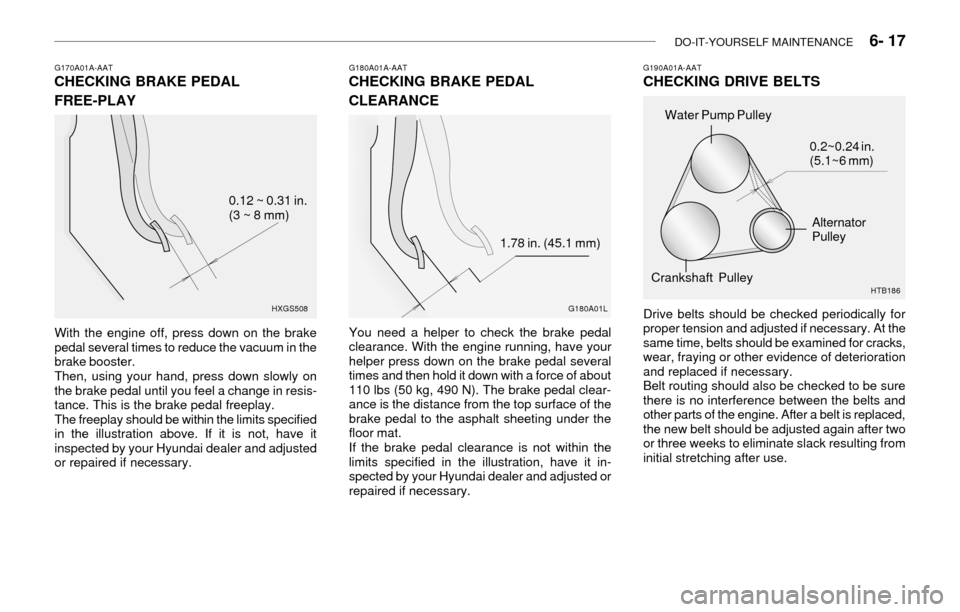
With the engine off, press down on the brake
pedal several times to reduce the vacuum in the
brake booster.
Then, using your hand, press down slowly on
the brake pedal until you feel a change in resis-
tance. This is the brake pedal freeplay.
The freeplay should be within the limits specified
in the illustration above. If it is not, have it
inspected by your Hyundai dealer and adjusted
or repaired if necessary.
HXGS508
0.12 ~ 0.31 in.
(3 ~ 8 mm)
G190A01A-AATCHECKING DRIVE BELTS
Drive belts should be checked periodically for
proper tension and adjusted if necessary. At the
same time, belts should be examined for cracks,
wear, fraying or other evidence of deterioration
and replaced if necessary.
Belt routing should also be checked to be sure
there is no interference between the belts and
other parts of the engine. After a belt is replaced,
the new belt should be adjusted again after two
or three weeks to eliminate slack resulting from
initial stretching after use.
Water Pump Pulley
Alternator
Pulley
Crankshaft Pulley0.2~0.24 in.
(5.1~6 mm)
HTB186 G180A01A-AAT
CHECKING BRAKE PEDAL
CLEARANCE
You need a helper to check the brake pedal
clearance. With the engine running, have your
helper press down on the brake pedal several
times and then hold it down with a force of about
110 lbs (50 kg, 490 N). The brake pedal clear-
ance is the distance from the top surface of the
brake pedal to the asphalt sheeting under the
floor mat.
If the brake pedal clearance is not within the
limits specified in the illustration, have it in-
spected by your Hyundai dealer and adjusted or
repaired if necessary.
G180A01L
1.78 in. (45.1 mm)
Page 156 of 186
6- 20 DO-IT-YOURSELF MAINTENANCE
G220A01A-AATCHECKING ELECTRIC COOLING
FANSG230A03A-AATPOWER STEERING FLUID LEVEL
G220B01A-AATChecking Engine Cooling Fan
The engine cooling fan should come on auto-
matically if the engine coolant temperature is
high.
WARNING:The radiator fan is controlled by engine cool-
ant temperature and may sometimes operate
even when the engine is not running. Use
extreme caution when working near the
blades of the cooling fan, so that you are not
injured by a rotating fan blade. As the cool-
ant temperature decreases the fan will auto-
matically shut off. This is a normal condition.
!
G220C01A-AATChecking Condenser Cooling Fan
The condenser cooling fan should come on
automatically whenever the air conditioner is in
operation.
HLC5006
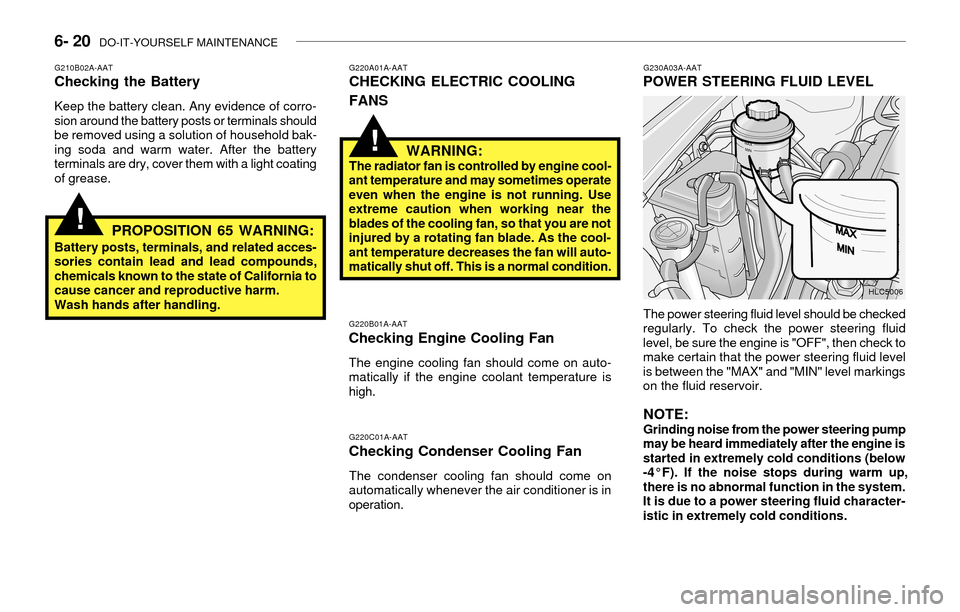
The power steering fluid level should be checked
regularly. To check the power steering fluid
level, be sure the engine is "OFF", then check to
make certain that the power steering fluid level
is between the "MAX" and "MIN" level markings
on the fluid reservoir.
NOTE:Grinding noise from the power steering pump
may be heard immediately after the engine is
started in extremely cold conditions (below
-4°F). If the noise stops during warm up,
there is no abnormal function in the system.
It is due to a power steering fluid character-
istic in extremely cold conditions.
G210B02A-AATChecking the Battery
Keep the battery clean. Any evidence of corro-
sion around the battery posts or terminals should
be removed using a solution of household bak-
ing soda and warm water. After the battery
terminals are dry, cover them with a light coating
of grease.
PROPOSITION 65 WARNING:
Battery posts, terminals, and related acces-
sories contain lead and lead compounds,
chemicals known to the state of California to
cause cancer and reproductive harm.
Wash hands after handling.
!