warning Hyundai Accent 2004 Manual PDF
[x] Cancel search | Manufacturer: HYUNDAI, Model Year: 2004, Model line: Accent, Model: Hyundai Accent 2004Pages: 205, PDF Size: 3.2 MB
Page 172 of 205
6DO-IT-YOURSELF MAINTENANCE
23HEADLIGHT AIMING ADJUSTMENT
G250A01A-AAT
FOR MORE INFORMATION ABOUT
YOUR HYUNDAI
If you desire additional information about main-
taining and servicing your Hyundai, you may
purchase a factory Shop Manual at your Hyundai
dealer's parts department. This is the same
manual used by dealership technicians and while
it is highly technical it can be useful in obtaining
a better understanding of your car and how it
works.
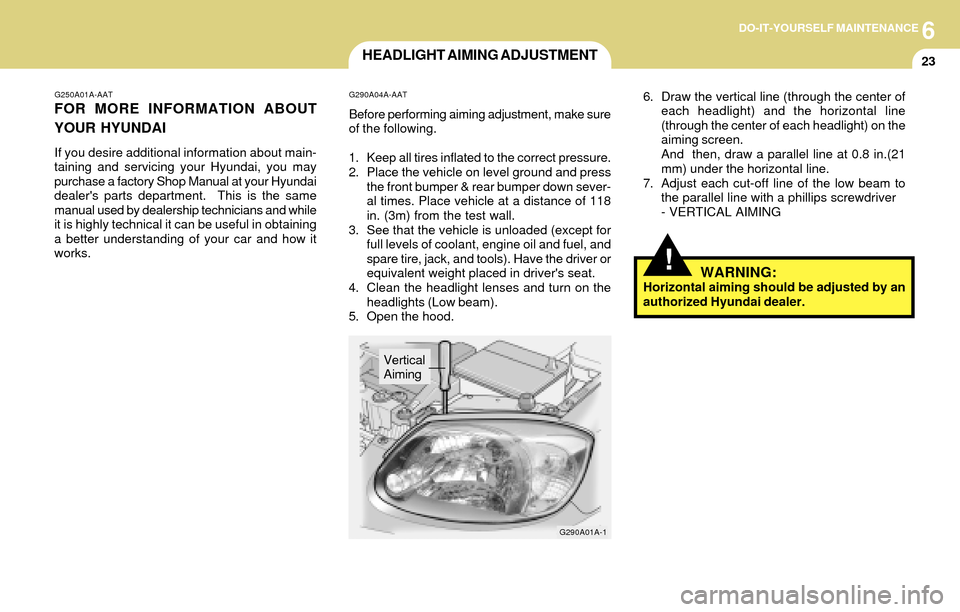
G290A04A-AAT
Before performing aiming adjustment, make sure
of the following.
1. Keep all tires inflated to the correct pressure.
2. Place the vehicle on level ground and press
the front bumper & rear bumper down sever-
al times. Place vehicle at a distance of 118
in. (3m) from the test wall.
3. See that the vehicle is unloaded (except for
full levels of coolant, engine oil and fuel, and
spare tire, jack, and tools). Have the driver or
equivalent weight placed in driver's seat.
4. Clean the headlight lenses and turn on the
headlights (Low beam).
5. Open the hood.
G290A01A-1
Vertical
Aiming
!
6. Draw the vertical line (through the center of
each headlight) and the horizontal line
(through the center of each headlight) on the
aiming screen.
And then, draw a parallel line at 0.8 in.(21
mm) under the horizontal line.
7. Adjust each cut-off line of the low beam to
the parallel line with a phillips screwdriver
- VERTICAL AIMING
WARNING:Horizontal aiming should be adjusted by an
authorized Hyundai dealer.
Page 175 of 205
6DO-IT-YOURSELF MAINTENANCE
26
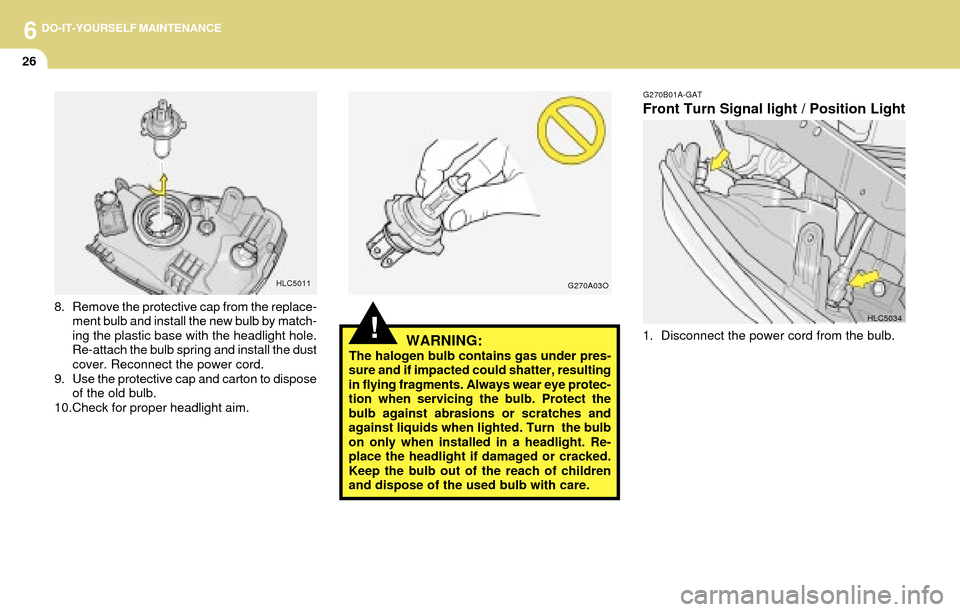
!WARNING:The halogen bulb contains gas under pres-
sure and if impacted could shatter, resulting
in flying fragments. Always wear eye protec-
tion when servicing the bulb. Protect the
bulb against abrasions or scratches and
against liquids when lighted. Turn the bulb
on only when installed in a headlight. Re-
place the headlight if damaged or cracked.
Keep the bulb out of the reach of children
and dispose of the used bulb with care.
G270B01A-GAT
Front Turn Signal light / Position Light
1. Disconnect the power cord from the bulb.
HLC50348. Remove the protective cap from the replace-
ment bulb and install the new bulb by match-
ing the plastic base with the headlight hole.
Re-attach the bulb spring and install the dust
cover. Reconnect the power cord.
9. Use the protective cap and carton to dispose
of the old bulb.
10.Check for proper headlight aim.
G270A03OHLC5011
Page 182 of 205
6DO-IT-YOURSELF MAINTENANCE
33
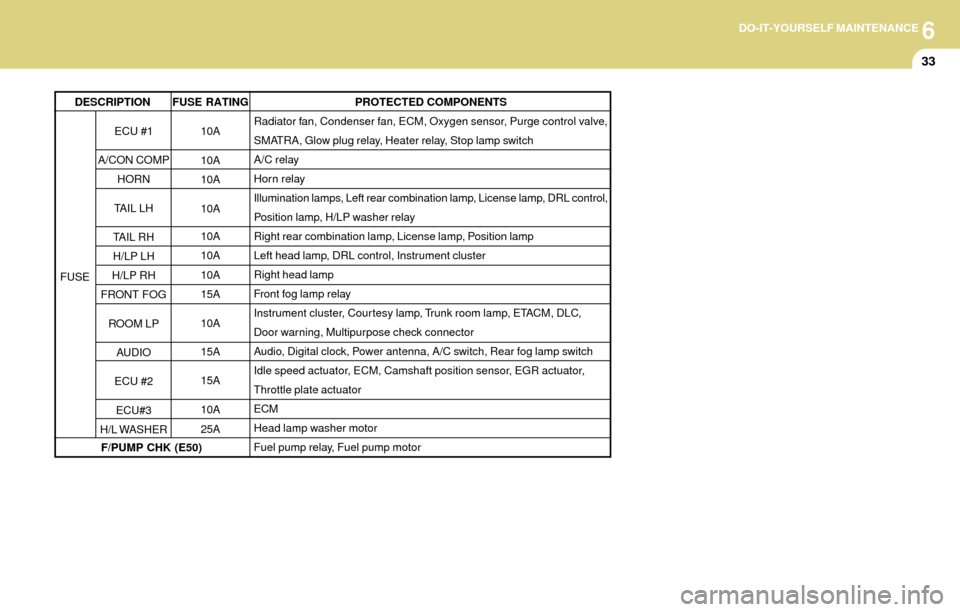
FUSE RATING
10A
10A
10A
10A
10A
10A
10A
15A
10A
15A
15A
10A
25APROTECTED COMPONENTS
Radiator fan, Condenser fan, ECM, Oxygen sensor, Purge control valve,
SMATRA, Glow plug relay, Heater relay, Stop lamp switch
A/C relay
Horn relay
Illumination lamps, Left rear combination lamp, License lamp, DRL control,
Position lamp, H/LP washer relay
Right rear combination lamp, License lamp, Position lamp
Left head lamp, DRL control, Instrument cluster
Right head lamp
Front fog lamp relay
Instrument cluster, Cour tesy lamp, Trunk room lamp, ETACM, DLC,
Door warning, Multipurpose check connector
Audio, Digital clock, Power antenna, A/C switch, Rear fog lamp switch
Idle speed actuator, ECM, Camshaft position sensor, EGR actuator,
Throttle plate actuator
ECM
Head lamp washer motor
Fuel pump relay, Fuel pump motor
ECU #1
A/CON COMP
HORN
TAIL LH
TAIL RH
H/LP LH
H/LP RH
FRONT FOG
ROOM LP
AUDIO
ECU #2
ECU#3
H/L WASHER FUSE
DESCRIPTION
F/PUMP CHK (E50)
Page 183 of 205
6DO-IT-YOURSELF MAINTENANCE
34
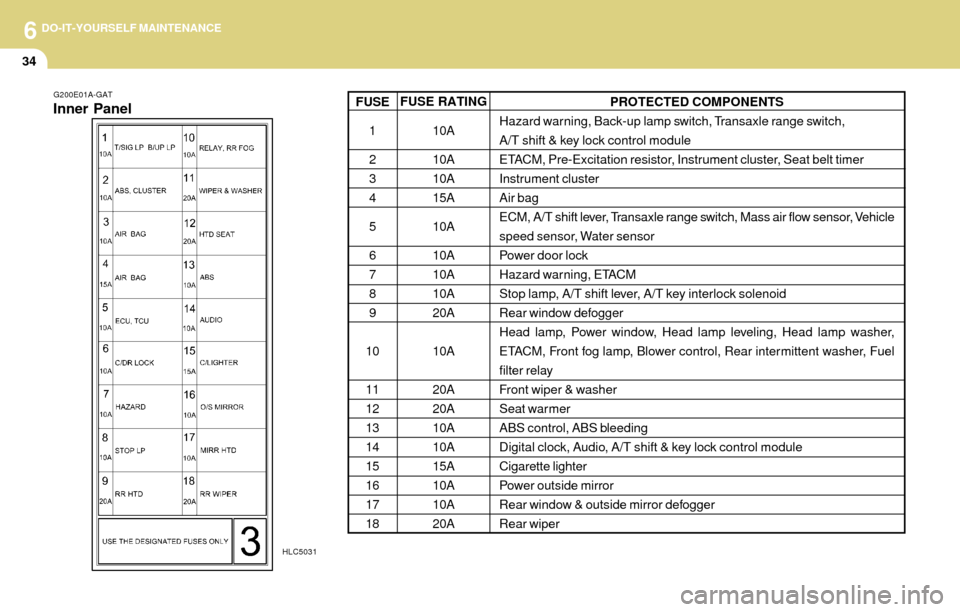
G200E01A-GAT
Inner Panel
HLC5031
PROTECTED COMPONENTS
Hazard warning, Back-up lamp switch, Transaxle range switch,
A/T shift & key lock control module
ETACM, Pre-Excitation resistor, Instrument cluster, Seat belt timer
Instrument cluster
Air bag
ECM, A/T shift lever, Transaxle range switch, Mass air flow sensor, Vehicle
speed sensor, Water sensor
Power door lock
Hazard warning, ETACM
Stop lamp, A/T shift lever, A/T key interlock solenoid
Rear window defogger
Head lamp, Power window, Head lamp leveling, Head lamp washer,
ETACM, Front fog lamp, Blower control, Rear intermittent washer, Fuel
filter relay
Front wiper & washer
Seat warmer
ABS control, ABS bleeding
Digital clock, Audio, A/T shift & key lock control module
Cigarette lighter
Power outside mirror
Rear window & outside mirror defogger
Rear wiperFUSE RATING
10A
10A
10A
15A
10A
10A
10A
10A
20A
10A
20A
20A
10A
10A
15A
10A
10A
20A FUSE
1
2
3
4
5
6
7
8
9
10
11
12
13
14
15
16
17
18
Page 186 of 205
7EMISSION CONTROL SYSTEMS
3CATALYTIC CONVERTER
!!
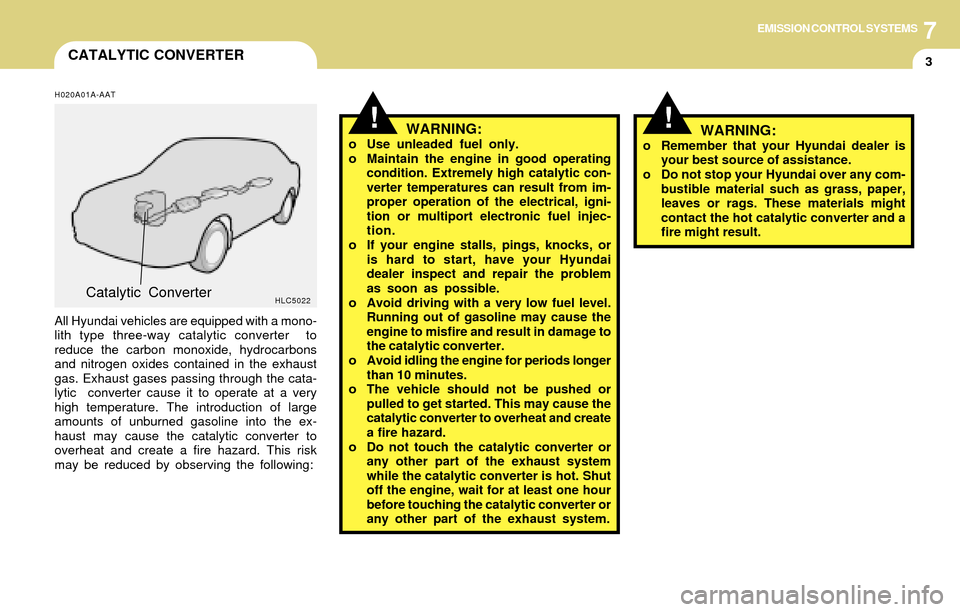
H020A01A-AAT
All Hyundai vehicles are equipped with a mono-
lith type three-way catalytic converter to
reduce the carbon monoxide, hydrocarbons
and nitrogen oxides contained in the exhaust
gas. Exhaust gases passing through the cata-
lytic converter cause it to operate at a very
high temperature. The introduction of large
amounts of unburned gasoline into the ex-
haust may cause the catalytic converter to
overheat and create a fire hazard. This risk
may be reduced by observing the following:
WARNING:o Remember that your Hyundai dealer is
your best source of assistance.
o Do not stop your Hyundai over any com-
bustible material such as grass, paper,
leaves or rags. These materials might
contact the hot catalytic converter and a
fire might result.
HLC5022Catalytic ConverterWARNING:
o Use unleaded fuel only.
o Maintain the engine in good operating
condition. Extremely high catalytic con-
verter temperatures can result from im-
proper operation of the electrical, igni-
tion or multiport electronic fuel injec-
tion.
o If your engine stalls, pings, knocks, or
is hard to start, have your Hyundai
dealer inspect and repair the problem
as soon as possible.
o Avoid driving with a very low fuel level.
Running out of gasoline may cause the
engine to misfire and result in damage to
the catalytic converter.
o Avoid idling the engine for periods longer
than 10 minutes.
o The vehicle should not be pushed or
pulled to get started. This may cause the
catalytic converter to overheat and create
a fire hazard.
o Do not touch the catalytic converter or
any other part of the exhaust system
while the catalytic converter is hot. Shut
off the engine, wait for at least one hour
before touching the catalytic converter or
any other part of the exhaust system.
Page 190 of 205
8CONSUMER INFORMATION & REPORTING SAFETY DEFECTS
4
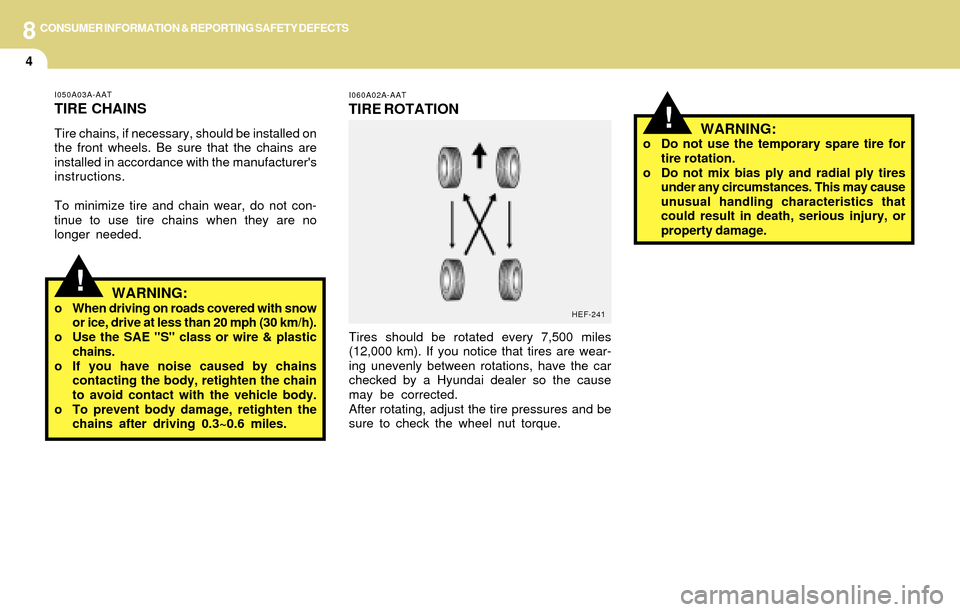
I060A02A-AAT
TIRE ROTATION
Tires should be rotated every 7,500 miles
(12,000 km). If you notice that tires are wear-
ing unevenly between rotations, have the car
checked by a Hyundai dealer so the cause
may be corrected.
After rotating, adjust the tire pressures and be
sure to check the wheel nut torque.
HEF-241
!
I050A03A-AAT
TIRE CHAINS
Tire chains, if necessary, should be installed on
the front wheels. Be sure that the chains are
installed in accordance with the manufacturer's
instructions.
To minimize tire and chain wear, do not con-
tinue to use tire chains when they are no
longer needed.
WARNING:o When driving on roads covered with snow
or ice, drive at less than 20 mph (30 km/h).
o Use the SAE "S" class or wire & plastic
chains.
o If you have noise caused by chains
contacting the body, retighten the chain
to avoid contact with the vehicle body.
o To prevent body damage, retighten the
chains after driving 0.3~0.6 miles.
!WARNING:o Do not use the temporary spare tire for
tire rotation.
o Do not mix bias ply and radial ply tires
under any circumstances. This may cause
unusual handling characteristics that
could result in death, serious injury, or
property damage.
Page 191 of 205
8CONSUMER INFORMATION & REPORTING SAFETY DEFECTS
5
I070A01A-AAT
TIRE BALANCING
A tire that is out of balance may affect handling
and tire wear. The tires on your Hyundai were
balanced before the car was delivered but may
need balancing again during the years you own
the car.
Whenever a tire is dismounted for repair, it
should be rebalanced before being reinstalled
on the car.
I080A01A-AATTIRE TRACTION
Tire traction can be reduced if you drive on worn
tires, tires that are improperly inflated or on
slippery road surfaces. Tires should be replaced
when tread wear indicators appear. To reduce
the possibility of losing control, slow down when-
ever there is rain, snow or ice on the road.
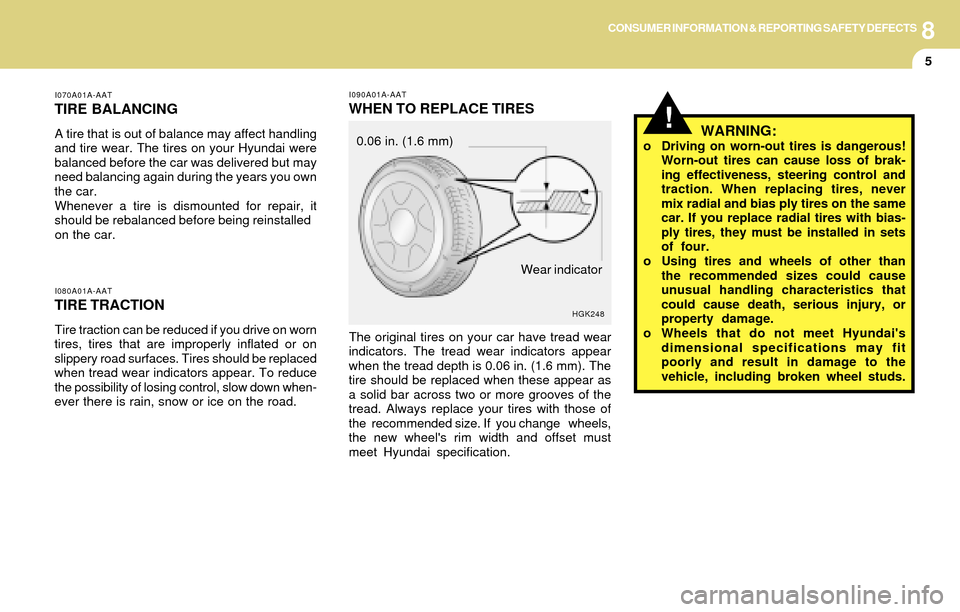
I090A01A-AAT
WHEN TO REPLACE TIRES
Wear indicator 0.06 in. (1.6 mm)
HGK248
The original tires on your car have tread wear
indicators. The tread wear indicators appear
when the tread depth is 0.06 in. (1.6 mm). The
tire should be replaced when these appear as
a solid bar across two or more grooves of the
tread. Always replace your tires with those of
the recommended size. If you change wheels,
the new wheel's rim width and offset must
meet Hyundai specification.
!WARNING:o Driving on worn-out tires is dangerous!
Worn-out tires can cause loss of brak-
ing effectiveness, steering control and
traction. When replacing tires, never
mix radial and bias ply tires on the same
car. If you replace radial tires with bias-
ply tires, they must be installed in sets
of four.
o Using tires and wheels of other than
the recommended sizes could cause
unusual handling characteristics that
could cause death, serious injury, or
property damage.
o Wheels that do not meet Hyundai's
dimensional specifications may fit
poorly and result in damage to the
vehicle, including broken wheel studs.
Page 193 of 205
8CONSUMER INFORMATION & REPORTING SAFETY DEFECTS
7CONSUMER INFORMATION
!
I130A01A-AAT
This consumer information has been prepared
in accordance with regulations issued by the
National Highway Traffic Safety Administration
of the U.S. Department of Transportation. It
provides the purchasers and/or prospective
purchasers of Hyundai automobiles with infor-
mation on uniform tire quality grading. Your
Hyundai dealer will help answer any questions
you may have as you read this information.
I130B03A-AAT
Tire Quality Grading
Department of Transportation quality grades -
All passenger vehicle tires must conform to
Federal Safety Standards in addition to these
grades. These quality grades are molded on the
sidewall.
Treadwear - The treadwear grade is a com-
parative rating based on the wear rate of the
tire when tested under controlled conditions on
a specified government test course. For ex-
ample, a tire graded 150 would wear one and
a half (1 - 1/2) times as well on the government
course as a tire graded 100. The relative
performance of tires depends upon the actual
conditions of their use, however, and may
depart significantly from the norm due to varia-
tions in driving habits, service practices and
differences in road characteristics and cli-
mate.
Traction AA, A, B, C - The traction grades,
from highest to lowest, are AA, A, B, and C.
Those grades represent the tire's ability to stop
on wet pavement as measured under controlled
conditions on specified government test surfac-
es of asphalt and concrete. A tire marked C
may have poor traction performance.WARNING:The traction grade assigned to this tire is
based on straight-ahead braking traction
tests, and does not include acceleration,
cornering, hydroplaning, or peak traction
characteristics.
Temperature A, B, C - The temperature
grades are A (the highest), B, and C, repre-
senting the tire's resistance to the generation
of heat and
its ability to dissipate heat when tested under
controlled conditions on a specified indoor labo-
ratory test wheel. Sustained high temperature
can cause the material of the tire to degenerate
and reduce tire life, and excessive temperature
can lead to sudden tire failure. The grade C
corresponds to a level of performance which
all passenger car tires must meet under the
Federal Motor Vehicle Safety Standard No.
109. Grades B and A represent higher levels
of performance on the laboratory test wheel
than the minimum required by law.
Page 194 of 205
8CONSUMER INFORMATION & REPORTING SAFETY DEFECTS
8
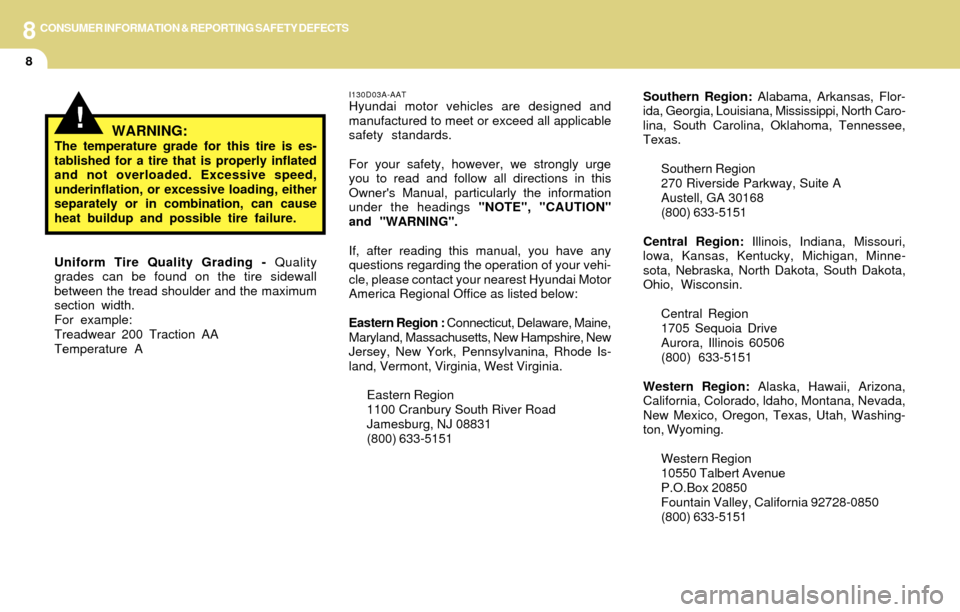
I130D03A-AATHyundai motor vehicles are designed and
manufactured to meet or exceed all applicable
safety standards.
For your safety, however, we strongly urge
you to read and follow all directions in this
Owner's Manual, particularly the information
under the headings "NOTE", "CAUTION"
and "WARNING".
If, after reading this manual, you have any
questions regarding the operation of your vehi-
cle, please contact your nearest Hyundai Motor
America Regional Office as listed below:
Eastern Region : Connecticut, Delaware, Maine,
Maryland, Massachusetts, New Hampshire, New
Jersey, New York, Pennsylvanina, Rhode Is-
land, Vermont, Virginia, West Virginia.
Eastern Region
1100 Cranbury South River Road
Jamesburg, NJ 08831
(800) 633-5151Southern Region: Alabama, Arkansas, Flor-
ida, Georgia, Louisiana, Mississippi, North Caro-
lina, South Carolina, Oklahoma, Tennessee,
Texas.
Southern Region
270 Riverside Parkway, Suite A
Austell, GA 30168
(800) 633-5151
Central Region: Illinois, Indiana, Missouri,
lowa, Kansas, Kentucky, Michigan, Minne-
sota, Nebraska, North Dakota, South Dakota,
Ohio, Wisconsin.
Central Region
1705 Sequoia Drive
Aurora, Illinois 60506
(800) 633-5151
Western Region: Alaska, Hawaii, Arizona,
California, Colorado, ldaho, Montana, Nevada,
New Mexico, Oregon, Texas, Utah, Washing-
ton, Wyoming.
Western Region
10550 Talbert Avenue
P.O.Box 20850
Fountain Valley, California 92728-0850
(800) 633-5151
!WARNING:The temperature grade for this tire is es-
tablished for a tire that is properly inflated
and not overloaded. Excessive speed,
underinflation, or excessive loading, either
separately or in combination, can cause
heat buildup and possible tire failure.
Uniform Tire Quality Grading - Quality
grades can be found on the tire sidewall
between the tread shoulder and the maximum
section width.
For example:
Treadwear 200 Traction AA
Temperature A
Page 202 of 205
10INDEX
3
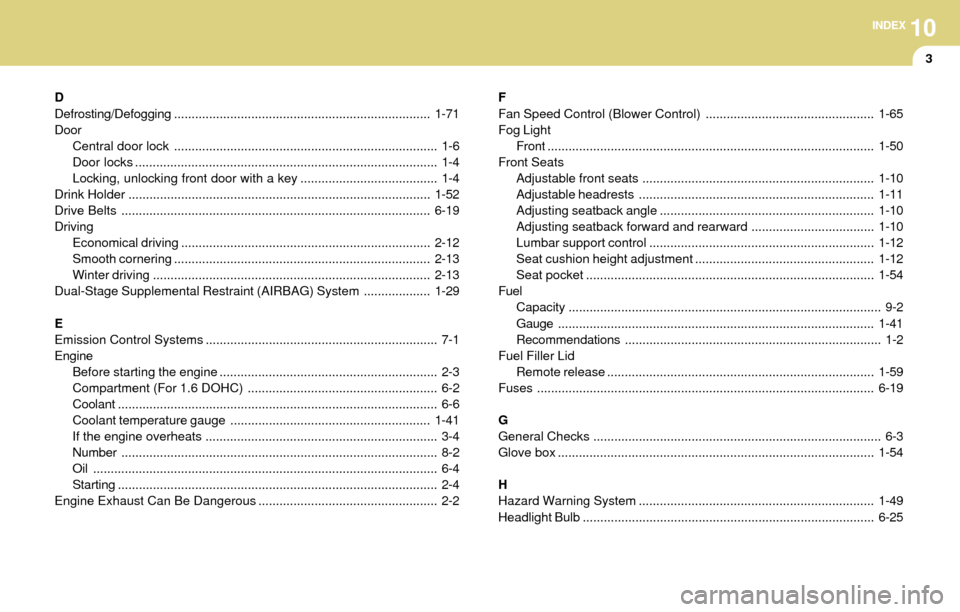
D
Defrosting/Defogging.........................................................................1-71
Door
Central door lock........................................................................... 1-6
Door locks ...................................................................................... 1-4
Locking, unlocking front door with a key ....................................... 1-4
Drink Holder......................................................................................1-52
Drive Belts........................................................................................6-19
Driving
Economical driving.......................................................................2-12
Smooth cornering .........................................................................2-13
Winter driving...............................................................................2-13
Dual-Stage Supplemental Restraint (AIRBAG) System...................1-29
E
Emission Control Systems.................................................................. 7-1
Engine
Before starting the engine .............................................................. 2-3
Compartment (For 1.6 DOHC) ...................................................... 6-2
Coolant........................................................................................... 6-6
Coolant temperature gauge .........................................................1-41
If the engine overheats .................................................................. 3-4
Number.......................................................................................... 8-2
Oil .................................................................................................. 6-4
Starting........................................................................................... 2-4
Engine Exhaust Can Be Dangerous................................................... 2-2F
Fan Speed Control (Blower Control)................................................1-65
Fog Light
Front.............................................................................................1-50
Front Seats
Adjustable front seats..................................................................1-10
Adjustable headrests ...................................................................1-11
Adjusting seatback angle .............................................................1-10
Adjusting seatback forward and rearward...................................1-10
Lumbar support control ................................................................1-12
Seat cushion height adjustment...................................................1-12
Seat pocket ..................................................................................1-54
Fuel
Capacity......................................................................................... 9-2
Gauge..........................................................................................1-41
Recommendations......................................................................... 1-2
Fuel Filler Lid
Remote release ............................................................................1-59
Fuses ................................................................................................6-19
G
General Checks.................................................................................. 6-3
Glove box ..........................................................................................1-54
H
Hazard Warning System ...................................................................1-49
Headlight Bulb ...................................................................................6-25