Od off Hyundai Accent 2004 Owner's Manual
[x] Cancel search | Manufacturer: HYUNDAI, Model Year: 2004, Model line: Accent, Model: Hyundai Accent 2004Pages: 205, PDF Size: 3.2 MB
Page 10 of 205
YOUR VEHICLE AT A GLANCE
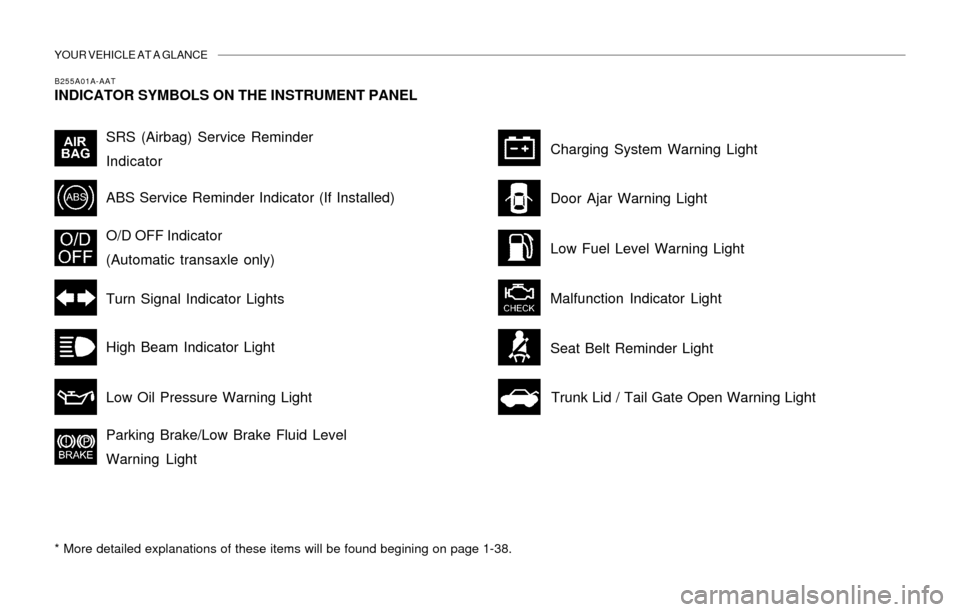
High Beam Indicator Light
Parking Brake/Low Brake Fluid Level
Warning LightDoor Ajar Warning Light
O/D OFF Indicator
(Automatic transaxle only)
B255A01A-AAT
INDICATOR SYMBOLS ON THE INSTRUMENT PANEL
* More detailed explanations of these items will be found begining on page 1-38.
SRS (Airbag) Service Reminder
Indicator
ABS Service Reminder Indicator (If Installed)
Turn Signal Indicator Lights
Low Oil Pressure Warning LightCharging System Warning Light
Low Fuel Level Warning Light
Malfunction Indicator Light
Seat Belt Reminder Light
Trunk Lid / Tail Gate Open Warning Light
Page 14 of 205
1FEATURES OF YOUR HYUNDAI
2FUEL RECOMMENDATIONS
UNLEADED
FUEL ONLY
B010A04A
!
B010A02A-AAT
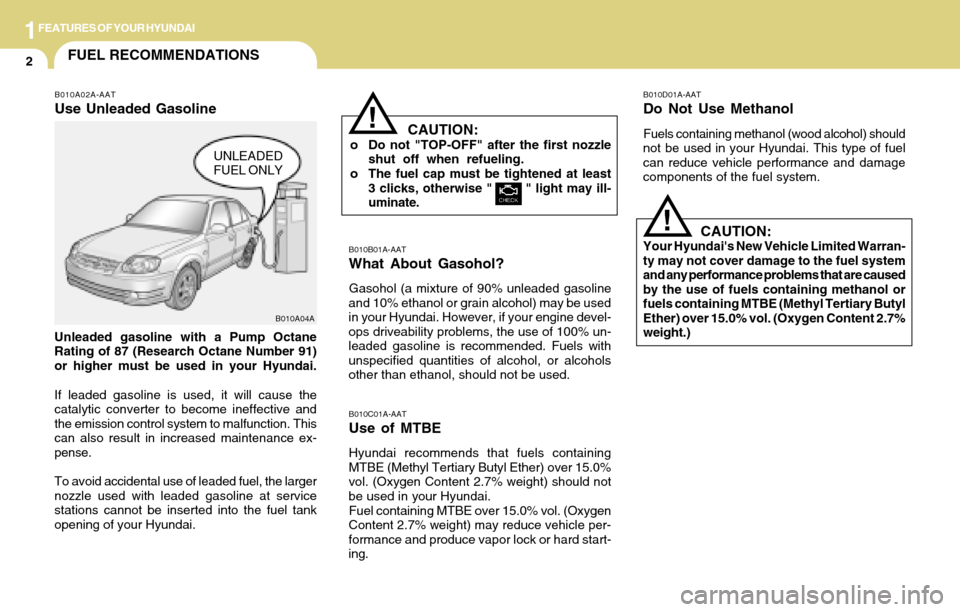
Use Unleaded Gasoline
Unleaded gasoline with a Pump Octane
Rating of 87 (Research Octane Number 91)
or higher must be used in your Hyundai.
If leaded gasoline is used, it will cause the
catalytic converter to become ineffective and
the emission control system to malfunction. This
can also result in increased maintenance ex-
pense.
To avoid accidental use of leaded fuel, the larger
nozzle used with leaded gasoline at service
stations cannot be inserted into the fuel tank
opening of your Hyundai.
B010B01A-AAT
What About Gasohol?
Gasohol (a mixture of 90% unleaded gasoline
and 10% ethanol or grain alcohol) may be used
in your Hyundai. However, if your engine devel-
ops driveability problems, the use of 100% un-
leaded gasoline is recommended. Fuels with
unspecified quantities of alcohol, or alcohols
other than ethanol, should not be used.
B010C01A-AAT
Use of MTBE
Hyundai recommends that fuels containing
MTBE (Methyl Tertiary Butyl Ether) over 15.0%
vol. (Oxygen Content 2.7% weight) should not
be used in your Hyundai.
Fuel containing MTBE over 15.0% vol. (Oxygen
Content 2.7% weight) may reduce vehicle per-
formance and produce vapor lock or hard start-
ing.
B010D01A-AAT
Do Not Use Methanol
Fuels containing methanol (wood alcohol) should
not be used in your Hyundai. This type of fuel
can reduce vehicle performance and damage
components of the fuel system.CAUTION:o Do not "TOP-OFF" after the first nozzle
shut off when refueling.
o The fuel cap must be tightened at least
3 clicks, otherwise " " light may ill-
uminate.
CAUTION:Your Hyundai's New Vehicle Limited Warran-
ty may not cover damage to the fuel system
and any performance problems that are caused
by the use of fuels containing methanol or
fuels containing MTBE (Methyl Tertiary Butyl
Ether) over 15.0% vol. (Oxygen Content 2.7%
weight.)
!
Page 19 of 205
1FEATURES OF YOUR HYUNDAI
7
B070C03A-AAT
Alarm Stage
The alarm will be activated if any of the follow-
ing occurs while the car is parked and the
system is armed.
1) A door or tail gate(3 Door) is opened without
using the transmitter or the ignition key.
2) The trunk lid(4 Door) is opened without using
the ignition key.
3) The engine hood is opened.
The alarming horn will sound and the turn signal
lights will blink continuously for 27 seconds
(This happens 3 times). To turn off the system,
unlock the door with the transmitter or the igni-
tion key.
B070D02A-AAT
Disarmed Stage
The system will be disarmed when the following
step is taken:
The driver's or passenger's door is unlocked by
depressing the "UNLOCK" button on the trans-
mitter or the ignition key.
After completion of the steps above, the turn
signal lights will blink twice to indicate that the
system is disarmed.
If any door, trunk lid(4 Door)/tail gate(3 Door) or
engine hood is not opened within 30 seconds,
the system will be rearmed.
NOTE:When the system is disarmed with the interior
light switched to "DR" or "
", the interior
light will illuminate for 30 seconds. 1) Remove the ignition key from the ignition
switch.
2) Make sure that the engine hood and trunk lid
(4 Door)/tail gate (3 Door) are closed and
latched.
3) Lock the doors using the transmitter of the
keyless entry system.
After completion of the steps above, the turn
signal lights will blink once to indicate that the
system is armed.
NOTE:If any door, trunk lid (4 Door)/tail gate (3 Door)
or engine hood remains open, the system will
not be armed. If this happens, rearm the sys-
tem as described above.
!CAUTION:o Do not arm the system until all passen-
gers have left the car. If the system is
armed while a passenger(s) remains in
the car, the alarm may be activated when
the remaining passenger(s) leaves the car.
o If the "LOCK" button is pressed once
more within 4 seconds after pushing the
"LOCK" button on the transmitter, the
alarming horn will sound once to indicate
that the system is armed.CAUTION:Avoid trying to start the engine while the
system is armed.
!
B070E02A-AAT
Panic Warning
1. Push the "PANIC" button on the transmitter.
2. At the same time, the alarming horn will
sound and the turn signal lights will blink
continuously for 30 seconds.
3. To turn off the system, push the "PANIC"
button again on the transmitter.
Page 22 of 205
1FEATURES OF YOUR HYUNDAI
10ADJUSTABLE FRONT SEATS
!
B080C01A-AAT
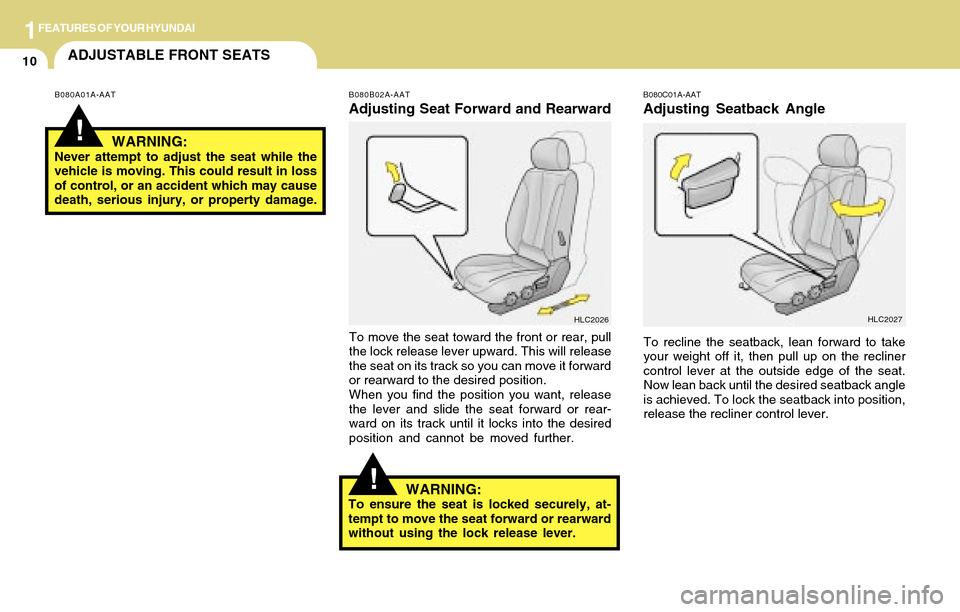
Adjusting Seatback Angle
To recline the seatback, lean forward to take
your weight off it, then pull up on the recliner
control lever at the outside edge of the seat.
Now lean back until the desired seatback angle
is achieved. To lock the seatback into position,
release the recliner control lever.
B080A01A-AAT
To move the seat toward the front or rear, pull
the lock release lever upward. This will release
the seat on its track so you can move it forward
or rearward to the desired position.
When you find the position you want, release
the lever and slide the seat forward or rear-
ward on its track until it locks into the desired
position and cannot be moved further.
B080B02A-AAT
Adjusting Seat Forward and Rearward
WARNING:
Never attempt to adjust the seat while the
vehicle is moving. This could result in loss
of control, or an accident which may cause
death, serious injury, or property damage.
HLC2026HLC2027
!WARNING:To ensure the seat is locked securely, at-
tempt to move the seat forward or rearward
without using the lock release lever.
Page 40 of 205
1FEATURES OF YOUR HYUNDAI
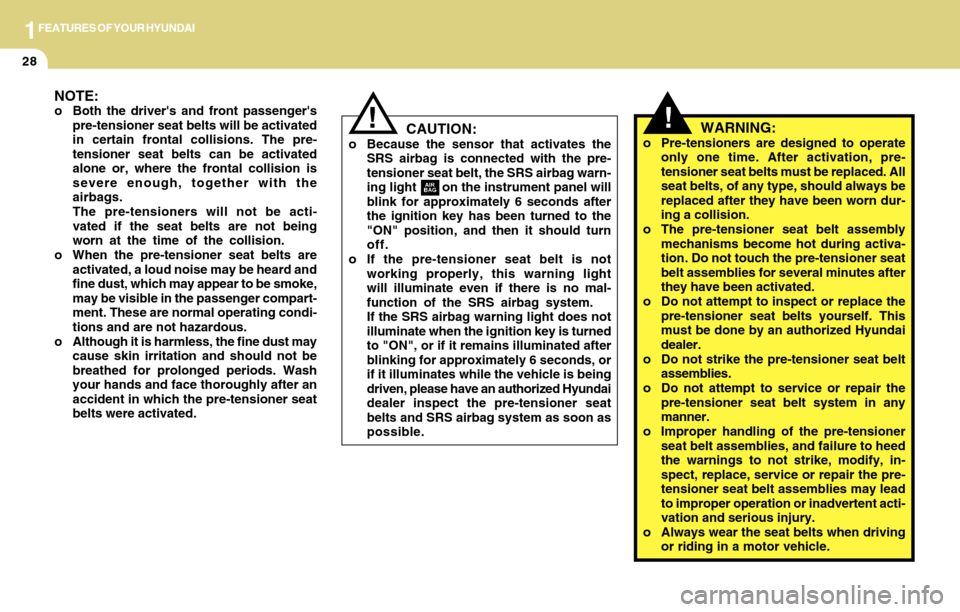
28
!WARNING:o Pre-tensioners are designed to operate
only one time. After activation, pre-
tensioner seat belts must be replaced. All
seat belts, of any type, should always be
replaced after they have been worn dur-
ing a collision.
o The pre-tensioner seat belt assembly
mechanisms become hot during activa-
tion. Do not touch the pre-tensioner seat
belt assemblies for several minutes after
they have been activated.
o Do not attempt to inspect or replace the
pre-tensioner seat belts yourself. This
must be done by an authorized Hyundai
dealer.
o Do not strike the pre-tensioner seat belt
assemblies.
o Do not attempt to service or repair the
pre-tensioner seat belt system in any
manner.
o Improper handling of the pre-tensioner
seat belt assemblies, and failure to heed
the warnings to not strike, modify, in-
spect, replace, service or repair the pre-
tensioner seat belt assemblies may lead
to improper operation or inadvertent acti-
vation and serious injury.
o Always wear the seat belts when driving
or riding in a motor vehicle.CAUTION:o Because the sensor that activates the
SRS airbag is connected with the pre-
tensioner seat belt, the SRS airbag warn-
ing light on the instrument panel will
blink for approximately 6 seconds after
the ignition key has been turned to the
"ON" position, and then it should turn
off.
o If the pre-tensioner seat belt is not
working properly, this warning light
will illuminate even if there is no mal-
function of the SRS airbag system.
If the SRS airbag warning light does not
illuminate when the ignition key is turned
to "ON", or if it remains illuminated after
blinking for approximately 6 seconds, or
if it illuminates while the vehicle is being
driven, please have an authorized Hyundai
dealer inspect the pre-tensioner seat
belts and SRS airbag system as soon as
possible.
!
NOTE:o Both the driver's and front passenger's
pre-tensioner seat belts will be activated
in certain frontal collisions. The pre-
tensioner seat belts can be activated
alone or, where the frontal collision is
severe enough, together with the
airbags.
The pre-tensioners will not be acti-
vated if the seat belts are not being
worn at the time of the collision.
o When the pre-tensioner seat belts are
activated, a loud noise may be heard and
fine dust, which may appear to be smoke,
may be visible in the passenger compart-
ment. These are normal operating condi-
tions and are not hazardous.
o Although it is harmless, the fine dust may
cause skin irritation and should not be
breathed for prolonged periods. Wash
your hands and face thoroughly after an
accident in which the pre-tensioner seat
belts were activated.
Page 41 of 205
1FEATURES OF YOUR HYUNDAI
29DUAL-STAGE SUPPLEMENTAL
RESTRAINT (AIRBAG) SYSTEM (SRS)
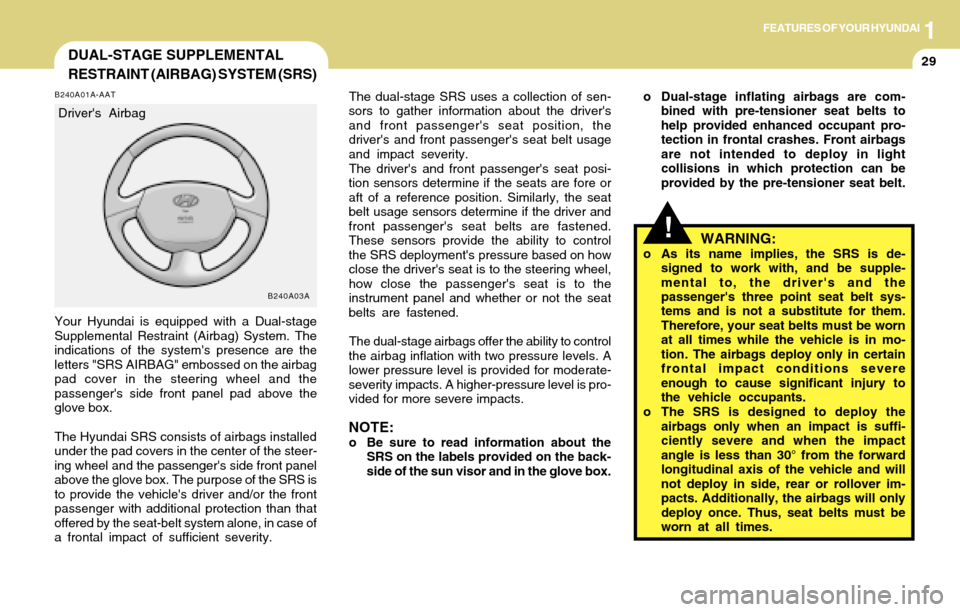
B240A01A-AAT
Your Hyundai is equipped with a Dual-stage
Supplemental Restraint (Airbag) System. The
indications of the system's presence are the
letters "SRS AIRBAG" embossed on the airbag
pad cover in the steering wheel and the
passenger's side front panel pad above the
glove box.
The Hyundai SRS consists of airbags installed
under the pad covers in the center of the steer-
ing wheel and the passenger's side front panel
above the glove box. The purpose of the SRS is
to provide the vehicle's driver and/or the front
passenger with additional protection than that
offered by the seat-belt system alone, in case of
a frontal impact of sufficient severity.
B240A03A
Driver's AirbagThe dual-stage SRS uses a collection of sen-
sors to gather information about the driver's
and front passenger's seat position, the
driver's and front passenger's seat belt usage
and impact severity.
The driver's and front passenger's seat posi-
tion sensors determine if the seats are fore or
aft of a reference position. Similarly, the seat
belt usage sensors determine if the driver and
front passenger's seat belts are fastened.
These sensors provide the ability to control
the SRS deployment's pressure based on how
close the driver's seat is to the steering wheel,
how close the passenger's seat is to the
instrument panel and whether or not the seat
belts are fastened.
The dual-stage airbags offer the ability to control
the airbag inflation with two pressure levels. A
lower pressure level is provided for moderate-
severity impacts. A higher-pressure level is pro-
vided for more severe impacts.
NOTE:o Be sure to read information about the
SRS on the labels provided on the back-
side of the sun visor and in the glove box.
WARNING:o As its name implies, the SRS is de-
signed to work with, and be supple-
mental to, the driver's and the
passenger's three point seat belt sys-
tems and is not a substitute for them.
Therefore, your seat belts must be worn
at all times while the vehicle is in mo-
tion. The airbags deploy only in certain
frontal impact conditions severe
enough to cause significant injury to
the vehicle occupants.
o The SRS is designed to deploy the
airbags only when an impact is suffi-
ciently severe and when the impact
angle is less than 30° from the forward
longitudinal axis of the vehicle and will
not deploy in side, rear or rollover im-
pacts. Additionally, the airbags will only
deploy once. Thus, seat belts must be
worn at all times.
!
o Dual-stage inflating airbags are com-
bined with pre-tensioner seat belts to
help provided enhanced occupant pro-
tection in frontal crashes. Front airbags
are not intended to deploy in light
collisions in which protection can be
provided by the pre-tensioner seat belt.
Page 45 of 205
1FEATURES OF YOUR HYUNDAI
33
!
!
WARNING:o For best protection from the side im-
pact airbag system and to avoid being
injured by the deploying side impact
airbag, both front seat occupants
should sit in an upright position with
the seat belt properly fastened. The
driver's hands should be placed on the
steering wheel at the 9:00 and 3:00
o'clock positions.
The passenger's arms and hands should
be placed on their laps.
o Do not use any accessory seat covers.
o Use of seat covers could reduce or pre-
vent the effectiveness of the system.
o Do not install any accessories on the side
or near the side impact airbag.
o Do not use excessive force on the side of
the seat.
o Do not place any objects over the airbag
or between the airbag and yourself.
o Do not place any objects (an umbrella,
bag, etc.) between the front door and the
front seat. Such objects may become dan-
gerous projectiles and cause injury if the
supplemental side impact airbag inflates.
B990B01A-1
Side airbag
sensor
WARNING:o The side impact airbag is supplemental to
the driver's and the passenger's three
point seat belt systems and is not a sub-
stitute for them. Therefore your seat belts
must be worn at all times while the ve-
hicle is in motion. The airbags deploy
only in certain side impact conditions
severe enough to cause significant injury
to the vehicle occupants.
B990B04Y-GAT
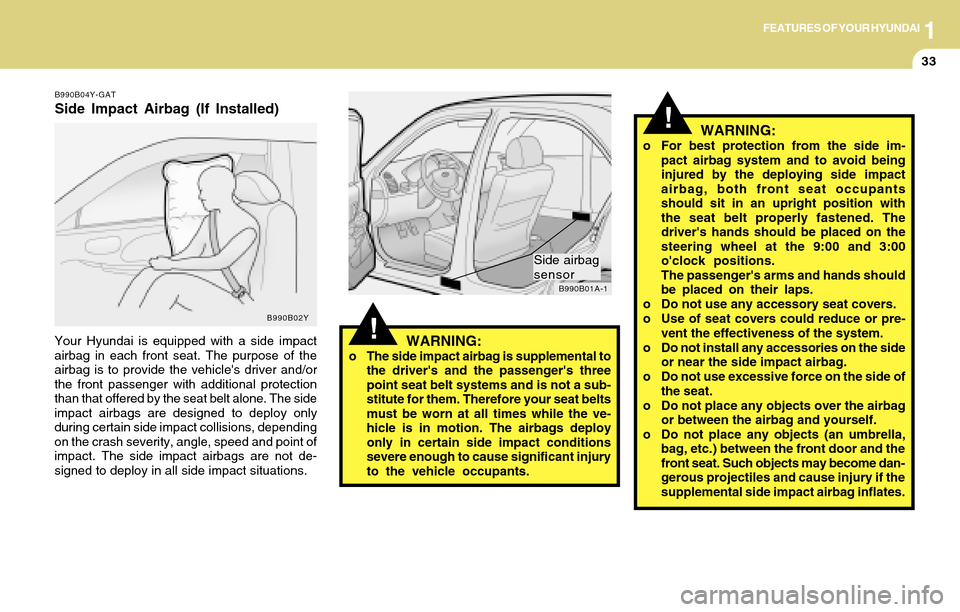
Side Impact Airbag (If Installed)
Your Hyundai is equipped with a side impact
airbag in each front seat. The purpose of the
airbag is to provide the vehicle's driver and/or
the front passenger with additional protection
than that offered by the seat belt alone. The side
impact airbags are designed to deploy only
during certain side impact collisions, depending
on the crash severity, angle, speed and point of
impact. The side impact airbags are not de-
signed to deploy in all side impact situations.
B990B02Y
Page 49 of 205
1FEATURES OF YOUR HYUNDAI
37
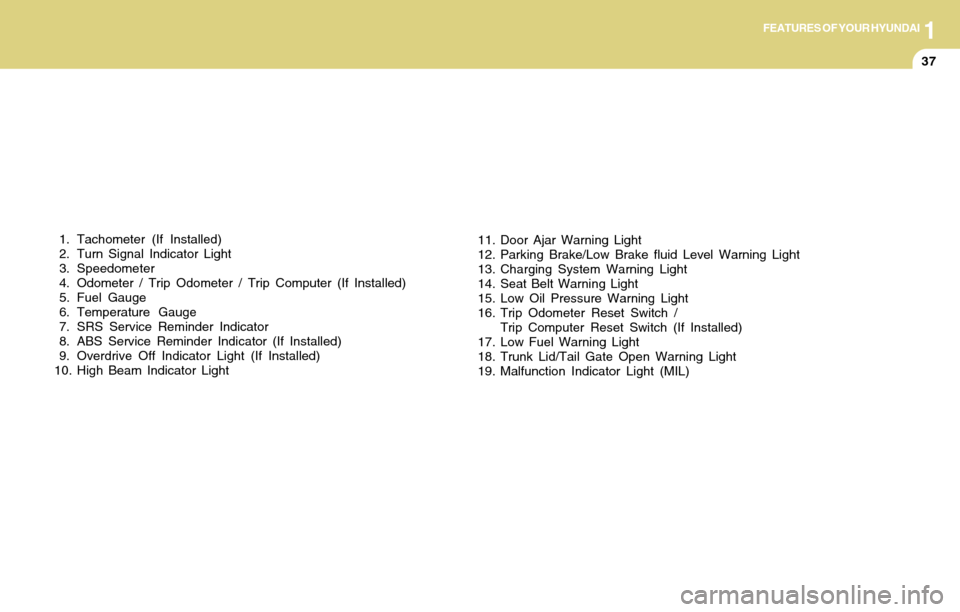
11. Door Ajar Warning Light
12. Parking Brake/Low Brake fluid Level Warning Light
13. Charging System Warning Light
14. Seat Belt Warning Light
15. Low Oil Pressure Warning Light
16. Trip Odometer Reset Switch /
Trip Computer Reset Switch (If Installed)
17. Low Fuel Warning Light
18. Trunk Lid/Tail Gate Open Warning Light
19. Malfunction Indicator Light (MIL) 1. Tachometer (If Installed)
2. Turn Signal Indicator Light
3. Speedometer
4. Odometer / Trip Odometer / Trip Computer (If Installed)
5. Fuel Gauge
6. Temperature Gauge
7. SRS Service Reminder Indicator
8. ABS Service Reminder Indicator (If Installed)
9. Overdrive Off Indicator Light (If Installed)
10. High Beam Indicator Light
Page 50 of 205
1FEATURES OF YOUR HYUNDAI
38WARNING AND INDICATOR LIGHTS
!
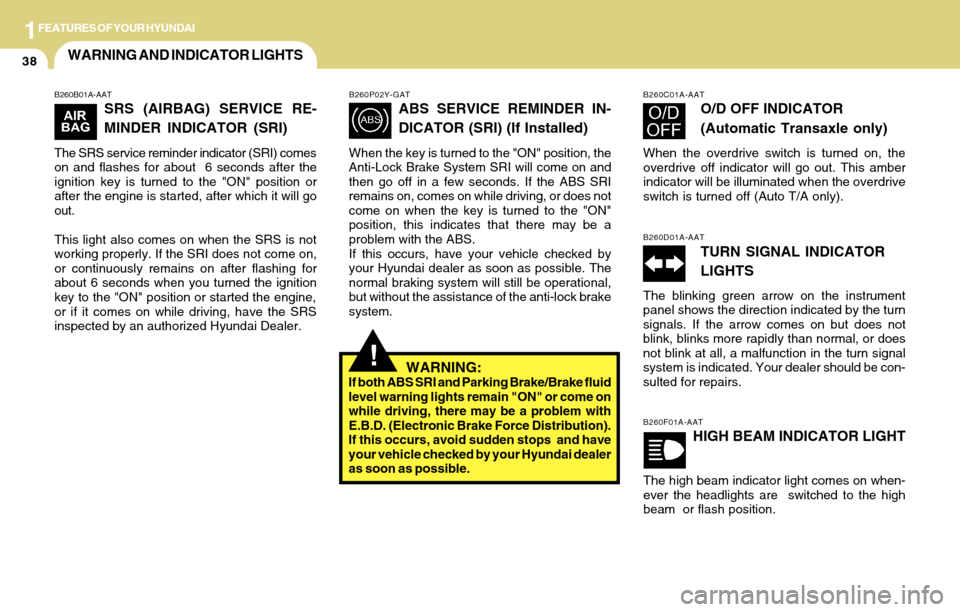
B260B01A-AAT
SRS (AIRBAG) SERVICE RE-
MINDER INDICATOR (SRI)
The SRS service reminder indicator (SRI) comes
on and flashes for about 6 seconds after the
ignition key is turned to the "ON" position or
after the engine is started, after which it will go
out.
This light also comes on when the SRS is not
working properly. If the SRI does not come on,
or continuously remains on after flashing for
about 6 seconds when you turned the ignition
key to the "ON" position or started the engine,
or if it comes on while driving, have the SRS
inspected by an authorized Hyundai Dealer.
B260P02Y-GAT
ABS SERVICE REMINDER IN-
DICATOR (SRI) (If Installed)
When the key is turned to the "ON" position, the
Anti-Lock Brake System SRI will come on and
then go off in a few seconds. If the ABS SRI
remains on, comes on while driving, or does not
come on when the key is turned to the "ON"
position, this indicates that there may be a
problem with the ABS.
If this occurs, have your vehicle checked by
your Hyundai dealer as soon as possible. The
normal braking system will still be operational,
but without the assistance of the anti-lock brake
system.
WARNING:If both ABS SRI and Parking Brake/Brake fluid
level warning lights remain "ON" or come on
while driving, there may be a problem with
E.B.D. (Electronic Brake Force Distribution).
If this occurs, avoid sudden stops and have
your vehicle checked by your Hyundai dealer
as soon as possible.
B260F01A-AAT
HIGH BEAM INDICATOR LIGHT
The high beam indicator light comes on when-
ever the headlights are switched to the high
beam or flash position.
B260C01A-AAT
O/D OFF INDICATOR
(Automatic Transaxle only)
When the overdrive switch is turned on, the
overdrive off indicator will go out. This amber
indicator will be illuminated when the overdrive
switch is turned off (Auto T/A only).
B260D01A-AAT
TURN SIGNAL INDICATOR
LIGHTS
The blinking green arrow on the instrument
panel shows the direction indicated by the turn
signals. If the arrow comes on but does not
blink, blinks more rapidly than normal, or does
not blink at all, a malfunction in the turn signal
system is indicated. Your dealer should be con-
sulted for repairs.
Page 51 of 205
1FEATURES OF YOUR HYUNDAI
39
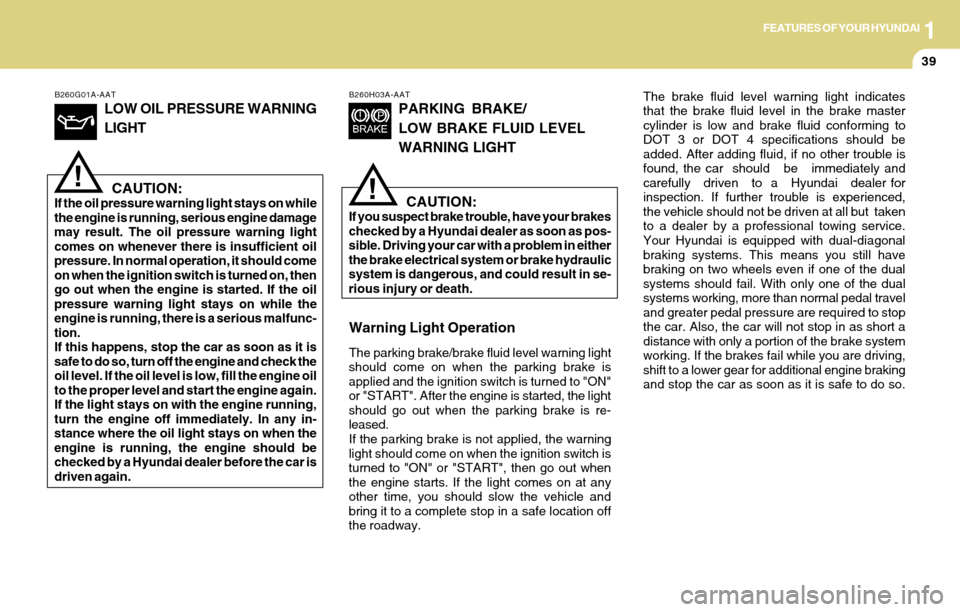
B260G01A-AAT
LOW OIL PRESSURE WARNING
LIGHT
CAUTION:If the oil pressure warning light stays on while
the engine is running, serious engine damage
may result. The oil pressure warning light
comes on whenever there is insufficient oil
pressure. In normal operation, it should come
on when the ignition switch is turned on, then
go out when the engine is started. If the oil
pressure warning light stays on while the
engine is running, there is a serious malfunc-
tion.
If this happens, stop the car as soon as it is
safe to do so, turn off the engine and check the
oil level. If the oil level is low, fill the engine oil
to the proper level and start the engine again.
If the light stays on with the engine running,
turn the engine off immediately. In any in-
stance where the oil light stays on when the
engine is running, the engine should be
checked by a Hyundai dealer before the car is
driven again.
!
B260H03A-AAT
PARKING BRAKE/
LOW BRAKE FLUID LEVEL
WARNING LIGHT
CAUTION:
If you suspect brake trouble, have your brakes
checked by a Hyundai dealer as soon as pos-
sible. Driving your car with a problem in either
the brake electrical system or brake hydraulic
system is dangerous, and could result in se-
rious injury or death.
Warning Light Operation
The parking brake/brake fluid level warning light
should come on when the parking brake is
applied and the ignition switch is turned to "ON"
or "START". After the engine is started, the light
should go out when the parking brake is re-
leased.
If the parking brake is not applied, the warning
light should come on when the ignition switch is
turned to "ON" or "START", then go out when
the engine starts. If the light comes on at any
other time, you should slow the vehicle and
bring it to a complete stop in a safe location off
the roadway.
!
The brake fluid level warning light indicates
that the brake fluid level in the brake master
cylinder is low and brake fluid conforming to
DOT 3 or DOT 4 specifications should be
added. After adding fluid, if no other trouble is
found, the car should be immediately and
carefully driven to a Hyundai dealer for
inspection. If further trouble is experienced,
the vehicle should not be driven at all but taken
to a dealer by a professional towing service.
Your Hyundai is equipped with dual-diagonal
braking systems. This means you still have
braking on two wheels even if one of the dual
systems should fail. With only one of the dual
systems working, more than normal pedal travel
and greater pedal pressure are required to stop
the car. Also, the car will not stop in as short a
distance with only a portion of the brake system
working. If the brakes fail while you are driving,
shift to a lower gear for additional engine braking
and stop the car as soon as it is safe to do so.