belt Hyundai Accent 2005 Owner's Guide
[x] Cancel search | Manufacturer: HYUNDAI, Model Year: 2005, Model line: Accent, Model: Hyundai Accent 2005Pages: 219, PDF Size: 7.07 MB
Page 43 of 219
1
FEATURES OF YOUR HYUNDAI
31
WARNING:
o No objects should be placed over or
near the airbag modules on the steer-
ing wheel, instrument panel, and the
front passenger's panel above the glove
box, because any such object could
cause harm if the vehicle is in a crash
severe enough to cause the airbags to
deploy.
o If the airbags deploy, they must be
replaced by an authorized Hyundai
dealer.
o Do not tamper with or disconnect SRS
wiring, or other components of the SRS
system. Doing so could result in injury,
due to accidental firing of the airbags
or by rendering the SRS inoperative.
o Do not install a child restraint system in
the front passenger seat position. A
child restraint system must never be
placed in the front seat. The infant or
child could be severely injured or killed
by an airbag deployment in case of an
accident.
o Do not allow children to ride in the front
passenger seat. If older children (teen-
agers and older) must ride in the front
seat, make sure they are always prop-
erly belted and that the seat is moved
back as far as possible.
WARNING:
o For maximum safety protection in all
types of crashes, all occupants includ-
ing the driver should always wear their
seat belts whether or not an airbag is
also provided at their seating position
to minimize the risk of severe injury or
death in the event of a crash. Do not sit
or lean unnecessarily close to the airbag
while the vehicle is in motion.
o Sitting improperly or out of position
can result in serious or fatal injury in a
crash. All occupants should sit upright
in their seats with their feet on the floor
until the vehicle is parked and the igni-
tion key is removed.
o The SRS airbag system must deploy
very rapidly to provide protection in a
crash. If an occupant is out of position
because of not wearing a seat belt, the
airbag may forcefully contact the occu-
pant causing serious or fatal injuries.
!
!
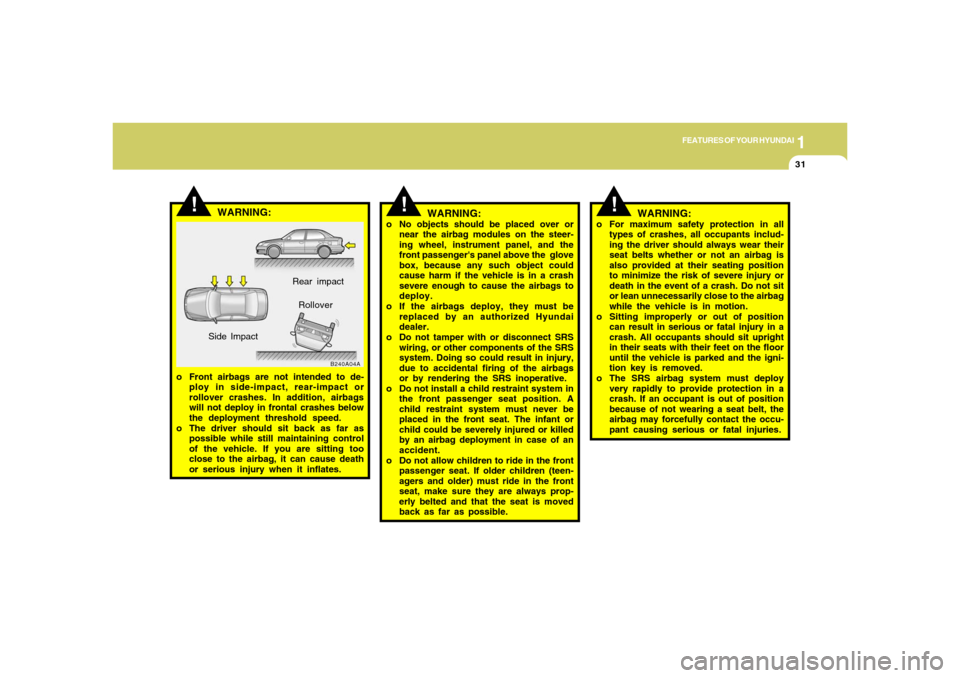
o Front airbags are not intended to de-
ploy in side-impact, rear-impact or
rollover crashes. In addition, airbags
will not deploy in frontal crashes below
the deployment threshold speed.
o The driver should sit back as far as
possible while still maintaining control
of the vehicle. If you are sitting too
close to the airbag, it can cause death
or serious injury when it inflates.
B240A04A
Rear impact
Side ImpactRollover
WARNING:
!
Page 44 of 219
1FEATURES OF YOUR HYUNDAI32
The SRSCM continually monitors all elements
while the ignition is "ON" to determine if a frontal
or near-frontal impact is severe enough to re-
quire airbag deployment.
The SRS service reminder indicator (SRI) on
the instrument panel will blink for about 6
seconds after the ignition key is turned to the
"ON" position or after the engine is started,
after which the SRI should go out.
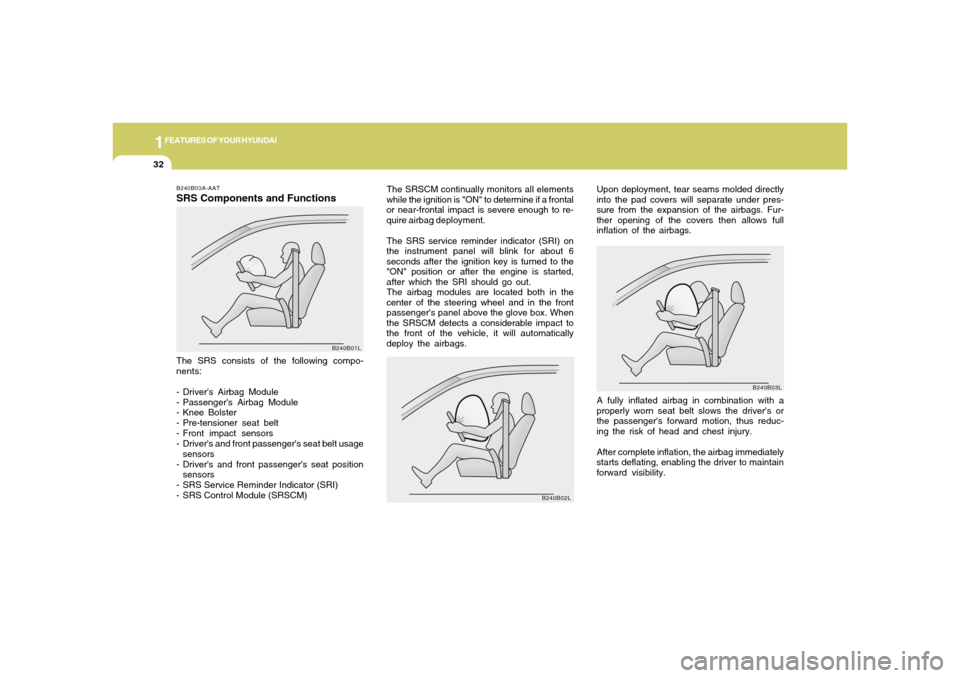
The airbag modules are located both in the
center of the steering wheel and in the front
passenger's panel above the glove box. When
the SRSCM detects a considerable impact to
the front of the vehicle, it will automatically
deploy the airbags.
A fully inflated airbag in combination with a
properly worn seat belt slows the driver's or
the passenger's forward motion, thus reduc-
ing the risk of head and chest injury.
After complete inflation, the airbag immediately
starts deflating, enabling the driver to maintain
forward visibility.
B240B02L B240B03A-AAT
SRS Components and FunctionsThe SRS consists of the following compo-
nents:
- Driver's Airbag Module
- Passenger's Airbag Module
- Knee Bolster
- Pre-tensioner seat belt
- Front impact sensors
- Driver's and front passenger's seat belt usage
sensors
- Driver's and front passenger's seat position
sensors
- SRS Service Reminder Indicator (SRI)
- SRS Control Module (SRSCM)
B240B01L
Upon deployment, tear seams molded directly
into the pad covers will separate under pres-
sure from the expansion of the airbags. Fur-
ther opening of the covers then allows full
inflation of the airbags.
B240B03L
Page 46 of 219
1FEATURES OF YOUR HYUNDAI34
!
!
WARNING:
o For best protection from the side im-
pact airbag system and to avoid being
injured by the deploying side impact
airbag, both front seat occupants
should sit in an upright position with
the seat belt properly fastened. The
driver's hands should be placed on the
steering wheel at the 9:00 and 3:00
o'clock positions.
The passenger's arms and hands should
be placed on their laps.
o Do not use any accessory seat covers.
o Use of seat covers could reduce or pre-
vent the effectiveness of the system.
o Do not install any accessories on the side
or near the side impact airbag.
o Do not use excessive force on the side of
the seat.
o Do not place any objects over the airbag
or between the airbag and yourself.
o Do not place any objects (an umbrella,
bag, etc.) between the front door and the
front seat. Such objects may become dan-
gerous projectiles and cause injury if the
supplemental side impact airbag inflates.
B990B01A-1
Side airbag
sensor
WARNING:
o The side impact airbag is supplemental to
the driver's and the passenger's three
point seat belt systems and is not a sub-
stitute for them. Therefore your seat belts
must be worn at all times while the ve-
hicle is in motion. The airbags deploy
only in certain side impact conditions
severe enough to cause significant injury
to the vehicle occupants.
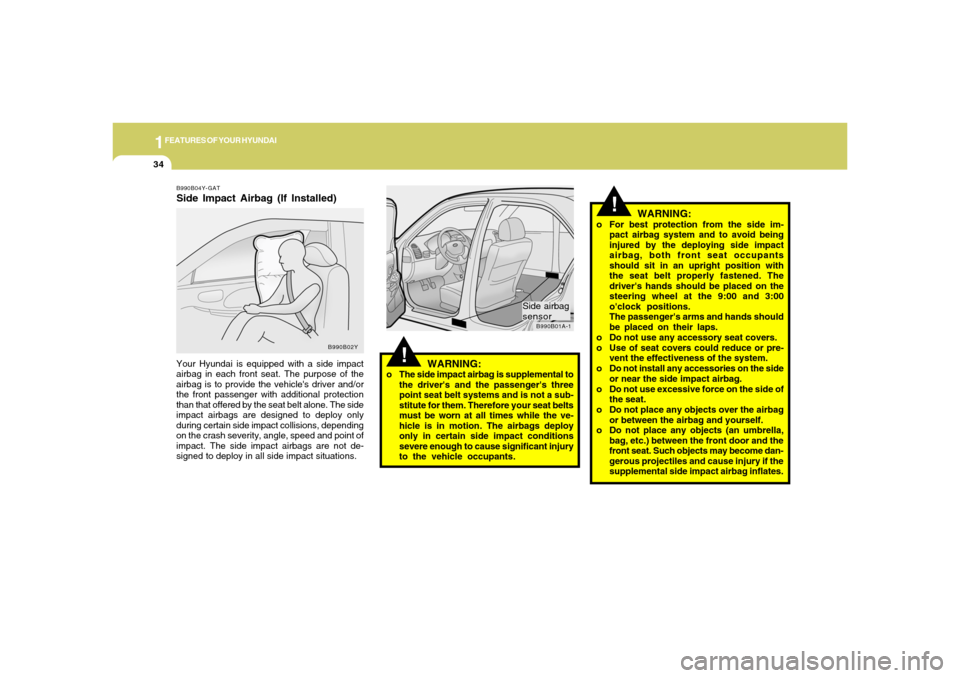
B990B04Y-GATSide Impact Airbag (If Installed)Your Hyundai is equipped with a side impact
airbag in each front seat. The purpose of the
airbag is to provide the vehicle's driver and/or
the front passenger with additional protection
than that offered by the seat belt alone. The side
impact airbags are designed to deploy only
during certain side impact collisions, depending
on the crash severity, angle, speed and point of
impact. The side impact airbags are not de-
signed to deploy in all side impact situations.
B990B02Y
Page 48 of 219
1FEATURES OF YOUR HYUNDAI36
!
!
oEach seat belt is designed to restrain
one occupant. If more than one person
uses the same seat belt, they could be
seriously injured or killed in a collision.
oDo not use any accessories on seat
belts. Devices claiming to improve occu-
pant comfort or reposition the seat belt can
reduce the protection provided by the seat
belt and increase the chance of serious
injury in a crash.
oPassengers should not place hard or
sharp objects between themselves and
the airbags. Carrying hard or sharp ob-
jects on your lap or in your mouth can result
in injuries if an airbag inflates.
oKeep occupants away from the airbag
covers. All occupants should sit upright,
fully back in their seats with their seat belts
on and their feet on the floor. If occupants
are too close to the airbag covers, they
could be injured if the airbags inflate.
oDo not attach or place objects on or
near the airbag covers. Any object at-
tached to or placed on the front or side
impact airbag covers could interfere with
the proper operation of the airbags.
oDo not modify the front seats. Modifica-
tion of the front seats could interfere with
the operation of the supplemental restraint
system sensing components or side im-
pact airbags.
B240D01JM-AATAdditional Safety PrecautionsoNever let passengers ride in the cargo
area (trunk) or on top of a folded-down
back seat. All occupants should sit upright,
fully back in their seats with their seat belts
on and their feet on the floor.
oPassengers should not move out of or
change seats while the vehicle is mov-
ing. A passenger who is not wearing a seat
belt during a crash or emergency stop can
be thrown against the inside of the vehicle,
against other occupants, or out of the
vehicle. o If you sell your vehicle, be sure to
inform the new owner of these impor-
tant points and make certain that this
manual is transferred to the new owner.
o If your car was flooded and has soaked
carpeting or water on the floor, you
shouldn't try to start the engine; have
the car towed to an authorized Hyundai
dealer.oDo not place items under the front
seats. Placing items under the front seats
could interfere with the operation of the
supplemental restraint system sensing
components and wiring harnesses.
oNever hold an infant or child on your
lap. The infant or child could be seriously
injured or killed in the event of a crash. All
infants and children should be properly
restrained in appropriate child safety seats
or seat belts in the rear seat.
WARNING:
o Sitting improperly or out of position
can result in serious injury or death in
a crash.
o Always sit upright, fully back in the
seat, with your seat belt on, and your
feet on the floor.Adding Equipment to or Modifying Your
Airbag-Equipped Vehicle.If you modify your vehicle by changing your
vehicle's frame, bumper system, front end or
side sheet metal or ride height, this may affect
the operation of your vehicle's airbag system.
WARNING:
Page 50 of 219

1FEATURES OF YOUR HYUNDAI38
11. Door Ajar Warning Light
12. Parking Brake/Low Brake fluid Level Warning Light
13. Charging System Warning Light
14. Seat Belt Warning Light
15. Low Oil Pressure Warning Light
16. Trip Odometer Reset Switch /
Trip Computer Reset Switch (If Installed)
17. Low Fuel Warning Light
18. Trunk Lid/Tail Gate Open Warning Light
19. Malfunction Indicator Light (MIL) 1. Tachometer (If Installed)
2. Turn Signal Indicator Light
3. Speedometer
4. Odometer / Trip Odometer / Trip Computer (If Installed)
5. Fuel Gauge
6. Temperature Gauge
7. SRS Service Reminder Indicator
8. ABS Service Reminder Indicator (If Installed)
9. Overdrive Off Indicator Light (If Installed)
10. High Beam Indicator Light
Page 53 of 219

1
FEATURES OF YOUR HYUNDAI
41
B260E02O-AAT
SEAT BELT REMINDER LIGHT
AND CHIME
The seat belt reminder light blinks until your seat
belt is fastened when the ignition key is turned
from the "OFF" position to "ON" or "START",
and the warning chime will sound for 6 sec-
onds.
B260N01A-AAT
MALFUNCTION INDICATOR
LIGHT
This light illuminates when there is a malfunction
of an exhaust gas related component, and the
system is not functioning properly so that the
exhaust gas regulation values are not satisfied.
This light will also illuminate when the ignition
key is turned to the "ON" position, and will go
out in a few seconds. If it illuminates while
driving, or does not illuminate when the ignition
key is turned to the "ON" position, take your car
to your nearest authorized Hyundai dealer and
have the system checked.
B260K02A-AAT
TRUNK LID(4 DOOR)/
TAIL GATE(3 DOOR) OPEN
WARNING LIGHT
This light remains on unless the trunk lid/tail
gate is completely closed and latched.
B260J01A-AAT
CHARGING SYSTEM WARNING
LIGHT
The charging system warning light should come
on when the ignition is turned on, then go out
when the engine is running. If the light stays on
while the engine is running, there is a malfunc-
tion in the electrical charging system. If the light
comes on while you are driving, stop, turn off the
engine and check under the hood. First, make
certain the generator drive belt is in place. If it is,
check the tension of the belt. Do this as shown
on page 6-19 by pushing down on the center
of the belt. And then have the system checked
by your Hyundai dealer.
B260M01A-AAT
LOW FUEL LEVEL WARNING
LIGHT
The low fuel level warning light comes on when
the fuel tank is approaching empty. When it
comes on, you should add fuel as soon as
possible. Driving with the fuel level warning light
on or with the fuel level below "E" can cause the
engine to misfire and damage the catalytic con-
verter.
B260L02HP-GAT
DOOR AJAR WARNING LIGHT
AND CHIME (If Installed)
The door ajar warning light warns you that a
door is not completely closed and the chime
warns you that the key is in the ignition switch.NOTE :The warning chime only sounds whenever
the key is in the ignition switch and the driver's
side front door is open simultaneously. The
chime sounds until the key is removed from
the ignition switch or the driver's side front
door is closed.
Page 55 of 219
1
FEATURES OF YOUR HYUNDAI
43
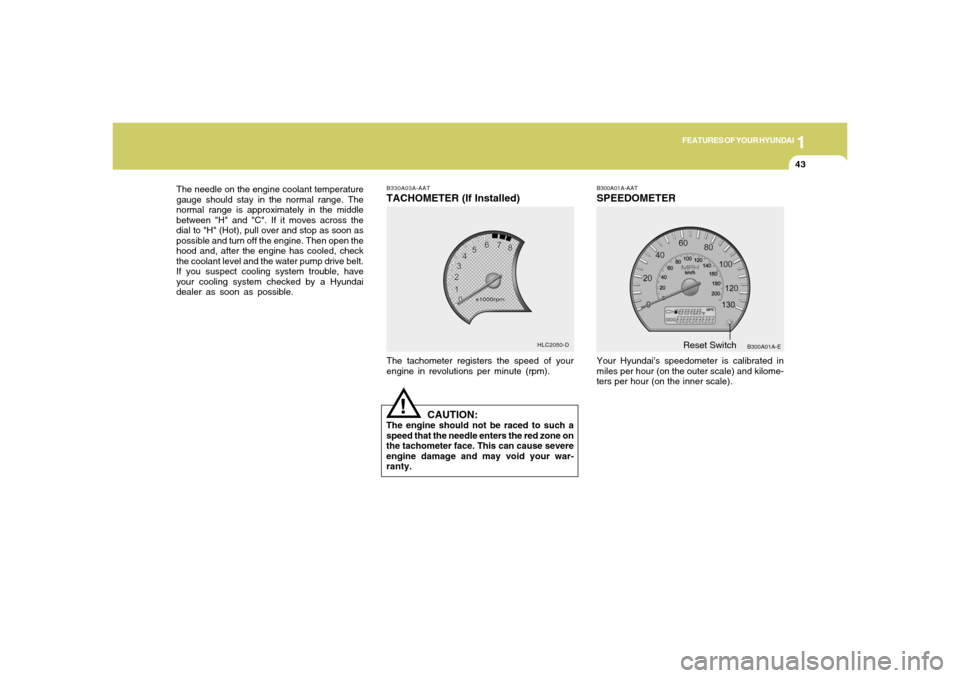
B330A03A-AATTACHOMETER (If Installed)The tachometer registers the speed of your
engine in revolutions per minute (rpm).
B300A01A-AATSPEEDOMETERYour Hyundai's speedometer is calibrated in
miles per hour (on the outer scale) and kilome-
ters per hour (on the inner scale).
B300A01A-E HLC2050-D
Reset Switch
CAUTION:
The engine should not be raced to such a
speed that the needle enters the red zone on
the tachometer face. This can cause severe
engine damage and may void your war-
ranty.
!
The needle on the engine coolant temperature
gauge should stay in the normal range. The
normal range is approximately in the middle
between "H" and "C". If it moves across the
dial to "H" (Hot), pull over and stop as soon as
possible and turn off the engine. Then open the
hood and, after the engine has cooled, check
the coolant level and the water pump drive belt.
If you suspect cooling system trouble, have
your cooling system checked by a Hyundai
dealer as soon as possible.
Page 109 of 219
DRIVING YOUR HYUNDAI
32
TO START THE ENGINE
BEFORE STARTING THE ENGINEC020A01A-AATBefore you start the engine, you should al-
ways:
1. Look around the vehicle to be sure there
are no flat tires, puddles of oil or water or
other indications of possible trouble.
2. After entering the car, check to be sure the
parking brake is engaged.
3. Check that all windows, and lights are clean.
4. Check that the interior and exterior mirrors
are clean and in position.
5. Check your seat, seatback and headrest to
be sure they are in their proper positions.
6. Lock all the doors.
7. Fasten your seat belt and be sure that all
other occupants have fastened theirs.
8. Turn off all lights and accessories that are
not needed.
9. When you turn the ignition switch to "ON",
check that all appropriate warning lights are
operating and that you have sufficient fuel.
10. Check the operation of warning lights and all
bulbs when key is in the "ON" position.
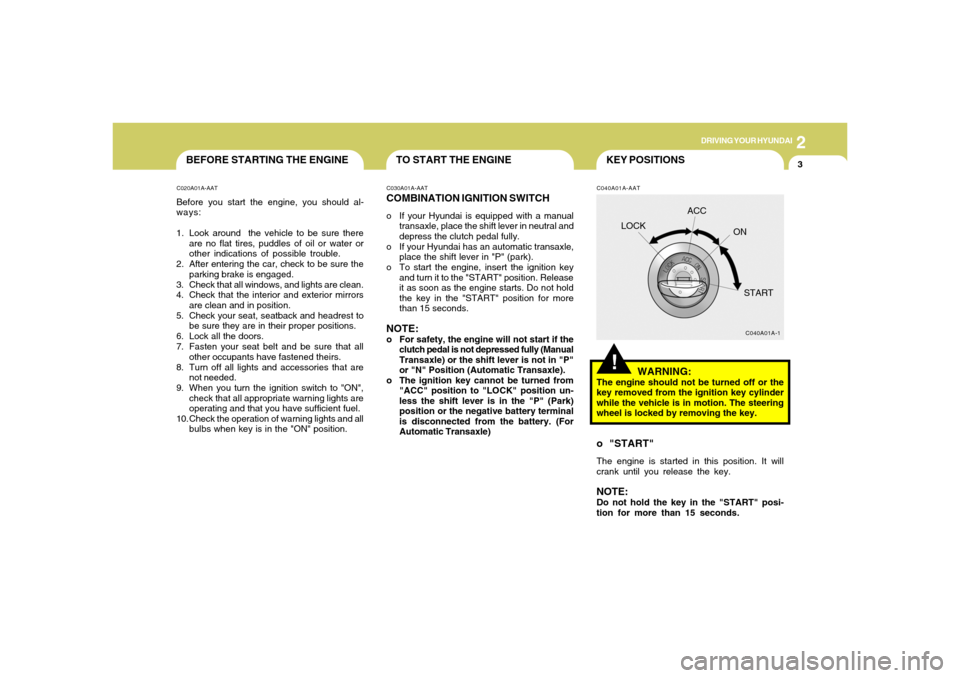
C030A01A-AATCOMBINATION IGNITION SWITCHo If your Hyundai is equipped with a manual
transaxle, place the shift lever in neutral and
depress the clutch pedal fully.
o If your Hyundai has an automatic transaxle,
place the shift lever in "P" (park).
o To start the engine, insert the ignition key
and turn it to the "START" position. Release
it as soon as the engine starts. Do not hold
the key in the "START" position for more
than 15 seconds.NOTE:o For safety, the engine will not start if the
clutch pedal is not depressed fully (Manual
Transaxle) or the shift lever is not in "P"
or "N" Position (Automatic Transaxle).
o The ignition key cannot be turned from
"ACC" position to "LOCK" position un-
less the shift lever is in the "P" (Park)
position or the negative battery terminal
is disconnected from the battery. (For
Automatic Transaxle)
C040A01A-AAT
C040A01A-1
LOCKACC
ON
START
WARNING:
The engine should not be turned off or the
key removed from the ignition key cylinder
while the vehicle is in motion. The steering
wheel is locked by removing the key.o "START"The engine is started in this position. It will
crank until you release the key.NOTE:Do not hold the key in the "START" posi-
tion for more than 15 seconds.
!KEY POSITIONS
Page 111 of 219
DRIVING YOUR HYUNDAI
52
OPERATING THE MANUAL
TRANSAXLE
4. Turn the ignition key to the "Start" position
and release it when the engine starts.
After the engine has started, allow the engine
to run for 10 to 20 seconds prior to placing
the vehicle in gear.
The starter should not be operated for more
than 15 seconds at a time. Wait 15-30 sec-
onds between starting attempts to protect
the starter from overheating.
C050B01A-AATNormal Conditions:The Starting Procedure:
1. Insert key, and fasten the seat belt.
2. Depress the clutch pedal fully and place the
gearshift lever (manual transaxle) in neutral
or the selector lever (automatic transaxle) in
"P" (park) position.
3. After turning the ignition key to the "ON"
position, make certain all warning lights and
gauges are functioning properly before start-
ing the engine.
WARNING:
Be sure that the clutch is fully depressed
when starting a manual transaxle vehicle.
Your manual transaxle equipped vehicle will
not start unless the clutch pedal is fully
depressed. On a manual transaxle equipped
vehicle that can be started without depress-
ing the clutch, there is the potential to cause
damage to the vehicle or injury to someone
inside or outside the vehicle as a result of
the forward or backward movement of the
vehicle that will occur if the clutch is not
depressed when the vehicle is started.
!
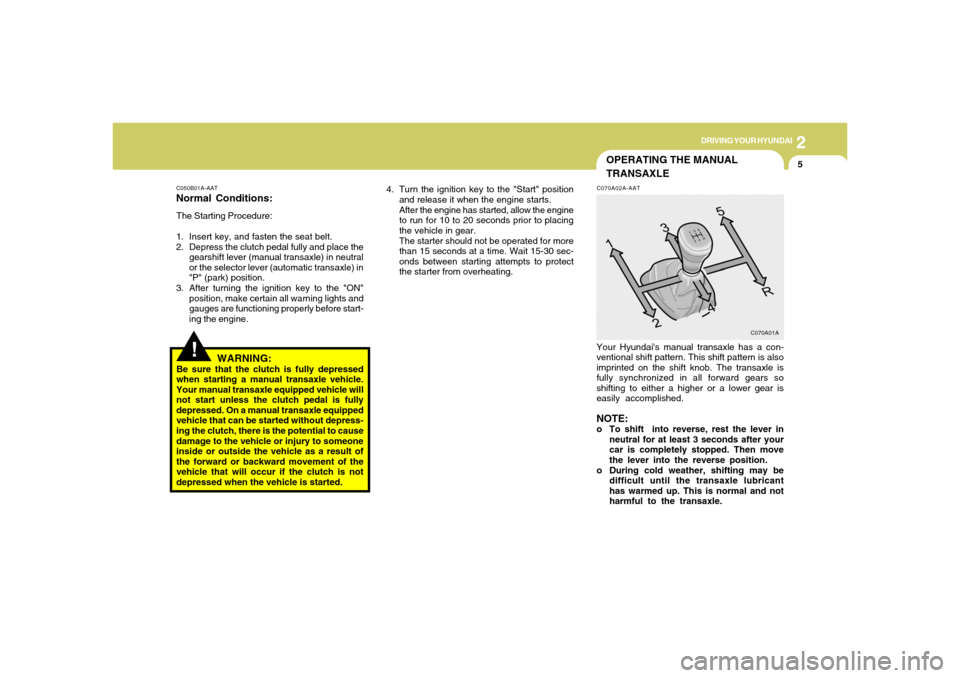
C070A02A-AATYour Hyundai's manual transaxle has a con-
ventional shift pattern. This shift pattern is also
imprinted on the shift knob. The transaxle is
fully synchronized in all forward gears so
shifting to either a higher or a lower gear is
easily accomplished.NOTE:o To shift into reverse, rest the lever in
neutral for at least 3 seconds after your
car is completely stopped. Then move
the lever into the reverse position.
o During cold weather, shifting may be
difficult until the transaxle lubricant
has warmed up. This is normal and not
harmful to the transaxle.
C070A01A
Page 113 of 219
DRIVING YOUR HYUNDAI
72
AUTOMATIC TRANSAXLE
!
WARNING:
o Avoid high cornering speeds.
o Do not make quick steering wheel move-
ments, such as sharp lane changes or
fast, sharp turns.
o Always wear your seat belts.
In a collision crash, un unbelted person
is significantly more likely to die than a
person wearing a seatbelt.
o The risk of rollover is greatly increased
if you lose control of your vehicle at
highway speeds.
o Loss of control often occurs if two or
more wheels drop off the roadway and
the driver oversteers to reenter the road-
way.
o In the event your vehicle leaves the
roadway, do not steer sharply. Instead,
slow down before pulling back into the
travel lanes.
o Never exceed posted speed limits.
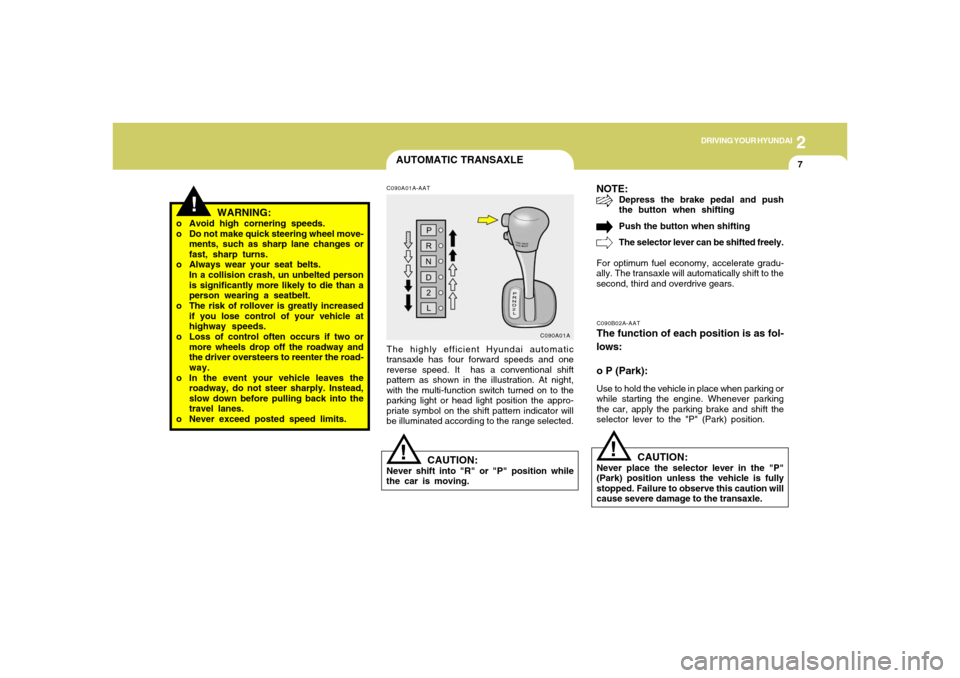
C090A01A-AATThe highly efficient Hyundai automatic
transaxle has four forward speeds and one
reverse speed. It has a conventional shift
pattern as shown in the illustration. At night,
with the multi-function switch turned on to the
parking light or head light position the appro-
priate symbol on the shift pattern indicator will
be illuminated according to the range selected.
CAUTION:
Never shift into "R" or "P" position while
the car is moving.
C090A01A
!
C090B02A-AATThe function of each position is as fol-
lows:
o P (Park):Use to hold the vehicle in place when parking or
while starting the engine. Whenever parking
the car, apply the parking brake and shift the
selector lever to the "P" (Park) position.NOTE:
Depress the brake pedal and push
the button when shifting
Push the button when shifting
The selector lever can be shifted freely.
For optimum fuel economy, accelerate gradu-
ally. The transaxle will automatically shift to the
second, third and overdrive gears.
CAUTION:
Never place the selector lever in the "P"
(Park) position unless the vehicle is fully
stopped. Failure to observe this caution will
cause severe damage to the transaxle.
!