belt Hyundai Accent 2005 Service Manual
[x] Cancel search | Manufacturer: HYUNDAI, Model Year: 2005, Model line: Accent, Model: Hyundai Accent 2005Pages: 219, PDF Size: 7.07 MB
Page 156 of 219
Engine Compartment .................................................... 6-2
General Checks ............................................................ 6-3
Checking the Engine Oil ............................................... 6-4
Changing the Oil and Filter ........................................... 6-5
Checking and Changing the Engine Coolant ............... 6-6
Spark Plugs .................................................................. 6-8
Changing the Air Cleaner Filter ..................................6-10
Checking the Transaxle Oil (manual) .........................6-11
Checking the Transaxle Fluid (Automatic) .................6-12
Checking the Brakes ..................................................6-14
Checking the Clutch Fluid ..........................................6-15
Air Conditioning Care .................................................6-15
Changing the Air Conditioner Filter
(For Evaporator and Blower Unit) ..............................6-16
Checking Drive Belts ..................................................6-19
Checking and Replacing Fuses .................................6-19
Power Steering Fluid Level ........................................6-22
Replacement of Bulbs ................................................6-25
Bulb Wattages ............................................................6-31
Fuse Panel Description ..............................................6-32
Do-It-Yourself Maintenance
6
6
Page 158 of 219
6
DO-IT-YOURSELF MAINTENANCE
3
GENERAL CHECKS
G020C01A-AATVehicle InteriorThe following should be checked each time
when the vehicle is driven:
o Light operation
o Windshield wiper operation
o Horn operation
o Defroster, heater system operation (and air
conditioning, if installed)
o Steering operation and condition
o Mirror condition and operation
o Turn signal operation
o Accelerator pedal operation
o Brake operation, including parking brake
o Manual transaxle operation, including clutch
operation
o Automatic transaxle operation, including
"Park" mechanism operation
o Seat control condition and operation
o Seat belt condition and operation
o Sun visor operation
If you notice anything that does not operate
correctly or appear to be functioning correctly,
inspect it carefully and seek assistance from
your Hyundai dealer if service is needed.
G020A01A-AATEngine Compartment
The following should be checked regularly:
o Engine oil level and condition
o Transaxle fluid level and condition
o Brake fluid level
o Clutch fluid level
o Engine coolant level
o Windshield washer fluid level
o Accessory drive belt condition
o Engine coolant hose condition
o Fluid leaks (on or below components)
o Power steering fluid level and condition
o Battery Condition
o Air filter condition
G020B01A-AATVehicle ExteriorThe following should be checked monthly:
o Overall appearance and condition
o Wheel condition and wheel nut tightness
o Exhaust system condition
o Light condition and operation
o Windshield glass condition
o Wiper blade condition
o Paint condition and body corrosion
o Fluid leaks
o Door and hood lock condition
o Tire pressure and condition
(including spare tire)
Page 171 of 219
6
DO-IT-YOURSELF MAINTENANCE
16
CHANGING THE AIR CONDITIONER
FILTER
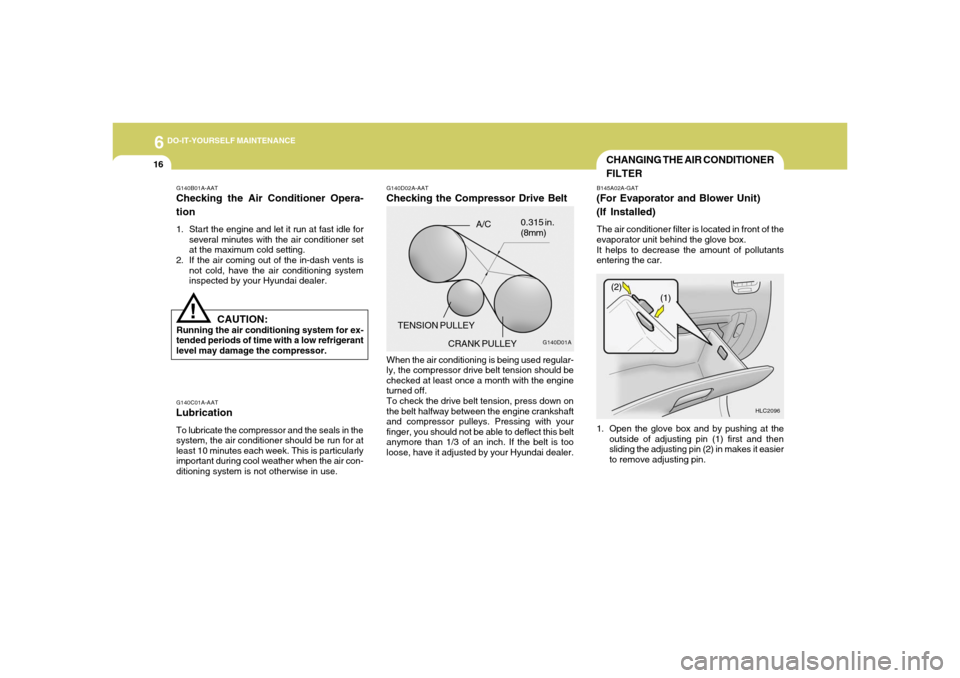
G140D02A-AATChecking the Compressor Drive BeltWhen the air conditioning is being used regular-
ly, the compressor drive belt tension should be
checked at least once a month with the engine
turned off.
To check the drive belt tension, press down on
the belt halfway between the engine crankshaft
and compressor pulleys. Pressing with your
finger, you should not be able to deflect this belt
anymore than 1/3 of an inch. If the belt is too
loose, have it adjusted by your Hyundai dealer.CRANK PULLEY
G140D01A
A/C
TENSION PULLEY0.315 in.
(8mm)
HLC2096 B145A02A-GAT
(For Evaporator and Blower Unit)
(If Installed)The air conditioner filter is located in front of the
evaporator unit behind the glove box.
It helps to decrease the amount of pollutants
entering the car.
1. Open the glove box and by pushing at the
outside of adjusting pin (1) first and then
sliding the adjusting pin (2) in makes it easier
to remove adjusting pin.
G140C01A-AATLubricationTo lubricate the compressor and the seals in the
system, the air conditioner should be run for at
least 10 minutes each week. This is particularly
important during cool weather when the air con-
ditioning system is not otherwise in use.G140B01A-AATChecking the Air Conditioner Opera-
tion1. Start the engine and let it run at fast idle for
several minutes with the air conditioner set
at the maximum cold setting.
2. If the air coming out of the in-dash vents is
not cold, have the air conditioning system
inspected by your Hyundai dealer.
CAUTION:
Running the air conditioning system for ex-
tended periods of time with a low refrigerant
level may damage the compressor.
!
(1) (2)
Page 174 of 219
6
DO-IT-YOURSELF MAINTENANCE
19
CHECKING AND REPLACING
FUSES
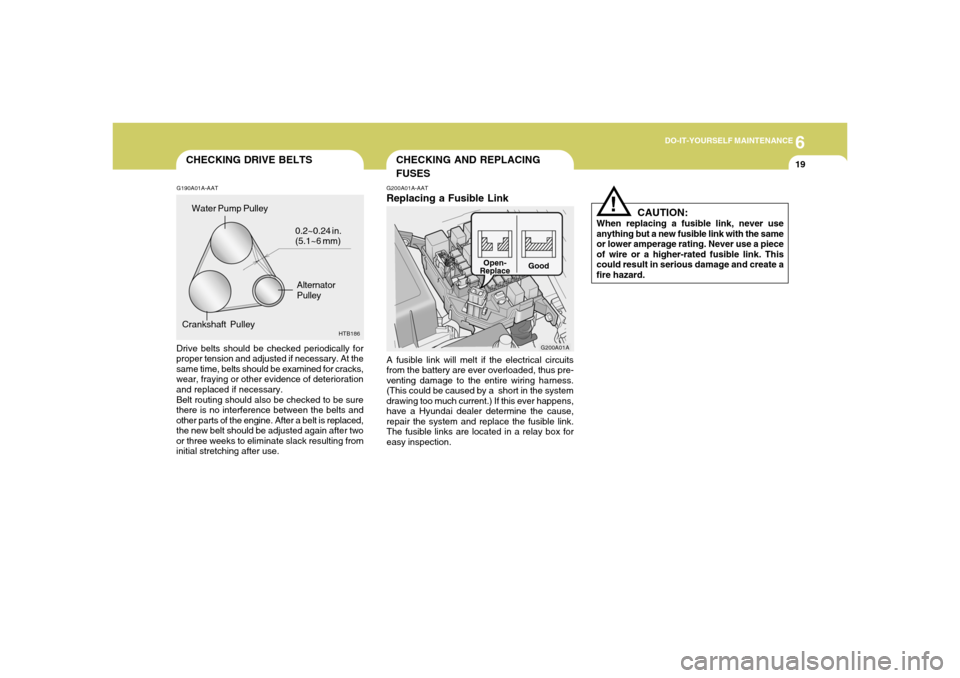
CHECKING DRIVE BELTSG190A01A-AATDrive belts should be checked periodically for
proper tension and adjusted if necessary. At the
same time, belts should be examined for cracks,
wear, fraying or other evidence of deterioration
and replaced if necessary.
Belt routing should also be checked to be sure
there is no interference between the belts and
other parts of the engine. After a belt is replaced,
the new belt should be adjusted again after two
or three weeks to eliminate slack resulting from
initial stretching after use.
Water Pump Pulley
Alternator
Pulley
Crankshaft Pulley0.2~0.24 in.
(5.1~6 mm)
HTB186G200A01A-AAT
Replacing a Fusible LinkA fusible link will melt if the electrical circuits
from the battery are ever overloaded, thus pre-
venting damage to the entire wiring harness.
(This could be caused by a short in the system
drawing too much current.) If this ever happens,
have a Hyundai dealer determine the cause,
repair the system and replace the fusible link.
The fusible links are located in a relay box for
easy inspection.
G200A01A
Open-
ReplaceGood
CAUTION:
When replacing a fusible link, never use
anything but a new fusible link with the same
or lower amperage rating. Never use a piece
of wire or a higher-rated fusible link. This
could result in serious damage and create a
fire hazard.
!
Page 189 of 219
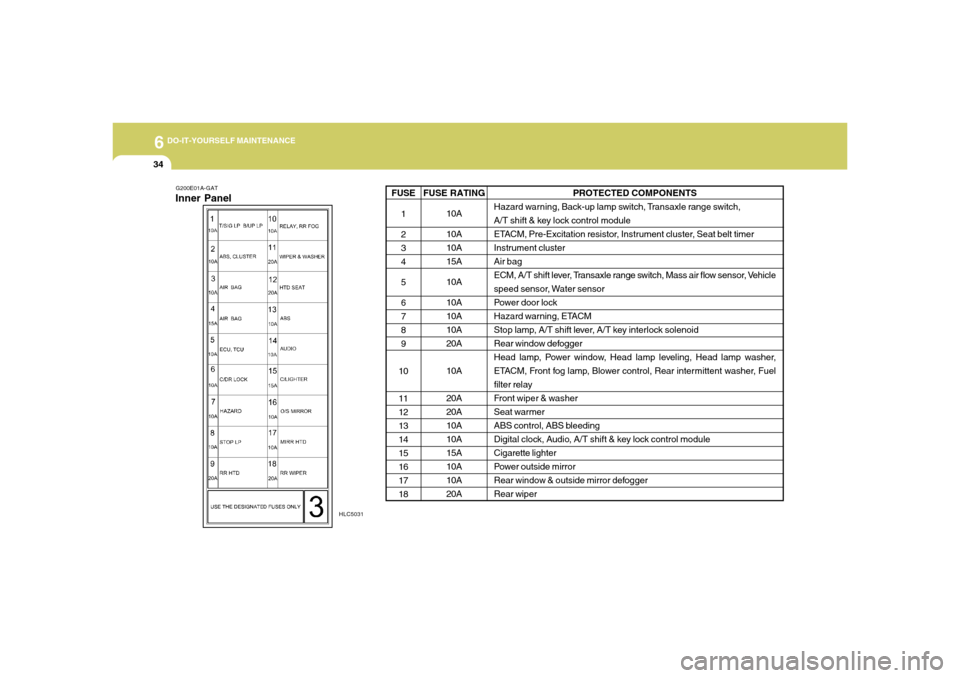
6
DO-IT-YOURSELF MAINTENANCE
34
G200E01A-GATInner Panel
HLC5031
PROTECTED COMPONENTS
Hazard warning, Back-up lamp switch, Transaxle range switch,
A/T shift & key lock control module
ETACM, Pre-Excitation resistor, Instrument cluster, Seat belt timer
Instrument cluster
Air bag
ECM, A/T shift lever, Transaxle range switch, Mass air flow sensor, Vehicle
speed sensor, Water sensor
Power door lock
Hazard warning, ETACM
Stop lamp, A/T shift lever, A/T key interlock solenoid
Rear window defogger
Head lamp, Power window, Head lamp leveling, Head lamp washer,
ETACM, Front fog lamp, Blower control, Rear intermittent washer, Fuel
filter relay
Front wiper & washer
Seat warmer
ABS control, ABS bleeding
Digital clock, Audio, A/T shift & key lock control module
Cigarette lighter
Power outside mirror
Rear window & outside mirror defogger
Rear wiper
FUSE RATING
10A
10A
10A
15A
10A
10A
10A
10A
20A
10A
20A
20A
10A
10A
15A
10A
10A
20A FUSE
1
2
3
4
5
6
7
8
9
10
11
12
13
14
15
16
17
18
Page 198 of 219

8
CONSUMER INFORMATION, REPORTING SAFETY DEFECTS & BINDING ARBITRATION OF WARRANTY CLAIMS6
1. Manufacturer or Brand name
o Manufacturer or Brand name is
shown.
2. Tire size (example: P175/70R13)
o The "P" indicates the tire is de-
signed for passenger vehicles. A
"T" is the designation for a tempo-
rary spare tire.
o Three-digit number (175): This
number gives the width in millime-
ters of the tire from sidewall edge
to sidewall edge.
o Two-digit number (70): This num-
ber, known as the aspect ratio,
gives the tire's ratio of height to
width.
o R: The "R" stands for radial.
o Two-digit number (13): This num-
ber is the wheel or rim diameter in
inches.
o Two (or three) digit number (82):
This number is the tire's load in-
dex. It is a measurement of how
much weight each tire can sup-
port.o T: Speed Rating. The speed rat-
ing denotes the speed at which a
tire is designed to be driven for
extended periods of time. The
ratings range from "A" to "Z" (98
to 186 MPH).
3. TIN (Tire Identification Number) for
new tire (example: DOT XX XX
XXX XXXX)
o DOT: Abbreviation for the "De-
partment of Transportation". The
symbol can be placed above, be-
low or to the left or right of the Tire
Iden tification Number. In-
dicates tire is in compliance with
the U.S. Department of
Transportation Motor Vehicle
Safety Standards.
o 1st two-digit code: Manufacturer's
identification mark
o 2nd two-digit code: Tire size
o 3rd three-digit code: Tire type code
(Optional)
o 4th four-digit code: Date of Manu-
factureo Four numbers represent the week
and year the tire was built. For
example, the numbers 3104
means the 31st week of 2004.
4. Tire ply composition and mate-
rial
The number of layers or plies of
rubbercoated fabric in the tire. Tire
manufacturers also must indicate
the materials in the tire, which in-
clude steel, nylon, polyester, and
others. The letter "R" means radial
ply construction; the letter "D" means
diagonal or bias ply construction;
and the letter "B" means belted-bias
ply construction.
5. Maximum permissible inflation
pressure
This number is the greatest amount
of air pressure that should be put in
the tire. Do not exceed the maxi-
mum permissible inflation pressure.
Refer to the Tire and Loading Infor-
mation label for recommended infla-
tion pressure.
Page 199 of 219

8
CONSUMER INFORMATION, REPORTING SAFETY DEFECTS & BINDING ARBITRATION OF WARRANTY CLAIMS
7
6. Maximum load rating
This number indicates the maxi-
mum load in kilograms and pounds
that can be carried by the tire. When
replacing the tires on the vehicle,
always use a tire that has the same
load rating as the factory installed
tire.
7. Uniform Tire Quality Grading
(UTQG):
Tire manufacturers are required to
grade tires based on three perfor-
mance factors: treadwear, traction
and temperature resistance. For
more information, see Uniform Tire
Quality Grading on page 8-13.
I030D01JM-AATTIRE TERMINOLOGY AND DEFINI-
TIONS
Air Pressure: The amount of air inside
the tire pressing outward on the tire.
Air pressure is expressed in pounds
per square inch (psi) or kilopascal
(kPa).
Accessory Weight: This means the
combined weight of optional accesso-
ries. Some examples of optional ac-
cessories are, automatic transmission,
power seats, and air conditioning.
Aspect Ratio: The relationship of a
tire's height to its width.
Belt: A rubber coated layer of cords
that is located between the plies and
the tread. Cords may be made from
steel or other reinforcing materials.
Bead: The tire bead contains steel
wires wrapped by steel cords that hold
the tire onto the rim.
Bias Ply Tire: A pneumatic tire in
which the plies are laid at alternate
angles less than 90 degrees to the
centerline of the tread.Cold Tire Pressure: The amount of
air pressure in a tire, measured in
pounds per square inch (psi) or
kilopascals (kPa) before a tire has
built up heat from driving.
Curb Weight: This means the weight
of a motor vehicle with standard and
optional equipment including the maxi-
mum capacity of fuel, oil and coolant,
but without passengers and cargo.
DOT Markings: A code molded into
the sidewall of a tire signifying that the
tire is in compliance with the U.S.
Department of Transportation motor
vehicle safety standards. The DOT
code includes the Tire Identification
Number (TIN), an alphanumeric desig-
nator which can also identify the tire
manufacturer, production plant, brand
and date of production.
GVWR: Gross Vehicle Weight Rating
GAWR FRT: Gross Axle Weight Rat-
ing for the front Axle.
GAWR RR: Gross Axle Weight Rating
for the rear axle.
Page 215 of 219

10
INDEX
3
D
Defrosting/Defogging.......................................................................1-72
Door
Central door lock .......................................................................... 1-6
Door locks.................................................................................... 1-4
Locking, unlocking front door with a key ................................... 1-4
Drink Holder.....................................................................................1-53
Drive Belts........................................................................................6-19
Driving
Economical driving......................................................................2-12
Smooth cornering.......................................................................2-13
Winter driving..............................................................................2-13
Dual-Stage Supplemental Restraint (AIRBAG) System ................1-30
E
Emission Control Systems................................................................ 7-1
Engine
Before starting the engine ............................................................ 2-3
Compartment (For 1.6 DOHC) ................................................... 6-2
Coolant.......................................................................................... 6-6
Coolant temperature gauge .......................................................1-42
If the engine overheats ................................................................ 3-4
Number.......................................................................................... 8-2
Oil .................................................................................................. 6-4
Starting.......................................................................................... 2-4
Engine Exhaust Can Be Dangerous ................................................ 2-2F
Fan Speed Control (Blower Control)..............................................1-66
Fog Light
Front............................................................................................1-51
Front Seats
Adjustable front seats ................................................................1-11
Adjustable headrests..................................................................1-12
Adjusting seatback angle ...........................................................1-11
Adjusting seatback forward and rearward...............................1-11
Lumbar support control ..............................................................1-13
Seat cushion height adjustment................................................1-13
Seat pocket.................................................................................1-55
Fuel
Capacity........................................................................................ 9-2
Gauge..........................................................................................1-42
Recommendations........................................................................ 1-2
Fuel Filler Lid
Remote release..........................................................................1-60
Fuses ......................................................................................................
6-19
G
General Checks................................................................................ 6-3
Glove box.........................................................................................1-55
H
Hazard Warning System .................................................................1-50
Page 216 of 219

10
INDEX
4
Maintenance under severe usage conditions ................................ 5-6
Scheduled maintenance................................................................. 5-4
Service requirements ..................................................................... 5-2
Mirrors
Day/night inside rearview.............................................................1-58
Outside rear view ........................................................................1-56
O
Odometer/Trip Odometer..................................................................1-44
P
Parking Brake...................................................................................1-58
Power Steering Fluid Level ...............................................................6-22
Pretensioner Seat Belt ......................................................................1-28
R
Rear Seats
Folding seatbacks........................................................................1-15
Rear seat entry ............................................................................1-13
Rear Window Defroster Switch .........................................................1-51
Rear Window Wiper and Washer.....................................................1-49
Replacement of Bulbs .......................................................................6-24
S
Seat Belts
2-Point static type ........................................................................1-21
3-Point type..................................................................................1-19
Adjusting your seat belt ...............................................................1-20
Adjutable height...........................................................................1-18
Care of seat belts ........................................................................1-18 Headlight Bulb..................................................................................6-25
Heating and Ventilation
Air flow control ............................................................................1-67
Air intake control.........................................................................1-66
Bi-level heating............................................................................1-69
Defrosting/Defogging ..................................................................1-72
Fan seed control (Blower control)............................................1-66
Temperature control...................................................................1-69
High-Mounted Rear Stop Light .......................................................1-58
Hood Release..................................................................................1-59
Horn................................................................................................1-64
I
Ignition Switch..................................................................................... 2-3
Instrument Cluster and Indicator Lights............................................
1-39
Instrument Panel Light Control (Rheostat).......................................1-50
Interior Light ......................................................................................1-54
J
Jump Starting...................................................................................... 3-3
K
Keys .................................................................................................. 1-3
If you lose your keys...................................................................3-14
Positions........................................................................................ 2-3
M
Maintenance Intervals
Explanation of scheduled maintenance items .............................. 5-7