tire Hyundai Accent 2005 Owner's Guide
[x] Cancel search | Manufacturer: HYUNDAI, Model Year: 2005, Model line: Accent, Model: Hyundai Accent 2005Pages: 219, PDF Size: 7.07 MB
Page 199 of 219

8
CONSUMER INFORMATION, REPORTING SAFETY DEFECTS & BINDING ARBITRATION OF WARRANTY CLAIMS
7
6. Maximum load rating
This number indicates the maxi-
mum load in kilograms and pounds
that can be carried by the tire. When
replacing the tires on the vehicle,
always use a tire that has the same
load rating as the factory installed
tire.
7. Uniform Tire Quality Grading
(UTQG):
Tire manufacturers are required to
grade tires based on three perfor-
mance factors: treadwear, traction
and temperature resistance. For
more information, see Uniform Tire
Quality Grading on page 8-13.
I030D01JM-AATTIRE TERMINOLOGY AND DEFINI-
TIONS
Air Pressure: The amount of air inside
the tire pressing outward on the tire.
Air pressure is expressed in pounds
per square inch (psi) or kilopascal
(kPa).
Accessory Weight: This means the
combined weight of optional accesso-
ries. Some examples of optional ac-
cessories are, automatic transmission,
power seats, and air conditioning.
Aspect Ratio: The relationship of a
tire's height to its width.
Belt: A rubber coated layer of cords
that is located between the plies and
the tread. Cords may be made from
steel or other reinforcing materials.
Bead: The tire bead contains steel
wires wrapped by steel cords that hold
the tire onto the rim.
Bias Ply Tire: A pneumatic tire in
which the plies are laid at alternate
angles less than 90 degrees to the
centerline of the tread.Cold Tire Pressure: The amount of
air pressure in a tire, measured in
pounds per square inch (psi) or
kilopascals (kPa) before a tire has
built up heat from driving.
Curb Weight: This means the weight
of a motor vehicle with standard and
optional equipment including the maxi-
mum capacity of fuel, oil and coolant,
but without passengers and cargo.
DOT Markings: A code molded into
the sidewall of a tire signifying that the
tire is in compliance with the U.S.
Department of Transportation motor
vehicle safety standards. The DOT
code includes the Tire Identification
Number (TIN), an alphanumeric desig-
nator which can also identify the tire
manufacturer, production plant, brand
and date of production.
GVWR: Gross Vehicle Weight Rating
GAWR FRT: Gross Axle Weight Rat-
ing for the front Axle.
GAWR RR: Gross Axle Weight Rating
for the rear axle.
Page 200 of 219

8
CONSUMER INFORMATION, REPORTING SAFETY DEFECTS & BINDING ARBITRATION OF WARRANTY CLAIMS8
Intended Outboard Sidewall: The
side of an asymmetrical tire, that must
always face outward when mounted on
a vehicle.
Kilopascal (kPa): The metric unit for
air pressure.
Load Index: An assigned number rang-
ing from 1 to 279 that corresponds to
the load carrying capacity of a tire.
Maximum Inflation Pressure: The
maximum air pressure to which a cold
tire may be inflated. The maximum air
pressure is molded onto the sidewall.
Maximum Load Rating: The load rat-
ing for a tire at the maximum permis-
sible inflation pressure for that tire.
Maximum Loaded Vehicle Weight:
The sum of curb weight; accessory
weight; vehicle capacity weight; and
production options weight.
Normal Occupant Weight: The num-
ber of occupants a vehicle is designed
to seat multiplied by 150 pounds (68
kg).Occupant Distribution: Designated
seating positions.
Outward Facing Sidewall: The side
of a asymmetrical tire that has a par-
ticular side that faces outward when
mounted on a vehicle. The side of the
tire that contains a whitewall, bears
white lettering or bears manufacturer,
brand and or model name molding that
is higher or deeper than the same
moldings on the other sidewall of the
tire.
Passenger (P-Metric) Tire: A tire used
on passenger cars and some light duty
trucks and multipurpose vehicles.
Recommended Inflation Pressure:
Vehicle manufacturer's recommended
tire inflation pressure and shown on
the tire placard.
Radial Ply tire: A pneumatic tire in
which the ply cords that extend to the
beads are laid at 90 degrees to the
centerline of the tread.
Rim: A metal support for a tire and
upon which the tire beads are seated.Sidewall: The portion of a tire be-
tween the tread and the bead.
Speed Rating: An alphanumeric code
assigned to a tire indicating the maxi-
mum speed at which a tire can oper-
ate.
Traction: The friction between the tire
and the road surface. The amount of
grip provided.
Tread: The portion of a tire that comes
into contact with the road.
Treadwear Indicators: Narrow bands,
sometimes called "wear bars," that
show across the tread of a tire when
only 2/32 inch of tread remains.
UTQGS: Uniform Tire Quality Grading
Standards, a tire information system
that provides consumers with ratings
for a tire's traction, temperature and
treadwear. Ratings are determined by
tire manufacturers using government
testing procedures. The ratings are
molded into the sidewall of the tire.
Page 201 of 219

8
CONSUMER INFORMATION, REPORTING SAFETY DEFECTS & BINDING ARBITRATION OF WARRANTY CLAIMS
9
Vehicle Capacity Weight: The num-
ber of designated seating positions
multiplied by 150 lbs. (68 kg) plus the
rated cargo and luggage load
Vehicle Maximum Load on the Tire:
Load on an individual tire due to curb
and accessory weight plus maximum
occupant and cargo weight.
Vehicle Normal Load on the Tire:
That load on an individual tire that is
determined by distributing to each axle
its share of the curb weight, accessory
weight, and normal occupant weight
and driving by 2.
Vehicle Placard: A label permanently
attached to a vehicle showing the origi-
nal equipment tire size and recom-
mended inflation pressure
I040A01O-AATSNOW TIRES
If you equip your car with snow tires,
they should be the same size and
have the same load capacity as the
original tires. Snow tires should be
installed on all four wheels; otherwise,
poor handling may result.
Snow tires should carry 4 psi (28 kPa)
more air pressure than the pressure
recommended for the standard tires on
the tire label on the driver's side of the
center pillar , or up to the maximum
pressure shown on the tire sidewall
whichever is less.
Do not drive faster than 75 mph (120
km/h) when your car is equipped with
snow tires.
I040B01JM-AATALL SEASON TIRES
Hyundai specifies all season tires on
some models to provide good perfor-
mance for use all year round, including
snowy and icy road conditions. All sea-
son tires are identified by ALL SEA-
SON and/or M+S (Mud and Snow) on
the tire sidewall. Snow tires have better
snow traction than all season tires an
may be more appropriate in some ar-
eas.I040C01JM-AATSUMMER TIRES
Hyundai specifies summer tires on
some models to provide superior per-
formance on dry roads. Summer tire
performance is substantrally reduced in
snow and ice. Summer tires do not
have the tire traction rating M+S (Mud
and Snow) on the tire side wall. if you
plan to operate your vehicle in snowy or
icy conditions. Hyundai recommends
the use of snow tires or all season tires
on all four wheels.
Page 202 of 219
8
CONSUMER INFORMATION, REPORTING SAFETY DEFECTS & BINDING ARBITRATION OF WARRANTY CLAIMS
10
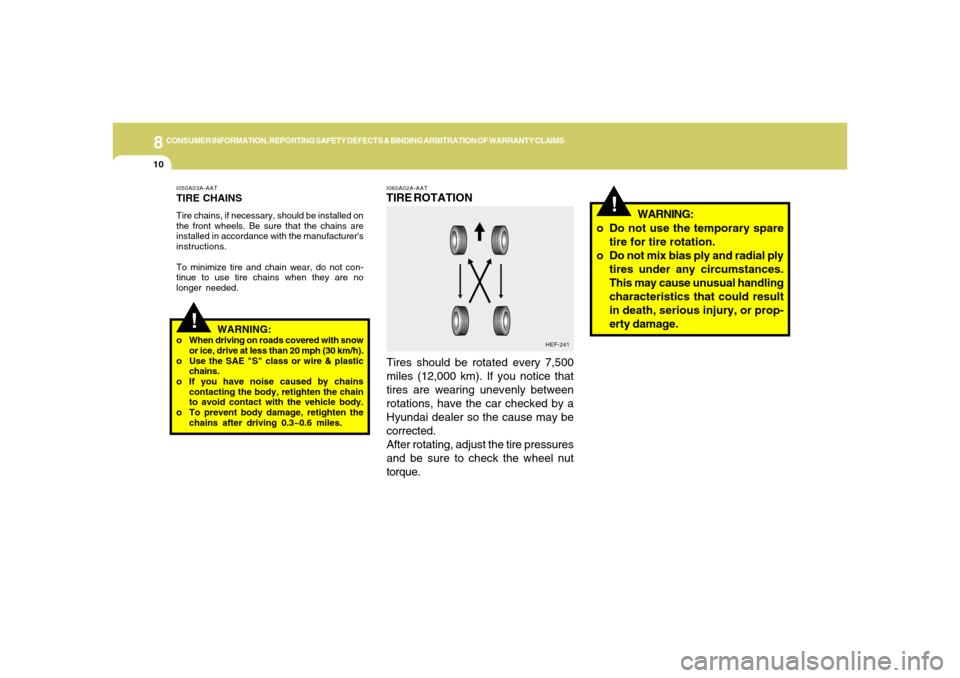
I060A02A-AATTIRE ROTATION
Tires should be rotated every 7,500
miles (12,000 km). If you notice that
tires are wearing unevenly between
rotations, have the car checked by a
Hyundai dealer so the cause may be
corrected.
After rotating, adjust the tire pressures
and be sure to check the wheel nut
torque.
HEF-241
!
I050A03A-AATTIRE CHAINSTire chains, if necessary, should be installed on
the front wheels. Be sure that the chains are
installed in accordance with the manufacturer's
instructions.
To minimize tire and chain wear, do not con-
tinue to use tire chains when they are no
longer needed.
WARNING:
o When driving on roads covered with snow
or ice, drive at less than 20 mph (30 km/h).
o Use the SAE "S" class or wire & plastic
chains.
o If you have noise caused by chains
contacting the body, retighten the chain
to avoid contact with the vehicle body.
o To prevent body damage, retighten the
chains after driving 0.3~0.6 miles.
!
WARNING:
o Do not use the temporary spare
tire for tire rotation.
o Do not mix bias ply and radial ply
tires under any circumstances.
This may cause unusual handling
characteristics that could result
in death, serious injury, or prop-
erty damage.
Page 203 of 219
8
CONSUMER INFORMATION, REPORTING SAFETY DEFECTS & BINDING ARBITRATION OF WARRANTY CLAIMS
11
I070A01A-AATTIRE BALANCING
A tire that is out of balance may affect
handling and tire wear. The tires on
your Hyundai were balanced before
the car was delivered but may need
balancing again during the years you
own the car.
Whenever a tire is dismounted for
repair, it should be rebalanced before
being reinstalled
on the car.I080A01A-AATTIRE TRACTION
Tire traction can be reduced if you
drive on worn tires, tires that are im-
properly inflated or on slippery road
surfaces. Tires should be replaced
when tread wear indicators appear. To
reduce the possibility of losing control,
slow down whenever there is rain,
snow or ice on the road.
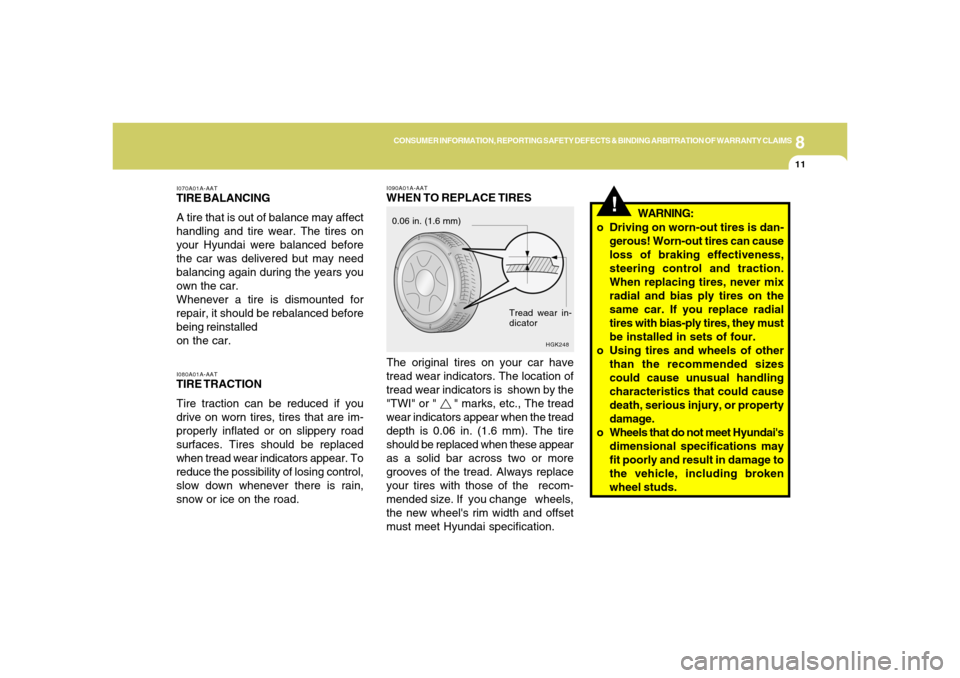
I090A01A-AATWHEN TO REPLACE TIRES
Tread wear in-
dicator 0.06 in. (1.6 mm)
HGK248
The original tires on your car have
tread wear indicators. The location of
tread wear indicators is shown by the
"TWI" or " " marks, etc., The tread
wear indicators appear when the tread
depth is 0.06 in. (1.6 mm). The tire
should be replaced when these appear
as a solid bar across two or more
grooves of the tread. Always replace
your tires with those of the recom-
mended size. If you change wheels,
the new wheel's rim width and offset
must meet Hyundai specification.
!
WARNING:
o Driving on worn-out tires is dan-
gerous! Worn-out tires can cause
loss of braking effectiveness,
steering control and traction.
When replacing tires, never mix
radial and bias ply tires on the
same car. If you replace radial
tires with bias-ply tires, they must
be installed in sets of four.
o Using tires and wheels of other
than the recommended sizes
could cause unusual handling
characteristics that could cause
death, serious injury, or property
damage.
o Wheels that do not meet Hyundai's
dimensional specifications may
fit poorly and result in damage to
the vehicle, including broken
wheel studs.
Page 204 of 219
8
CONSUMER INFORMATION, REPORTING SAFETY DEFECTS & BINDING ARBITRATION OF WARRANTY CLAIMS
12
WARRANTIES FOR YOUR HYUNDAI
VEHICLE
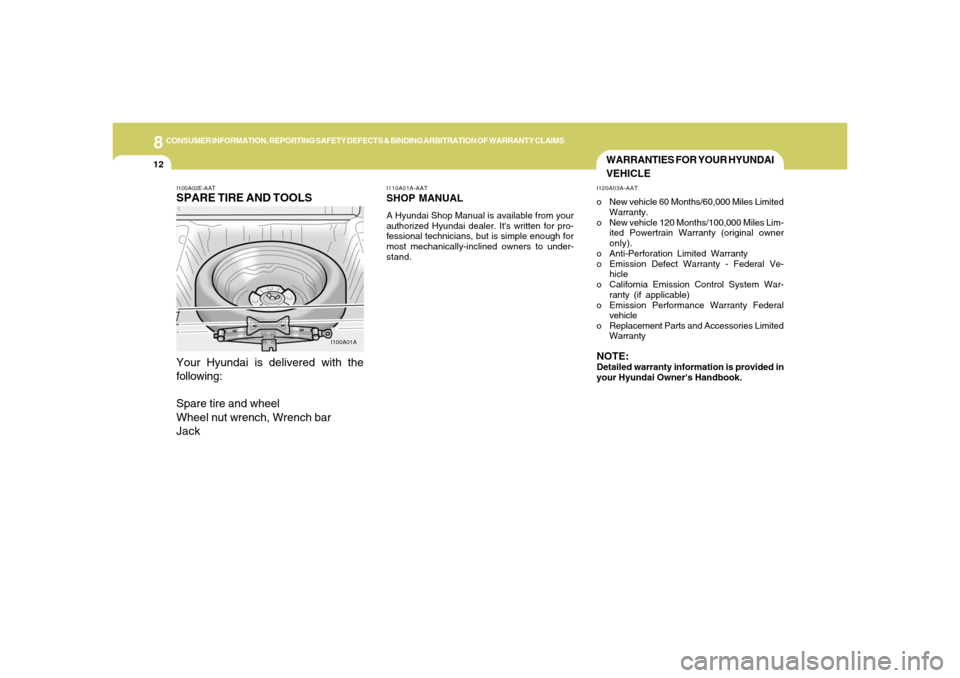
I100A02E-AATSPARE TIRE AND TOOLS
Your Hyundai is delivered with the
following:
Spare tire and wheel
Wheel nut wrench, Wrench bar
Jack
I100A01AI110A01A-AAT
SHOP MANUALA Hyundai Shop Manual is available from your
authorized Hyundai dealer. It's written for pro-
fessional technicians, but is simple enough for
most mechanically-inclined owners to under-
stand.
I120A03A-AATo New vehicle 60 Months/60,000 Miles Limited
Warranty.
o New vehicle 120 Months/100,000 Miles Lim-
ited Powertrain Warranty (original owner
only).
o Anti-Perforation Limited Warranty
o Emission Defect Warranty - Federal Ve-
hicle
o California Emission Control System War-
ranty (if applicable)
o Emission Performance Warranty Federal
vehicle
o Replacement Parts and Accessories Limited
WarrantyNOTE:Detailed warranty information is provided in
your Hyundai Owner's Handbook.
Page 205 of 219
8
CONSUMER INFORMATION, REPORTING SAFETY DEFECTS & BINDING ARBITRATION OF WARRANTY CLAIMS
13
CONSUMER INFORMATION
!
I130A01A-AATThis consumer information has been prepared
in accordance with regulations issued by the
National Highway Traffic Safety Administration
of the U.S. Department of Transportation. It
provides the purchasers and/or prospective
purchasers of Hyundai automobiles with infor-
mation on uniform tire quality grading. Your
Hyundai dealer will help answer any questions
you may have as you read this information.
I130B03A-AATTire Quality Grading
Department of Transportation quality
grades - All passenger vehicle tires
must conform to Federal Safety Stan-
dards in addition to these grades. These
quality grades are molded on the
sidewall.
Treadwear - The treadwear grade is a
comparative rating based on the wear
rate of the tire when tested under
controlled conditions on a specified
government test course. For example,
a tire graded 150 would wear one and
a half (1 - 1/2) times as well on the
government course as a tire graded
100. The relative performance of tires
depends upon the actual conditions of
their use, however, and may depart
significantly from the norm due to
variations in driving habits, service
practices and differences in road char-
acteristics and climate.Traction AA, A, B, C - The traction
grades, from highest to lowest, are
AA, A, B, and C. Those grades repre-
sent the tire's ability to stop on wet
pavement as measured under con-
trolled conditions on specified govern-
ment test surfaces of asphalt and
concrete. A tire marked C may have
poor traction performance.
WARNING:
The traction grade assigned to this
tire is based on straight-ahead brak-
ing traction tests, and does not in-
clude acceleration, cornering, hy-
droplaning, or peak traction charac-
teristics.
Page 206 of 219

8
CONSUMER INFORMATION, REPORTING SAFETY DEFECTS & BINDING ARBITRATION OF WARRANTY CLAIMS
14
Temperature A, B, C - The tempera-
ture grades are A (the highest), B, and
C, representing the tire's resistance to
the generation of heat and its ability to
dissipate heat when tested under con-
trolled conditions on a specified indoor
laboratory test wheel. Sustained high
temperature can cause the material of
the tire to degenerate and reduce tire
life, and excessive temperature can
lead to sudden tire failure. The grade C
corresponds to a level of performance
which all passenger car tires must
meet under the Federal Motor Vehicle
Safety Standard No. 109. Grades B
and A represent higher levels of perfor-
mance on the laboratory test wheel
than the minimum required by law.
!
WARNING:
The temperature grade for this tire
is established for a tire that is prop-
erly inflated and not overloaded.
Excessive speed, underinflation, or
excessive loading, either separately
or in combination, can cause heat
buildup and possible tire failure.
Uniform Tire Quality Grading - Qual-
ity grades can be found on the tire
sidewall between the tread shoulder
and the maximum section width.
For example:
Treadwear 200 Traction AA
Temperature A
I130D03A-AATHyundai motor vehicles are designed and
manufactured to meet or exceed all applicable
safety standards.
For your safety, however, we strongly urge
you to read and follow all directions in this
Owner's Manual, particularly the information
under the headings "NOTE", "CAUTION"
and "WARNING".
If, after reading this manual, you have any
questions regarding the operation of your vehi-
cle, please contact your nearest Hyundai Motor
America Regional Office as listed below:
Eastern Region : Connecticut, Delaware, Maine,
Maryland, Massachusetts, New Hampshire, New
Jersey, New York, Pennsylvanina, Rhode Is-
land, Vermont, Virginia, West Virginia.
Eastern Region
1100 Cranbury South River Road
Jamesburg, NJ 08831
(800) 633-5151
Page 210 of 219
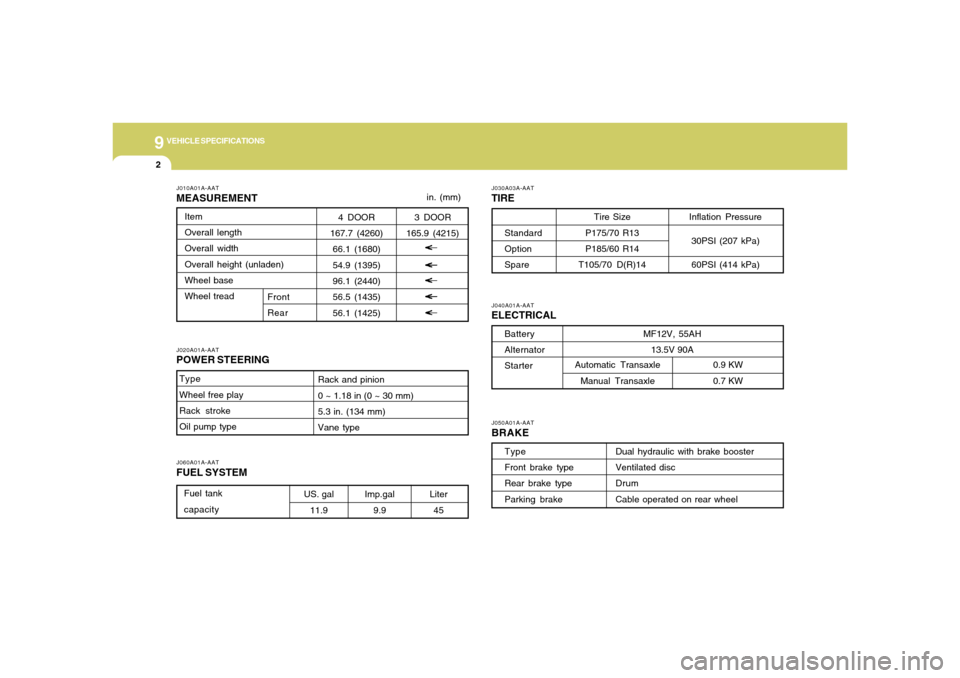
9
VEHICLE SPECIFICATIONS2
Tire Size
P175/70 R13
P185/60 R14
T105/70 D(R)14 in. (mm)
Liter
45Automatic Transaxle
Manual Transaxle
MF12V, 55AH
13.5V 90A
Dual hydraulic with brake booster
Ventilated disc
Drum
Cable operated on rear wheel
Standard
Option
Spare
US. gal
11.9 Fuel tank
capacityImp.gal
9.9Battery
Alternator
Starter0.9 KW
0.7 KW
Type
Front brake type
Rear brake type
Parking brake
Inflation Pressure
30PSI (207 kPa)
60PSI (414 kPa)
J010A01A-AATMEASUREMENTJ020A01A-AATPOWER STEERINGJ060A01A-AATFUEL SYSTEM
J040A01A-AATELECTRICALJ050A01A-AATBRAKEJ030A03A-AATTIRE
4 DOOR
167.7 (4260)
66.1 (1680)
54.9 (1395)
96.1 (2440)
56.5 (1435)
56.1 (1425) Item
Overall length
Overall width
Overall height (unladen)
Wheel base
Wheel tread
Front
Rear
3 DOOR
165.9 (4215)
Type
Wheel free play
Rack stroke
Oil pump type
Rack and pinion
0 ~ 1.18 in (0 ~ 30 mm)
5.3 in. (134 mm)
Vane type
Page 214 of 219

10
INDEX
2
CCare of Cassette tapes..................................................................1-91
Care of Disc .....................................................................................1-91
Cargo Area Cover ...........................................................................1-63
Catalytic Converter............................................................................ 7-3
Changing a flat tire ............................................................................ 3-7
Child-Protector Rear Door Look ....................................................... 1-5
Child Restraint System ....................................................................1-22
Installing a child restraint seat with the
"Tether Anchorage" system ....................................................1-24
Securing the child restraint seat with the "ISOFIX" system ...1-25
Cigarette Lighter..............................................................................1-52
Clock................................................................................................1-52
Clutch
Checking fluid.............................................................................6-15
Pedal free-play............................................................................6-18
Combination Light
Headlight flasher.........................................................................1-48
Headlight switch..........................................................................1-47
High-beam switch.......................................................................1-48
Lane change signal....................................................................1-47
Turn signal operation.................................................................1-47
Cooling Fans....................................................................................6-22
Corrosion Protection
Cleaning the interior..................................................................... 4-5
Protecting your Hyundai from corrosion.................................... 4-2
Washing and waxing.................................................................... 4-3 A
Airbag......................................................................................................
1-30
Air Cleaner Filter ..............................................................................6-10
Air Conditioner
Care.............................................................................................6-15
Filter.............................................................................................1-73
Operation.....................................................................................1-71
Antenna............................................................................................1-93
Ashtray.............................................................................................1-52
Audio Fault Code .............................................................................1-90
Audio System
Cassette tape player operation (H245)....................................1-82
Compact disc player operation (H265)....................................1-87
Stereo radio operation (H215, H245, H265) ........ 1-76, 1-79, 1-84
Automatic Transaxle.......................................................................... 2-7
Overdrive switch.......................................................................... 2-9
Shift lock release.......................................................................... 2-9
B
Battery..............................................................................................6-21
Bi-Level Heating...............................................................................1-69
Binding Arbitration............................................................................8-16
Brake
Anti-lock system.........................................................................2-11
Checking the brakes ..................................................................6-14
Fluid .............................................................................................6-14
Pedal clearance..........................................................................6-18
Pedal free-play............................................................................6-18
Practices.....................................................................................2-10
Breaking-In your new Hyundai ......................................................... 1-3