tire Hyundai Accent 2005 User Guide
[x] Cancel search | Manufacturer: HYUNDAI, Model Year: 2005, Model line: Accent, Model: Hyundai Accent 2005Pages: 219, PDF Size: 7.07 MB
Page 125 of 219
DRIVING YOUR HYUNDAI
192
Refer to your vehicle’s tire and loading
information label for specific informa-
tion about your vehicle’s capacity
weight and seating positions. The com-
bined weight of the driver, passengers
and cargo should never exceed your
vehicle’s capacity weight.
!
The label shows the maximum allow-
able weight of the fully loaded vehicle.
This is called the GVWR (Gross Ve-
hicle Weight Rating). The GVWR in-
cludes the weight of the vehicle, all
occupants, fuel and cargo.
This label also tells you the maximum
weights that can be supported by the
front and rear axles, called Gross Axle
Weight Rating (GAWR). To find out the
actual loads on your front and rear
axles, you need to go to a weigh
station and weigh your vehicle. Your
dealer can help you with this. Be sure
to spread out your load equally on both
sides of the centerline.WARNING:
o Never exceed the GVWR for your
vehicle, the GAWR for either the
front or rear axle and vehicle ca-
pacity weight. Exceeding these
ratings can cause an accident or
vehicle damage. You can calcu-
late the weight of your load by
weighing the items (or people)
before putting them in the ve-
hicle. Be careful not to overload
your vehicle.
o Do not load your vehicle any
heavier than the GVWR, either the
maximum front or rear GAWR and
vehicle capacity weight. If you
do, parts, including tires on your
vehicle can break, and it can
change the way your vehicle
handles and braking ability. This
could cause you to lose control
and crash. Also, overloading can
shorten the life of your vehicle.
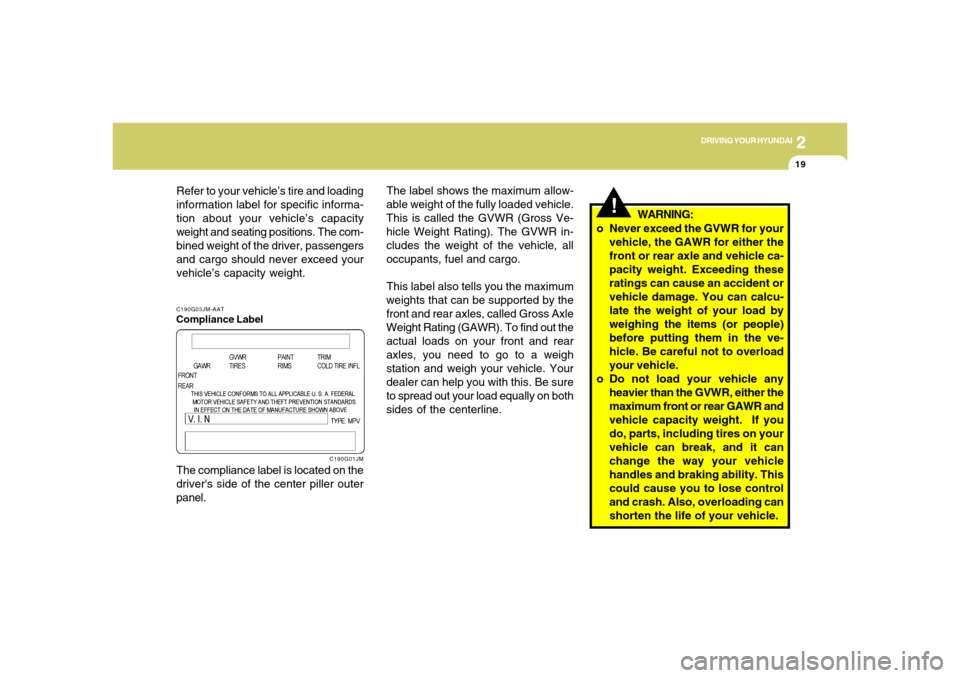
C190G03JM-AATCompliance LabelThe compliance label is located on the
driver's side of the center piller outer
panel.
C190G01JM
Page 126 of 219
2
DRIVING YOUR HYUNDAI
20
!
!
WARNING:
Items you carry inside your vehicle
can strike and injure people in a
sudden stop or turn, or in a crash.
o Put things in the cargo area of
your vehicle. Try to spread the
weight evenly.
o Never stack items, like suitcases,
inside the vehicle above the tops
of the seats.
o Do not leave an unsecured child
restraint in your vehicle.
o When you carry something in-
side the vehicle, secure it.
o Do not drive with a seat folded
down unless necessary. WARNING:
o Overloading your vehicle can
cause heat buildup in your
vehicle's tires and possible tire
failure that could lead to a crash.
o Overloading your vehicle can
cause increased stopping dis-
tances that could lead to a crash.
o A crash resulting from poor han-
dling vehicle damage, tire failure,
or increased stopping dis-
tances could result in serious
injury or death.The label will help you decide how
much cargo and installed equipment
your vehicle can carry.
If you carry items inside your vehicle
– like suitcases, tools, packages, or
anything else – they more as fast as
the vehicle goes. If you have to stop or
turn quickly, or if there is a crash, the
items will keep going and can cause
an injury if they strikes the driver or a
passenger.
Page 127 of 219
If the Engine Will Not Start .......................................... 3-2
Jump Starting ............................................................... 3-3
If the Engine Overheats ............................................... 3-4
Spare Tire ..................................................................... 3-5
If You Have a Flat Tire ................................................ 3-6
Changing a Flat Tire .................................................... 3-7
If Your Car Must Be Towed ......................................3-12
Emergency Towing .....................................................3-14
If You Lose Your Keys ..............................................3-14
WHAT TO DO IN AN EMERGENCY
3
3
Page 131 of 219
3
WHAT TO DO IN AN EMERGENCY
5
SPARE TIRE
Spare Tire PressureD040A01A-AATThe following instructions for the tem-
porary spare tire should be observed:
1. Check inflation pressure as soon
as is practical after installing the
spare tire, and adjust to the speci-
fied pressure. The tire pressure
should be periodically checked and
maintained at the specified pres-
sure while the tire is stored.
!
Tire Size
Inflation Pressure
T105/70D(R)14
60 psi (420 kPa)
CAUTION:
Serious loss of coolant indicates there is a
leak in the cooling system and this should
be checked as soon as possible by a Hyundai
dealer.
3. Continuous use at speeds of over
50 mph (80 km/h) is not recom-
mended.
4. As the temporary spare tire is spe-
cifically designed for your car, it
should not be used on any other
vehicle.
5. The temporary spare tire should
not be used on any other wheels,
nor should standard tires, snow
tires, wheel covers or trim rings be
used with the temporary spare
wheel. If such use is attempted,
damage to these items or other car
components may occur.
6. The temporary spare tire pressure
should be checked once a month
while the tire is stored. 2. The spare tire should only be used
temporarily and should be returned
to the luggage compartment as
soon as the original tire can be
repaired or replaced.
Page 132 of 219
36WHAT TO DO IN AN EMERGENCY
IF YOU HAVE A FLAT TIRE
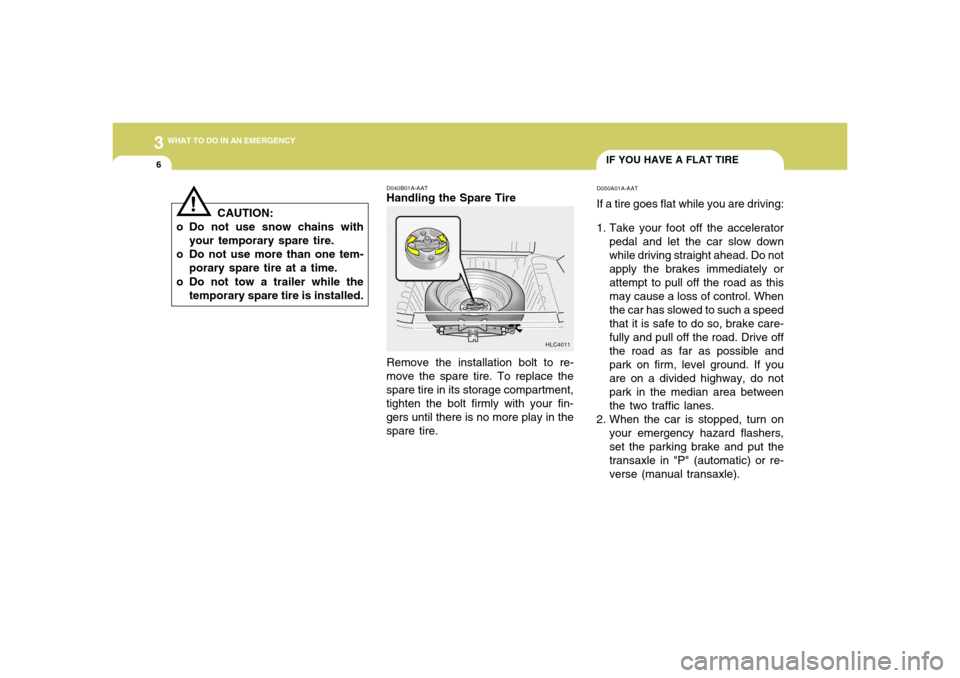
D040B01A-AATHandling the Spare Tire
Remove the installation bolt to re-
move the spare tire. To replace the
spare tire in its storage compartment,
tighten the bolt firmly with your fin-
gers until there is no more play in the
spare tire.
HLC4011D050A01A-AAT
If a tire goes flat while you are driving:
1. Take your foot off the accelerator
pedal and let the car slow down
while driving straight ahead. Do not
apply the brakes immediately or
attempt to pull off the road as this
may cause a loss of control. When
the car has slowed to such a speed
that it is safe to do so, brake care-
fully and pull off the road. Drive off
the road as far as possible and
park on firm, level ground. If you
are on a divided highway, do not
park in the median area between
the two traffic lanes.
2. When the car is stopped, turn on
your emergency hazard flashers,
set the parking brake and put the
transaxle in "P" (automatic) or re-
verse (manual transaxle). CAUTION:
o Do not use snow chains with
your temporary spare tire.
o Do not use more than one tem-
porary spare tire at a time.
o Do not tow a trailer while the
temporary spare tire is installed.
!
Page 133 of 219
3
WHAT TO DO IN AN EMERGENCY
7
CHANGING A FLAT TIRED060A01A-AATThe procedure described on the fol-
lowing pages can be used to rotate
tires as well as to change a flat tire.
When preparing to change a flat tire,
check to be sure the gear selector
lever is in "P" (automatic) or reverse
gear (manual transaxle) and that the
parking brake is set, then:
D060A01A
3. Have all passengers get out of the
car. Be sure they all get out on the
side of the car that is away from
traffic.
4. Change the tire following the in-
structions provided on the follow-
ing pages.
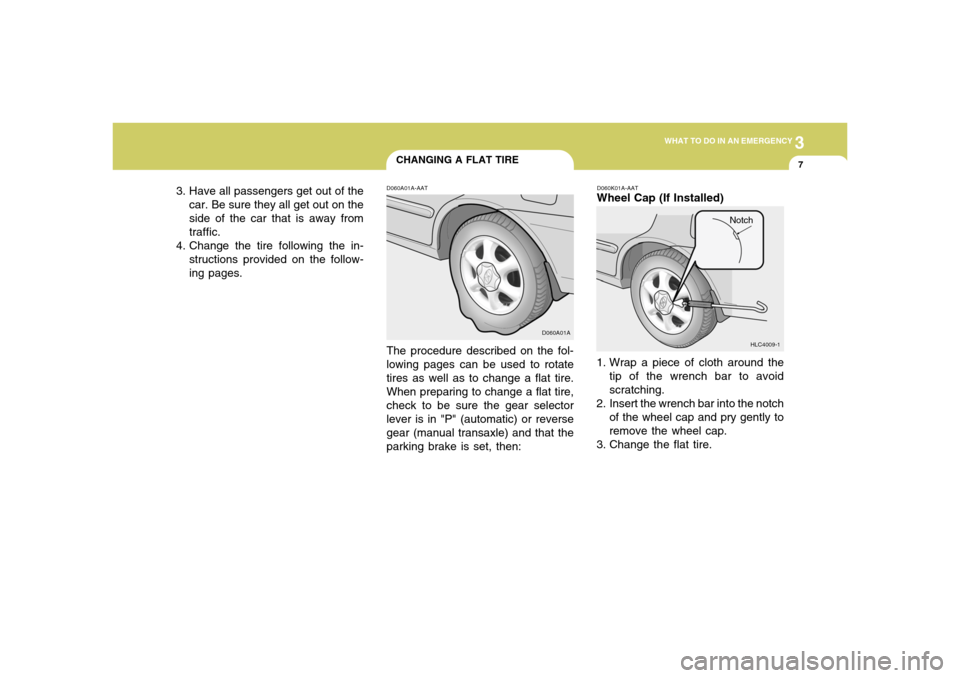
D060K01A-AATWheel Cap (If Installed)
1. Wrap a piece of cloth around the
tip of the wrench bar to avoid
scratching.
2. Insert the wrench bar into the notch
of the wheel cap and pry gently to
remove the wheel cap.
3. Change the flat tire.
HLC4009-1
Notch
Page 134 of 219
38WHAT TO DO IN AN EMERGENCY
HTB156
Flat tire
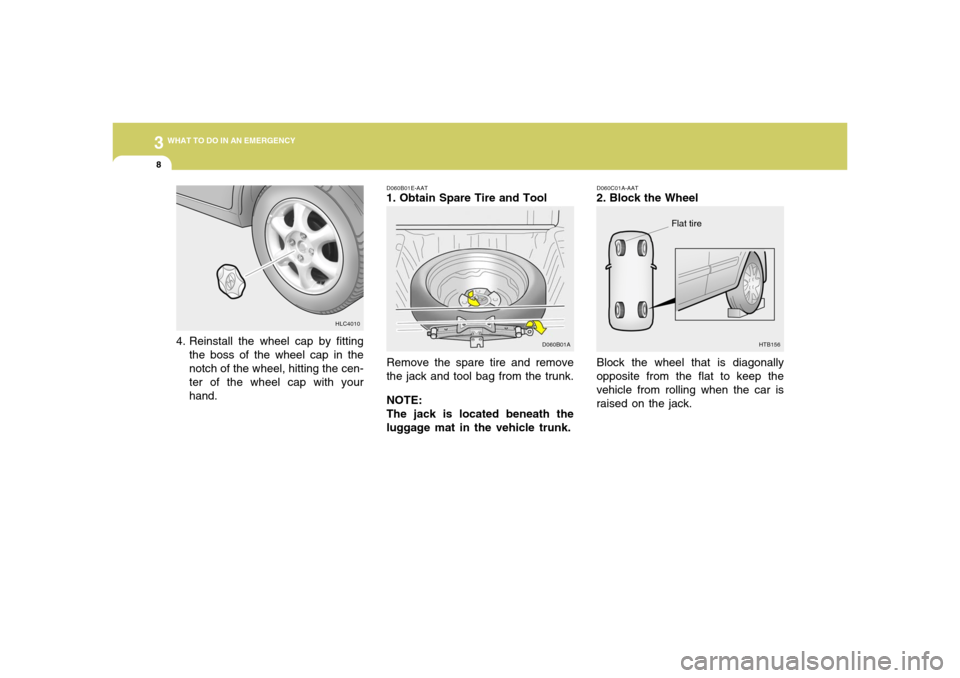
Block the wheel that is diagonally
opposite from the flat to keep the
vehicle from rolling when the car is
raised on the jack.D060C01A-AAT2. Block the Wheel
4. Reinstall the wheel cap by fitting
the boss of the wheel cap in the
notch of the wheel, hitting the cen-
ter of the wheel cap with your
hand.
HLC4010
Remove the spare tire and remove
the jack and tool bag from the trunk.
NOTE:
The jack is located beneath the
luggage mat in the vehicle trunk.D060B01E-AAT1. Obtain Spare Tire and Tool
D060B01A
Page 136 of 219
310
WHAT TO DO IN AN EMERGENCY
!
Raise the car high enough so that the
fully inflated spare tire can be in-
stalled. To do this, you will need more
ground clearance than is required to
remove the flat tire.
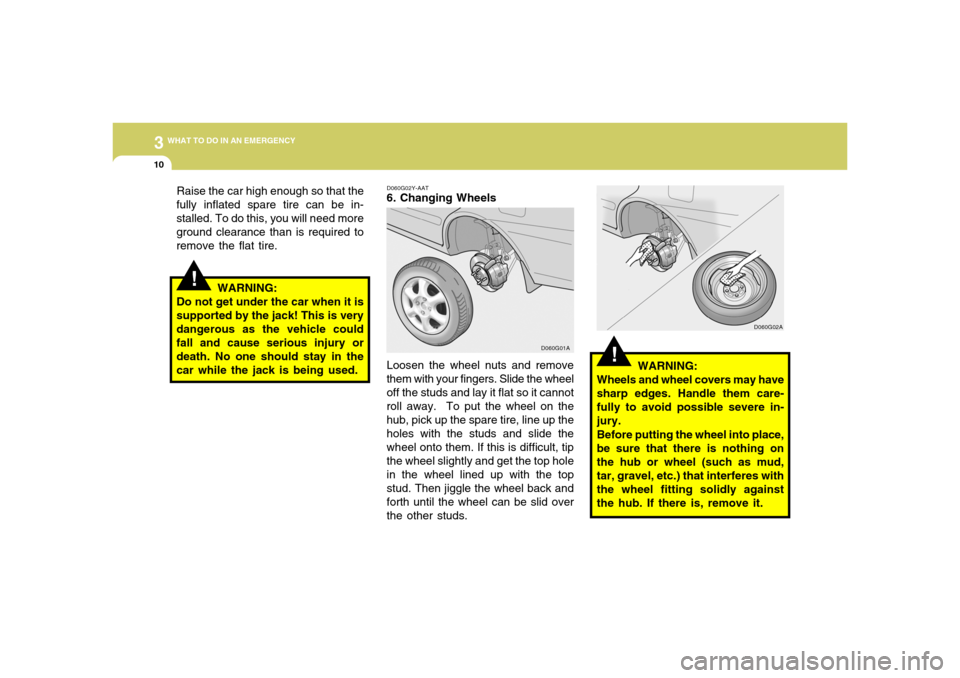
D060G02Y-AAT6. Changing Wheels
Loosen the wheel nuts and remove
them with your fingers. Slide the wheel
off the studs and lay it flat so it cannot
roll away. To put the wheel on the
hub, pick up the spare tire, line up the
holes with the studs and slide the
wheel onto them. If this is difficult, tip
the wheel slightly and get the top hole
in the wheel lined up with the top
stud. Then jiggle the wheel back and
forth until the wheel can be slid over
the other studs.
D060G01A
WARNING:
Do not get under the car when it is
supported by the jack! This is very
dangerous as the vehicle could
fall and cause serious injury or
death. No one should stay in the
car while the jack is being used.
!
WARNING:
Wheels and wheel covers may have
sharp edges. Handle them care-
fully to avoid possible severe in-
jury.
Before putting the wheel into place,
be sure that there is nothing on
the hub or wheel (such as mud,
tar, gravel, etc.) that interferes with
the wheel fitting solidly against
the hub. If there is, remove it.
D060G02A
Page 137 of 219
3
WHAT TO DO IN AN EMERGENCY
11
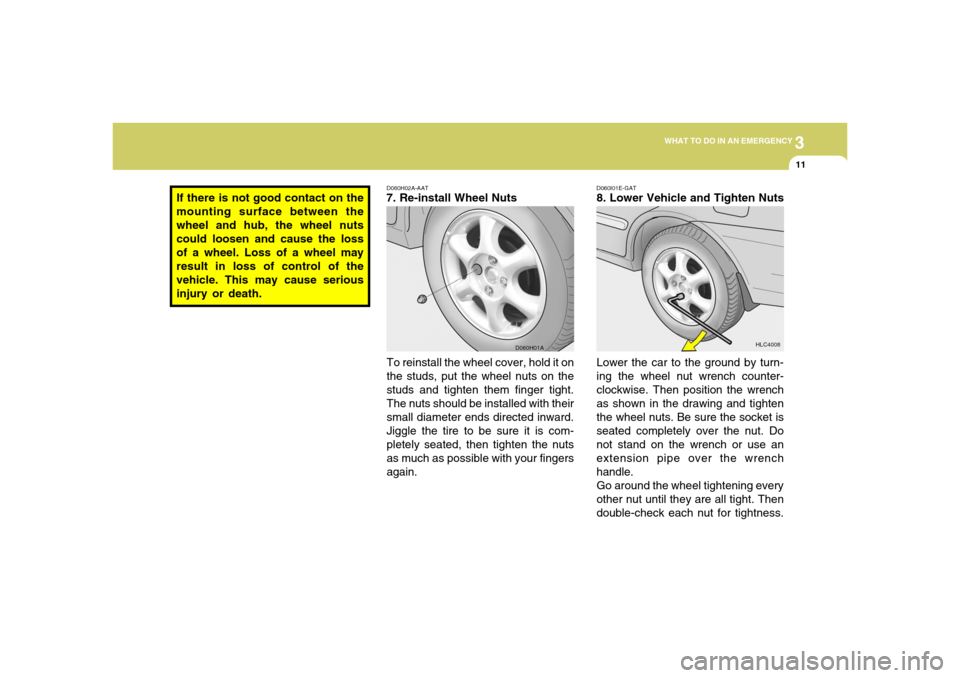
D060H02A-AAT7. Re-install Wheel Nuts
To reinstall the wheel cover, hold it on
the studs, put the wheel nuts on the
studs and tighten them finger tight.
The nuts should be installed with their
small diameter ends directed inward.
Jiggle the tire to be sure it is com-
pletely seated, then tighten the nuts
as much as possible with your fingers
again.
D060H01A
If there is not good contact on the
mounting surface between the
wheel and hub, the wheel nuts
could loosen and cause the loss
of a wheel. Loss of a wheel may
result in loss of control of the
vehicle. This may cause serious
injury or death.
D060I01E-GAT8. Lower Vehicle and Tighten Nuts
Lower the car to the ground by turn-
ing the wheel nut wrench counter-
clockwise. Then position the wrench
as shown in the drawing and tighten
the wheel nuts. Be sure the socket is
seated completely over the nut. Do
not stand on the wrench or use an
extension pipe over the wrench
handle.
Go around the wheel tightening every
other nut until they are all tight. Then
double-check each nut for tightness.
HLC4008
Page 138 of 219
312
WHAT TO DO IN AN EMERGENCY
IF YOUR CAR MUST BE TOWED
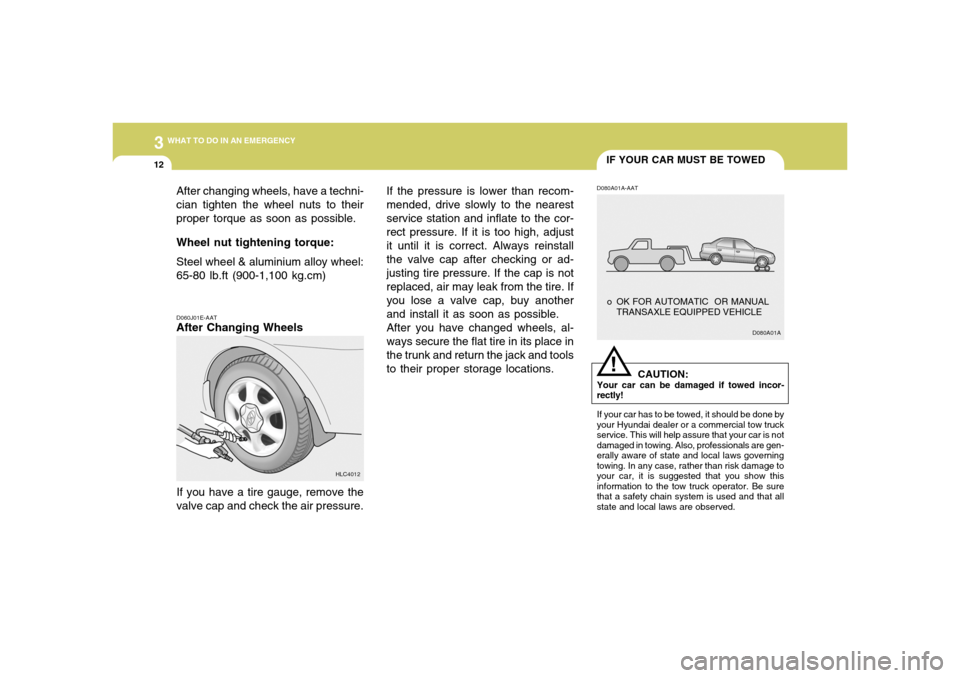
D060J01E-AATAfter Changing Wheels
If you have a tire gauge, remove the
valve cap and check the air pressure.
D080A01A-AAT
CAUTION:
Your car can be damaged if towed incor-
rectly!
HLC4012
If your car has to be towed, it should be done by
your Hyundai dealer or a commercial tow truck
service. This will help assure that your car is not
damaged in towing. Also, professionals are gen-
erally aware of state and local laws governing
towing. In any case, rather than risk damage to
your car, it is suggested that you show this
information to the tow truck operator. Be sure
that a safety chain system is used and that all
state and local laws are observed.
D080A01A
o OK FOR AUTOMATIC OR MANUAL
TRANSAXLE EQUIPPED VEHICLE!
After changing wheels, have a techni-
cian tighten the wheel nuts to their
proper torque as soon as possible.
Wheel nut tightening torque:
Steel wheel & aluminium alloy wheel:
65-80 lb.ft (900-1,100 kg.cm)If the pressure is lower than recom-
mended, drive slowly to the nearest
service station and inflate to the cor-
rect pressure. If it is too high, adjust
it until it is correct. Always reinstall
the valve cap after checking or ad-
justing tire pressure. If the cap is not
replaced, air may leak from the tire. If
you lose a valve cap, buy another
and install it as soon as possible.
After you have changed wheels, al-
ways secure the flat tire in its place in
the trunk and return the jack and tools
to their proper storage locations.