warning Hyundai Accent 2005 Manual PDF
[x] Cancel search | Manufacturer: HYUNDAI, Model Year: 2005, Model line: Accent, Model: Hyundai Accent 2005Pages: 219, PDF Size: 7.07 MB
Page 176 of 219
6
DO-IT-YOURSELF MAINTENANCE
21
CHECKING THE BATTERY!
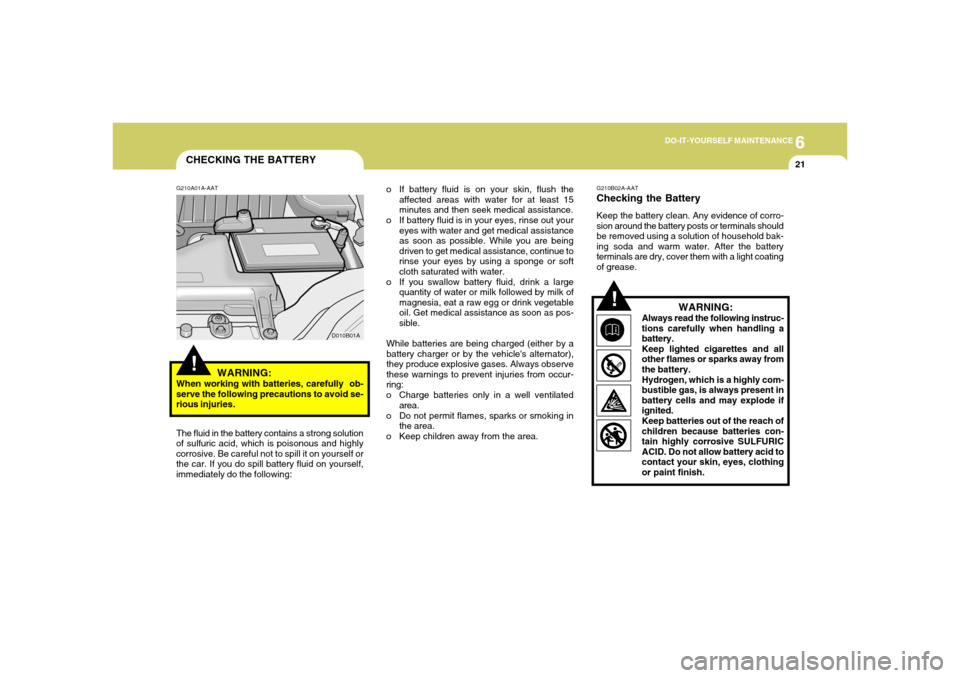
G210A01A-AAT
WARNING:
When working with batteries, carefully ob-
serve the following precautions to avoid se-
rious injuries.o If battery fluid is on your skin, flush the
affected areas with water for at least 15
minutes and then seek medical assistance.
o If battery fluid is in your eyes, rinse out your
eyes with water and get medical assistance
as soon as possible. While you are being
driven to get medical assistance, continue to
rinse your eyes by using a sponge or soft
cloth saturated with water.
o If you swallow battery fluid, drink a large
quantity of water or milk followed by milk of
magnesia, eat a raw egg or drink vegetable
oil. Get medical assistance as soon as pos-
sible.
While batteries are being charged (either by a
battery charger or by the vehicle's alternator),
they produce explosive gases. Always observe
these warnings to prevent injuries from occur-
ring:
o Charge batteries only in a well ventilated
area.
o Do not permit flames, sparks or smoking in
the area.
o Keep children away from the area.
D010B01A
The fluid in the battery contains a strong solution
of sulfuric acid, which is poisonous and highly
corrosive. Be careful not to spill it on yourself or
the car. If you do spill battery fluid on yourself,
immediately do the following:
G210B02A-AATChecking the BatteryKeep the battery clean. Any evidence of corro-
sion around the battery posts or terminals should
be removed using a solution of household bak-
ing soda and warm water. After the battery
terminals are dry, cover them with a light coating
of grease.
WARNING:
Always read the following instruc-
tions carefully when handling a
battery.
Keep lighted cigarettes and all
other flames or sparks away from
the battery.
Hydrogen, which is a highly com-
bustible gas, is always present in
battery cells and may explode if
ignited.
Keep batteries out of the reach of
children because batteries con-
tain highly corrosive SULFURIC
ACID. Do not allow battery acid to
contact your skin, eyes, clothing
or paint finish.
!
Page 177 of 219
6
DO-IT-YOURSELF MAINTENANCE
22
POWER STEERING FLUID LEVEL
CHECKING ELECTRIC COOLING
FANS!
G220A01A-AAT G230A03A-AAT
G220B01A-AATChecking Engine Cooling FanThe engine cooling fan should come on auto-
matically if the engine coolant temperature is
high.
WARNING:
The radiator fan is controlled by engine cool-
ant temperature and may sometimes operate
even when the engine is not running. Use
extreme caution when working near the
blades of the cooling fan, so that you are not
injured by a rotating fan blade. As the cool-
ant temperature decreases the fan will auto-
matically shut off. This is a normal condition.G220C01A-AATChecking Condenser Cooling FanThe condenser cooling fan should come on
automatically whenever the air conditioner is in
operation.
HLC5006
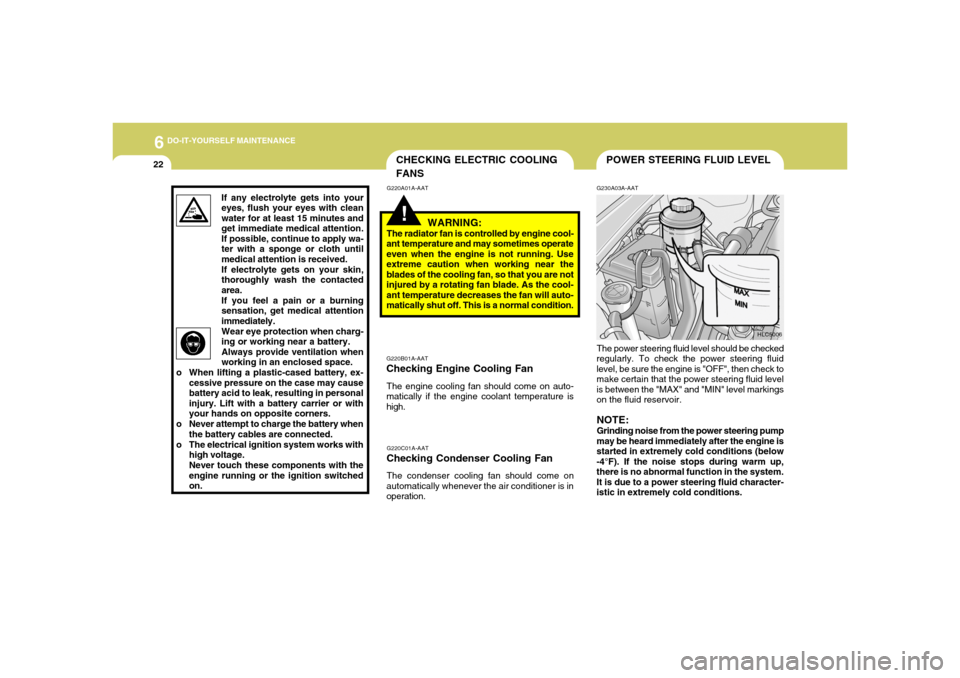
The power steering fluid level should be checked
regularly. To check the power steering fluid
level, be sure the engine is "OFF", then check to
make certain that the power steering fluid level
is between the "MAX" and "MIN" level markings
on the fluid reservoir.NOTE:Grinding noise from the power steering pump
may be heard immediately after the engine is
started in extremely cold conditions (below
-4°F). If the noise stops during warm up,
there is no abnormal function in the system.
It is due to a power steering fluid character-
istic in extremely cold conditions.
If any electrolyte gets into your
eyes, flush your eyes with clean
water for at least 15 minutes and
get immediate medical attention.
If possible, continue to apply wa-
ter with a sponge or cloth until
medical attention is received.
If electrolyte gets on your skin,
thoroughly wash the contacted
area.
If you feel a pain or a burning
sensation, get medical attention
immediately.
Wear eye protection when charg-
ing or working near a battery.
Always provide ventilation when
working in an enclosed space.
o When lifting a plastic-cased battery, ex-
cessive pressure on the case may cause
battery acid to leak, resulting in personal
injury. Lift with a battery carrier or with
your hands on opposite corners.
o Never attempt to charge the battery when
the battery cables are connected.
o The electrical ignition system works with
high voltage.
Never touch these components with the
engine running or the ignition switched
on.
Page 179 of 219
6
DO-IT-YOURSELF MAINTENANCE
24
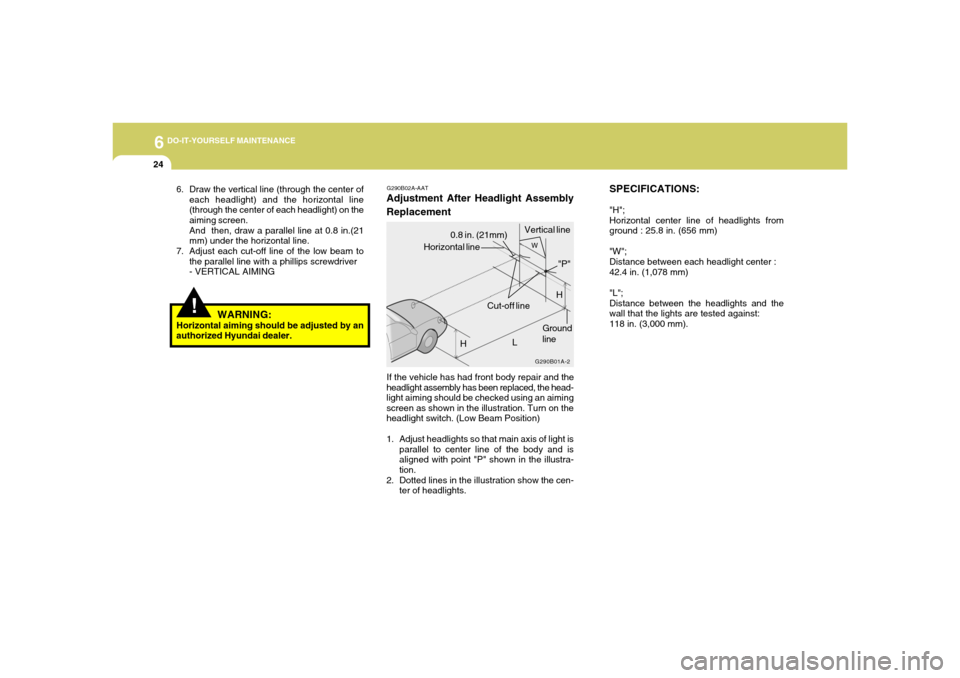
SPECIFICATIONS:"H";
Horizontal center line of headlights from
ground : 25.8 in. (656 mm)
"W";
Distance between each headlight center :
42.4 in. (1,078 mm)
"L";
Distance between the headlights and the
wall that the lights are tested against:
118 in. (3,000 mm).
G290B02A-AATAdjustment After Headlight Assembly
ReplacementIf the vehicle has had front body repair and the
headlight assembly has been replaced, the head-
light aiming should be checked using an aiming
screen as shown in the illustration. Turn on the
headlight switch. (Low Beam Position)
1. Adjust headlights so that main axis of light is
parallel to center line of the body and is
aligned with point "P" shown in the illustra-
tion.
2. Dotted lines in the illustration show the cen-
ter of headlights.
G290B01A-2
HGround
line Horizontal line0.8 in. (21mm)Vertical line
L
W
H
Cut-off line"P"
!
6. Draw the vertical line (through the center of
each headlight) and the horizontal line
(through the center of each headlight) on the
aiming screen.
And then, draw a parallel line at 0.8 in.(21
mm) under the horizontal line.
7. Adjust each cut-off line of the low beam to
the parallel line with a phillips screwdriver
- VERTICAL AIMING
WARNING:
Horizontal aiming should be adjusted by an
authorized Hyundai dealer.
Page 181 of 219
6
DO-IT-YOURSELF MAINTENANCE
26
!
WARNING:
The halogen bulb contains gas under pres-
sure and if impacted could shatter, resulting
in flying fragments. Always wear eye protec-
tion when servicing the bulb. Protect the
bulb against abrasions or scratches and
against liquids when lighted. Turn the bulb
on only when installed in a headlight. Re-
place the headlight if damaged or cracked.
Keep the bulb out of the reach of children
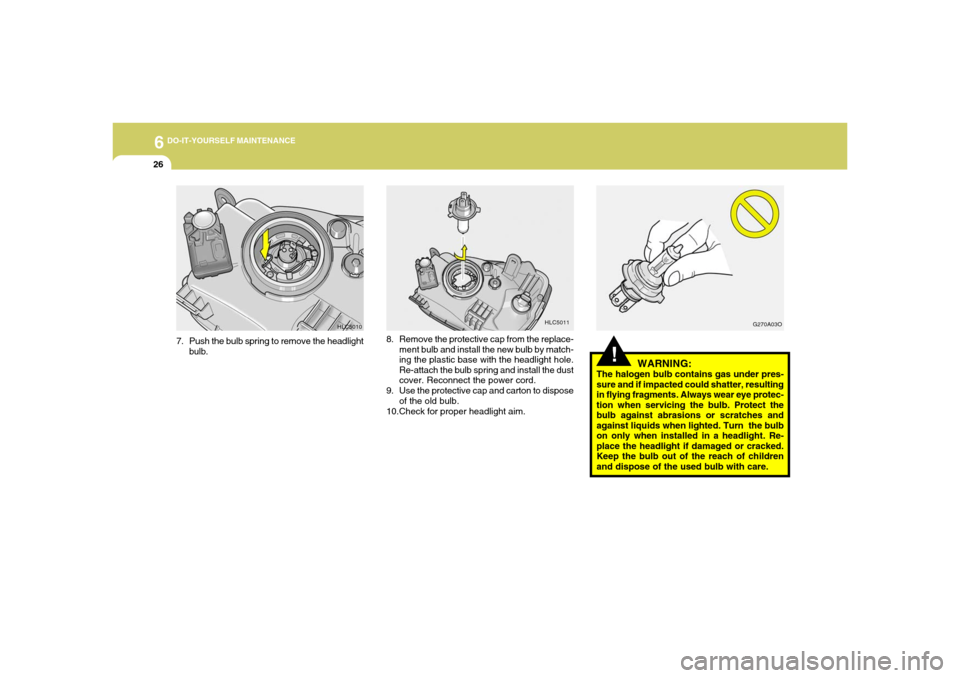
and dispose of the used bulb with care. 8. Remove the protective cap from the replace-
ment bulb and install the new bulb by match-
ing the plastic base with the headlight hole.
Re-attach the bulb spring and install the dust
cover. Reconnect the power cord.
9. Use the protective cap and carton to dispose
of the old bulb.
10.Check for proper headlight aim.
G270A03O
HLC5011
7. Push the bulb spring to remove the headlight
bulb.
HLC5010
Page 188 of 219
6
DO-IT-YOURSELF MAINTENANCE
33
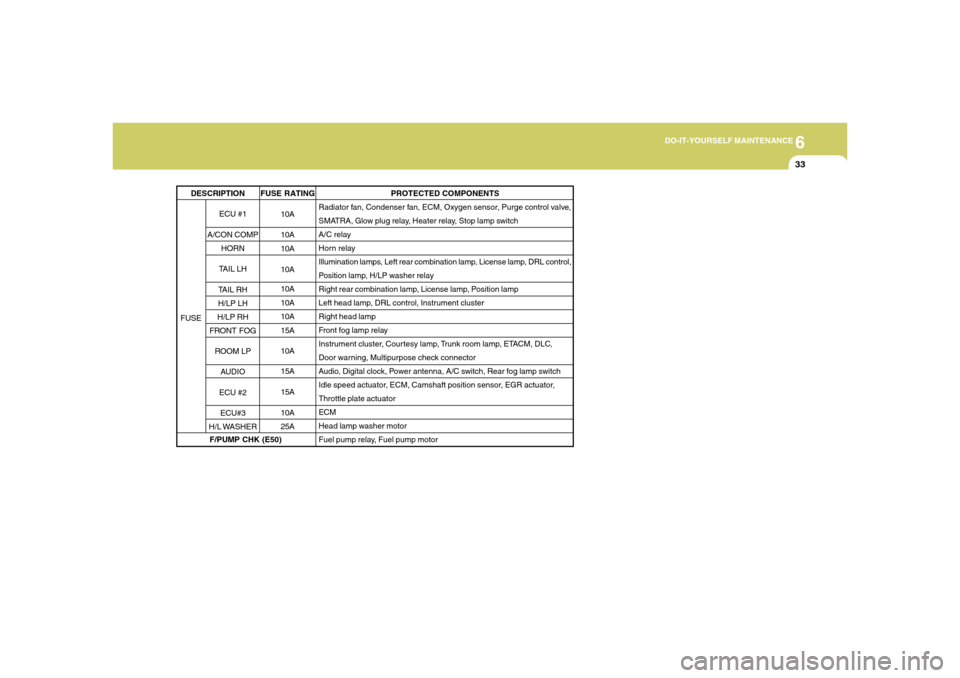
FUSE RATING
10A
10A
10A
10A
10A
10A
10A
15A
10A
15A
15A
10A
25APROTECTED COMPONENTS
Radiator fan, Condenser fan, ECM, Oxygen sensor, Purge control valve,
SMATRA, Glow plug relay, Heater relay, Stop lamp switch
A/C relay
Horn relay
Illumination lamps, Left rear combination lamp, License lamp, DRL control,
Position lamp, H/LP washer relay
Right rear combination lamp, License lamp, Position lamp
Left head lamp, DRL control, Instrument cluster
Right head lamp
Front fog lamp relay
Instrument cluster, Cour tesy lamp, Trunk room lamp, ETACM, DLC,
Door warning, Multipurpose check connector
Audio, Digital clock, Power antenna, A/C switch, Rear fog lamp switch
Idle speed actuator, ECM, Camshaft position sensor, EGR actuator,
Throttle plate actuator
ECM
Head lamp washer motor
Fuel pump relay, Fuel pump motor
ECU #1
A/CON COMP
HORN
TAIL LH
TAIL RH
H/LP LH
H/LP RH
FRONT FOG
ROOM LP
AUDIO
ECU #2
ECU#3
H/L WASHER FUSE
DESCRIPTION
F/PUMP CHK (E50)
Page 189 of 219
6
DO-IT-YOURSELF MAINTENANCE
34
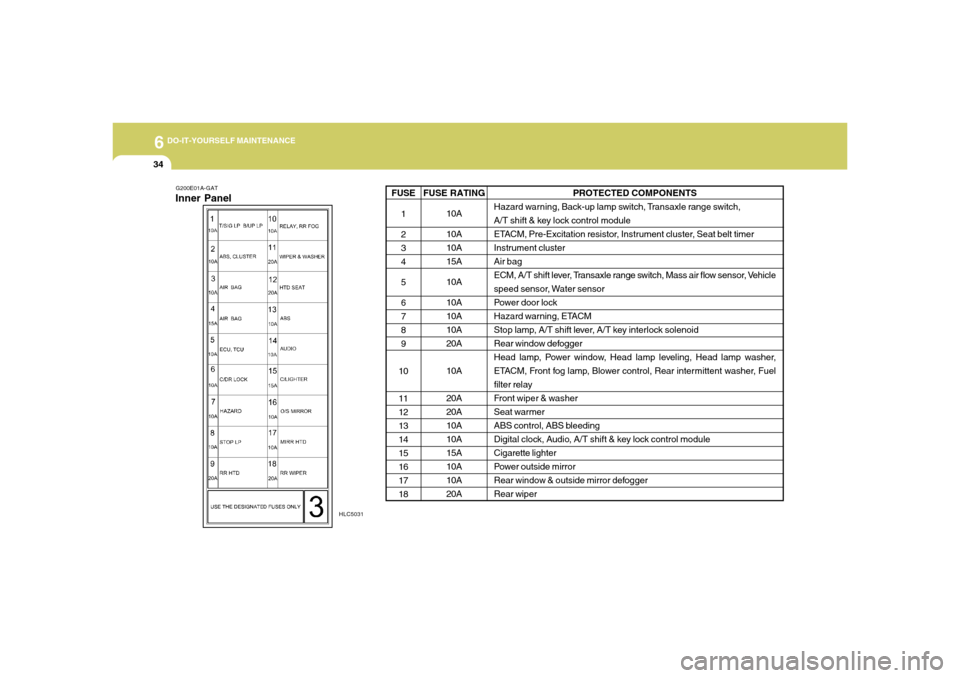
G200E01A-GATInner Panel
HLC5031
PROTECTED COMPONENTS
Hazard warning, Back-up lamp switch, Transaxle range switch,
A/T shift & key lock control module
ETACM, Pre-Excitation resistor, Instrument cluster, Seat belt timer
Instrument cluster
Air bag
ECM, A/T shift lever, Transaxle range switch, Mass air flow sensor, Vehicle
speed sensor, Water sensor
Power door lock
Hazard warning, ETACM
Stop lamp, A/T shift lever, A/T key interlock solenoid
Rear window defogger
Head lamp, Power window, Head lamp leveling, Head lamp washer,
ETACM, Front fog lamp, Blower control, Rear intermittent washer, Fuel
filter relay
Front wiper & washer
Seat warmer
ABS control, ABS bleeding
Digital clock, Audio, A/T shift & key lock control module
Cigarette lighter
Power outside mirror
Rear window & outside mirror defogger
Rear wiper
FUSE RATING
10A
10A
10A
15A
10A
10A
10A
10A
20A
10A
20A
20A
10A
10A
15A
10A
10A
20A FUSE
1
2
3
4
5
6
7
8
9
10
11
12
13
14
15
16
17
18
Page 192 of 219
7
EMISSION CONTROL SYSTEMS
3
CATALYTIC CONVERTER
!
!
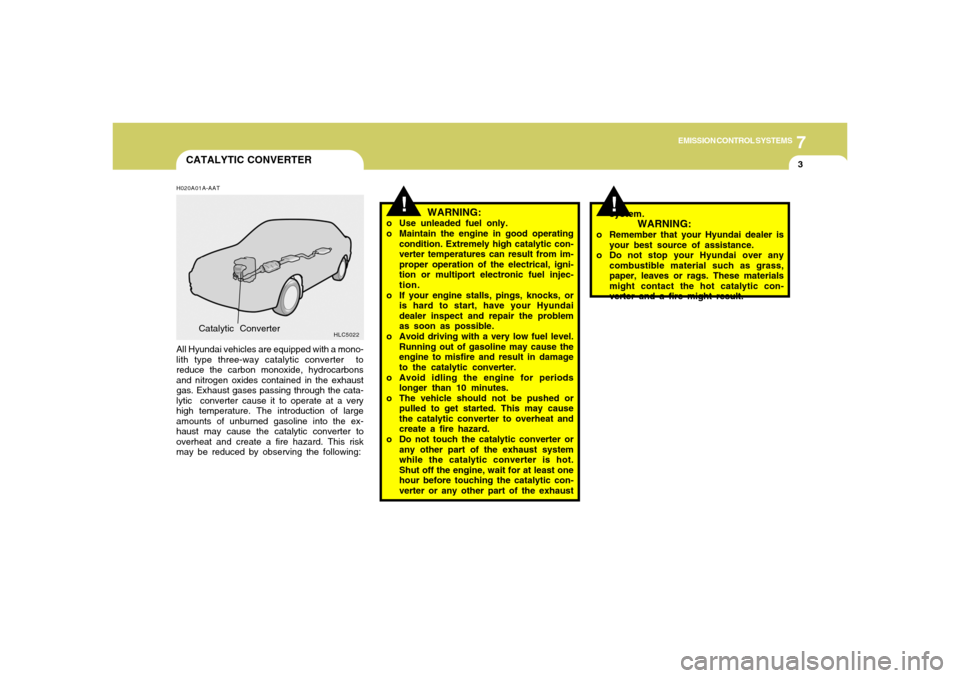
H020A01A-AATAll Hyundai vehicles are equipped with a mono-
lith type three-way catalytic converter to
reduce the carbon monoxide, hydrocarbons
and nitrogen oxides contained in the exhaust
gas. Exhaust gases passing through the cata-
lytic converter cause it to operate at a very
high temperature. The introduction of large
amounts of unburned gasoline into the ex-
haust may cause the catalytic converter to
overheat and create a fire hazard. This risk
may be reduced by observing the following:system.
WARNING:
o Remember that your Hyundai dealer is
your best source of assistance.
o Do not stop your Hyundai over any
combustible material such as grass,
paper, leaves or rags. These materials
might contact the hot catalytic con-
verter and a fire might result.
HLC5022
Catalytic Converter
WARNING:
o Use unleaded fuel only.
o Maintain the engine in good operating
condition. Extremely high catalytic con-
verter temperatures can result from im-
proper operation of the electrical, igni-
tion or multiport electronic fuel injec-
tion.
o If your engine stalls, pings, knocks, or
is hard to start, have your Hyundai
dealer inspect and repair the problem
as soon as possible.
o Avoid driving with a very low fuel level.
Running out of gasoline may cause the
engine to misfire and result in damage
to the catalytic converter.
o Avoid idling the engine for periods
longer than 10 minutes.
o The vehicle should not be pushed or
pulled to get started. This may cause
the catalytic converter to overheat and
create a fire hazard.
o Do not touch the catalytic converter or
any other part of the exhaust system
while the catalytic converter is hot.
Shut off the engine, wait for at least one
hour before touching the catalytic con-
verter or any other part of the exhaust
Page 195 of 219
8
CONSUMER INFORMATION, REPORTING SAFETY DEFECTS & BINDING ARBITRATION OF WARRANTY CLAIMS
3
!
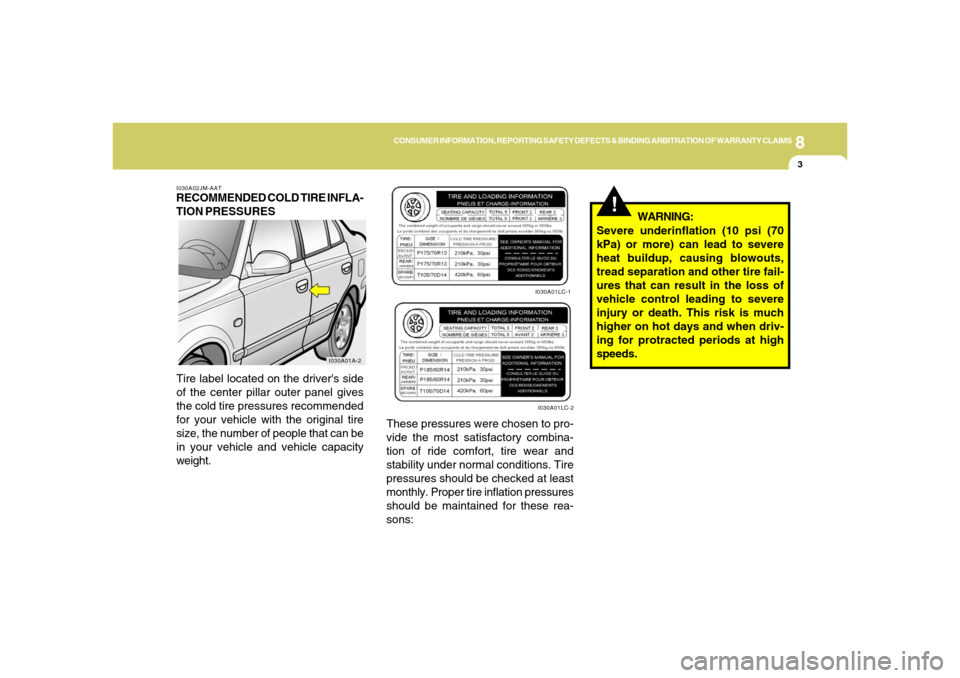
I030A02JM-AATRECOMMENDED COLD TIRE INFLA-
TION PRESSURES
Tire label located on the driver's side
of the center pillar outer panel gives
the cold tire pressures recommended
for your vehicle with the original tire
size, the number of people that can be
in your vehicle and vehicle capacity
weight.
I030A01A-2
These pressures were chosen to pro-
vide the most satisfactory combina-
tion of ride comfort, tire wear and
stability under normal conditions. Tire
pressures should be checked at least
monthly. Proper tire inflation pressures
should be maintained for these rea-
sons:
I030A01LC-1
WARNING:
Severe underinflation (10 psi (70
kPa) or more) can lead to severe
heat buildup, causing blowouts,
tread separation and other tire fail-
ures that can result in the loss of
vehicle control leading to severe
injury or death. This risk is much
higher on hot days and when driv-
ing for protracted periods at high
speeds.
I030A01LC-2
Page 196 of 219
8
CONSUMER INFORMATION, REPORTING SAFETY DEFECTS & BINDING ARBITRATION OF WARRANTY CLAIMS4
!
NOTE:
o Underinflation also results in ex-
cessive wear, poor handling and
reduced fuel economy. Wheel de-
formation also is possible. Keep
your tire pressures at the proper
levels. If a tire frequently needs
refilling, have it checked by your
Hyundai Dealer.
o Overinflation produces a harsh
ride, excessive wear at the center
of the tire tread, and a greater
possibility of damage from road
hazards.WARNING:
Overinflation or underinflation can
reduce the tire life, adversely affect
vehicle handling, and lead to sud-
den tire failure. This could rusult in
loss of vehicle control and potential
injury.CAUTION:
Always observe the following:
o Check pressures when the tires
are cold. (After the vehicle has
been parked for at least three
hours or hasn't been driven more
than one mile (1.6 km) since start-
ing up.)
o Check the pressure of your spare
tire each time you check the pres-
sure of other tires.
o Never overload your vehicle. Be
especially careful about overload-
ing if you equip your vehicle with
a luggage rack.
o Worn, old tires can cause acci-
dents. If your tread is badly worn,
or if your tires have been dam-
aged, replace them.
!
Page 202 of 219
8
CONSUMER INFORMATION, REPORTING SAFETY DEFECTS & BINDING ARBITRATION OF WARRANTY CLAIMS
10
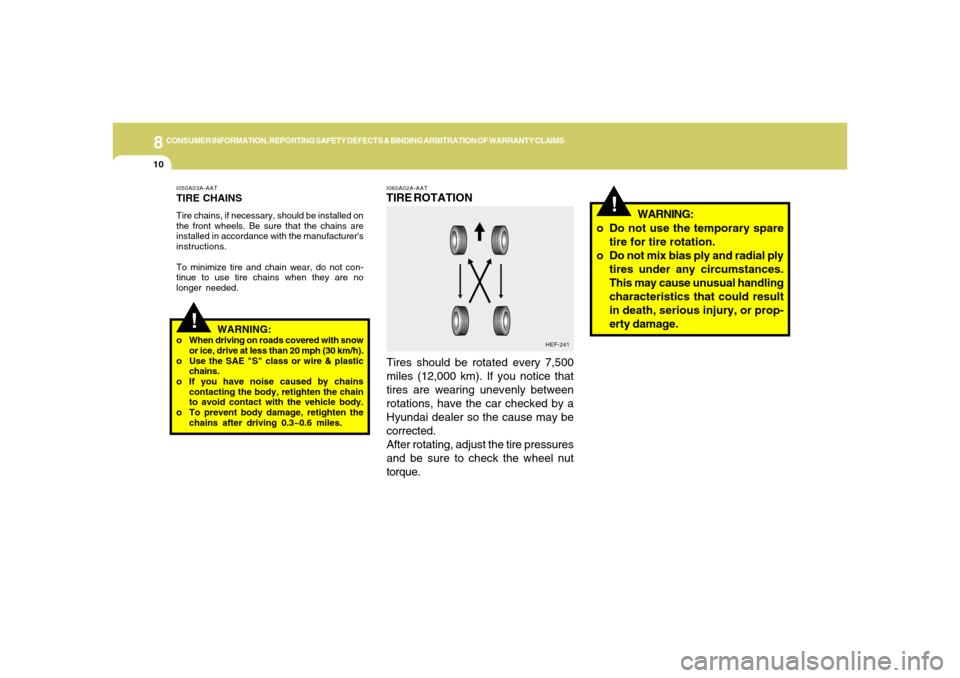
I060A02A-AATTIRE ROTATION
Tires should be rotated every 7,500
miles (12,000 km). If you notice that
tires are wearing unevenly between
rotations, have the car checked by a
Hyundai dealer so the cause may be
corrected.
After rotating, adjust the tire pressures
and be sure to check the wheel nut
torque.
HEF-241
!
I050A03A-AATTIRE CHAINSTire chains, if necessary, should be installed on
the front wheels. Be sure that the chains are
installed in accordance with the manufacturer's
instructions.
To minimize tire and chain wear, do not con-
tinue to use tire chains when they are no
longer needed.
WARNING:
o When driving on roads covered with snow
or ice, drive at less than 20 mph (30 km/h).
o Use the SAE "S" class or wire & plastic
chains.
o If you have noise caused by chains
contacting the body, retighten the chain
to avoid contact with the vehicle body.
o To prevent body damage, retighten the
chains after driving 0.3~0.6 miles.
!
WARNING:
o Do not use the temporary spare
tire for tire rotation.
o Do not mix bias ply and radial ply
tires under any circumstances.
This may cause unusual handling
characteristics that could result
in death, serious injury, or prop-
erty damage.