oil pressure Hyundai Accent 2005 Owner's Manual
[x] Cancel search | Manufacturer: HYUNDAI, Model Year: 2005, Model line: Accent, Model: Hyundai Accent 2005Pages: 219, PDF Size: 7.07 MB
Page 12 of 219

YOUR VEHICLE AT A GLANCE
High Beam Indicator Light
Parking Brake/Low Brake Fluid Level
Warning LightDoor Ajar Warning Light
O/D OFF Indicator
(Automatic transaxle only)
B255A01A-AATINDICATOR SYMBOLS ON THE INSTRUMENT PANEL* More detailed explanations of these items will be found begining on page 1-38.
SRS (Airbag) Service Reminder
Indicator
ABS Service Reminder Indicator (If Installed)
Turn Signal Indicator Lights
Low Oil Pressure Warning LightCharging System Warning Light
Low Fuel Level Warning Light
Malfunction Indicator Light
Seat Belt Reminder Light
Trunk Lid / Tail Gate Open Warning Light
Page 50 of 219

1FEATURES OF YOUR HYUNDAI38
11. Door Ajar Warning Light
12. Parking Brake/Low Brake fluid Level Warning Light
13. Charging System Warning Light
14. Seat Belt Warning Light
15. Low Oil Pressure Warning Light
16. Trip Odometer Reset Switch /
Trip Computer Reset Switch (If Installed)
17. Low Fuel Warning Light
18. Trunk Lid/Tail Gate Open Warning Light
19. Malfunction Indicator Light (MIL) 1. Tachometer (If Installed)
2. Turn Signal Indicator Light
3. Speedometer
4. Odometer / Trip Odometer / Trip Computer (If Installed)
5. Fuel Gauge
6. Temperature Gauge
7. SRS Service Reminder Indicator
8. ABS Service Reminder Indicator (If Installed)
9. Overdrive Off Indicator Light (If Installed)
10. High Beam Indicator Light
Page 52 of 219
1FEATURES OF YOUR HYUNDAI40
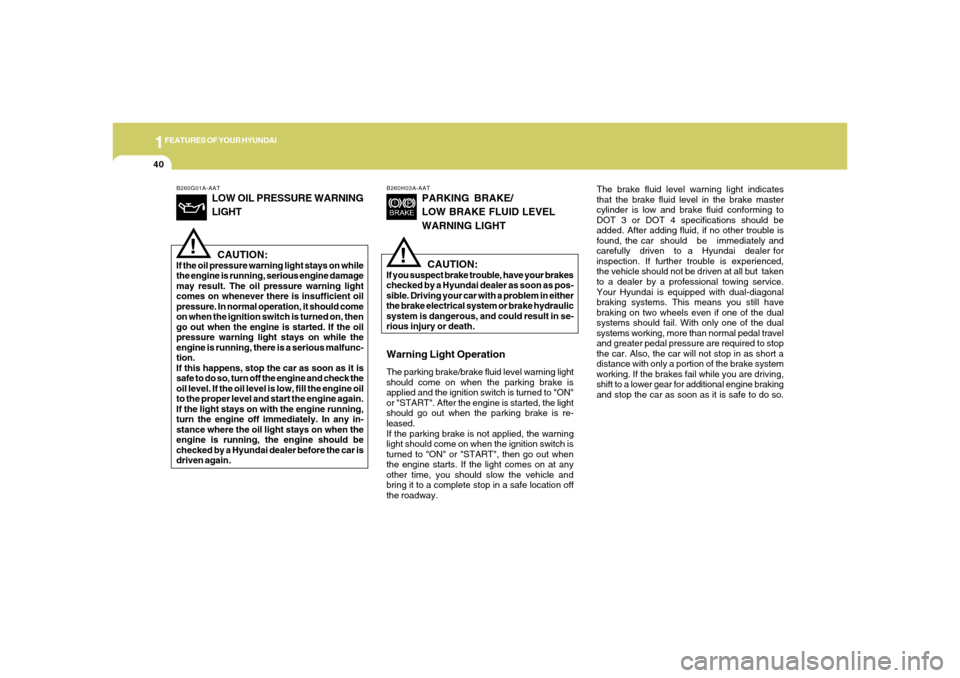
B260G01A-AAT
LOW OIL PRESSURE WARNING
LIGHTCAUTION:
If the oil pressure warning light stays on while
the engine is running, serious engine damage
may result. The oil pressure warning light
comes on whenever there is insufficient oil
pressure. In normal operation, it should come
on when the ignition switch is turned on, then
go out when the engine is started. If the oil
pressure warning light stays on while the
engine is running, there is a serious malfunc-
tion.
If this happens, stop the car as soon as it is
safe to do so, turn off the engine and check the
oil level. If the oil level is low, fill the engine oil
to the proper level and start the engine again.
If the light stays on with the engine running,
turn the engine off immediately. In any in-
stance where the oil light stays on when the
engine is running, the engine should be
checked by a Hyundai dealer before the car is
driven again.
!
B260H03A-AAT
PARKING BRAKE/
LOW BRAKE FLUID LEVEL
WARNING LIGHT
CAUTION:
If you suspect brake trouble, have your brakes
checked by a Hyundai dealer as soon as pos-
sible. Driving your car with a problem in either
the brake electrical system or brake hydraulic
system is dangerous, and could result in se-
rious injury or death.Warning Light OperationThe parking brake/brake fluid level warning light
should come on when the parking brake is
applied and the ignition switch is turned to "ON"
or "START". After the engine is started, the light
should go out when the parking brake is re-
leased.
If the parking brake is not applied, the warning
light should come on when the ignition switch is
turned to "ON" or "START", then go out when
the engine starts. If the light comes on at any
other time, you should slow the vehicle and
bring it to a complete stop in a safe location off
the roadway.
!
The brake fluid level warning light indicates
that the brake fluid level in the brake master
cylinder is low and brake fluid conforming to
DOT 3 or DOT 4 specifications should be
added. After adding fluid, if no other trouble is
found, the car should be immediately and
carefully driven to a Hyundai dealer for
inspection. If further trouble is experienced,
the vehicle should not be driven at all but taken
to a dealer by a professional towing service.
Your Hyundai is equipped with dual-diagonal
braking systems. This means you still have
braking on two wheels even if one of the dual
systems should fail. With only one of the dual
systems working, more than normal pedal travel
and greater pedal pressure are required to stop
the car. Also, the car will not stop in as short a
distance with only a portion of the brake system
working. If the brakes fail while you are driving,
shift to a lower gear for additional engine braking
and stop the car as soon as it is safe to do so.
Page 121 of 219
DRIVING YOUR HYUNDAI
152
HIGHER SPEED MOTORING
C160I01A-AATDon't Let Your Parking Brake FreezeUnder some conditions your parking brake can
freeze in the engaged position. This is most
likely to happen when there is an accumulation
of snow or ice around or near the rear brakes or
if the brakes are wet. If you think the parking
brake may freeze, apply it only temporarily while
you put the gear selector lever in "P" (automatic)
or in first or reverse gear (manual transaxle) and
block the rear wheels so the car cannot roll.
Then release the parking brake.
C160K01A-AATCarry Emergency EquipmentDepending on the severity of the weather where
you drive your car, you should carry appropriate
emergency equipment. Some of the items you
may want to carry include tire chains, tow straps
or chains, flashlight, emergency flares, sand, a
shovel, jumper cables, a window scraper, gloves,
ground cloth, coveralls, a blanket, etc.
C160J01A-AATDon't Let Ice and Snow Accumulate
UnderneathUnder some conditions, snow and ice can build
up under the fenders and interfere with the
steering. When driving in severe winter condi-
tions where this may happen, you should peri-
odically check underneath the car to be sure the
movement of the front wheels and the steering
components is not obstructed.
C170A01A-AATPre-Trip Inspections1. Tires:
Adjust the tire inflation pressures for highway
driving. Low tire inflation pressures will result in
overheating and possible failure of the tires.
Avoid using worn or damaged tires which may
result in reduced traction or tire failure.NOTE:Never exceed the maximum tire inflation pres-
sure shown on the tires.
2. Fuel, engine coolant and engine oil:
High speed travel consumes more fuel than
urban motoring. Do not forget to check both
engine coolant and engine oil.
3. Drive belt:
A loose or damaged drive belt may result in
overheating of the engine.
Page 158 of 219
6
DO-IT-YOURSELF MAINTENANCE
3
GENERAL CHECKS
G020C01A-AATVehicle InteriorThe following should be checked each time
when the vehicle is driven:
o Light operation
o Windshield wiper operation
o Horn operation
o Defroster, heater system operation (and air
conditioning, if installed)
o Steering operation and condition
o Mirror condition and operation
o Turn signal operation
o Accelerator pedal operation
o Brake operation, including parking brake
o Manual transaxle operation, including clutch
operation
o Automatic transaxle operation, including
"Park" mechanism operation
o Seat control condition and operation
o Seat belt condition and operation
o Sun visor operation
If you notice anything that does not operate
correctly or appear to be functioning correctly,
inspect it carefully and seek assistance from
your Hyundai dealer if service is needed.
G020A01A-AATEngine Compartment
The following should be checked regularly:
o Engine oil level and condition
o Transaxle fluid level and condition
o Brake fluid level
o Clutch fluid level
o Engine coolant level
o Windshield washer fluid level
o Accessory drive belt condition
o Engine coolant hose condition
o Fluid leaks (on or below components)
o Power steering fluid level and condition
o Battery Condition
o Air filter condition
G020B01A-AATVehicle ExteriorThe following should be checked monthly:
o Overall appearance and condition
o Wheel condition and wheel nut tightness
o Exhaust system condition
o Light condition and operation
o Windshield glass condition
o Wiper blade condition
o Paint condition and body corrosion
o Fluid leaks
o Door and hood lock condition
o Tire pressure and condition
(including spare tire)
Page 178 of 219
6
DO-IT-YOURSELF MAINTENANCE
23
G240A01A-AATPOWER STEERING HOSESIt is suggested that you check the power steer-
ing hose connections for fluid leakage at those
intervals specified in the vehicle maintenance
schedule in Section 5.
The power steering hoses should be replaced if
there is severe surface cracking, pulling, scuff-
ing or worn spots. Deterioration of the hose
could cause premature failure.Recommended FluidUse PSF-3 type fluidNOTE:Do not start the engine when the power
steering oil reservoir is empty.
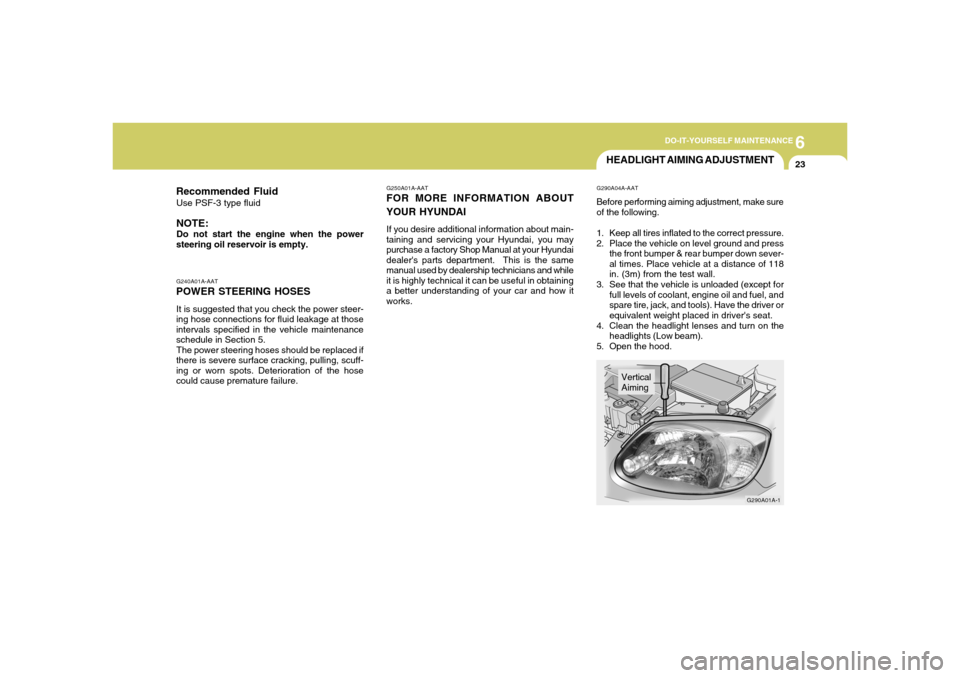
HEADLIGHT AIMING ADJUSTMENT
G250A01A-AATFOR MORE INFORMATION ABOUT
YOUR HYUNDAIIf you desire additional information about main-
taining and servicing your Hyundai, you may
purchase a factory Shop Manual at your Hyundai
dealer's parts department. This is the same
manual used by dealership technicians and while
it is highly technical it can be useful in obtaining
a better understanding of your car and how it
works.
G290A04A-AATBefore performing aiming adjustment, make sure
of the following.
1. Keep all tires inflated to the correct pressure.
2. Place the vehicle on level ground and press
the front bumper & rear bumper down sever-
al times. Place vehicle at a distance of 118
in. (3m) from the test wall.
3. See that the vehicle is unloaded (except for
full levels of coolant, engine oil and fuel, and
spare tire, jack, and tools). Have the driver or
equivalent weight placed in driver's seat.
4. Clean the headlight lenses and turn on the
headlights (Low beam).
5. Open the hood.
G290A01A-1
Vertical
Aiming
Page 199 of 219

8
CONSUMER INFORMATION, REPORTING SAFETY DEFECTS & BINDING ARBITRATION OF WARRANTY CLAIMS
7
6. Maximum load rating
This number indicates the maxi-
mum load in kilograms and pounds
that can be carried by the tire. When
replacing the tires on the vehicle,
always use a tire that has the same
load rating as the factory installed
tire.
7. Uniform Tire Quality Grading
(UTQG):
Tire manufacturers are required to
grade tires based on three perfor-
mance factors: treadwear, traction
and temperature resistance. For
more information, see Uniform Tire
Quality Grading on page 8-13.
I030D01JM-AATTIRE TERMINOLOGY AND DEFINI-
TIONS
Air Pressure: The amount of air inside
the tire pressing outward on the tire.
Air pressure is expressed in pounds
per square inch (psi) or kilopascal
(kPa).
Accessory Weight: This means the
combined weight of optional accesso-
ries. Some examples of optional ac-
cessories are, automatic transmission,
power seats, and air conditioning.
Aspect Ratio: The relationship of a
tire's height to its width.
Belt: A rubber coated layer of cords
that is located between the plies and
the tread. Cords may be made from
steel or other reinforcing materials.
Bead: The tire bead contains steel
wires wrapped by steel cords that hold
the tire onto the rim.
Bias Ply Tire: A pneumatic tire in
which the plies are laid at alternate
angles less than 90 degrees to the
centerline of the tread.Cold Tire Pressure: The amount of
air pressure in a tire, measured in
pounds per square inch (psi) or
kilopascals (kPa) before a tire has
built up heat from driving.
Curb Weight: This means the weight
of a motor vehicle with standard and
optional equipment including the maxi-
mum capacity of fuel, oil and coolant,
but without passengers and cargo.
DOT Markings: A code molded into
the sidewall of a tire signifying that the
tire is in compliance with the U.S.
Department of Transportation motor
vehicle safety standards. The DOT
code includes the Tire Identification
Number (TIN), an alphanumeric desig-
nator which can also identify the tire
manufacturer, production plant, brand
and date of production.
GVWR: Gross Vehicle Weight Rating
GAWR FRT: Gross Axle Weight Rat-
ing for the front Axle.
GAWR RR: Gross Axle Weight Rating
for the rear axle.
Page 210 of 219
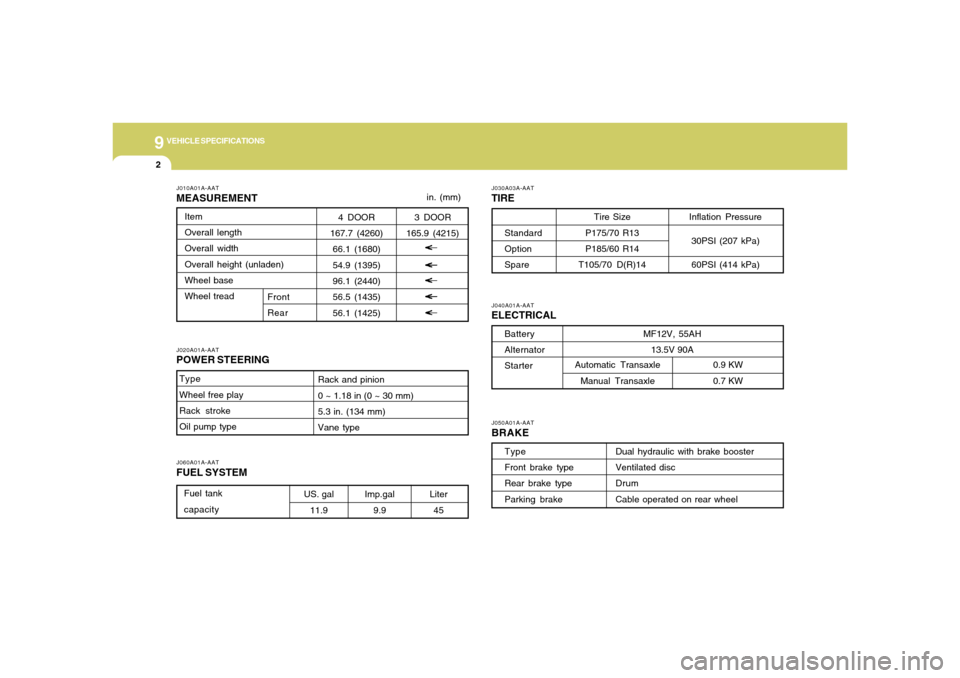
9
VEHICLE SPECIFICATIONS2
Tire Size
P175/70 R13
P185/60 R14
T105/70 D(R)14 in. (mm)
Liter
45Automatic Transaxle
Manual Transaxle
MF12V, 55AH
13.5V 90A
Dual hydraulic with brake booster
Ventilated disc
Drum
Cable operated on rear wheel
Standard
Option
Spare
US. gal
11.9 Fuel tank
capacityImp.gal
9.9Battery
Alternator
Starter0.9 KW
0.7 KW
Type
Front brake type
Rear brake type
Parking brake
Inflation Pressure
30PSI (207 kPa)
60PSI (414 kPa)
J010A01A-AATMEASUREMENTJ020A01A-AATPOWER STEERINGJ060A01A-AATFUEL SYSTEM
J040A01A-AATELECTRICALJ050A01A-AATBRAKEJ030A03A-AATTIRE
4 DOOR
167.7 (4260)
66.1 (1680)
54.9 (1395)
96.1 (2440)
56.5 (1435)
56.1 (1425) Item
Overall length
Overall width
Overall height (unladen)
Wheel base
Wheel tread
Front
Rear
3 DOOR
165.9 (4215)
Type
Wheel free play
Rack stroke
Oil pump type
Rack and pinion
0 ~ 1.18 in (0 ~ 30 mm)
5.3 in. (134 mm)
Vane type
Page 217 of 219

10
INDEX
5
Precautions..................................................................................1-16
Spark Plugs........................................................................................ 6-8
Speedometer....................................................................................1-43
Starting Procedures........................................................................... 2-5
Steering Wheel
Free-play.....................................................................................6-17
Stereo Sound System.....................................................................1-74
Sun Visor..........................................................................................1-63
T
Tachometer......................................................................................1-43
Tailgate .............................................................................................1-62
Theft-Alarm System........................................................................... 1-7
Tires
Balancing.....................................................................................8-11
Chains.........................................................................................8-10
Changing a flat tire ....................................................................... 3-7
If you have a flat tire .................................................................... 3-6
Information.................................................................................... 8-2
Pressure (see glove box) ............................................................ 8-3
Replacement...............................................................................8-11
Rotation.......................................................................................8-10
Snow tires..................................................................................... 8-9
Spare tire....................................................................................... 3-5
Traction.......................................................................................8-11
Towing
Emergency..................................................................................3-14
If your car must be towed .........................................................3-12Trailer towing..............................................................................2-16
Transaxle
Automatic....................................................................................... 2-7
Automatic transaxle fluid checking ............................................6-12
Manual........................................................................................... 2-5
Manual transaxle oil checking...................................................6-11
Trip Computer..................................................................................1-44
Trunk
Emergency latch release ...........................................................1-62
Remote release..........................................................................1-61
V
Vehicle Identification Number (VIN) ................................................. 8-2
Vehicle Load Limt ............................................................................2-16
Vehicle Specifications
Engine ............................................................................................ 9-3
Lubrication Chart.......................................................................... 9-4
Measurement................................................................................ 9-2
W
Warning and Indicatior Lights .........................................................
1-39
Windows
Manual........................................................................................... 1-9
Power..........................................................................................1-10
Windshield Wiper and Washer ........................................................1-48
Adjustable intermittent wiper operation.....................................1-49
Windshield Wiper Blades ............................................................6-10
Page 219 of 219

Seoul KoreaPrinting: JUN. 23, 2005
Publication No.: A25O-EU56N
Printed in KoreaSERVICE STATION INFORMATION
FUEL:
UNLEADED gasoline only
Pump Octane Rating of 87 (Research Octane Number 91) or higher.
FUEL TANK CAPACITY
Original, US.gal (Imp.gal., liter) 11.9 (9.9, 45)
TIRE PRESSURE:
See the label in the glove box.
OTHER TIRE INFORMATION:
See pages 8-1 through 8-12
HOOD RELEASE:
Pull handle under left side of dash.
ENGINE OIL:
API grade SJ, SL or ABOVE / ILSAC grade GF-3 or ABOVE and fuel
efficient oil. Use SAE 5W-20, 5W-30 or 10W-30 if normal tempera-
tures are above 0°F (-18°C). For other viscosity recommendations,
see page 6-4 or 9-4.MANUAL TRANSAXLE:
HYUNDAI GENUINE PARTS MTF 75W/85 (API GL-4) Oil level
should be up to filler-bolt hole in housing beside differential.
AUTOMATIC TRANSAXLE:
Apply the parking brake, with the engine running, shift the selector lever
through all ranges and return to “N” (Neutral) position. Then check the
level of fluid on the dipstick. Use only HYUNDAI GENUINE ATF
SP III, DIAMOND ATF SP III, SK ATF SP III or other brands meeting
the SP III specification approved by Hyundai Motor Co..
QUICK INDEX
o Car will not start .................................................................... 3-2
o Flat tire ................................................................................. 3-6
o Warning light/chime comes on .................................... 1-39 ~ 1-42
o Engine overheats ................................................................... 3-4
o Towing of your vehicle ......................................................... 3-11
o Starting the engine ................................................................. 2-4
o Driving tips for first 1,200 miles (2,000 km) .......................... 1-3
o Scheduled maintenance ......................................................... 5-4
o Reporting safety defects ...................................................... 8-14