overheating Hyundai Accent 2006 User Guide
[x] Cancel search | Manufacturer: HYUNDAI, Model Year: 2006, Model line: Accent, Model: Hyundai Accent 2006Pages: 599, PDF Size: 17.59 MB
Page 513 of 599

2
DRIVING YOUR HYUNDAI
23
11. Avoid jerky starts, sudden accel- eration or sudden stops.
12. Avoid sharp turns and rapid lane changes.
13. Avoid holding the brake pedal down
too long or too frequently. This could cause the brakes to over- heat, resulting in reduced brakingefficiency.
14. When going down a hill, shift into a
lower gear and use the enginebraking effect. When ascending a long grade, downshift the transaxle to a lowergear and reduce speed to reduce chances of engine overloading and/ or overheating.
15. If you have to stop whilst going uphill, do not hold the vehicle inplace by pressing on the accelera-tor. This can cause the automatic transaxle to overheat. Use the park- ing brake or footbrake.
NOTE: When towing check transaxle fluid more frequently. CAUTION:
If overheating should occur when towing, (temperature gauge reads near red zone), taking the following action may reduce or eliminate theproblem.
1. Turn off the air conditioner.
2. Reduce highway speed.
3. Select a lower gear when going uphill.
4. Whilst in stop and go traffic, place the gear selection in park or neu- tral and idle the engine at a higherspeed.
!
Page 518 of 599
3
IN CASE OF EMERGENCY
5IF THE ENGINE OVERHEATS
!
!
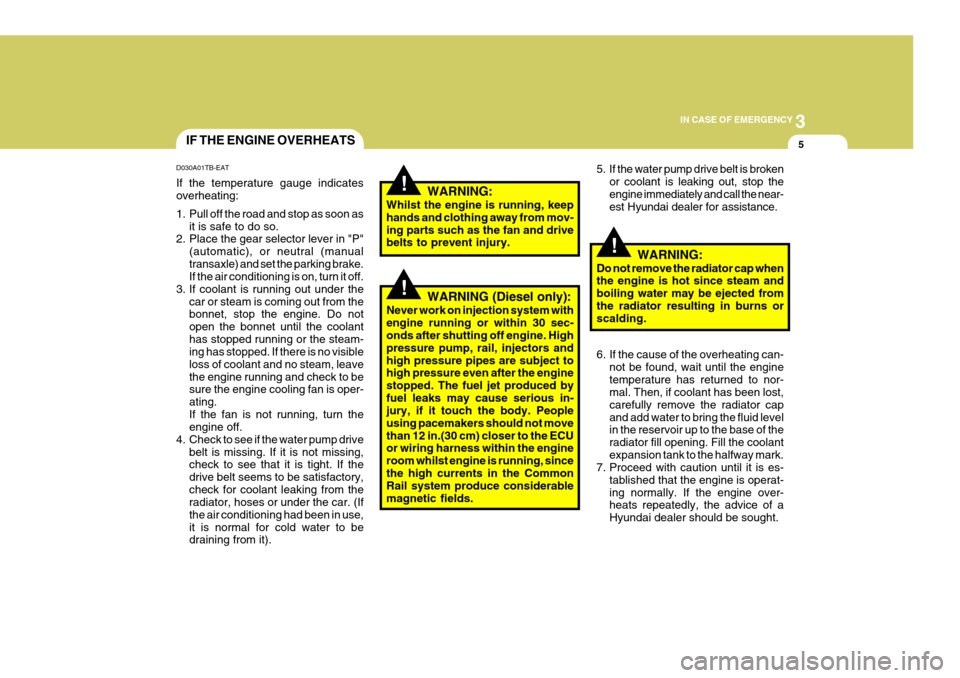
D030A01TB-EAT If the temperature gauge indicates overheating:
1. Pull off the road and stop as soon as
it is safe to do so.
2. Place the gear selector lever in "P"
(automatic), or neutral (manual transaxle) and set the parking brake. If the air conditioning is on, turn it off.
3. If coolant is running out under the car or steam is coming out from thebonnet, stop the engine. Do not open the bonnet until the coolanthas stopped running or the steam- ing has stopped. If there is no visible loss of coolant and no steam, leavethe engine running and check to be sure the engine cooling fan is oper- ating.If the fan is not running, turn the engine off.
4. Check to see if the water pump drive belt is missing. If it is not missing,check to see that it is tight. If the drive belt seems to be satisfactory,check for coolant leaking from the radiator, hoses or under the car. (If the air conditioning had been in use,it is normal for cold water to be draining from it). WARNING:
Whilst the engine is running, keep hands and clothing away from mov-ing parts such as the fan and drive belts to prevent injury.
WARNING (Diesel only):
Never work on injection system with engine running or within 30 sec- onds after shutting off engine. High pressure pump, rail, injectors andhigh pressure pipes are subject to high pressure even after the engine stopped. The fuel jet produced byfuel leaks may cause serious in- jury, if it touch the body. People using pacemakers should not movethan 12 in.(30 cm) closer to the ECU or wiring harness within the engine room whilst engine is running, sincethe high currents in the Common Rail system produce considerable magnetic fields. 5. If the water pump drive belt is broken
or coolant is leaking out, stop theengine immediately and call the near- est Hyundai dealer for assistance.
!WARNING:
Do not remove the radiator cap when the engine is hot since steam and boiling water may be ejected fromthe radiator resulting in burns or scalding.
6. If the cause of the overheating can- not be found, wait until the engine temperature has returned to nor- mal. Then, if coolant has been lost, carefully remove the radiator capand add water to bring the fluid level in the reservoir up to the base of the radiator fill opening. Fill the coolantexpansion tank to the halfway mark.
7. Proceed with caution until it is es-
tablished that the engine is operat-ing normally. If the engine over- heats repeatedly, the advice of a Hyundai dealer should be sought.
Page 552 of 599
6OWNER MAINTENANCE
10
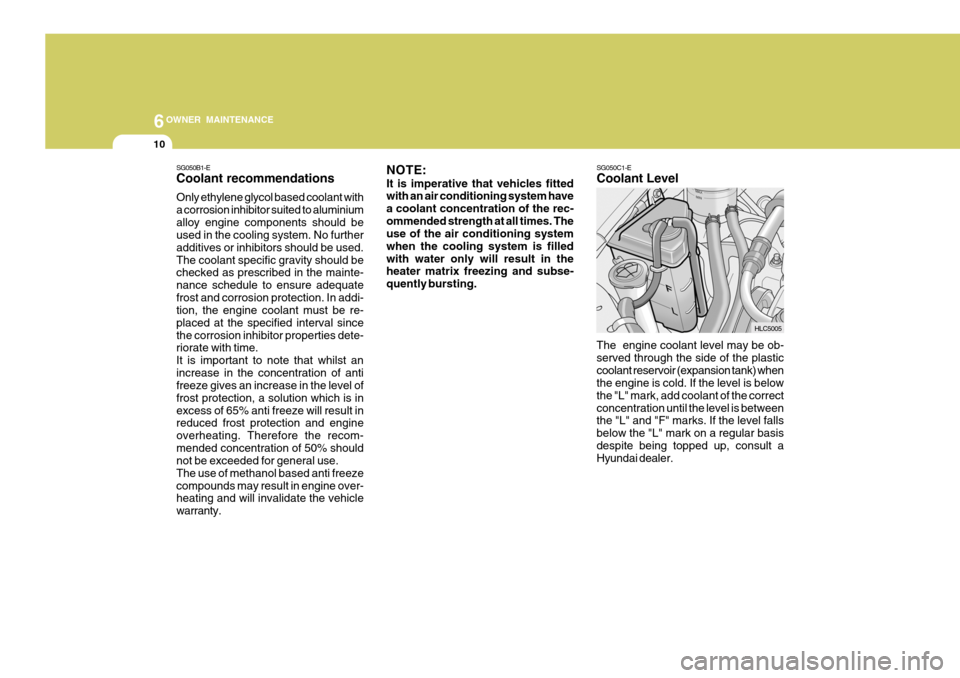
NOTE: It is imperative that vehicles fitted with an air conditioning system have a coolant concentration of the rec-ommended strength at all times. The use of the air conditioning system when the cooling system is filledwith water only will result in the heater matrix freezing and subse- quently bursting. SG050C1-E Coolant Level The engine coolant level may be ob- served through the side of the plasticcoolant reservoir (expansion tank) when the engine is cold. If the level is below the "L" mark, add coolant of the correctconcentration until the level is between the "L" and "F" marks. If the level falls below the "L" mark on a regular basisdespite being topped up, consult a Hyundai dealer.
SG050B1-E Coolant recommendations Only ethylene glycol based coolant with a corrosion inhibitor suited to aluminiumalloy engine components should be used in the cooling system. No further additives or inhibitors should be used.The coolant specific gravity should be checked as prescribed in the mainte- nance schedule to ensure adequatefrost and corrosion protection. In addi- tion, the engine coolant must be re- placed at the specified interval sincethe corrosion inhibitor properties dete- riorate with time. It is important to note that whilst anincrease in the concentration of anti freeze gives an increase in the level of frost protection, a solution which is inexcess of 65% anti freeze will result in reduced frost protection and engine overheating. Therefore the recom-mended concentration of 50% should not be exceeded for general use. The use of methanol based anti freezecompounds may result in engine over- heating and will invalidate the vehicle warranty.
HLC5005
Page 588 of 599
8
CONSUMER INFORMATION
3TYRE INFORMATION
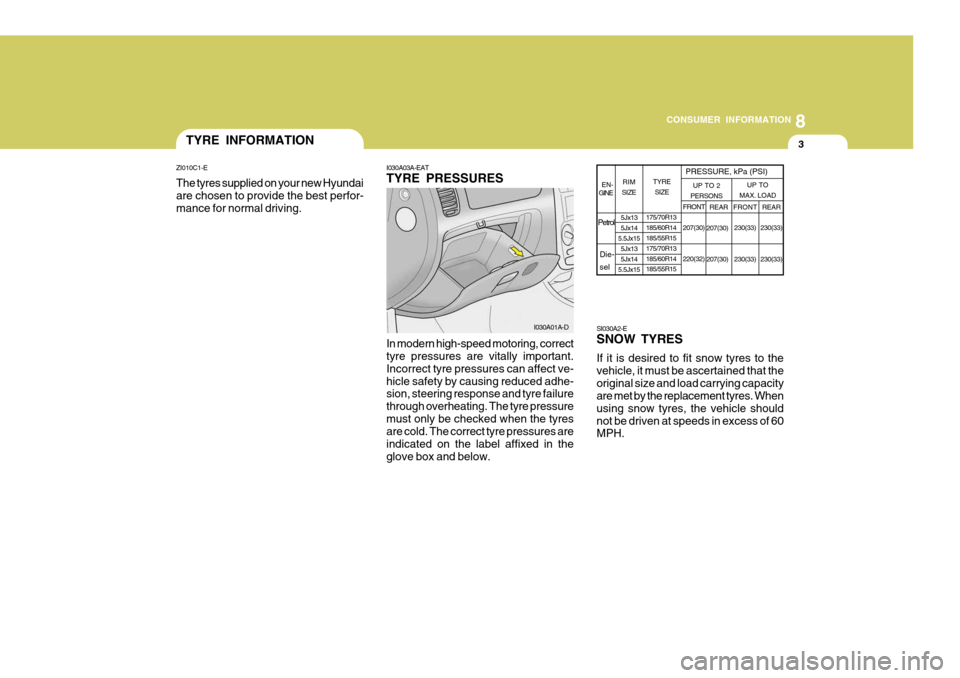
ZI010C1-E The tyres supplied on your new Hyundai are chosen to provide the best perfor- mance for normal driving. I030A03A-EAT TYRE PRESSURES In modern high-speed motoring, correct tyre pressures are vitally important. Incorrect tyre pressures can affect ve-hicle safety by causing reduced adhe- sion, steering response and tyre failure through overheating. The tyre pressuremust only be checked when the tyres are cold. The correct tyre pressures are indicated on the label affixed in theglove box and below.I030A01A-D
5Jx13 5Jx14
5.5Jx15 5Jx135Jx14
5.5Jx15 TYRE
SIZE
RIM
SIZE PRESSURE, kPa (PSI)
175/70R13185/60R14185/55R15175/70R13185/60R14 185/55R15 REAR
207(30) 207(30) FRONT
230(33) 230(33)
UP TO 2
PERSONS UP TO
MAX. LOAD
REAR
230(33)230(33)
FRONT 207(30) 220(32)
EN-
GINE
Die- sel
Petrol
SI030A2-E SNOW TYRES If it is desired to fit snow tyres to the vehicle, it must be ascertained that theoriginal size and load carrying capacity are met by the replacement tyres. When using snow tyres, the vehicle shouldnot be driven at speeds in excess of 60 MPH.