weight Hyundai Accent 2006 User Guide
[x] Cancel search | Manufacturer: HYUNDAI, Model Year: 2006, Model line: Accent, Model: Hyundai Accent 2006Pages: 599, PDF Size: 17.59 MB
Page 425 of 599

1CONTROLS AND EQUIPMENT
18
SB090E1-E Injured Persons A seat belt should be used when an injured person is being transported. Forspecific recommendations, the advice of a qualified Medical Practioner should be sought. SB090F1-E Seat Belt Occupancy The seat belts are designed to be used by one seat occupant only. The use of a seat belt by more than one person increases the levels of injury whichmay be sustained in the event of an accident. SE090G1-E Do Not Lie Down To ensure that the maximum level of protection may be afforded by the seat belt system, all passengers should besitting in an upright position throughout the journey. The seat belt will be unable to afford maximum protection if thefront seats are at or near the fully reclined position.
SB090C1-E Larger Children Larger children should occupy the rear seat and be restrained at all times. Therestraint may take the form of a special safety belt or the original factory fitted seat belt used in conjunction with anapproved booster cushion depending upon the size and weight of the child. Under no circumstances should chil-dren be allowed to travel standing, kneel- ing or lying on the seat. Never allow children to ride in the frontpassenger seat. SB090O1-E Pregnant Women The use of a seat belt is recommended for pregnant women. The seat belt should be worn as low and snugly as possible across the hips, not across the abdo-men. A qualified Medical Practitioner should be consulted for further informa- tion.SEAT BELT
SB090A1-E SEAT BELT PRECAUTIONS Seat belts should be worn at all times by all occupants front and rear. Thepossibility of injury or the severity of injuries suffered in the event of an accident will be greatly reduced by thewearing of seat belts. In addition the following recommenda- tions should be observed. SB090B1-E Babies/Small Children Babies and small children must be restrained using a restraint system spe-cifically designed for this purpose. Un- der no circumstances should a child be carried in the vehicle without the use ofa suitable restraint which meets the regulations in force in the country where the vehicle is in operation.
Page 461 of 599
1CONTROLS AND EQUIPMENT
54
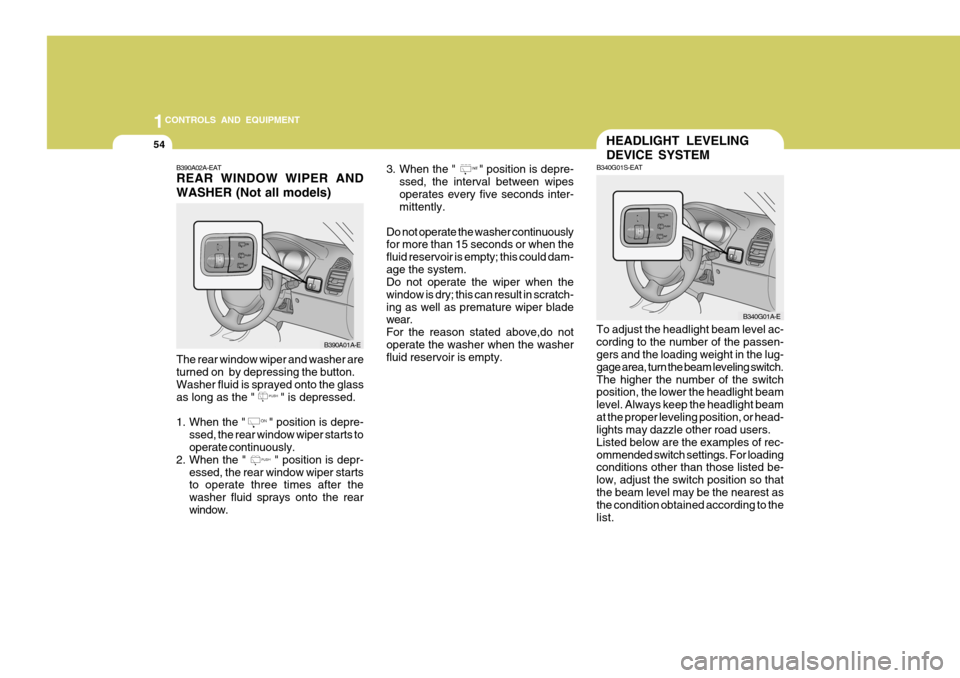
3. When the " " position is depre-
ssed, the interval between wipes operates every five seconds inter- mittently.
Do not operate the washer continuouslyfor more than 15 seconds or when the fluid reservoir is empty; this could dam-age the system. Do not operate the wiper when the window is dry; this can result in scratch-ing as well as premature wiper blade wear. For the reason stated above,do notoperate the washer when the washer fluid reservoir is empty.B390A02A-EAT REAR WINDOW WIPER AND WASHER (Not all models)
B390A01A-E
The rear window wiper and washer are turned on by depressing the button. Washer fluid is sprayed onto the glass
as long as the " " is depressed.
1. When the " " position is depre- ssed, the rear window wiper starts to operate continuously.
2. When the " " position is depr- essed, the rear window wiper startsto operate three times after the washer fluid sprays onto the rearwindow.
HEADLIGHT LEVELING DEVICE SYSTEM
B340G01S-EAT
To adjust the headlight beam level ac- cording to the number of the passen- gers and the loading weight in the lug- gage area, turn the beam leveling switch.The higher the number of the switch position, the lower the headlight beam level. Always keep the headlight beamat the proper leveling position, or head- lights may dazzle other road users. Listed below are the examples of rec-ommended switch settings. For loading conditions other than those listed be- low, adjust the switch position so thatthe beam level may be the nearest as the condition obtained according to the list. B340G01A-E
Page 497 of 599
2
DRIVING YOUR HYUNDAI
7FUEL ECONOMY
!
!
C055B01B-GAT STARTING AND STOPPING THE ENGINE FOR TURBO CHARGERINTERCOOLER (DIESEL EN-GINE)
(1) Do not race the engine or sudden
accelerate the engine immediately after start it. If the engine is cold,allow the engine to idle for several seconds before it is driven to en- sure sufficient lubrication of theturbo charger unit.
(2) After high speed or extended driv-
ing, requiring a heavy engine load,the engine should be allowed to idle about 1 minute before turning it off. This idle time will allow the turbocharger to cool prior to shutting the engine off.
WARNING:
Do not turn the engine off immedi-ately after it has been subjected to a heavy load. Doing so may causesevere damage to the engine or turbo charger unit.
WARNING:
Be sure that the clutch is fully de-pressed when starting a manual transaxle vehicle. Otherwise thereis the potential to cause damage to the vehicle or injury to someone inside or outside the vehicle as aresult of the forward or backward movement of the vehicle that will occur if the clutch is not depressedwhen the vehicle is started. SC060B1-E The following suggestions are made to assist in achieving the greatest degree of fuel economy.
o Maintaining a constant check on
fuel consumption will enable the most economical use pattern anddriving style to be adopted.
o Avoid using the vehicle for very
short journeys if possible, particu-larly when a cold start is involved.
o Ensure that tyre pressures are main-
tained at the correct level.
o Use only the recommended grade of fuel.
o Avoid carrying unnecessary weight, and if a roof rack is in use, remove it as soon as possible after use.
o Anticipate the road and conditions ahead to enable adjustments inspeed to be made smoothly. Avoid heavy acceleration and sharp brak-ing.
o Avoid cruising at unnecessary high
speeds.
5. Turn the ignition key to the "START"
position and release it when theengine starts.
Page 506 of 599

2DRIVING YOUR HYUNDAI
16DRIVING FOR ECONOMY
nance schedule in Section 5. If you drive your car in severe conditions,more frequent maintenance is re- quired (see Section 5 for details).
o Keep your car clean. For maximum
service, your car should be keptclean and free of corrosive materi- als. It is especially important thatmud, dirt, ice, etc. not be allowed to accumulate on the underside of the car. This extra weight can result inincreased fuel consumption and also contribute to corrosion.
o Travel lightly. Don't carry unneces- sary weight in your car. Weight is anenemy of good fuel economy.
o Don't let the engine idle longer than necessary. If you are waiting (andnot in traffic), turn off your engine and restart only when you're readyto go.
o Remember, your car does not re-
quire extended warm-up. As soonas the engine is running smoothly, you can drive away. In very cold weather, however, give your enginea slightly longer warm-up period.
C140A01A-EAT You can save fuel and get more miles from your car if you follow these sug- gestions:
o Drive smoothly. Accelerate at a
moderate rate. Don't make "jack- rabbit" starts or full-throttle shiftsand maintain a steady cruising speed. Don't race between stop- lights. Try to adjust your speed tothat of the other traffic so you don't have to change speeds unneces- sarily. Avoid heavy traffic wheneverpossible. Always maintain a safe distance from other vehicles so you can avoidunnecessary braking. This also re- duces brake wear.
o Drive at a moderate speed. The faster you drive, the more fuel yourcar uses. Driving at a moderate speed, especially on the highway, isone of the most effective ways to reduce fuel consumption. o Don't "ride" the brake or clutch pedal.
This can increase fuel consumption and also increase wear on these components. In addition, driving with your foot resting on the brake pedalmay cause the brakes to overheat, which reduces their effectiveness and may lead to more serious con-sequences.
o Take care of your tyres. Keep them
inflated to the recommended pres-sure. Incorrect inflation, either too much or too little, results in unnec- essary tyre wear. Check the tyrepressures at least once a month.
o Be sure that the wheels are aligned
correctly. Improper alignment canresult from hitting curbs or driving too fast over irregular surfaces. Poor alignment causes faster tyre wearand may also result in other prob- lems as well as greater fuel con- sumption.
o Keep your car in good condition. For better fuel economy and reducedmaintenance costs, maintain yourcar in accordance with the mainte-
Page 509 of 599
2
DRIVING YOUR HYUNDAI
19
o The formation of snow or ice built up inside the wheel arches may inter- fere with the road wheels or steering mechanism. In such instances, un- usual noises or an increase in steer-ing effort may result. Therefore, ensure that the wheel arches are checked periodically and any accu-mulated snow or ice removed.
o It is advisable to carry emergency
equipment including, torch, shovel,tow rope, blankets etc., if a journey is to be undertaken into areas of severe road conditions.TRAILER AND CARAVAN TOWING
!
C195F01A-EAT TOWING ATTACHMENTS It is strongly recommended that only an Hyundai Approved towing attach-ment is used to ensure that the loads placed upon the body structure are correctly distributed. The use of a nonapproved attachment will result in the invalidation of the vehicle warranty. Hyundai towing attachments are de-signed and constructed to ensure maximum towing performance and ease of fitment. A range of accesso-ries including electrical kits are avail- able through the Hyundai dealer net- work. It is of the utmost importance that those areas of the vehicle which aresubjected to greater stress during tow- ing are maintained in accordance with the recommendations given at the endof this book. In addition, the daily oper- ating checks relating to engine oil, transmission oil and tyres must beperformed at each refuelling to ensure maximum reliability and safety.
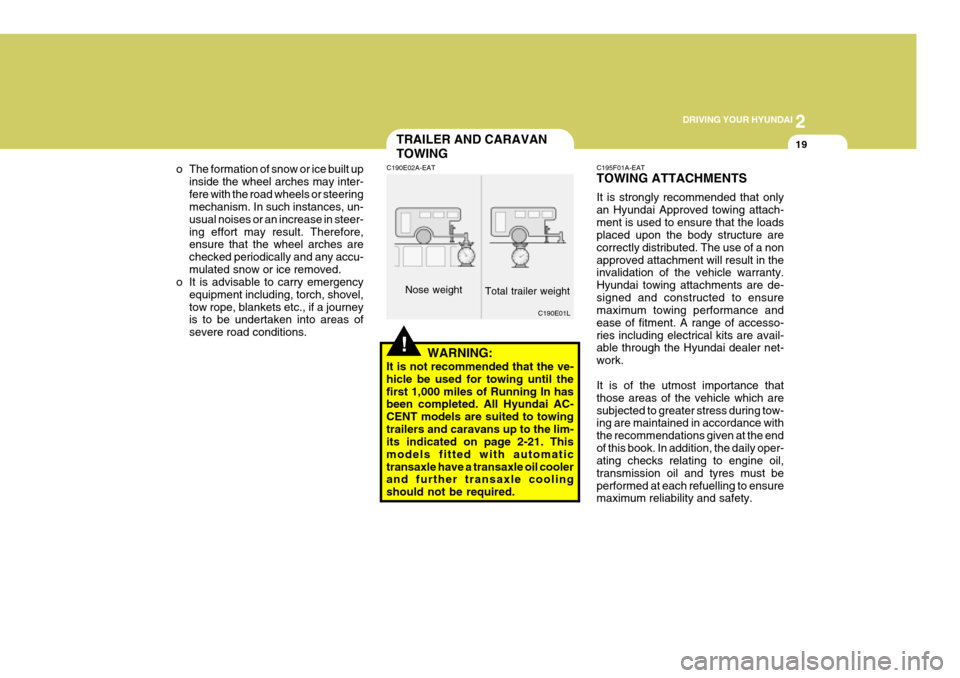
C190E02A-EAT
WARNING:
It is not recommended that the ve- hicle be used for towing until thefirst 1,000 miles of Running In has been completed. All Hyundai AC- CENT models are suited to towingtrailers and caravans up to the lim- its indicated on page 2-21. This models fitted with automatictransaxle have a transaxle oil cooler and further transaxle cooling should not be required. C190E01L
Nose weight
Total trailer weight
Page 510 of 599
2DRIVING YOUR HYUNDAI
20
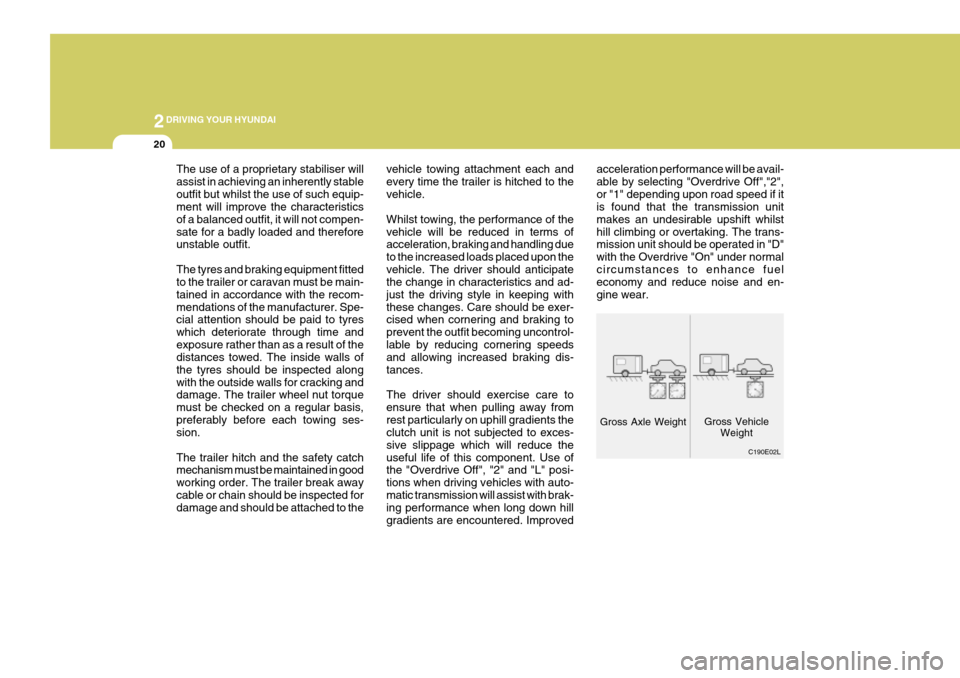
vehicle towing attachment each and every time the trailer is hitched to thevehicle. Whilst towing, the performance of the vehicle will be reduced in terms of acceleration, braking and handling due to the increased loads placed upon thevehicle. The driver should anticipate the change in characteristics and ad- just the driving style in keeping withthese changes. Care should be exer- cised when cornering and braking to prevent the outfit becoming uncontrol-lable by reducing cornering speeds and allowing increased braking dis- tances. The driver should exercise care to ensure that when pulling away fromrest particularly on uphill gradients the clutch unit is not subjected to exces- sive slippage which will reduce theuseful life of this component. Use of the "Overdrive Off", "2" and "L" posi- tions when driving vehicles with auto-matic transmission will assist with brak- ing performance when long down hill gradients are encountered. Improved acceleration performance will be avail-able by selecting "Overdrive Off","2",or "1" depending upon road speed if it is found that the transmission unit makes an undesirable upshift whilsthill climbing or overtaking. The trans- mission unit should be operated in "D" with the Overdrive "On" under normalcircumstances to enhance fuel economy and reduce noise and en- gine wear.
C190E02L
Gross Axle Weight
Gross Vehicle
Weight
The use of a proprietary stabiliser willassist in achieving an inherently stableoutfit but whilst the use of such equip- ment will improve the characteristics of a balanced outfit, it will not compen-sate for a badly loaded and therefore unstable outfit. The tyres and braking equipment fitted to the trailer or caravan must be main- tained in accordance with the recom-mendations of the manufacturer. Spe- cial attention should be paid to tyres which deteriorate through time andexposure rather than as a result of the distances towed. The inside walls of the tyres should be inspected alongwith the outside walls for cracking and damage. The trailer wheel nut torque must be checked on a regular basis,preferably before each towing ses- sion. The trailer hitch and the safety catch mechanism must be maintained in good working order. The trailer break awaycable or chain should be inspected for damage and should be attached to the
Page 511 of 599
2
DRIVING YOUR HYUNDAI
21
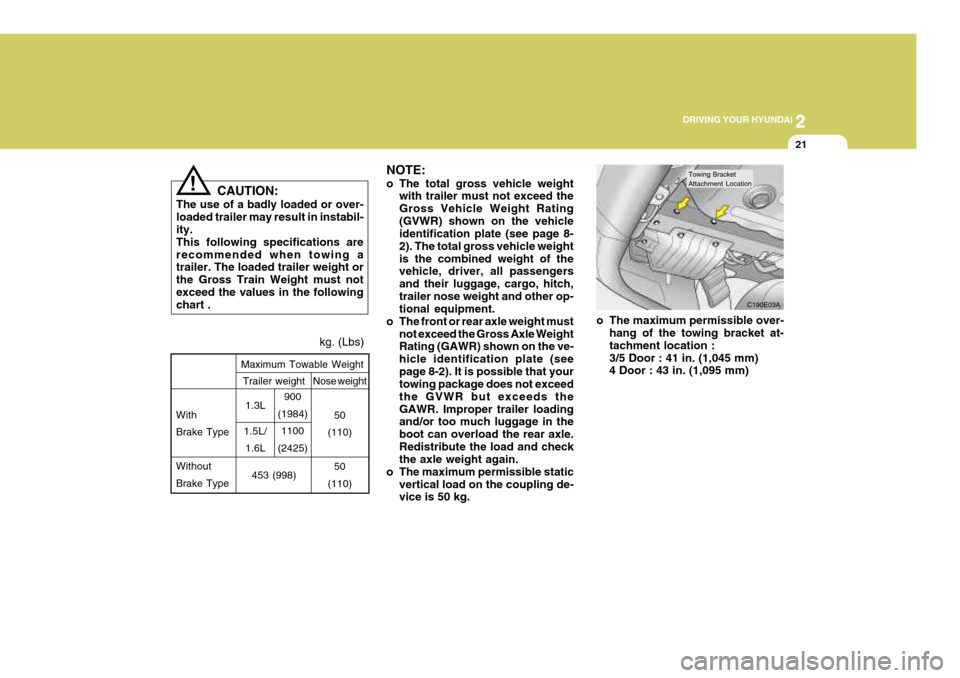
Maximum Towable Weight kg. (Lbs)
1.3L
1.5L/ 1.6L 900
(1984) 1100
(2425)
453 (998)
Trailer weight
Nose weight
50
(110)
50
(110)
With Brake Type Without Brake Type
CAUTION:
The use of a badly loaded or over- loaded trailer may result in instabil- ity. This following specifications arerecommended when towing a trailer. The loaded trailer weight or the Gross Train Weight must notexceed the values in the following chart .!
C190E03A
NOTE:
o The total gross vehicle weight
with trailer must not exceed the Gross Vehicle Weight Rating(GVWR) shown on the vehicle identification plate (see page 8- 2). The total gross vehicle weightis the combined weight of the vehicle, driver, all passengers and their luggage, cargo, hitch,trailer nose weight and other op- tional equipment.
o The front or rear axle weight must not exceed the Gross Axle WeightRating (GAWR) shown on the ve- hicle identification plate (seepage 8-2). It is possible that your towing package does not exceed the GVWR but exceeds theGAWR. Improper trailer loading and/or too much luggage in the boot can overload the rear axle.Redistribute the load and check the axle weight again.
o The maximum permissible static vertical load on the coupling de-vice is 50 kg. o The maximum permissible over-
hang of the towing bracket at-tachment location : 3/5 Door : 41 in. (1,045 mm) 4 Door : 43 in. (1,095 mm) Towing Bracket Attachment Location
Page 512 of 599

2DRIVING YOUR HYUNDAI
22
7. The vehicle/trailer combination ismore affected by crosswind and buffeting. When being passed by a large vehicle, keep a constant speedand steer straight ahead. If there is too much wind buffeting slow down to get out of the other vehicle's airturbulence.
8. When parking your car and trailer,
especially on a hill, be sure tofollow all the normal precautions. Turn your front wheel into the curb, set the parking brake firmly, andput the transaxle in 1st or Reverse (manual) or Park (automatic). In addition, place wheel chocks ateach of the trailer's tyres.
9. If the trailer has electric brakes,
start your vehicle and trailer mov-ing, and then apply the trailer brake controller by hand to be sure the brakes are working. This lets youcheck your electrical connection at the same time.
10. During your trip, check occasion- ally to be sure that the load issecure, and that the lights and any trailer brakes are still working.
C190F02A-EAT Trailer or Vehicle Towing Tips
1. Before towing, check towbar hitch
and safety cable connections as well as proper operation of the trailer running lights, brake lights, and turn signals.
2. Always drive your vehicle at a mod- erate speed (Less than 60 MPH)
3. Trailer towing requires more fuel than normal conditions.
4. To maintain engine braking effi-
ciency and electrical charging per-formance, do not use fifth gear (manual transaxle) or overdrive (automatic transaxle).
5. Always secure items in the trailer to prevent load shift whilst driving.
6. Check the condition and air pres- sure of all tyres on the trailer and your car. Low tyre pressure can seriously affect the handling. Alsocheck the spare tyre.
C190G01A-EAT Important Trailer Weight Infor- mation The Maximum Towable Weight of your Hyundai Accent will be reduced if thevehicle is load. The Maximum Towable Weight for a fully load is vehicle is calculated asfollows:
1. Find the Vehicle Identification Num-
ber (VIN) plate (see section 8).
2. Note the top 2 weights (in kg) of the
4 lines of weight information on the VIN plate.
3. Subtract the weight on line 1 from
line 2. This result (in kg) is themaximum towable weight of a fully loaded vehicle. For more information, contact yourlocal Hyundai Dealer.
Page 570 of 599
6OWNER MAINTENANCE
28HEADLIGHT AIMING ADJUSTMENT
!
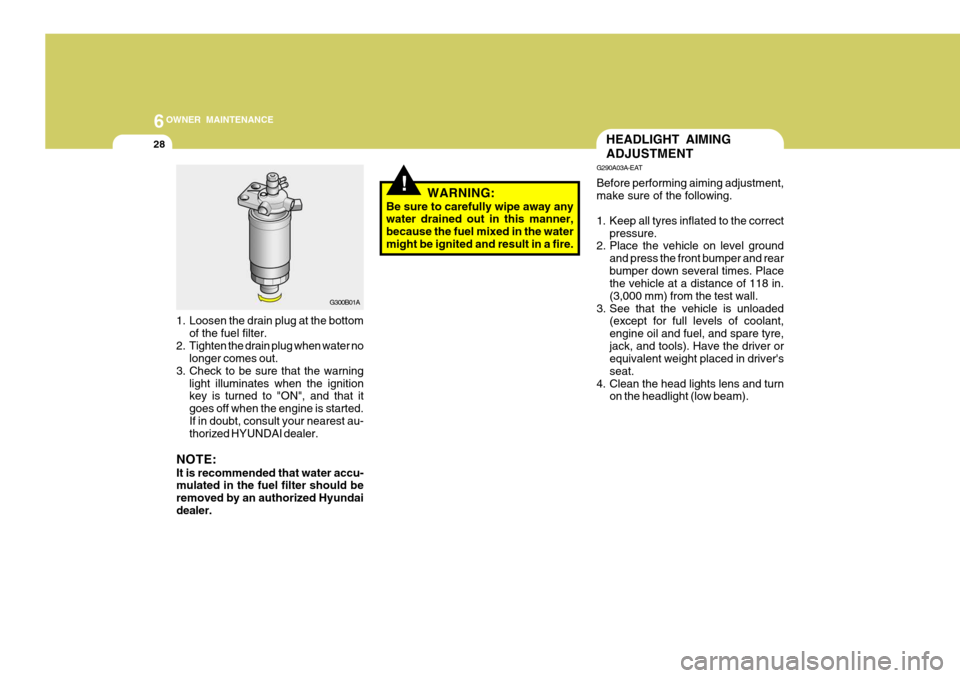
1. Loosen the drain plug at the bottom
of the fuel filter.
2. Tighten the drain plug when water no longer comes out.
3. Check to be sure that the warning light illuminates when the ignition key is turned to "ON", and that it goes off when the engine is started.If in doubt, consult your nearest au- thorized HYUNDAI dealer.
NOTE: It is recommended that water accu- mulated in the fuel filter should be removed by an authorized Hyundaidealer. WARNING:
Be sure to carefully wipe away any water drained out in this manner, because the fuel mixed in the watermight be ignited and result in a fire. G290A03A-EAT Before performing aiming adjustment, make sure of the following.
1. Keep all tyres inflated to the correct
pressure.
2. Place the vehicle on level ground
and press the front bumper and rear bumper down several times. Place the vehicle at a distance of 118 in. (3,000 mm) from the test wall.
3. See that the vehicle is unloaded (except for full levels of coolant,engine oil and fuel, and spare tyre,jack, and tools). Have the driver or equivalent weight placed in driver's seat.
4. Clean the head lights lens and turn on the headlight (low beam).
G300B01A