brakes Hyundai Accent 2006 Owner's Guide
[x] Cancel search | Manufacturer: HYUNDAI, Model Year: 2006, Model line: Accent, Model: Hyundai Accent 2006Pages: 599, PDF Size: 17.59 MB
Page 502 of 599
2DRIVING YOUR HYUNDAI
12
C090H01A-EAT NOTE:
o The brake pedal should be de-
pressed when shifting from NEU- TRAL to a forward or reversegear.
o The brake pedal fully depressed
in order to move the shift leverfrom the "P" (Park) position to any of the other positions.
o It is always possible to shift from "R", "N", "D", "2", "L" position to"P" position. The vehicle must be fully stopped to avoidtransaxle damage.
!
C090I02A-EAT
CAUTION:
o Shift into "R" and "P" only when the vehicle has completely stopped.
o Do not accelerate the engine in
reverse or any of the forwardpositions with the brakes applied.
o Always apply the footbrake when
shifting from "P" or "N", to "R","D", "2" or "L" position.
o Do not use the "P" (Park) posi-
tion in place of the parking brake.Always set the parking brake, shift the transaxle into "P" (Park) and turn off the ignition whenyou leave the vehicle, even mo- mentarily. Never leave the vehicle unattended whilst the engine isrunning.
o Check the automatic transaxle
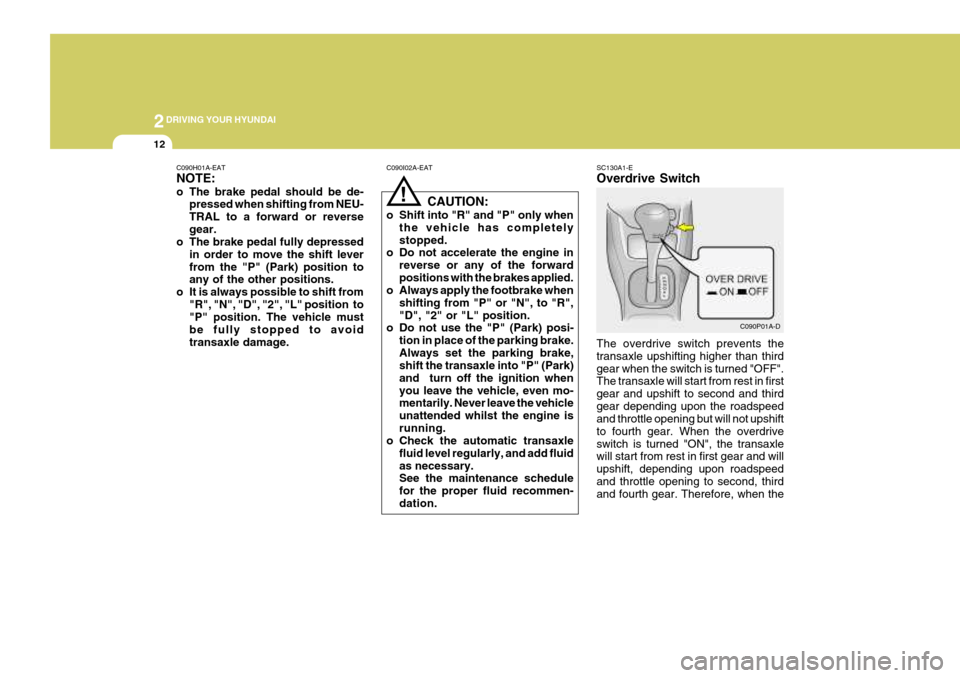
fluid level regularly, and add fluidas necessary. See the maintenance schedule for the proper fluid recommen-dation. SC130A1-E Overdrive Switch The overdrive switch prevents the transaxle upshifting higher than thirdgear when the switch is turned "OFF". The transaxle will start from rest in first gear and upshift to second and thirdgear depending upon the roadspeed and throttle opening but will not upshift to fourth gear. When the overdriveswitch is turned "ON", the transaxle will start from rest in first gear and will upshift, depending upon roadspeedand throttle opening to second, third and fourth gear. Therefore, when the
C090P01A-D
Page 504 of 599
2DRIVING YOUR HYUNDAI
14EFFECTIVE BRAKING
SC140A1-E Braking system performance and fric- tion material life are greatly affected by the driving style adopted. The follow- ing suggestions are made to assist inachieving the best results from the braking system.
o Anticipate the road and conditions ahead in order that heavy braking may be avoided.
o When descending long gradients, use the engine to assist in retardingthe vehicle to minimize the possibil-ity of brake fade occurring.
o When trailer towing, ensure that the
trailer brakes function correctly anduse engine braking to assist the vehicle braking system.
o Use only genuine Hyundai replace- ment brake pads and shoes to en-sure consistent friction characteris- tics and wear rates. o After driving through deep water
(e.g. fording), the brakes may be-come wet and performance reduced. Always check brake efficiency after emerging from the water and dry thebrakes by lightly depressing the brake pedal several times whilst driving slowly.
o Apply the parking brake only when the vehicle is at rest.
o Since the power assistance pro- vided by the brake servo is derived from the engine, coasting with the engine turned off or towing of thevehicle with the engine turned off will result in greatly increased pedal pressures being required to stop thevehicle.
o Do not hold the vehicle on the up-
grade with the accelerator pedal.This can cause the transmission to overheat. Always use the brake pedal or parking brake.
o The automatic transaxle may be
used to great effect if the vehiclebecomes stuck in snow or mud by allowing the vehicle to be rocked to and fro. The engine speed shouldbe held at approximately 1,000rpm by means of the accelerator pedal and the selector lever moved be-tween the "D" and "R" positions to induce a rocking motion.
o Do not depress the accelerator pedal
with the brakes applied and the se-lector at the "R", "D", "2" or "L" position.
o Turn the overdrive switch on for good fuel economy and smooth driv-ing. But if engine braking is neededin the "D" range or if repeated up- shifting and downshifting between the 3rd and 4th gear is needed whenclimbing a gentle slope, it is recom- mended that the overdrive switch be turned off. Turn the overdriveswitch back on immediately after- ward.
Page 505 of 599
2
DRIVING YOUR HYUNDAI
15ANTI-LOCK BRAKE SYSTEM
C120A02A-EAT (Not all models) The Anti-Lock Brake System (ABS) is designed to prevent wheel lock-upduring sudden braking or on hazard- ous road surfaces. The ABS control module monitors the wheel speed andcontrols the pressure applied to each brake. Thus, in emergency situations or on slick roads, ABS will increasevehicle control during braking. NOTE: During ABS operation, a slight pul- sation may be felt in the brake pedal when the brakes are applied. Also, a noise may be heard in the enginecompartment whilst braking. These conditions are normal and indicate that the anti-lock brake system isfunctioning properly.
These roads should be driven at reduced speeds. The safety features of an ABS equipped vehicle should not be tested by high speed drivingor cornering. This could endanger the safety of yourself or others.
WARNING:
ABS will not prevent accidents due to improper or dangerous driving manoeuvres. Even though vehiclecontrol is improved during emer- gency braking, always maintain a safe distance between you and ob-jects ahead. Vehicle speeds should always be reduced during extreme road conditions. The braking distance for cars equipped with an anti-lock brakingsystem may be longer than for those without it in the following road con- ditions.
o Driving on rough, gravel or snow- covered roads.
o Driving with tyre chains installed.
o Driving on roads where the road surface is pitted or has different surface height.!
Page 506 of 599
2DRIVING YOUR HYUNDAI
16DRIVING FOR ECONOMY
nance schedule in Section 5. If you drive your car in severe conditions,more frequent maintenance is re- quired (see Section 5 for details).
o Keep your car clean. For maximum
service, your car should be keptclean and free of corrosive materi- als. It is especially important thatmud, dirt, ice, etc. not be allowed to accumulate on the underside of the car. This extra weight can result inincreased fuel consumption and also contribute to corrosion.
o Travel lightly. Don't carry unneces- sary weight in your car. Weight is anenemy of good fuel economy.
o Don't let the engine idle longer than necessary. If you are waiting (andnot in traffic), turn off your engine and restart only when you're readyto go.
o Remember, your car does not re-
quire extended warm-up. As soonas the engine is running smoothly, you can drive away. In very cold weather, however, give your enginea slightly longer warm-up period.
C140A01A-EAT You can save fuel and get more miles from your car if you follow these sug- gestions:
o Drive smoothly. Accelerate at a
moderate rate. Don't make "jack- rabbit" starts or full-throttle shiftsand maintain a steady cruising speed. Don't race between stop- lights. Try to adjust your speed tothat of the other traffic so you don't have to change speeds unneces- sarily. Avoid heavy traffic wheneverpossible. Always maintain a safe distance from other vehicles so you can avoidunnecessary braking. This also re- duces brake wear.
o Drive at a moderate speed. The faster you drive, the more fuel yourcar uses. Driving at a moderate speed, especially on the highway, isone of the most effective ways to reduce fuel consumption. o Don't "ride" the brake or clutch pedal.
This can increase fuel consumption and also increase wear on these components. In addition, driving with your foot resting on the brake pedalmay cause the brakes to overheat, which reduces their effectiveness and may lead to more serious con-sequences.
o Take care of your tyres. Keep them
inflated to the recommended pres-sure. Incorrect inflation, either too much or too little, results in unnec- essary tyre wear. Check the tyrepressures at least once a month.
o Be sure that the wheels are aligned
correctly. Improper alignment canresult from hitting curbs or driving too fast over irregular surfaces. Poor alignment causes faster tyre wearand may also result in other prob- lems as well as greater fuel con- sumption.
o Keep your car in good condition. For better fuel economy and reducedmaintenance costs, maintain yourcar in accordance with the mainte-
Page 512 of 599

2DRIVING YOUR HYUNDAI
22
7. The vehicle/trailer combination ismore affected by crosswind and buffeting. When being passed by a large vehicle, keep a constant speedand steer straight ahead. If there is too much wind buffeting slow down to get out of the other vehicle's airturbulence.
8. When parking your car and trailer,
especially on a hill, be sure tofollow all the normal precautions. Turn your front wheel into the curb, set the parking brake firmly, andput the transaxle in 1st or Reverse (manual) or Park (automatic). In addition, place wheel chocks ateach of the trailer's tyres.
9. If the trailer has electric brakes,
start your vehicle and trailer mov-ing, and then apply the trailer brake controller by hand to be sure the brakes are working. This lets youcheck your electrical connection at the same time.
10. During your trip, check occasion- ally to be sure that the load issecure, and that the lights and any trailer brakes are still working.
C190F02A-EAT Trailer or Vehicle Towing Tips
1. Before towing, check towbar hitch
and safety cable connections as well as proper operation of the trailer running lights, brake lights, and turn signals.
2. Always drive your vehicle at a mod- erate speed (Less than 60 MPH)
3. Trailer towing requires more fuel than normal conditions.
4. To maintain engine braking effi-
ciency and electrical charging per-formance, do not use fifth gear (manual transaxle) or overdrive (automatic transaxle).
5. Always secure items in the trailer to prevent load shift whilst driving.
6. Check the condition and air pres- sure of all tyres on the trailer and your car. Low tyre pressure can seriously affect the handling. Alsocheck the spare tyre.
C190G01A-EAT Important Trailer Weight Infor- mation The Maximum Towable Weight of your Hyundai Accent will be reduced if thevehicle is load. The Maximum Towable Weight for a fully load is vehicle is calculated asfollows:
1. Find the Vehicle Identification Num-
ber (VIN) plate (see section 8).
2. Note the top 2 weights (in kg) of the
4 lines of weight information on the VIN plate.
3. Subtract the weight on line 1 from
line 2. This result (in kg) is themaximum towable weight of a fully loaded vehicle. For more information, contact yourlocal Hyundai Dealer.
Page 513 of 599

2
DRIVING YOUR HYUNDAI
23
11. Avoid jerky starts, sudden accel- eration or sudden stops.
12. Avoid sharp turns and rapid lane changes.
13. Avoid holding the brake pedal down
too long or too frequently. This could cause the brakes to over- heat, resulting in reduced brakingefficiency.
14. When going down a hill, shift into a
lower gear and use the enginebraking effect. When ascending a long grade, downshift the transaxle to a lowergear and reduce speed to reduce chances of engine overloading and/ or overheating.
15. If you have to stop whilst going uphill, do not hold the vehicle inplace by pressing on the accelera-tor. This can cause the automatic transaxle to overheat. Use the park- ing brake or footbrake.
NOTE: When towing check transaxle fluid more frequently. CAUTION:
If overheating should occur when towing, (temperature gauge reads near red zone), taking the following action may reduce or eliminate theproblem.
1. Turn off the air conditioner.
2. Reduce highway speed.
3. Select a lower gear when going uphill.
4. Whilst in stop and go traffic, place the gear selection in park or neu- tral and idle the engine at a higherspeed.
!
Page 527 of 599
3 IN CASE OF EMERGENCY
14IF YOU LOSE YOUR KEYS
D120A01A-EAT Information about the key of immobiliser system will be found on page 1-4.
The vehicle must not be towed atspeeds faster than 25 mph. or dis- tances greater than fifty miles. Thegeneral points regarding the steer- ing lock etc. described in the pre- ceding section (Manual transaxlevehicle) should be observed.
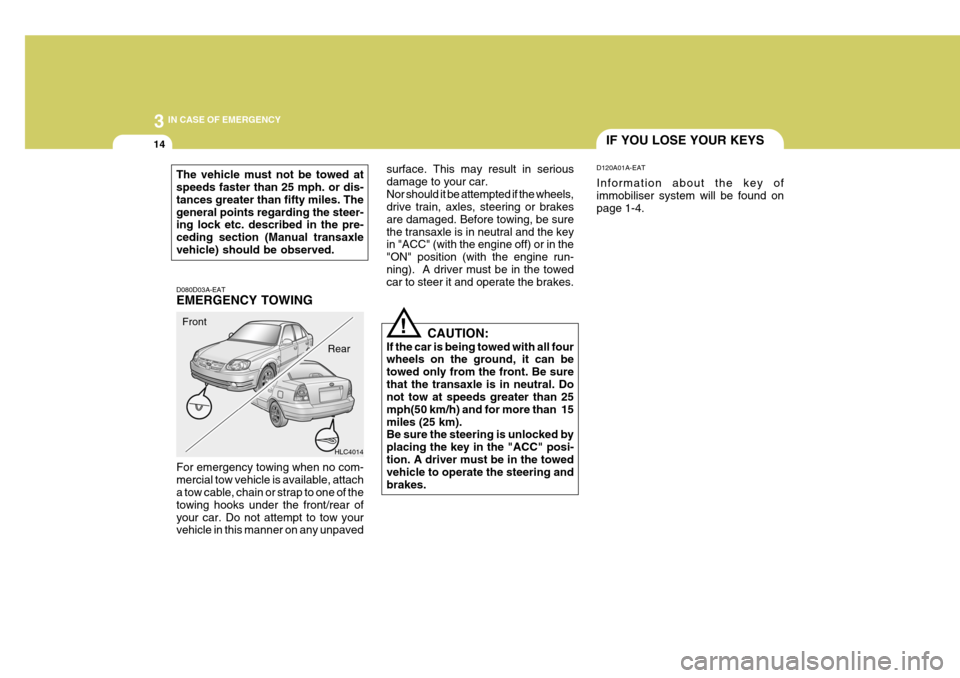
D080D03A-EAT EMERGENCY TOWING For emergency towing when no com- mercial tow vehicle is available, attach a tow cable, chain or strap to one of the towing hooks under the front/rear ofyour car. Do not attempt to tow your vehicle in this manner on any unpaved HLC4014surface. This may result in serious damage to your car.Nor should it be attempted if the wheels, drive train, axles, steering or brakes are damaged. Before towing, be surethe transaxle is in neutral and the key in "ACC" (with the engine off) or in the "ON" position (with the engine run-ning). A driver must be in the towed car to steer it and operate the brakes.
CAUTION:
If the car is being towed with all fourwheels on the ground, it can be towed only from the front. Be surethat the transaxle is in neutral. Do not tow at speeds greater than 25 mph(50 km/h) and for more than 15miles (25 km). Be sure the steering is unlocked by placing the key in the "ACC" posi-tion. A driver must be in the towed vehicle to operate the steering and brakes.
!
Front
Rear