clutch Hyundai Accent 2006 Owner's Guide
[x] Cancel search | Manufacturer: HYUNDAI, Model Year: 2006, Model line: Accent, Model: Hyundai Accent 2006Pages: 599, PDF Size: 17.59 MB
Page 499 of 599

2
DRIVING YOUR HYUNDAI
9
o When slippery conditions are en- countered, increased caution should be exercised when gear changing, braking or accelerat-ing. Abrupt changes in speed may cause a loss of traction or control of the vehicle.
o During cold weather, shifting may be difficult until the transaxle lu-bricant has warmed up. This isnormal and not harmful to the transaxle.
o If you've come to a complete stop and it's hard to shift into 1st orR(Reverse), put the shift lever in N(Neutral) position and releasethe clutch. Press the clutch pedal back down, and then shift into 1st or R(Reverse) gear position.
o Do not use the shift lever as a handrest during driving, as thiscan result in premature wear ofthe transaxle shift forks.
C070E03A-EAT Recommended Shift Points
1-2 2-33-4 4-5
Shift
from-to Recommended
15 mph (20 km/h) 25 mph (40 km/h) 35 mph (55 km/h) 45 mph (75 km/h)
The shift points as shown above are recommended for optimum fuel economy and performance.
C070B01A-EAT Using the Clutch The clutch should be pressed all the way to the floor before shifting, thenreleased slowly. The clutch pedal should always be used after fully re- turning to the original position. Do notrest your foot on the clutch pedal whilst driving. This can cause unnecessary wear.Do not partially engage the clutch to hold the car on an incline. This causes unnecessary wear.Use the parking brake to hold the car on an incline. Do not operate the clutch pedal rapidly and repeatedly.
Page 506 of 599
2DRIVING YOUR HYUNDAI
16DRIVING FOR ECONOMY
nance schedule in Section 5. If you drive your car in severe conditions,more frequent maintenance is re- quired (see Section 5 for details).
o Keep your car clean. For maximum
service, your car should be keptclean and free of corrosive materi- als. It is especially important thatmud, dirt, ice, etc. not be allowed to accumulate on the underside of the car. This extra weight can result inincreased fuel consumption and also contribute to corrosion.
o Travel lightly. Don't carry unneces- sary weight in your car. Weight is anenemy of good fuel economy.
o Don't let the engine idle longer than necessary. If you are waiting (andnot in traffic), turn off your engine and restart only when you're readyto go.
o Remember, your car does not re-
quire extended warm-up. As soonas the engine is running smoothly, you can drive away. In very cold weather, however, give your enginea slightly longer warm-up period.
C140A01A-EAT You can save fuel and get more miles from your car if you follow these sug- gestions:
o Drive smoothly. Accelerate at a
moderate rate. Don't make "jack- rabbit" starts or full-throttle shiftsand maintain a steady cruising speed. Don't race between stop- lights. Try to adjust your speed tothat of the other traffic so you don't have to change speeds unneces- sarily. Avoid heavy traffic wheneverpossible. Always maintain a safe distance from other vehicles so you can avoidunnecessary braking. This also re- duces brake wear.
o Drive at a moderate speed. The faster you drive, the more fuel yourcar uses. Driving at a moderate speed, especially on the highway, isone of the most effective ways to reduce fuel consumption. o Don't "ride" the brake or clutch pedal.
This can increase fuel consumption and also increase wear on these components. In addition, driving with your foot resting on the brake pedalmay cause the brakes to overheat, which reduces their effectiveness and may lead to more serious con-sequences.
o Take care of your tyres. Keep them
inflated to the recommended pres-sure. Incorrect inflation, either too much or too little, results in unnec- essary tyre wear. Check the tyrepressures at least once a month.
o Be sure that the wheels are aligned
correctly. Improper alignment canresult from hitting curbs or driving too fast over irregular surfaces. Poor alignment causes faster tyre wearand may also result in other prob- lems as well as greater fuel con- sumption.
o Keep your car in good condition. For better fuel economy and reducedmaintenance costs, maintain yourcar in accordance with the mainte-
Page 510 of 599
2DRIVING YOUR HYUNDAI
20
vehicle towing attachment each and every time the trailer is hitched to thevehicle. Whilst towing, the performance of the vehicle will be reduced in terms of acceleration, braking and handling due to the increased loads placed upon thevehicle. The driver should anticipate the change in characteristics and ad- just the driving style in keeping withthese changes. Care should be exer- cised when cornering and braking to prevent the outfit becoming uncontrol-lable by reducing cornering speeds and allowing increased braking dis- tances. The driver should exercise care to ensure that when pulling away fromrest particularly on uphill gradients the clutch unit is not subjected to exces- sive slippage which will reduce theuseful life of this component. Use of the "Overdrive Off", "2" and "L" posi- tions when driving vehicles with auto-matic transmission will assist with brak- ing performance when long down hill gradients are encountered. Improved acceleration performance will be avail-able by selecting "Overdrive Off","2",or "1" depending upon road speed if it is found that the transmission unit makes an undesirable upshift whilsthill climbing or overtaking. The trans- mission unit should be operated in "D" with the Overdrive "On" under normalcircumstances to enhance fuel economy and reduce noise and en- gine wear.
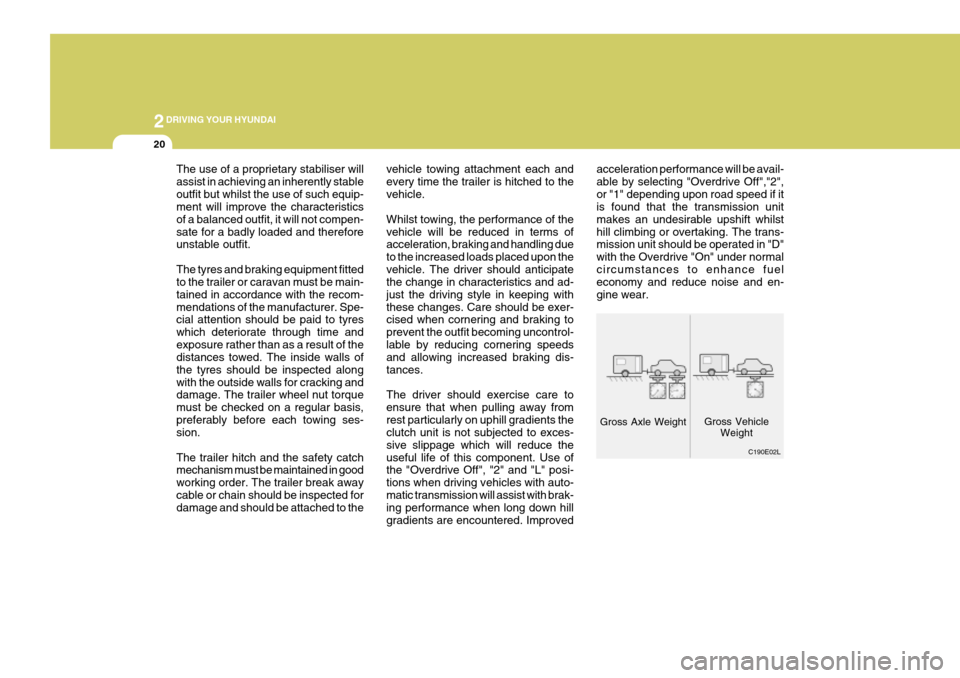
C190E02L
Gross Axle Weight
Gross Vehicle
Weight
The use of a proprietary stabiliser willassist in achieving an inherently stableoutfit but whilst the use of such equip- ment will improve the characteristics of a balanced outfit, it will not compen-sate for a badly loaded and therefore unstable outfit. The tyres and braking equipment fitted to the trailer or caravan must be main- tained in accordance with the recom-mendations of the manufacturer. Spe- cial attention should be paid to tyres which deteriorate through time andexposure rather than as a result of the distances towed. The inside walls of the tyres should be inspected alongwith the outside walls for cracking and damage. The trailer wheel nut torque must be checked on a regular basis,preferably before each towing ses- sion. The trailer hitch and the safety catch mechanism must be maintained in good working order. The trailer break awaycable or chain should be inspected for damage and should be attached to the
Page 515 of 599
3 IN CASE OF EMERGENCY
2IF THE ENGINE WILL NOT START
!
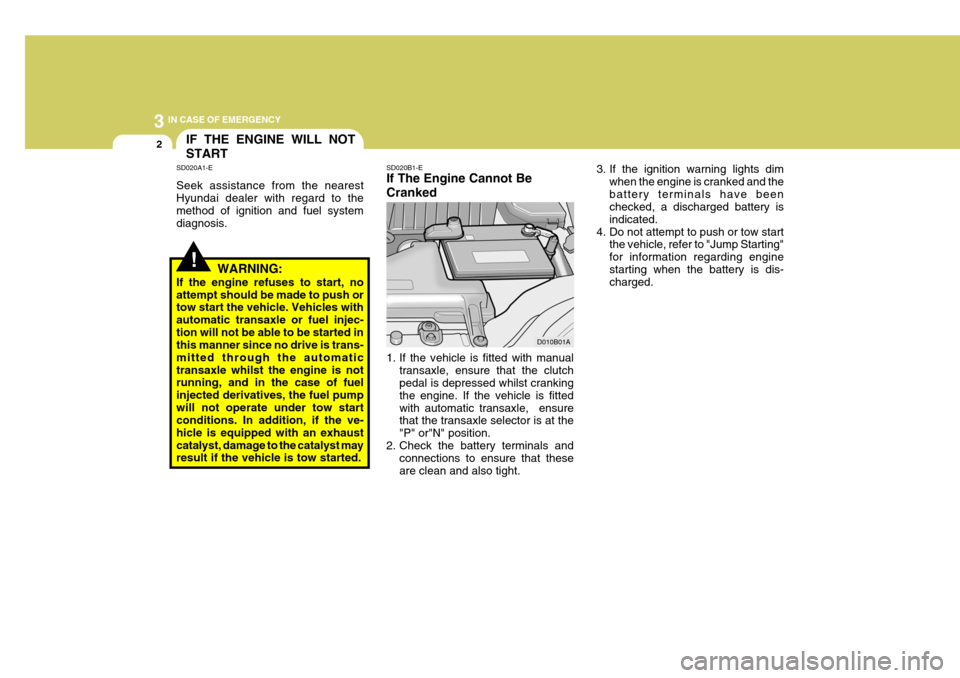
SD020B1-E If The Engine Cannot Be Cranked
1. If the vehicle is fitted with manual
transaxle, ensure that the clutch pedal is depressed whilst cranking the engine. If the vehicle is fittedwith automatic transaxle, ensure that the transaxle selector is at the "P" or"N" position.
2. Check the battery terminals and connections to ensure that theseare clean and also tight.
SD020A1-E Seek assistance from the nearest Hyundai dealer with regard to themethod of ignition and fuel system diagnosis.
WARNING:
If the engine refuses to start, no attempt should be made to push or tow start the vehicle. Vehicles with automatic transaxle or fuel injec-tion will not be able to be started in this manner since no drive is trans- mitted through the automatictransaxle whilst the engine is not running, and in the case of fuel injected derivatives, the fuel pumpwill not operate under tow start conditions. In addition, if the ve- hicle is equipped with an exhaustcatalyst, damage to the catalyst may result if the vehicle is tow started. 3. If the ignition warning lights dim
when the engine is cranked and the battery terminals have been checked, a discharged battery is indicated.
4. Do not attempt to push or tow start the vehicle, refer to "Jump Starting"for information regarding enginestarting when the battery is dis- charged.
D010B01A
Page 537 of 599
5
VEHICLE MAINTENANCE REQUIREMENTS
5
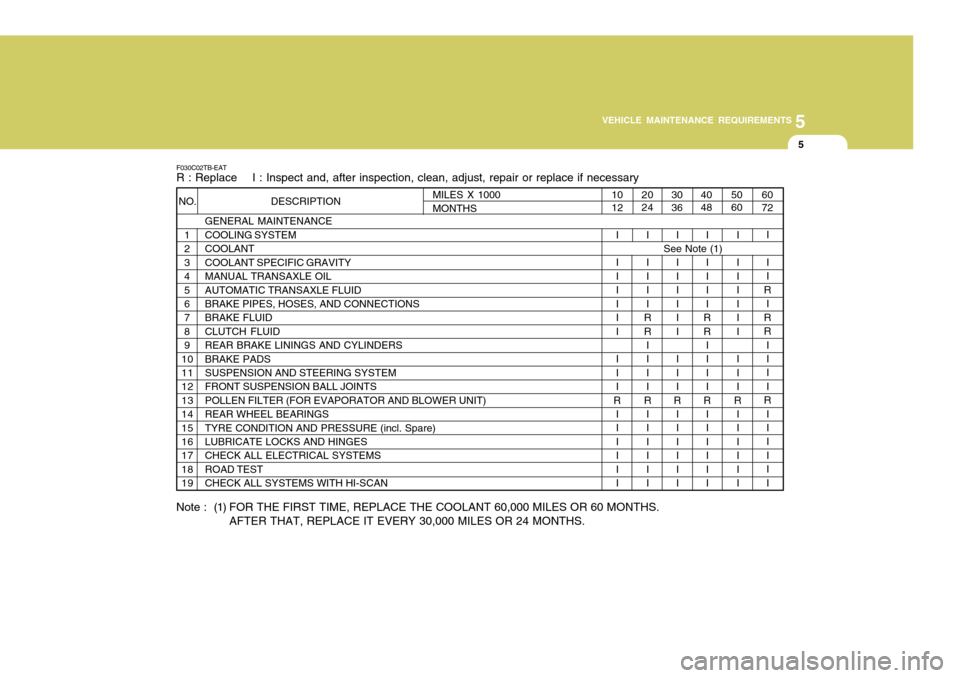
F030C02TB-EAT R : Replace I : Inspect and, after inspection, clean, adjust, repair or replace if necessary
GENERAL MAINTENANCE COOLING SYSTEMCOOLANTCOOLANT SPECIFIC GRAVITYMANUAL TRANSAXLE OILAUTOMATIC TRANSAXLE FLUID BRAKE PIPES, HOSES, AND CONNECTIONS BRAKE FLUIDCLUTCH FLUIDREAR BRAKE LININGS AND CYLINDERSBRAKE PADS SUSPENSION AND STEERING SYSTEM FRONT SUSPENSION BALL JOINTSPOLLEN FILTER (FOR EVAPORATOR AND BLOWER UNIT)REAR WHEEL BEARINGSTYRE CONDITION AND PRESSURE (incl. Spare)LUBRICATE LOCKS AND HINGES CHECK ALL ELECTRICAL SYSTEMS ROAD TESTCHECK ALL SYSTEMS WITH HI-SCAN 60 72
50 60
4048
I I I
R I
R R I I II
R II I III
I I IIIII I II
R I I IIII
I I III
RR IIII
R I I IIII
30 36
I I IIIII I II
R I I IIII
I I III
RR IIII
R I I IIII
10 12
I I IIIII I II
R I I IIII
MILES X 1000 MONTHS
NO. DESCRIPTION
1 2345 6 789
10 11 1213141516 17 1819
See Note (1)
Note : (1) FOR THE FIRST TIME, REPLACE THE COOLANT 60,000 MILES OR 60 MONTHS. AFTER THAT, REPLACE IT EVERY 30,000 MILES OR 24 MONTHS.
20 24
Page 543 of 599
Engine Compartment .................................................... 6-2
Daily Operating Checks ............................................... 6-5
Engine Oil ..................................................................... 6-5
Engine Oil and Filter Replacement ............................... 6-8
Engine Coolant Checking and Replacing ..................... 6-9
Sparking Plug Replacement ........................................6-12
Air Cleaner Element Replacement ............................... 6-13
Manual Transaxle Lubricant .................... ....................6-15
Automatic Transaxle Fl uid........................................... 6-16
Brake System Checking .............................................. 6-18
Checking the Clutch Fluid ............................................ 6-19
Air Conditioning System Maintenance ......................... 6-20
Changing the Pollen Filter
(For Evaporator and Blower U nit) .............................6-21
Drive Belts ................................................................... 6-23
Fusible Links ............................................................... 6-24
Power Steering Fluid Level .......................................... 6-27
Replacing Light Bulbs .................................................. 6-30
Fuse Panel Description ............................................... 6-37
OWNER MAINTENANCE
6
6
Page 544 of 599
6OWNER MAINTENANCE
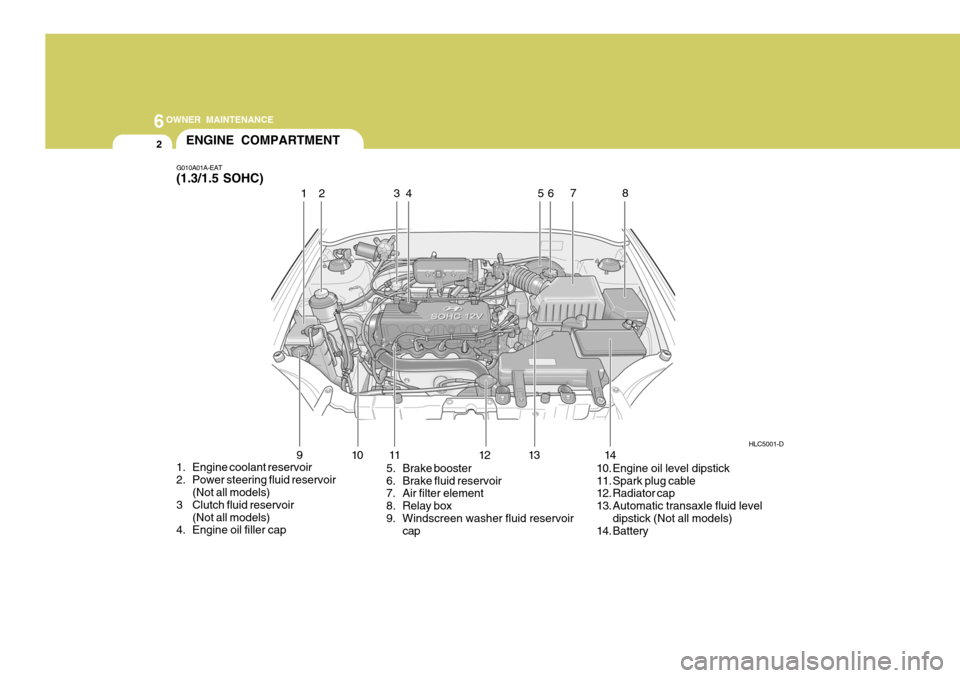
2ENGINE COMPARTMENT
HLC5001-D
G010A01A-EAT (1.3/1.5 SOHC)
1. Engine coolant reservoir
2. Power steering fluid reservoir
(Not all models)
3 Clutch fluid reservoir (Not all models)
4. Engine oil filler cap 5. Brake booster
6. Brake fluid reservoir
7. Air filter element
8. Relay box
9. Windscreen washer fluid reservoir
cap 10. Engine oil level dipstick
11. Spark plug cable
12. Radiator cap
13. Automatic transaxle fluid level
dipstick (Not all models)
14. Battery
12 34 56
78
91 011 1 213 1 4
Page 545 of 599
6
OWNER MAINTENANCE
3
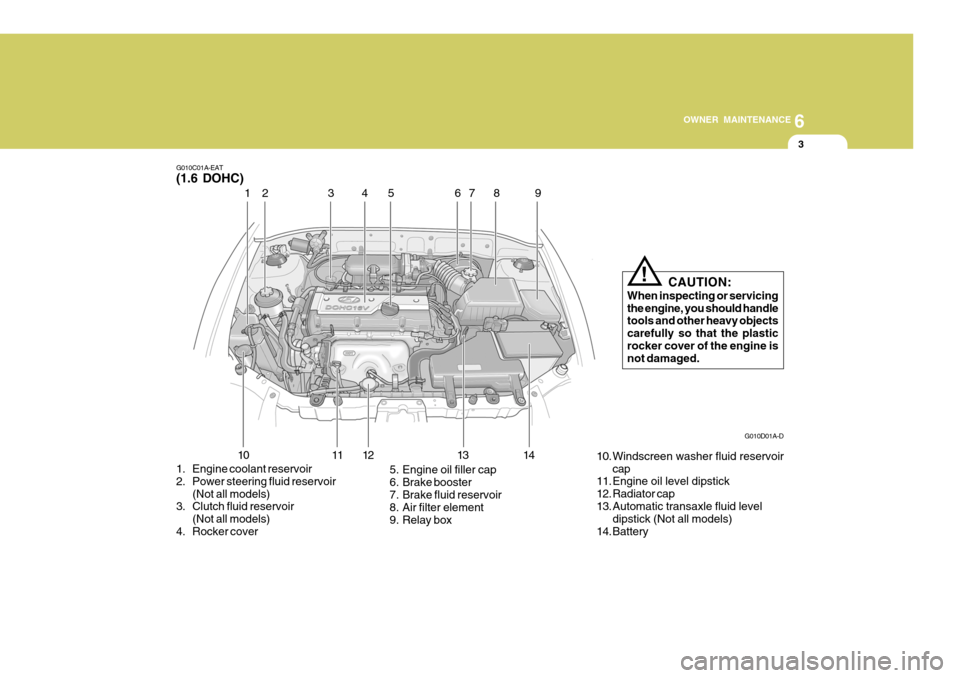
G010C01A-EAT (1.6 DOHC)
G010D01A-D
1. Engine coolant reservoir
2. Power steering fluid reservoir (Not all models)
3. Clutch fluid reservoir
(Not all models)
4. Rocker cover 5. Engine oil filler cap
6. Brake booster
7. Brake fluid reservoir
8. Air filter element
9. Relay box10. Windscreen washer fluid reservoir
cap
11. Engine oil level dipstick
12. Radiator cap
13. Automatic transaxle fluid level dipstick (Not all models)
14. Battery
12 4 5 67 8 9
10 11 12 3
CAUTION:
When inspecting or servicingthe engine, you should handle tools and other heavy objects carefully so that the plasticrocker cover of the engine is not damaged.
!
13 14
Page 546 of 599
6OWNER MAINTENANCE
4
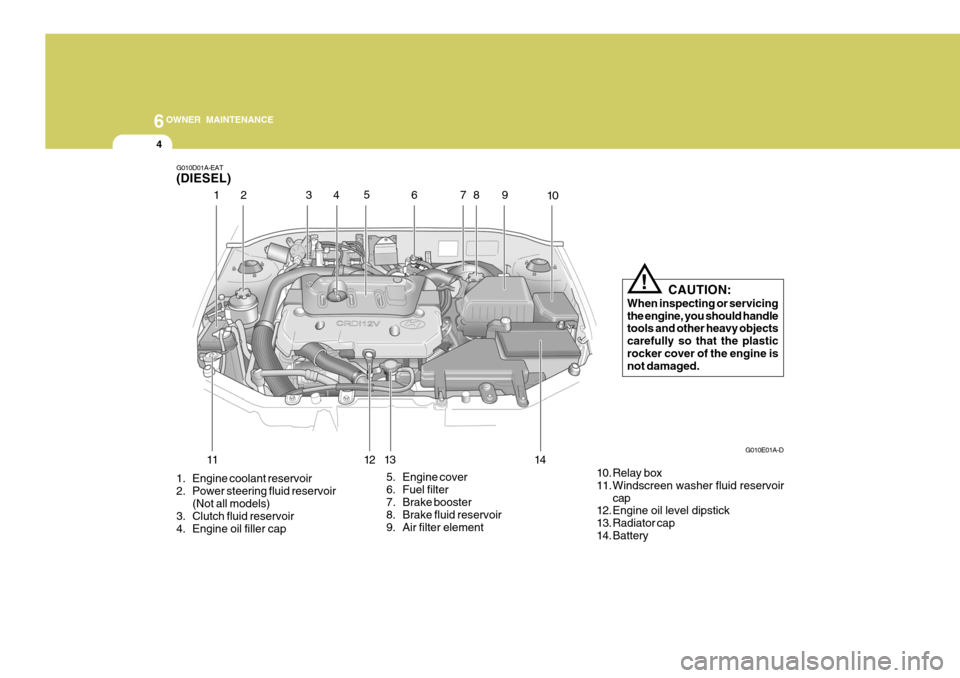
G010D01A-EAT (DIESEL)
1. Engine coolant reservoir
2. Power steering fluid reservoir
(Not all models)
3. Clutch fluid reservoir
4. Engine oil filler cap 5. Engine cover
6. Fuel filter
7. Brake booster
8. Brake fluid reservoir
9. Air filter element 10. Relay box
11. Windscreen washer fluid reservoir
cap
12. Engine oil level dipstick
13. Radiator cap
14. Battery G010E01A-D
12 34
5
67 89
11 12 13 14 10
CAUTION:
When inspecting or servicingthe engine, you should handle tools and other heavy objects carefully so that the plastic rocker cover of the engine is not damaged.
!
Page 561 of 599
6
OWNER MAINTENANCE
19CHECKING THE CLUTCH FLUID
!
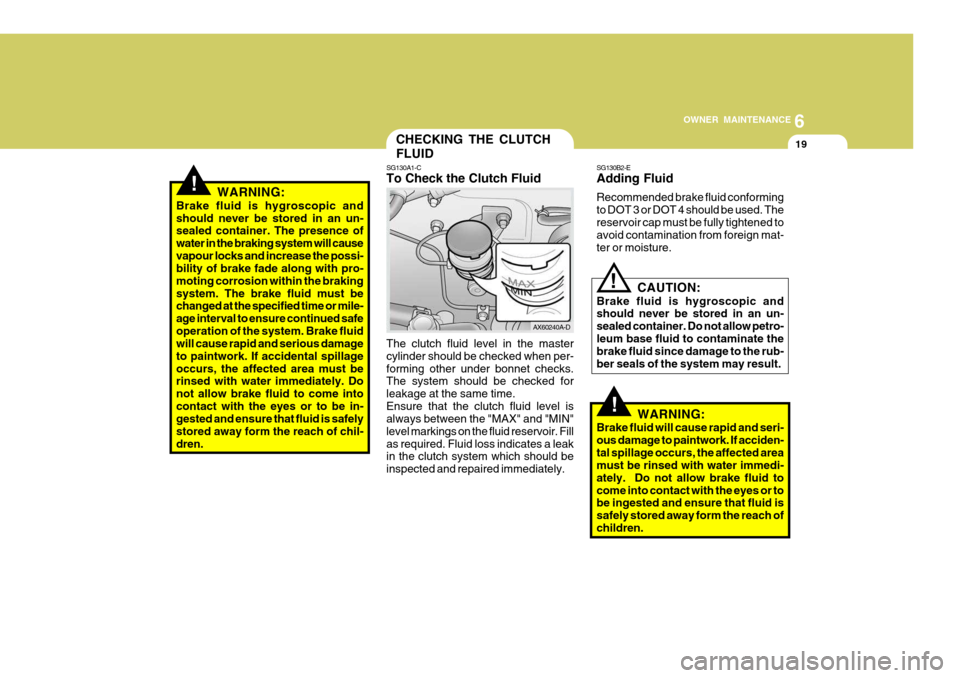
SG130A1-C To Check the Clutch Fluid The clutch fluid level in the master cylinder should be checked when per-forming other under bonnet checks. The system should be checked for leakage at the same time.Ensure that the clutch fluid level is always between the "MAX" and "MIN" level markings on the fluid reservoir. Fillas required. Fluid loss indicates a leak in the clutch system which should be inspected and repaired immediately.
WARNING:
Brake fluid is hygroscopic andshould never be stored in an un- sealed container. The presence of water in the braking system will causevapour locks and increase the possi- bility of brake fade along with pro- moting corrosion within the brakingsystem. The brake fluid must be changed at the specified time or mile- age interval to ensure continued safeoperation of the system. Brake fluid will cause rapid and serious damage to paintwork. If accidental spillageoccurs, the affected area must be rinsed with water immediately. Do not allow brake fluid to come intocontact with the eyes or to be in- gested and ensure that fluid is safely stored away form the reach of chil-dren.
AX60240A-D
!
SG130B2-E Adding Fluid Recommended brake fluid conforming to DOT 3 or DOT 4 should be used. Thereservoir cap must be fully tightened to avoid contamination from foreign mat- ter or moisture.
! CAUTION:
Brake fluid is hygroscopic and should never be stored in an un- sealed container. Do not allow petro-leum base fluid to contaminate the brake fluid since damage to the rub- ber seals of the system may result.
WARNING:
Brake fluid will cause rapid and seri-ous damage to paintwork. If acciden-tal spillage occurs, the affected area must be rinsed with water immedi- ately. Do not allow brake fluid tocome into contact with the eyes or to be ingested and ensure that fluid is safely stored away form the reach ofchildren.