towing Hyundai Accent 2006 Owner's Guide
[x] Cancel search | Manufacturer: HYUNDAI, Model Year: 2006, Model line: Accent, Model: Hyundai Accent 2006Pages: 599, PDF Size: 17.59 MB
Page 511 of 599
2
DRIVING YOUR HYUNDAI
21
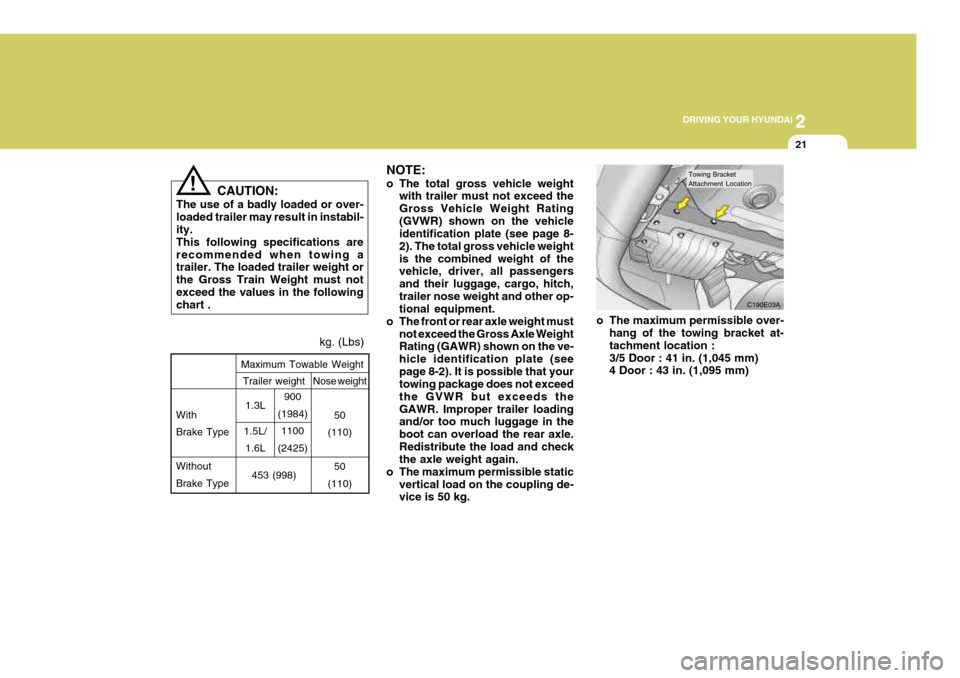
Maximum Towable Weight kg. (Lbs)
1.3L
1.5L/ 1.6L 900
(1984) 1100
(2425)
453 (998)
Trailer weight
Nose weight
50
(110)
50
(110)
With Brake Type Without Brake Type
CAUTION:
The use of a badly loaded or over- loaded trailer may result in instabil- ity. This following specifications arerecommended when towing a trailer. The loaded trailer weight or the Gross Train Weight must notexceed the values in the following chart .!
C190E03A
NOTE:
o The total gross vehicle weight
with trailer must not exceed the Gross Vehicle Weight Rating(GVWR) shown on the vehicle identification plate (see page 8- 2). The total gross vehicle weightis the combined weight of the vehicle, driver, all passengers and their luggage, cargo, hitch,trailer nose weight and other op- tional equipment.
o The front or rear axle weight must not exceed the Gross Axle WeightRating (GAWR) shown on the ve- hicle identification plate (seepage 8-2). It is possible that your towing package does not exceed the GVWR but exceeds theGAWR. Improper trailer loading and/or too much luggage in the boot can overload the rear axle.Redistribute the load and check the axle weight again.
o The maximum permissible static vertical load on the coupling de-vice is 50 kg. o The maximum permissible over-
hang of the towing bracket at-tachment location : 3/5 Door : 41 in. (1,045 mm) 4 Door : 43 in. (1,095 mm) Towing Bracket Attachment Location
Page 512 of 599

2DRIVING YOUR HYUNDAI
22
7. The vehicle/trailer combination ismore affected by crosswind and buffeting. When being passed by a large vehicle, keep a constant speedand steer straight ahead. If there is too much wind buffeting slow down to get out of the other vehicle's airturbulence.
8. When parking your car and trailer,
especially on a hill, be sure tofollow all the normal precautions. Turn your front wheel into the curb, set the parking brake firmly, andput the transaxle in 1st or Reverse (manual) or Park (automatic). In addition, place wheel chocks ateach of the trailer's tyres.
9. If the trailer has electric brakes,
start your vehicle and trailer mov-ing, and then apply the trailer brake controller by hand to be sure the brakes are working. This lets youcheck your electrical connection at the same time.
10. During your trip, check occasion- ally to be sure that the load issecure, and that the lights and any trailer brakes are still working.
C190F02A-EAT Trailer or Vehicle Towing Tips
1. Before towing, check towbar hitch
and safety cable connections as well as proper operation of the trailer running lights, brake lights, and turn signals.
2. Always drive your vehicle at a mod- erate speed (Less than 60 MPH)
3. Trailer towing requires more fuel than normal conditions.
4. To maintain engine braking effi-
ciency and electrical charging per-formance, do not use fifth gear (manual transaxle) or overdrive (automatic transaxle).
5. Always secure items in the trailer to prevent load shift whilst driving.
6. Check the condition and air pres- sure of all tyres on the trailer and your car. Low tyre pressure can seriously affect the handling. Alsocheck the spare tyre.
C190G01A-EAT Important Trailer Weight Infor- mation The Maximum Towable Weight of your Hyundai Accent will be reduced if thevehicle is load. The Maximum Towable Weight for a fully load is vehicle is calculated asfollows:
1. Find the Vehicle Identification Num-
ber (VIN) plate (see section 8).
2. Note the top 2 weights (in kg) of the
4 lines of weight information on the VIN plate.
3. Subtract the weight on line 1 from
line 2. This result (in kg) is themaximum towable weight of a fully loaded vehicle. For more information, contact yourlocal Hyundai Dealer.
Page 513 of 599

2
DRIVING YOUR HYUNDAI
23
11. Avoid jerky starts, sudden accel- eration or sudden stops.
12. Avoid sharp turns and rapid lane changes.
13. Avoid holding the brake pedal down
too long or too frequently. This could cause the brakes to over- heat, resulting in reduced brakingefficiency.
14. When going down a hill, shift into a
lower gear and use the enginebraking effect. When ascending a long grade, downshift the transaxle to a lowergear and reduce speed to reduce chances of engine overloading and/ or overheating.
15. If you have to stop whilst going uphill, do not hold the vehicle inplace by pressing on the accelera-tor. This can cause the automatic transaxle to overheat. Use the park- ing brake or footbrake.
NOTE: When towing check transaxle fluid more frequently. CAUTION:
If overheating should occur when towing, (temperature gauge reads near red zone), taking the following action may reduce or eliminate theproblem.
1. Turn off the air conditioner.
2. Reduce highway speed.
3. Select a lower gear when going uphill.
4. Whilst in stop and go traffic, place the gear selection in park or neu- tral and idle the engine at a higherspeed.
!
Page 514 of 599
3
If the Engine Will Not Start .......................................... 3-2
Jump Starting .............................................................. 3-3
If the Engine Overheats .............................................. 3-5
Spare Wheel ................................................................ 3-6
In the Event of a Puncture .......................................... 3-7
Vehicle Towing or Recovery .....................................3-12
If You Lose Your Keys .............................................. 3-14
IN CASE OF EMERGENCY
3
Page 525 of 599
3 IN CASE OF EMERGENCY
12
D080B01A
VEHICLE TOWING OR RECOVERY
D080A01A
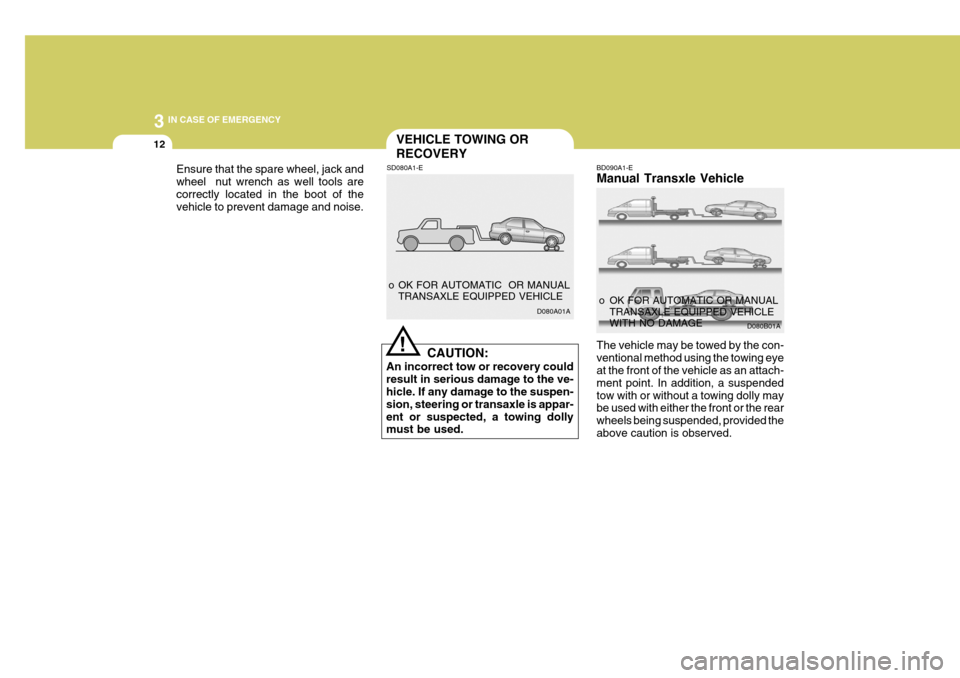
o OK FOR AUTOMATIC OR MANUAL
TRANSAXLE EQUIPPED VEHICLE WITH NO DAMAGE
BD090A1-E Manual Transxle Vehicle The vehicle may be towed by the con- ventional method using the towing eye at the front of the vehicle as an attach- ment point. In addition, a suspendedtow with or without a towing dolly may be used with either the front or the rear wheels being suspended, provided theabove caution is observed.
SD080A1-E
CAUTION:
An incorrect tow or recovery couldresult in serious damage to the ve- hicle. If any damage to the suspen- sion, steering or transaxle is appar-ent or suspected, a towing dolly must be used. o OK FOR AUTOMATIC OR MANUAL
TRANSAXLE EQUIPPED VEHICLE
!
Ensure that the spare wheel, jack and wheel nut wrench as well tools arecorrectly located in the boot of the vehicle to prevent damage and noise.
Page 526 of 599
3
IN CASE OF EMERGENCY
13
D080C02A
D080C01A
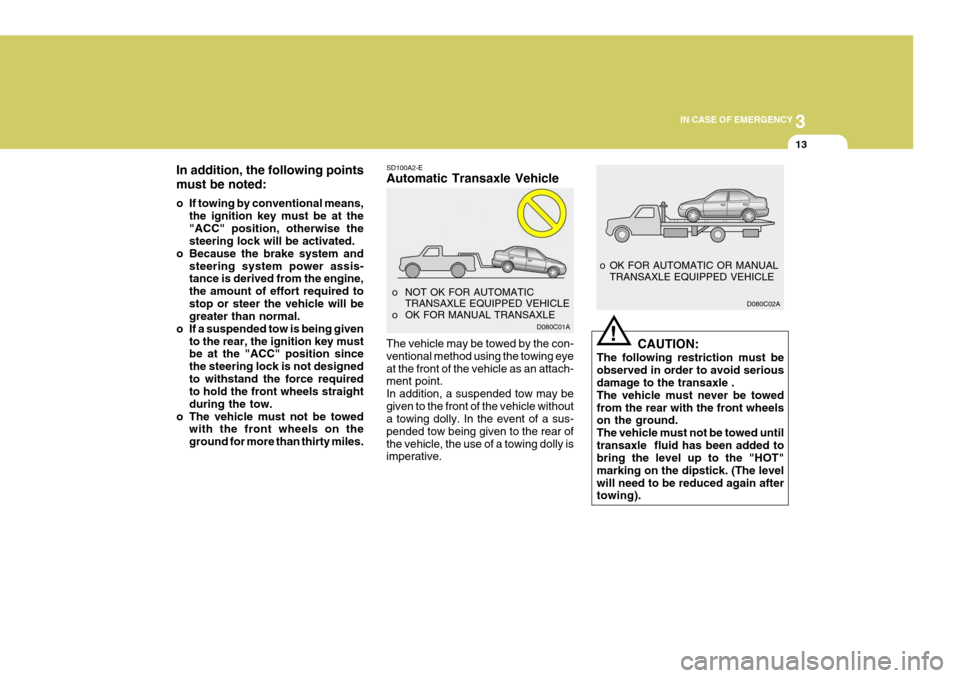
SD100A2-E Automatic Transaxle Vehicle The vehicle may be towed by the con- ventional method using the towing eyeat the front of the vehicle as an attach- ment point. In addition, a suspended tow may begiven to the front of the vehicle without a towing dolly. In the event of a sus- pended tow being given to the rear ofthe vehicle, the use of a towing dolly is imperative. o NOT OK FOR AUTOMATIC
TRANSAXLE EQUIPPED VEHICLE
o OK FOR MANUAL TRANSAXLE
In addition, the following points must be noted:
o If towing by conventional means,
the ignition key must be at the "ACC" position, otherwise the steering lock will be activated.
o Because the brake system and
steering system power assis-tance is derived from the engine, the amount of effort required tostop or steer the vehicle will be greater than normal.
o If a suspended tow is being given to the rear, the ignition key mustbe at the "ACC" position since the steering lock is not designedto withstand the force required to hold the front wheels straight during the tow.
o The vehicle must not be towed with the front wheels on theground for more than thirty miles.
! CAUTION:
The following restriction must be observed in order to avoid serious damage to the transaxle . The vehicle must never be towedfrom the rear with the front wheels on the ground. The vehicle must not be towed untiltransaxle fluid has been added to bring the level up to the "HOT" marking on the dipstick. (The levelwill need to be reduced again after towing).
o OK FOR AUTOMATIC OR MANUAL
TRANSAXLE EQUIPPED VEHICLE
Page 527 of 599
3 IN CASE OF EMERGENCY
14IF YOU LOSE YOUR KEYS
D120A01A-EAT Information about the key of immobiliser system will be found on page 1-4.
The vehicle must not be towed atspeeds faster than 25 mph. or dis- tances greater than fifty miles. Thegeneral points regarding the steer- ing lock etc. described in the pre- ceding section (Manual transaxlevehicle) should be observed.
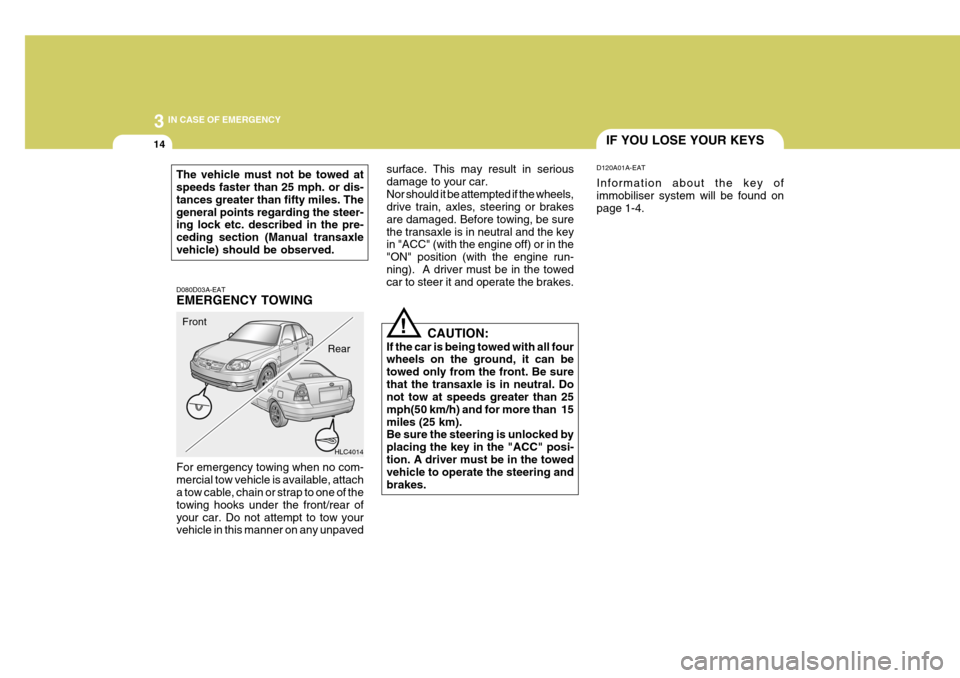
D080D03A-EAT EMERGENCY TOWING For emergency towing when no com- mercial tow vehicle is available, attach a tow cable, chain or strap to one of the towing hooks under the front/rear ofyour car. Do not attempt to tow your vehicle in this manner on any unpaved HLC4014surface. This may result in serious damage to your car.Nor should it be attempted if the wheels, drive train, axles, steering or brakes are damaged. Before towing, be surethe transaxle is in neutral and the key in "ACC" (with the engine off) or in the "ON" position (with the engine run-ning). A driver must be in the towed car to steer it and operate the brakes.
CAUTION:
If the car is being towed with all fourwheels on the ground, it can be towed only from the front. Be surethat the transaxle is in neutral. Do not tow at speeds greater than 25 mph(50 km/h) and for more than 15miles (25 km). Be sure the steering is unlocked by placing the key in the "ACC" posi-tion. A driver must be in the towed vehicle to operate the steering and brakes.
!
Front
Rear
Page 538 of 599

5VEHICLE MAINTENANCE REQUIREMENTS
6MAINTENANCE UNDER SEVERE USAGE CONDITIONS
F040A07A-EAT The following items must be serviced more frequently on cars normally used under severe driving conditions. Refer to the chart below for the appropriate maintenance intervals.
R : Replace I : Inspect and, after inspection, clean, adjust, repair or replace if necessary
SEVERE DRIVING CONDITIONS
A - Repeatly driving short distance of less than 5miles(8km) in normal temperature or less than 10miles(16km) in freezing temperature
B - Extensive engine idling or low speed driving for long distances
C - Driving on rough, dusty, muddy, unpaved, graveled or salt-spread roads
ENGINE OIL AND FILTER AIR CLEANER FILTER SPARK PLUGSTIMING BELTBRAKE PADS REAR BRAKE LININGS AND CYLINDERS SUSPENSION AND STEERING SYSTEMMANUAL TRANSAXLE OILAUTOMATIC TRANSAXLE FLUIDPOLLEN FILTER(FOR EVAPORATOR AND BLOWER UNIT)
EVERY 4,500 MILES OR 6 MONTHS MORE FREQUENTLY
MORE FREQUENTLY EVERY 37,000 MILES OR 48 MONTHSMORE FREQUENTLYMORE FREQUENTLY MORE FREQUENTLY EVERY 60,000 MILESEVERY 27,000 MILES
MORE FREQUENTLY
MAINTENANCE OPERATIONMAINTENANCE ITEM
R R R RI I I
R R R A, B, C, F, H, G, I, K A, B, C, F, H, I, JC, E B, H D, E, F, GC, D, G, H C, D, G, H C, D, E, FA, C, D, E, F, G, H, I, J A, C, E, F, G, H, I C,E
MAINTENANCE INTERVALS
DRIVING
CONDITION
D - Driving in areas using salt or other corrosive materials or in
very cold weather
E - Driving in sandy areas
F - Driving in heavy traffic area over 90°F(32°C)
G - Driving on uphill, downhill, or mountain road
H - Towing a Trailer, or using a camper, or roof rack
I - Driving as a patrol car, taxi, other commercial use or vehicle towing
J - Driving over 100 MPH(170 Km/h) K - Frequently driving in stop-and-go conditions
Petrol Diesel
Page 599 of 599

10
INDEX
5
Steering Wheel Freeplay .................. ........................ 6-22
Steering Wheel Tilt Lever .............. ...........................1-70
Stereo Sound System ............................................... 1-81
Sunroof ...................................................................... 1-60
Sunshade .................................................................. 1-59
Sun Visor .................................................................. 1-70
T Tachometer ............................................................... 1-47
Towing Trailer and caravan towing .................................... 2-19
Vehicle towing or recovery .................................... 3-12
Transaxle
Autom atic ............................................................... 2-10
Automatic transaxle fluid level checking................ 6-16
Manual ..................................................................... 2-8
Manual transaxle lubricant level checking .............6-15
Trip Computer ........................................................... 1-48
Trip Odometer ........................................................... 1-48
Tyre Balancing .................................................................. 8-4
Chains ...................................................................... 8-4
Changing a flat tyre ................................................. 3-7
In the event of a puncture ....................................... 3-7
Information ............................................................... 8-3
Pressures ................................................................. 8-3
Replacement ............................................................ 8-5
Rotation .................................................................... 8-4
Snow tyres ............................................................... 8-3
Spare tyre(wheel) ..................................................... 3-6 V Vehicle Identification Number
..................................... 8-2
Vehicle Specifications ................................................. 9-1
W Warning and Indicator Lights.................................... 1-42
Windscreen Wiper / Washer Switch......................... 1-52
Adjustable intermittent wiper operation ..................1-53
Rear window wiper and washer ............................ 1-54
Windscreen Wiper Blades .......... .............................. 6-14
Winter Motoring ......................................................... 2-17