service Hyundai Accent 2006 Service Manual
[x] Cancel search | Manufacturer: HYUNDAI, Model Year: 2006, Model line: Accent, Model: Hyundai Accent 2006Pages: 599, PDF Size: 17.59 MB
Page 439 of 599
1CONTROLS AND EQUIPMENT
32
o For maximum safety protection in
all types of crashes, all occupants including the driver should always wear their seat belts whether or not an airbag is also provided attheir seating position to minimize the risk of severe injury or death in the event of a crash. Do not sit orlean unnecessarily close to the airbag while the vehicle is in mo- tion.
o The SRS airbag system must de- ploy very rapidly to provide pro-tection in a crash. If an occupant is out of position because of not wearing a seat belt, the airbag mayforcefully contact the occupant causing serious or fatal injuries. The SRS consists of the following com- ponents:
- Driver's Airbag Module
- Passenger's Airbag Module
- SRS Service Reminder Indicator (SRI)
- SRS Control Module (SRSCM)
The SRSCM continually monitors allelements whilst the ignition is "ON" todetermine if a frontal or near-frontal impact is severe enough to require airbag deployment.
B240B02A-EAT SRS Components and Functions
B240B01L-D
B240A04A
Rear impact
Side Impact Rollover
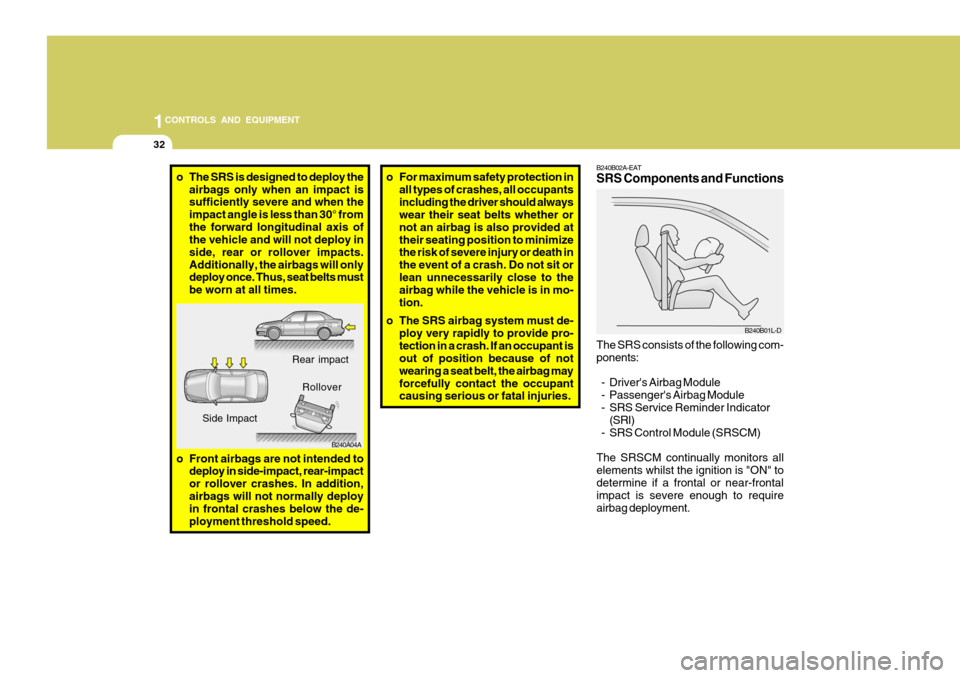
o The SRS is designed to deploy the
airbags only when an impact is sufficiently severe and when the impact angle is less than 30° fromthe forward longitudinal axis of the vehicle and will not deploy in side, rear or rollover impacts.Additionally, the airbags will only deploy once. Thus, seat belts must be worn at all times.
o Front airbags are not intended to deploy in side-impact, rear-impactor rollover crashes. In addition,airbags will not normally deploy in frontal crashes below the de- ployment threshold speed.
Page 440 of 599
33
1
CONTROLS AND EQUIPMENT
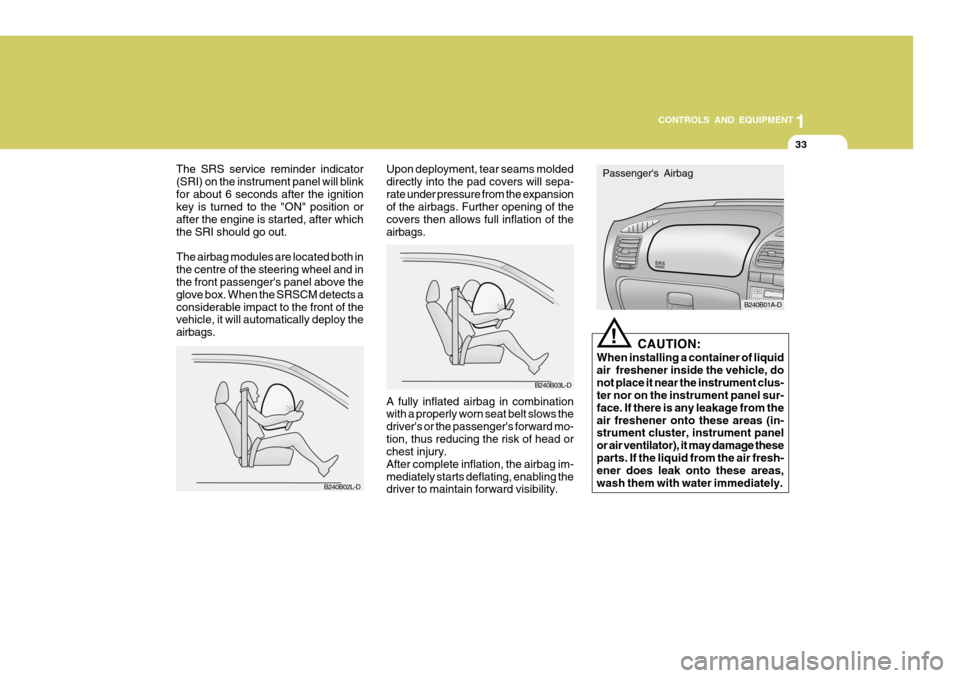
The SRS service reminder indicator (SRI) on the instrument panel will blinkfor about 6 seconds after the ignition key is turned to the "ON" position or after the engine is started, after whichthe SRI should go out. The airbag modules are located both in the centre of the steering wheel and in the front passenger's panel above the glove box. When the SRSCM detects aconsiderable impact to the front of the vehicle, it will automatically deploy the airbags.
B240B02L-D
B240B03L-D
Upon deployment, tear seams molded directly into the pad covers will sepa-rate under pressure from the expansion of the airbags. Further opening of the covers then allows full inflation of theairbags. A fully inflated airbag in combination with a properly worn seat belt slows the driver's or the passenger's forward mo-tion, thus reducing the risk of head or chest injury. After complete inflation, the airbag im-mediately starts deflating, enabling the driver to maintain forward visibility.
CAUTION:
When installing a container of liquid air freshener inside the vehicle, donot place it near the instrument clus- ter nor on the instrument panel sur- face. If there is any leakage from theair freshener onto these areas (in- strument cluster, instrument panel or air ventilator), it may damage theseparts. If the liquid from the air fresh- ener does leak onto these areas, wash them with water immediately.
! B240B01A-D
Passenger's Airbag
Page 443 of 599
1CONTROLS AND EQUIPMENT
36
o Modification to SRS components
or wiring, including the addition of any kind of badges to the padcovers or modifications to the body structure, can adversely affect SRS performance and lead to possibleinjury.
o For cleaning the airbag pad cov- ers, use only a soft, dry cloth or one which has been moistened with plain water. Solvents orcleaners could adversely affect the airbag covers and proper deployment of the system.
o No objects should be placed over or near the airbag modules on the steering wheel, instrument panel, and the front passenger'spanel above the glove box, be- cause any such object could cause harm if the vehicle is in acrash severe enough to cause the airbags to inflate.
o If the airbags inflate, they must be replaced by an authorized Hyundai dealer.
!WARNING:
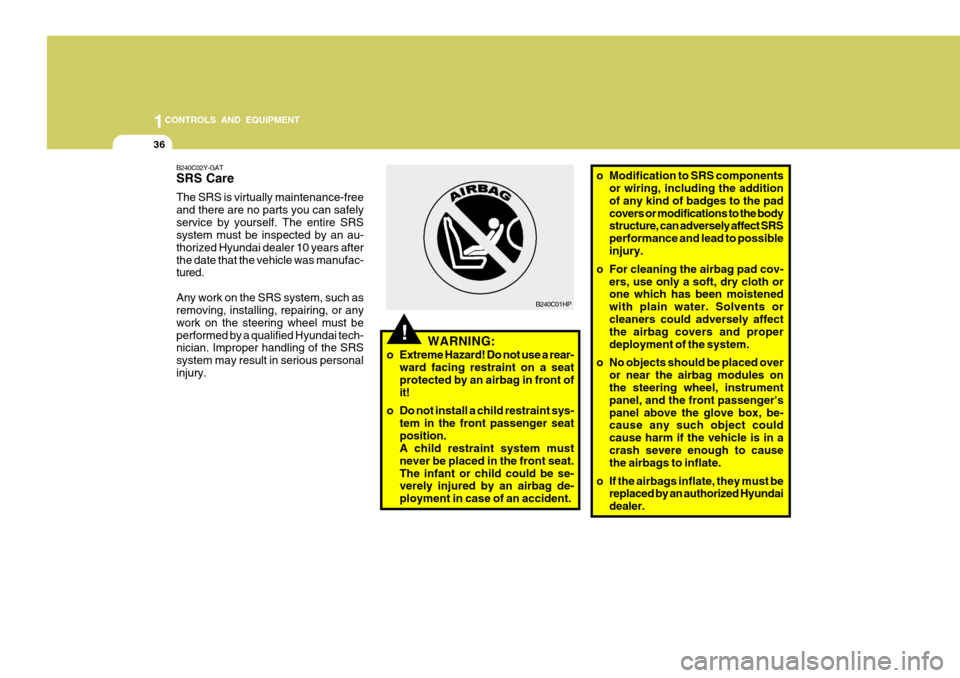
o Extreme Hazard! Do not use a rear- ward facing restraint on a seat protected by an airbag in front of it!
o Do not install a child restraint sys- tem in the front passenger seatposition. A child restraint system must never be placed in the front seat.The infant or child could be se- verely injured by an airbag de- ployment in case of an accident. B240C01HP
B240C02Y-GAT SRS Care The SRS is virtually maintenance-free and there are no parts you can safelyservice by yourself. The entire SRS system must be inspected by an au- thorized Hyundai dealer 10 years afterthe date that the vehicle was manufac- tured. Any work on the SRS system, such as removing, installing, repairing, or any work on the steering wheel must beperformed by a qualified Hyundai tech- nician. Improper handling of the SRS system may result in serious personalinjury.
Page 449 of 599
1CONTROLS AND EQUIPMENT
42WARNING AND INDICATOR LIGHTS
!
B260B01S-GAT
SRS (Airbag) Service Reminder Indicator (SRI)
The SRS service reminder indicator (SRI) comes on and flashes for about 6seconds after the ignition key is turned to the "ON" position or after the engine is started, after which it will go out. This light also comes on when the SRS is not working properly. If the SRI doesnot come on, or continuously remains on after flashing for about 6 seconds when you turned the ignition key to the"ON" position or started the engine, or if it comes on whilst driving, have the SRS inspected by an authorized HyundaiDealer. B260P02Y-EAT
ABS Service
Reminder Indicator (SRI)(Not all models)
When the key is turned to the "ON" position, the Anti-Lock Brake System SRI will come on and then go off in a fewseconds. If the ABS SRI remains on, comes on while driving, or does not come on when the key is turned to the"ON" position, this indicates that there may be a problem with the ABS. If this occurs, have your vehiclechecked by your Hyundai dealer as soon as possible. The normal braking system will still be operational, butwithout the assistance of the anti-lock brake system. SB210E1-E
Overdrive OFF Indicator Light(Automatic Transaxle only)
When the overdrive (4th gear) switch is turned off and the operation of overdrive (4th gear) is cancelled, the overdrivewarning light (O/D OFF) will be illumi- nated. When the switch is at the on position, the gearbox will operate in thenormal fully automatic mode and the warning light will be extinguished. SB210G1-E Turn Signal Indicator Light
Operation of a turn signal is indicated by the warning light located in the in- strument cluster. If the light fails toilluminate or does not flash, a malfunc- tion within the turn signal system is indicated.
WARNING:
If the both ABS SRI and Parking Brake/ Brake fluid level warning lights re- main "ON" or come on while driving, there may be a problem with E.B.D(Electronic brake force distribution). If this occurs, avoid sudden stops and have your vehicle checked byyour Hyundai dealer as soon as pos- sible.
Page 498 of 599
2DRIVING YOUR HYUNDAI
8MANUAL TRANSAXLE
CAUTION:
o Do not attempt to engage reverse gear when the car is in motion.
o To avoid damaging the selector
mechanism, do not use the gear shift lever as a hand rest. Release the lever immediately the shift is completed.
o To avoid premature clutch wear, do not use the clutch pedal as afoot rest, and do not hold thevehicle on a gradient using the clutch.
o Ensure that the engine is not over-revved by upshifting beforethe tachometer needle enters the red zone.
o Do not coast with the shift lever at the neutral position.
o When descending long gradi- ents, make use of the engine brak- ing to assist the footbrake to avoid brake fade or overheating.
SC090A03-E
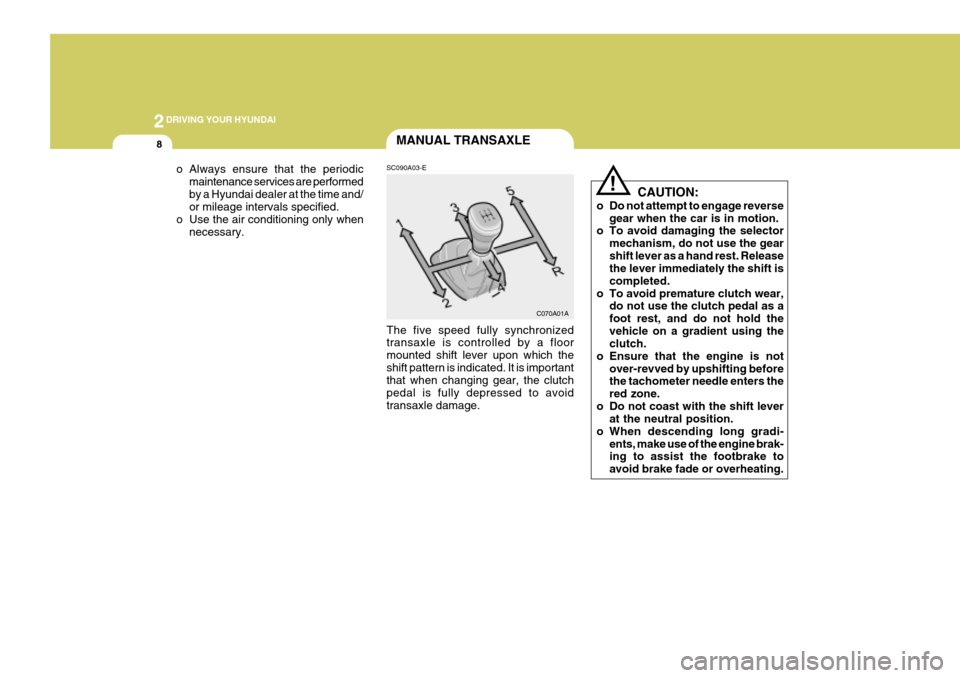
The five speed fully synchronized transaxle is controlled by a floor mounted shift lever upon which theshift pattern is indicated. It is important that when changing gear, the clutch pedal is fully depressed to avoidtransaxle damage.
o Always ensure that the periodic
maintenance services are performedby a Hyundai dealer at the time and/ or mileage intervals specified.
o Use the air conditioning only when necessary.
!
C070A01A
Page 506 of 599

2DRIVING YOUR HYUNDAI
16DRIVING FOR ECONOMY
nance schedule in Section 5. If you drive your car in severe conditions,more frequent maintenance is re- quired (see Section 5 for details).
o Keep your car clean. For maximum
service, your car should be keptclean and free of corrosive materi- als. It is especially important thatmud, dirt, ice, etc. not be allowed to accumulate on the underside of the car. This extra weight can result inincreased fuel consumption and also contribute to corrosion.
o Travel lightly. Don't carry unneces- sary weight in your car. Weight is anenemy of good fuel economy.
o Don't let the engine idle longer than necessary. If you are waiting (andnot in traffic), turn off your engine and restart only when you're readyto go.
o Remember, your car does not re-
quire extended warm-up. As soonas the engine is running smoothly, you can drive away. In very cold weather, however, give your enginea slightly longer warm-up period.
C140A01A-EAT You can save fuel and get more miles from your car if you follow these sug- gestions:
o Drive smoothly. Accelerate at a
moderate rate. Don't make "jack- rabbit" starts or full-throttle shiftsand maintain a steady cruising speed. Don't race between stop- lights. Try to adjust your speed tothat of the other traffic so you don't have to change speeds unneces- sarily. Avoid heavy traffic wheneverpossible. Always maintain a safe distance from other vehicles so you can avoidunnecessary braking. This also re- duces brake wear.
o Drive at a moderate speed. The faster you drive, the more fuel yourcar uses. Driving at a moderate speed, especially on the highway, isone of the most effective ways to reduce fuel consumption. o Don't "ride" the brake or clutch pedal.
This can increase fuel consumption and also increase wear on these components. In addition, driving with your foot resting on the brake pedalmay cause the brakes to overheat, which reduces their effectiveness and may lead to more serious con-sequences.
o Take care of your tyres. Keep them
inflated to the recommended pres-sure. Incorrect inflation, either too much or too little, results in unnec- essary tyre wear. Check the tyrepressures at least once a month.
o Be sure that the wheels are aligned
correctly. Improper alignment canresult from hitting curbs or driving too fast over irregular surfaces. Poor alignment causes faster tyre wearand may also result in other prob- lems as well as greater fuel con- sumption.
o Keep your car in good condition. For better fuel economy and reducedmaintenance costs, maintain yourcar in accordance with the mainte-
Page 524 of 599
3
IN CASE OF EMERGENCY
11
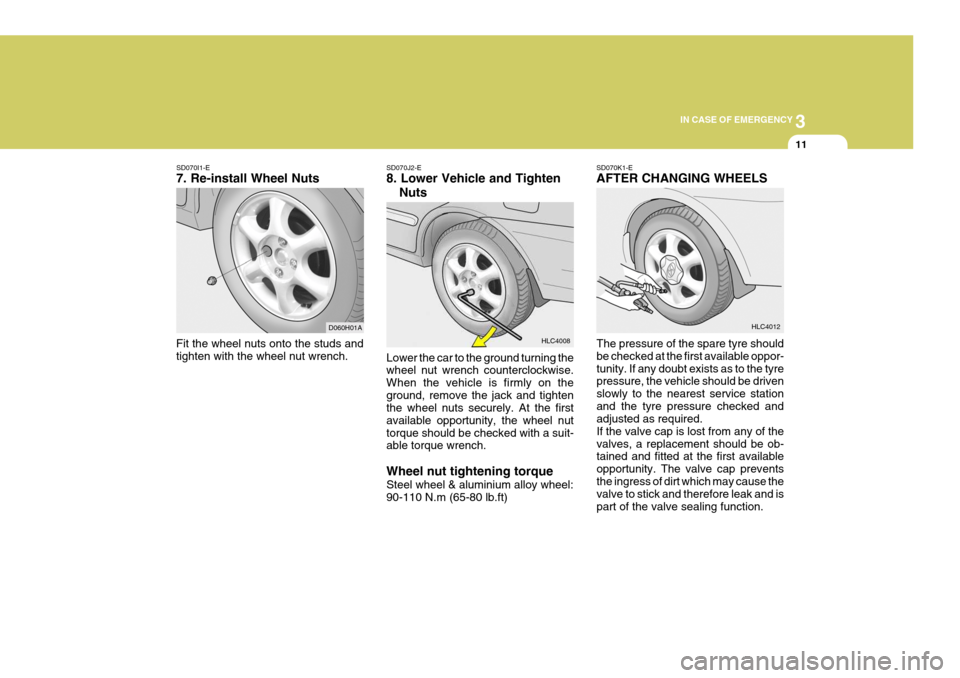
SD070I1-E 7. Re-install Wheel Nuts
Fit the wheel nuts onto the studs and tighten with the wheel nut wrench. D060H01ASD070J2-E 8. Lower Vehicle and Tighten
Nuts
Lower the car to the ground turning the wheel nut wrench counterclockwise. When the vehicle is firmly on theground, remove the jack and tighten the wheel nuts securely. At the first available opportunity, the wheel nuttorque should be checked with a suit- able torque wrench. Wheel nut tightening torque Steel wheel & aluminium alloy wheel: 90-110 N.m (65-80 lb.ft) SD070K1-E AFTER CHANGING WHEELS
The pressure of the spare tyre should be checked at the first available oppor-tunity. If any doubt exists as to the tyre pressure, the vehicle should be driven slowly to the nearest service stationand the tyre pressure checked and adjusted as required. If the valve cap is lost from any of thevalves, a replacement should be ob- tained and fitted at the first available opportunity. The valve cap preventsthe ingress of dirt which may cause the valve to stick and therefore leak and is part of the valve sealing function.
HLC4008 HLC4012
Page 534 of 599
5VEHICLE MAINTENANCE REQUIREMENTS
2MAINTENANCE AND SER- VICING REQUIREMENTS
SF020A1-E To ensure the continued reliability and safety of the vehicle, certain routine maintenance operations are requiredat specific mileage or time intervals.It is the responsibility of the vehicleowner to ensure that the maintenanceschedules shown in both this Owners Manual and the Warranty and Service Passport are adhered to.The new vehicle warranty may beinvalidated if the routine maintenanceoperations are not performed in line with the recommendations outlined and the safety and durability of thevehicle adversely affected.It is recommended that all mainte-nance operations with the exceptionof the daily operating checks are en- trusted to a Hyundai dealer to ensure that the latest repair and maintenanceprocedures and specialized servicing tools are employed. In addition, the use of genuine Hyundai replacementparts will ensure that the vehicle safety and performance will not be compro- mised. NOTE:
The inspection and testing of cer-
tain electronic fuel injection/engine management and automatic trans- mission control systems requirespecialised electronic equipment specifically designed for Hyundai vehicles. The use of general pur-pose electrical test equipment may result in damage to the control unit microprocessors.
SF020C2-E
Specified Scheduled Procedures
The Specified scheduled procedures
are listed in the maintenance chartsbeginning at page 5-3. The opera- tions specified must be performed at the time or mileage intervals shownirrespective of whether the mileage interval has been reached before the specified time interval. Certain lubricants and components
degrade with both time and mileage(e.g. engine oil and brake fluid) and therefore it is not permissable to base the maintenance schedule upon mile-age alone. It is strongly recommended that the maintenance operations are performed by the factory-trained or distributor-trained technicians at yourHyundai dealer because of the need for specialized knowledge and tooling and to ensure that no possibility ofinvalidating the manufacturers war- ranty exists.
The maintenance schedules relate to
vehicles operated under normal con-ditions, vehicles which are operated under adverse conditions will requiremore frequent maintenance which is described at page 5-6. NOTE:
Service schedules may change de-
pending on individual country needs. Please ask your local Hyundai dealer for a copy of the service schedule that relates to thatcountry.
SF030B1-E
SERVICE HISTORY
It is important that all scheduled main-
tenance services are recorded in thewarranty and service passport to en-sure that proof of maintenance is avail- able when warranty service is required.
Page 535 of 599

5
VEHICLE MAINTENANCE REQUIREMENTS
3SCHEDULED MAINTENANCE
AF040C4-E In order to ensure the continued safety, reliability and longevity of the vehicle, the following maintenance service operations should be performed at the time or mileage intervals specified. It is recommended that all routine maintenance services are entrusted to a Hyundai dealer to ensure that the manufacturers recommended procedures are employed and that only genuine Hyundai replacement parts are used. Incorrect mainte- nance techniques or the use of non genuine replacement parts may invalidate the vehicle warranty. F030B03A-EAT R : Replace I : Inspect and, after inspection, clean, adjust, repair or replace if necessary
Note : (1) EVERY 6,000 MILES OR 6 MONTHS : "R" (2) EVERY 25,000 MILES : "R"
ENGINE CONTROL SYSTEM MAINTENANCE (PETROL)
1 ENGINE OIL & FILTER See Note (1)
2 DRIVE BELT (WATER PUMP, ALTERNATOR & A/CON)
3 FUEL FILTER (MPI)
4 FLUID LEAKS
5 TIMING BELT
6 VENTILATION HOSES
7 AIR CLEANER FILTER
8 SPARK PLUGS
NO. DESCRIPTION60 72
5060
4048
3036
2024
1012
MILES X 1000 MONTHS
R
I I
R
R
I
R I I
R
I
R I
R
R
II I
R
II
R
R
I I
See Note (2)
Page 538 of 599

5VEHICLE MAINTENANCE REQUIREMENTS
6MAINTENANCE UNDER SEVERE USAGE CONDITIONS
F040A07A-EAT The following items must be serviced more frequently on cars normally used under severe driving conditions. Refer to the chart below for the appropriate maintenance intervals.
R : Replace I : Inspect and, after inspection, clean, adjust, repair or replace if necessary
SEVERE DRIVING CONDITIONS
A - Repeatly driving short distance of less than 5miles(8km) in normal temperature or less than 10miles(16km) in freezing temperature
B - Extensive engine idling or low speed driving for long distances
C - Driving on rough, dusty, muddy, unpaved, graveled or salt-spread roads
ENGINE OIL AND FILTER AIR CLEANER FILTER SPARK PLUGSTIMING BELTBRAKE PADS REAR BRAKE LININGS AND CYLINDERS SUSPENSION AND STEERING SYSTEMMANUAL TRANSAXLE OILAUTOMATIC TRANSAXLE FLUIDPOLLEN FILTER(FOR EVAPORATOR AND BLOWER UNIT)
EVERY 4,500 MILES OR 6 MONTHS MORE FREQUENTLY
MORE FREQUENTLY EVERY 37,000 MILES OR 48 MONTHSMORE FREQUENTLYMORE FREQUENTLY MORE FREQUENTLY EVERY 60,000 MILESEVERY 27,000 MILES
MORE FREQUENTLY
MAINTENANCE OPERATIONMAINTENANCE ITEM
R R R RI I I
R R R A, B, C, F, H, G, I, K A, B, C, F, H, I, JC, E B, H D, E, F, GC, D, G, H C, D, G, H C, D, E, FA, C, D, E, F, G, H, I, J A, C, E, F, G, H, I C,E
MAINTENANCE INTERVALS
DRIVING
CONDITION
D - Driving in areas using salt or other corrosive materials or in
very cold weather
E - Driving in sandy areas
F - Driving in heavy traffic area over 90°F(32°C)
G - Driving on uphill, downhill, or mountain road
H - Towing a Trailer, or using a camper, or roof rack
I - Driving as a patrol car, taxi, other commercial use or vehicle towing
J - Driving over 100 MPH(170 Km/h) K - Frequently driving in stop-and-go conditions
Petrol Diesel