steering Hyundai Accent 2006 Workshop Manual
[x] Cancel search | Manufacturer: HYUNDAI, Model Year: 2006, Model line: Accent, Model: Hyundai Accent 2006Pages: 599, PDF Size: 17.59 MB
Page 459 of 599
1CONTROLS AND EQUIPMENT
52WINDSCREEN WIPER/ WASHER SWITCH
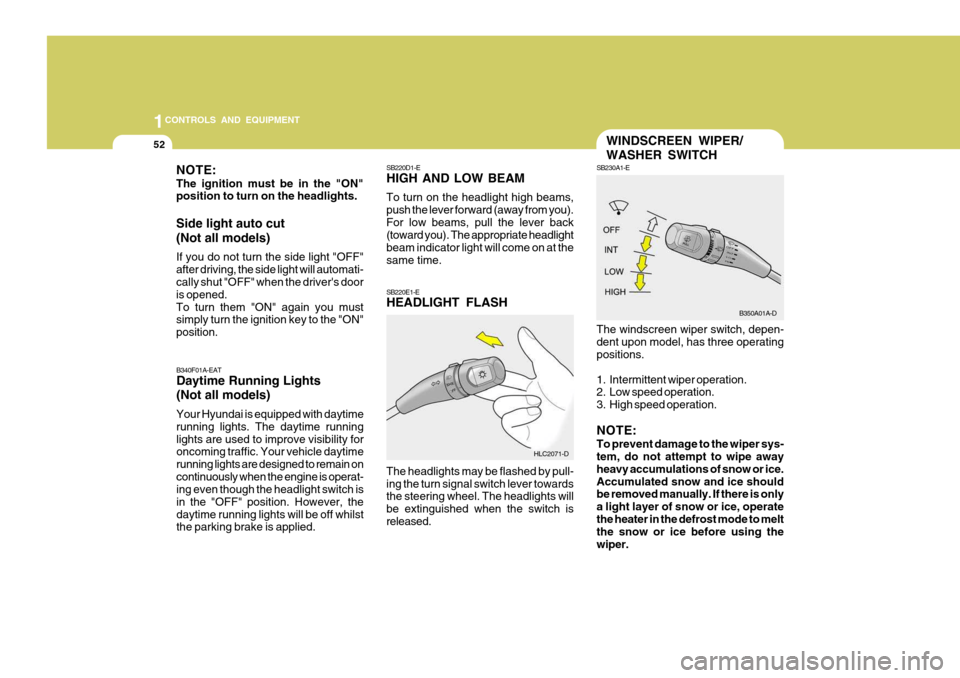
SB230A1-E The windscreen wiper switch, depen- dent upon model, has three operating positions.
1. Intermittent wiper operation.
2. Low speed operation.
3. High speed operation. NOTE: To prevent damage to the wiper sys- tem, do not attempt to wipe away heavy accumulations of snow or ice.Accumulated snow and ice should be removed manually. If there is only a light layer of snow or ice, operatethe heater in the defrost mode to melt the snow or ice before using the wiper.
NOTE: The ignition must be in the "ON" position to turn on the headlights. Side light auto cut (Not all models) If you do not turn the side light "OFF" after driving, the side light will automati- cally shut "OFF" when the driver's door is opened.To turn them "ON" again you must simply turn the ignition key to the "ON" position.
SB220D1-E HIGH AND LOW BEAM To turn on the headlight high beams, push the lever forward (away from you).For low beams, pull the lever back (toward you). The appropriate headlight beam indicator light will come on at thesame time. SB220E1-E HEADLIGHT FLASH The headlights may be flashed by pull- ing the turn signal switch lever towards the steering wheel. The headlights will be extinguished when the switch isreleased.
B340F01A-EAT Daytime Running Lights (Not all models) Your Hyundai is equipped with daytime running lights. The daytime runninglights are used to improve visibility for oncoming traffic. Your vehicle daytime running lights are designed to remain oncontinuously when the engine is operat- ing even though the headlight switch is in the "OFF" position. However, thedaytime running lights will be off whilst the parking brake is applied.
HLC2071-DB350A01A-D
Page 460 of 599
53
1
CONTROLS AND EQUIPMENT
NOTE:
o Do not operate the washer more
than 15 seconds at a time or when the fluid reservoir is empty.
o In icy or freezing weather, be sure the wiper blades are not frozen tothe glass prior to operating thewipers.
o In areas where water freezes in
winter, use windscreen washerantifreeze.
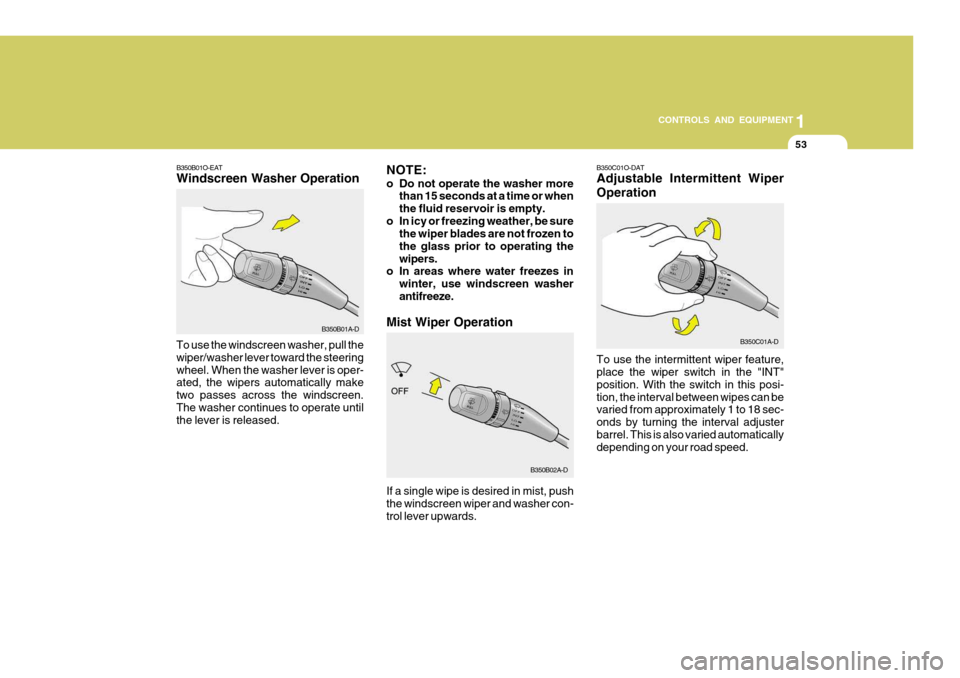
Mist Wiper Operation
To use the windscreen washer, pull thewiper/washer lever toward the steeringwheel. When the washer lever is oper- ated, the wipers automatically make two passes across the windscreen.The washer continues to operate until the lever is released. B350B01O-EAT Windscreen Washer Operation
If a single wipe is desired in mist, push the windscreen wiper and washer con-trol lever upwards.
B350B01A-D
B350B02A-DB350C01O-DAT Adjustable Intermittent Wiper Operation To use the intermittent wiper feature, place the wiper switch in the "INT" position. With the switch in this posi-tion, the interval between wipes can be varied from approximately 1 to 18 sec- onds by turning the interval adjusterbarrel. This is also varied automatically depending on your road speed.
B350C01A-D
Page 477 of 599
1CONTROLS AND EQUIPMENT
70STEERING WHEEL TILT LEVER
!
B600A01A-EAT (Not all models)
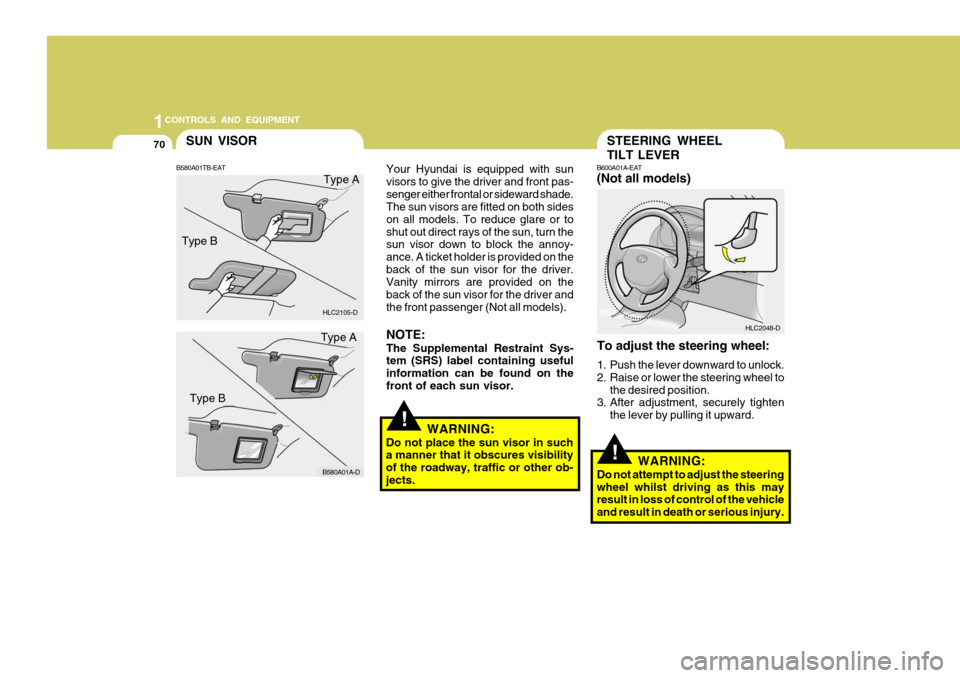
To adjust the steering wheel:
1. Push the lever downward to unlock.
2. Raise or lower the steering wheel to the desired position.
3. After adjustment, securely tighten
the lever by pulling it upward.
WARNING:
Do not attempt to adjust the steeringwheel whilst driving as this may result in loss of control of the vehicle and result in death or serious injury. HLC2048-D
B580A01A-D
SUN VISOR
!
Your Hyundai is equipped with sun visors to give the driver and front pas-senger either frontal or sideward shade. The sun visors are fitted on both sides on all models. To reduce glare or toshut out direct rays of the sun, turn the sun visor down to block the annoy- ance. A ticket holder is provided on theback of the sun visor for the driver. Vanity mirrors are provided on the back of the sun visor for the driver andthe front passenger (Not all models). NOTE: The Supplemental Restraint Sys- tem (SRS) label containing useful information can be found on thefront of each sun visor.
WARNING:
Do not place the sun visor in such a manner that it obscures visibility of the roadway, traffic or other ob-jects.
B580A01TB-EAT
HLC2105-DType A
Type B
Type A
Type B
Page 478 of 599
71
1
CONTROLS AND EQUIPMENT
HORN
B610B01A-DAT
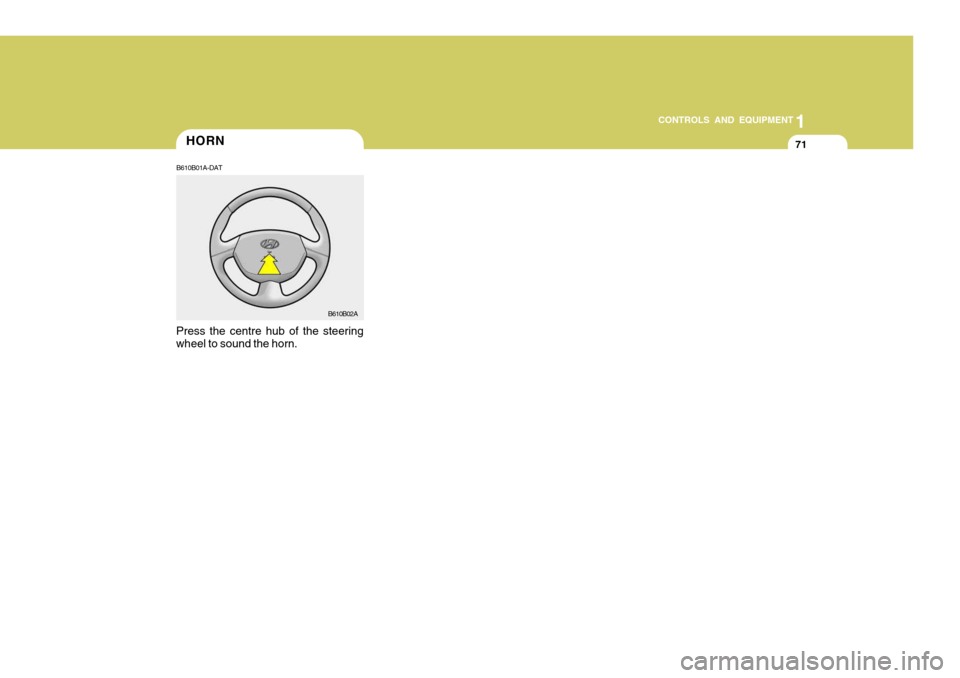
Press the centre hub of the steering wheel to sound the horn. B610B02A
Page 493 of 599
2
DRIVING YOUR HYUNDAI
3TO START THE ENGINEBEFORE STARTING THE ENGINE
!
C020A01O-EAT Before you start the engine, you should always:
1. Look around the vehicle to be sure
there are no flat tyres, puddles of oil or water or other indications of pos- sible trouble.
2. After entering the car, check to be sure the parking brake is engaged.
3. Check that all windows, and lights are clean.
4. Check that the interior and exterior
mirrors are clean and in position.
5. Check your seat, seatback and headrestraint to be sure they are intheir proper positions.
6. Close all the doors.
7. Fasten your seat belt and be sure
that all other occupants have fas- tened theirs.
8. Turn off all lights and accessories
that are not needed.
9. When you turn the ignition switch to "ON" check that all appropriate warn-ing lights are operating and that youhave sufficient fuel. 10.Check the operation of warning
lights and all bulbs when key is inthe "ON" position.
WARNING: (DIESEL ENGINE)
To ensure that sufficient vacuum exists within the brake system dur- ing cold weather start-up condi- tions, it is necessary to run theengine at idle for several seconds after starting the engine. SC040A1-F COMBINATION IGNITION SWITCH AND STEERING LOCK
o If your Hyundai is equipped with a
manual transaxle, place the shift lever in neutral and depress the clutch pedal fully.
o If your Hyundai has an automatic
transaxle, place the shift lever in "P"(park).
o To start the engine, insert the igni- tion key and turn it to the "START"position. Release it as soon as the engine starts. Do not hold the key inthe "START" position for more than 15 seconds.
NOTE: For safety, the engine will not start if the shift lever is not in "P" or "N" position (Automatic Transaxle).
Page 494 of 599
2DRIVING YOUR HYUNDAI
4KEY POSITIONS
!
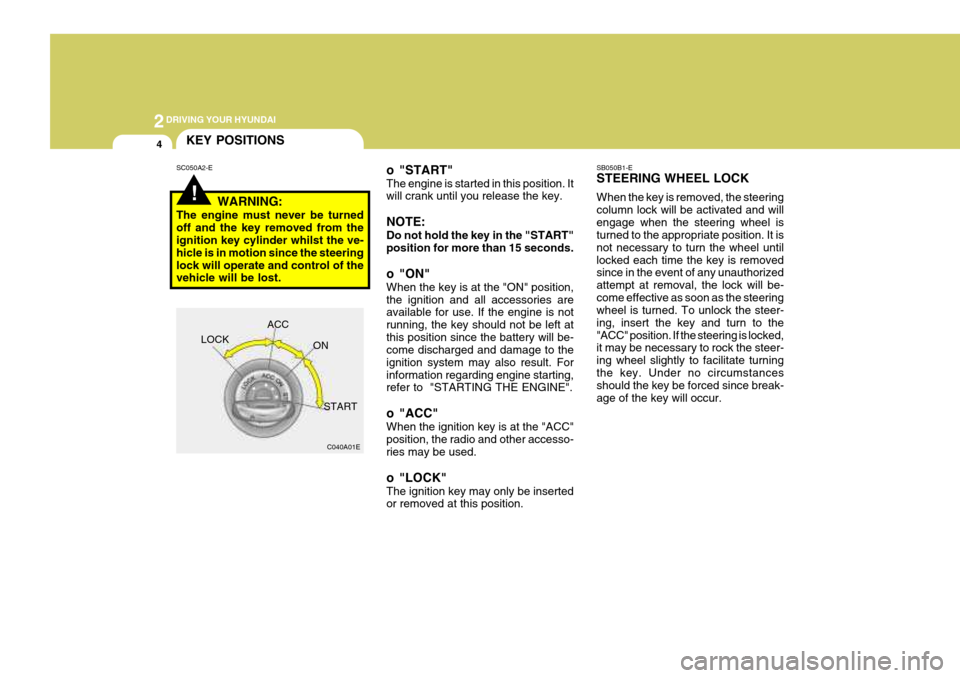
o "START" The engine is started in this position. It will crank until you release the key. NOTE: Do not hold the key in the "START" position for more than 15 seconds.
o "ON" When the key is at the "ON" position, the ignition and all accessories are available for use. If the engine is not running, the key should not be left atthis position since the battery will be- come discharged and damage to the ignition system may also result. Forinformation regarding engine starting, refer to "STARTING THE ENGINE".
o "ACC" When the ignition key is at the "ACC" position, the radio and other accesso- ries may be used.
o "LOCK" The ignition key may only be inserted or removed at this position.
SC050A2-E
WARNING:
The engine must never be turned off and the key removed from the ignition key cylinder whilst the ve- hicle is in motion since the steeringlock will operate and control of the vehicle will be lost. SB050B1-E STEERING WHEEL LOCK When the key is removed, the steering column lock will be activated and willengage when the steering wheel is turned to the appropriate position. It is not necessary to turn the wheel untillocked each time the key is removed since in the event of any unauthorized attempt at removal, the lock will be-come effective as soon as the steering wheel is turned. To unlock the steer- ing, insert the key and turn to the"ACC" position. If the steering is locked, it may be necessary to rock the steer- ing wheel slightly to facilitate turningthe key. Under no circumstances should the key be forced since break- age of the key will occur.
C040A01E
LOCK
ACC
ON
START
Page 509 of 599
2
DRIVING YOUR HYUNDAI
19
o The formation of snow or ice built up inside the wheel arches may inter- fere with the road wheels or steering mechanism. In such instances, un- usual noises or an increase in steer-ing effort may result. Therefore, ensure that the wheel arches are checked periodically and any accu-mulated snow or ice removed.
o It is advisable to carry emergency
equipment including, torch, shovel,tow rope, blankets etc., if a journey is to be undertaken into areas of severe road conditions.TRAILER AND CARAVAN TOWING
!
C195F01A-EAT TOWING ATTACHMENTS It is strongly recommended that only an Hyundai Approved towing attach-ment is used to ensure that the loads placed upon the body structure are correctly distributed. The use of a nonapproved attachment will result in the invalidation of the vehicle warranty. Hyundai towing attachments are de-signed and constructed to ensure maximum towing performance and ease of fitment. A range of accesso-ries including electrical kits are avail- able through the Hyundai dealer net- work. It is of the utmost importance that those areas of the vehicle which aresubjected to greater stress during tow- ing are maintained in accordance with the recommendations given at the endof this book. In addition, the daily oper- ating checks relating to engine oil, transmission oil and tyres must beperformed at each refuelling to ensure maximum reliability and safety.
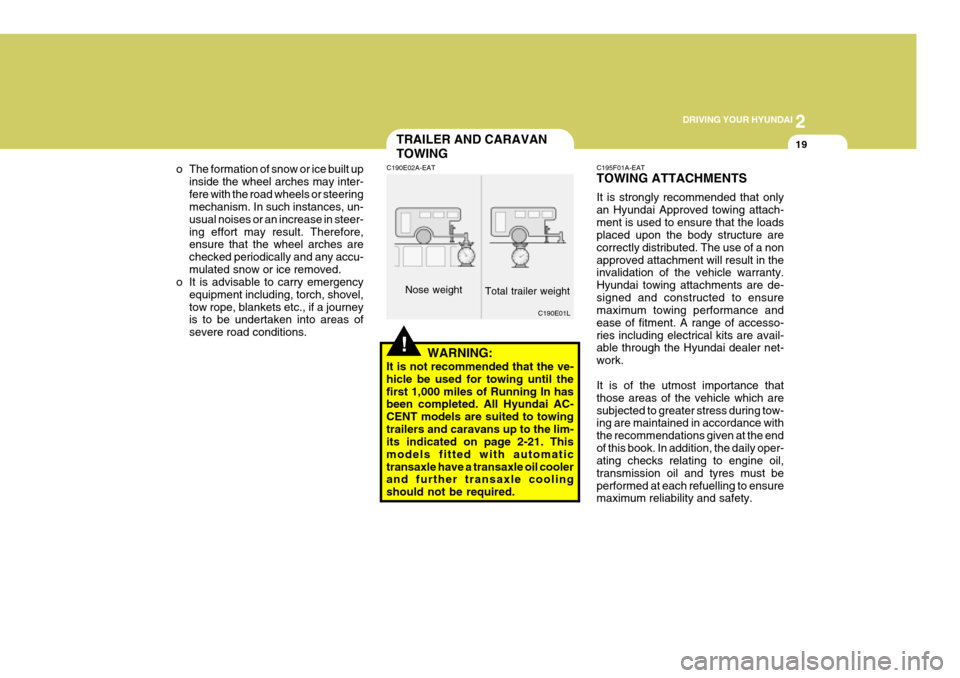
C190E02A-EAT
WARNING:
It is not recommended that the ve- hicle be used for towing until thefirst 1,000 miles of Running In has been completed. All Hyundai AC- CENT models are suited to towingtrailers and caravans up to the lim- its indicated on page 2-21. This models fitted with automatictransaxle have a transaxle oil cooler and further transaxle cooling should not be required. C190E01L
Nose weight
Total trailer weight
Page 525 of 599
3 IN CASE OF EMERGENCY
12
D080B01A
VEHICLE TOWING OR RECOVERY
D080A01A
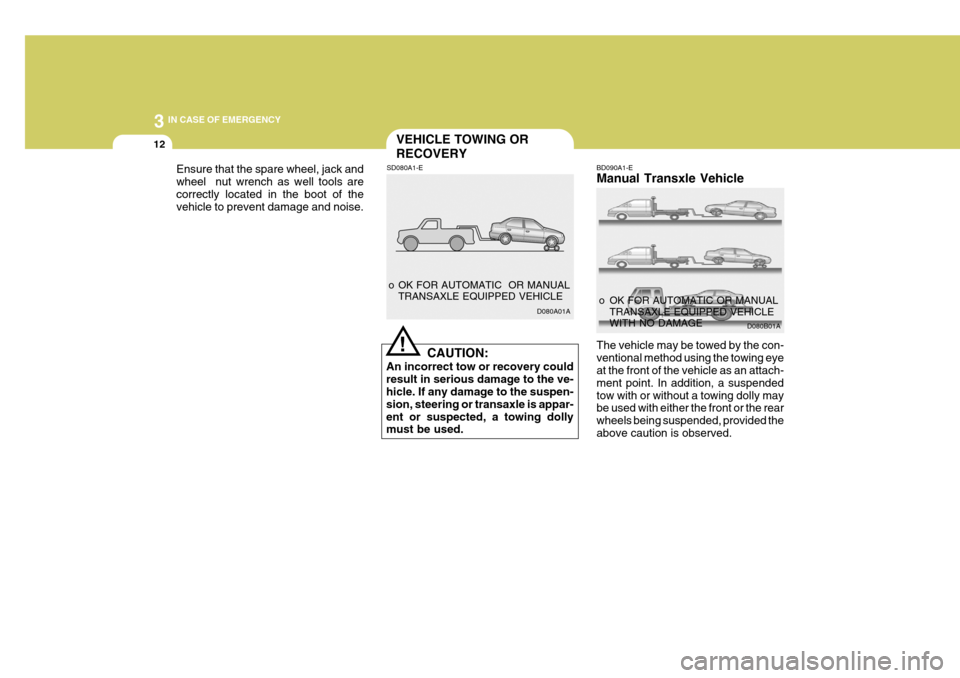
o OK FOR AUTOMATIC OR MANUAL
TRANSAXLE EQUIPPED VEHICLE WITH NO DAMAGE
BD090A1-E Manual Transxle Vehicle The vehicle may be towed by the con- ventional method using the towing eye at the front of the vehicle as an attach- ment point. In addition, a suspendedtow with or without a towing dolly may be used with either the front or the rear wheels being suspended, provided theabove caution is observed.
SD080A1-E
CAUTION:
An incorrect tow or recovery couldresult in serious damage to the ve- hicle. If any damage to the suspen- sion, steering or transaxle is appar-ent or suspected, a towing dolly must be used. o OK FOR AUTOMATIC OR MANUAL
TRANSAXLE EQUIPPED VEHICLE
!
Ensure that the spare wheel, jack and wheel nut wrench as well tools arecorrectly located in the boot of the vehicle to prevent damage and noise.
Page 526 of 599
3
IN CASE OF EMERGENCY
13
D080C02A
D080C01A
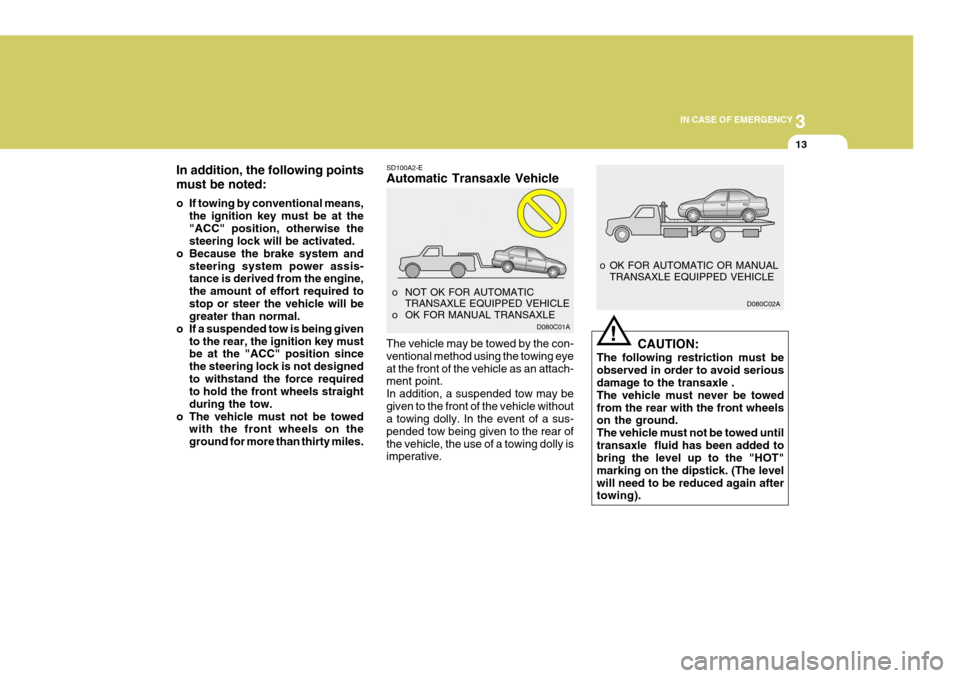
SD100A2-E Automatic Transaxle Vehicle The vehicle may be towed by the con- ventional method using the towing eyeat the front of the vehicle as an attach- ment point. In addition, a suspended tow may begiven to the front of the vehicle without a towing dolly. In the event of a sus- pended tow being given to the rear ofthe vehicle, the use of a towing dolly is imperative. o NOT OK FOR AUTOMATIC
TRANSAXLE EQUIPPED VEHICLE
o OK FOR MANUAL TRANSAXLE
In addition, the following points must be noted:
o If towing by conventional means,
the ignition key must be at the "ACC" position, otherwise the steering lock will be activated.
o Because the brake system and
steering system power assis-tance is derived from the engine, the amount of effort required tostop or steer the vehicle will be greater than normal.
o If a suspended tow is being given to the rear, the ignition key mustbe at the "ACC" position since the steering lock is not designedto withstand the force required to hold the front wheels straight during the tow.
o The vehicle must not be towed with the front wheels on theground for more than thirty miles.
! CAUTION:
The following restriction must be observed in order to avoid serious damage to the transaxle . The vehicle must never be towedfrom the rear with the front wheels on the ground. The vehicle must not be towed untiltransaxle fluid has been added to bring the level up to the "HOT" marking on the dipstick. (The levelwill need to be reduced again after towing).
o OK FOR AUTOMATIC OR MANUAL
TRANSAXLE EQUIPPED VEHICLE
Page 527 of 599
3 IN CASE OF EMERGENCY
14IF YOU LOSE YOUR KEYS
D120A01A-EAT Information about the key of immobiliser system will be found on page 1-4.
The vehicle must not be towed atspeeds faster than 25 mph. or dis- tances greater than fifty miles. Thegeneral points regarding the steer- ing lock etc. described in the pre- ceding section (Manual transaxlevehicle) should be observed.
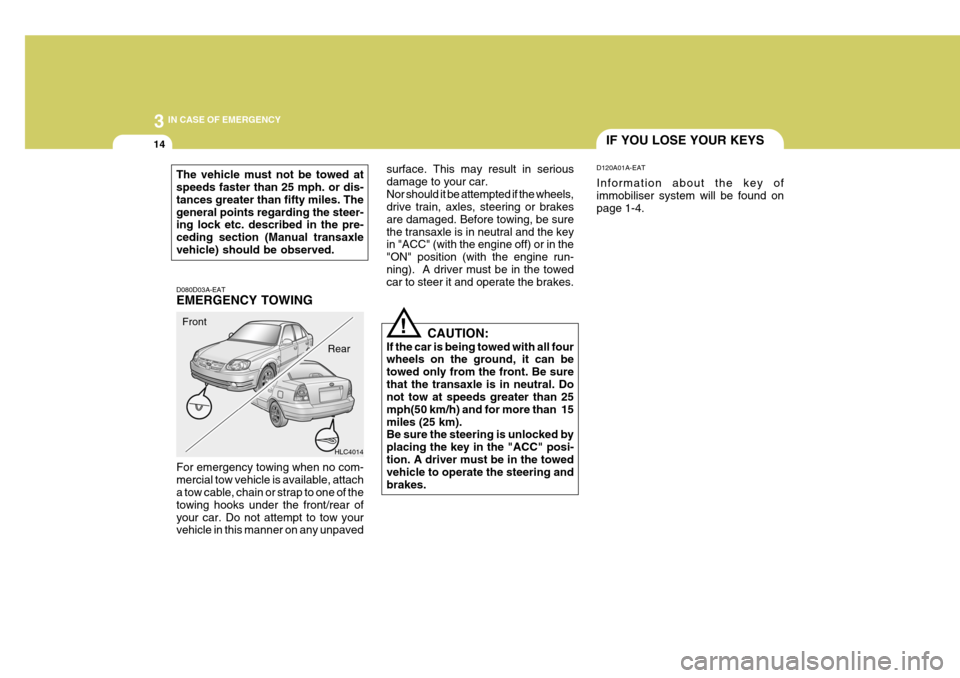
D080D03A-EAT EMERGENCY TOWING For emergency towing when no com- mercial tow vehicle is available, attach a tow cable, chain or strap to one of the towing hooks under the front/rear ofyour car. Do not attempt to tow your vehicle in this manner on any unpaved HLC4014surface. This may result in serious damage to your car.Nor should it be attempted if the wheels, drive train, axles, steering or brakes are damaged. Before towing, be surethe transaxle is in neutral and the key in "ACC" (with the engine off) or in the "ON" position (with the engine run-ning). A driver must be in the towed car to steer it and operate the brakes.
CAUTION:
If the car is being towed with all fourwheels on the ground, it can be towed only from the front. Be surethat the transaxle is in neutral. Do not tow at speeds greater than 25 mph(50 km/h) and for more than 15miles (25 km). Be sure the steering is unlocked by placing the key in the "ACC" posi-tion. A driver must be in the towed vehicle to operate the steering and brakes.
!
Front
Rear