boot Hyundai Accent 2006 Owner's Manual
[x] Cancel search | Manufacturer: HYUNDAI, Model Year: 2006, Model line: Accent, Model: Hyundai Accent 2006Pages: 599, PDF Size: 17.59 MB
Page 205 of 599
4
CORROSION PREVENTION AND APPEARANCE CARE
5
4
CORROSION PREVENTION AND APPEARANCE CARE
5
E030D01A-AAT When to Wax Again You should polish and wax the car again when water no longer beads on a clean surface but spreads out over alarger area. E030E01A-AAT Maintaining Bumpers Special precautions must be observed to preserve the appearance of thebumpers on your Hyundai. They are:
o Be careful not to spill battery elec-
trolyte or hydraulic brake fluid on the bumpers. If you do, wash it off im- mediately with clear water.
o Be gentle when cleaning the bumper surfaces. They are made of softplastic and the surface can be dam-aged if mistreated. Do not use abra- sive cleaners. Use warm water and mild soap or car-washing solution.
o Do not expose the bumpers to high temperatures. For example, if youhave your car repainted, do notleave the bumpers on the car if the car is going to be placed in a high- temperature paint booth.
E030B01A-AAT Spot Cleaning Don't use gasoline, strong solvents or corrosive cleaning agents. These can damage the finish of the car. To re-move road tar, use turpentine on a clean, soft cloth or commercially avail- able bug and tar remover. Be gentle.To remove dead insects or tree sap, use warm water and mild soap or car- washing solution. Soak the spot andrub gently. If the paint has lost its luster, use a commercial car-cleaning polish. E030C01A-AAT Polishing and Waxing Always wash and dry the car before polishing or waxing or using a combi-nation cleaner and wax. Use a good quality commercial product and follow the manufacturer's directions on thecontainer. Polish and wax the bright trim pieces as well as the paint.
mulated dirt, use a mild car washing solution. Be sure to rinse the surfaceafter washing to remove the solution. Never allow the solution to dry on the painted surfaces.
Page 213 of 599
5VEHICLE MAINTENANCE REQUIREMENTS
6
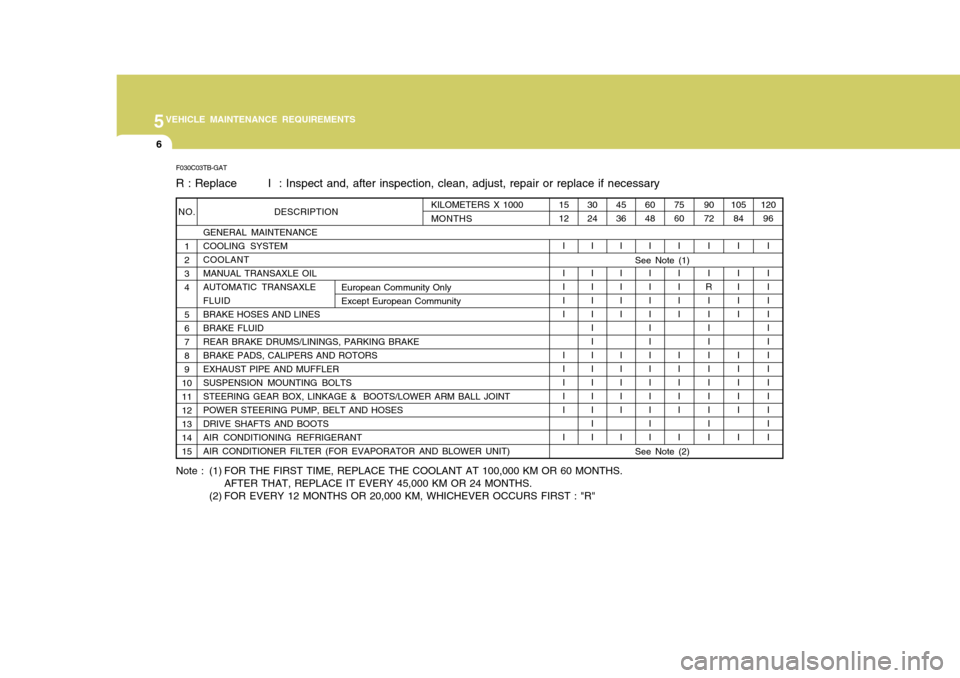
DESCRIPTION
GENERAL MAINTENANCE COOLING SYSTEMCOOLANTMANUAL TRANSAXLE OILAUTOMATIC TRANSAXLEFLUIDBRAKE HOSES AND LINESBRAKE FLUIDREAR BRAKE DRUMS/LININGS, PARKING BRAKEBRAKE PADS, CALIPERS AND ROTORSEXHAUST PIPE AND MUFFLERSUSPENSION MOUNTING BOLTSSTEERING GEAR BOX, LINKAGE & BOOTS/LOWER ARM BALL JOINTPOWER STEERING PUMP, BELT AND HOSESDRIVE SHAFTS AND BOOTSAIR CONDITIONING REFRIGERANTAIR CONDITIONER FILTER (FOR EVAPORATOR AND BLOWER UNIT)
NO.
1234 5 6789
101112131415
Note : (1) FOR THE FIRST TIME, REPLACE THE COOLANT AT 100,000 KM OR 60 MONTHS. AFTER THAT, REPLACE IT EVERY 45,000 KM OR 24 MONTHS.
(2) FOR EVERY 12 MONTHS OR 20,000 KM, WHICHEVER OCCURS FIRST : "R"
F030C03TB-GAT R : Replace I : Inspect and, after inspection, clean, adjust, repair or replace if necessary
120
96
I I IIIIIIIIIIII
105
84
I I III I IIII I
90 72
I I
R I IIIIIIIIII
7560
I I III I IIII I
60 48
I I IIIIIIIIIIII
4536
I I III I IIII I
30 24
I I IIIIIIIIIIII
1512
I I III I IIII I
KILOMETERS X 1000 MONTHS
European Community Only Except European Community
See Note (2)
See Note (1)
Page 214 of 599

5
VEHICLE MAINTENANCE REQUIREMENTS
7
ENGINE OIL AND FILTER AIR CLEANER FILTER SPARK PLUGS TIMING BELTBRAKE PADS, CALIPERS AND ROTORS REAR BRAKE DRUMS/LININGS, PARKING BRAKE STEERING GEAR BOX, LINKAGE & BOOTS/LOWER ARM BALL JOINT DRIVESHAFTS AND BOOTS MANUAL TRANSAXLE OILAUTOMATIC TRANSAXLE FLUID
AIR CONDITIONER FILTER (For Evaporator and Blower unit)
SEVERE DRIVING CONDITIONS
A - Repeatly driving short distance of less than 8km(5miles) in normal temperature or less than 16km(10miles) in freezing temperature
B - Extensive engine idling or low speed driving for long distances
C - Driving on rough, dusty, muddy, unpaved, graveled or salt-spread roads D - Driving in areas using salt or other corrosive materials or in very
cold weather
E - Driving in sandy areas
F - Driving in heavy traffic area over 32°C(90°F)G - Driving on uphill, downhill, or mountain roadH - Towing a Trailer, or using a camper, or roof rack
I - Driving as a patrol car, taxi, other commercial use or vehicle towing
J - Driving over 170 Km/h(100 MPH)K - Frequently driving in stop-and-go conditions R R R R
I I I I
RR R
European community Only Except European community
MAINTENANCE ITEM
EVERY 7,500 KM OR 6 MONTHS MORE FREQUENTLY MORE FREQUENTLY EVERY 60,000 KM OR 48 MONTHSMORE FREQUENTLY MORE FREQUENTLY MORE FREQUENTLY EVERY 15,000 KM OR 12 MONTHS EVERY 100,000 KM EVERY 45,000 KM EVERY 40,000 KMMORE FREQUENTLY A, B, C, D, E, F, G, H, I, KA, B, C, F, H, I, JC, E B, H D, E, F, GC, D, G, H C, D, G, H C, D, E, F C, D, E, F A, C, D, E, F, G, H, I, J A, C, E, F, G, H, I C, E
MAINTENANCE
INTERVALS DRIVING
CONDITION
MAINTENANCE
OPERATIONGASOLINE DIESEL
MAINTENANCE UNDER SEVERE USAGE CONDITIONS
F040A08A-GAT The following items must be serviced more frequently on cars normally used under severe driving conditions. Refer to the
chart below for the appropriate maintenance intervals.
R : Replace I : Inspect and, after inspection, clean, adjust, repair or replace if necessary
Page 218 of 599
5
VEHICLE MAINTENANCE REQUIREMENTS
11
F070M01A-AAT
o Steering Gear Box, Linkage &
Boots/Lower arm Ball Joint
With the vehicle stopped and engine off, check for excessive free-play in the steering wheel. Check the linkage for bends or damage. Check the dustboots and ball joints for deterioration, cracks, or damage. Replace any dam- aged parts. F070N01A-AAT
o Power Steering Pump, Belt
and Hoses
Check the power steering pump and hoses for leakage and damage. Re- place any damaged or leaking partsimmediately. Inspect the power steer- ing belt for evidence of cuts, cracks, excessive wear, oiliness and propertension. Replace or adjust it if neces- sary. F070P01A-AAT
o Driveshafts and Boots
Check the drive shafts, boots and clamps for cracks, deterioration, or damage. Replace any damaged parts and, if necessary, repack the grease. F070Q01A-AAT
o Air Conditioning Refrigerant
Check the air conditioning lines and connections for leakage and damage. Check air conditioning performance according to the relevant shop manual if necessary.
Page 414 of 599
7
1
CONTROLS AND EQUIPMENT
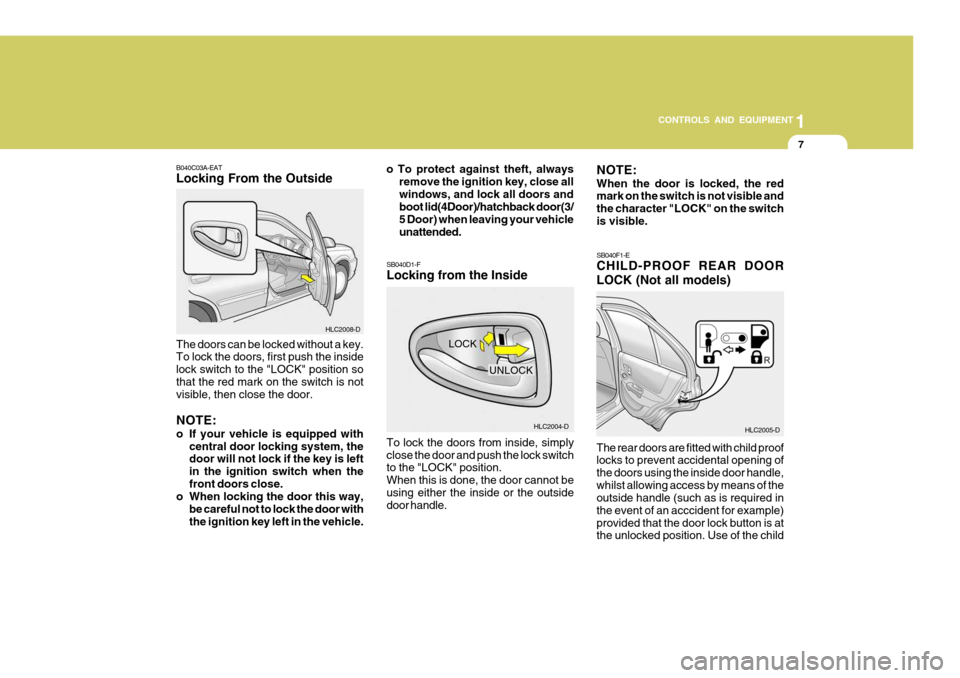
SB040D1-F Locking from the Inside To lock the doors from inside, simply close the door and push the lock switch to the "LOCK" position. When this is done, the door cannot beusing either the inside or the outside door handle. SB040F1-E CHILD-PROOF REAR DOOR LOCK (Not all models) The rear doors are fitted with child proof locks to prevent accidental opening of the doors using the inside door handle,whilst allowing access by means of the outside handle (such as is required in the event of an acccident for example)provided that the door lock button is at the unlocked position. Use of the child
NOTE: When the door is locked, the red mark on the switch is not visible and the character "LOCK" on the switchis visible.
LOCK HLC2005-D
B040C03A-EAT Locking From the Outside The doors can be locked without a key. To lock the doors, first push the inside lock switch to the "LOCK" position sothat the red mark on the switch is not visible, then close the door. NOTE:
o If your vehicle is equipped with
central door locking system, the door will not lock if the key is left in the ignition switch when thefront doors close.
o When locking the door this way,
be careful not to lock the door withthe ignition key left in the vehicle. HLC2008-D
o To protect against theft, always
remove the ignition key, close allwindows, and lock all doors and boot lid(4Door)/hatchback door(3/ 5 Door) when leaving your vehicleunattended.
HLC2004-D
UNLOCK
Page 416 of 599
9
1
CONTROLS AND EQUIPMENT
CAUTION:
Do not arm the system until all pas- sengers have left the car. If the sys- tem is armed while a passenger(s) remains in the car, the alarm may beactivated when the remaining passenger(s) leaves the car.! B070C04A-EAT Alarm Stage The alarm will be activated if any of the following occurs while the car is parkedand the system is armed.
1) A door or hatchback door (3/5 Door)
is opened without using the trans- mitter.
2) The boot lid (4 Door) is opened with- out using the key.
3) The engine bonnet is opened. The alarming horn will sound and the turn signal light will blink continuously for 27 seconds. To turn off the system,unlock the door or hatchback door with the transmitter.
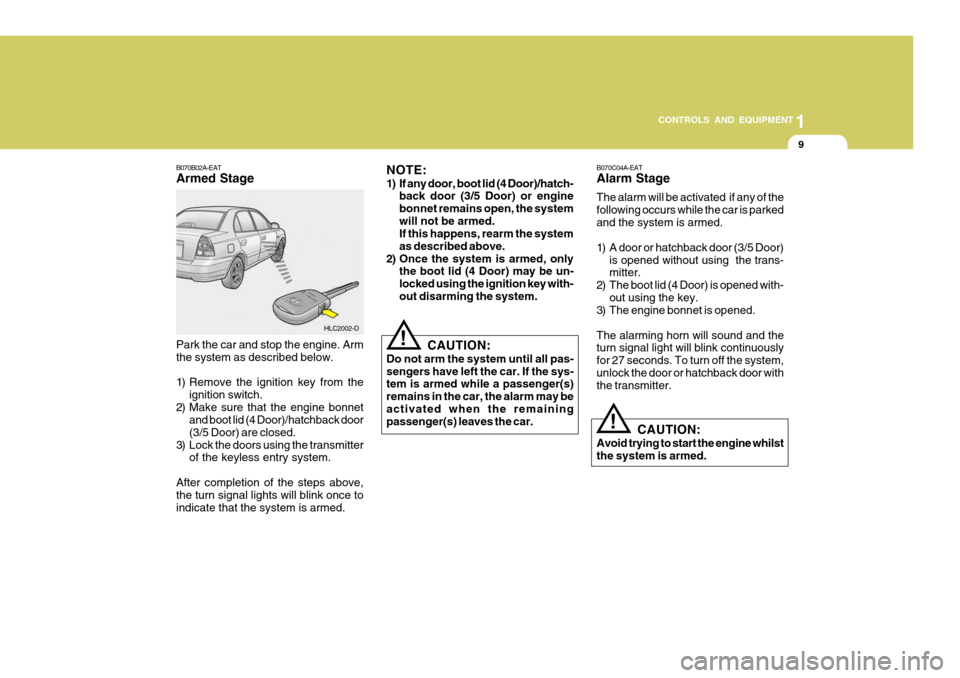
Park the car and stop the engine. Arm the system as described below.
1) Remove the ignition key from the
ignition switch.
2) Make sure that the engine bonnet and boot lid (4 Door)/hatchback door (3/5 Door) are closed.
3) Lock the doors using the transmitter of the keyless entry system.
After completion of the steps above, the turn signal lights will blink once to indicate that the system is armed. HLC2002-D
B070B02A-EAT Armed Stage
NOTE:
1) If any door, boot lid (4 Door)/hatch-
back door (3/5 Door) or engine bonnet remains open, the systemwill not be armed. If this happens, rearm the system as described above.
2) Once the system is armed, only the boot lid (4 Door) may be un-locked using the ignition key with-out disarming the system.
CAUTION:
Avoid trying to start the engine whilst the system is armed.
!
Page 417 of 599
1CONTROLS AND EQUIPMENT
10
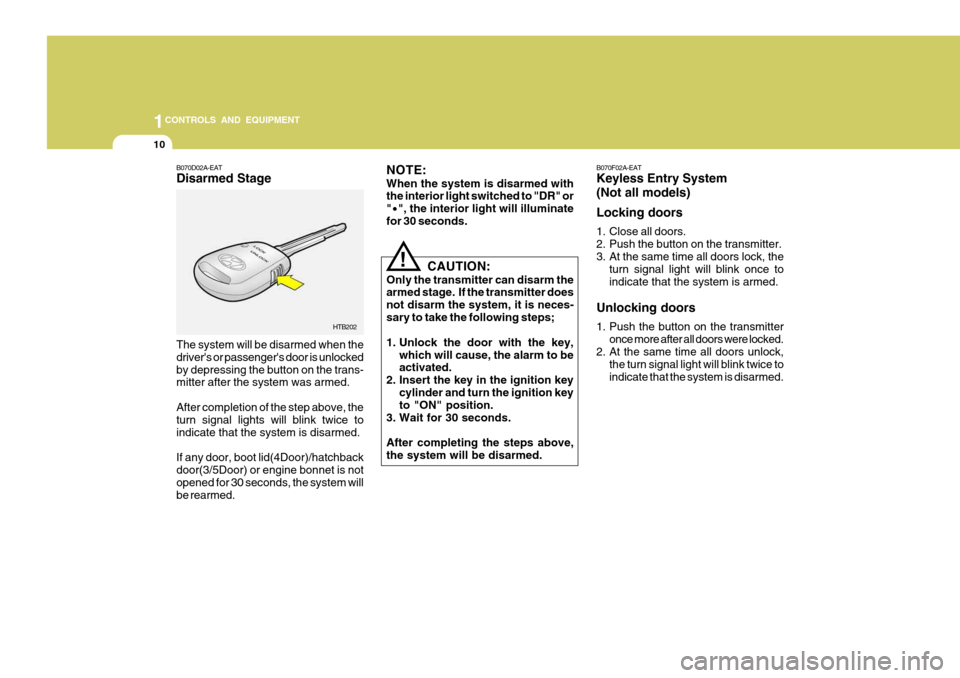
B070D02A-EAT Disarmed Stage The system will be disarmed when the driver's or passenger's door is unlockedby depressing the button on the trans- mitter after the system was armed. After completion of the step above, the turn signal lights will blink twice to indicate that the system is disarmed. If any door, boot lid(4Door)/hatchback door(3/5Door) or engine bonnet is notopened for 30 seconds, the system will be rearmed. HTB202
CAUTION:
Only the transmitter can disarm thearmed stage. If the transmitter does not disarm the system, it is neces-sary to take the following steps;
1. Unlock the door with the key, which will cause, the alarm to be activated.
2. Insert the key in the ignition key
cylinder and turn the ignition keyto "ON" position.
3. Wait for 30 seconds. After completing the steps above, the system will be disarmed.
!
NOTE: When the system is disarmed with the interior light switched to "DR" or "
· ", the interior light will illuminate
for 30 seconds. B070F02A-EAT Keyless Entry System (Not all models) Locking doors
1. Close all doors.
2. Push the button on the transmitter.
3. At the same time all doors lock, the
turn signal light will blink once toindicate that the system is armed.
Unlocking doors
1. Push the button on the transmitter once more after all doors were locked.
2. At the same time all doors unlock,
the turn signal light will blink twice to indicate that the system is disarmed.
Page 430 of 599
23
1
CONTROLS AND EQUIPMENT
!WARNING:
o A child restraint system must be placed in the rear seat. Never in- stall a child or infant seat on the front passenger's seat. Should an accident occur andcause the passenger side airbag to deploy, it could severely injure or kill an infant or child seated inan infant or child seat. Thus, only use a child restraint in the rear seat of your vehicle.
o Since a safety belt or child re-
straint system can become veryhot if it is left in a closed vehicle, be sure to check the seat cover and buckles before placing a childthere.
o When the child restraint system is
not in use, store it in the boot orfasten it with a safety belt so that it will not be thrown forward in the case of a sudden stop or an acci-dent.
o Children who are too large to be in
a child restraint should sit in therear seat and be restrained with the available lap/shoulder belts.
Never allow children to ride in the front passenger seat.
o Always make sure that the shoul-
der belt portion of the outboardlap/shoulder belt is positioned midway over the shoulder, never across the neck or behind theback. Moving the child closer to the centre of the vehicle may help provide a good shoulder belt fit.The lap belt portion of the lap/ shoulder belt or the centre seat lap belt must always be positioned aslow as possible on the child's hips and as snug as possible.
o If the seat belt will not properly fit the child, Hyundai recommendsthe use of an approved booster seat in the rear seat in order toraise the child's seating height so that the seat belt will properly fit the child.
o Never allow a child to stand up or kneel on the seat.o Never use an infant carrier or child
safety seat that "hooks" over a seatback; it may not provide ad- equate security in an accident.
o Never allow a child to be held in a person's arms while they are in amoving vehicle, as this could re-sult in serious injury to the child in the event of an accident or a sudden stop. Holding a child in amoving vehicle does not provide the child with any means of pro- tection during an accident, even ifthe person holding the child is wearing a seat belt.
o If the child restraint seat is not anchored properly, the risk of achild being seriously injured or killed in a collision greatly in-creases.
Page 462 of 599
55
1
CONTROLS AND EQUIPMENT
HEATED REAR WINDOWHAZARD WARNING SYSTEM
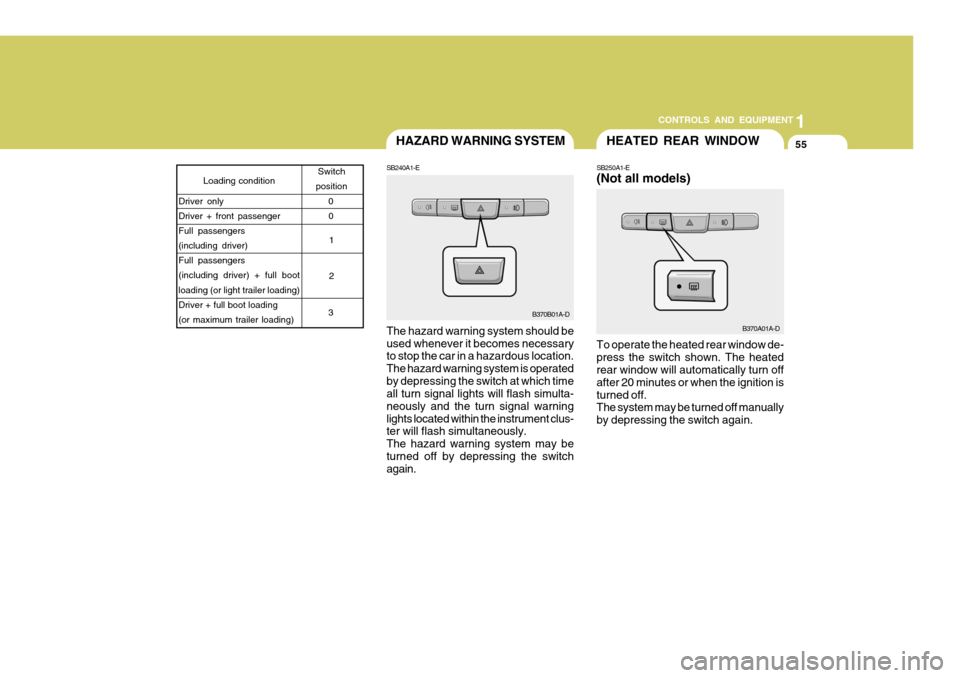
SB250A1-E (Not all models) To operate the heated rear window de- press the switch shown. The heated rear window will automatically turn off after 20 minutes or when the ignition isturned off. The system may be turned off manually by depressing the switch again. B370A01A-D
SB240A1-E The hazard warning system should be used whenever it becomes necessary to stop the car in a hazardous location. The hazard warning system is operatedby depressing the switch at which time all turn signal lights will flash simulta- neously and the turn signal warninglights located within the instrument clus- ter will flash simultaneously. The hazard warning system may beturned off by depressing the switch again.
B370B01A-D
Loading condition
Switch
position
Driver only Driver + front passengerFull passengers (including driver) Full passengers(including driver) + full boot loading (or light trailer loading) Driver + full boot loading(or maximum trailer loading) 0
1 2
3 0
Page 475 of 599
1CONTROLS AND EQUIPMENT
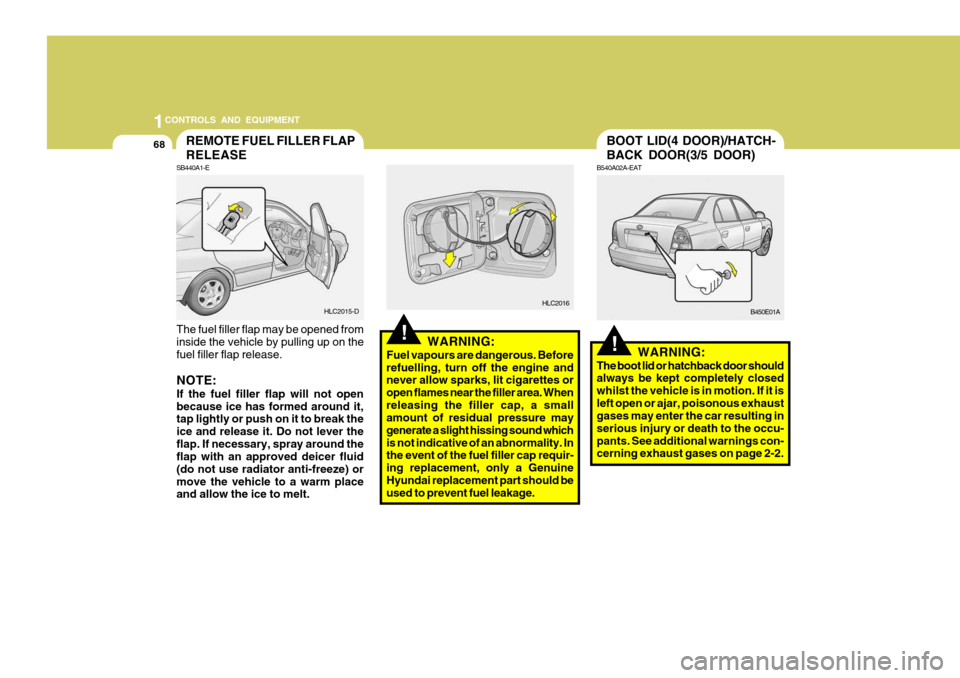
68BOOT LID(4 DOOR)/HATCH- BACK DOOR(3/5 DOOR)
!
B540A02A-EAT
B450E01A
WARNING:
The boot lid or hatchback door should always be kept completely closed whilst the vehicle is in motion. If it isleft open or ajar, poisonous exhaust gases may enter the car resulting in serious injury or death to the occu-pants. See additional warnings con- cerning exhaust gases on page 2-2.
REMOTE FUEL FILLER FLAP RELEASE
!WARNING:
Fuel vapours are dangerous. Before refuelling, turn off the engine and never allow sparks, lit cigarettes or open flames near the filler area. Whenreleasing the filler cap, a small amount of residual pressure may generate a slight hissing sound which
is not indicative of an abnormality. In the event of the fuel filler cap requir- ing replacement, only a GenuineHyundai replacement part should be used to prevent fuel leakage.
SB440A1-E
The fuel filler flap may be opened from inside the vehicle by pulling up on the fuel filler flap release. NOTE: If the fuel filler flap will not open because ice has formed around it, tap lightly or push on it to break the ice and release it. Do not lever theflap. If necessary, spray around the flap with an approved deicer fluid (do not use radiator anti-freeze) ormove the vehicle to a warm place and allow the ice to melt. HLC2016
HLC2015-D