tire size Hyundai Accent 2006 Owner's Manual
[x] Cancel search | Manufacturer: HYUNDAI, Model Year: 2006, Model line: Accent, Model: Hyundai Accent 2006Pages: 599, PDF Size: 17.59 MB
Page 165 of 599
2
DRIVING YOUR HYUNDAI
3
!
BEFORE STARTING THE EN- GINE
C020A01O-GAT Before you start the engine, you should always:
1. Look around the vehicle to be sure
there are no flat tires, puddles of oil, water or other indications of pos- sible trouble.
2. After entering the car, check to be sure the parking brake is engaged.
3. Check that all windows, and lights are clean.
4. Check that the interior and exterior
mirrors are clean and in position.
5. Check your seat, seatback and headrest to be sure they are in theirproper positions.
6. Lock all the doors.
7. Fasten your seat belt and be sure
that all other occupants have fas- tened theirs.
8. Turn off all lights and accessories
that are not needed.
9. When you turn the ignition switch to "ON", check that all appropriatewarning lights are operating andthat you have sufficient fuel.
10.Check the operation of warning
lights and all bulbs when key is inthe "ON" position. WARNING: (DIESEL ENGINE)
To ensure that sufficient vacuum exists within the brake system dur-ing cold weather start-up condi- tions, it is necessary to run the engine at idle for several secondsafter starting the engine.
!WARNING:
o In a collision crash, an unbelted person is significantly more likely to die than a person wearing a seatbelt.
o Your vehicle is equipped with tires designed to provide for saferide and handling capability.Do not use a size and type of tire and wheel that is different from the one that is originally installedon your vehicle. It can affect the safety and performance of your vehicle, which could lead to han-dling failure or rollover and seri- ous injury. When replacing the tires, be sureto equip all four tires with the tire and wheel of the same size, type, tread, brand and load-carryingcapacity. If you nevertheless de- cide to equip your vehicle with any tire/wheel combination notrecommended by Hyundai for off- road driving, you should not use these tires for highway driving.
Page 180 of 599
2 DRIVING YOUR HYUNDAI
18WINTER DRIVINGSMOOTH CORNERING
C150A01A-AAT Avoid braking or gear changing in cor- ners, especially when roads are wet. Ideally, corners should always be taken under gentle acceleration. If you followthese suggestions, tire wear will be held to a minimum. C160A01A-AAT The more severe weather conditions of winter result in greater wear and other problems. To minimize the prob- lems of winter driving, you should fol-low these suggestions: C160B02A-GAT Snowy or Icy Conditions To drive your vehicle in deep snow, it may be necessary to use snow tires orto install tire chains on your tires. If snow tires are needed, it is necessary to select tires equivalent in size andtype to the original equipment tires. Failure to do so may adversely affect the safety and handling of your car.Speeding, rapid acceleration, sudden brake applications, and sharp turns are potentially very hazardous prac-tices. During deceleration, use engine braking to the fullest extent. Sudden brake applications on snowy or icyroads may cause skids to occur. You need to keep sufficient distance be- tween the vehicle in front and yourvehicle. Also, apply the brake gently. It should be noted that installing tire
o Don't "lug" or "over-rev" the engine.
Lugging is driving too slowly in too high a gear resulting in the engine bucking. If this happens, shift to a lower gear. Over-revving is racingthe engine beyond its safe limit. This can be avoided by shifting at the recommended speeds.
o Use your air conditioning sparingly. The air conditioning system is oper-ated by engine power so your fueleconomy is reduced when you use it.
Page 192 of 599
3
WHAT TO DO IN AN EMERGENCY
5
!!
SPARE TIRE
WARNING (Diesel only):
Never work on injection system with engine running or within 30 sec- onds after shutting off engine. High pressure pump, rail, injectors andhigh pressure pipes are subject to high pressure even after the engine stopped. The fuel jet produced byfuel leaks may cause serious in- jury, if it touch the body. People using pacemakers should not movethan 30cm closer to the ECU or wiring harness within the engine room while engine is running, sincethe high currents in the Common Rail system produce considerable magnetic fields. WARNING:
Do not remove the radiator cap whenthe engine is hot. This can allowcoolant to be blown out of the open- ing and cause serious burns.
6. If you cannot find the cause of the overheating, wait until the engine temperature has returned to nor-mal. Then, if the engine coolant has been lost, carefully add coolant to the reservoir (Page 6-14) to bringthe fluid level in the reservoir up to the halfway mark.
7. Proceed with caution, keeping alert
for further signs of overheating. Ifoverheating happens again, call a Hyundai dealer for assistance.
!
5. If the water pump drive belt is bro-
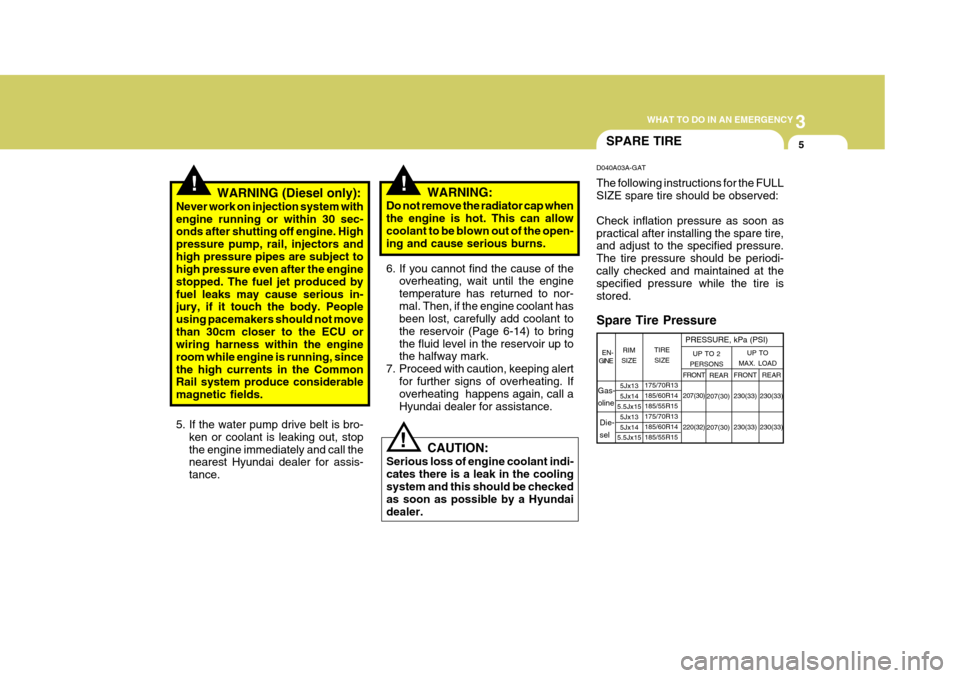
ken or coolant is leaking out, stop the engine immediately and call the nearest Hyundai dealer for assis- tance. D040A03A-GAT The following instructions for the FULL SIZE spare tire should be observed: Check inflation pressure as soon as practical after installing the spare tire, and adjust to the specified pressure. The tire pressure should be periodi-cally checked and maintained at the specified pressure while the tire is stored.
Spare Tire Pressure
5Jx13 5Jx14
5.5Jx15 5Jx135Jx14
5.5Jx15 TIRE
SIZE
RIM
SIZE PRESSURE, kPa (PSI)
175/70R13185/60R14185/55R15175/70R13185/60R14185/55R15 REAR
207(30) 207(30) FRONT 230(33) 230(33)
UP TO 2
PERSONS UP TO
MAX. LOAD
REAR
230(33)230(33)
FRONT 207(30) 220(32)
EN-
GINE
Die- sel
Gas-oline
CAUTION:
Serious loss of engine coolant indi- cates there is a leak in the coolingsystem and this should be checked as soon as possible by a Hyundai dealer.
Page 269 of 599

8
CONSUMER INFORMATION
3
UP TO
MAX. LOAD
UP TO
PERSONSTIRE
I020A01A-AAT TIRE INFORMATION The tires supplied on your new Hyundai are chosen to provide the best perfor-mance for normal driving. I030A03A-GAT RECOMMENDED INFLATION PRESSURES The tire label located in the glove box gives the tire pressures recommended for your car. These pressures were chosen to pro-vide the most satisfactory combinationof ride comfort, tire wear and stability under normal conditions. Tire pres- sures should be checked at leastmonthly. Proper tire inflation pressures should be maintained for these rea- sons:
o Lower-than-recommended tire pres-
sures cause uneven tread wear and poor handling.
o Higher-than-recommended tire
pressures increase the chance ofdamage from impacts and cause uneven tread wear.
I030A01A CAUTION:
Always observe the following:
o Check pressures when the tires are cold. That is, after the car has been parked for at least threehours and hasn't been driven more than 1.6 km or one mile since starting up.
o Check the pressure of your spare tire each time you check the pres-sure of other tires.
o Never overload your vehicle. Be
especially careful about overload- ing if you equip your vehicle witha luggage rack.
o Worn, old tires can cause acci- dents. If your tread is badly worn,or if your tires have been dam-aged, replace them.
!
5Jx13 5Jx145Jx135Jx14 175/70R13185/60R14175/70R13185/60R14 FRONT
230(33) 230(33) REAR
230(33) 230(33)
FRONT 207(30) 220(32)
Gas- olineDie-sel
TIRE
SIZE
RIM
SIZE PRESSURE, kPa (PSI)EN-
GINE
REAR
207(30) 207(30)
Page 270 of 599
8CONSUMER INFORMATION
4
!
!
I050A01TB-AAT TIRE CHAINS Tire chains, if necessary should be installed on the front wheels. Be surethat the chains are installed in accor- dance with the manufacturer's instruc- tions.To minimize tire and chain wear, do not continue to use tire chains when they are no longer needed.
I040A02A-GAT SNOW TIRES If you equip your car with snow tires, they should be the same size and havethe same load capacity as the original tires. Snow tires should be installed on all four wheels; otherwise, poor han-dling may result. Snow tires should carry 28 kPa (4 psi) more air pressure than the pressurerecommended for the standard tires on the tire label in the glove box, or up to the maximum pressure shown on thetire sidewall whichever is less. Do not drive faster than 120 km/h (75 mph) when your car is equipped withsnow tires. I060A02A-AAT TIRE ROTATION
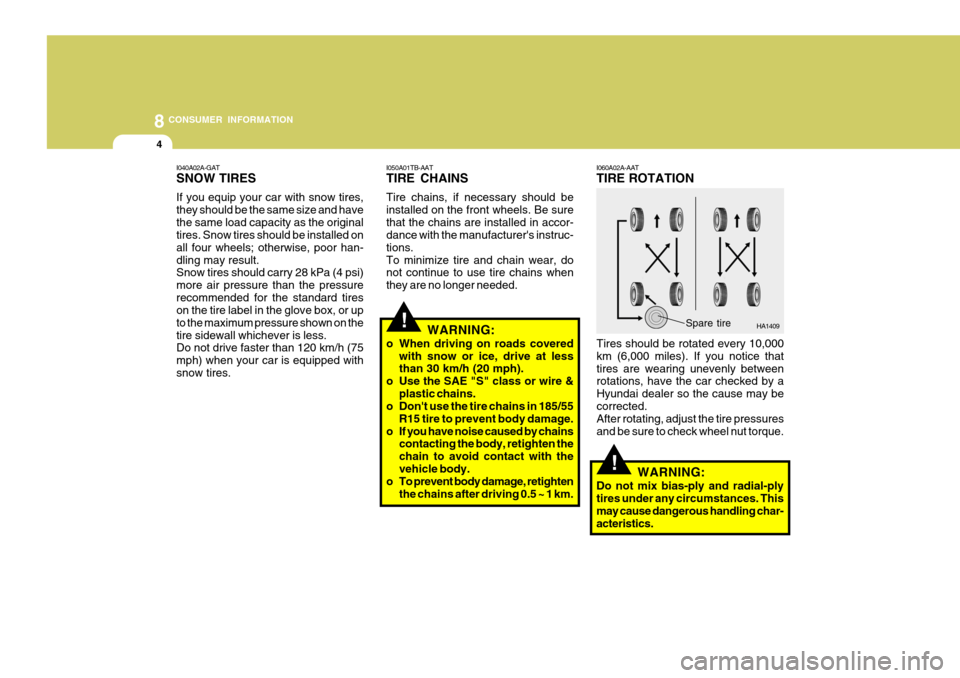
Tires should be rotated every 10,000 km (6,000 miles). If you notice thattires are wearing unevenly between rotations, have the car checked by a Hyundai dealer so the cause may becorrected. After rotating, adjust the tire pressures and be sure to check wheel nut torque.
WARNING:
o When driving on roads covered with snow or ice, drive at less than 30 km/h (20 mph).
o Use the SAE "S" class or wire & plastic chains.
o Don't use the tire chains in 185/55
R15 tire to prevent body damage.
o If you have noise caused by chains contacting the body, retighten the chain to avoid contact with thevehicle body.
o To prevent body damage, retighten
the chains after driving 0.5 ~ 1 km. HA1409
Spare tire
WARNING:
Do not mix bias-ply and radial-ply tires under any circumstances. Thismay cause dangerous handling char- acteristics.
Page 271 of 599
8
CONSUMER INFORMATION
5
I070A01A-AAT TIRE BALANCING A tire that is out of balance may affect handling and tire wear. The tires onyour Hyundai were balanced before the car was delivered but may need balancing again during the years youown the car. Whenever a tire is dismounted for repair, it should be rebalanced before
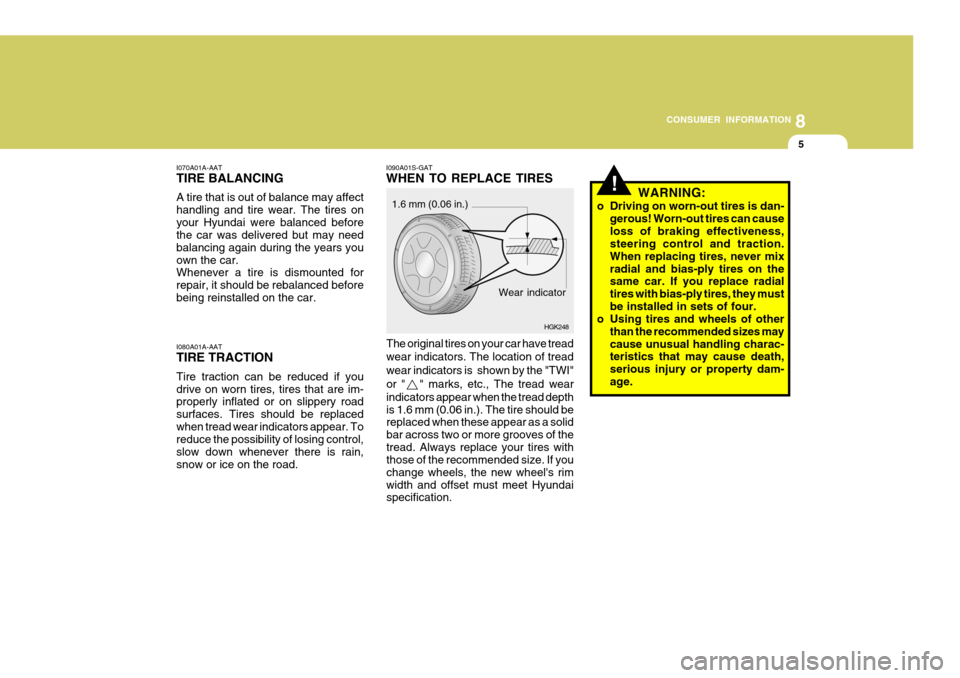
being reinstalled on the car. I080A01A-AAT TIRE TRACTION Tire traction can be reduced if you drive on worn tires, tires that are im- properly inflated or on slippery road surfaces. Tires should be replacedwhen tread wear indicators appear. To reduce the possibility of losing control, slow down whenever there is rain,snow or ice on the road. I090A01S-GAT WHEN TO REPLACE TIRES
Wear indicator
1.6 mm (0.06 in.)
HGK248
The original tires on your car have tread wear indicators. The location of tread wear indicators is shown by the "TWI"or " " marks, etc., The tread wear indicators appear when the tread depth is 1.6 mm (0.06 in.). The tire should be replaced when these appear as a solid bar across two or more grooves of thetread. Always replace your tires with those of the recommended size. If you change wheels, the new wheel's rimwidth and offset must meet Hyundai specification.
!WARNING:
o Driving on worn-out tires is dan- gerous! Worn-out tires can cause loss of braking effectiveness, steering control and traction. When replacing tires, never mixradial and bias-ply tires on the same car. If you replace radial tires with bias-ply tires, they mustbe installed in sets of four.
o Using tires and wheels of other
than the recommended sizes maycause unusual handling charac- teristics that may cause death, serious injury or property dam-age.
Page 274 of 599

9 VEHICLE SPECIFICATIONS
2
Type Wheel free playRack stroke Oil pump type 4 DOOR
4260 (167.7)
1680 (66.1) 1395 (54.9) 2440 (96.1) 1435 (56.5)1425 (56.1)
ItemOverall length Overall width Overall height (unladen)Wheel base Wheel tread J030A02A-GAT TIRE
GASOLINE
MF45AH, MF55AH 90A (13.5V)
0.7 KW 0.9 KW
Dual hydraulic with brake booster Ventilated disc DrumCable operated on rear wheel
J010A01A-GAT MEASUREMENT
J060A01A-GAT FUEL SYSTEM
Rack and pinion 0 ~ 30 mm (0 ~ 1.18 in.) 134 mm (5.3 in.) Vane type
175/70 R13 185/60R14, 185/55 R15 Full size
StandardOption Spare
Front Rear
mm (in.)
J020A01A-GAT POWER STEERING Fuel tank Capacity Liter
45 Imp.gal
9.9
J040A03A-GAT ELECTRICAL
Item Battery Alternator Starter
J050A01A-GAT BRAKE Type Front brake typeRear brake type Parking brake
3/5 DOOR
4215 (165.9)
DIESEL
CMF60AH 90A(12V) 1.7 KW
-
Manual T/A Automatic T/A