tires Hyundai Accent 2007 User Guide
[x] Cancel search | Manufacturer: HYUNDAI, Model Year: 2007, Model line: Accent, Model: Hyundai Accent 2007Pages: 282, PDF Size: 10.55 MB
Page 249 of 282
6 DO-IT-YOURSELF MAINTENANCE
26HEADLIGHT AIMING ADJUSTMENT
5. Open the hood.
6. Draw the vertical line (through the
center of each headlight beam pat-tern) and the horizontal line (throughthe center of each headlight beam pattern) on the aiming screen. And then, draw a horizontal parallel line at 30 mm (1.18 in.) under the horizontal line.
7. Adjust each cut-off line of the low beam to the parallel line with a phillipsscrewdriver - VERTICAL AIMING.
8. Adjust each cut-off line of the low
beam to each vertical line with aphillips screwdriver - HORIZONTAL AIMING. Horizontal aiming
Vertical aiming
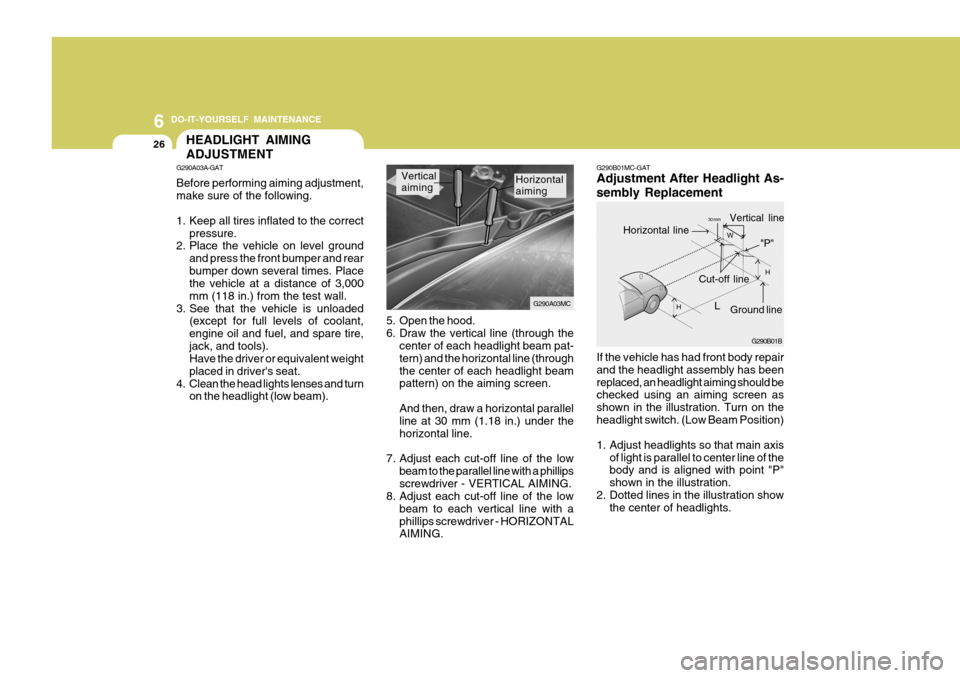
If the vehicle has had front body repair and the headlight assembly has beenreplaced, an headlight aiming should be checked using an aiming screen as shown in the illustration. Turn on theheadlight switch. (Low Beam Position)
1. Adjust headlights so that main axisof light is parallel to center line of the body and is aligned with point "P" shown in the illustration.
2. Dotted lines in the illustration show the center of headlights.
G290B01MC-GAT Adjustment After Headlight As- sembly Replacement
G290A03A-GAT Before performing aiming adjustment, make sure of the following.
1. Keep all tires inflated to the correct
pressure.
2. Place the vehicle on level ground
and press the front bumper and rear bumper down several times. Place the vehicle at a distance of 3,000 mm (118 in.) from the test wall.
3. See that the vehicle is unloaded (except for full levels of coolant,engine oil and fuel, and spare tire,jack, and tools). Have the driver or equivalent weight placed in driver's seat.
4. Clean the head lights lenses and turn on the headlight (low beam). G290B01B
LW
H
H Cut-off line
Ground line
"P"
Horizontal line
Vertical line30 mm
G290A03MC
Page 266 of 282
Vehicle Identification Number (VIN) .............................. 8-2
Engine Number ............................................................. 8-3
Recommended Inflation Pressures .............................. 8-3
Snow Tires ................................................................... 8-4
Tire Chains ................................................................... 8-5
Tire Rotation ................................................................. 8-5
Tire Balancing ............................................................... 8-6
Tire Traction ................................................................. 8-6
When to Replace Tires ................................................. 8-6
Spare Tire and Tools .................................................... 8-7
8
CONSUMER INFORMATION
8
Page 268 of 282
8
CONSUMER INFORMATION
3ENGINE NUMBERTIRE
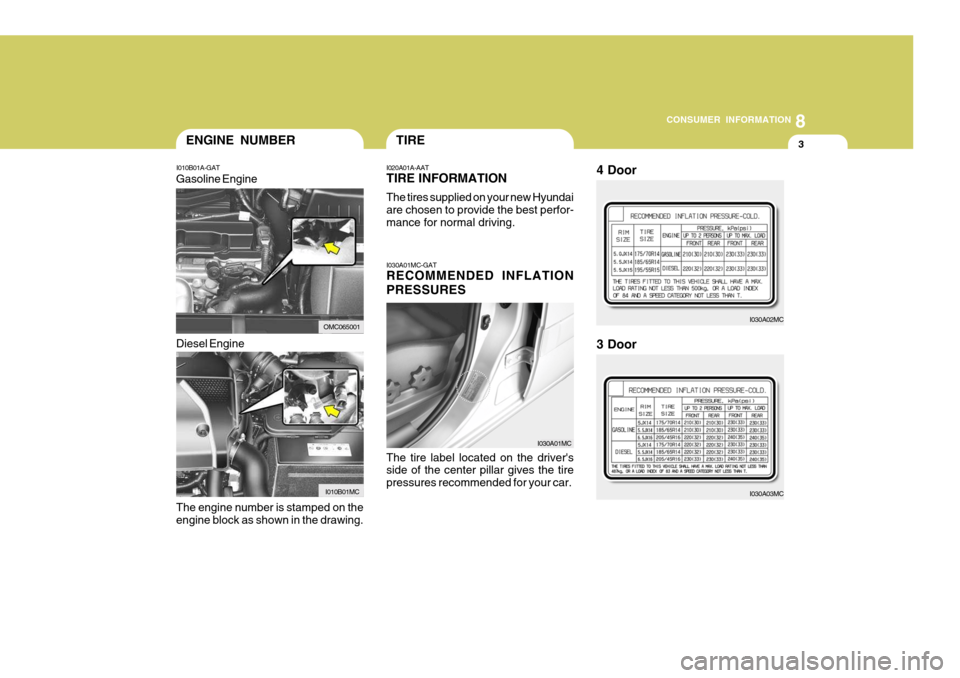
I010B01A-GAT
The engine number is stamped on the engine block as shown in the drawing. I020A01A-AAT TIRE INFORMATION The tires supplied on your new Hyundai are chosen to provide the best perfor-mance for normal driving. I030A01MC-GAT RECOMMENDED INFLATION PRESSURES The tire label located on the driver's side of the center pillar gives the tire pressures recommended for your car.
I030A01MC
Gasoline Engine Diesel Engine
OMC065001
I010B01MC
I030A01MC
I030A02MC
4 Door
I030A03MC
3 Door
Page 269 of 282

8CONSUMER INFORMATION
4
I040A02S-GAT SNOW TIRES If you equip your car with snow tires, they should be the same size and havethe same load capacity as the original tires. Snow tires should be installed on all four wheels; otherwise, poor han-dling may result. Snow tires should carry 28 kPa (4 psi) more air pressure than the pressurerecommended for the standard tires on the tire label on the driver's door edge, or up to the maximum pressure shownon the tire sidewall whichever is less. Do not drive faster than 120 km/h (75 mph) when your car is equipped withsnow tires.
These pressures were chosen to pro-vide the most satisfactory combinationof ride comfort, tire wear and stability under normal conditions. Tire pres- sures should be checked at leastmonthly. Proper tire inflation pressures should be maintained for these rea- sons:
o Lower-than-recommended tire pres-
sures cause uneven tread wear and poor handling.
o Higher-than-recommended tire
pressures increase the chance ofdamage from impacts and cause uneven tread wear. CAUTION:
Always observe the following:
o Check pressures when the tires are cold. That is, after the car has been parked for at least threehours and hasn't been driven more than 1.6 km or one mile since starting up.
o Check the pressure of your spare tire each time you check the pres-sure of other tires.
o Worn, old tires can cause acci-
dents. If your tread is badly worn, or if your tires have been dam-aged, replace them.
!
Page 270 of 282
8
CONSUMER INFORMATION
5
!
!
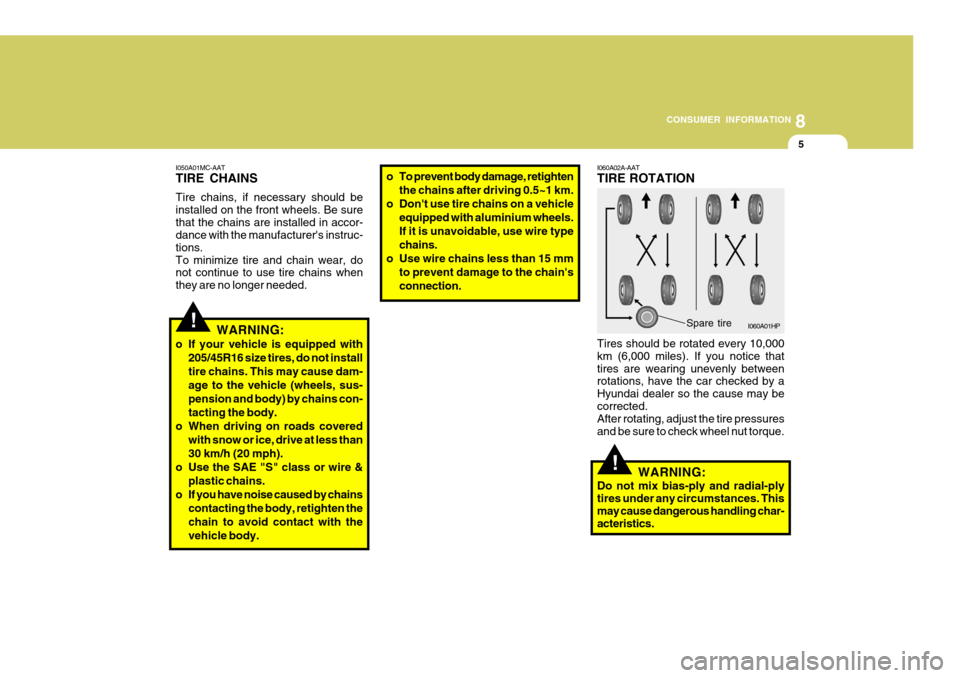
I050A01MC-AAT TIRE CHAINS Tire chains, if necessary should be installed on the front wheels. Be surethat the chains are installed in accor- dance with the manufacturer's instruc- tions.To minimize tire and chain wear, do not continue to use tire chains when they are no longer needed. I060A02A-AAT TIRE ROTATION Tires should be rotated every 10,000 km (6,000 miles). If you notice thattires are wearing unevenly between rotations, have the car checked by a Hyundai dealer so the cause may becorrected. After rotating, adjust the tire pressures and be sure to check wheel nut torque.
WARNING:
o If your vehicle is equipped with 205/45R16 size tires, do not install tire chains. This may cause dam-age to the vehicle (wheels, sus-pension and body) by chains con-tacting the body.
o When driving on roads covered with snow or ice, drive at less than30 km/h (20 mph).
o Use the SAE "S" class or wire & plastic chains.
o If you have noise caused by chains contacting the body, retighten thechain to avoid contact with thevehicle body. I060A01HP
Spare tire
WARNING:
Do not mix bias-ply and radial-ply tires under any circumstances. Thismay cause dangerous handling char- acteristics.
o To prevent body damage, retighten
the chains after driving 0.5~1 km.
o Don't use tire chains on a vehicle equipped with aluminium wheels. If it is unavoidable, use wire typechains.
o Use wire chains less than 15 mm to prevent damage to the chain'sconnection.
Page 271 of 282
8CONSUMER INFORMATION
6
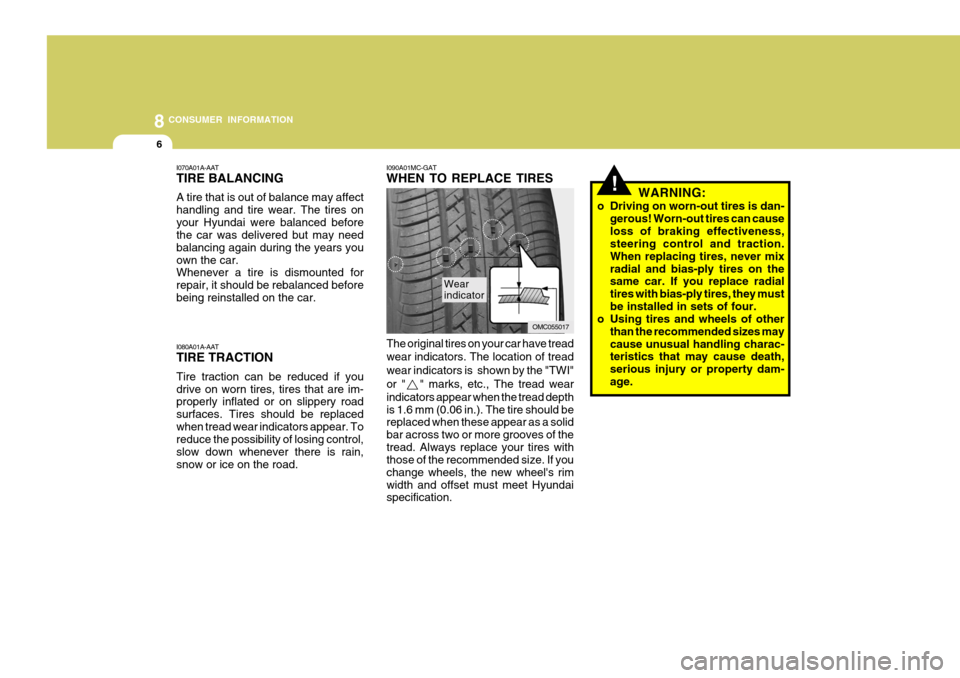
I090A01MC-GAT WHEN TO REPLACE TIRES
The original tires on your car have tread wear indicators. The location of tread wear indicators is shown by the "TWI"or " " marks, etc., The tread wear indicators appear when the tread depth is 1.6 mm (0.06 in.). The tire should be replaced when these appear as a solid bar across two or more grooves of thetread. Always replace your tires with those of the recommended size. If you change wheels, the new wheel's rimwidth and offset must meet Hyundai specification.
!WARNING:
o Driving on worn-out tires is dan- gerous! Worn-out tires can cause
loss of braking effectiveness, steering control and traction. When replacing tires, never mixradial and bias-ply tires on the same car. If you replace radial tires with bias-ply tires, they mustbe installed in sets of four.
o Using tires and wheels of other
than the recommended sizes maycause unusual handling charac- teristics that may cause death, serious injury or property dam-age.
OMC055017
Wear indicator
I070A01A-AAT TIRE BALANCING A tire that is out of balance may affect handling and tire wear. The tires onyour Hyundai were balanced before the car was delivered but may need balancing again during the years youown the car. Whenever a tire is dismounted for repair, it should be rebalanced beforebeing reinstalled on the car. I080A01A-AAT TIRE TRACTION Tire traction can be reduced if you drive on worn tires, tires that are im- properly inflated or on slippery road surfaces. Tires should be replacedwhen tread wear indicators appear. To reduce the possibility of losing control, slow down whenever there is rain,snow or ice on the road.
Page 281 of 282

10
INDEX
5
R
Rear Seat .................................................................. 1-18
Folding rear seatbacks ........................................... 1-19
Rear Window Defroster Switch .................................. 1-77
S Seats ......................................................................... 1-14
Front seat ............................................................... 1-15
Rear seat ................................................................ 1-18
Rear seat entry ....................................................... 1-18
Seat warmer ........................................................... 1-17
Seat Belts 2-Point type ............................................................ 1-29
3-Point system ....................................................... 1-27
Adjustabl e height .................................................... 1-26
Adjusting your seat belt ................................. 1-28, 1-29
Care of seat belts ................................................... 1-25
Precautions ............................................................. 1-24
Pre-tensioner seat belt ........................................... 1-40
Spectacle Ca se ......................................................... 1-85
Speedometer ............................................................. 1-67
Starting ........................................................................ 2-5
Steering Wheel Tilt Lever .......................................... 1-98
Stereo Sound System ............................................. 1-116
Sun Visor ................................................................... 1-96
Sunroof ...................................................................... 1-81
Sunshade ................................................................... 1-81T Tachometer
................................................................ 1-67
Theft-Alarm system ..................................................... 1-9
Tires Balancing .................................................................. 8-6
Chains ...................................................................... 8-5
If you have a flat tire ................................................ 3-6
Information ................................................................ 8-3
Pressure ................................................................... 8-3
Replacement ............................................................. 8-6
Rotation .................................................................... 8-5
Snow tires ................................................................ 8-4
Spare tire .................................................................. 3-5
Traction ..................................................................... 8-6
Towing
A trailer (or vehicle) ................................................ 2-23
Emergency ............................................................. 3-14
If your vehicle must be towed ................................ 3-13
Trailer or Vehicle towing ............................................ 2-23
Transaxle Automatic ................................................................. 2-9
Automatic transaxle fluid checking ......................... 6-15
Manual ...................................................................... 2-7
Manual transaxle oil checking ................................ 6-14
Trip Computer ............................................................ 1-69
Trip Odometer ............................................................ 1-68
Trunk Lid/Tail gate ..................................................... 1-94