ABS Hyundai Accent 2007 Owner's Manual
[x] Cancel search | Manufacturer: HYUNDAI, Model Year: 2007, Model line: Accent, Model: Hyundai Accent 2007Pages: 282, PDF Size: 10.55 MB
Page 12 of 282

YOUR VEHICLE AT A GLANCE
B255A02MC-GAT INDICATOR SYMBOLS ON THE INSTRUMENT PANEL * More detailed explanations of these items will be found begining on page 1-58.Turn Signal Indicator Lights
SRS (Airbag) Service Reminder Indicator (If Installed) O/D OFF Indicator Light (Automatic transaxle only) High Beam Indicator Light
Low Oil Pressure Warning Light
ABS Service Reminder Indicator (If Installed)
Door Ajar Warning Light
Parking Brake/Low Brake Fluid Level Warning Light
Charging System Warning Light Fuel Filter Warning Light (Diesel only)
Low Fuel Level Warning Light Diesel Pre-heat Indicator Light (Diesel only)
Malfunction Indicator Light (If Installed)
Immobilizer Warning Light (If Installed)
Passenger's Front Airbag OFF Indicator Light (If Installed)
Trunk Lid/Tail Gate Open Warning Light
Engine Coolant Temperature Indicator Light (If Installed) Seat Belt Warning Light
Electronic Power Steering (EPS) System Warning Light (If Installed)
Electronic Stability Program Indicator Lights (If Installed)
120
km/hOverspeed Warning Light (If Installed)
Page 43 of 282
1
FEATURES OF YOUR HYUNDAI
31
!WARNING:
o When using the rear seat center belt, you must lock all metal tabs and buckles. If any metal tab or buckle is not locked, it will in- crease the chance of injury in theevent of collision.
o Never unlock the metal tab (A) and
the buckle (B) with the followingexceptions.(1)In case of folding rear seatbacks
down.
(2)If transporting an object on the rear seat may cause damage tothe rear seat center belt.
B220D04MC
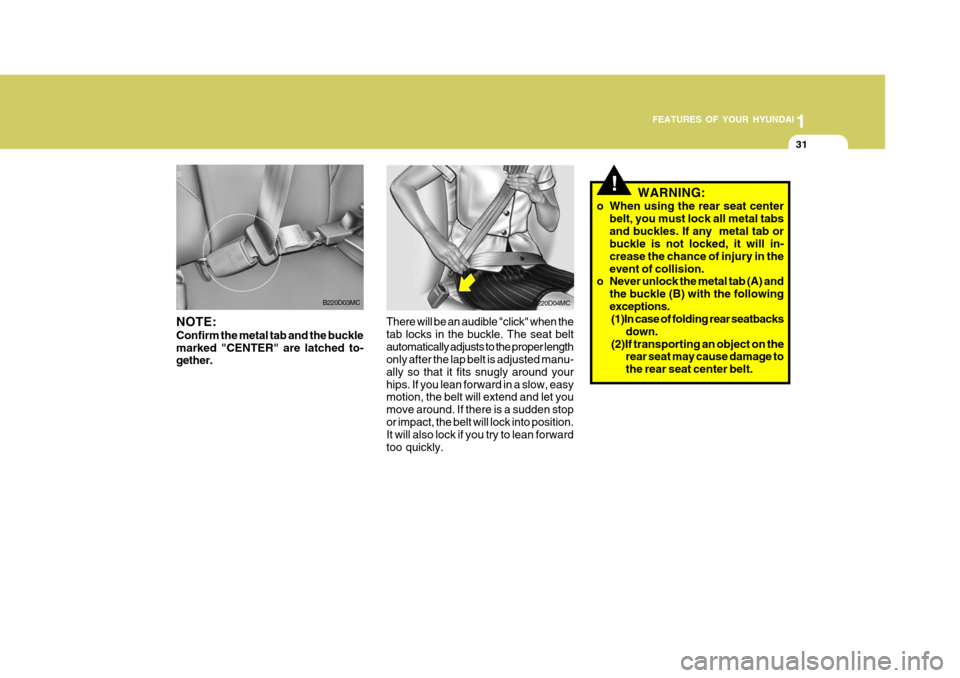
There will be an audible "click" when thetab locks in the buckle. The seat beltautomatically adjusts to the proper length only after the lap belt is adjusted manu- ally so that it fits snugly around yourhips. If you lean forward in a slow, easy motion, the belt will extend and let you move around. If there is a sudden stopor impact, the belt will lock into position. It will also lock if you try to lean forward too quickly.
NOTE: Confirm the metal tab and the buckle marked "CENTER" are latched to- gether. B220D03MC
Page 50 of 282
1FEATURES OF YOUR HYUNDAI
38
WARNING:
o Do not install a child restraint seat at the center of the rear seat using the vehicle's ISOFIX anchors. The ISOFIX anchors are only providedfor the left and right outboard rear seating positions. Do not misuse the ISOFIX anchors by attemptingto attach a child restraint seat in the middle of the rear seat to the ISOFIX anchors. In a crash, thechild restraint seat ISOFIX attach- ments may not be strong enough to secure the child restraint seatproperly in the center of the rear seat and may break, causing seri- ous injury or death.
o When using the vehicle’s "ISOFIX" system to install a child restraintsystem in the rear seat, all unusedvehicle rear seat belt metal latch plates or tabs must be latched securely in their seat belt bucklesand the seat belt webbing must be retracted behind the child restraint to prevent the child from reachingand taking hold of unretracted seat
belts. Unlatched metal latch plates
B230D03MC
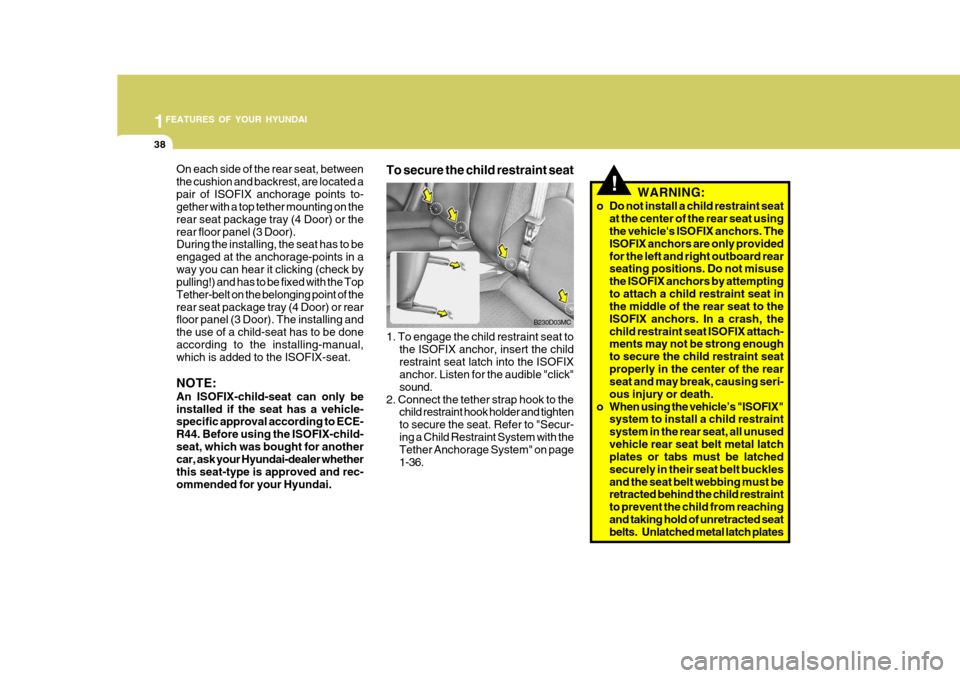
1. To engage the child restraint seat to the ISOFIX anchor, insert the child restraint seat latch into the ISOFIX anchor. Listen for the audible "click" sound.
2. Connect the tether strap hook to the child restraint hook holder and tightento secure the seat. Refer to "Secur-ing a Child Restraint System with the Tether Anchorage System" on page 1-36.
To secure the child restraint seat!
On each side of the rear seat, between the cushion and backrest, are located apair of ISOFIX anchorage points to- gether with a top tether mounting on the rear seat package tray (4 Door) or therear floor panel (3 Door). During the installing, the seat has to be engaged at the anchorage-points in away you can hear it clicking (check by pulling!) and has to be fixed with the Top Tether-belt on the belonging point of therear seat package tray (4 Door) or rear floor panel (3 Door). The installing and the use of a child-seat has to be doneaccording to the installing-manual, which is added to the ISOFIX-seat. NOTE: An ISOFIX-child-seat can only be installed if the seat has a vehicle- specific approval according to ECE- R44. Before using the ISOFIX-child-seat, which was bought for another car, ask your Hyundai-dealer whether this seat-type is approved and rec-ommended for your Hyundai.
Page 51 of 282
1
FEATURES OF YOUR HYUNDAI
39
or tabs may allow the child to reach the unretracted seat belts which may result in strangulationand a serious injury or death to the child in the child restraint.
o Do not mount more than one child
restraint to a child restraint loweranchorage point. The improper increased load may cause the an-chorage points or tether anchor to break, causing serious injury or death.
o Attach the ISOFIX or ISOFIX-com- patible child restraint seat only tothe appropriate locations shownin the illustration.
o Always follow the installation and
use instructions provided by themanufacturer of the child restraint.
L1 : Suitable for Bebe comfort ELIOS(E2 037014) approved for the use in this mass group
L2 :Suitable for PegPerego primo
Viaggio (E13 030010) approved forthe use in this mass group
L3 : Suitable for Bebe comfort iSEOS
(E2 039014) approved for the use inthis mass group
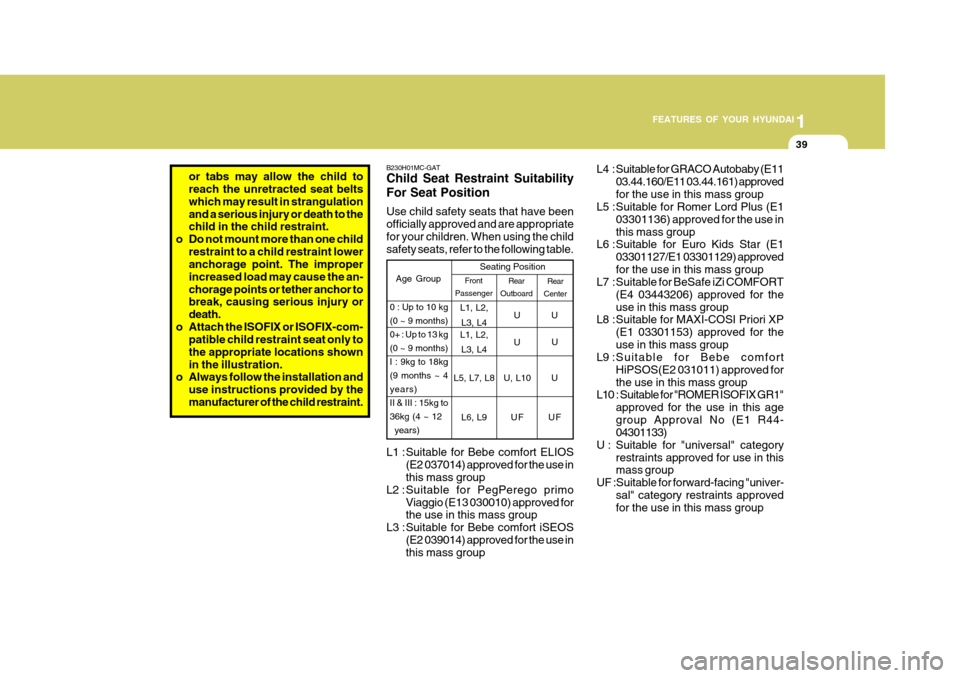
B230H01MC-GAT Child Seat Restraint Suitability For Seat Position Use child safety seats that have been officially approved and are appropriatefor your children. When using the child safety seats, refer to the following table.
Rear
Center
Age Group Seating Position
UU
L1, L2, L3, L4 U
U
Rear
Outboard
Front
Passenger
0 : Up to 10 kg (0 ~ 9 months)0+ : Up to 13 kg(0 ~ 9 months)I : 9kg to 18kg(9 months ~ 4years)II & III : 15kg to36kg (4 ~ 12 years) L1, L2,
L3, L4
L5, L7, L8 U, L10 U
L6, L9 U F U F
L4 : Suitable for GRACO Autobaby (E11 03.44.160/E11 03.44.161) approved for the use in this mass group
L5 :Suitable for Romer Lord Plus (E1
03301136) approved for the use inthis mass group
L6 :Suitable for Euro Kids Star (E1
03301127/E1 03301129) approvedfor the use in this mass group
L7 :Suitable for BeSafe iZi COMFORT
(E4 03443206) approved for theuse in this mass group
L8 :Suitable for MAXI-COSI Priori XP
(E1 03301153) approved for theuse in this mass group
L9 :Suitable for Bebe comfort
HiPSOS(E2 031011) approved forthe use in this mass group
L10 : Suitable for "ROMER ISOFIX GR1"
approved for the use in this agegroup Approval No (E1 R44- 04301133)
U : Suitable for "universal" category restraints approved for use in thismass group
UF :Suitable for forward-facing "univer- sal" category restraints approvedfor the use in this mass group
Page 67 of 282

1
FEATURES OF YOUR HYUNDAI
55
1. Tachometer
2. Turn Signal Indicator Lights
3. Door Ajar Warning Light
4. Passenger's Front Airbag OFF Indicator Light (If Installed)
5. Automatic Transaxle Position Indicator Light (If Installed)
6. Odometer/Trip Odometer/Trip Computer (If Installed)
7. Over Speed Warning Light (If Installed)
8. Immobilizer Warning Light (If Installed)
9. Speedometer
10. Fuel Filter Warning Light (Diesel only)
11. Electronic Power Steering Warning Light (If Installed)
12. Diesel Pre-heat Indicator Light (Diesel only) 13. Coolant Temperature Gauge
14. Seat Belt Warning Light
15. Charging System Warning Light
16. Low Oil Pressure Warning Light
17. High Beam Indicator Light
18. SRS (Airbag) Warning Light (If Installed)
19. Parking Brake/Low Brake Fluid Level Warning Light
20. Malfunction Indicator Light (MIL) (If Installed)
21. Overdrive Off Indicator Light (Automatic Transaxle only)
22. Trunk Lid/Tail Gate Open Warning Light
23. Fuel Gauge
24. ABS Service Reminder Indicator Light (If Installed)
25. Low Fuel Warning Light
26. Electronic Stability Program (ESP) Indicator Lights
(If Installed)
Page 69 of 282

1
FEATURES OF YOUR HYUNDAI
57
1. Tachometer
2. Turn Signal Indicator Lights
3. Low Oil Pressure Warning Light
4. Automatic Transaxle Position Indicator Light (If Installed)
5. Odometer/Trip Odometer
6. SRS (Airbag) Warning Light (If Installed)
7. Malfunction Indicator Light (MIL) (If Installed)
8. Speedometer
9. Fuel Filter Warning Light (Diesel only)
10. Diesel Pre-heat Indicator Light (Diesel only)
11. Passenger's Front Airbag OFF Indicator Light (If Installed)
12. Over Speed Warning Light (If Installed)
13. Door Ajar Warning Light 14. Charging System Warning Light
15. Parking Brake/Low Brake Fluid Level Warning Light
16. Seat Belt Warning Light
17. High Beam Indicator Light
18. Engine Coolant Temperature Indicator Light
19. Fuel Gauge
20. Overdrive Off Indicator Light (Automatic Transaxle only)
21. Low Fuel Warning Light
22. Immobilizer Warning Light (If Installed)
23. Trunk Lid/Tail Gate Open Warning Light
24. Electronic Power Steering Warning Light (If Installed)
25. ABS Service Reminder Indicator Light (If Installed)
26. Electronic Stability Program (ESP) Indicator Lights
(If Installed)
Page 71 of 282
1
FEATURES OF YOUR HYUNDAI
59
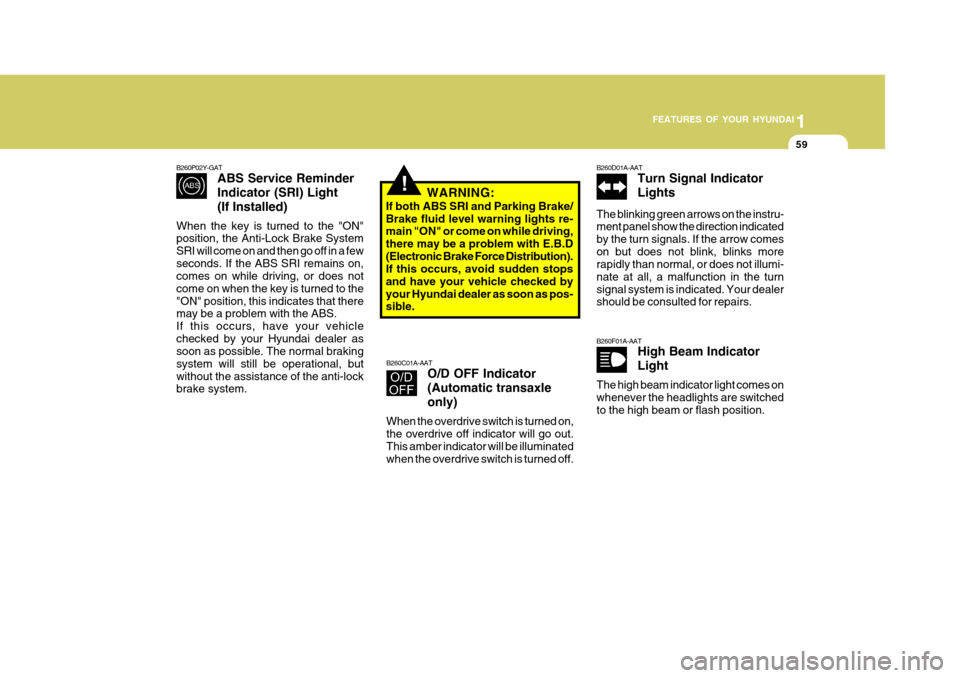
B260F01A-AAT High Beam Indicator Light
The high beam indicator light comes on whenever the headlights are switched to the high beam or flash position.
B260D01A-AAT Turn Signal Indicator Lights
The blinking green arrows on the instru- ment panel show the direction indicated by the turn signals. If the arrow comeson but does not blink, blinks more rapidly than normal, or does not illumi- nate at all, a malfunction in the turnsignal system is indicated. Your dealer should be consulted for repairs.
!
B260P02Y-GAT ABS Service Reminder Indicator (SRI) Light(If Installed)
When the key is turned to the "ON" position, the Anti-Lock Brake System SRI will come on and then go off in a fewseconds. If the ABS SRI remains on, comes on while driving, or does not come on when the key is turned to the"ON" position, this indicates that there may be a problem with the ABS. If this occurs, have your vehiclechecked by your Hyundai dealer as soon as possible. The normal braking system will still be operational, butwithout the assistance of the anti-lock brake system. B260C01A-AAT
O/D OFF Indicator (Automatic transaxleonly)
When the overdrive switch is turned on, the overdrive off indicator will go out. This amber indicator will be illuminatedwhen the overdrive switch is turned off. WARNING:
If both ABS SRI and Parking Brake/Brake fluid level warning lights re- main "ON" or come on while driving, there may be a problem with E.B.D(Electronic Brake Force Distribution). If this occurs, avoid sudden stops and have your vehicle checked byyour Hyundai dealer as soon as pos- sible.
Page 164 of 282
2
Engine Exhaust can be Dangerous! ............................. 2-2
Before Starting the Engine ............................................ 2-3
Key Position ................................................................. 2-4Starting ......................................................................... 2-5
Operating the Manual Transaxle .................................. 2-7
Automatic Transaxle ..................................................... 2-9Anti-lock Brake System (ABS) .................................... 2-13
Electronic Stability Program (ESP) ..............................2-14
Back Warning System ................................................. 2-15
Good Braking Practices .............................................. 2-17
Driving for Economy .................................................... 2-18
Smooth Cornering ........................................................ 2-20
Winter Driving .............................................................. 2-20
Trailer or Vehicle Towing ............................................. 2-23
DRIVING YOUR HYUNDAI
2
Page 176 of 282
2
DRIVING YOUR HYUNDAI
13
2
DRIVING YOUR HYUNDAI
13
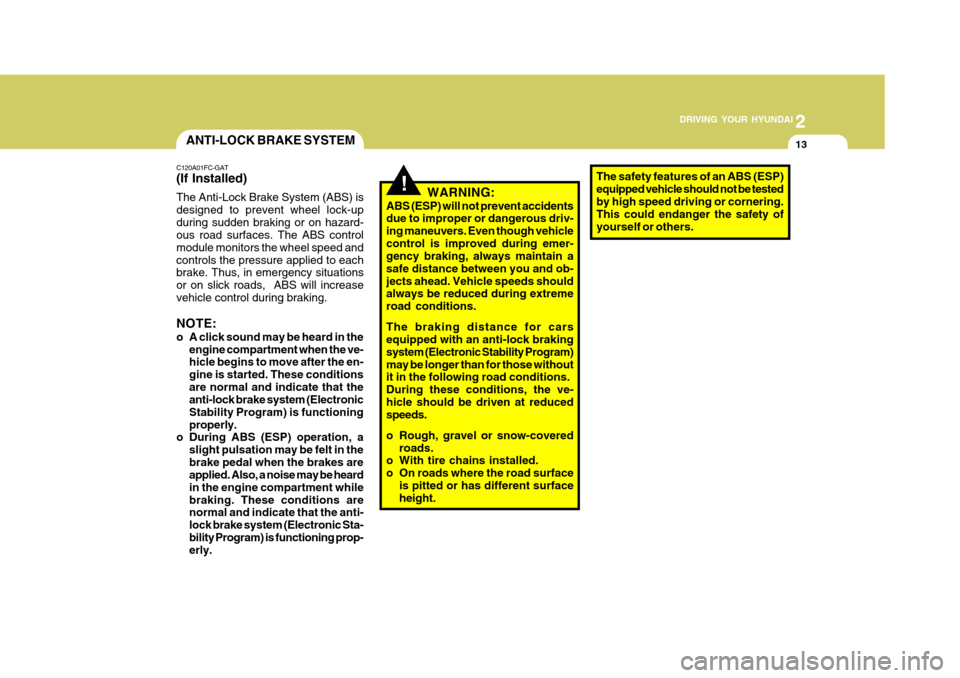
!WARNING:
ABS (ESP) will not prevent accidents due to improper or dangerous driv- ing maneuvers. Even though vehiclecontrol is improved during emer- gency braking, always maintain a safe distance between you and ob-jects ahead. Vehicle speeds should always be reduced during extreme road conditions. The braking distance for cars equipped with an anti-lock braking system (Electronic Stability Program)may be longer than for those without it in the following road conditions. During these conditions, the ve-hicle should be driven at reduced speeds.
o Rough, gravel or snow-covered roads.
o With tire chains installed.
o On roads where the road surface
is pitted or has different surface height. The safety features of an ABS (ESP) equipped vehicle should not be testedby high speed driving or cornering. This could endanger the safety of yourself or others.
ANTI-LOCK BRAKE SYSTEM
C120A01FC-GAT (If Installed) The Anti-Lock Brake System (ABS) is designed to prevent wheel lock-upduring sudden braking or on hazard- ous road surfaces. The ABS control module monitors the wheel speed andcontrols the pressure applied to each brake. Thus, in emergency situations or on slick roads, ABS will increasevehicle control during braking. NOTE:
o A click sound may be heard in the engine compartment when the ve- hicle begins to move after the en- gine is started. These conditionsare normal and indicate that the anti-lock brake system (Electronic Stability Program) is functioningproperly.
o During ABS (ESP) operation, a
slight pulsation may be felt in thebrake pedal when the brakes are applied. Also, a noise may be heard in the engine compartment whilebraking. These conditions are normal and indicate that the anti- lock brake system (Electronic Sta-bility Program) is functioning prop- erly.
Page 179 of 282

2 DRIVING YOUR HYUNDAI
16
Types of warning sound
o When an object is 120 cm to 81 cm(47 in. to 32 in.) from the rear bumper : Buzzer beeps intermittently
o When an object is 80 cm to 41 cm (31
in. to 16 in.) from the rear bumper :Buzzer beeps more frequently
o When an object is within 40 cm (15 in.) of the rear bumper : Buzzersounds continuously.
Non-operational conditions of back warning system The back warning system may not operate properly when: 1. Moisture is frozen to the sensor. (It will operate normally when the mois- ture has been cleared.)
2. The sensor is covered with foreign
matter, such as snow or water, or thesensor cover is blocked. (It will oper- ate normally when the material isremoved or the sensor is no longer blocked.)
3. Driving on uneven road surfaces
(unpaved roads, gravel, bumps, gra-dient).
4. Objects generating excessive noise
(vehicle horns, loud motorcycle en-gines, or truck air brakes) are within range of the sensor. 5. Heavy rain or water spray exists.
6. Wireless transmitters or mobile
phones are within range of the sen- sor.
7. The sensor is covered with snow. 8. Trailer towing The detecting range may decrease when: 1. The sensor is stained with foreign matter such as snow or water. (The sensing range will return to normal when removed.)
2. Outside air temperature is extremely hot or cold.
The following objects may not be recognized by the sensor: 1. Sharp or slim objects such as ropes, chains or small poles.
2. Objects which tend to absorb the sensor frequency such as clothes, spongy material or snow.
3. Undetectable objects smaller than 1 m (40 in.) and narrower than 14 cm (6in.) in diameter. CAUTION:
1. The back warning may not sound sequentially depending on the speed and shapes of the objects detected.
2. The back warning system may malfunction if the vehicle bumperheight or sensor installation hasbeen modified or damaged. Any non-factory installed equipment or accessories may also interferewith the sensor performance.
3. The sensor may not recognize
objects less than 15 in. (40 cm)from the sensor, or it may sense an incorrect distance. Use cau- tion.
4. When the sensor is frozen or stained with snow, dirt, or water,the sensor may be inoperative untilthe stains are removed using a soft cloth.
5. Do not push, scratch or strike the
sensor. Sensor damage couldoccur.
!