coolant temperature Hyundai Accent 2007 Owner's Manual
[x] Cancel search | Manufacturer: HYUNDAI, Model Year: 2007, Model line: Accent, Model: Hyundai Accent 2007Pages: 282, PDF Size: 10.55 MB
Page 12 of 282

YOUR VEHICLE AT A GLANCE
B255A02MC-GAT INDICATOR SYMBOLS ON THE INSTRUMENT PANEL * More detailed explanations of these items will be found begining on page 1-58.Turn Signal Indicator Lights
SRS (Airbag) Service Reminder Indicator (If Installed) O/D OFF Indicator Light (Automatic transaxle only) High Beam Indicator Light
Low Oil Pressure Warning Light
ABS Service Reminder Indicator (If Installed)
Door Ajar Warning Light
Parking Brake/Low Brake Fluid Level Warning Light
Charging System Warning Light Fuel Filter Warning Light (Diesel only)
Low Fuel Level Warning Light Diesel Pre-heat Indicator Light (Diesel only)
Malfunction Indicator Light (If Installed)
Immobilizer Warning Light (If Installed)
Passenger's Front Airbag OFF Indicator Light (If Installed)
Trunk Lid/Tail Gate Open Warning Light
Engine Coolant Temperature Indicator Light (If Installed) Seat Belt Warning Light
Electronic Power Steering (EPS) System Warning Light (If Installed)
Electronic Stability Program Indicator Lights (If Installed)
120
km/hOverspeed Warning Light (If Installed)
Page 67 of 282

1
FEATURES OF YOUR HYUNDAI
55
1. Tachometer
2. Turn Signal Indicator Lights
3. Door Ajar Warning Light
4. Passenger's Front Airbag OFF Indicator Light (If Installed)
5. Automatic Transaxle Position Indicator Light (If Installed)
6. Odometer/Trip Odometer/Trip Computer (If Installed)
7. Over Speed Warning Light (If Installed)
8. Immobilizer Warning Light (If Installed)
9. Speedometer
10. Fuel Filter Warning Light (Diesel only)
11. Electronic Power Steering Warning Light (If Installed)
12. Diesel Pre-heat Indicator Light (Diesel only) 13. Coolant Temperature Gauge
14. Seat Belt Warning Light
15. Charging System Warning Light
16. Low Oil Pressure Warning Light
17. High Beam Indicator Light
18. SRS (Airbag) Warning Light (If Installed)
19. Parking Brake/Low Brake Fluid Level Warning Light
20. Malfunction Indicator Light (MIL) (If Installed)
21. Overdrive Off Indicator Light (Automatic Transaxle only)
22. Trunk Lid/Tail Gate Open Warning Light
23. Fuel Gauge
24. ABS Service Reminder Indicator Light (If Installed)
25. Low Fuel Warning Light
26. Electronic Stability Program (ESP) Indicator Lights
(If Installed)
Page 69 of 282

1
FEATURES OF YOUR HYUNDAI
57
1. Tachometer
2. Turn Signal Indicator Lights
3. Low Oil Pressure Warning Light
4. Automatic Transaxle Position Indicator Light (If Installed)
5. Odometer/Trip Odometer
6. SRS (Airbag) Warning Light (If Installed)
7. Malfunction Indicator Light (MIL) (If Installed)
8. Speedometer
9. Fuel Filter Warning Light (Diesel only)
10. Diesel Pre-heat Indicator Light (Diesel only)
11. Passenger's Front Airbag OFF Indicator Light (If Installed)
12. Over Speed Warning Light (If Installed)
13. Door Ajar Warning Light 14. Charging System Warning Light
15. Parking Brake/Low Brake Fluid Level Warning Light
16. Seat Belt Warning Light
17. High Beam Indicator Light
18. Engine Coolant Temperature Indicator Light
19. Fuel Gauge
20. Overdrive Off Indicator Light (Automatic Transaxle only)
21. Low Fuel Warning Light
22. Immobilizer Warning Light (If Installed)
23. Trunk Lid/Tail Gate Open Warning Light
24. Electronic Power Steering Warning Light (If Installed)
25. ABS Service Reminder Indicator Light (If Installed)
26. Electronic Stability Program (ESP) Indicator Lights
(If Installed)
Page 74 of 282
1FEATURES OF YOUR HYUNDAI
62
B290A01MC-GAT
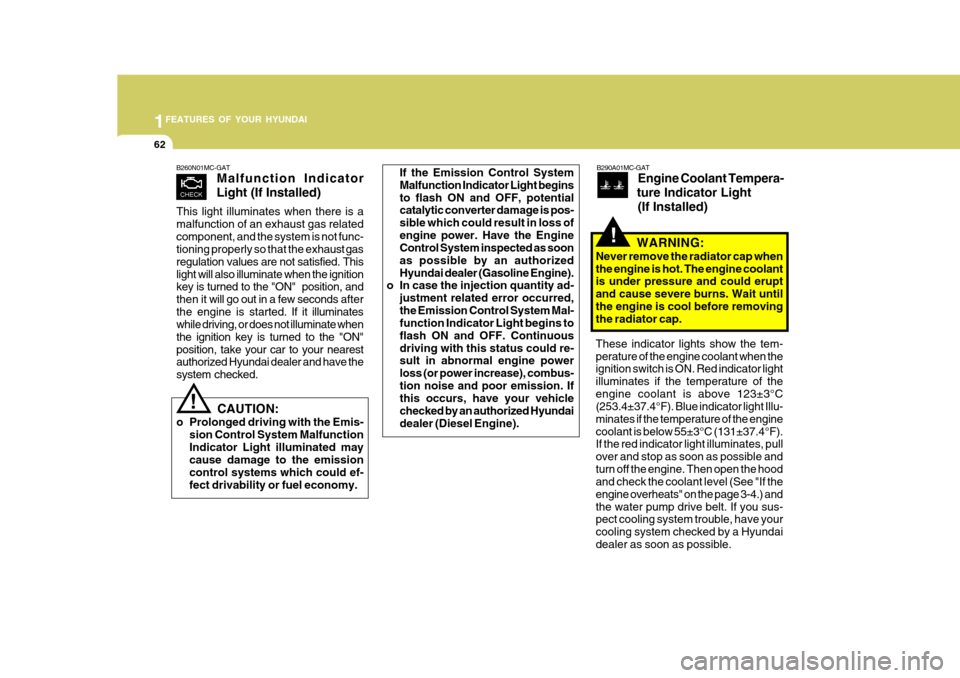
Engine Coolant Tempera-
ture Indicator Light
(If Installed)
WARNING:
Never remove the radiator cap when the engine is hot. The engine coolant is under pressure and could erupt and cause severe burns. Wait untilthe engine is cool before removing the radiator cap.
!
These indicator lights show the tem- perature of the engine coolant when the ignition switch is ON. Red indicator light illuminates if the temperature of theengine coolant is above 123±3°C (253.4±37.4°F). Blue indicator light Illu- minates if the temperature of the enginecoolant is below 55±3°C (131±37.4°F). If the red indicator light illuminates, pull over and stop as soon as possible andturn off the engine. Then open the hood and check the coolant level (See "If the engine overheats" on the page 3-4.) andthe water pump drive belt. If you sus- pect cooling system trouble, have your cooling system checked by a Hyundaidealer as soon as possible.
If the Emission Control SystemMalfunction Indicator Light beginsto flash ON and OFF, potential catalytic converter damage is pos- sible which could result in loss ofengine power. Have the Engine Control System inspected as soon as possible by an authorizedHyundai dealer (Gasoline Engine).
o In case the injection quantity ad-
justment related error occurred,the Emission Control System Mal- function Indicator Light begins to flash ON and OFF. Continuousdriving with this status could re- sult in abnormal engine power loss (or power increase), combus-tion noise and poor emission. If this occurs, have your vehicle checked by an authorized Hyundaidealer (Diesel Engine).
B260N01MC-GAT Malfunction Indicator Light (If Installed)
This light illuminates when there is a malfunction of an exhaust gas relatedcomponent, and the system is not func- tioning properly so that the exha ust gas
regulation values are not satisfied. This light will also illuminate when the ignition
key is turned to the "ON" position, and then it will go out in a few seconds after
the engine is started. If it illuminates
while driving, or does not illuminate whenthe ignition key is turned to the "ON"position, take your car to your nearest authorized Hyundai dealer and have the system checked.
CAUTION:
o Prolonged driving with the Emis- sion Control System Malfunction Indicator Light illuminated may cause damage to the emission control systems which could ef-fect drivability or fuel economy.!
Page 75 of 282

1
FEATURES OF YOUR HYUNDAI
63
B260E01TB-GAT Seat Belt Warning Light
(Except E.C)
The seat belt warning light blinks for about 6 seconds when the ignition key is turned from the "OFF" position to the "ON".
NOTE: If the red engine coolant temperature indicator light illuminates, it indi- cates overheating that may damagethe engine. B260E02HP-GAT Seat Belt Reminder Light and Chime (Mideast only)
The seat belt reminder light blinks for 6 seconds when the ignition key is turned from the "OFF" position to "ON" or"START". If the driver's seat belt is not fastened, the warning chime will sound at the same time.B265E01MC-GAT Seat Belt Warning Light
and Chime (E.C only)
*1) When the ignition key is turned from "OFF" position to "ON" within 1 minute.
*2) The switch returns to "ON" when you let go of the key.
*3) If the vehicle speed exceeds 9km/ h, the seat belt chime also sounds for about 1~2 minutes. If the vehicle speed is below 9km/h,1 minute later the seat belt chime also sounds for about 1~2 minutes.
The seat belt warning light and chimewill activate to the following table.
User (Driver) Condition
Seat Belt WarningLight
Seat Belt Ignition Switch
Unbuckled ON Stay on until buckled up
Buckled ON Come on for 6 seconds
Unbuckled ON * 1
Blink until buckled up
START * 2
Blink until buckled up* 3
Buckled
Unbuckled NOTE: If the driver's seat belt is operated in this order "unbuckled
buckled
unbuckled" within 9 seconds after the seat belt is buckled, the seat belt warning light and chime will not activate.
Page 184 of 282

2
DRIVING YOUR HYUNDAI
21
2
DRIVING YOUR HYUNDAI
21
C160H01A-AAT Use Approved Anti-Freeze in Window Washer System To keep the water in the window washer system from freezing, add an approvedanti-freeze solution in accordance with instructions on the container. Window washer anti-freeze is available fromHyundai dealers and most auto parts outlets. Do not use engine coolant or other types of anti-freeze as thesemay damage the finish. C160I01A-AAT Don't Let Your Parking Brake Freeze Under some conditions your parking brake can freeze in the engaged posi- tion. This is most likely to happen when there is an accumulation of snowor ice around or near the rear brakes or if the brakes are wet. If there is a risk the parking brake may freeze, apply itonly temporarily while you put the gear selector lever in "P" (automatic) or in first or reverse gear (manual transaxle)and block the rear wheels so the car cannot roll. Then release the parking brake.
C160G01A-GAT To Keep Locks from Freezing To keep the locks from freezing, squirt an approved de-icer fluid or glycerine into the key opening. If a lock is cov- ered with ice, squirt it with an approvedde-icing fluid to remove the ice. If the lock is frozen internally, you may be able to thaw it out by using a heatedkey. Handle the heated key with care to avoid injury. NOTE: The proper temperature for using the immobilizer key is from -40°C (-40°F) to 80°C(176°F). If you heat the immobilizer key over 80°C(176°F) to open the frozen lock, it may cause damage to the transpon- der in its head.
C160F01A-AAT Check Spark Plugs and Ignition System Inspect your spark plugs as described in Section 6 and replace them if neces-sary. Also check all ignition wiring and components to be sure they are not cracked, worn or damaged in any way.
C160D01A-AAT Check Battery and Cables Winter puts additional burdens on the battery system. Visually inspect thebattery and cables as described in Section 6. The level of charge in your battery can be checked by your Hyun-dai dealer or a service station. C160E01A-AAT Change to "Winter Weight" Oil if Necessary In some climates it is recommended that a lower viscosity "winter weight"oil be used during cold weather. See Section 9 for recommendations. If you aren't sure what weight oil you shoulduse, consult your Hyundai dealer.
Page 186 of 282
2
DRIVING YOUR HYUNDAI
23
2
DRIVING YOUR HYUNDAI
23
C190C03S-GAT Trailer Brakes If your trailer is equipped with a braking system, make sure it conforms to fed-eral and/or local regulations and that it is properly installed and operating cor- rectly. NOTE: If you tow a trailer or vehicle, your car will require more frequent main-tenance due to the additional load. See "Maintenance Under Severe Usage Conditions" on page 5-7.
CAUTION:
o Never connect a trailer brake sys- tem directly to the vehicle brakesystem.
o When towing a trailer on steep
grades (in excess of 6%) pay closeattention to the engine coolant temperature gauge to ensure the engine does not overheat. If theneedle of the coolant temperature gauge moves across the dial to- wards "H" (HOT), pull over andstop as soon as it is safe to do so,
!
TRAILER OR VEHICLE TOWING
C190A02A-GAT If you are considering towing with your car, you should first check with your Province Department of Motor Vehicles to determine their legal requirements.Since laws vary from province to prov- ince, the requirements for towing trail- ers, cars, other types of vehicles, orapparatus may differ. Ask your Hyundai dealer for further details before towing. C190B01S-AAT Trailer Hitches Select the proper hitch and ball combi- nation, making sure that it's location iscompatible with that of the trailer or vehicle being towed. Use a quality non-equalizing hitch whichdistributes the tongue load uniformly throughout the chassis. The hitch should be bolted securely to the car and installed by a qualified technician. DO NOT USE A HITCHDESIGNED FOR TEMPORARY IN- STALLATION AND NEVER USE ONE THAT ATTACHES ONLY TO THEBUMPER.
!
CAUTION
Do not do any towing with your car during its first 2,000 km (1,200 miles)in order to allow the engine to prop- erly break in. Failure to heed this caution may result in serious en-gine or transaxle damage.
Page 193 of 282
3 WHAT TO DO IN AN EMERGENCY
4
!
IF THE ENGINE OVERHEATS
D030A02TB-AAT If your temperature gauge indicates overheating, you experience a loss of power, or hear loud pinging or knock- ing, the engine is probably too hot. Ifthis happens to you, you should:
1. Pull off the road and stop as soon as it is safe to do so.
2. Place the gear selector lever in "P"
(automatic), or neutral (manual transaxle) and set the parking brake. If the air conditioning is on, turn it off.
3. If engine coolant is running out un- der the car or steam is coming outfrom the hood, stop the engine. Donot open the hood until the engine coolant has stopped running or the steaming has stopped. If there is novisible loss of engine coolant and no steam, leave the engine running and check to be sure the enginecooling fan is operating. If the fan is not running, turn the engine off.
5. Start the engine in the car with the
discharged battery using the nor- mal starting procedure. After the engine starts, leave the jumper cables connected and let the enginerun at fast idle or about 2,000 rpm for several minutes.
6. Carefully remove the jumper cables in the reverse order of attachment.
If you do not know why your battery became discharged (because the lights were left on, etc.), have the charging system checked by your Hyundaidealer. 4. Check to see if the water pump drive
belt is missing. If it is not missing,check to see that it is tight. If the drive belt seems to be satisfactory, check for coolant leaking from theradiator, hoses or under the car. (If the air conditioning had been in use, it is normal for cold water to bedraining from it when you stop).
WARNING:
While the engine is running, keephair, hands, and clothing away from moving parts such as the fan and drive belts to prevent injury.
Page 194 of 282
3
WHAT TO DO IN AN EMERGENCY
5
!!
SPARE TIRE
WARNING (Diesel Only):
Never work on injection system with engine running or within 30 sec- onds after shutting off engine. High pressure pump, rail, injectors andhigh pressure pipes are subject to high pressure even after the engine stopped. The fuel jet produced byfuel leaks may cause serious in- jury, if it touch the body. People using pacemakers should not movethan 30cm closer to the ECU or wiring harness within the engine room while engine is running, sincethe high currents in the Common Rail system produce considerable magnetic fields. WARNING:
Do not remove the radiator cap whenthe engine is hot. This can allowcoolant to be blown out of the open- ing and cause serious burns.
6. If you cannot find the cause of the overheating, wait until the engine temperature has returned to nor-mal. Then, if the engine coolant has been lost, carefully add coolant to the reservoir (Page 6-11) to bring thefluid level in the reservoir up to the halfway mark.
7. Proceed with caution, keeping alert
for further signs of overheating. Ifoverheating happens again, call a Hyundai dealer for assistance.
!
5. If the water pump drive belt is broken
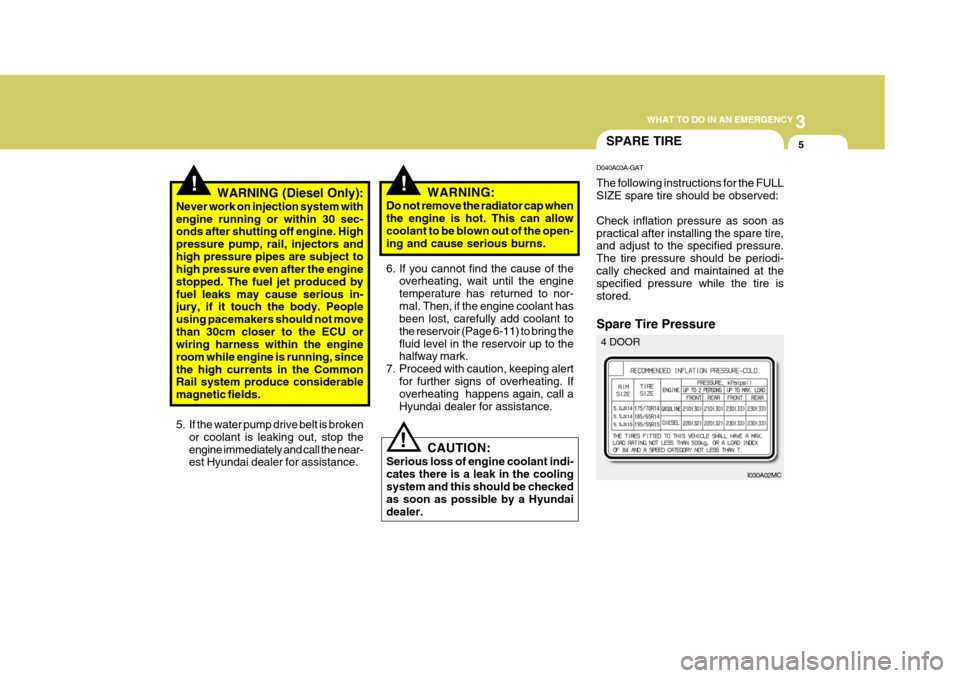
or coolant is leaking out, stop the engine immediately and call the near- est Hyundai dealer for assistance. D040A03A-GAT The following instructions for the FULL SIZE spare tire should be observed: Check inflation pressure as soon as practical after installing the spare tire, and adjust to the specified pressure. The tire pressure should be periodi-cally checked and maintained at the specified pressure while the tire is stored.
CAUTION:
Serious loss of engine coolant indi-cates there is a leak in the coolingsystem and this should be checked as soon as possible by a Hyundai dealer. Spare Tire Pressure
I030A02MC
4 DOOR
Page 233 of 282
6 DO-IT-YOURSELF MAINTENANCE
10
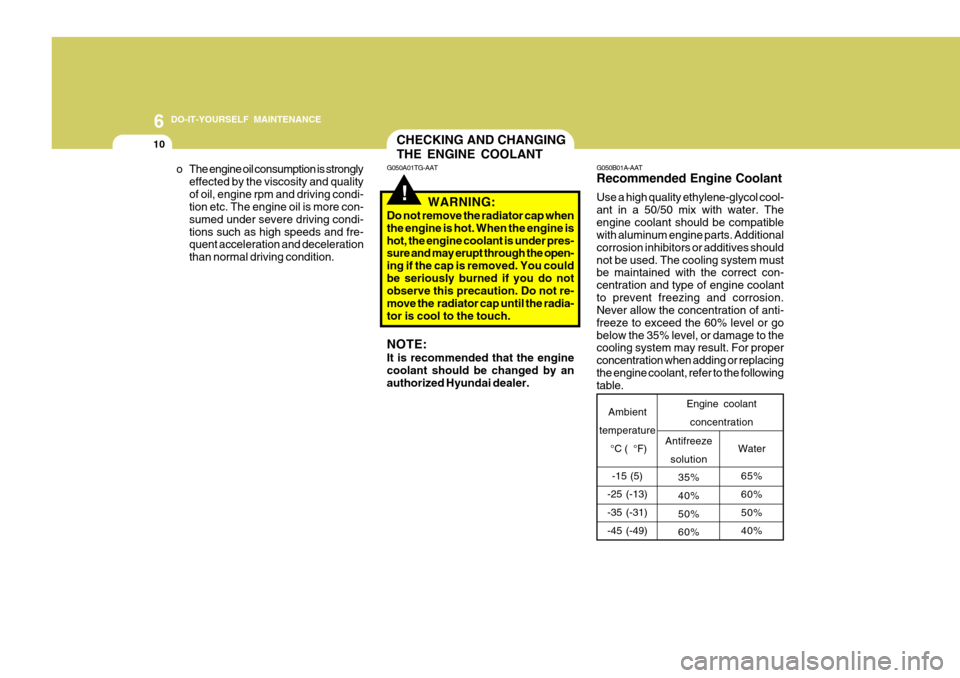
G050B01A-AAT Recommended Engine Coolant Use a high quality ethylene-glycol cool- ant in a 50/50 mix with water. Theengine coolant should be compatible with aluminum engine parts. Additional corrosion inhibitors or additives shouldnot be used. The cooling system must be maintained with the correct con- centration and type of engine coolantto prevent freezing and corrosion. Never allow the concentration of anti- freeze to exceed the 60% level or gobelow the 35% level, or damage to the cooling system may result. For proper concentration when adding or replacingthe engine coolant, refer to the following table.
Water
65% 60% 50% 40%
Antifreeze
solution 35% 40% 50%60%
Ambient
temperature
°C ( °F)
-15 (5)
-25 (-13)-35 (-31) -45 (-49) Engine coolant
concentration
!
CHECKING AND CHANGING THE ENGINE COOLANT
G050A01TG-AAT
WARNING:
Do not remove the radiator cap when the engine is hot. When the engine ishot, the engine coolant is under pres- sure and may erupt through the open- ing if the cap is removed. You couldbe seriously burned if you do not observe this precaution. Do not re- move the radiator cap until the radia-tor is cool to the touch. NOTE: It is recommended that the engine coolant should be changed by an authorized Hyundai dealer.
o The engine oil consumption is strongly
effected by the viscosity and qualityof oil, engine rpm and driving condi- tion etc. The engine oil is more con- sumed under severe driving condi-tions such as high speeds and fre- quent acceleration and deceleration than normal driving condition.