check engine Hyundai Accent 2008 Owner's Guide
[x] Cancel search | Manufacturer: HYUNDAI, Model Year: 2008, Model line: Accent, Model: Hyundai Accent 2008Pages: 273, PDF Size: 9.36 MB
Page 214 of 273
6
DO-IT-YOURSELF MAINTENANCE
5
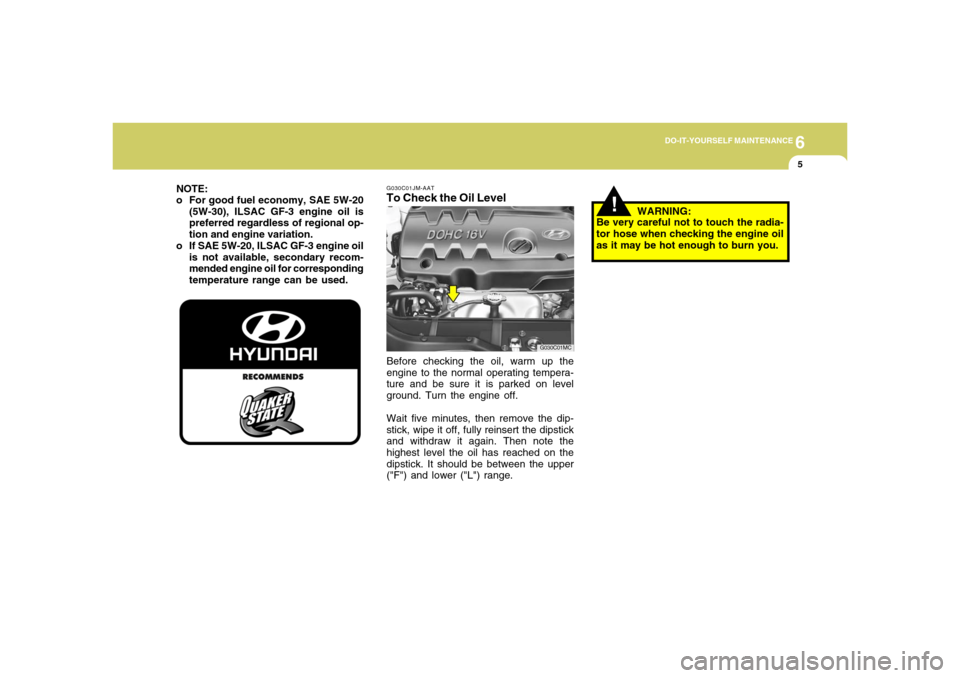
G030C01JM-AATTo Check the Oil LevelBefore checking the oil, warm up the
engine to the normal operating tempera-
ture and be sure it is parked on level
ground. Turn the engine off.
Wait five minutes, then remove the dip-
stick, wipe it off, fully reinsert the dipstick
and withdraw it again. Then note the
highest level the oil has reached on the
dipstick. It should be between the upper
("F") and lower ("L") range.
G030C01MC
NOTE:
o For good fuel economy, SAE 5W-20
(5W-30), ILSAC GF-3 engine oil is
preferred regardless of regional op-
tion and engine variation.
o If SAE 5W-20, ILSAC GF-3 engine oil
is not available, secondary recom-
mended engine oil for corresponding
temperature range can be used.
!
WARNING:
Be very careful not to touch the radia-
tor hose when checking the engine oil
as it may be hot enough to burn you.
Page 215 of 273
6
DO-IT-YOURSELF MAINTENANCE6
!
CAUTION:
Slowly pour the recommended oil by
using a funnel. Do not overfill so as not
to damage engine.
!
WARNING:
Be very careful not to touch the radia-
tor hose when adding the engine oil as
it may be hot enough to burn you.
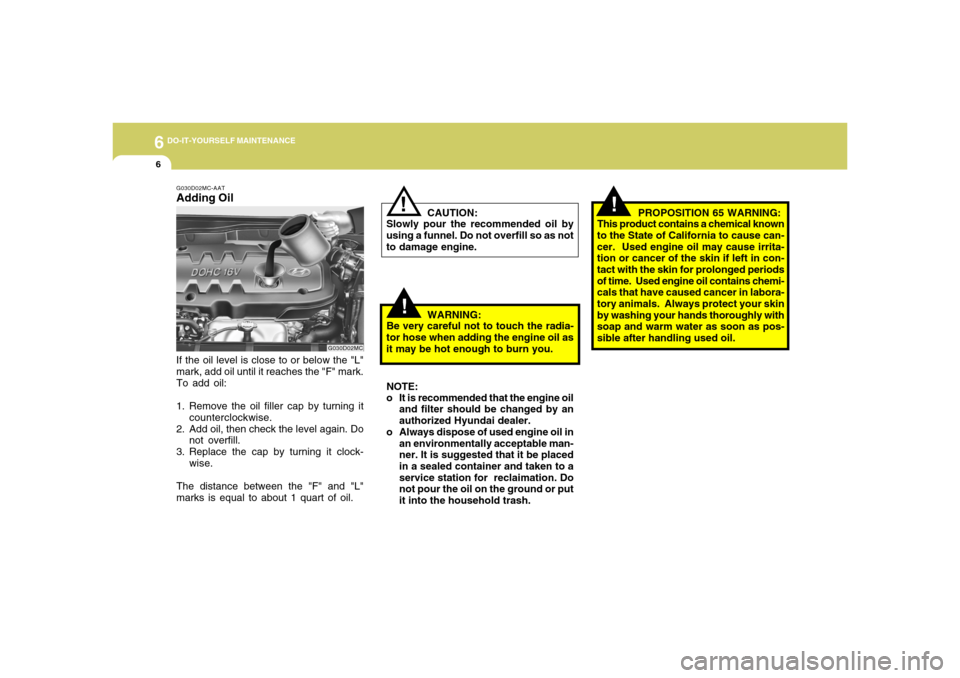
G030D02MC-AATAdding OilIf the oil level is close to or below the "L"
mark, add oil until it reaches the "F" mark.
To add oil:
1. Remove the oil filler cap by turning it
counterclockwise.
2. Add oil, then check the level again. Do
not overfill.
3. Replace the cap by turning it clock-
wise.
The distance between the "F" and "L"
marks is equal to about 1 quart of oil.
G030D02MC
NOTE:
o It is recommended that the engine oil
and filter should be changed by an
authorized Hyundai dealer.
o Always dispose of used engine oil in
an environmentally acceptable man-
ner. It is suggested that it be placed
in a sealed container and taken to a
service station for reclaimation. Do
not pour the oil on the ground or put
it into the household trash.
!
PROPOSITION 65 WARNING:
This product contains a chemical known
to the State of California to cause can-
cer. Used engine oil may cause irrita-
tion or cancer of the skin if left in con-
tact with the skin for prolonged periods
of time. Used engine oil contains chemi-
cals that have caused cancer in labora-
tory animals. Always protect your skin
by washing your hands thoroughly with
soap and warm water as soon as pos-
sible after handling used oil.
Page 216 of 273
6
DO-IT-YOURSELF MAINTENANCE
7
CHECKING AND CHANGING
THE ENGINE COOLANT!
G050A01TG-AAT
WARNING:
Do not remove the radiator cap when
the engine is hot. When the engine is
hot, the engine coolant is under pres-
sure and may erupt through the open-
ing if the cap is removed. You could be
seriously burned if you do not observe
this precaution. Do not remove the ra-
diator cap until the radiator is cool to
the touch.
NOTE:
It is recommended that the engine cool-
ant should be changed by an authorized
Hyundai dealer.
G050B01A-AATRecommended Engine CoolantUse a high quality ethylene-glycol cool-
ant in a 50/50 mix with water. The engine
coolant should be compatible with alumi-
num engine parts. Additional corrosion
inhibitors or additives should not be used.
The cooling system must be maintained
with the correct concentration and type of
engine coolant to prevent freezing and
corrosion.
Never allow the concentration of anti-
freeze to exceed the 60% level or go
below the 35% level or damage to the
coolant system may result. For proper
concentration when adding or replacing
the coolant, refer to the following table.
Water
65%
60%
50%
40% Antifreeze
solution
35%
40%
50%
60% Ambient
temperature
°F (°C)
5 (-15)
-13 (-25)
-31 (-35)
-49 (-45)Engine coolant
concentration
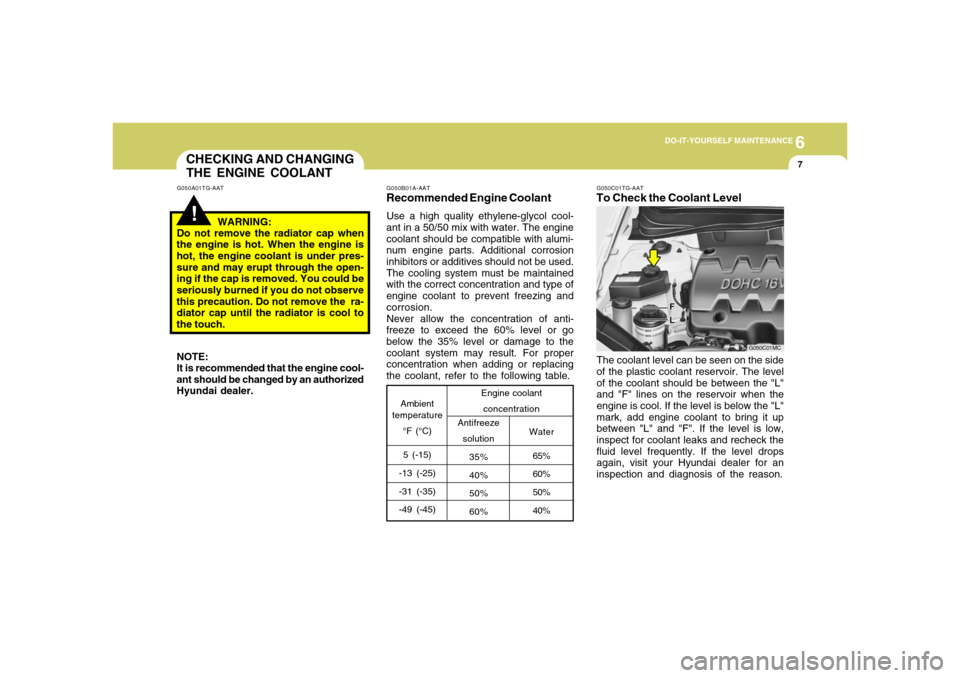
G050C01TG-AATTo Check the Coolant LevelThe coolant level can be seen on the side
of the plastic coolant reservoir. The level
of the coolant should be between the "L"
and "F" lines on the reservoir when the
engine is cool. If the level is below the "L"
mark, add engine coolant to bring it up
between "L" and "F". If the level is low,
inspect for coolant leaks and recheck the
fluid level frequently. If the level drops
again, visit your Hyundai dealer for an
inspection and diagnosis of the reason.
G050C01MC
Page 220 of 273
6
DO-IT-YOURSELF MAINTENANCE
11
!
G100A01MC-GATTransaxle lubricant in the manual
transaxle should be checked at those
intervals specified in the vehicle mainte-
nance schedule in Section 5.
!CHECKING THE TRANSAXLE
OIL (MANUAL)
!
CAUTION:
o Radiator anti-freeze (engine coolant)
should not be used in the washer
system because it will damage the
car's finish.
o The washer should not be operated
if the washer reservoir is empty.
This can damage the washer fluid
pump.WARNING:
It is always better to check the transaxle
oil level when the engine is cool or cold.
If the engine is hot, you should exercise
great caution to avoid burning yourself
on hot engine or exhaust parts.
WARNING:
o Windshield washer fluid agents con-
tain some amounts of alcohol and
can be flammable under certain cir-
cumstances. Do not allow sparks or
flame to contact the washer fluid or
the washer fluid reservoir. Damage
to the vehicle or its occupants could
occur.
o Windshield washer fluid is poison-
ous to humans and animals. Do not
drink windshield washer fluid. Seri-
ous injury or death could occur.NOTE:
It is recommended that the manual
transaxle fluid should be checked by an
authorized Hyundai dealer.
G110A01MC-AATTransaxle fluid in the automatic transaxle
should be checked at those intervals
specified in the vehicle maintenance
schedule in Section 5.
NOTE:
Automatic transaxle fluid is basically a
red color. As driving distance increases,
the fluid color turns darkish red gradu-
ally. It is a normal condition and you
should not judge the need to replace
based upon the changing color.
You must replace the automatic
transaxle fluid in accordance with inter-
vals specified in the vehicle mainte-
nance schedule in section 5.CHECKING THE TRANSAXLE
FLUID (AUTOMATIC)
Page 221 of 273
6
DO-IT-YOURSELF MAINTENANCE
12
G110D02MC
!
WARNING:
The transaxle fluid level should be
checked when the engine is at normal
operating temperature. This means that
the engine, radiator, exhaust system
etc., are very hot. Exercise great care
not to burn yourself during this proce-
dure.
!
CAUTION:
Use of aftermarket ATF additives may
cause damage to the automatic
transaxle.
Only use HYUNDAI GENUINE ATF SP
III, DIAMOND ATF SP III, SK ATF SP III or
other brands meeting the SP III specifi-
cation approved by Hyundai Motor Co..
If you are having your vehicle serviced
at a facility other than a Hyundai dealer,
verify that the correct ATF is used for
your vehicle.
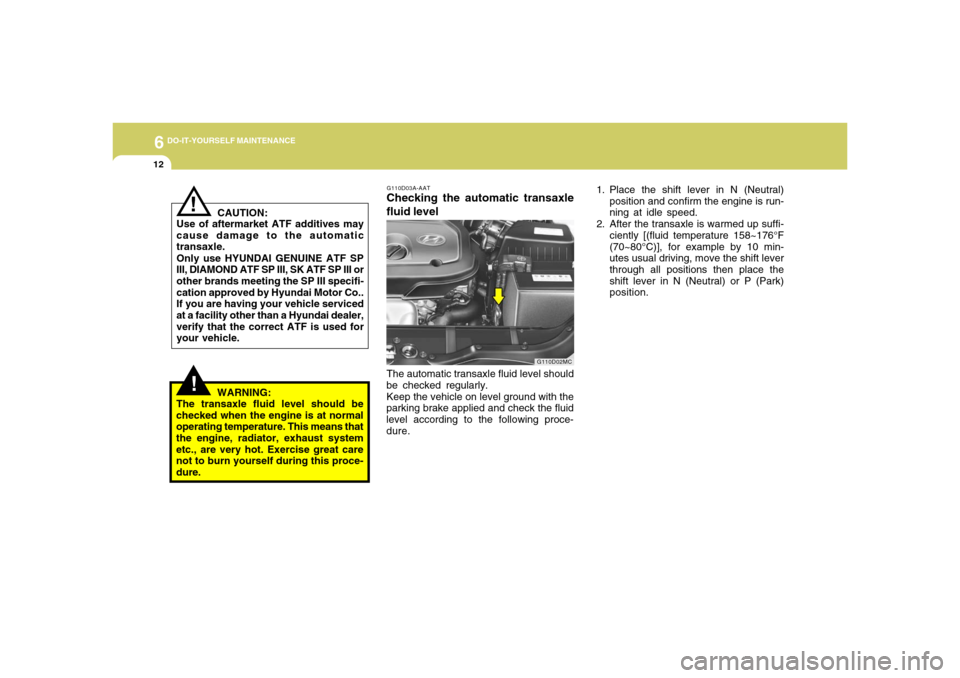
G110D03A-AATChecking the automatic transaxle
fluid level
1. Place the shift lever in N (Neutral)
position and confirm the engine is run-
ning at idle speed.
2. After the transaxle is warmed up suffi-
ciently [(fluid temperature 158~176°F
(70~80°C)], for example by 10 min-
utes usual driving, move the shift lever
through all positions then place the
shift lever in N (Neutral) or P (Park)
position.
The automatic transaxle fluid level should
be checked regularly.
Keep the vehicle on level ground with the
parking brake applied and check the fluid
level according to the following proce-
dure.
Page 222 of 273
6
DO-IT-YOURSELF MAINTENANCE
13
CHECKING THE BRAKES!
G120A01A-AAT
G120B01A-AATChecking the Brake Fluid Level
CAUTION:
Because brakes are essential to the
safe operation of the car, it is sug-
gested that they be checked and in-
spected by your Hyundai dealer. The
brakes should be checked and in-
spected for wear at those intervals
specified in the vehicle maintenance
schedule in Section 5.
!
WARNING:
Use caution when handling brake fluid.
It can damage your vision if it gets into
your eyes. It will also damage your
vehicle's paint if spilled on it and not
removed immediately.
!
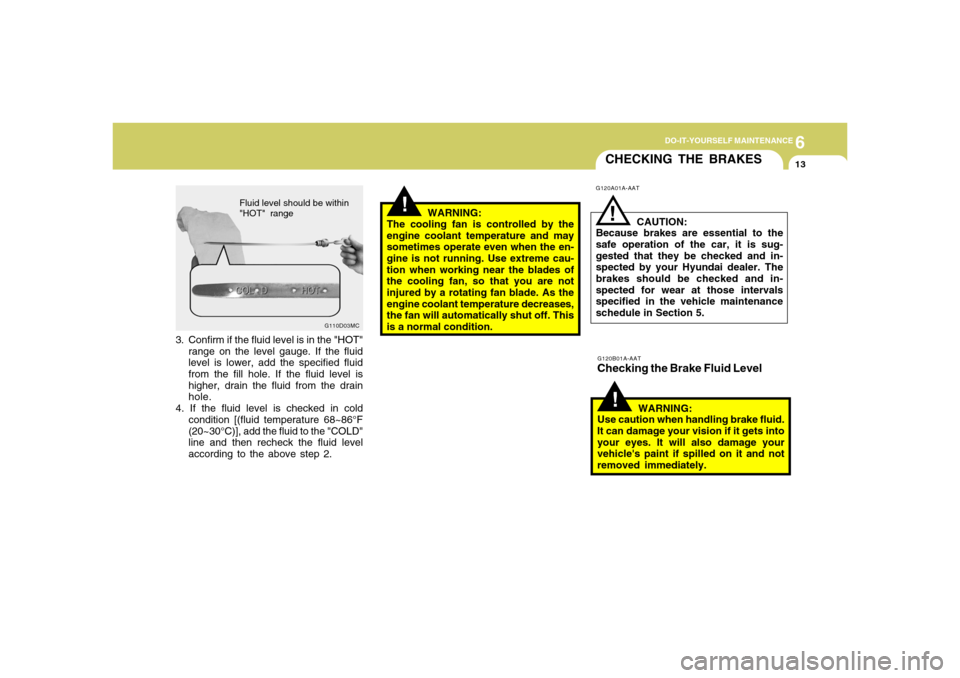
3. Confirm if the fluid level is in the "HOT"
range on the level gauge. If the fluid
level is lower, add the specified fluid
from the fill hole. If the fluid level is
higher, drain the fluid from the drain
hole.
4. If the fluid level is checked in cold
condition [(fluid temperature 68~86°F
(20~30°C)], add the fluid to the "COLD"
line and then recheck the fluid level
according to the above step 2.
G110D03MC
Fluid level should be within
"HOT" range
WARNING:
The cooling fan is controlled by the
engine coolant temperature and may
sometimes operate even when the en-
gine is not running. Use extreme cau-
tion when working near the blades of
the cooling fan, so that you are not
injured by a rotating fan blade. As the
engine coolant temperature decreases,
the fan will automatically shut off. This
is a normal condition.
Page 224 of 273
6
DO-IT-YOURSELF MAINTENANCE
15
G140C01A-AATLubricationTo lubricate the compressor and the seals
in the system, the air conditioner should
be run for at least 10 minutes each week.
This is particularly important during cool
weather when the air conditioning sys-
tem is not otherwise in use.G140B01A-AATChecking the Air Conditioner Opera-
tion1. Start the engine and let it run at fast
idle for several minutes with the air
conditioner set at the maximum cold
setting.
2. If the air coming out of the in-dash
vents is not cold, have the air condi-
tioning system inspected by your
Hyundai dealer.
CAUTION:
Running the air conditioning system for
extended periods of time with a low
refrigerant level may damage the com-
pressor.
!
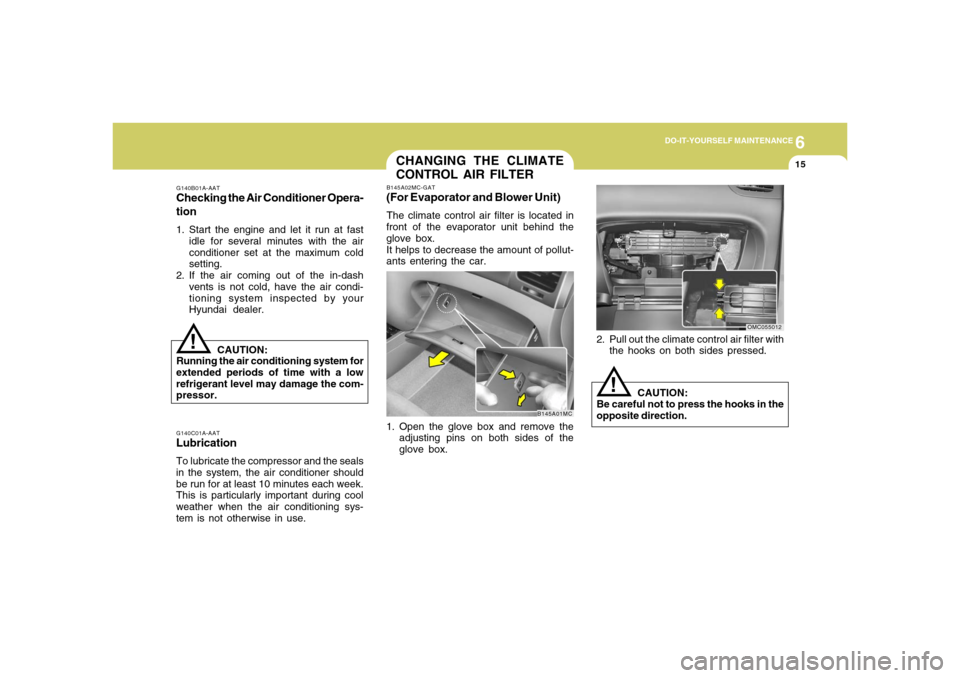
2. Pull out the climate control air filter with
the hooks on both sides pressed.
CAUTION:
Be careful not to press the hooks in the
opposite direction.
!
CHANGING THE CLIMATE
CONTROL AIR FILTERB145A02MC-GAT(For Evaporator and Blower Unit)The climate control air filter is located in
front of the evaporator unit behind the
glove box.
It helps to decrease the amount of pollut-
ants entering the car.
1. Open the glove box and remove the
adjusting pins on both sides of the
glove box.
B145A01MC
OMC055012
Page 226 of 273
6
DO-IT-YOURSELF MAINTENANCE
17
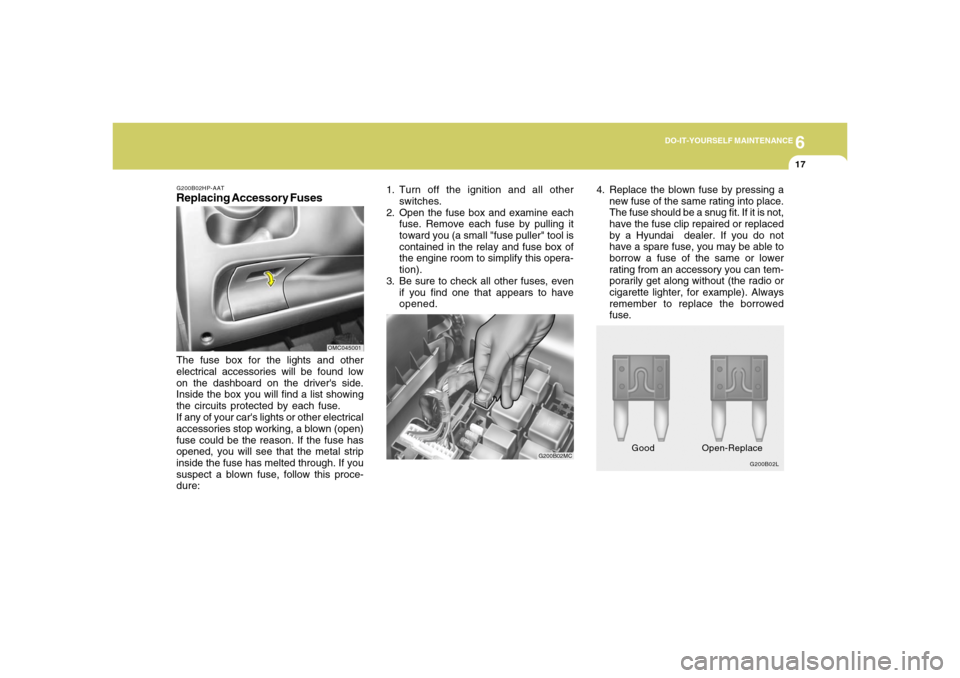
G200B02L
GoodOpen-Replace
G200B02HP-AATReplacing Accessory FusesThe fuse box for the lights and other
electrical accessories will be found low
on the dashboard on the driver's side.
Inside the box you will find a list showing
the circuits protected by each fuse.
If any of your car's lights or other electrical
accessories stop working, a blown (open)
fuse could be the reason. If the fuse has
opened, you will see that the metal strip
inside the fuse has melted through. If you
suspect a blown fuse, follow this proce-
dure:1. Turn off the ignition and all other
switches.
2. Open the fuse box and examine each
fuse. Remove each fuse by pulling it
toward you (a small "fuse puller" tool is
contained in the relay and fuse box of
the engine room to simplify this opera-
tion).
3. Be sure to check all other fuses, even
if you find one that appears to have
opened.4. Replace the blown fuse by pressing a
new fuse of the same rating into place.
The fuse should be a snug fit. If it is not,
have the fuse clip repaired or replaced
by a Hyundai dealer. If you do not
have a spare fuse, you may be able to
borrow a fuse of the same or lower
rating from an accessory you can tem-
porarily get along without (the radio or
cigarette lighter, for example). Always
remember to replace the borrowed
fuse.
OMC045001
G200B02MC
Page 229 of 273
6
DO-IT-YOURSELF MAINTENANCE
20
!
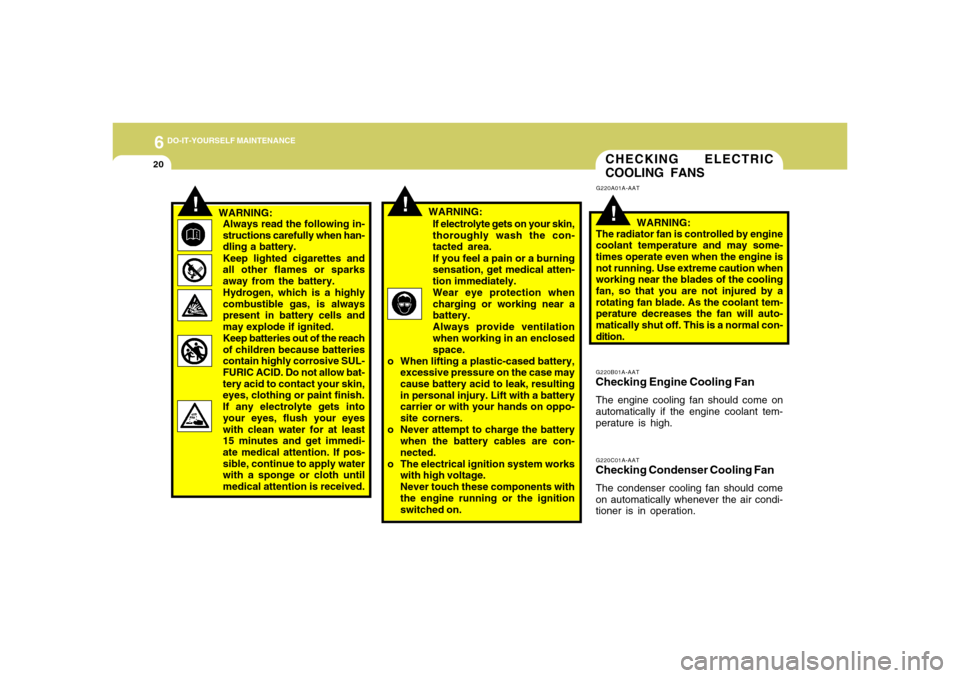
G220A01A-AAT
G220B01A-AATChecking Engine Cooling FanThe engine cooling fan should come on
automatically if the engine coolant tem-
perature is high.WARNING:
The radiator fan is controlled by engine
coolant temperature and may some-
times operate even when the engine is
not running. Use extreme caution when
working near the blades of the cooling
fan, so that you are not injured by a
rotating fan blade. As the coolant tem-
perature decreases the fan will auto-
matically shut off. This is a normal con-
dition.G220C01A-AATChecking Condenser Cooling FanThe condenser cooling fan should come
on automatically whenever the air condi-
tioner is in operation.CHECKING ELECTRIC
COOLING FANS
!
If electrolyte gets on your skin,
thoroughly wash the con-
tacted area.
If you feel a pain or a burning
sensation, get medical atten-
tion immediately.
Wear eye protection when
charging or working near a
battery.
Always provide ventilation
when working in an enclosed
space.
o When lifting a plastic-cased battery,
excessive pressure on the case may
cause battery acid to leak, resulting
in personal injury. Lift with a battery
carrier or with your hands on oppo-
site corners.
o Never attempt to charge the battery
when the battery cables are con-
nected.
o The electrical ignition system works
with high voltage.
Never touch these components with
the engine running or the ignition
switched on.
WARNING:
Always read the following in-
structions carefully when han-
dling a battery.
Keep lighted cigarettes and
all other flames or sparks
away from the battery.
Hydrogen, which is a highly
combustible gas, is always
present in battery cells and
may explode if ignited.
Keep batteries out of the reach
of children because batteries
contain highly corrosive SUL-
FURIC ACID. Do not allow bat-
tery acid to contact your skin,
eyes, clothing or paint finish.
If any electrolyte gets into
your eyes, flush your eyes
with clean water for at least
15 minutes and get immedi-
ate medical attention. If pos-
sible, continue to apply water
with a sponge or cloth until
medical attention is received.
!
WARNING:
Page 230 of 273
6
DO-IT-YOURSELF MAINTENANCE
21
G240A01A-AATPOWER STEERING HOSESIt is suggested that you check the power
steering hose connections for fluid leak-
age at those intervals specified in the
vehicle maintenance schedule in Section
5.
The power steering hoses should be re-
placed if there is severe surface cracking,
pulling, scuffing or worn spots. Deteriora-
tion of the hose could cause premature
failure.
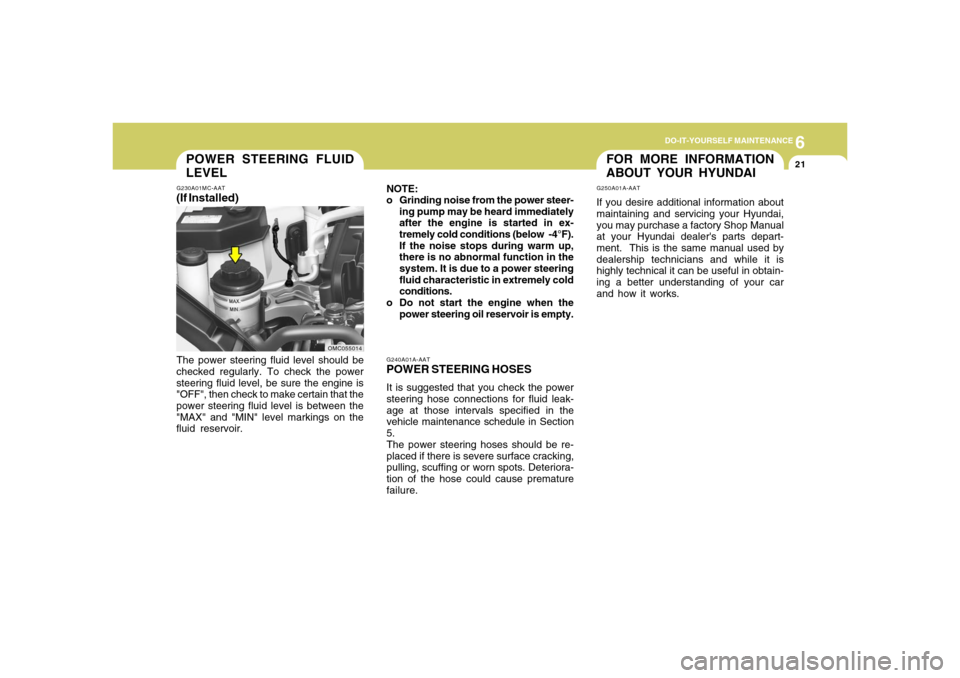
POWER STEERING FLUID
LEVELG230A01MC-AAT(If Installed)The power steering fluid level should be
checked regularly. To check the power
steering fluid level, be sure the engine is
"OFF", then check to make certain that the
power steering fluid level is between the
"MAX" and "MIN" level markings on the
fluid reservoir.NOTE:
o Grinding noise from the power steer-
ing pump may be heard immediately
after the engine is started in ex-
tremely cold conditions (below -4°F).
If the noise stops during warm up,
there is no abnormal function in the
system. It is due to a power steering
fluid characteristic in extremely cold
conditions.
o Do not start the engine when the
power steering oil reservoir is empty.
OMC055014
FOR MORE INFORMATION
ABOUT YOUR HYUNDAIG250A01A-AATIf you desire additional information about
maintaining and servicing your Hyundai,
you may purchase a factory Shop Manual
at your Hyundai dealer's parts depart-
ment. This is the same manual used by
dealership technicians and while it is
highly technical it can be useful in obtain-
ing a better understanding of your car
and how it works.