vin Hyundai Accent 2008 Manual Online
[x] Cancel search | Manufacturer: HYUNDAI, Model Year: 2008, Model line: Accent, Model: Hyundai Accent 2008Pages: 273, PDF Size: 9.36 MB
Page 231 of 273
6
DO-IT-YOURSELF MAINTENANCE
22
Headlight
1. Allow the bulb to cool. Wear eye pro-
tection.
2. Open the engine hood and disconnect
the negative (-) post of the battery.
3. Always grasp the bulb by its plastic
base, avoid touching the glass.
4. Disconnect the power cord from the
back of the headlight.
REPLACEMENT OF LIGHT
BULBS!
G260A01MC-AATBefore attempting to replace a light bulb,
be sure the switch is turned to the "OFF"
position.
The next paragraph shows how to reach
the light bulbs so they may be changed.
Be sure to replace the burned-out bulb
with one of the same number and watt-
age rating.
See page 6-28 for the wattage descrip-
tions.
CAUTION:
o Keep the lamps out of contact with
petroleum products, such as oil,
gasoline, etc.
o If you don't have necessary tools,
the correct bulbs and the expertise,
consult your authorized Hyundai
dealer.
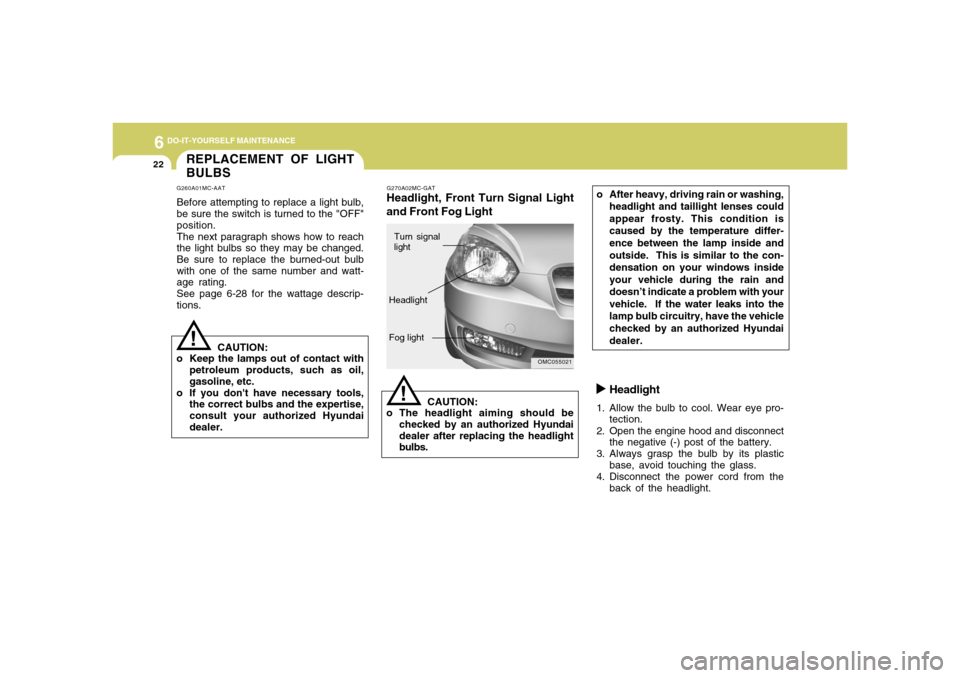
G270A02MC-GATHeadlight, Front Turn Signal Light
and Front Fog Light
CAUTION:
o The headlight aiming should be
checked by an authorized Hyundai
dealer after replacing the headlight
bulbs.
!
OMC055021
Turn signal
light
Headlight
Fog light
o After heavy, driving rain or washing,
headlight and taillight lenses could
appear frosty. This condition is
caused by the temperature differ-
ence between the lamp inside and
outside. This is similar to the con-
densation on your windows inside
your vehicle during the rain and
doesn’t indicate a problem with your
vehicle. If the water leaks into the
lamp bulb circuitry, have the vehicle
checked by an authorized Hyundai
dealer.
Page 232 of 273
6
DO-IT-YOURSELF MAINTENANCE
23
G270A03O
!
WARNING:
o When removing/replacing halogen
bulbs, always handle the metal body
of the bulb, not the glass.
o The halogen bulb contains gas under
pressure and if impacted could shat-
ter, resulting in flying fragments. Al-
ways wear eye protection when ser-
vicing the bulb. Protect the bulb
against abrasions or scratches and
against liquids when lighted. Turn
the bulb on only when installed in a
headlight. Replace the headlight if
damaged or cracked. Keep the bulb
out of the reach of children and dis-
pose of the used bulb with care.
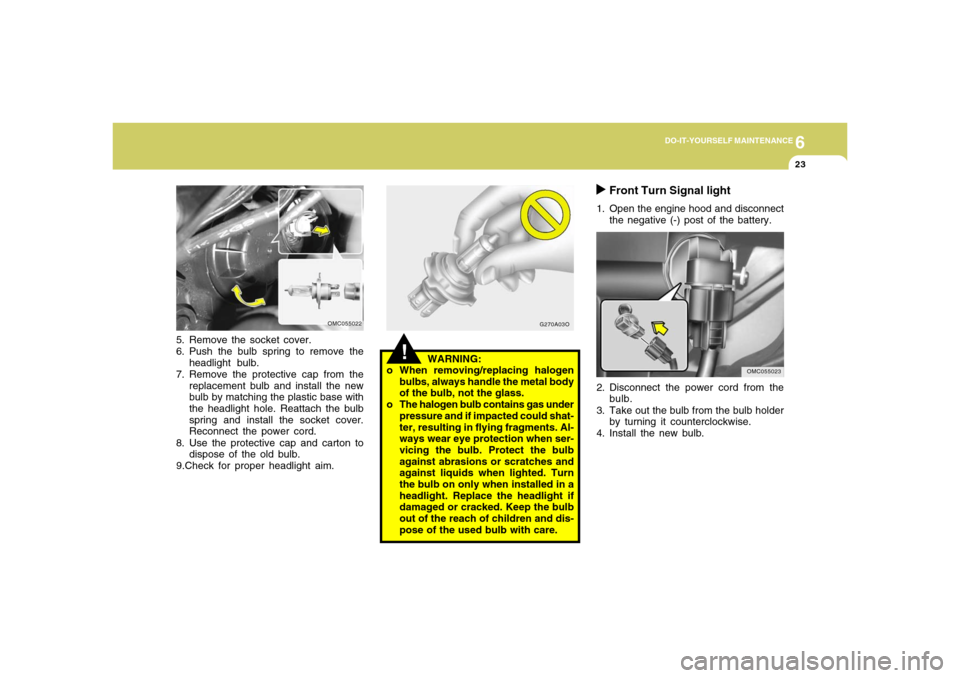
5. Remove the socket cover.
6. Push the bulb spring to remove the
headlight bulb.
7. Remove the protective cap from the
replacement bulb and install the new
bulb by matching the plastic base with
the headlight hole. Reattach the bulb
spring and install the socket cover.
Reconnect the power cord.
8. Use the protective cap and carton to
dispose of the old bulb.
9.Check for proper headlight aim.
OMC055022
Front Turn Signal light
1. Open the engine hood and disconnect
the negative (-) post of the battery.
2. Disconnect the power cord from the
bulb.
3. Take out the bulb from the bulb holder
by turning it counterclockwise.
4. Install the new bulb.
OMC055023
Page 242 of 273

7
EMISSION CONTROL SYSTEMS2
EMISSION CONTROL SYSTEM
CanisterFuel vapors generated inside the fuel
tank are absorbed and stored in the
onboard canister. When the engine is
running, the fuel vapors absorbed in the
canister are drawn into the induction sys-
tem through the purge control solenoid
valve.Purge Control Solenoid Valve (PCSV)The purge control solenoid valve is con-
trolled by the Engine Control Module
(ECM); when the engine coolant tem-
perature is low during idling, the PCSV
closes so that evaporated fuel is not taken
into the engine. After the engine warms-
up during ordinary driving, the PCSV
opens to introduce evaporated fuel to the
engine.
H010B01A-AAT1. Crankcase Emission Control
SystemThe positive crankcase ventilation sys-
tem is employed to prevent air pollution
caused by blow-by gases being emitted
from the crankcase. This system supplies
filtered fresh air to the crankcase through
the air intake hose. Inside the crankcase,
the fresh air mixes with blow-by gases,
then passes through the PCV valve into
the induction system.
H010A01A-AATYour Hyundai is equipped with an emis-
sion control system to meet all require-
ments of the U.S. Environmental Protec-
tion Agency or California Air Resources
Board.
There are three emission control systems
which are as follows.
1) Crankcase Emission Control System
2) Evaporative Emission Control System
3) Exhaust Emission Control System
In order to ensure the proper function of
the emission control systems, it is recom-
mended that you have your car inspected
and maintained by an authorized Hyundai
dealer in accordance with the mainte-
nance schedule in this manual.
H010D01A-AAT3. Exhaust Emission
Control SystemThe Exhaust Emission Control System is
a highly effective system which controls
exhaust emissions while maintaining
good vehicle performace.
H010C01S-AAT2. Evaporative Emission Control (In-
cluding ORVR: Onboard Refuel-
ing Vapor Recovery) SystemThe Evaporative Emission Control Sys-
tem is designed to prevent fuel vapors
from escaping into the atmosphere.
(The ORVR system is designed to allow
the vapors from the fuel tank to be loaded
into a canister while refueling at the gas
station, preventing the escape of fuel
vapors into the atmosphere.)
Page 243 of 273
7
EMISSION CONTROL SYSTEMS
3
CATALYTIC CONVERTER
!
!
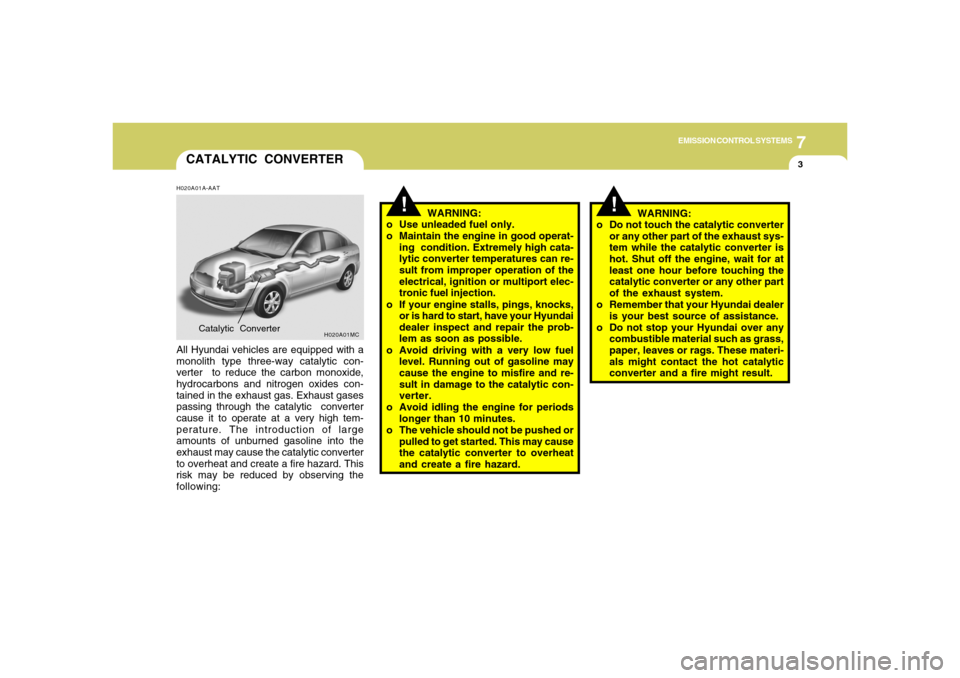
H020A01A-AATAll Hyundai vehicles are equipped with a
monolith type three-way catalytic con-
verter to reduce the carbon monoxide,
hydrocarbons and nitrogen oxides con-
tained in the exhaust gas. Exhaust gases
passing through the catalytic converter
cause it to operate at a very high tem-
perature. The introduction of large
amounts of unburned gasoline into the
exhaust may cause the catalytic converter
to overheat and create a fire hazard. This
risk may be reduced by observing the
following:WARNING:
o Do not touch the catalytic converter
or any other part of the exhaust sys-
tem while the catalytic converter is
hot. Shut off the engine, wait for at
least one hour before touching the
catalytic converter or any other part
of the exhaust system.
o Remember that your Hyundai dealer
is your best source of assistance.
o Do not stop your Hyundai over any
combustible material such as grass,
paper, leaves or rags. These materi-
als might contact the hot catalytic
converter and a fire might result.
H020A01MC
Catalytic Converter
WARNING:
o Use unleaded fuel only.
o Maintain the engine in good operat-
ing condition. Extremely high cata-
lytic converter temperatures can re-
sult from improper operation of the
electrical, ignition or multiport elec-
tronic fuel injection.
o If your engine stalls, pings, knocks,
or is hard to start, have your Hyundai
dealer inspect and repair the prob-
lem as soon as possible.
o Avoid driving with a very low fuel
level. Running out of gasoline may
cause the engine to misfire and re-
sult in damage to the catalytic con-
verter.
o Avoid idling the engine for periods
longer than 10 minutes.
o The vehicle should not be pushed or
pulled to get started. This may cause
the catalytic converter to overheat
and create a fire hazard.
Page 244 of 273
CONSUMER INFORMATION, REPORTING
SAFETY DEFECTS & BINDING
ARBITRATION OF WARRANTY CLAIMS
Vehicle Identification Number (VIN) ............................. 8-2
Engine Number ............................................................. 8-3
Tire Information ............................................................. 8-3
Recommended Cold Tire Inflation Pressures .............. 8-3
Checking Tire Inflation Pressure .................................. 8-5
Tire Sidewall Labeling ................................................... 8-6
Tire Terminology and Definitions .................................. 8-8
All Season Tires .........................................................8-10
Snow Tires..................................................................8-10
Tire Chains ................................................................. 8-10
Tire Rotation ...............................................................8-11
Tire Balancing.............................................................8-12
Tire Traction................................................................8-12
When to Replace Tires ...............................................8-12
Tire Maintenance........................................................8-13
Spare Tire and Tools..................................................8-14
Warranties for Your Hyundai Vehicle.........................8-15
Consumer Information................................................8-15
Reporting Safety Defects ...........................................8-18
Binding Arbitration of Warranty Claims...................... 8-18
8
8
Page 245 of 273
8
CONSUMER INFORMATION, REPORTING SAFETY DEFECTS & BINDING ARBITRATION OF WARRANTY CLAIMS2
VEHICLE IDENTIFICATION
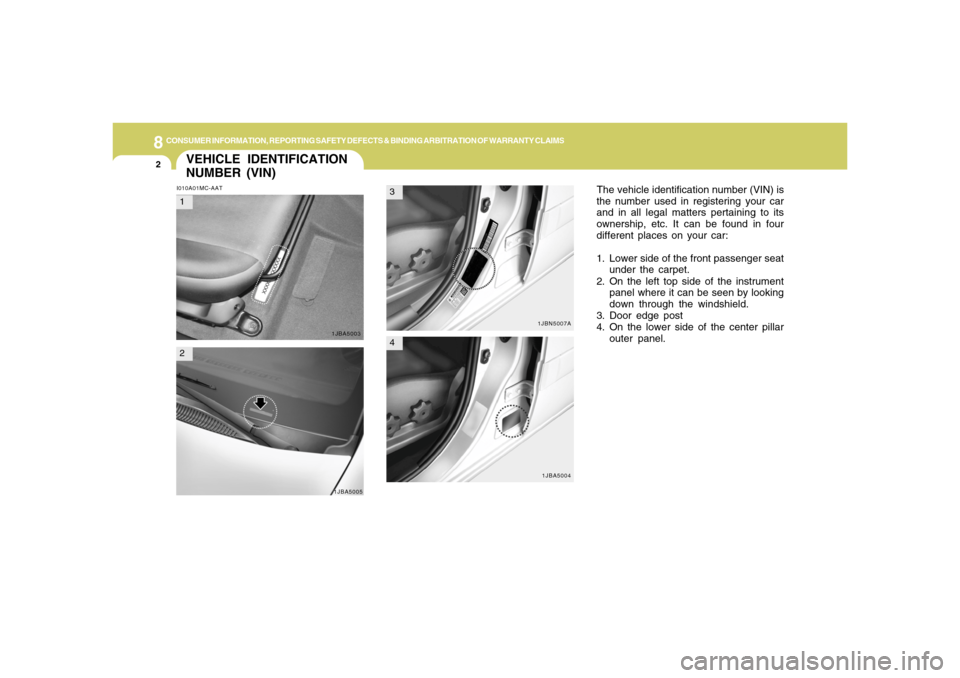
NUMBER (VIN)I010A01MC-AAT
The vehicle identification number (VIN) is
the number used in registering your car
and in all legal matters pertaining to its
ownership, etc. It can be found in four
different places on your car:
1. Lower side of the front passenger seat
under the carpet.
2. On the left top side of the instrument
panel where it can be seen by looking
down through the windshield.
3. Door edge post
4. On the lower side of the center pillar
outer panel.
1JBA5003
1JBA5004
1JBA50051JBN5007A
12
34
Page 246 of 273
8
CONSUMER INFORMATION, REPORTING SAFETY DEFECTS & BINDING ARBITRATION OF WARRANTY CLAIMS
3
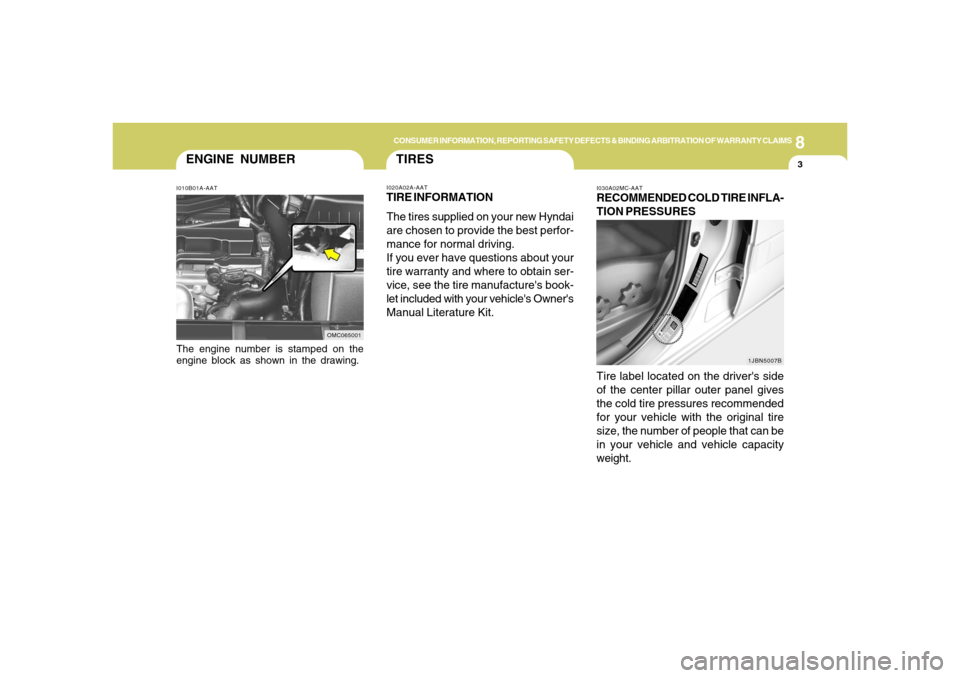
ENGINE NUMBERI010B01A-AATThe engine number is stamped on the
engine block as shown in the drawing.
TIRESI020A02A-AATTIRE INFORMATION
The tires supplied on your new Hyndai
are chosen to provide the best perfor-
mance for normal driving.
If you ever have questions about your
tire warranty and where to obtain ser-
vice, see the tire manufacture's book-
let included with your vehicle's Owner's
Manual Literature Kit.
I030A02MC-AATRECOMMENDED COLD TIRE INFLA-
TION PRESSURES
Tire label located on the driver's side
of the center pillar outer panel gives
the cold tire pressures recommended
for your vehicle with the original tire
size, the number of people that can be
in your vehicle and vehicle capacity
weight.
1JBN5007B
OMC065001
Page 251 of 273

8
CONSUMER INFORMATION, REPORTING SAFETY DEFECTS & BINDING ARBITRATION OF WARRANTY CLAIMS8
I030D01JM-AATTIRE TERMINOLOGY AND DEFINI-
TIONS
Air Pressure: The amount of air inside
the tire pressing outward on the tire.
Air pressure is expressed in pounds
per square inch (psi) or kilopascal (kPa).
Accessory Weight: This means the
combined weight of optional accesso-
ries. Some examples of optional ac-
cessories are, automatic transmission,
power seats, and air conditioning.
Aspect Ratio: The relationship of a
tire's height to its width.
Belt: A rubber coated layer of cords
that is located between the plies and
the tread. Cords may be made from
steel or other reinforcing materials.
Bead: The tire bead contains steel
wires wrapped by steel cords that hold
the tire onto the rim.
Bias Ply Tire: A pneumatic tire in
which the plies are laid at alternate
angles less than 90 degrees to the
centerline of the tread.Cold Tire Pressure: The amount of
air pressure in a tire, measured in
pounds per square inch (psi) or
kilopascals (kPa) before a tire has
built up heat from driving.
Curb Weight: This means the weight
of a motor vehicle with standard and
optional equipment including the maxi-
mum capacity of fuel, oil and coolant,
but without passengers and cargo.
DOT Markings: A code molded into
the sidewall of a tire signifying that the
tire is in compliance with the U.S.
Department of Transportation motor
vehicle safety standards. The DOT
code includes the Tire Identification
Number (TIN), an alphanumeric desig-
nator which can also identify the tire
manufacturer, production plant, brand
and date of production.
GVWR: Gross Vehicle Weight Rating
GAWR FRT: Gross Axle Weight Rat-
ing for the front Axle.
GAWR RR: Gross Axle Weight Rating
for the rear axle. 6. Maximum load rating
This number indicates the maxi-
mum load in kilograms and pounds
that can be carried by the tire. When
replacing the tires on the vehicle,
always use a tire that has the same
load rating as the factory installed
tire.
7. Uniform Tire Quality Grading
(UTQG):
Tire manufacturers are required to
grade tires based on three perfor-
mance factors: treadwear, traction
and temperature resistance. For
more information, see Uniform Tire
Quality Grading on page 8-15.
Page 253 of 273

8
CONSUMER INFORMATION, REPORTING SAFETY DEFECTS & BINDING ARBITRATION OF WARRANTY CLAIMS
10
I040A01O-AATSNOW TIRES
If you equip your car with snow tires,
they should be the same size and
have the same load capacity as the
original tires. Snow tires should be
installed on all four wheels; otherwise,
poor handling may result.
Snow tires should carry 4 psi (28 kPa)
more air pressure than the pressure
recommended for the standard tires on
the tire label on the driver's side of the
center pillar , or up to the maximum
pressure shown on the tire sidewall
whichever is less.
Do not drive faster than 75 mph (120
km/h) when your car is equipped with
snow tires.
I040B01JM-AATALL SEASON TIRES
Hyundai specifies all season tires on
some models to provide good perfor-
mance for use all year round, including
snowy and icy road conditions. All sea-
son tires are identified by ALL SEA-
SON and/or M+S (Mud and Snow) on
the tire sidewall. Snow tires have better
snow traction than all season tires an
may be more appropriate in some areas. Vehicle Capacity Weight: The num-
ber of designated seating positions
multiplied by 150 lbs. (68 kg) plus the
rated cargo and luggage load.
Vehicle Maximum Load on the Tire:
Load on an individual tire due to curb
and accessory weight plus maximum
occupant and cargo weight.
Vehicle Normal Load on the Tire:
That load on an individual tire that is
determined by distributing to each axle
its share of the curb weight, accessory
weight, and normal occupant weight
and driving by 2.
Vehicle Placard: A label permanently
attached to a vehicle showing the origi-
nal equipment tire size and recom-
mended inflation pressure.
Page 254 of 273
8
CONSUMER INFORMATION, REPORTING SAFETY DEFECTS & BINDING ARBITRATION OF WARRANTY CLAIMS
11
!
!
I050A01MC-AATTIRE CHAINS
Tire chains, if necessary, should be
installed on the front wheels. Be sure
that the chains are installed in accor-
dance with the manufacturer's instruc-
tions.
To minimize tire and chain wear, do
not continue to use tire chains when
they are no longer needed.
WARNING:
o If your vehicle is equipped with
P205/45R16 size tires, do not in-
stall tire chains. This may cause
damage to the vehicle (wheels,
suspension and body) by chains
contacting the body.
o When driving on roads covered
with snow or ice, drive at less
than 20 mph (30 km/h).
o Use the SAE "S" class or wire &
plastic chains.o If you have noise caused by
chains contacting the body, re-
tighten the chain to avoid contact
with the vehicle body.
o To prevent body damage, re-
tighten the chains after driving
0.3~0.6 miles.
o Don't use tire chains on a vehicle
equipped with aluminium wheels.
If it is unavoidable, use wire type
chains.
o Use wire chains less than 15 mm
to prevent damage to the chain's
connection.WARNING:
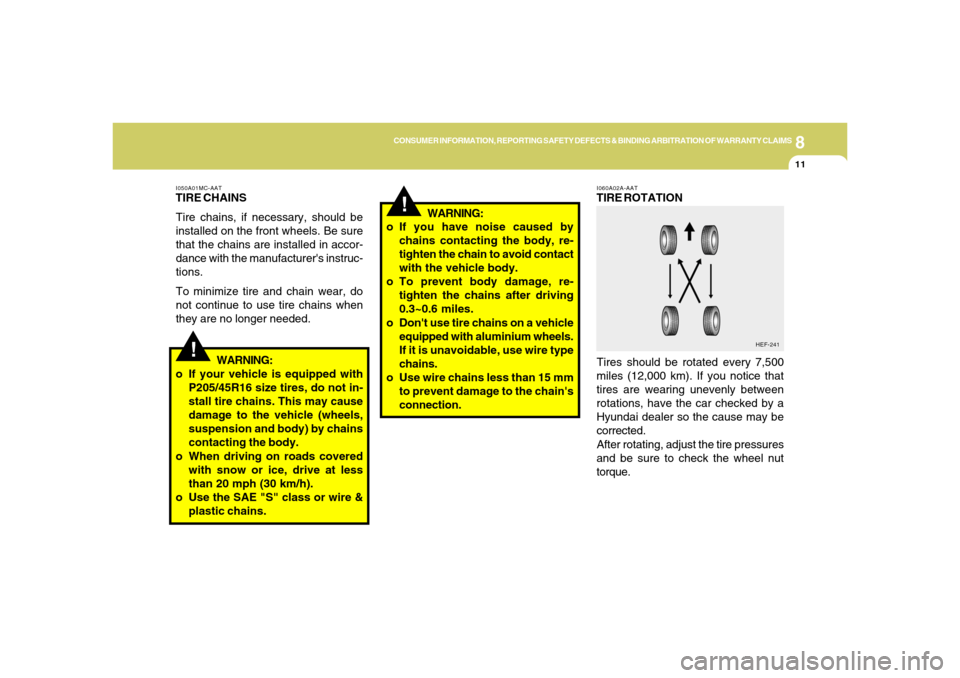
I060A02A-AATTIRE ROTATION
Tires should be rotated every 7,500
miles (12,000 km). If you notice that
tires are wearing unevenly between
rotations, have the car checked by a
Hyundai dealer so the cause may be
corrected.
After rotating, adjust the tire pressures
and be sure to check the wheel nut
torque.
HEF-241