vin Hyundai Accent 2008 Manual PDF
[x] Cancel search | Manufacturer: HYUNDAI, Model Year: 2008, Model line: Accent, Model: Hyundai Accent 2008Pages: 273, PDF Size: 9.36 MB
Page 183 of 273
3
WHAT TO DO IN AN EMERGENCY
11
IF YOU HAVE A FLAT TIRED050A01A-AATIf a tire goes flat while you are driving:
1. Take your foot off the accelerator
pedal and let the car slow down while
driving straight ahead. Do not apply
the brakes immediately or attempt to
pull off the road as this may cause a
loss of control. When the car has
slowed to such a speed that it is safe
to do so, brake carefully and pull off
the road. Drive off the road as far as
possible and park on firm, level
ground. If you are on a divided high-
way, do not park in the median area
between the two traffic lanes.
2. When the car is stopped, turn on
your emergency hazard flashers,
set the parking brake and put the
transaxle in "P" (automatic) or re-
verse (manual transaxle).
3.
Have all passengers get out of the car.
Be sure they all get out on the side of
the car that is away from traffic.
4. When changing a flat tire, follow the
instructions provided on the next
description.
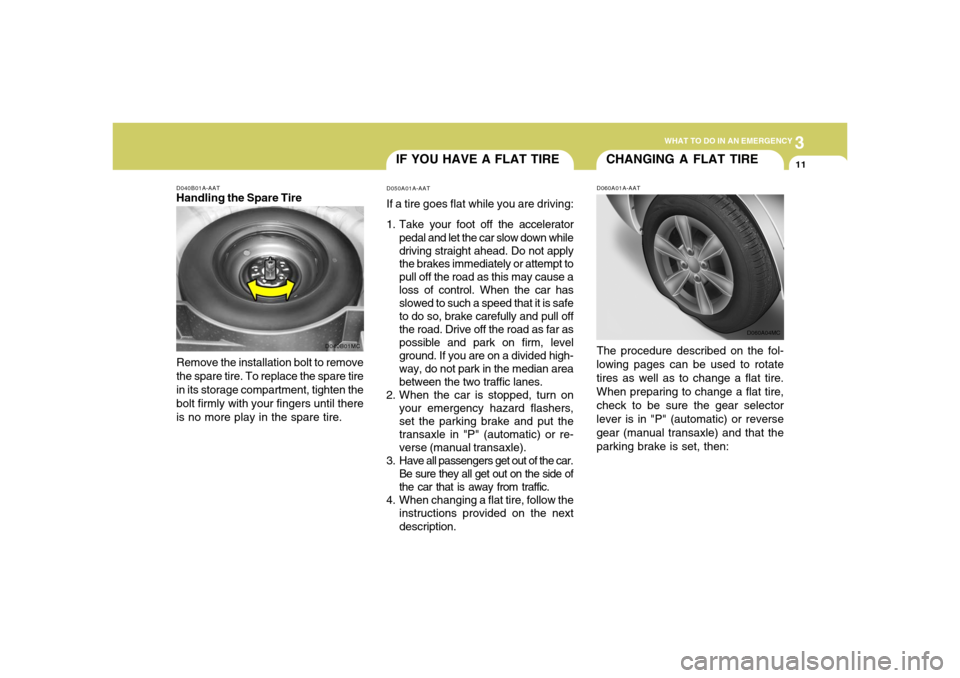
D040B01A-AATHandling the Spare Tire
Remove the installation bolt to remove
the spare tire. To replace the spare tire
in its storage compartment, tighten the
bolt firmly with your fingers until there
is no more play in the spare tire.
D040B01MC
CHANGING A FLAT TIRED060A01A-AATThe procedure described on the fol-
lowing pages can be used to rotate
tires as well as to change a flat tire.
When preparing to change a flat tire,
check to be sure the gear selector
lever is in "P" (automatic) or reverse
gear (manual transaxle) and that the
parking brake is set, then:
D060A04MC
Page 195 of 273
4
CORROSION PREVENTION AND APPEARANCE CARE
4
CORROSION PREVENTION AND APPEARANCE CARE
3
TO HELP PREVENT COR-
ROSIONE020A01A-AATYou can help prevent corrosion from
getting started by observing the follow-
ing:E020B01A-AATKeep Your Car CleanThe best way to prevent corrosion is to
keep your car clean and free of corrosive
materials. Attention to the underside of
the car is particularly important.
o If you live in a high-corrosion area —
where road salts are used, near the
ocean, areas with industrial pollution,
acid rain, etc.— you should take extra
care to prevent corrosion. In winter,
hose off the underside of your car at
least once a month and be sure to
clean the underside thoroughly when
winter is over.
o When cleaning underneath the car,
give particular attention to the compo-
nents under the fenders and other
areas that are hidden from view.
E020C01A-AATKeep Your Garage DryDon't park your car in a damp, poorly
ventilated garage. This creates a favor-
able environment for corrosion. This is
particularly true if you wash your car in
the garage or drive it into the garage
when it is still wet or covered with snow,
ice or mud. Even a heated garage can
contribute to corrosion unless it is well
ventilated so moisture is dispersed.
E020D02A-AATKeep Paint and Trim in Good Condi-
tionScratches or chips in the finish should be
covered with "touch-up" paint as soon as
possible to reduce the possibility of cor-
rosion. If bare metal is showing through,
the attention of a qualified body and paint
shop is recommended.
Bird droppings : Bird droppings are highly
corrosive and may damage painted sur-
faces in just a few hours. Always remove
bird droppings as soon as possible.E020E01A-AATDon't Neglect the InteriorMoisture can collect under the floor mats
and carpeting to cause corrosion. Check
under the mats periodically to be sure the
carpeting is dry. Use particular care if you
carry fertilizers, cleaning materials or
chemicals in the car.
These should be carried only in proper
containers and any spills or leaks should
be cleaned up, flushed with clear water
and thoroughly dried. Do a thorough job; just dampening the
accumulated mud rather than washing
it away will accelerate corrosion rather
than prevent it. Water under high pres-
sure and steam are particularly effec-
tive in removing accumulated mud and
corrosive materials.
o When cleaning lower door panels,
rocker panels and frame members, be
sure that drain holes are kept open so
that moisture can escape and not be
trapped inside to ac-celerate corro-
sion.
Page 198 of 273
44
CORROSION PREVENTION AND APPEARANCE CARE6
E040D01A-AATCleaning the Seat BeltsTo clean the seat belts, use a cloth or
sponge with mild soap or detergent and
warm water. Do not use strong deter-
gents, dye, bleach or abrasive materials
on the seat belts as this may weaken the
fabric.
While cleaning the belts, inspect them for
excessive wear, cuts, fraying or other
signs of damage and replace them if
necessary.E040E01A-AATCleaning the WindowsYou may use any household window
cleaner on the windows. However, when
cleaning the inside of the rear window be
careful not to damage the rear window
defroster wiring.
E040A01A-AATTo Clean the Vinyl UpholsteryTo clean the vinyl upholstery, first remove
loose dirt and dust with a vacuum cleaner.
Then apply a solution of mild soap or
detergent and water using a clean sponge
or soft cloth. Allow this to stay on the
surface to loosen the dirt, then wipe with
a clean damp sponge or cloth. If all the
dirt stains are not removed, repeat this
procedure until the upholstery is clean.
Do not use gasoline, solvent, paint thin-
ner or other strong cleaners.
E040C01A-AATCleaning the CarpetsUse a foam-type carpet cleaner. Clean-
ers of this type are available in aerosol
cans in liquid form or powder. Read the
instructions and follow them exactly. Us-
ing a vacuum cleaner with the appropri-
ate attachment, remove as much dirt from
the carpets as possible. Apply the foam
following the manufacturer's directions,
then rub in overlapping circles. Do not
add water. These cleaners work best
when the carpet is kept as dry as pos-
sible.
CLEANING THE INTERIOR
Page 205 of 273
5
VEHICLE MAINTENANCE REQUIREMENTS6
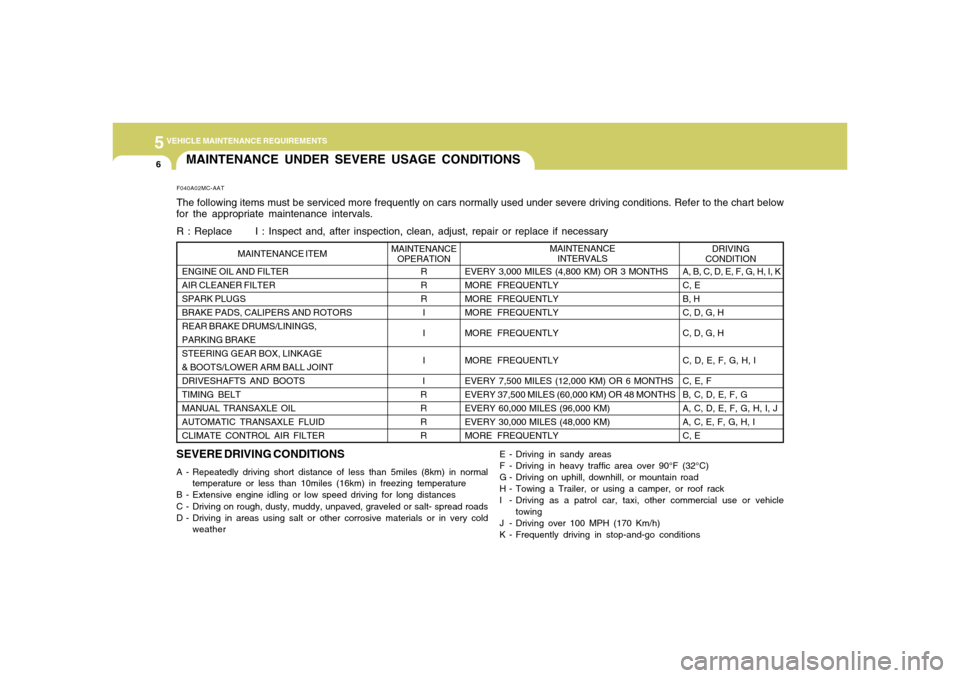
DRIVING
CONDITION MAINTENANCE
INTERVALS
ENGINE OIL AND FILTER
AIR CLEANER FILTER
SPARK PLUGS
BRAKE PADS, CALIPERS AND ROTORS
REAR BRAKE DRUMS/LININGS,
PARKING BRAKE
STEERING GEAR BOX, LINKAGE
& BOOTS/LOWER ARM BALL JOINT
DRIVESHAFTS AND BOOTS
TIMING BELT
MANUAL TRANSAXLE OIL
AUTOMATIC TRANSAXLE FLUID
CLIMATE CONTROL AIR FILTER
R
R
R
I
I
I
I
R
R
R
R MAINTENANCE
OPERATION MAINTENANCE ITEM
EVERY 3,000 MILES (4,800 KM) OR 3 MONTHS
MORE FREQUENTLY
MORE FREQUENTLY
MORE FREQUENTLY
MORE FREQUENTLY
MORE FREQUENTLY
EVERY 7,500 MILES (12,000 KM) OR 6 MONTHS
EVERY 37,500 MILES (60,000 KM) OR 48 MONTHS
EVERY 60,000 MILES (96,000 KM)
EVERY 30,000 MILES (48,000 KM)
MORE FREQUENTLY
SEVERE DRIVING CONDITIONSA - Repeatedly driving short distance of less than 5miles (8km) in normal
temperature or less than 10miles (16km) in freezing temperature
B - Extensive engine idling or low speed driving for long distances
C - Driving on rough, dusty, muddy, unpaved, graveled or salt- spread roads
D - Driving in areas using salt or other corrosive materials or in very cold
weatherE - Driving in sandy areas
F - Driving in heavy traffic area over 90°F (32°C)
G - Driving on uphill, downhill, or mountain road
H - Towing a Trailer, or using a camper, or roof rack
I - Driving as a patrol car, taxi, other commercial use or vehicle
towing
J - Driving over 100 MPH (170 Km/h)
K - Frequently driving in stop-and-go conditionsA, B, C, D, E, F, G, H, I, K
C, E
B, H
C, D, G, H
C, D, G, H
C, D, E, F, G, H, I
C, E, F
B, C, D, E, F, G
A, C, D, E, F, G, H, I, J
A, C, E, F, G, H, I
C, EMAINTENANCE UNDER SEVERE USAGE CONDITIONSF040A02MC-AATThe following items must be serviced more frequently on cars normally used under severe driving conditions. Refer to the chart below
for the appropriate maintenance intervals.
R : Replace I : Inspect and, after inspection, clean, adjust, repair or replace if necessary
Page 206 of 273
5
VEHICLE MAINTENANCE REQUIREMENTS
7
EXPLANATION OF SCHEDULED
MAINTENANCE ITEMS
F060D01A-AATo Fuel Lines, Fuel Hoses and
ConnectionsCheck the fuel lines, fuel hoses and con-
nections for leakage and damage. Have
a trained techincian, replace any dam-
aged or leaking parts immediately.
F060C01A-AATo Fuel FilterA clogged filter can limit the speed at
which the vehicle may be driven, damage
the emission system and cause hard start-
ing. If an excessive amount of foreign
matter accumulates in the fuel tank, the
filter may require replacement more fre-
quently.
After installing a new filter, run the engine
for several minutes, and check for leaks
at the connections.
Fuel filters should be installed by trained
technicians.F060M01A-AATo Engine Oil and FilterThe engine oil and filter should be
changed at the intervals specified in the
maintenance schedule. If the car is being
driven in severe conditions, more fre-
quent oil and filter changes are required.
F060H01A-AATo Air Cleaner FilterA Genuine Hyundai air cleaner filter is
recommended when the filter is replaced.F060G01A-AATo Vapor Hose and Fuel Filler CapThe vapor hose and fuel filler cap should
be inspected at those intervals specified
in the maintenance schedule. Make sure
that a new vapor hose or fuel filler cap is
correctly replaced.
F060F01A-AATo Vacuum, Crankcase Ventilation
HosesInspect the surface of hoses for evidence
of heat and/or mechanical damage. Hard
and brittle rubber, cracking, tears, cuts,
abrasions, and excessive swelling indi-
cate deterioration. Particular attention
should be paid to examine those hose
surfaces nearest to high heat sources,
such as the exhaust manifold.
Inspect the hose routing to assure that
the hoses do not come in contact with any
heat source, sharp edges or moving com-
ponent which might cause heat damage
or mechanical wear. Inspect all hose
connections, such as clamps and cou-
plings, to make sure they are secure, and
that no leaks are present. Hoses should
be replaced immediately if there is any
evidence of deterioration or damage.
F060B01A-AATo Drive BeltsInspect all drive belts for evidence of cuts,
cracks, excessive wear or oil saturation
and replace if necessary. Drive belts
should be checked periodically for proper
tension and adjusted as necessary.F060J01A-AATo Spark PlugsMake sure to install new spark plugs of
the correct heat range.
Page 213 of 273
6
DO-IT-YOURSELF MAINTENANCE4
CHECKING THE ENGINE OILG030A01A-AATEngine oil is essential to the performance
and service of the engine. It is suggested
that you check the oil level at least once
a week in normal use and more often if
you are on a trip or driving in severe
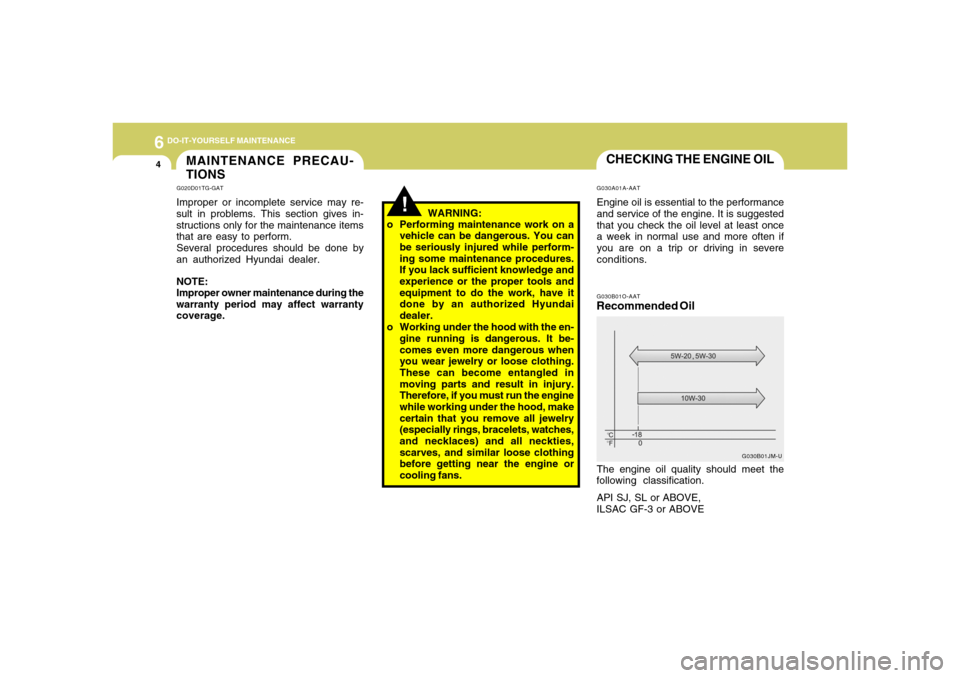
conditions.G030B01O-AATRecommended OilThe engine oil quality should meet the
following classification.
API SJ, SL or ABOVE,
ILSAC GF-3 or ABOVE
G030B01JM-U
MAINTENANCE PRECAU-
TIONS
!
G020D01TG-GATImproper or incomplete service may re-
sult in problems. This section gives in-
structions only for the maintenance items
that are easy to perform.
Several procedures should be done by
an authorized Hyundai dealer.
NOTE:
Improper owner maintenance during the
warranty period may affect warranty
coverage.WARNING:
o Performing maintenance work on a
vehicle can be dangerous. You can
be seriously injured while perform-
ing some maintenance procedures.
If you lack sufficient knowledge and
experience or the proper tools and
equipment to do the work, have it
done by an authorized Hyundai
dealer.
o Working under the hood with the en-
gine running is dangerous. It be-
comes even more dangerous when
you wear jewelry or loose clothing.
These can become entangled in
moving parts and result in injury.
Therefore, if you must run the engine
while working under the hood, make
certain that you remove all jewelry
(especially rings, bracelets, watches,
and necklaces) and all neckties,
scarves, and similar loose clothing
before getting near the engine or
cooling fans.
Page 217 of 273
6
DO-IT-YOURSELF MAINTENANCE8
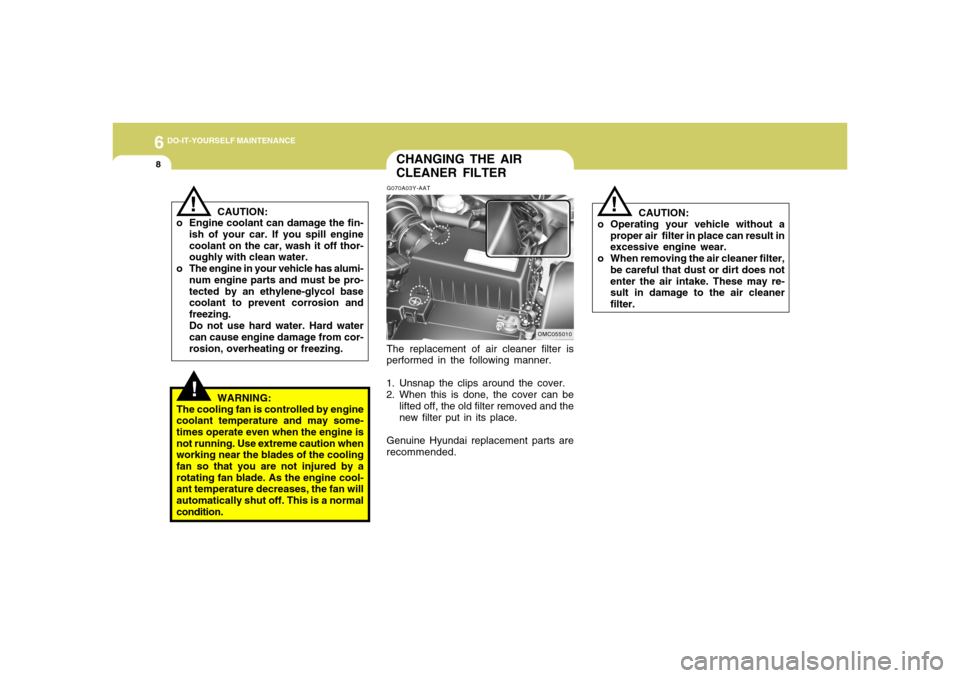
G070A03Y-AATThe replacement of air cleaner filter is
performed in the following manner.
1. Unsnap the clips around the cover.
2. When this is done, the cover can be
lifted off, the old filter removed and the
new filter put in its place.
Genuine Hyundai replacement parts are
recommended.CHANGING THE AIR
CLEANER FILTER
OMC055010
!
WARNING:
The cooling fan is controlled by engine
coolant temperature and may some-
times operate even when the engine is
not running. Use extreme caution when
working near the blades of the cooling
fan so that you are not injured by a
rotating fan blade. As the engine cool-
ant temperature decreases, the fan will
automatically shut off. This is a normal
condition.CAUTION:
o Engine coolant can damage the fin-
ish of your car. If you spill engine
coolant on the car, wash it off thor-
oughly with clean water.
o The engine in your vehicle has alumi-
num engine parts and must be pro-
tected by an ethylene-glycol base
coolant to prevent corrosion and
freezing.
Do not use hard water. Hard water
can cause engine damage from cor-
rosion, overheating or freezing.
!
CAUTION:
o Operating your vehicle without a
proper air filter in place can result in
excessive engine wear.
o When removing the air cleaner filter,
be careful that dust or dirt does not
enter the air intake. These may re-
sult in damage to the air cleaner
filter.
!
Page 220 of 273
6
DO-IT-YOURSELF MAINTENANCE
11
!
G100A01MC-GATTransaxle lubricant in the manual
transaxle should be checked at those
intervals specified in the vehicle mainte-
nance schedule in Section 5.
!CHECKING THE TRANSAXLE
OIL (MANUAL)
!
CAUTION:
o Radiator anti-freeze (engine coolant)
should not be used in the washer
system because it will damage the
car's finish.
o The washer should not be operated
if the washer reservoir is empty.
This can damage the washer fluid
pump.WARNING:
It is always better to check the transaxle
oil level when the engine is cool or cold.
If the engine is hot, you should exercise
great caution to avoid burning yourself
on hot engine or exhaust parts.
WARNING:
o Windshield washer fluid agents con-
tain some amounts of alcohol and
can be flammable under certain cir-
cumstances. Do not allow sparks or
flame to contact the washer fluid or
the washer fluid reservoir. Damage
to the vehicle or its occupants could
occur.
o Windshield washer fluid is poison-
ous to humans and animals. Do not
drink windshield washer fluid. Seri-
ous injury or death could occur.NOTE:
It is recommended that the manual
transaxle fluid should be checked by an
authorized Hyundai dealer.
G110A01MC-AATTransaxle fluid in the automatic transaxle
should be checked at those intervals
specified in the vehicle maintenance
schedule in Section 5.
NOTE:
Automatic transaxle fluid is basically a
red color. As driving distance increases,
the fluid color turns darkish red gradu-
ally. It is a normal condition and you
should not judge the need to replace
based upon the changing color.
You must replace the automatic
transaxle fluid in accordance with inter-
vals specified in the vehicle mainte-
nance schedule in section 5.CHECKING THE TRANSAXLE
FLUID (AUTOMATIC)
Page 221 of 273
6
DO-IT-YOURSELF MAINTENANCE
12
G110D02MC
!
WARNING:
The transaxle fluid level should be
checked when the engine is at normal
operating temperature. This means that
the engine, radiator, exhaust system
etc., are very hot. Exercise great care
not to burn yourself during this proce-
dure.
!
CAUTION:
Use of aftermarket ATF additives may
cause damage to the automatic
transaxle.
Only use HYUNDAI GENUINE ATF SP
III, DIAMOND ATF SP III, SK ATF SP III or
other brands meeting the SP III specifi-
cation approved by Hyundai Motor Co..
If you are having your vehicle serviced
at a facility other than a Hyundai dealer,
verify that the correct ATF is used for
your vehicle.
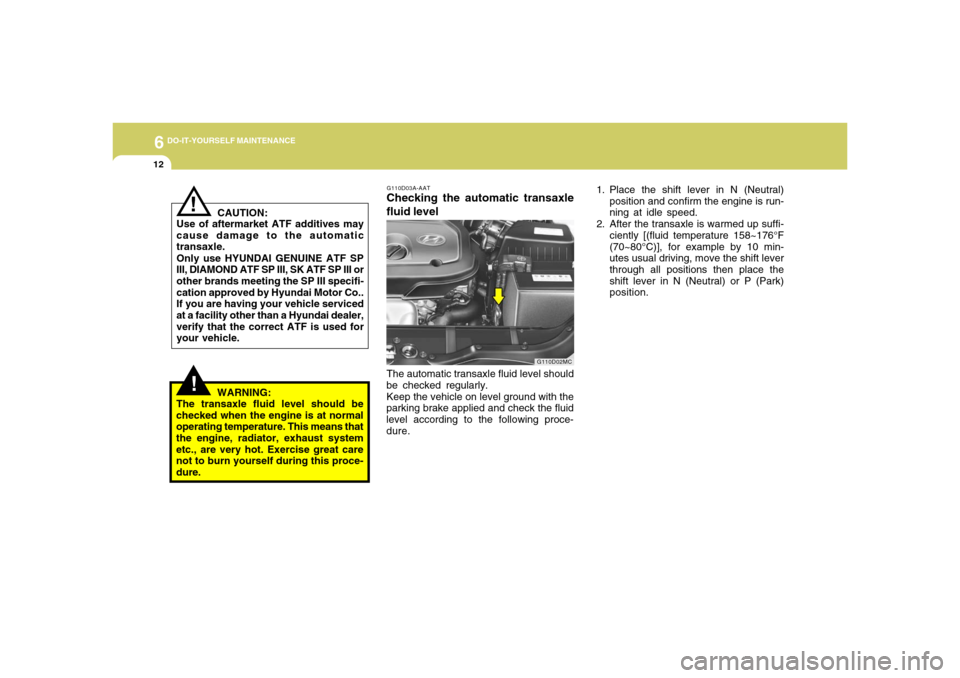
G110D03A-AATChecking the automatic transaxle
fluid level
1. Place the shift lever in N (Neutral)
position and confirm the engine is run-
ning at idle speed.
2. After the transaxle is warmed up suffi-
ciently [(fluid temperature 158~176°F
(70~80°C)], for example by 10 min-
utes usual driving, move the shift lever
through all positions then place the
shift lever in N (Neutral) or P (Park)
position.
The automatic transaxle fluid level should
be checked regularly.
Keep the vehicle on level ground with the
parking brake applied and check the fluid
level according to the following proce-
dure.
Page 223 of 273
6
DO-IT-YOURSELF MAINTENANCE
14
!
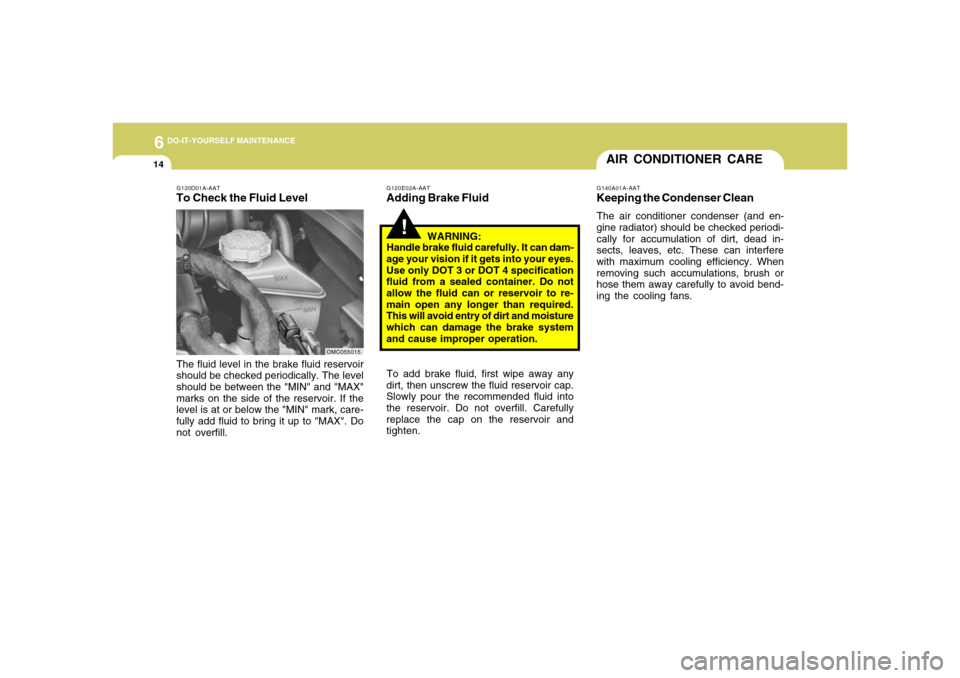
G120D01A-AATTo Check the Fluid Level
G120E02A-AATAdding Brake Fluid
The fluid level in the brake fluid reservoir
should be checked periodically. The level
should be between the "MIN" and "MAX"
marks on the side of the reservoir. If the
level is at or below the "MIN" mark, care-
fully add fluid to bring it up to "MAX". Do
not overfill.WARNING:
Handle brake fluid carefully. It can dam-
age your vision if it gets into your eyes.
Use only DOT 3 or DOT 4 specification
fluid from a sealed container. Do not
allow the fluid can or reservoir to re-
main open any longer than required.
This will avoid entry of dirt and moisture
which can damage the brake system
and cause improper operation.
To add brake fluid, first wipe away any
dirt, then unscrew the fluid reservoir cap.
Slowly pour the recommended fluid into
the reservoir. Do not overfill. Carefully
replace the cap on the reservoir and
tighten.
OMC055015
AIR CONDITIONER CAREG140A01A-AATKeeping the Condenser CleanThe air conditioner condenser (and en-
gine radiator) should be checked periodi-
cally for accumulation of dirt, dead in-
sects, leaves, etc. These can interfere
with maximum cooling efficiency. When
removing such accumulations, brush or
hose them away carefully to avoid bend-
ing the cooling fans.