coolant temperature Hyundai Accent 2009 - RHD (UK. Australia) User Guide
[x] Cancel search | Manufacturer: HYUNDAI, Model Year: 2009, Model line: Accent, Model: Hyundai Accent 2009Pages: 232, PDF Size: 8.36 MB
Page 188 of 232
6
DO-IT-YOURSELF MAINTENANCE
7
!
CHECKING AND CHANG- ING THE ENGINE COOLANT
35% 40%50%60%
Ambient
temperature °C ( °F)-15 (5)
-25 (-13)-35 (-31)-45 (-49)
Antifreeze solution Water
Engine coolant concentration
65% 60%50%40%
G050A01TG-DAT
WARNING:
Do not remove the radiator cap when the engine is hot. When the engine is hot, the engine coolant is under pres-sure and may erupt through the open- ing if the cap is removed. You could be seriously burned if you do notobserve this precaution. Do not re- move the radiator cap until the radia- tor is cool to touch. NOTE: It is recommended that the engine coolant should be changed by an authorised Hyundai dealer. G050B01A-AAT Recommended Engine Coolant Use a high quality ethylene-glycol cool- ant in a 50/50 mix with water. Theengine coolant should be compatible with aluminum engine parts. Additional corrosion inhibitors or additives shouldnot be used. The cooling system must be maintained with the correct con- centration and type of engine coolantto prevent freezing and corrosion. Never allow the concentration of anti- freeze to exceed the 60% level or gobelow the 35% level, or damage to the cooling system may result. For proper concentration when adding or replac-ing the engine coolant, refer to the following table.
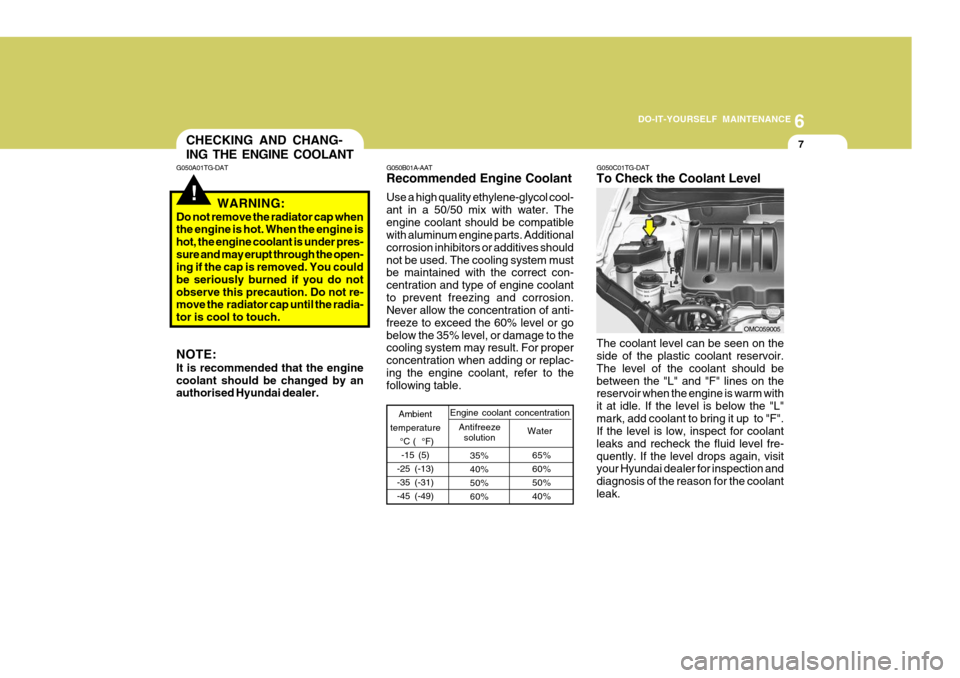
G050C01TG-DAT To Check the Coolant Level The coolant level can be seen on the side of the plastic coolant reservoir. The level of the coolant should bebetween the "L" and "F" lines on the reservoir when the engine is warm with it at idle. If the level is below the "L"mark, add coolant to bring it up to "F". If the level is low, inspect for coolant leaks and recheck the fluid level fre-quently. If the level drops again, visit your Hyundai dealer for inspection and diagnosis of the reason for the coolantleak.
OMC059005
Page 189 of 232
6 DO-IT-YOURSELF MAINTENANCE
8CHANGING THE AIR CLEANER FILTER
G070A03Y-AAT
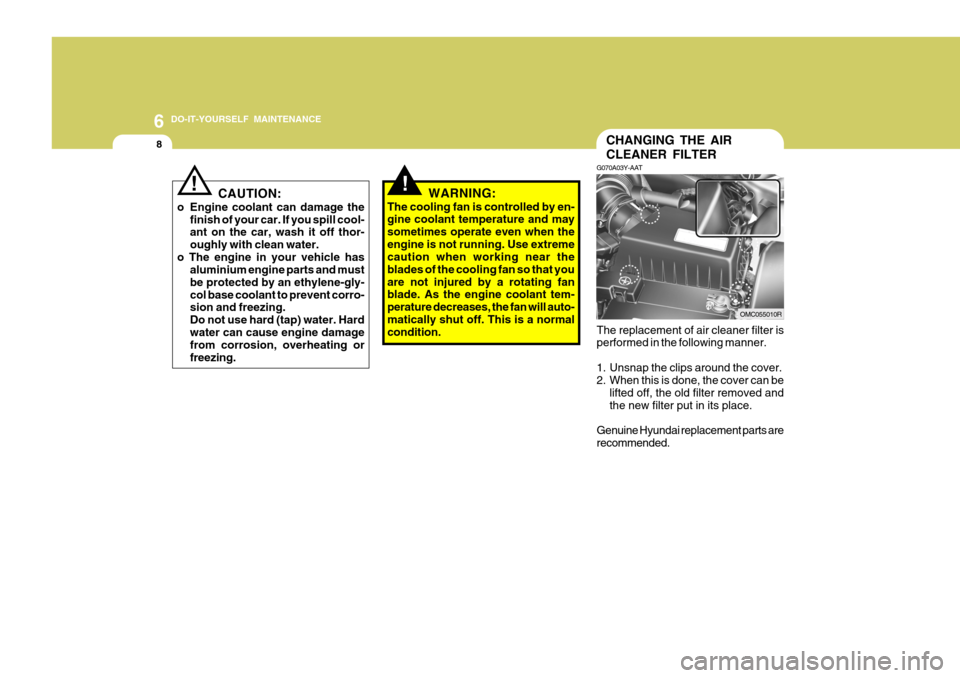
The replacement of air cleaner filter is performed in the following manner.
1. Unsnap the clips around the cover.
2. When this is done, the cover can be lifted off, the old filter removed and the new filter put in its place.
Genuine Hyundai replacement parts arerecommended.
!! CAUTION:
o Engine coolant can damage the finish of your car. If you spill cool- ant on the car, wash it off thor- oughly with clean water.
o The engine in your vehicle has aluminium engine parts and mustbe protected by an ethylene-gly-col base coolant to prevent corro- sion and freezing. Do not use hard (tap) water. Hardwater can cause engine damage from corrosion, overheating or freezing. WARNING:
The cooling fan is controlled by en- gine coolant temperature and may sometimes operate even when theengine is not running. Use extreme caution when working near the blades of the cooling fan so that youare not injured by a rotating fan blade. As the engine coolant tem- perature decreases, the fan will auto-matically shut off. This is a normal condition.
OMC055010R
Page 194 of 232
6
DO-IT-YOURSELF MAINTENANCE
13
!
!
CHECKING THE BRAKES
G120B01A-AAT Checking the Brake Fluid Level WARNING:
Use caution when handling brake fluid. It can damage your vision if it gets into your eyes. It will also dam-age your vehicle's paint if spilled on it and not removed immediately.
G120A01A-AAT
!
CAUTION:
Because brakes are essential to the safe operation of the car, it is sug- gested that they be checked andinspected by your Hyundai dealer. The brakes should be checked and inspected for wear at those inter-vals specified in the vehicle mainte- nance schedule in Section 5.
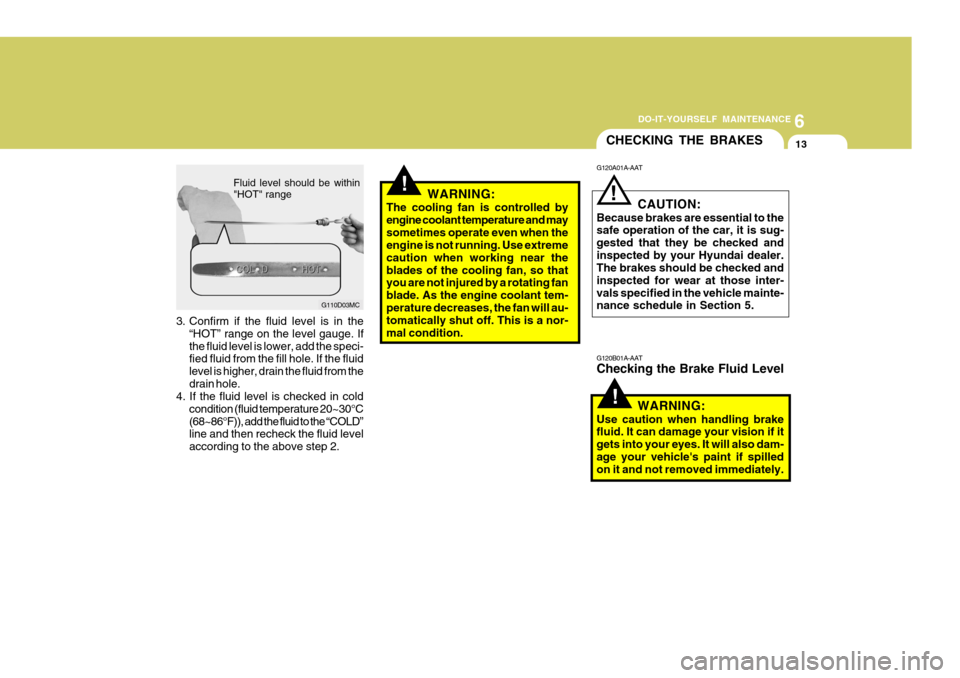
3. Confirm if the fluid level is in the “HOT” range on the level gauge. If the fluid level is lower, add the speci- fied fluid from the fill hole. If the fluid level is higher, drain the fluid from thedrain hole.
4. If the fluid level is checked in cold
condition (fluid temperature 20~30°C(68~86°F)), add the fluid to the “COLD” line and then recheck the fluid level according to the above step 2.
G110D03MC
Fluid level should be within "HOT" range
WARNING:
The cooling fan is controlled by engine coolant temperature and maysometimes operate even when the engine is not running. Use extreme caution when working near theblades of the cooling fan, so that you are not injured by a rotating fan blade. As the engine coolant tem-perature decreases, the fan will au- tomatically shut off. This is a nor- mal condition.
Page 202 of 232
6
DO-IT-YOURSELF MAINTENANCE
21
!
G220B01A-AAT Checking Engine Cooling Fan The engine coolant fan should come on automatically if the engine coolanttemperature is high. G220C01TB-GAT Checking Condenser Cooling Fan When the air conditioning is in opera- tion, the condenser cooling fan comeson automatically, being controlled by
the engine ECU.
WARNING:
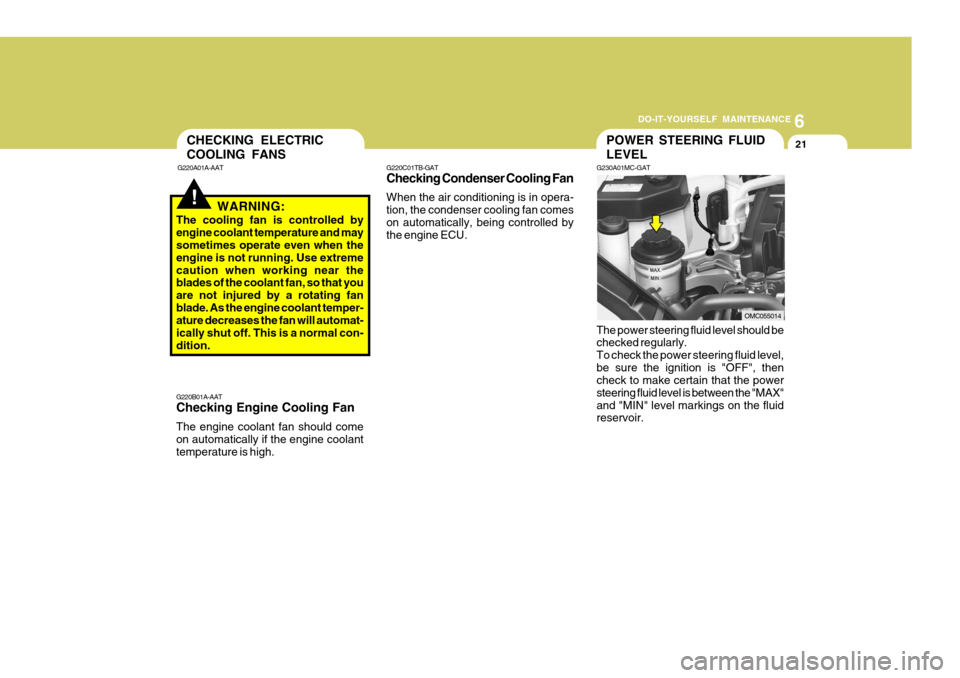
The cooling fan is controlled by engine coolant temperature and may sometimes operate even when the engine is not running. Use extremecaution when working near the blades of the coolant fan, so that you are not injured by a rotating fanblade. As the engine coolant temper- ature decreases the fan will automat- ically shut off. This is a normal con-dition. The power steering fluid level should be checked regularly. To check the power steering fluid level,be sure the ignition is "OFF", then check to make certain that the power steering fluid level is between the "MAX"and "MIN" level markings on the fluid reservoir.
CHECKING ELECTRIC COOLING FANS
G220A01A-AATPOWER STEERING FLUID LEVEL
G230A01MC-GAT
OMC055014
Page 230 of 232

10
INDEX
3
E Electronic Stability Program (ESP) ...........................2-12
Emission Contro l System ............................................ 7-2
Engine Before starting the engine ........................................ 2-3Compartment ............................................................ 6-2
Coolant ..................................................................... 6-7
If the engine overheats ............................................. 3-4
Number ..................................................................... 8-3
Oil ............................................................................. 6-4 Starting ..................................................................... 2-5
Engine Exhaust Can Be Dangerous ............................ 2-2
FFog Light Front ....................................................................... 1-67
Rear ........................................................................ 1-67
Front Seats Adjustable front seats ............................................. 1-14
Adjustable headrests .............................................. 1-15
Adjusting seat forward and rearward .......................1-14
Adjusting seatback angle ....................................... 1-14
Fuel
Capacity ................................................................... 9-2
Gauge ..................................................................... 1-55
Recommendations .................................................... 1-2
Fuel Filler Lid
Remote release ...................................................... 1-80
Fuses ........................................................................ 6-17
Fuse Panel description .............................................. 6-30G General Checks
........................................................... 6-3
Glove Box ................................................................. 1-75
H Hand Brake ................................................................ 1-78
Hazard Warning System ............................................ 1-66
Headlight Aiming Adjustment..................................... 6-22
Heating and Cooling Control ......................................1-89
Heating and Ventilation .............................................. 1-90
Air flow control ........................................................ 1-91
Air intake control .................................................... 1-90
Bi-level heati ng ....................................................... 1-94
Demisting/Defogging ............................................... 1-94
Fan speed control ................................................... 1-90
Temperature control ................................................ 1-93
High-Mounted Rear Stop Light................................... 1-79
Horn ........................................................................... 1-87
IImmobiliser System ..................................................... 1-3
Instrument Cluster and Indicator Lights ..................... 1-46
Instrument Panel Light Control (Rheostat) .................1-66
Interior Light
Interior light ............................................................. 1-73
Map light ................................................................. 1-73
JJump Starting .............................................................. 3-3