Children Hyundai Accent 2009 User Guide
[x] Cancel search | Manufacturer: HYUNDAI, Model Year: 2009, Model line: Accent, Model: Hyundai Accent 2009Pages: 266, PDF Size: 8.77 MB
Page 54 of 266
1FEATURES OF YOUR HYUNDAI44
!
WARNING:
o Move your seat as far back as prac-
tical from the front airbags, while still
maintaining control of the vehicle.
o Never sit or lean unnecessarily close
to the front or side airbags.
o Never lean against the door or cen-
ter console – always sit in an upright
position.
o Do not allow an adult passenger to
ride in the front seat when the “Pas-
senger Airbag OFF” indicator is illu-
minated, because the airbag will not
deploy in the event of a moderate or
severe frontal crash.
o Never place objects over or near
any airbag module (front or side im-
pact airbags), because these objects
can injure passengers in a crash.
o Never place covers, blankets or
aftermarket seat warmers on the
passenger seat as these may inter-
fere with the occupant classification
system.
!
WARNING:
Always use seat belts and child restraints
– every trip, every time, everyone!
Airbags inflate with considerable force
and in the blink of an eye. Seat belts help
keep occupants in proper position to
obtain maximum benefit from the airbag.
Even with advanced airbags, improp-
erly and unbelted occupants can be se-
verely injured when the airbag inflates.
Always follow the precautions about seat
belts, airbags and occupant safety con-
tained in this manual.
To reduce the chance of serious or fatal
injuries and receive the maximum safety
benefit from your restraint system:
o Never place a child in any child or
booster seat in the front seat (see
child restraints 1-31).
o ABC – Always Buckle Children in the
back seat. It is the safest place for
children of any age to ride.
o Front and side impact airbags can
injure occupants improperly posi-
tioned in the front seats.
!
WARNING:
o Do not tamper or disconnect SRS
wiring or other components. Injuries
could result from inadvertent deploy-
ment or failure of the airbag to de-
ploy in a crash.
o If the SRS airbag warning light (see
pg 1-64) remains illuminated while
the vehicle is being driven, have an
authorized Hyundai dealer inspect
the airbag system as soon as pos-
sible.
o Airbags can only be used once –
have an authorized Hyundai dealer
replace the airbag immediately after
deployment.
o The SRS is designed to deploy the
front airbags only when an impact is
sufficiently severe and when the im-
pact angle is within a range as mea-
sured from the forward longitudinal
axis of the vehicle. The front airbags
will not deploy in side, rear or rollover
impacts. Additionally, the airbags will
only deploy once. Seat belts must be
worn at all times.
Page 55 of 266
1
FEATURES OF YOUR HYUNDAI
451
FEATURES OF YOUR HYUNDAI
45
!
WARNING:
o No objects should be placed over or
near the airbag modules on the steer-
ing wheel, instrument panel, and the
front passenger's panel above the
glove box, because any such object
could cause harm if the vehicle is in
a crash severe enough to cause the
airbags to deploy.
o If the airbags deploy, they must be
replaced by an authorized Hyundai
dealer. Deployed airbags WILL NOT
inflate again and will provide no pro-
tection in subsequent collisions.
o Do not tamper with or disconnect
SRS wiring or other components of
the SRS system. Doing so could
result in injury, due to accidental
deployment of the airbags or by ren-
dering the SRS inoperative.
o Even though your vehicle is equipped
with the occupant classification sys-
tem, do not install a child restraint
system in the front passenger seat
position. A child restraint system
must never be placed in the front
seat.
An infant or child could be severely
injured or killed by an airbag deploy-
ment in case of an accident.
o Children younger than 13 years must
always be properly restrained in the
rear seat. Never allow children to
ride in the front passenger seat. If a
child over 13 must be seated in the
front seat, he or she must be prop-
erly belted and the seat should be
moved as far back as possible.
o For maximum safety protection in all
types of crashes, all occupants in-
cluding the driver should always wear
their seat belts whether or not an
airbag is also provided at their seat-
ing position to minimize the risk of
severe injury or death in the event of
a crash. Do not sit or lean unneces-
sarily close to the airbag while the
vehicle is in motion.!
WARNING:
!
WARNING:
B240A02MC
Rear impact
Side Impact
Rollover
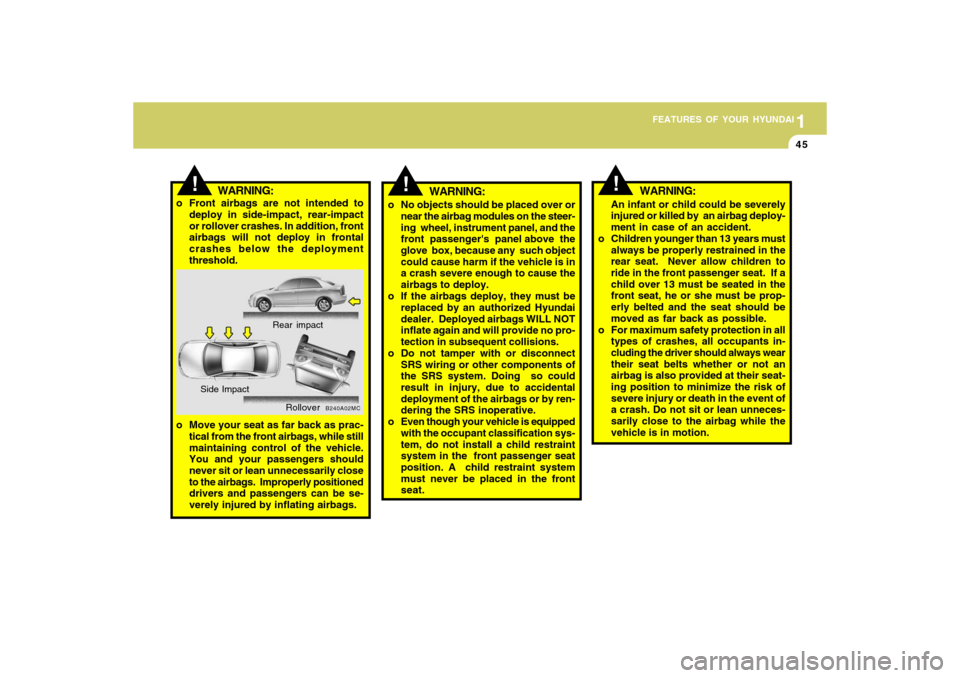
o Front airbags are not intended to
deploy in side-impact, rear-impact
or rollover crashes. In addition, front
airbags will not deploy in frontal
crashes below the deployment
threshold.
o Move your seat as far back as prac-
tical from the front airbags, while still
maintaining control of the vehicle.
You and your passengers should
never sit or lean unnecessarily close
to the airbags. Improperly positioned
drivers and passengers can be se-
verely injured by inflating airbags.
Page 60 of 266
1FEATURES OF YOUR HYUNDAI50
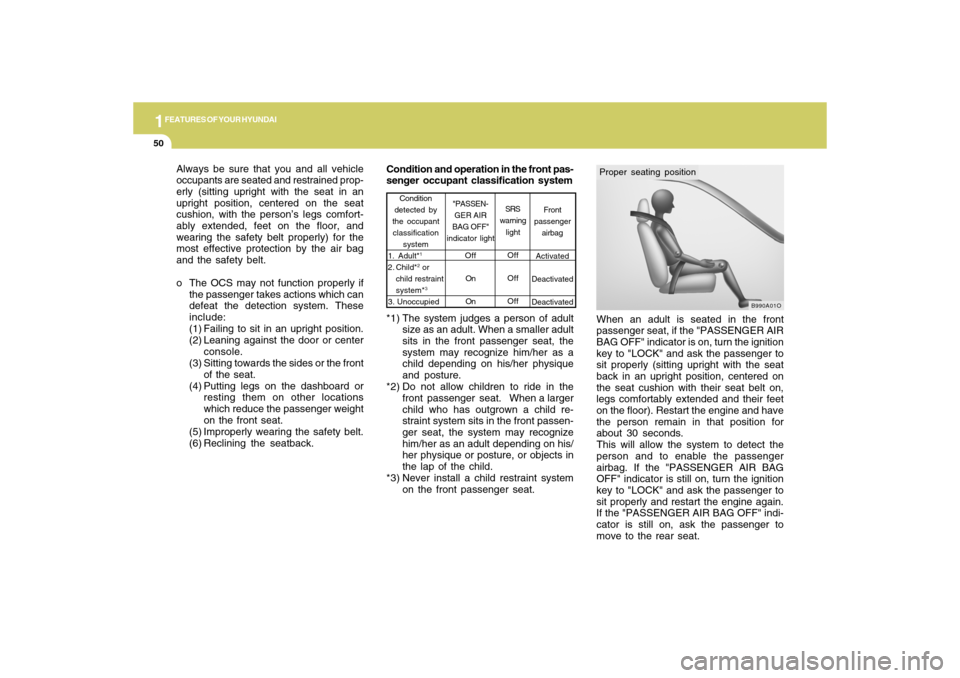
When an adult is seated in the front
passenger seat, if the "PASSENGER AIR
BAG OFF" indicator is on, turn the ignition
key to "LOCK" and ask the passenger to
sit properly (sitting upright with the seat
back in an upright position, centered on
the seat cushion with their seat belt on,
legs comfortably extended and their feet
on the floor). Restart the engine and have
the person remain in that position for
about 30 seconds.
This will allow the system to detect the
person and to enable the passenger
airbag. If the "PASSENGER AIR BAG
OFF" indicator is still on, turn the ignition
key to "LOCK" and ask the passenger to
sit properly and restart the engine again.
If the "PASSENGER AIR BAG OFF" indi-
cator is still on, ask the passenger to
move to the rear seat.Proper seating position
B990A01O
*1) The system judges a person of adult
size as an adult. When a smaller adult
sits in the front passenger seat, the
system may recognize him/her as a
child depending on his/her physique
and posture.
*2) Do not allow children to ride in the
front passenger seat. When a larger
child who has outgrown a child re-
straint system sits in the front passen-
ger seat, the system may recognize
him/her as an adult depending on his/
her physique or posture, or objects in
the lap of the child.
*3) Never install a child restraint system
on the front passenger seat. Condition and operation in the front pas-
senger occupant classification system
Front
passenger
airbag
Activated
Deactivated
Deactivated Condition
detected by
the occupant
classification
system
1. Adult*
1
2. Child*
2 or
child restraint
system*3
3. UnoccupiedSRS
warning
light
Off
Off
Off "PASSEN-
GER AIR
BAG OFF"
indicator light
Off
On
On
Always be sure that you and all vehicle
occupants are seated and restrained prop-
erly (sitting upright with the seat in an
upright position, centered on the seat
cushion, with the person’s legs comfort-
ably extended, feet on the floor, and
wearing the safety belt properly) for the
most effective protection by the air bag
and the safety belt.
o The OCS may not function properly if
the passenger takes actions which can
defeat the detection system. These
include:
(1) Failing to sit in an upright position.
(2) Leaning against the door or center
console.
(3) Sitting towards the sides or the front
of the seat.
(4) Putting legs on the dashboard or
resting them on other locations
which reduce the passenger weight
on the front seat.
(5) Improperly wearing the safety belt.
(6) Reclining the seatback.
Page 63 of 266
1
FEATURES OF YOUR HYUNDAI
531
FEATURES OF YOUR HYUNDAI
53
!
WARNING:
If the occupant classification system is
not working properly, the SRS airbag
warning light on the instrument panel
will illuminate because the passenger's
front airbags are connected with the
occupant classification system. If there
is a malfunction of the occupant classi-
fication system, the "PASSENGER AIR
BAG OFF" indicator will not illuminate
and the passenger's front airbags will
inflate in frontal impact crashes even if
there is no occupant in the front
passenger's seat. If the SRS airbag
warning light does not illuminate when
the ignition key is turned to the "ON"
position, remains illuminated after ap-
proximately 6 seconds when the ignition
key is turned to the "ON" position, or if it
illuminates while the vehicle is being
driven, have an authorized Hyundai
dealer inspect the occupant classifica-
tion system and the SRS airbag system
as soon as possible.
NOTE:The "PASSENGER AIR BAG OFF" indi-
cator illuminates for about 4 seconds
after the ignition key is turned to the
"ON" position or after the engine is
started. If the front passenger seat is
occupied, the occupant classification
sensor will then classify the front pas-
senger within approximately 10 seconds
after the ignition is turned on.
!
WARNING:
o Even though your vehicle is equipped
with the occupation classification
system, never install a child restraint
system in the front passenger's seat.
A deploying airbag can forcefully
strike a child resulting in serious
injuries or death. Any child under 13
years of age should ride in the rear
seat. Children too large for child
restraints should use the available
lap/shoulder belts. No matter what
type of crash, children of all ages are
safer when restrained in the rear
seat.
o If the "PASSENGER AIR BAG OFF"
indicator is illuminated when the front
passenger's seat is occupied by an
adult and he/she sits properly (sit-
ting upright with the seatback in an
upright position, centered on the seat
cushion with their seat belt on, legs
comfortably extended and their feet
on the floor), have that person sit in
the rear seat.
Page 66 of 266
1FEATURES OF YOUR HYUNDAI56
!
WARNING:
o The space between the occupant and
the curtain airbag must never be
occupied by children, passengers or
pets. Occupants should never lean
out or have any parts of their body
protruding from the window while the
engine is running.
o Do not move the sun visor out to
cover the side window if there is an
item attached to it such as a garage
door remote control, pens, air fresh-
eners or the like. These objects could
cause injury if the Curtain Airbag is
deployed.
o Do not install sun blinds to the rear
doors, these must not obstruct or
impair the airbag in any way.
o Do not install any accessories or
children’s toys in the Curtain Airbag
deployment zones, as this may im-
pair the operation of the system or
throw parts of them into the vehicle
cabin causing injury to occupants if
the system is deployed.
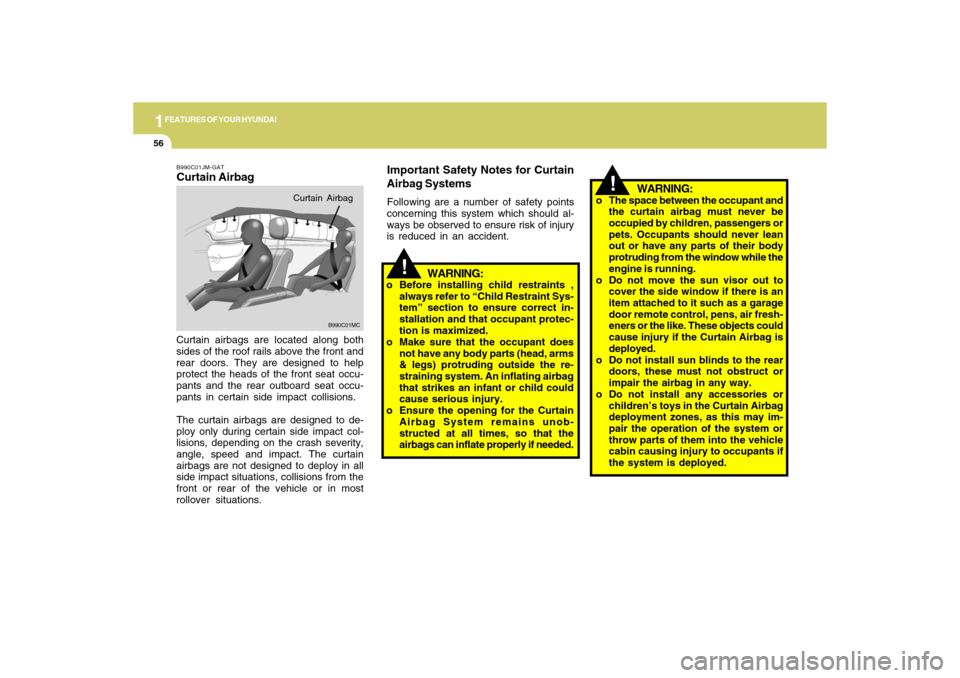
B990C01JM-GATCurtain AirbagCurtain airbags are located along both
sides of the roof rails above the front and
rear doors. They are designed to help
protect the heads of the front seat occu-
pants and the rear outboard seat occu-
pants in certain side impact collisions.
The curtain airbags are designed to de-
ploy only during certain side impact col-
lisions, depending on the crash severity,
angle, speed and impact. The curtain
airbags are not designed to deploy in all
side impact situations, collisions from the
front or rear of the vehicle or in most
rollover situations.
B990C01MC
Curtain Airbag
!
WARNING:
o Before installing child restraints ,
always refer to “Child Restraint Sys-
tem” section to ensure correct in-
stallation and that occupant protec-
tion is maximized.
o Make sure that the occupant does
not have any body parts (head, arms
& legs) protruding outside the re-
straining system. An inflating airbag
that strikes an infant or child could
cause serious injury.
o Ensure the opening for the Curtain
Airbag System remains unob-
structed at all times, so that the
airbags can inflate properly if needed.Important Safety Notes for Curtain
Airbag SystemsFollowing are a number of safety points
concerning this system which should al-
ways be observed to ensure risk of injury
is reduced in an accident.
Page 69 of 266
1
FEATURES OF YOUR HYUNDAI
591
FEATURES OF YOUR HYUNDAI
59
!
WARNING:
o Sitting improperly or out of position
can cause occupants to be shifted
too close to a deploying airbag, strike
the interior structure or be thrown
from the vehicle resulting in serious
injury or death.
o Always sit upright with the seatback
in an upright position, centered on
the seat cushion with your seat belt
on, legs comfortably extended and
your feet on the floor. oKeep occupants away from the airbag
covers. All occupants should sit up-
right, fully back in their seats with their
seat belts on and their feet on the floor.
If occupants are too close to the airbag
covers, they could be injured if the
airbags inflate.
oDo not attach or place objects on or
near the airbag covers. Any object
attached to or placed on the front or
side impact airbag covers could inter-
fere with the proper operation of the
airbags.
oDo not modify the front seats. Modi-
fication of the front seats could inter-
fere with the operation of the supple-
mental restraint system sensing com-
ponents or side impact airbags.
oDo not place items under the front
seats. Placing items under the front
seats could interfere with the opera-
tion of the supplemental restraint sys-
tem sensing components and wiring
harnesses.
oNever hold an infant or child on your
lap. The infant or child could be seri-
ously injured or killed in the event of a
crash. All infants and children should
be properly restrained in appropriate
child safety seats or seat belts in the
rear seat.
Adding Equipment to or Modifying
Your Airbag-Equipped Vehicle.If you modify your vehicle by changing
your vehicle's frame, bumper system, front
end or side sheet metal or ride height, this
may adversely affect the operation of your
vehicle's airbag system.
Page 108 of 266
1FEATURES OF YOUR HYUNDAI98
!
WARNING:
o If a person becomes locked in the
trunk, pull the emergency trunk re-
lease lever of the inside panel in the
trunk to open the trunk lid.
o Keep cars locked and keys out of the
reach of children. HYUNDAI recom-
mends parents teach children about
the emergency trunk release lever
in their vehicle and how to open the
trunk lid if they are accidentally
locked in the trunk.
!
CAUTION:
To prevent damage to the goods or the
vehicle, care should be taken when car-
rying fragile or bulky objects in the lug-
gage compartment.
!
WARNING:
Avoid eye injury. DO NOT overstretch
the luggage net. ALWAYS keep your
face and body out of its recoil path. DO
NOT use when the luggage net straps
have visible signs of wear or damage.
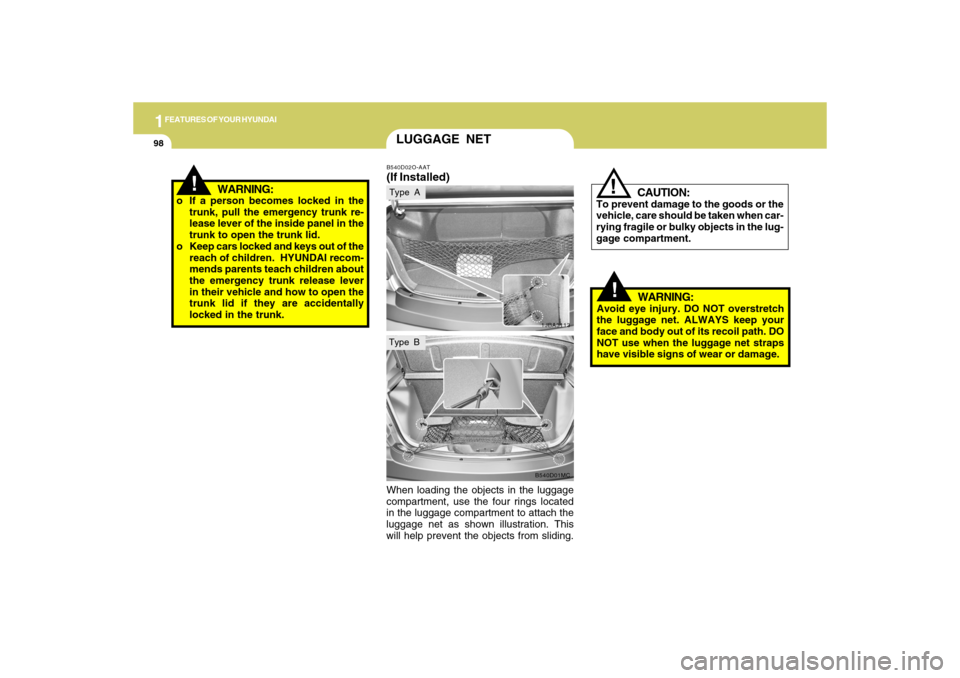
When loading the objects in the luggage
compartment, use the four rings located
in the luggage compartment to attach the
luggage net as shown illustration. This
will help prevent the objects from sliding.
LUGGAGE NETB540D02O-AAT(If Installed)
1JBA3113B540D01MC
Type AType B
Page 146 of 266
DRIVING YOUR HYUNDAI
32
!
BEFORE STARTING THE
ENGINEC020A03A-AATBefore you start the engine, you should
always:
1. Look around the vehicle to be sure
there are no flat tires, puddles of oil or
water or other indications of possible
trouble.
2. After entering the car, check to be
sure the parking brake is engaged.
3. Check that all windows, and lights are
clean.
4. Check that the interior and exterior
mirrors are clean and in position.
5. Check your seat, seatback and head-
rest to be sure they are in their proper
positions.
6. Lock all the doors.
7. Fasten your seat belt and be sure that
all other occupants have fastened
theirs.
8. Turn off all lights and accessories that
are not needed.
9. When you turn the ignition switch to
"ON", check that all appropriate warn-
ing lights are operating and that you
have sufficient fuel.
10. Check the operation of warning lights
and all bulbs when key is in the "ON"
position.
PROPOSITION 65 WARNING:
Engine exhaust and a wide variety of
automobile components and parts, in-
cluding components found in the inte-
rior furnishings in a vehicle, contain or
emit chemicals known to the State of
California to cause cancer and birth
defects and reproductive harm. In addi-
tion, certain fluids contained in vehicles
and certain products of component
wear contain or emit chemicals known
to the State of California to cause can-
cer and birth defects or other reproduc-
tive harm.
!
WARNING:
o Always wear appropriate shoes
when operating your vehicle. Unsuit-
able shoes (high heels, ski boots,
etc.) may interfere with your ability
to use the brake and accelerator
pedal, and the clutch (if installed).
o All passengers must be properly
belted whenever the vehicle is mov-
ing. Refer to pages: 1-22 through 1-
31 for more information on their
proper use.
o Always check the surrounding ar-
eas near your vehicle for people,
especially children, before putting a
car into 'drive'.
o When you intend to park or stop the
vehicle with the engine on, be careful
not to depress the accelerator pedal
for a long period of time. It may over-
heat the engine or exhaust system
and cause fire.
Page 224 of 266
6
DO-IT-YOURSELF MAINTENANCE
19
CHECKING THE BATTERY!
G210A01A-AAT
WARNING:
Batteries can be dangerous! When
working with batteries, carefully ob-
serve the following precautions to avoid
serious injuries.o If battery fluid is on your skin, flush the
affected areas with water for at least 15
minutes and then seek medical assis-
tance.
o If battery fluid is in your eyes, rinse out
your eyes with water and get medical
assistance as soon as possible. While
you are being driven to get medical
assistance, continue to rinse your eyes
by using a sponge or soft cloth saturat-
ed with water.
o If you swallow battery fluid, drink a
large quantity of water or milk followed
by milk of magnesia, eat a raw egg or
drink vegetable oil. Get medical assis-
tance as soon as possible.
While batteries are being charged (either
by a battery charger or by the vehicle's
alternator), they produce explosive gases.
Always observe these warnings to pre-
vent injuries from occurring:
o Charge batteries only in a well venti-
lated area.
o Do not permit flames, sparks or smok-
ing in the area.
o Keep children away from the area.
OMC055018
The fluid in the battery contains a strong
solution of sulfuric acid, which is poison-
ous and highly corrosive. Be careful not
to spill it on yourself or the car. If you do
spill battery fluid on yourself, immediately
do the following:
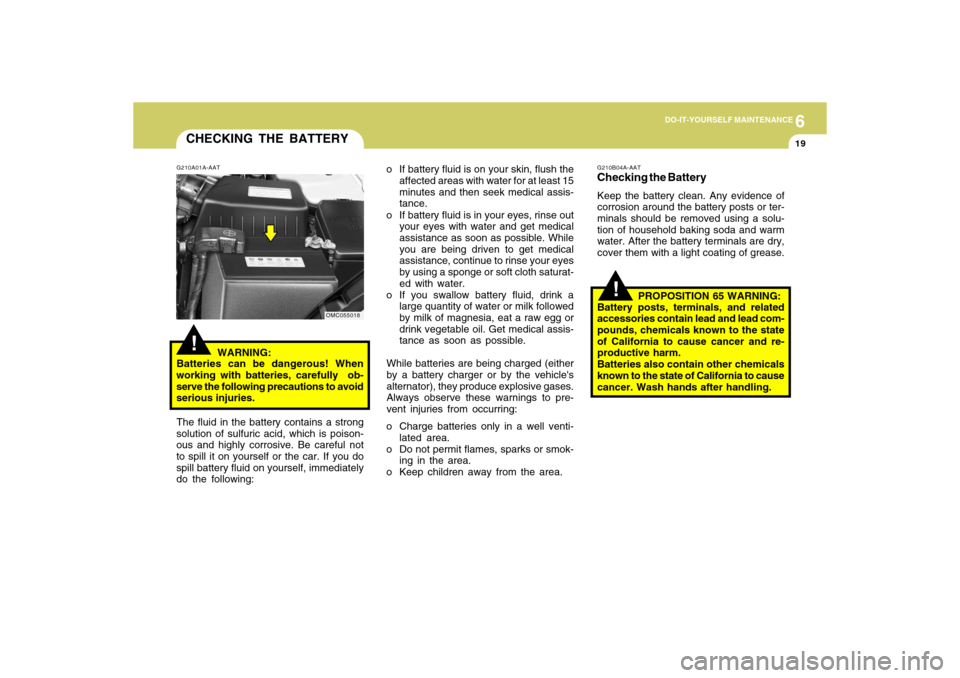
G210B04A-AATChecking the BatteryKeep the battery clean. Any evidence of
corrosion around the battery posts or ter-
minals should be removed using a solu-
tion of household baking soda and warm
water. After the battery terminals are dry,
cover them with a light coating of grease.
!
PROPOSITION 65 WARNING:
Battery posts, terminals, and related
accessories contain lead and lead com-
pounds, chemicals known to the state
of California to cause cancer and re-
productive harm.
Batteries also contain other chemicals
known to the state of California to cause
cancer. Wash hands after handling.
Page 225 of 266
6
DO-IT-YOURSELF MAINTENANCE
20
!
G220A01A-AAT
G220B01A-AATChecking Engine Cooling FanThe engine cooling fan should come on
automatically if the engine coolant tem-
perature is high.WARNING:
The radiator fan is controlled by engine
coolant temperature and may some-
times operate even when the engine is
not running. Use extreme caution when
working near the blades of the cooling
fan, so that you are not injured by a
rotating fan blade. As the coolant tem-
perature decreases the fan will auto-
matically shut off. This is a normal con-
dition.G220C01A-AATChecking Condenser Cooling FanThe condenser cooling fan should come
on automatically whenever the air condi-
tioner is in operation.CHECKING ELECTRIC
COOLING FANS
!
If electrolyte gets on your skin,
thoroughly wash the con-
tacted area.
If you feel a pain or a burning
sensation, get medical atten-
tion immediately.
Wear eye protection when
charging or working near a
battery.
Always provide ventilation
when working in an enclosed
space.
o When lifting a plastic-cased battery,
excessive pressure on the case may
cause battery acid to leak, resulting
in personal injury. Lift with a battery
carrier or with your hands on oppo-
site corners.
o Never attempt to charge the battery
when the battery cables are con-
nected.
o The electrical ignition system works
with high voltage.
Never touch these components with
the engine running or the ignition
switched on.
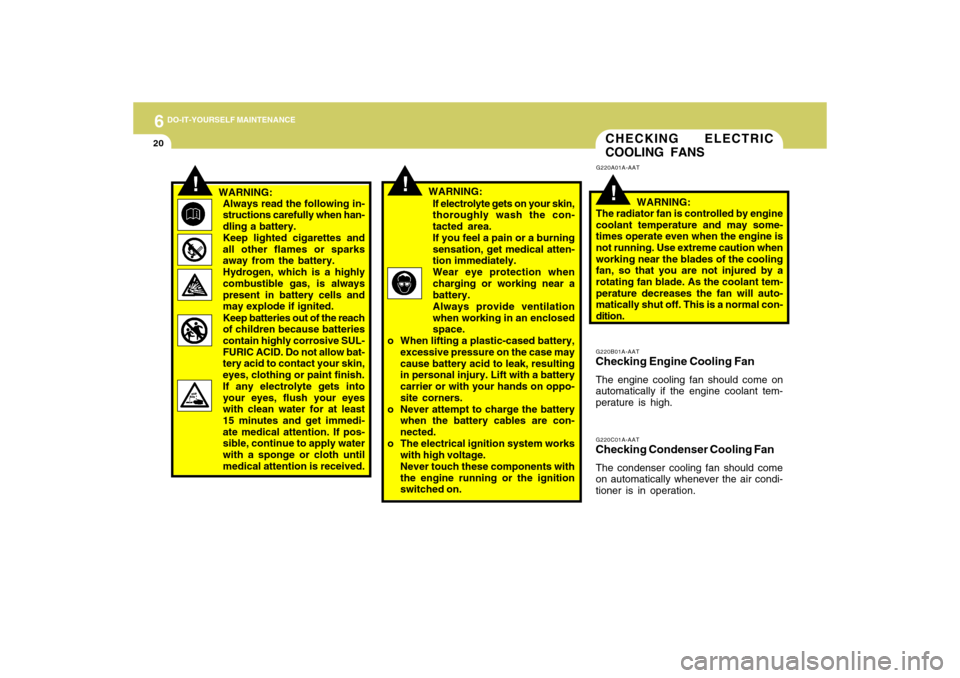
WARNING:
Always read the following in-
structions carefully when han-
dling a battery.
Keep lighted cigarettes and
all other flames or sparks
away from the battery.
Hydrogen, which is a highly
combustible gas, is always
present in battery cells and
may explode if ignited.
Keep batteries out of the reach
of children because batteries
contain highly corrosive SUL-
FURIC ACID. Do not allow bat-
tery acid to contact your skin,
eyes, clothing or paint finish.
If any electrolyte gets into
your eyes, flush your eyes
with clean water for at least
15 minutes and get immedi-
ate medical attention. If pos-
sible, continue to apply water
with a sponge or cloth until
medical attention is received.
!
WARNING: