Door Hyundai Accent 2009 User Guide
[x] Cancel search | Manufacturer: HYUNDAI, Model Year: 2009, Model line: Accent, Model: Hyundai Accent 2009Pages: 266, PDF Size: 8.77 MB
Page 22 of 266
1FEATURES OF YOUR HYUNDAI12
!
WARNING:
o Passengers can be injured if their
head, hands or other body parts are
trapped by a closing window. Al-
ways check for obstructions before
raising any window.
o NEVER leave the ignition key in the
vehicle.
o NEVER leave any child unattended
in the vehicle. Even very young
children may inadvertently cause the
vehicle to move, entangle them-
selves in the windows, or otherwise
injure themselves or others.
OMC025015
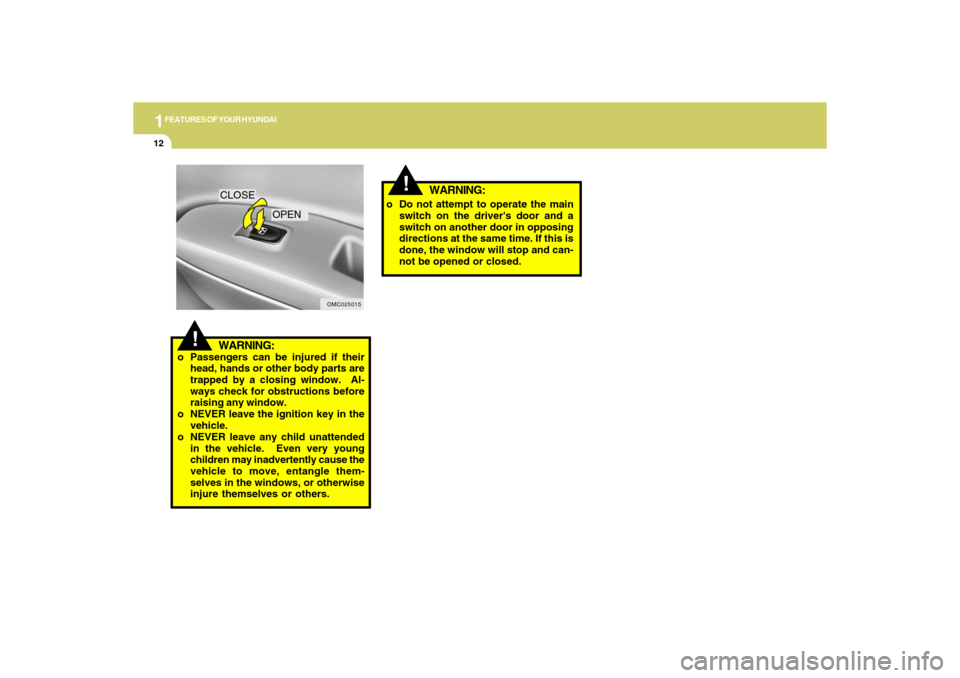
CLOSE
OPEN
!
WARNING:
o Do not attempt to operate the main
switch on the driver's door and a
switch on another door in opposing
directions at the same time. If this is
done, the window will stop and can-
not be opened or closed.
Page 23 of 266
1
FEATURES OF YOUR HYUNDAI
131
FEATURES OF YOUR HYUNDAI
13
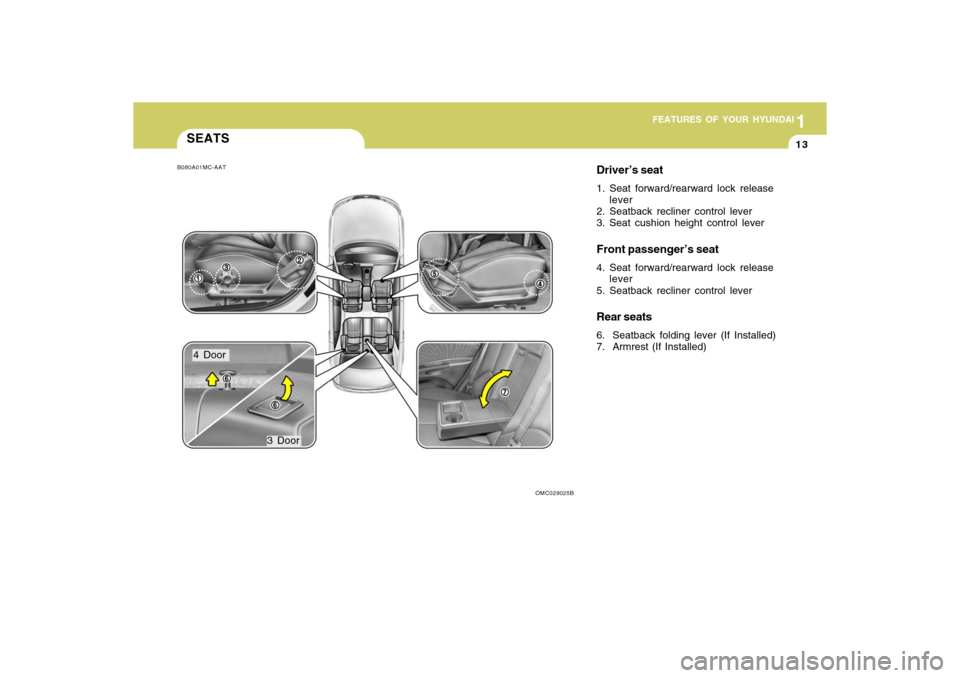
SEATS
Driver’s seat1. Seat forward/rearward lock release
lever
2. Seatback recliner control lever
3. Seat cushion height control leverFront passenger’s seat4. Seat forward/rearward lock release
lever
5. Seatback recliner control leverRear seats6. Seatback folding lever (If Installed)
7. Armrest (If Installed)
B080A01MC-AAT
OMC029025B
4 Door
3 Door
Page 27 of 266

1
FEATURES OF YOUR HYUNDAI
171
FEATURES OF YOUR HYUNDAI
17
B080G01A-GATAdjusting Armrest Angle
(Driver's side only)The armrest will be raised or lowered
manually.
To raise the armrest, pull it up.
To lower it, press the armrest down.
OMC025031
B080F01MC-AATSeat Cushion Height Adjustment
(Driver's Seat only)To raise or lower the front part of the seat
cushion, turn the front knob forward or
rearward.
OMC029028
B130A01A-AATREAR SEAT ENTRY (3 Door)The front passenger's seatback should
be tilted to enter the rear seat.
By pulling up on the recliner control lever
(1) at the outside of the front passenger's
seat, the seatback will tilt forward and the
seat will automatically slide forward.
Rear seat occupants can tilt the front
passenger's seatback by depressing the
foot lever (2) as shown in the illustration.
HTB258
(1)
(2)
!
WARNING:
Passengers sitting in the rear seat should
be careful not to accidentally press the
foot lever (2) while the vehicle is moving,
as this may cause the seatback to move
forward and injure a front seat occupant.
Page 28 of 266
1FEATURES OF YOUR HYUNDAI18
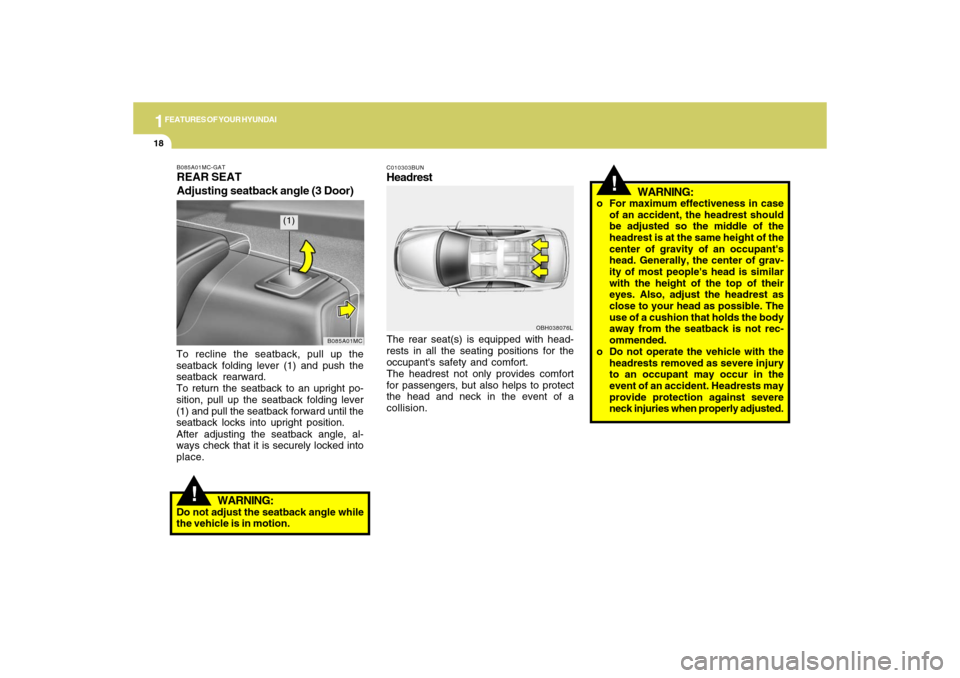
B085A01MC-GATREAR SEAT
Adjusting seatback angle (3 Door)To recline the seatback, pull up the
seatback folding lever (1) and push the
seatback rearward.
To return the seatback to an upright po-
sition, pull up the seatback folding lever
(1) and pull the seatback forward until the
seatback locks into upright position.
After adjusting the seatback angle, al-
ways check that it is securely locked into
place.
B085A01MC
(1)
!
WARNING:
Do not adjust the seatback angle while
the vehicle is in motion.
C010303BUNHeadrest
OBH038076L
The rear seat(s) is equipped with head-
rests in all the seating positions for the
occupant's safety and comfort.
The headrest not only provides comfort
for passengers, but also helps to protect
the head and neck in the event of a
collision.
!
WARNING:
o For maximum effectiveness in case
of an accident, the headrest should
be adjusted so the middle of the
headrest is at the same height of the
center of gravity of an occupant's
head. Generally, the center of grav-
ity of most people's head is similar
with the height of the top of their
eyes. Also, adjust the headrest as
close to your head as possible. The
use of a cushion that holds the body
away from the seatback is not rec-
ommended.
o Do not operate the vehicle with the
headrests removed as severe injury
to an occupant may occur in the
event of an accident. Headrests may
provide protection against severe
neck injuries when properly adjusted.
Page 30 of 266

1FEATURES OF YOUR HYUNDAI20
3. Pull up the seatback folding lever to
release the seatback. o Before folding the seatback, insert
the buckle in the pocket. This can
prevent the buckle from being dam-
aged by the seatback.
B110A01MC
To fold down the seatback :1. Slide the front seats forward and ad-
just the front seatbacks to be upright
before folding the rear seatbacks down.
2. Lower the rear seat headrests to the
lowest position.
B220D05MC
o In order to prevent the center shoul-
der belt from being damaged while
folding the rear seat, disconnect the
metal tab (A) from the buckle (B). To
disconnect the metal tab (A) from
the buckle (B) , insert a narrow-ended
tool into the groove located on the
buckle (B).
!
CAUTION:
B090A02MCOMC029041
4 Door3 Door
Page 31 of 266
1
FEATURES OF YOUR HYUNDAI
211
FEATURES OF YOUR HYUNDAI
21
!
CAUTION:
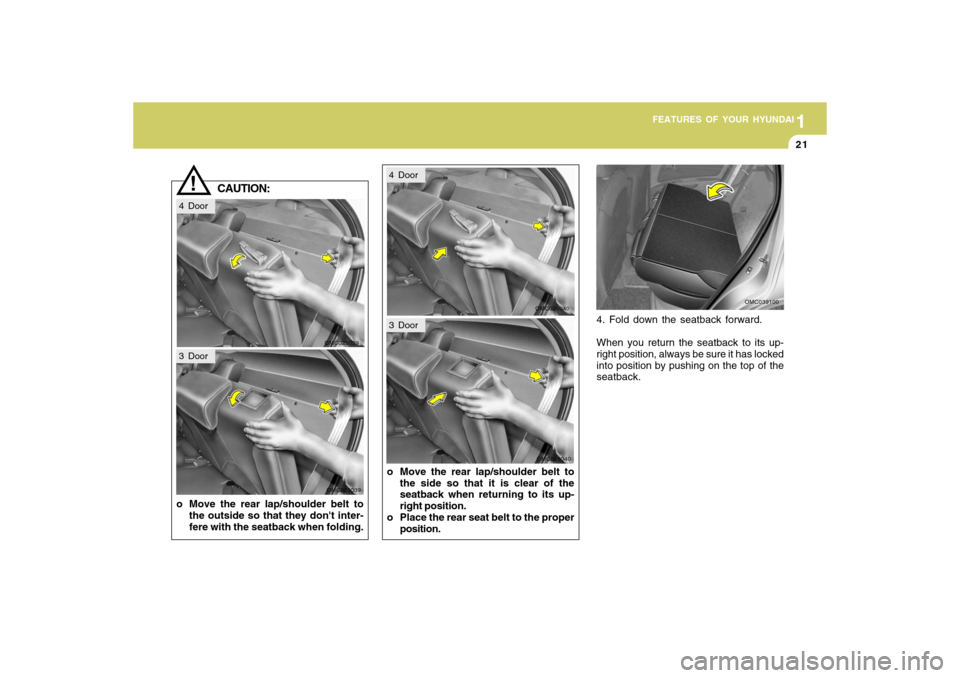
o Move the rear lap/shoulder belt to
the outside so that they don't inter-
fere with the seatback when folding.o Move the rear lap/shoulder belt to
the side so that it is clear of the
seatback when returning to its up-
right position.
o Place the rear seat belt to the proper
position.
OMC025040
OMC025039
OMC029039
4 Door3 Door
OMC029040
4 Door3 Door
4. Fold down the seatback forward.
When you return the seatback to its up-
right position, always be sure it has locked
into position by pushing on the top of the
seatback.
OMC039100
Page 35 of 266
1
FEATURES OF YOUR HYUNDAI
251
FEATURES OF YOUR HYUNDAI
25
!
B160A02A-AATCARE OF SEAT BELTSSeat belt systems should never be disas-
sembled or modified. In addition, care
should be taken to assure that seat belts
and belt hardware are not damaged by
seat hinges, doors or other abuse.
WARNING:
When you return the rear seatback to its
upright position after the rear seatback
was folded down, be careful not to dam-
age the seat belt webbing or buckle. Be
sure that the webbing or buckle does not
get caught or pinched in the rear seat. A
seat belt with damaged webbing or buckle
will not be as strong and could possibly
fail during a collision or sudden stop,
resulting in serious injury.
B160D01A-AATWhen to Replace Seat BeltsEntire in-use seat belt assemblies should
be replaced if the vehicle has been in-
volved in an accident. This should be
done even if no damage is visible. Addi-
tional questions concerning seat belt
operation should be directed to your
Hyundai Dealer.B160C01A-AATKeep Belts Clean and DrySeat belts should be kept clean and dry.
If belts become dirty, they can be cleaned
by using a mild soap solution and warm
water. Bleach, dye, strong detergents or
abrasives should not be used because
they may damage and weaken the fabric.
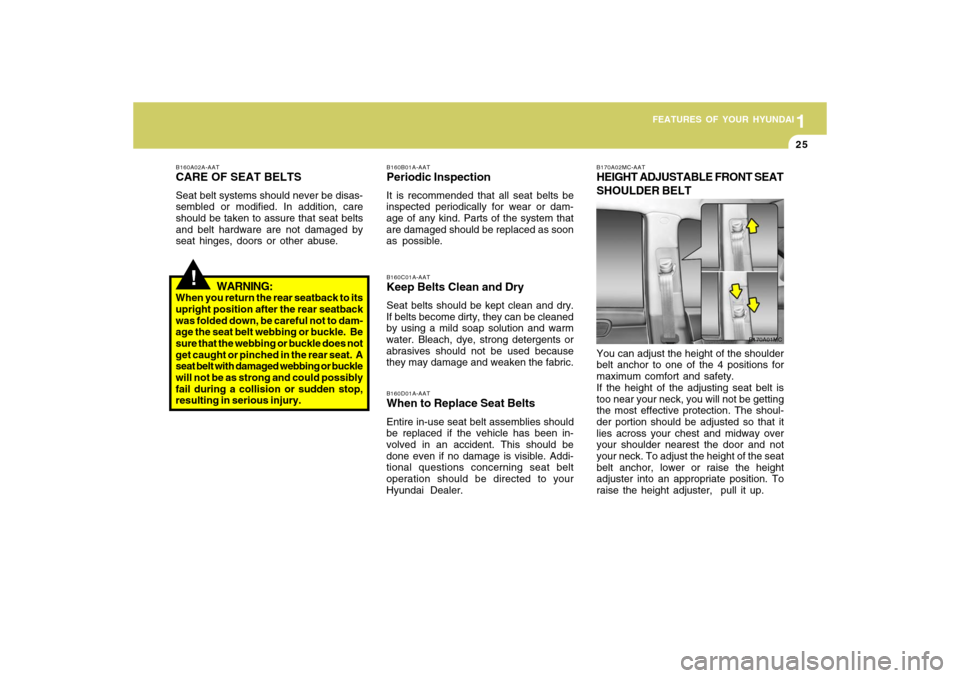
B170A02MC-AATHEIGHT ADJUSTABLE FRONT SEAT
SHOULDER BELT
B170A01MC
You can adjust the height of the shoulder
belt anchor to one of the 4 positions for
maximum comfort and safety.
If the height of the adjusting seat belt is
too near your neck, you will not be getting
the most effective protection. The shoul-
der portion should be adjusted so that it
lies across your chest and midway over
your shoulder nearest the door and not
your neck. To adjust the height of the seat
belt anchor, lower or raise the height
adjuster into an appropriate position. To
raise the height adjuster, pull it up.
B160B01A-AATPeriodic InspectionIt is recommended that all seat belts be
inspected periodically for wear or dam-
age of any kind. Parts of the system that
are damaged should be replaced as soon
as possible.
Page 38 of 266
1FEATURES OF YOUR HYUNDAI28
!
WARNING:
!
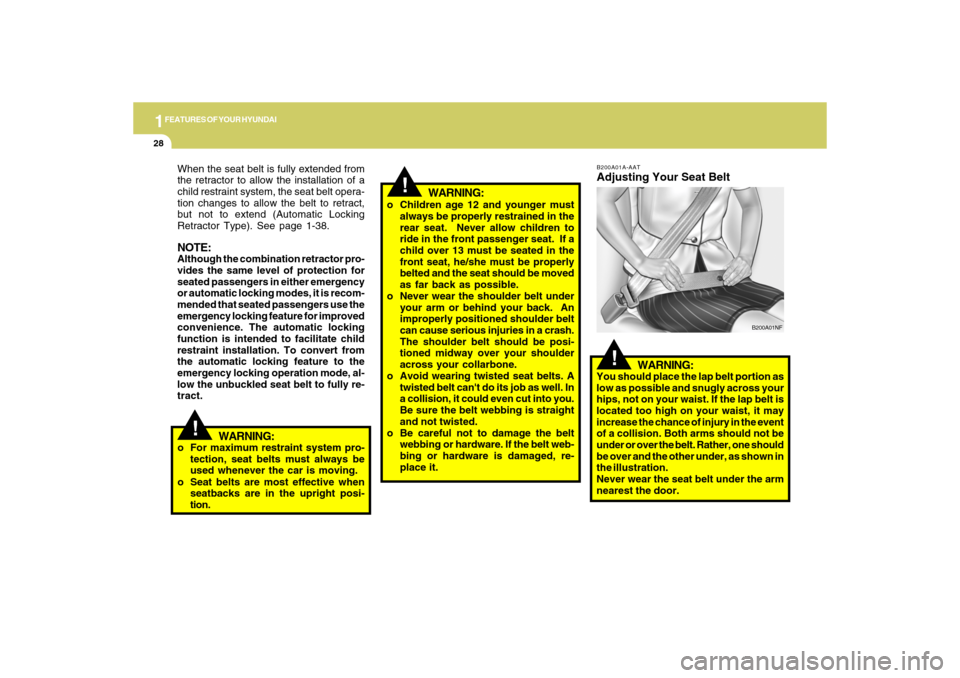
B200A01A-AATAdjusting Your Seat Belt
WARNING:You should place the lap belt portion as
low as possible and snugly across your
hips, not on your waist. If the lap belt is
located too high on your waist, it may
increase the chance of injury in the event
of a collision. Both arms should not be
under or over the belt. Rather, one should
be over and the other under, as shown in
the illustration.
Never wear the seat belt under the arm
nearest the door.
B200A01NF
o Children age 12 and younger must
always be properly restrained in the
rear seat. Never allow children to
ride in the front passenger seat. If a
child over 13 must be seated in the
front seat, he/she must be properly
belted and the seat should be moved
as far back as possible.
o Never wear the shoulder belt under
your arm or behind your back. An
improperly positioned shoulder belt
can cause serious injuries in a crash.
The shoulder belt should be posi-
tioned midway over your shoulder
across your collarbone.
o Avoid wearing twisted seat belts. A
twisted belt can't do its job as well. In
a collision, it could even cut into you.
Be sure the belt webbing is straight
and not twisted.
o Be careful not to damage the belt
webbing or hardware. If the belt web-
bing or hardware is damaged, re-
place it. When the seat belt is fully extended from
the retractor to allow the installation of a
child restraint system, the seat belt opera-
tion changes to allow the belt to retract,
but not to extend (Automatic Locking
Retractor Type). See page 1-38.
NOTE:Although the combination retractor pro-
vides the same level of protection for
seated passengers in either emergency
or automatic locking modes, it is recom-
mended that seated passengers use the
emergency locking feature for improved
convenience. The automatic locking
function is intended to facilitate child
restraint installation. To convert from
the automatic locking feature to the
emergency locking operation mode, al-
low the unbuckled seat belt to fully re-
tract.
!
WARNING:
o For maximum restraint system pro-
tection, seat belts must always be
used whenever the car is moving.
o Seat belts are most effective when
seatbacks are in the upright posi-
tion.
Page 43 of 266
1
FEATURES OF YOUR HYUNDAI
331
FEATURES OF YOUR HYUNDAI
33
!
WARNING:
o Never allow a child to stand-up or
kneel on the seat or floorboard of a
moving vehicle. During a collision or
sudden stop, the child can be vio-
lently thrown against the vehicle's
interior, resulting in serious injury.
o Never use an infant carrier or a child
safety seat that "hooks" over a
seatback, it may not provide ad-
equate security in an accident.
o Seat belts can become very hot, es-
pecially when the car is parked in
direct sunlight. Always check seat
belt buckles before fastening them
over a child.
o Always store or secure a child seat,
even when it is not in use. During a
collision or sudden stop, the child
seat could be thrown inside the ve-
hicle.
B230B01E-AATUsing a Child Restraint System with
the "Tether Anchorage" SystemFor small children and babies, the use of
a child seat or infant seat is required. This
child seat or infant seat should be of
appropriate size for the child and should
be installed in accordance with the
manufacturer's instructions. It is further
required that the seat be placed in the
vehicle's rear seat since this can make an
important contribution to safety. Your ve-
hicle is provided with three child restraint
hook holders for installing the child seat
or infant seat.
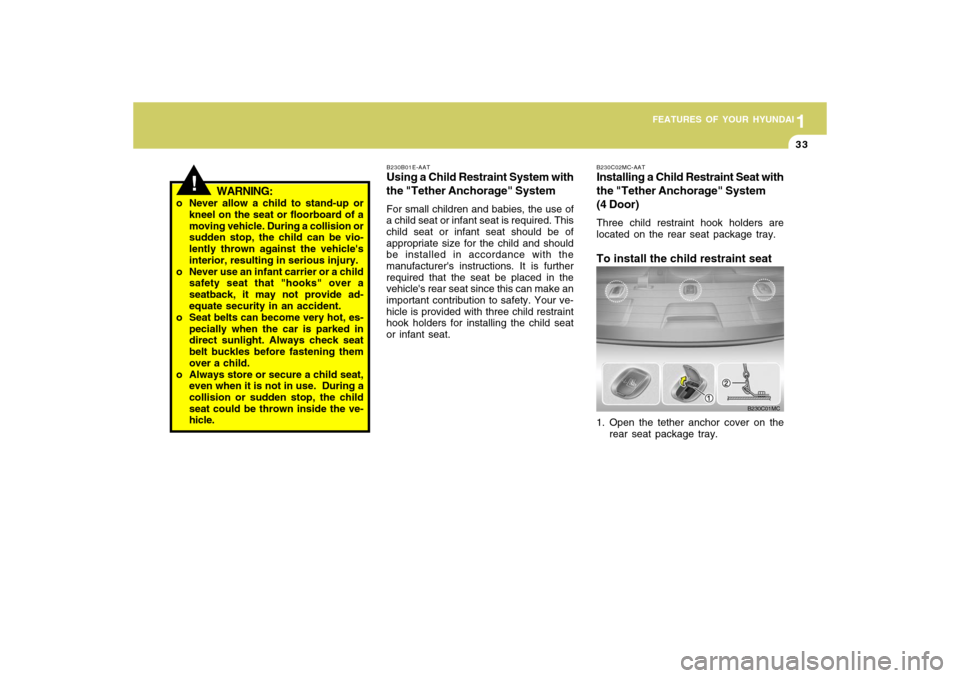
B230C02MC-AATInstalling a Child Restraint Seat with
the "Tether Anchorage" System
(4 Door)Three child restraint hook holders are
located on the rear seat package tray.To install the child restraint seat
B230C01MC
1. Open the tether anchor cover on the
rear seat package tray.
Page 44 of 266
1FEATURES OF YOUR HYUNDAI34
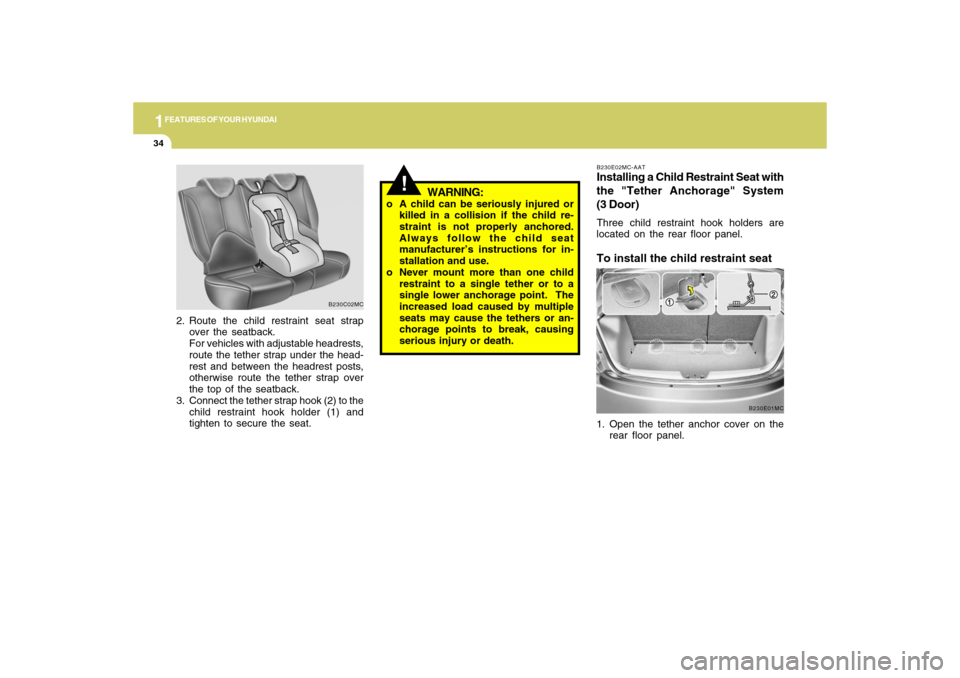
B230E02MC-AATInstalling a Child Restraint Seat with
the "Tether Anchorage" System
(3 Door)Three child restraint hook holders are
located on the rear floor panel.To install the child restraint seat
!
WARNING:
o A child can be seriously injured or
killed in a collision if the child re-
straint is not properly anchored.
Always follow the child seat
manufacturer’s instructions for in-
stallation and use.
o Never mount more than one child
restraint to a single tether or to a
single lower anchorage point. The
increased load caused by multiple
seats may cause the tethers or an-
chorage points to break, causing
serious injury or death.
1. Open the tether anchor cover on the
rear floor panel.
B230E01MC
2. Route the child restraint seat strap
over the seatback.
For vehicles with adjustable headrests,
route the tether strap under the head-
rest and between the headrest posts,
otherwise route the tether strap over
the top of the seatback.
3. Connect the tether strap hook (2) to the
child restraint hook holder (1) and
tighten to secure the seat.
B230C02MC