Door Hyundai Accent 2009 Service Manual
[x] Cancel search | Manufacturer: HYUNDAI, Model Year: 2009, Model line: Accent, Model: Hyundai Accent 2009Pages: 266, PDF Size: 8.77 MB
Page 188 of 266
320
WHAT TO DO IN AN EMERGENCY
IF YOU LOSE YOUR KEYSD120A01A-AATIf you lose your keys, many Hyundai
dealers can make you a new key if you
have your key number.
If you lock the keys inside your car and
you cannot obtain a new key, many
Hyundai dealers can use special tools to
open the door for you.
Page 191 of 266
4
CORROSION PREVENTION AND APPEARANCE CARE
4
CORROSION PREVENTION AND APPEARANCE CARE
3
TO HELP PREVENT COR-
ROSIONE020A01A-AATYou can help prevent corrosion from
getting started by observing the follow-
ing:E020B01A-AATKeep Your Car CleanThe best way to prevent corrosion is to
keep your car clean and free of corrosive
materials. Attention to the underside of
the car is particularly important.
o If you live in a high-corrosion area —
where road salts are used, near the
ocean, areas with industrial pollution,
acid rain, etc.— you should take extra
care to prevent corrosion. In winter,
hose off the underside of your car at
least once a month and be sure to
clean the underside thoroughly when
winter is over.
o When cleaning underneath the car,
give particular attention to the compo-
nents under the fenders and other
areas that are hidden from view.
Do a thorough job; just dampening the
accumulated mud rather than washing
it away will accelerate corrosion rather
than prevent it. Water under high pres-
sure and steam are particularly effec-
tive in removing accumulated mud and
corrosive materials.
E020C01A-AATKeep Your Garage DryDon't park your car in a damp, poorly
ventilated garage. This creates a favor-
able environment for corrosion. This is
particularly true if you wash your car in
the garage or drive it into the garage
when it is still wet or covered with snow,
ice or mud. Even a heated garage can
contribute to corrosion unless it is well
ventilated so moisture is dispersed.
E020D02A-AATKeep Paint and Trim in Good Condi-
tionScratches or chips in the finish should be
covered with "touch-up" paint as soon as
possible to reduce the possibility of cor-
rosion. If bare metal is showing through,
the attention of a qualified body and paint
shop is recommended.
Bird droppings : Bird droppings are highly
corrosive and may damage painted sur-
faces in just a few hours. Always remove
bird droppings as soon as possible.E020E01A-AATDon't Neglect the InteriorMoisture can collect under the floor mats
and carpeting to cause corrosion. Check
under the mats periodically to be sure the
carpeting is dry. Use particular care if you
carry fertilizers, cleaning materials or
chemicals in the car.
These should be carried only in proper
containers and any spills or leaks should
be cleaned up, flushed with clear water
and thoroughly dried. o When cleaning lower door panels,
rocker panels and frame members, be
sure that drain holes are kept open so
that moisture can escape and not be
trapped inside to ac-celerate corro-
sion.
Page 192 of 266
44
CORROSION PREVENTION AND APPEARANCE CARE4
Use a clean sponge or cloth, rinse it
frequently and don't damage the finish by
rubbing too hard. For stubborn spots,
dampen them frequently and remove
them a little at a time.
To clean whitewall tires, use a stiff brush
or soap-impregnated steel-wool scour-
ing pad.
To clean plastic wheel covers, use a
clean sponge or soft cloth and water.
To clean cast aluminum alloy wheels,
use a mild soap or neutral detergent. Do
not use abrasive cleaners. Protect the
bare-metal surfaces by cleaning, polish-
ing and waxing. Because aluminum is
subject to corrosion, be sure to give alu-
minum alloy wheels special attention in
winter. If you drive on salted roads, clean
the wheels thoroughly afterwards.
After washing, be sure to rinse thoroughly.
If soapy water dries on the finish, streak-
ing will result.
When the weather is warm and the hu-
midity low, you may find it necessary to
rinse each section immediately after wash-
ing to avoid streaking.After rinsing, dry the car using a damp
chamois or soft, absorbent cloth. The rea-
son for drying the car is to remove water
from the car so it will dry without water
spots. Don't rub, this can damage the
finish.
If you find any nicks or scratches in the
paint, use touch-up paint to cover them to
prevent corrosion. To protect the
paintwork of the car against corrosion,
you must clean your Hyundai (at least
once a month). Give special attention to
the removal of salt, mud and other sub-
stances on the underside of the
splashboards of the car. Make sure that
the outlets and the underside of the doors
are open. Paint damage can be caused
by small accumulation of tar, industrial
precipitation, tree resin, insects and bird
droppings, when not removed immedi-
ately.
If water alone is not strong enough to
remove the accumulated dirt, use a mild
car washing solution. Be sure to rinse the
surface after washing to remove the solu-
tion. Never allow the solution to dry on the
painted surfaces.
WASHING AND WAXINGE030A02A-AATWashing Your HyundaiNever wash your car when the surface is
hot from being in the sun. Always wash
your car in the shade.
Wash your car frequently. Dirt is abrasive
and can scratch the paint if it is not re-
moved. Air pollution or acid rain may
damage the paint and trim through chemi-
cal action if pollutants are allowed to
remain in contact with the surface. If you
live near the ocean or in an area where
road salts or dust control chemicals are
used, you should pay particular attention
to the underside of the car. Start by rins-
ing the car to remove dust and loose dirt.
In winter, or if you have driven through
mud or muddy water, be sure to thor-
oughly clean the underside as well. Use
a hard direct stream of water to remove
accumulations of mud or corrosive mate-
rials. Use a good quality car-washing
solution and follow the manufacturer's
directions on the package. These are
available at your Hyundai dealer or auto
parts outlet. Don't use strong household
detergents, gasoline, strong solvents or
abrasive cleaning powders as these may
damage the finish.
Page 208 of 266
6
DO-IT-YOURSELF MAINTENANCE
3
GENERAL CHECKS
G020C01A-AATVehicle InteriorThe following should be checked each
time when the vehicle is driven:
o Light operation
o Windshield wiper operation
o Horn operation
o Defroster, heater system operation (and
air conditioning, if installed)
o Steering operation and condition
o Mirror condition and operation
o Turn signal operation
o Accelerator pedal operation
o Brake operation, including parking
brake
o Manual transaxle operation, including
clutchoperation
o Automatic transaxle operation, includ-
ing "Park" mechanism operation
o Seat control condition and operation
o Seat belt condition and operation
o Sun visor operation
If you notice anything that does not oper-
ate correctly or appear to be functioning
correctly, inspect it carefully and seek
assistance from your Hyundai dealer if
service is needed.
G020A01A-AATEngine Compartment
The following should be checked regu-
larly:
o Engine oil level and condition
o Transaxle fluid level and condition
o Brake fluid level
o Clutch fluid level
o Engine coolant level
o Windshield washer fluid level
o Accessory drive belt condition
o Engine coolant hose condition
o Fluid leaks (on or below components)
o Power steering fluid level and condi-
tion
o Battery condition
o Air cleaner filter condition
G020B01A-AATVehicle ExteriorThe following should be checked monthly:
o Overall appearance and condition
o Wheel condition and wheel nut tight-
ness
o Exhaust system condition
o Light condition and operation
o Windshield glass condition
o Wiper blade condition
o Paint condition and body corrosion
o Fluid leaks
o Door and hood lock condition
o Tire pressure and condition
(including spare tire)
Page 229 of 266
6
DO-IT-YOURSELF MAINTENANCE
24
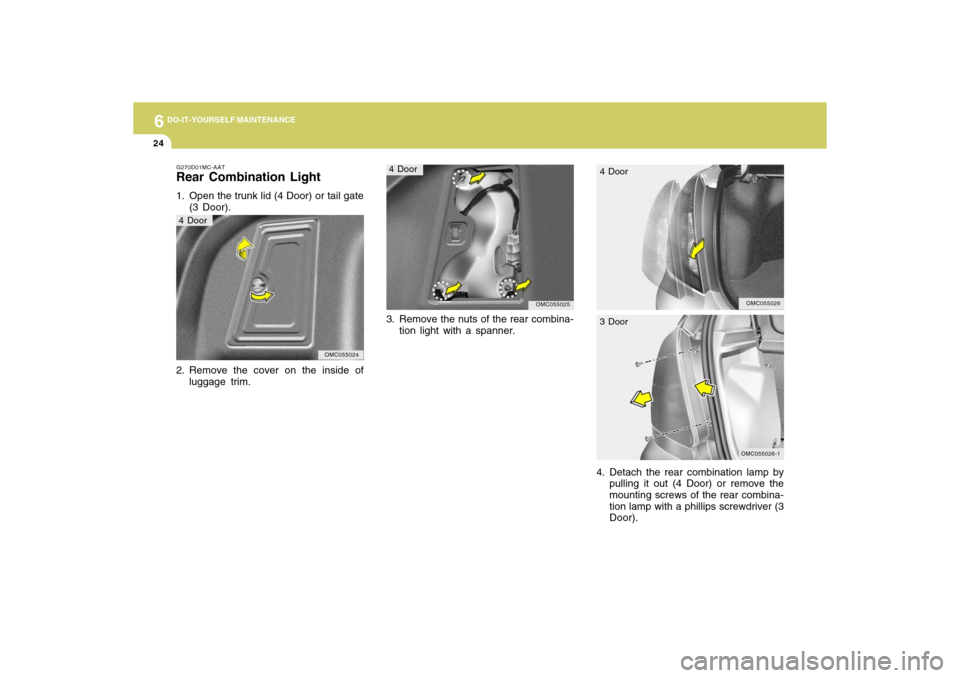
4. Detach the rear combination lamp by
pulling it out (4 Door) or remove the
mounting screws of the rear combina-
tion lamp with a phillips screwdriver (3
Door).
OMC055026
3. Remove the nuts of the rear combina-
tion light with a spanner.
G270D01MC-AATRear Combination Light1. Open the trunk lid (4 Door) or tail gate
(3 Door).
OMC055024
OMC055025
2. Remove the cover on the inside of
luggage trim.4 Door
4 Door
4 Door
OMC055026-1
3 Door
Page 230 of 266
6
DO-IT-YOURSELF MAINTENANCE
25
OMC055028-1
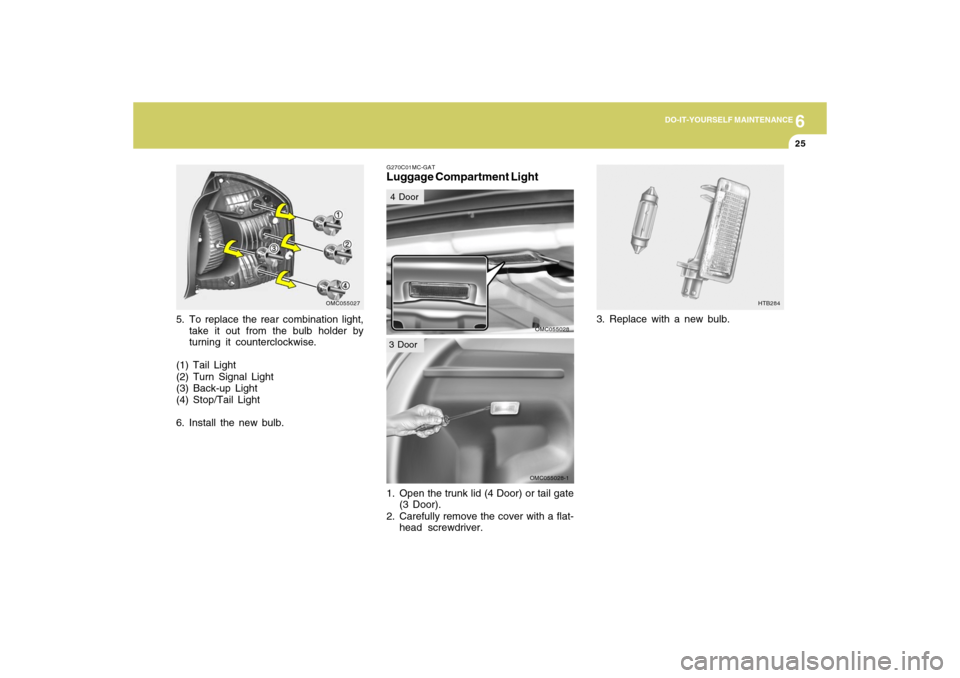
5. To replace the rear combination light,
take it out from the bulb holder by
turning it counterclockwise.
(1) Tail Light
(2) Turn Signal Light
(3) Back-up Light
(4) Stop/Tail Light
6. Install the new bulb.
OMC055027
G270C01MC-GATLuggage Compartment Light
OMC055028
1. Open the trunk lid (4 Door) or tail gate
(3 Door).
2. Carefully remove the cover with a flat-
head screwdriver.
3. Replace with a new bulb.
HTB284
4 Door3 Door
Page 232 of 266
6
DO-IT-YOURSELF MAINTENANCE
27
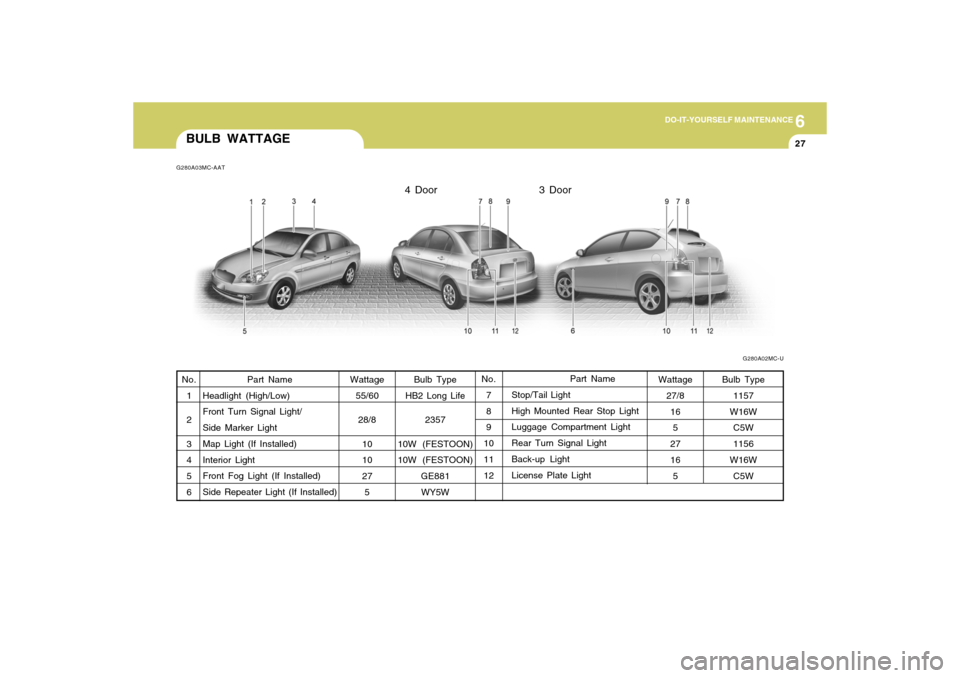
BULB WATTAGEG280A03MC-AAT
G280A02MC-U
Bulb Type
HB2 Long Life
2357
10W (FESTOON)
10W (FESTOON)
GE881
WY5WPart Name
Stop/Tail Light
High Mounted Rear Stop Light
Luggage Compartment Light
Rear Turn Signal Light
Back-up Light
License Plate Light Part Name
Headlight (High/Low)
Front Turn Signal Light/
Side Marker Light
Map Light (If Installed)
Interior Light
Front Fog Light (If Installed)
Side Repeater Light (If Installed) No.
1
2
3
4
5
6No.
7
8
9
10
11
12 Wattage
55/60
28/8
10
10
27
5
Wattage
27/8
16
5
27
16
5Bulb Type
1157
W16W
C5W
1156
W16W
C5W
4 Door 3 Door
Page 234 of 266
6
DO-IT-YOURSELF MAINTENANCE
29
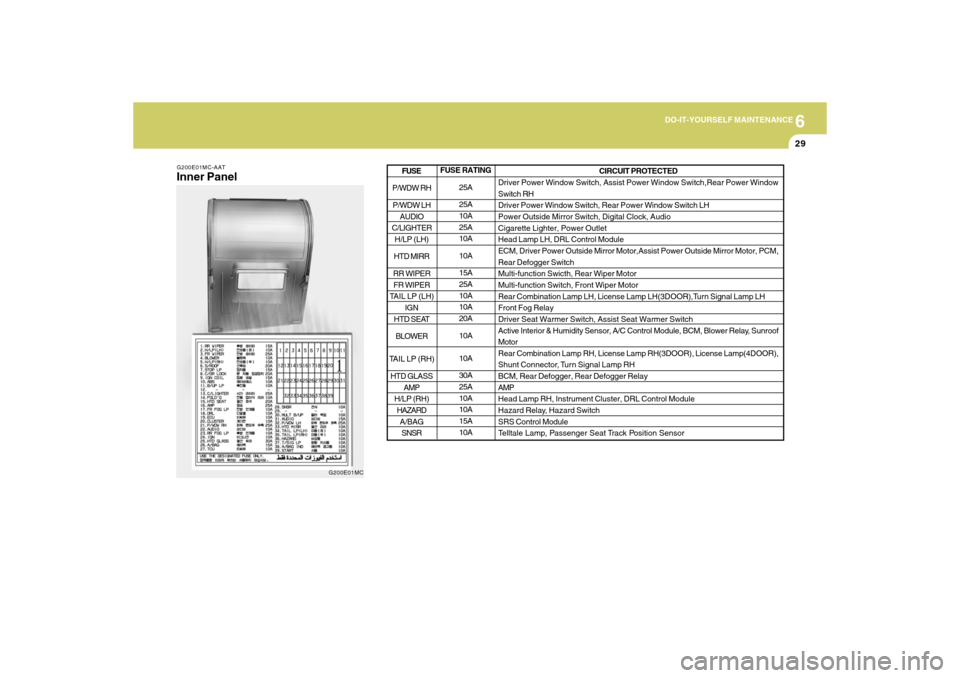
G200E01MC-AATInner Panel
G200E01MC
FUSE RATING
25A
25A
10A
25A
10A
10A
15A
25A
10A
10A
20A
10A
10A
30A
25A
10A
10A
15A
10ACIRCUIT PROTECTED
Driver Power Window Switch, Assist Power Window Switch,Rear Power Window
Switch RH
Driver Power Window Switch, Rear Power Window Switch LH
Power Outside Mirror Switch, Digital Clock, Audio
Cigarette Lighter, Power Outlet
Head Lamp LH, DRL Control Module
ECM, Driver Power Outside Mirror Motor,Assist Power Outside Mirror Motor, PCM,
Rear Defogger Switch
Multi-function Swicth, Rear Wiper Motor
Multi-function Switch, Front Wiper Motor
Rear Combination Lamp LH, License Lamp LH(3DOOR),Turn Signal Lamp LH
Front Fog Relay
Driver Seat Warmer Switch, Assist Seat Warmer Switch
Active Interior & Humidity Sensor, A/C Control Module, BCM, Blower Relay, Sunroof
Motor
Rear Combination Lamp RH, License Lamp RH(3DOOR), License Lamp(4DOOR),
Shunt Connector, Turn Signal Lamp RH
BCM, Rear Defogger, Rear Defogger Relay
AMP
Head Lamp RH, Instrument Cluster, DRL Control Module
Hazard Relay, Hazard Switch
SRS Control Module
Telltale Lamp, Passenger Seat Track Position Sensor
P/WDW RH
P/WDW LH
AUDIO
C/LIGHTER
H/LP (LH)
HTD MIRR
RR WIPER
FR WIPER
TAIL LP (LH)
IGN
HTD SEAT
BLOWER
TAIL LP (RH)
HTD GLASS
AMP
H/LP (RH)
HAZARD
A/BAG
SNSRFUSE
Page 235 of 266
6
DO-IT-YOURSELF MAINTENANCE
30
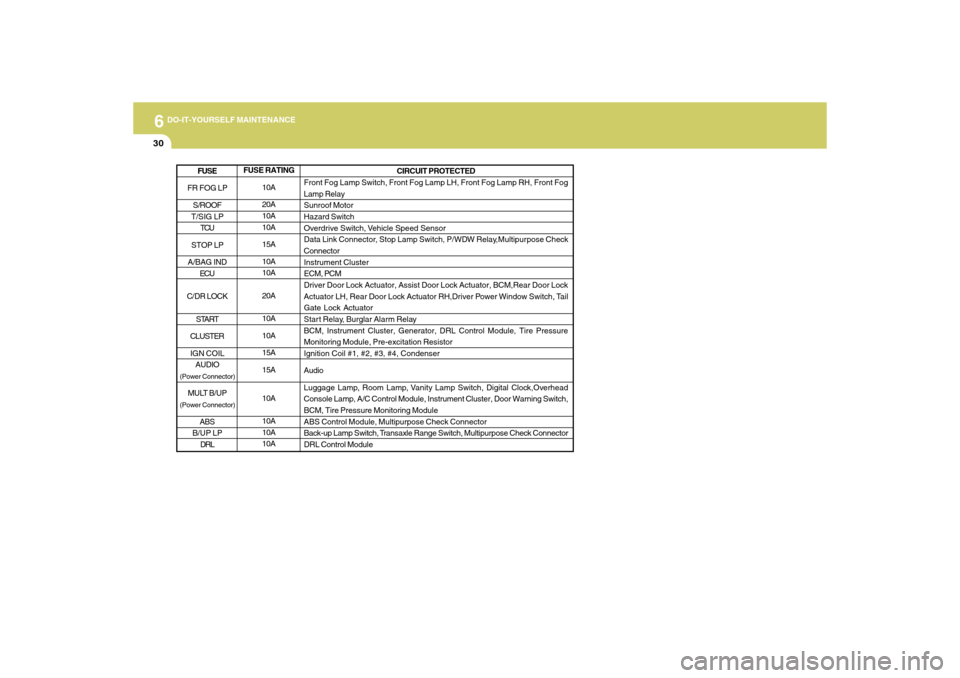
FUSE RATING
10A
20A
10A
10A
15A
10A
10A
20A
10A
10A
15A
15A
10A
10A
10A
10ACIRCUIT PROTECTED
Front Fog Lamp Switch, Front Fog Lamp LH, Front Fog Lamp RH, Front Fog
Lamp Relay
Sunroof Motor
Hazard Switch
Overdrive Switch, Vehicle Speed Sensor
Data Link Connector, Stop Lamp Switch, P/WDW Relay,Multipurpose Check
Connector
Instrument Cluster
ECM, PCM
Driver Door Lock Actuator, Assist Door Lock Actuator, BCM,Rear Door Lock
Actuator LH, Rear Door Lock Actuator RH,Driver Power Window Switch, Tail
Gate Lock Actuator
Star t Relay, Burglar Alarm Relay
BCM, Instrument Cluster, Generator, DRL Control Module, Tire Pressure
Monitoring Module, Pre-excitation Resistor
Ignition Coil #1, #2, #3, #4, Condenser
Audio
Luggage Lamp, Room Lamp, Vanity Lamp Switch, Digital Clock,Overhead
Console Lamp, A/C Control Module, Instrument Cluster, Door Warning Switch,
BCM, Tire Pressure Monitoring Module
ABS Control Module, Multipurpose Check Connector
Back-up Lamp Switch, Transaxle Range Switch, Multipurpose Check Connector
DRL Control Module
FR FOG LP
S/ROOF
T/SIG LP
TCU
STOP LP
A/BAG IND
ECU
C/DR LOCK
START
CLUSTER
IGN COIL
AUDIO(Power Connector)MULT B/UP(Power Connector)
ABS
B/UP LP
DRLFUSE
Page 240 of 266
8
CONSUMER INFORMATION, REPORTING SAFETY DEFECTS & BINDING ARBITRATION OF WARRANTY CLAIMS2
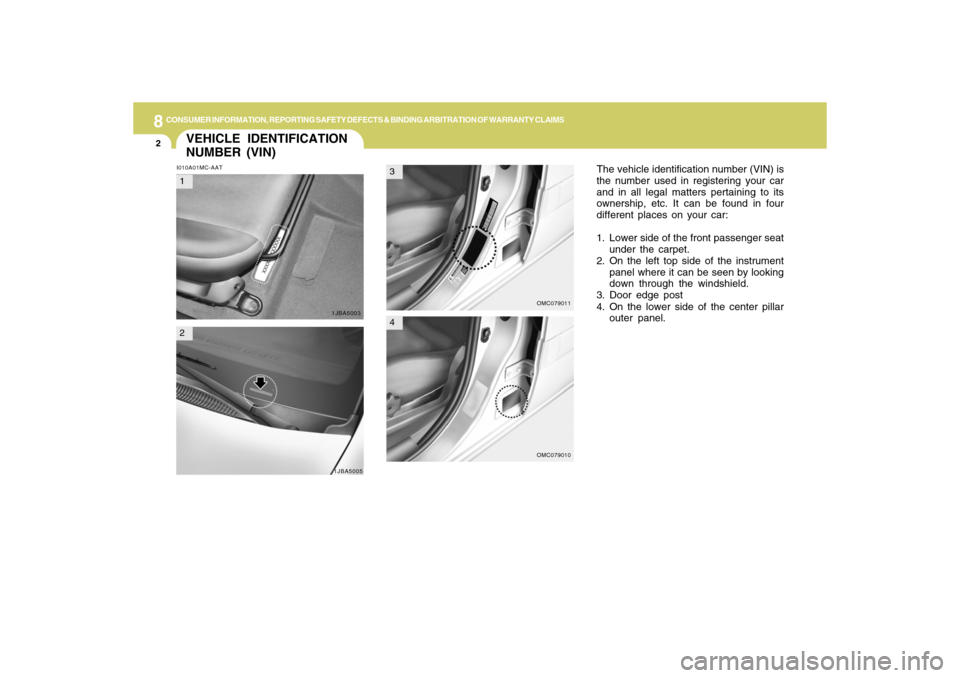
VEHICLE IDENTIFICATION
NUMBER (VIN)I010A01MC-AAT
The vehicle identification number (VIN) is
the number used in registering your car
and in all legal matters pertaining to its
ownership, etc. It can be found in four
different places on your car:
1. Lower side of the front passenger seat
under the carpet.
2. On the left top side of the instrument
panel where it can be seen by looking
down through the windshield.
3. Door edge post
4. On the lower side of the center pillar
outer panel.
1JBA5003
OMC079010
1JBA5005OMC079011
12
34