Windshield Hyundai Accent 2009 User Guide
[x] Cancel search | Manufacturer: HYUNDAI, Model Year: 2009, Model line: Accent, Model: Hyundai Accent 2009Pages: 266, PDF Size: 8.77 MB
Page 125 of 266

1
FEATURES OF YOUR HYUNDAI
1151
FEATURES OF YOUR HYUNDAI
115
B720A01MC-AATDEFROSTING/DEFOGGINGUse the heating/ventilation system to defrost or defog the
windshield:
To remove interior fog on the windshield;
o Set the air flow control to the defrost ( ) position (The
A/C will turn on automatically.) and the air intake control
to the fresh air (
) position.
o Set the temperature control to the desired position.
o Set the fan speed control between "1" and "4" position.To remove frost or exterior fog on the windshield;
o Set the air flow control to the defrost ( ) position (The
A/C will turn on automatically.) and the air intake control
to the fresh air (
) position.
o Set the temperature control to warm.
o Set the fan speed control to position "3" or "4".
NOTE:
When the A/C is operated continuously on the floor-defrost level ( ) or defrost level ( ), it may cause fog to form
on the exterior windshield. If this occurs, set the air flow control to the face level position ( ) and fan speed control
to the low position.
OMC029102
OMC029103
Page 145 of 266
2
DRIVING YOUR HYUNDAI2
!
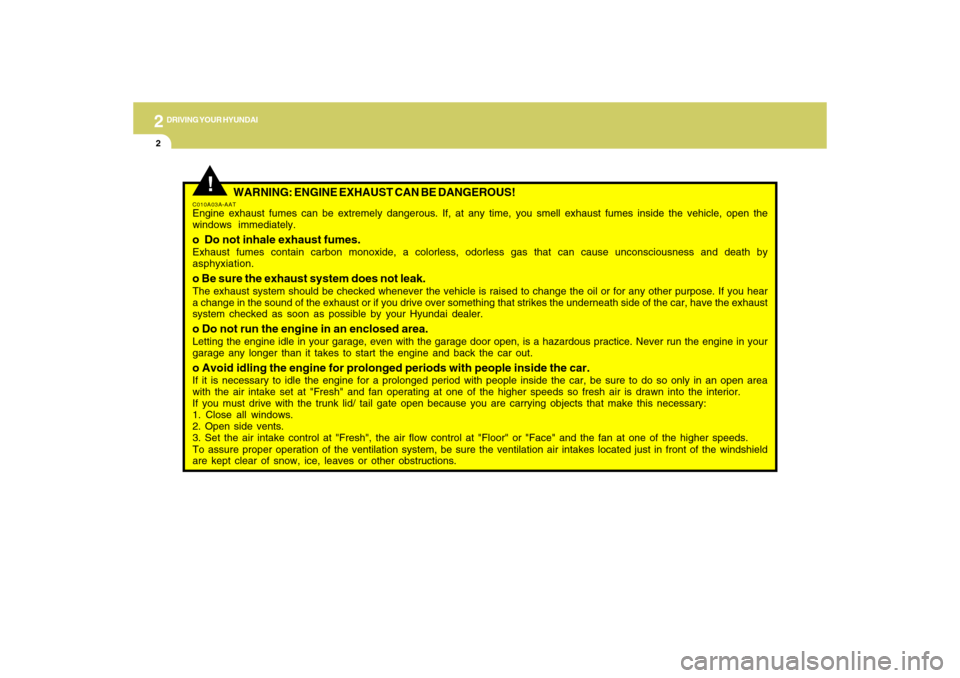
WARNING: ENGINE EXHAUST CAN BE DANGEROUS!
C010A03A-AATEngine exhaust fumes can be extremely dangerous. If, at any time, you smell exhaust fumes inside the vehicle, open the
windows immediately.o Do not inhale exhaust fumes.Exhaust fumes contain carbon monoxide, a colorless, odorless gas that can cause unconsciousness and death by
asphyxiation.o Be sure the exhaust system does not leak.The exhaust system should be checked whenever the vehicle is raised to change the oil or for any other purpose. If you hear
a change in the sound of the exhaust or if you drive over something that strikes the underneath side of the car, have the exhaust
system checked as soon as possible by your Hyundai dealer.o Do not run the engine in an enclosed area.Letting the engine idle in your garage, even with the garage door open, is a hazardous practice. Never run the engine in your
garage any longer than it takes to start the engine and back the car out.o Avoid idling the engine for prolonged periods with people inside the car.If it is necessary to idle the engine for a prolonged period with people inside the car, be sure to do so only in an open area
with the air intake set at "Fresh" and fan operating at one of the higher speeds so fresh air is drawn into the interior.
If you must drive with the trunk lid/ tail gate open because you are carrying objects that make this necessary:
1. Close all windows.
2. Open side vents.
3. Set the air intake control at "Fresh", the air flow control at "Floor" or "Face" and the fan at one of the higher speeds.
To assure proper operation of the ventilation system, be sure the ventilation air intakes located just in front of the windshield
are kept clear of snow, ice, leaves or other obstructions.
Page 207 of 266
6
DO-IT-YOURSELF MAINTENANCE2
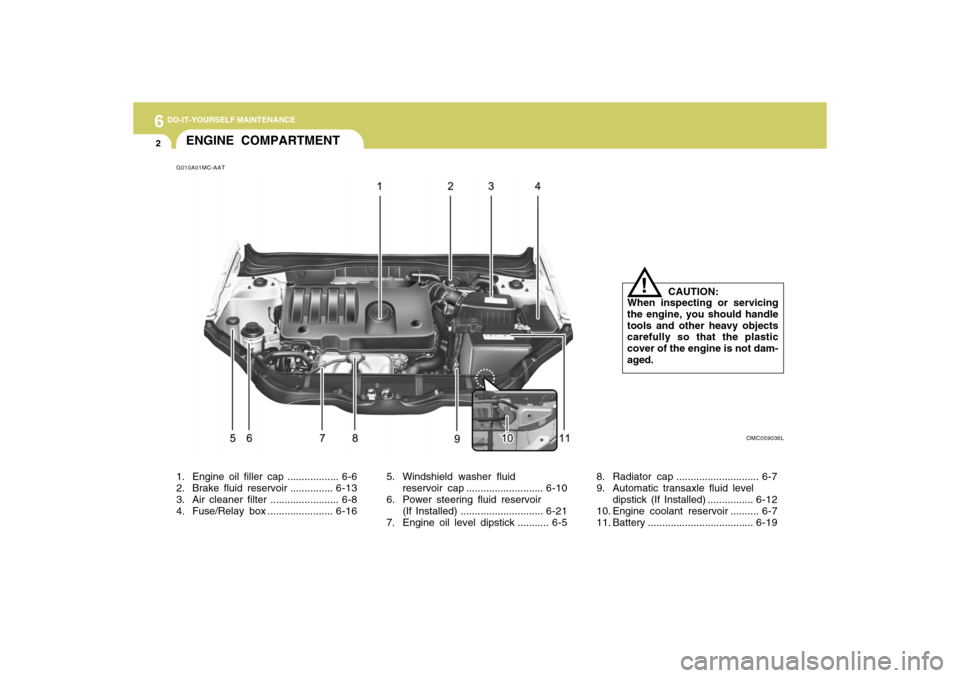
ENGINE COMPARTMENTG010A01MC-AAT1. Engine oil filler cap .................. 6-6
2. Brake fluid reservoir ...............6-13
3. Air cleaner filter ........................ 6-8
4. Fuse/Relay box .......................6-165. Windshield washer fluid
reservoir cap ...........................6-10
6. Power steering fluid reservoir
(If Installed) .............................6-21
7. Engine oil level dipstick ........... 6-58. Radiator cap ............................. 6-7
9. Automatic transaxle fluid level
dipstick (If Installed) ................6-12
10. Engine coolant reservoir .......... 6-7
11. Battery .....................................6-19
OMC059036L
CAUTION:
When inspecting or servicing
the engine, you should handle
tools and other heavy objects
carefully so that the plastic
cover of the engine is not dam-
aged.
!
Page 208 of 266
6
DO-IT-YOURSELF MAINTENANCE
3
GENERAL CHECKS
G020C01A-AATVehicle InteriorThe following should be checked each
time when the vehicle is driven:
o Light operation
o Windshield wiper operation
o Horn operation
o Defroster, heater system operation (and
air conditioning, if installed)
o Steering operation and condition
o Mirror condition and operation
o Turn signal operation
o Accelerator pedal operation
o Brake operation, including parking
brake
o Manual transaxle operation, including
clutchoperation
o Automatic transaxle operation, includ-
ing "Park" mechanism operation
o Seat control condition and operation
o Seat belt condition and operation
o Sun visor operation
If you notice anything that does not oper-
ate correctly or appear to be functioning
correctly, inspect it carefully and seek
assistance from your Hyundai dealer if
service is needed.
G020A01A-AATEngine Compartment
The following should be checked regu-
larly:
o Engine oil level and condition
o Transaxle fluid level and condition
o Brake fluid level
o Clutch fluid level
o Engine coolant level
o Windshield washer fluid level
o Accessory drive belt condition
o Engine coolant hose condition
o Fluid leaks (on or below components)
o Power steering fluid level and condi-
tion
o Battery condition
o Air cleaner filter condition
G020B01A-AATVehicle ExteriorThe following should be checked monthly:
o Overall appearance and condition
o Wheel condition and wheel nut tight-
ness
o Exhaust system condition
o Light condition and operation
o Windshield glass condition
o Wiper blade condition
o Paint condition and body corrosion
o Fluid leaks
o Door and hood lock condition
o Tire pressure and condition
(including spare tire)
Page 214 of 266
6
DO-IT-YOURSELF MAINTENANCE
9
WINDSHIELD WIPER
BLADESG080A02A-AATThe wiper blades should be carefully
inspected from time to time and cleaned
to remove accumulations of road film or
other debris. To clean the wiper blades
and arms, use a clean sponge or cloth
with a mild soap or detergent and water.
If the wipers continue to streak or smear
the glass, replace them with genuine
Hyundai replacement parts or their
equivalent.
CAUTION:
o Do not operate the wipers on dry
glass. This can result in more rapid
wear of the wiper blades and may
scratch the glass.
o Keep the blade rubber out of contact
with petroleum products such as
engine oil, gasoline, etc.
!
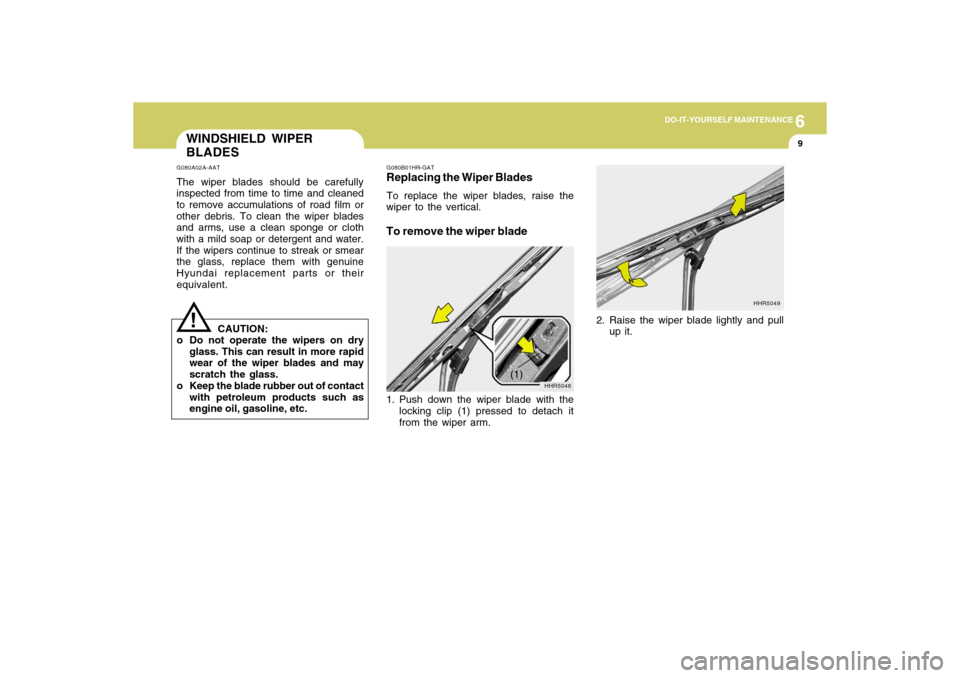
2. Raise the wiper blade lightly and pull
up it.
HHR5049
G080B01HR-GATReplacing the Wiper BladesTo replace the wiper blades, raise the
wiper to the vertical.To remove the wiper blade1. Push down the wiper blade with the
locking clip (1) pressed to detach it
from the wiper arm.
HHR5048
(1)
Page 215 of 266
6
DO-IT-YOURSELF MAINTENANCE
10
FILLING THE WASHER RES-
ERVOIRG090A01MC-AATA good quality washer fluid should be
used to fill the washer reservoir. The fluid
level should be checked more frequently
during inclement weather or whenever
the washer system is in more frequent
use.
OMC055016
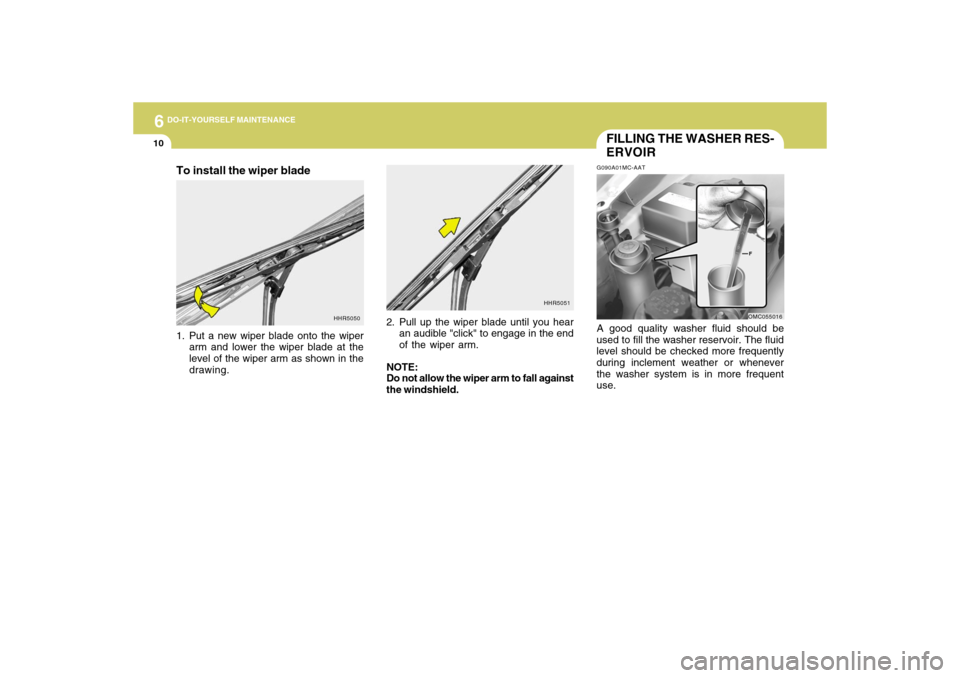
1. Put a new wiper blade onto the wiper
arm and lower the wiper blade at the
level of the wiper arm as shown in the
drawing.To install the wiper blade
HHR5050
2. Pull up the wiper blade until you hear
an audible "click" to engage in the end
of the wiper arm.
NOTE:
Do not allow the wiper arm to fall against
the windshield.
HHR5051
Page 216 of 266
6
DO-IT-YOURSELF MAINTENANCE
11
!
G100A01MC-GATTransaxle lubricant in the manual
transaxle should be checked at those
intervals specified in the vehicle mainte-
nance schedule in Section 5.
!CHECKING THE TRANSAXLE
OIL (MANUAL)
!
CAUTION:
o Radiator anti-freeze (engine coolant)
should not be used in the washer
system because it will damage the
car's finish.
o The washer should not be operated
if the washer reservoir is empty.
This can damage the washer fluid
pump.WARNING:
It is always better to check the transaxle
oil level when the engine is cool or cold.
If the engine is hot, you should exercise
great caution to avoid burning yourself
on hot engine or exhaust parts.
WARNING:
o Windshield washer fluid agents con-
tain some amounts of alcohol and
can be flammable under certain cir-
cumstances. Do not allow sparks or
flame to contact the washer fluid or
the washer fluid reservoir. Damage
to the vehicle or its occupants could
occur.
o Windshield washer fluid is poison-
ous to humans and animals. Do not
drink windshield washer fluid. Seri-
ous injury or death could occur.NOTE:
It is recommended that the manual
transaxle fluid should be checked by an
authorized Hyundai dealer.
G110A01MC-AATTransaxle fluid in the automatic transaxle
should be checked at those intervals
specified in the vehicle maintenance
schedule in Section 5.
NOTE:
Automatic transaxle fluid is basically a
red color. As driving distance increases,
the fluid color turns darkish red gradu-
ally. It is a normal condition and you
should not judge the need to replace
based upon the changing color.
You must replace the automatic
transaxle fluid in accordance with inter-
vals specified in the vehicle mainte-
nance schedule in section 5.CHECKING THE TRANSAXLE
FLUID (AUTOMATIC)
Page 240 of 266
8
CONSUMER INFORMATION, REPORTING SAFETY DEFECTS & BINDING ARBITRATION OF WARRANTY CLAIMS2
VEHICLE IDENTIFICATION
NUMBER (VIN)I010A01MC-AAT
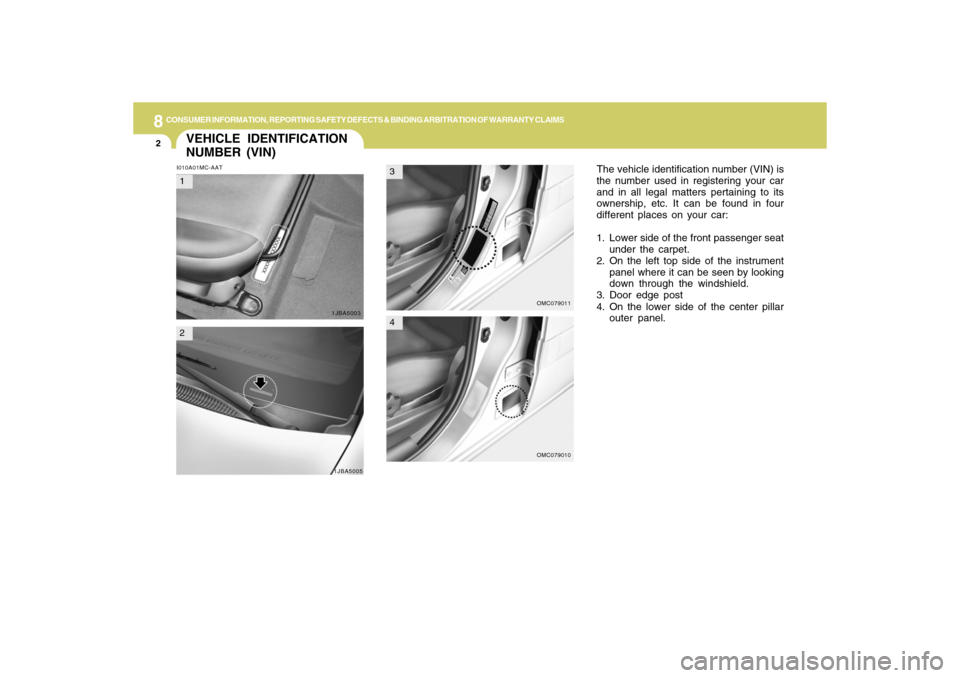
The vehicle identification number (VIN) is
the number used in registering your car
and in all legal matters pertaining to its
ownership, etc. It can be found in four
different places on your car:
1. Lower side of the front passenger seat
under the carpet.
2. On the left top side of the instrument
panel where it can be seen by looking
down through the windshield.
3. Door edge post
4. On the lower side of the center pillar
outer panel.
1JBA5003
OMC079010
1JBA5005OMC079011
12
34
Page 266 of 266

10
INDEX
6
Transaxle
Automatic.......................................................................... 2-9
Automatic transaxle fluid checking ................................6-11
Manual.............................................................................. 2-6
Manual transaxle oil checking .......................................6-11
Trip Computer ....................................................................1-73
Trip Odometer ....................................................................1-73
Trunk Lid/Tail Gate .............................................................1-96
Remote trunk lid release ................................................1-97
V
Vehicle Identification Number (VIN) .................................... 8-2
Vehicle Load Limit .............................................................2-20
Vehicle Specifications .......................................................... 9-1
W
Warning and Indicator Lights ............................................1-64
Warranties for Your Hyundai Vehicle ...............................8-15
Windows.............................................................................1-11
Window lock ....................................................................1-11
Windshield Wiper and Washer Switch ..............................1-78
Adjustable Intermittent wiper operation .........................1-80
Mist wiper operation .......................................................1-79
Rear window wiper and washer ....................................1-80
Washer reservoir ............................................................6-10
Windshield washer operation ........................................1-79
Windshield Wiper Blades .................................................... 6-9