section 6 Hyundai Accent 2009 Owner's Manual
[x] Cancel search | Manufacturer: HYUNDAI, Model Year: 2009, Model line: Accent, Model: Hyundai Accent 2009Pages: 266, PDF Size: 8.77 MB
Page 5 of 266

F5
A040A01A-AAT
FOREWORD
Thank you for choosing Hyundai. We are pleased to welcome you to the growing number of discriminating
people who drive a Hyundai. The advanced engineering and high-quality construction of each Hyundai we
build is something of which we're very proud.
Your Owner's Manual will introduce you to the features and operation of your new Hyundai. It is suggested
that you read it carefully because the information it contains can contribute greatly to the satisfaction you
receive from your new car.
The manufacturer also recommends that all service and maintenance on your car be performed by an
authorized Hyundai dealer. Hyundai dealers are prepared to provide high-quality service, maintenance and
any other assistance that may be required.A050A05A-AAT
HYUNDAI MOTOR AMERICA
Note: Because future owners will also need the information included in this manual, if you sell this Hyundai,
please leave the manual in the vehicle for their use. Thank you.
CAUTION:
Severe engine and transaxle damage may result from the use of poor quality fuels and lubricants that
do not meet Hyundai specifications. You must always use high quality fuels and lubricants that meet
the specifications listed on Page 9-4 in the Vehicle Specifications section of the Owner's Manual and
which also appear in the Service Station Information on the back cover of the Owner's Manual.
Copyright 2008 Hyundai Motor America. All rights reserved. No part of this publication may be reproduced,
stored in any retrieval system or transmitted in any form or by any means without the prior written permission
of Hyundai Motor America.
!
Page 7 of 266
F7
TABLE OF CONTENTS
SECTION
5 1
2
3
4
6
7
8
9
10
FEATURES OF YOUR HYUNDAI
DRIVING YOUR HYUNDAI
WHAT TO DO IN AN EMERGENCY
CORROSION PREVENTION & APPEARANCE CARE
VEHICLE MAINTENANCE REQUIREMENTS
DO-IT-YOURSELF MAINTENANCE
EMISSION CONTROL SYSTEMS
CONSUMER INFORMATION, REPORTING SAFETY DEFECTS &
BINDING ARBITRATION OF WARRANTY CLAIMS
VEHICLE SPECIFICATIONS
INDEX
Page 40 of 266
1FEATURES OF YOUR HYUNDAI30
!
WARNING:
o Never let anyone ride in the rear
center seat without fastening all
metal tabs and buckles as described
in this section. This seat belt is
designed to function as a typical 3-
point restraint (lap/shoulder belt).
Using only the shoulder portion or
lap portion of the belt can result in
serious or fatal injuries in the event
of a collision or sudden stop.
o Never unlock the metal tab (A) and
the buckle (B) with the following ex-
ceptions.
(1) In case of folding rear seatbacks
down.
(2) If transporting an object on the
rear seat may cause damage to
the rear seat center belt.
B220D04MC
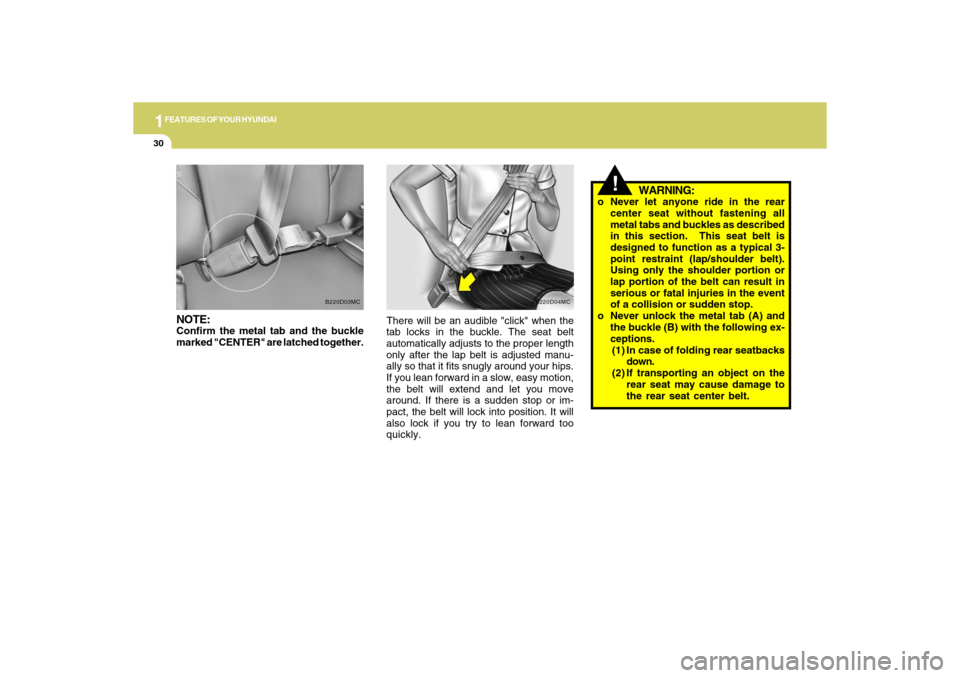
There will be an audible "click" when the
tab locks in the buckle. The seat belt
automatically adjusts to the proper length
only after the lap belt is adjusted manu-
ally so that it fits snugly around your hips.
If you lean forward in a slow, easy motion,
the belt will extend and let you move
around. If there is a sudden stop or im-
pact, the belt will lock into position. It will
also lock if you try to lean forward too
quickly.
NOTE:Confirm the metal tab and the buckle
marked "CENTER" are latched together.
B220D03MC
Page 48 of 266
1FEATURES OF YOUR HYUNDAI38
!
WARNING:
o If the retractor is not in the Auto-
matic Locking mode, the child re-
straint can move when your vehicle
turns or stops suddenly. A child can
be seriously injured or killed if the
child restraint is not properly an-
chored to the car, including setting
the retractor to the Automatic Lock-
ing mode.
o Do not install any child restraint sys-
tem in the front passenger seat.
Should an accident occur and cause
the passenger side airbag to deploy,
it could severely injure or kill an
infant or child seated in an infant or
child seat. Therefore, only use a child
restraint system in the rear seat of
your vehicle.
o Before installing a Child Restraint
System to vehicles fitted with Curtain
Airbags, always refer to safety no-
tices for Curtain Airbag systems in
this manual. Whenever installing child
restraints, use only approved devices
and refer to the "Child Restraint Sys-
tem" section to ensure correct instal-
lation and that occupant protection is
maximized. If the retractor is in the automatic locking
mode, the belt will be locked. After instal-
lation of the child restraint system, try to
move it in all directions to be sure the
child restraint system is securely installed.
If you need to tighten the belt, pull more
webbing toward the retractor. When you
unbuckle the seat belt and allow it to
retract, the retractor will automatically
revert back to its normal seated passen-
ger emergency locking usage condition.
NOTE:o Before installing the child restraint
system, read the instructions sup-
plied by the child restraint system
manufacturer.
o If the seat belt does not operate as
described, have the system checked
immediately by your authorized
Hyundai dealer.
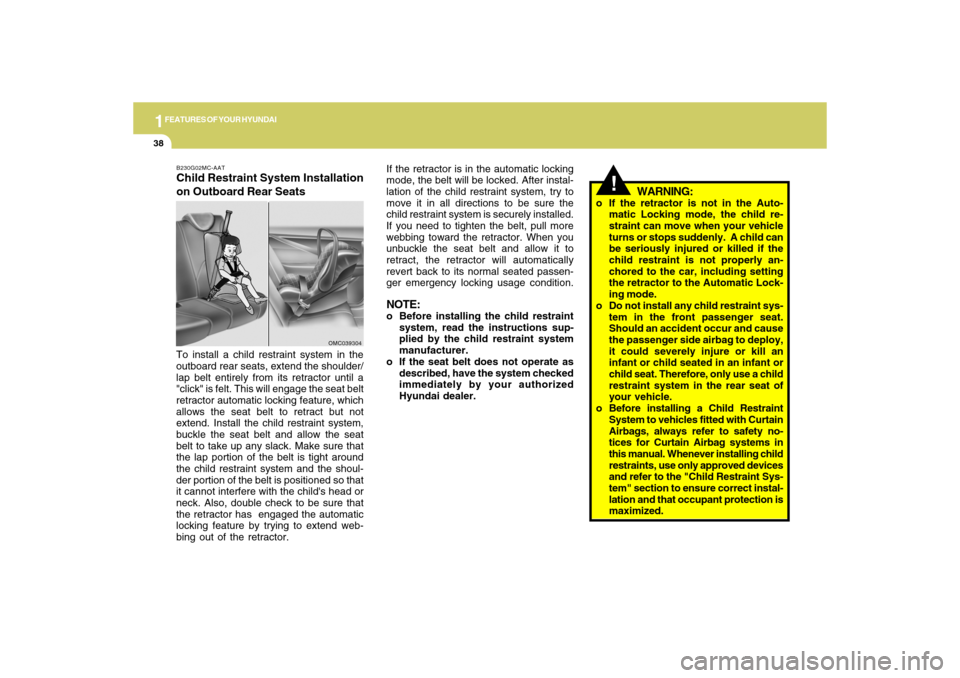
To install a child restraint system in the
outboard rear seats, extend the shoulder/
lap belt entirely from its retractor until a
"click" is felt. This will engage the seat belt
retractor automatic locking feature, which
allows the seat belt to retract but not
extend. Install the child restraint system,
buckle the seat belt and allow the seat
belt to take up any slack. Make sure that
the lap portion of the belt is tight around
the child restraint system and the shoul-
der portion of the belt is positioned so that
it cannot interfere with the child's head or
neck. Also, double check to be sure that
the retractor has engaged the automatic
locking feature by trying to extend web-
bing out of the retractor.B230G02MC-AATChild Restraint System Installation
on Outboard Rear Seats
OMC039304
Page 52 of 266
1FEATURES OF YOUR HYUNDAI42
B240A01MC
The purpose of the SRS is to provide the
vehicle's driver and/or the front passen-
ger with additional protection than that
offered by the seat belt system alone in
case of a frontal impact of sufficient sever-
ity. The SRS uses sensors to gather infor-
mation about the driver's and front
passenger's seat position, the driver's and
front passenger's seat belt usage and
impact severity.
The driver's and front passenger's seat
track position sensors, which are installed
on the seat track, determine if the seats
are fore or aft of a reference position. The
seat belt buckle sensors determine if the
driver and front passenger's seat belts
are fastened. These sensors provide the
ability to control the SRS deployment
based on how close the driver's seat is to
the steering wheel, how close the
passenger's seat is to the instrument
panel, whether or not the seat belts are
fastened, and how severe the impact is.The advanced SRS offers the ability to
control the airbag inflation with two lev-
els. A first stage level is provided for
moderate-severity impacts. A second
stage level is provided for more severe
impacts.
According to the impact severity, seating
position and seat belt usage, the
SRSCM(SRS Control Module) controls
the airbag inflation. Failure to properly
wear seat belts can increase the risk or
severity of injury in an accident.
Additionally, your Hyundai is equipped
with an occupant classification system in
the front passenger's seat. The occupant
classification system detects the pres-
ence of a passenger in the front
passenger's seat and will turn off the front
passenger's airbag under certain condi-
tions. For more detail, see "Occupant Clas-
sification System" later in this section.
B240A03NF-AATDriver's and Passenger's Front
AirbagYour Hyundai is equipped with an ad-
vanced Supplemental Restraint (Airbag)
System and lap/shoulder belts at both the
driver and passenger seating positions.
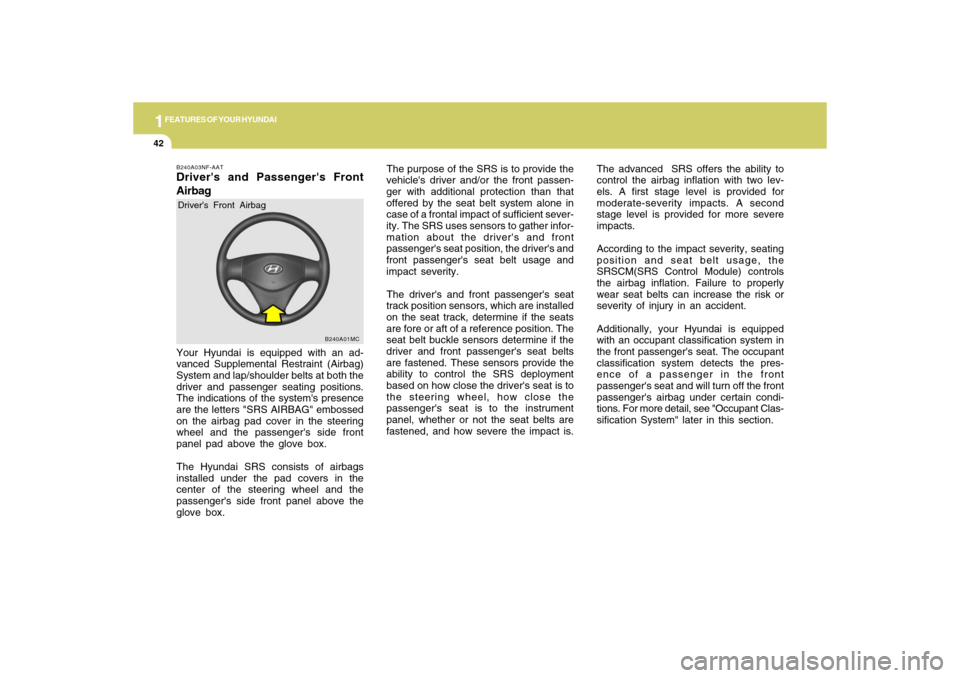
The indications of the system's presence
are the letters "SRS AIRBAG" embossed
on the airbag pad cover in the steering
wheel and the passenger's side front
panel pad above the glove box.
The Hyundai SRS consists of airbags
installed under the pad covers in the
center of the steering wheel and the
passenger's side front panel above the
glove box.Driver's Front Airbag
Page 66 of 266
1FEATURES OF YOUR HYUNDAI56
!
WARNING:
o The space between the occupant and
the curtain airbag must never be
occupied by children, passengers or
pets. Occupants should never lean
out or have any parts of their body
protruding from the window while the
engine is running.
o Do not move the sun visor out to
cover the side window if there is an
item attached to it such as a garage
door remote control, pens, air fresh-
eners or the like. These objects could
cause injury if the Curtain Airbag is
deployed.
o Do not install sun blinds to the rear
doors, these must not obstruct or
impair the airbag in any way.
o Do not install any accessories or
children’s toys in the Curtain Airbag
deployment zones, as this may im-
pair the operation of the system or
throw parts of them into the vehicle
cabin causing injury to occupants if
the system is deployed.
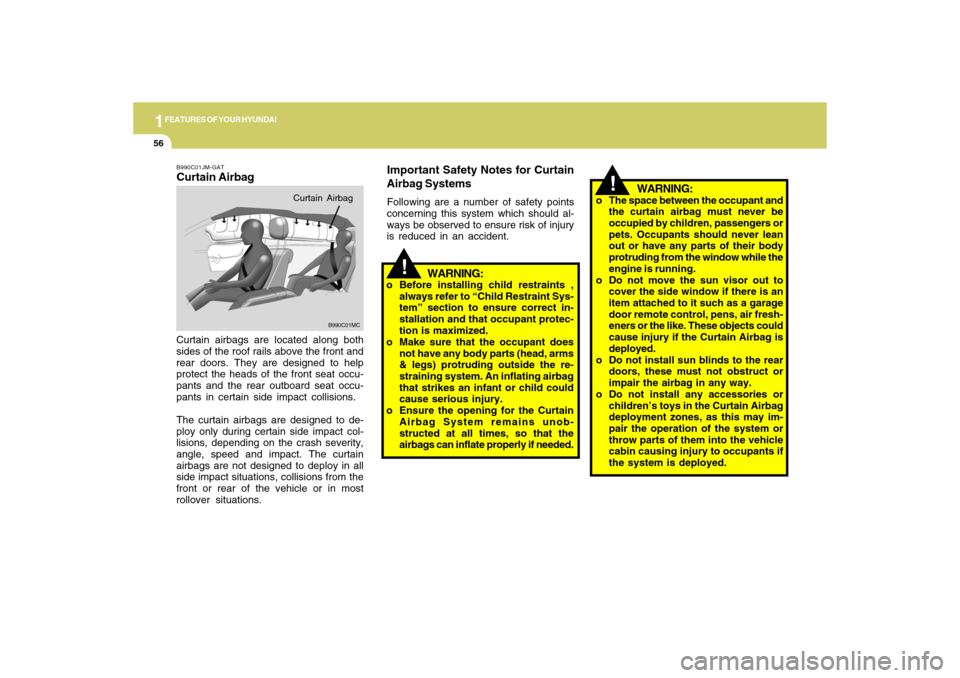
B990C01JM-GATCurtain AirbagCurtain airbags are located along both
sides of the roof rails above the front and
rear doors. They are designed to help
protect the heads of the front seat occu-
pants and the rear outboard seat occu-
pants in certain side impact collisions.
The curtain airbags are designed to de-
ploy only during certain side impact col-
lisions, depending on the crash severity,
angle, speed and impact. The curtain
airbags are not designed to deploy in all
side impact situations, collisions from the
front or rear of the vehicle or in most
rollover situations.
B990C01MC
Curtain Airbag
!
WARNING:
o Before installing child restraints ,
always refer to “Child Restraint Sys-
tem” section to ensure correct in-
stallation and that occupant protec-
tion is maximized.
o Make sure that the occupant does
not have any body parts (head, arms
& legs) protruding outside the re-
straining system. An inflating airbag
that strikes an infant or child could
cause serious injury.
o Ensure the opening for the Curtain
Airbag System remains unob-
structed at all times, so that the
airbags can inflate properly if needed.Important Safety Notes for Curtain
Airbag SystemsFollowing are a number of safety points
concerning this system which should al-
ways be observed to ensure risk of injury
is reduced in an accident.
Page 80 of 266
1FEATURES OF YOUR HYUNDAI70
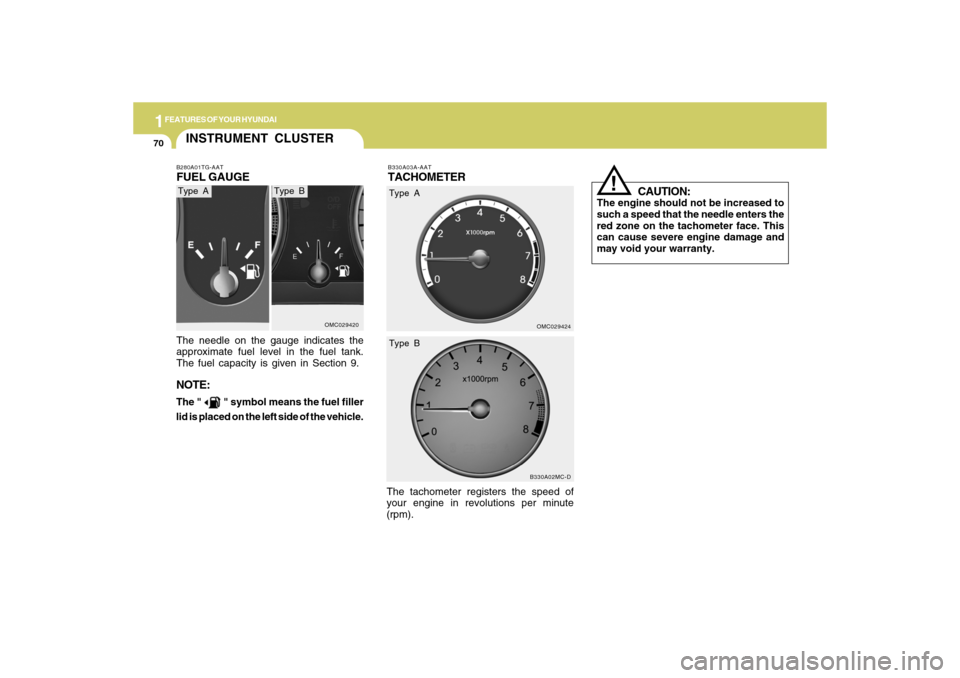
B330A03A-AATTACHOMETERThe tachometer registers the speed of
your engine in revolutions per minute
(rpm).
CAUTION:
The engine should not be increased to
such a speed that the needle enters the
red zone on the tachometer face. This
can cause severe engine damage and
may void your warranty.
!
INSTRUMENT CLUSTERB280A01TG-AATFUEL GAUGEThe needle on the gauge indicates the
approximate fuel level in the fuel tank.
The fuel capacity is given in Section 9.NOTE:The "
" symbol means the fuel filler
lid is placed on the left side of the vehicle.
OMC029420
Type A
Type B
OMC029424B330A02MC-D
Type A
Type B
Page 158 of 266
DRIVING YOUR HYUNDAI
152
DRIVING FOR ECONOMYC140A02A-AATYou can save fuel and get more miles
from your car if you follow these sugges-
tions:
o Drive smoothly. Accelerate at a mod-
erate rate. Don't make "jack-rabbit"
starts or full-throttle shifts and maintain
a steady cruising speed. Don't race
between stoplights. Try to adjust your
speed to that of the other traffic so you
don't have to change speeds unnec-
essarily. Avoid heavy traffic whenever
possible. Always maintain a safe dis-
tance from other vehicles so you can
avoid unnecessary braking. This also
reduces brake wear.
o Drive at a moderate speed. The faster
you drive, the more fuel your car uses.
Driving at a moderate speed, espe-
cially on the highway, is one of the
most effective ways to reduce fuel con-
sumption.
o Don't "ride" the brake or clutch pedal.
This can increase fuel consumption
and also increase wear on these com-
ponents. In addition, driving with your
foot resting on the brake pedal may
cause the brakes to overheat, which
reduces their effectiveness and may
lead to more serious consequences. o Under some conditions your parking
brake can freeze in the engaged posi-
tion. This is most likely to happen when
there is an accumulation of snow or ice
around or near the rear brakes or if the
brakes are wet. If there is a risk that the
parking brake may freeze, apply it only
temporarily while you put the gear
selector lever in "P" (automatic) or in
first or reverse gear (manual transaxle)
and block the rear wheels so the car
cannot roll. Then release the parking
brake.
o Do not hold the vehicle on the upgrade
with the accelerator pedal. This can
cause the transaxle to overheat. Al-
ways use the brake pedal or parking
brake.o Take care of your tires. Keep them
inflated to the recommended pressure.
Incorrect inflation, either too much or
too little, results in unnecessary tire
wear. Check the tire pressures at least
once a month.
o Be sure that the wheels are aligned
correctly. Improper alignment can re-
sult from hitting curbs or driving too fast
over irregular surfaces. Poor align-
ment causes faster tire wear and may
also result in other problems as well as
greater fuel consumption.
o Keep your car in good condition. For
better fuel economy and reduced main-
tenance costs, maintain your car in
accordance with the maintenance
schedule in Section 5. If you drive your
car in severe conditions, more fre-
quent maintenance is required (see
Section 5 for details).
o Keep your car clean. For maximum
service, your Hyundai should be kept
clean and free of corrosive materials.
It is especially important that mud, dirt,
ice, etc. not be allowed to accumulate
on the underside of the car. This extra
weight can result in increased fuel
consumption and also contribute to
corrosion.
Page 160 of 266

DRIVING YOUR HYUNDAI
172
C160D01A-AATCheck Battery and CablesWinter puts additional burdens on the
battery system. Visually inspect the bat-
tery and cables as described in Section
6. The level of charge in your battery can
be checked by your Hyundai dealer or a
service station.C160C01A-AATUse High Quality Ethylene Glycol
CoolantYour Hyundai is delivered with high qual-
ity ethylene glycol coolant in the cooling
system. It is the only type of coolant that
should be used because it helps prevent
corrosion in the cooling system, lubri-
cates the water pump and prevents freez-
ing. Be sure to replace or replenish your
coolant in accordance with the mainte-
nance schedule in Section 5. Before win-
ter, have your coolant tested to assure
that its freezing point is sufficient for the
temperatures anticipated during the win-
ter.
C160B01A-AATSnowy or Icy ConditionsTo drive your vehicle in deep snow, it may
be necessary to use snow tires or to
install tire chains on your tires. If snow
tires are needed, it is necessary to select
tires equivalent in size and type to the
original equipment tires. Failure to do so
may adversely affect the safety and han-
dling of your car. Furthermore, speeding,
rapid acceleration, sudden brake appli-
cations, and sharp turns are potentially
very hazardous practices.
During deceleration, use engine braking
to the fullest extent. Sudden brake appli-
cations on snowy or icy roads may cause
skids to occur. You need to keep suffi-
cient distance between the vehicle in
operation in front and your vehicle. Also,
apply the brake gently. It should be noted
that installing tire chains on the tire will
provide a greater driving force, but will
not prevent side skids.NOTE:Tire chains are not legal in all states.
Check state laws before fitting tire
chains.
C160E01A-AATChange to "Winter Weight" Oil if
NecessaryIn some climates it is recommended that
a lower viscosity "winter weight" oil be
used during cold weather. See Section 9
for recommendations. If you aren't sure
what weight oil you should use, consult
your Hyundai dealer.C160F02A-AATCheck Spark Plugs and Ignition
SystemInspect your spark plugs and replace
them if necessary. Also check all ignition
wiring and components to be sure they
are not cracked, worn or damaged in any
way.
Page 192 of 266
44
CORROSION PREVENTION AND APPEARANCE CARE4
Use a clean sponge or cloth, rinse it
frequently and don't damage the finish by
rubbing too hard. For stubborn spots,
dampen them frequently and remove
them a little at a time.
To clean whitewall tires, use a stiff brush
or soap-impregnated steel-wool scour-
ing pad.
To clean plastic wheel covers, use a
clean sponge or soft cloth and water.
To clean cast aluminum alloy wheels,
use a mild soap or neutral detergent. Do
not use abrasive cleaners. Protect the
bare-metal surfaces by cleaning, polish-
ing and waxing. Because aluminum is
subject to corrosion, be sure to give alu-
minum alloy wheels special attention in
winter. If you drive on salted roads, clean
the wheels thoroughly afterwards.
After washing, be sure to rinse thoroughly.
If soapy water dries on the finish, streak-
ing will result.
When the weather is warm and the hu-
midity low, you may find it necessary to
rinse each section immediately after wash-
ing to avoid streaking.After rinsing, dry the car using a damp
chamois or soft, absorbent cloth. The rea-
son for drying the car is to remove water
from the car so it will dry without water
spots. Don't rub, this can damage the
finish.
If you find any nicks or scratches in the
paint, use touch-up paint to cover them to
prevent corrosion. To protect the
paintwork of the car against corrosion,
you must clean your Hyundai (at least
once a month). Give special attention to
the removal of salt, mud and other sub-
stances on the underside of the
splashboards of the car. Make sure that
the outlets and the underside of the doors
are open. Paint damage can be caused
by small accumulation of tar, industrial
precipitation, tree resin, insects and bird
droppings, when not removed immedi-
ately.
If water alone is not strong enough to
remove the accumulated dirt, use a mild
car washing solution. Be sure to rinse the
surface after washing to remove the solu-
tion. Never allow the solution to dry on the
painted surfaces.
WASHING AND WAXINGE030A02A-AATWashing Your HyundaiNever wash your car when the surface is
hot from being in the sun. Always wash
your car in the shade.
Wash your car frequently. Dirt is abrasive
and can scratch the paint if it is not re-
moved. Air pollution or acid rain may
damage the paint and trim through chemi-
cal action if pollutants are allowed to
remain in contact with the surface. If you
live near the ocean or in an area where
road salts or dust control chemicals are
used, you should pay particular attention
to the underside of the car. Start by rins-
ing the car to remove dust and loose dirt.
In winter, or if you have driven through
mud or muddy water, be sure to thor-
oughly clean the underside as well. Use
a hard direct stream of water to remove
accumulations of mud or corrosive mate-
rials. Use a good quality car-washing
solution and follow the manufacturer's
directions on the package. These are
available at your Hyundai dealer or auto
parts outlet. Don't use strong household
detergents, gasoline, strong solvents or
abrasive cleaning powders as these may
damage the finish.