ECU Hyundai Accent 2010 User Guide
[x] Cancel search | Manufacturer: HYUNDAI, Model Year: 2010, Model line: Accent, Model: Hyundai Accent 2010Pages: 284, PDF Size: 10.23 MB
Page 52 of 284
1FEATURES OF YOUR HYUNDAI
40
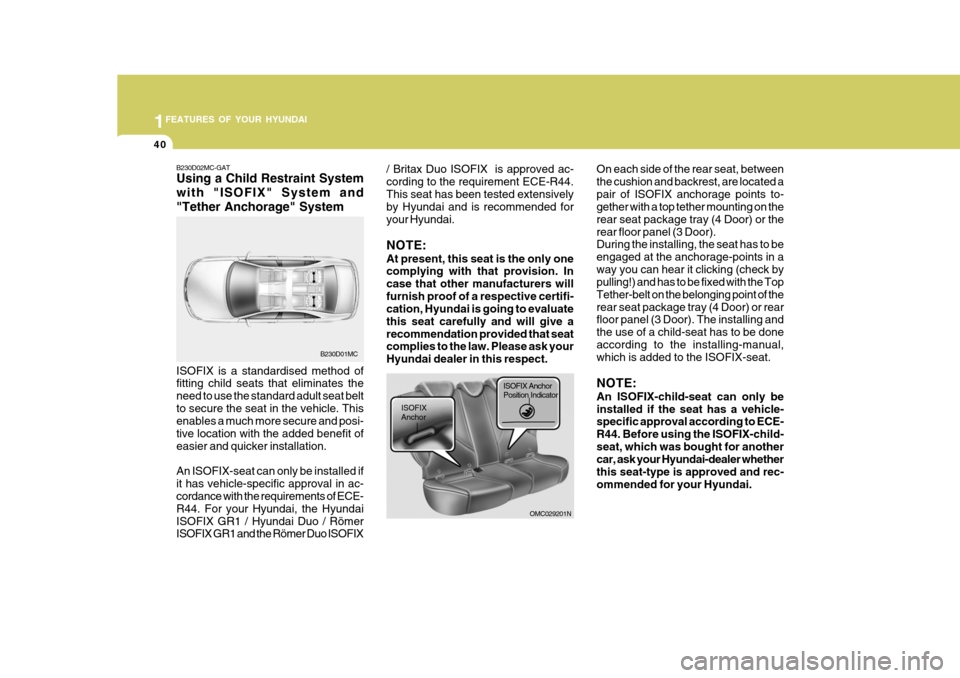
B230D02MC-GAT Using a Child Restraint System with "ISOFIX" System and"Tether Anchorage" System ISOFIX is a standardised method of fitting child seats that eliminates the need to use the standard adult seat beltto secure the seat in the vehicle. This enables a much more secure and posi- tive location with the added benefit ofeasier and quicker installation. An ISOFIX-seat can only be installed if it has vehicle-specific approval in ac- cordance with the requirements of ECE- R44. For your Hyundai, the HyundaiISOFIX GR1 / Hyundai Duo / Römer ISOFIX GR1 and the Römer Duo ISOFIX
B230D01MC / Britax Duo ISOFIX is approved ac- cording to the requirement ECE-R44.This seat has been tested extensively by Hyundai and is recommended for your Hyundai. NOTE: At present, this seat is the only one complying with that provision. In case that other manufacturers willfurnish proof of a respective certifi- cation, Hyundai is going to evaluate this seat carefully and will give arecommendation provided that seat complies to the law. Please ask your Hyundai dealer in this respect.
OMC029201N
ISOFIX Anchor
ISOFIX Anchor Position Indicator On each side of the rear seat, between the cushion and backrest, are located apair of ISOFIX anchorage points to- gether with a top tether mounting on the rear seat package tray (4 Door) or therear floor panel (3 Door). During the installing, the seat has to be engaged at the anchorage-points in away you can hear it clicking (check by pulling!) and has to be fixed with the Top Tether-belt on the belonging point of therear seat package tray (4 Door) or rear floor panel (3 Door). The installing and the use of a child-seat has to be doneaccording to the installing-manual, which is added to the ISOFIX-seat. NOTE: An ISOFIX-child-seat can only be installed if the seat has a vehicle- specific approval according to ECE- R44. Before using the ISOFIX-child-seat, which was bought for another car, ask your Hyundai-dealer whether this seat-type is approved and rec-ommended for your Hyundai.
Page 53 of 284
1
FEATURES OF YOUR HYUNDAI
41
o When using the vehicle’s "ISOFIX"
system to install a child restraint system in the rear seat, all unusedvehicle rear seat belt metal latch plates or tabs must be latched securely in their seat belt bucklesand the seat belt webbing must be retracted behind the child restraint to prevent the child from reachingand taking hold of unretracted seat
belts. Unlatched metal latch plates or tabs may allow the child toreach the unretracted seat belts which may result in strangulation and a serious injury or death to thechild in the child restraint.
o Do not mount more than one child
restraint to a child restraint loweranchorage point. The improper increased load may cause the an- chorage points or tether anchor tobreak, causing serious injury or death.
o Attach the ISOFIX or ISOFIX-com- patible child restraint seat only tothe appropriate locations shown in the illustration.
o Always follow the installation and use instructions provided by themanufacturer of the child restraint.
WARNING:
o Do not install a child restraint seat at the center of the rear seat using the vehicle's ISOFIX anchors. The ISOFIX anchors are only provided for the left and right outboard rear seating positions. Do not misusethe ISOFIX anchors by attempting to attach a child restraint seat in the middle of the rear seat to theISOFIX anchors. In a crash, the child restraint seat ISOFIX attach- ments may not be strong enoughto secure the child restraint seat properly in the center of the rear seat and may break, causing seri-ous injury or death.
B230D03MC
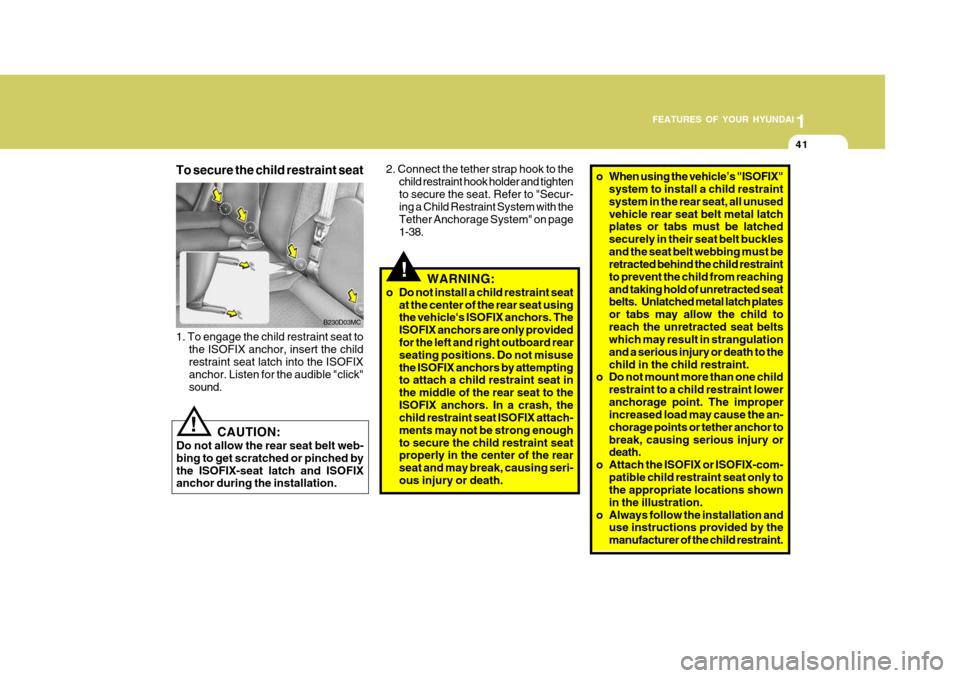
1. To engage the child restraint seat to the ISOFIX anchor, insert the childrestraint seat latch into the ISOFIX anchor. Listen for the audible "click" sound.
To secure the child restraint seat!
2. Connect the tether strap hook to the
child restraint hook holder and tighten to secure the seat. Refer to "Secur- ing a Child Restraint System with the Tether Anchorage System" on page1-38.
! CAUTION:
Do not allow the rear seat belt web- bing to get scratched or pinched bythe ISOFIX-seat latch and ISOFIX anchor during the installation.
Page 65 of 284
1
FEATURES OF YOUR HYUNDAI
53
!WARNING:
o Before installing child restraints , always refer to “Child Restraint System” section to ensure correctinstallation and that occupant pro- tection is maximized.
o Make sure that the occupant does not have any body parts (head,arms & legs) protruding outside the restraining system. If an inflat-ing airbag was to strike an infant or child, it may cause serious in- jury.
o Ensure the opening for the Cur- tain Airbag System remains unob-structed at all times, so that theairbags can inflate properly if needed.
o The built in coat hooks should only be used for light weight cloth-ing, ensure that pockets are free of any heavy or sharp objects. Whenusing coat hooks, do not hang clothes on coat hangers.
Important Safety Notes for Cur- tain Airbag Systems Following are a number of safety points concerning this system which shouldalways be observed to ensure risk of injury is reduced in an accident.
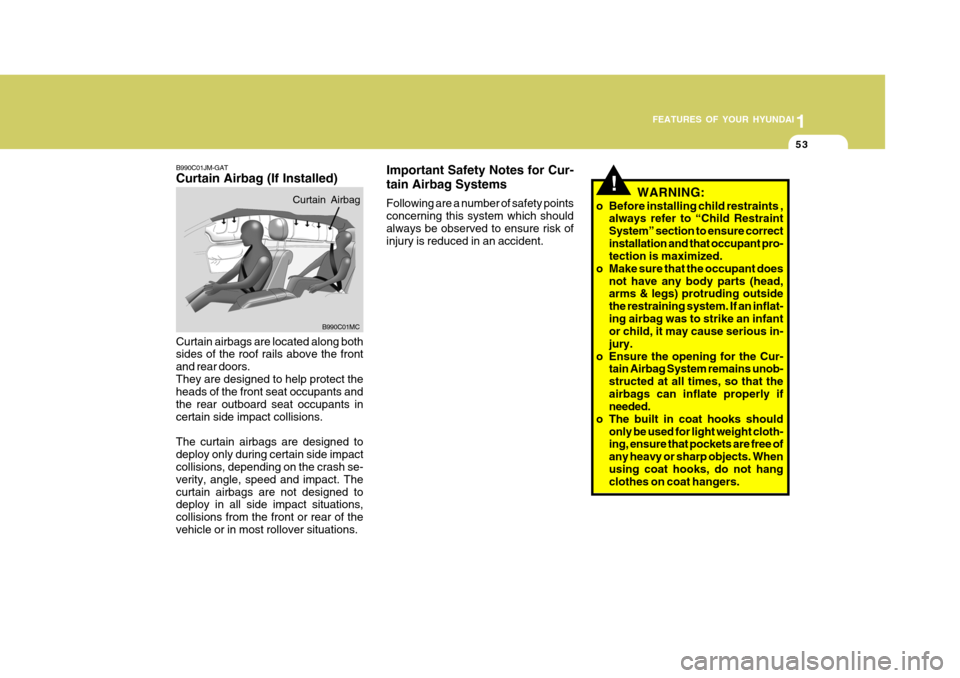
B990C01JM-GAT Curtain Airbag (If Installed)
Curtain airbags are located along both sides of the roof rails above the front and rear doors.They are designed to help protect the heads of the front seat occupants and the rear outboard seat occupants incertain side impact collisions. The curtain airbags are designed to deploy only during certain side impact collisions, depending on the crash se- verity, angle, speed and impact. Thecurtain airbags are not designed to deploy in all side impact situations, collisions from the front or rear of thevehicle or in most rollover situations. B990C01MC
Curtain Airbag
Page 111 of 284
1
FEATURES OF YOUR HYUNDAI
99
- When refueling always shut the
engine off. Sparks produced by electrical components related tothe engine can ignite fuel va- pors causing a fire. Always in- sure that the engine is OFF be-fore and during refueling. Once refueling is complete, check to make sure the fuel filler cap anddoor are securely closed, before starting the engine.
- Do not light any fire around a gas station. DO NOT use matchesor a lighter and DO NOT SMOKE or leave a lit cigarette in yourvehicle while at a gas station especially during refueling. Au- tomotive fuel is highly flammableand can, when ignited, result in explosion by flames.
- If a fire breaks out during refuel- ing, leave the vicinity of the ve-hicle, and immediately contact the manager of the gas stationor contact the police and local fire department. Follow any safety instructions they provide.
!
TRUNK LID/TAIL GATE
B540A01MC-GAT
WARNING:
The trunk lid or the tail gate should always be kept completely closed while the vehicle is in motion. If it is left open or ajar, poisonous exhaustgases may enter the car resulting in serious illiness or death to the occu- pants. See additional warnings con-cerning exhaust gases on page 2-2. Trunk Lid (4 Door)
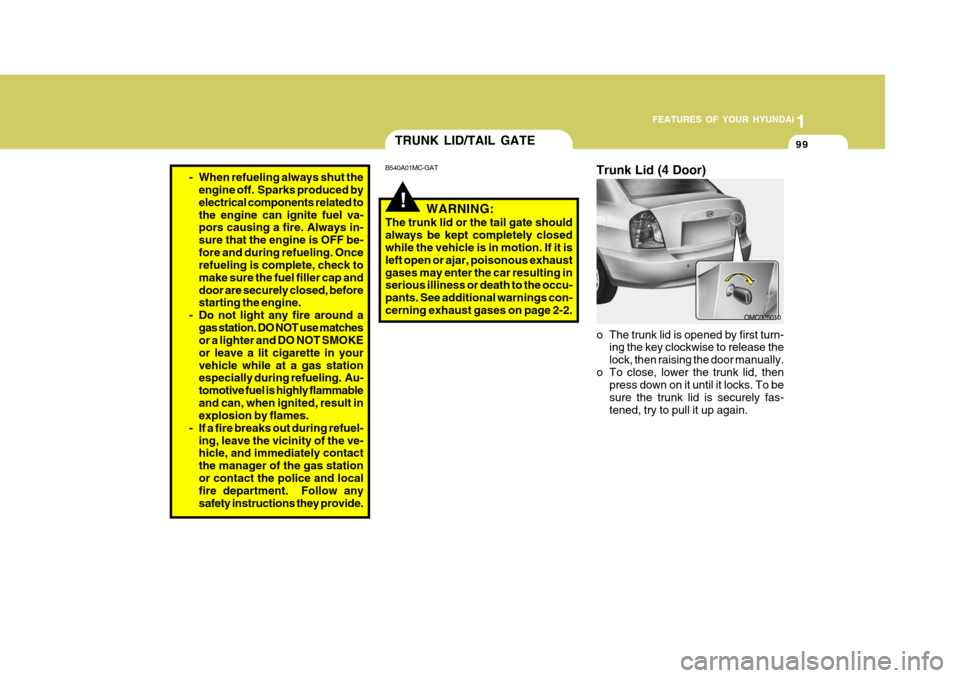
o The trunk lid is opened by first turn-
ing the key clockwise to release the lock, then raising the door manually.
o To close, lower the trunk lid, then press down on it until it locks. To besure the trunk lid is securely fas-tened, try to pull it up again.
OMC025010
Page 112 of 284
1FEATURES OF YOUR HYUNDAI
100
1JBA3113
LUGGAGE NET
B540D02O-AAT (If Installed)
B540D01MC
Type A
Type B
!WARNING:
The trunk lid should always be kept completely closed while the vehicle is in motion. If it is left open or ajar,exhaust gases may enter the car and serious illness may result.
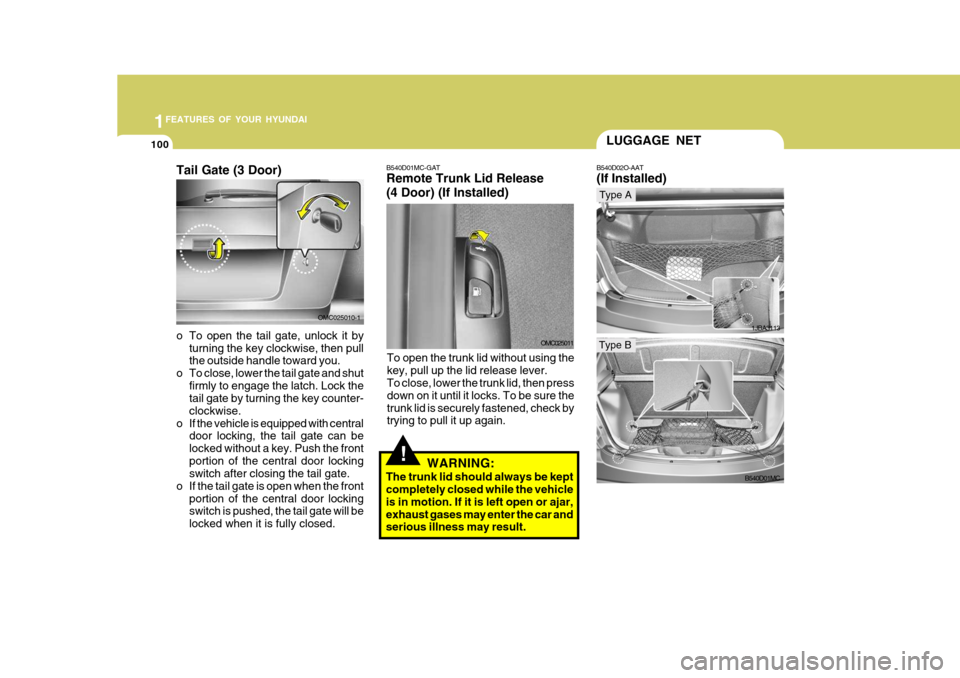
B540D01MC-GAT Remote Trunk Lid Release (4 Door) (If Installed)
OMC025011
To open the trunk lid without using the key, pull up the lid release lever. To close, lower the trunk lid, then press down on it until it locks. To be sure thetrunk lid is securely fastened, check by trying to pull it up again.
Tail Gate (3 Door)
o To open the tail gate, unlock it by
turning the key clockwise, then pull the outside handle toward you.
o To close, lower the tail gate and shut
firmly to engage the latch. Lock thetail gate by turning the key counter- clockwise.
o If the vehicle is equipped with central door locking, the tail gate can belocked without a key. Push the frontportion of the central door locking switch after closing the tail gate.
o If the tail gate is open when the front
portion of the central door lockingswitch is pushed, the tail gate will be locked when it is fully closed.
OMC025010-1
Page 114 of 284
1FEATURES OF YOUR HYUNDAI
102
!WARNING:
o Do not place the sun visor in such a manner that it obscures visibil- ity of the roadway, traffic or other objects.
o Do not move the sun visor out to cover the side window if there isan item attended to it such as agarage door remote control, pens, air fresheners or the like. These objects could cause injury if thecurtain airbag is deployed.
SUN VISOR
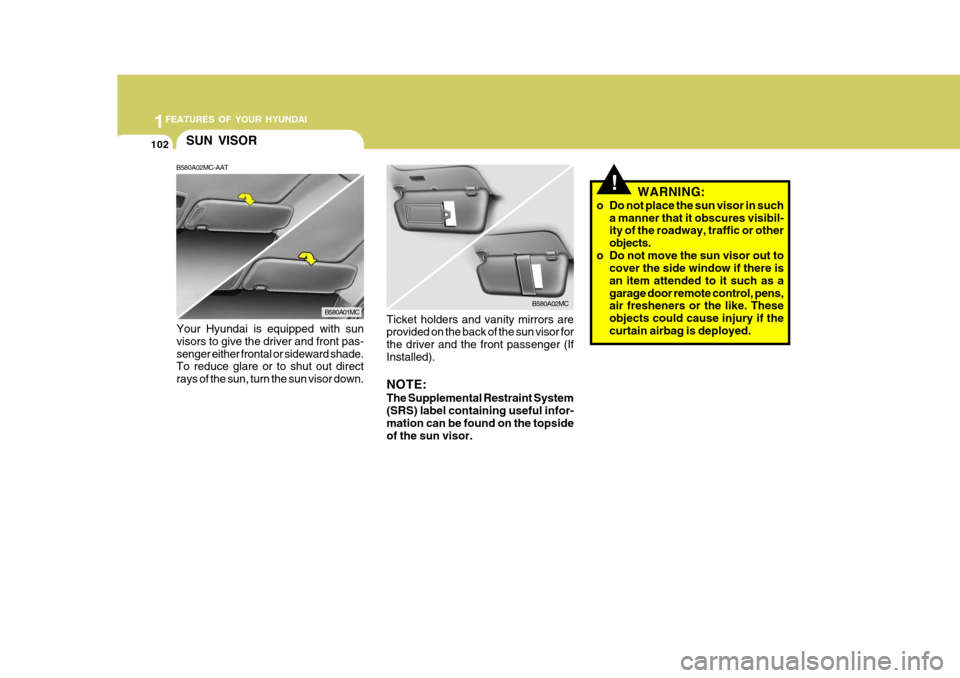
B580A02MC-AAT
B580A01MC
Your Hyundai is equipped with sun visors to give the driver and front pas- senger either frontal or sideward shade. To reduce glare or to shut out direct rays of the sun, turn the sun visor down. Ticket holders and vanity mirrors are provided on the back of the sun visor for the driver and the front passenger (IfInstalled). NOTE: The Supplemental Restraint System (SRS) label containing useful infor- mation can be found on the topsideof the sun visor.B580A02MC
Page 116 of 284
1FEATURES OF YOUR HYUNDAI
104HORN
B610B01L-GAT
Press the pad on the steering wheel to sound the horn.
OMC025046
!
STEERING WHEEL TILT LEVER
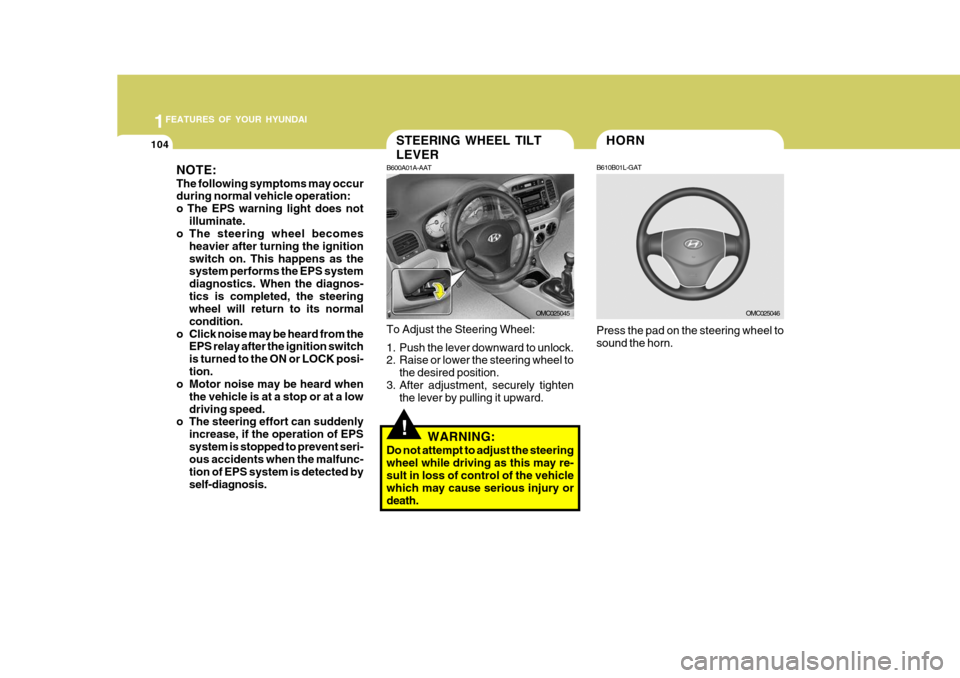
B600A01A-AAT To Adjust the Steering Wheel:
1. Push the lever downward to unlock.
2. Raise or lower the steering wheel to
the desired position.
3. After adjustment, securely tighten the lever by pulling it upward.
WARNING:
Do not attempt to adjust the steering wheel while driving as this may re-sult in loss of control of the vehicle which may cause serious injury or death.
OMC025045
NOTE: The following symptoms may occur during normal vehicle operation:
o The EPS warning light does not
illuminate.
o The steering wheel becomes
heavier after turning the ignitionswitch on. This happens as the system performs the EPS system diagnostics. When the diagnos-tics is completed, the steering wheel will return to its normal condition.
o Click noise may be heard from the EPS relay after the ignition switchis turned to the ON or LOCK posi-tion.
o Motor noise may be heard when
the vehicle is at a stop or at a lowdriving speed.
o The steering effort can suddenly
increase, if the operation of EPSsystem is stopped to prevent seri- ous accidents when the malfunc- tion of EPS system is detected byself-diagnosis.
Page 186 of 284
2 DRIVING YOUR HYUNDAI
24TRAILER OR VEHICLE TOWING
C190A03A-GAT If you are considering towing with your car, you should first check with your Province Department of Motor Vehicles to determine their legal requirements.Since laws vary from province to prov- ince, the requirements for towing trail- ers, cars, other types of vehicles, orapparatus may differ. Ask your Hyundai dealer for further details before towing. C190B01S-AAT Trailer Hitches Select the proper hitch and ball combi- nation, making sure that it's location iscompatible with that of the trailer or vehicle being towed. Use a quality non-equalizing hitch whichdistributes the tongue load uniformly throughout the chassis. The hitch should be bolted securely to the car and installed by a qualified technician. DO NOT USE A HITCHDESIGNED FOR TEMPORARY IN- STALLATION AND NEVER USE ONE THAT ATTACHES ONLY TO THEBUMPER.
!
CAUTION
Do not do any towing with your car during its first 2,000 km (1,200 miles)in order to allow the engine to prop- erly break in. Failure to heed this caution may result in serious en-gine or transaxle damage. NOTE - For Europe
o The technically permissible maxi-
mum load on the rear axle(s) may be exceeded by not more than 15% and the technically permissible maximum laden mass of the ve- hicle may be exceeded by not morethan 10 % or 100 kg (220.4 lbs), whichever value is lower. In this case, do not exceed 100 km/h (62.1mph) for vehicle of category M1 or 80 km/h (49.7 mph) for vehicle of category N1.
o When a vehicle of category M1 is towing a trailer, the additional loadimposed at the trailer couplingdevice may cause the tire maxi- mum load ratings to be exceeded, but not by more than 15 %. In thiscase, do not exceed 100 km/h (62.1 mph) and increase the tire infla- tion pressure by at least 0.2 bar.
Page 189 of 284

2
DRIVING YOUR HYUNDAI
27
2
DRIVING YOUR HYUNDAI
27
13. Avoid holding the brake pedal down too long or too frequently. This could cause the brakes to over- heat, resulting in reduced braking efficiency.
14. When going down a hill, shift into a lower gear and use the engine brak-ing effect.When ascending a long grade, downshift the transaxle to a lower gear and reduce speed to reducechances of engine overloading and/ or overheating.
15. If you have to stop while going uphill, do not hold the vehicle inplace by pressing on the accelera- tor. This can cause the automatictransaxle to overheat. Use the park- ing brake or footbrake.
NOTE: When towing check transaxle fluid more frequently.
When being passed by a large ve-hicle, keep a constant speed andsteer straight ahead. If there is too much wind buffeting, slow down to get out of the other vehicle's airturbulence.
8. When parking your car and trailer,
especially on a hill, be sure to fol-low all the normal precautions. Turn your front wheel into the curb, set the parking brake firmly, and putthe transaxle in 1st or Reverse (manual) or Park (automatic). In addition, place wheel chocks ateach of the trailer's tires.
9. If the trailer has electric brakes,
start your vehicle and trailer mov-ing, and then apply the trailer brake controller by hand to be sure the brakes are working. This lets youcheck your electrical connection at the same time.
10. During your trip, check occasion- ally to be sure that the load issecure, and that the lights and any trailer brakes are still working.
11. Avoid jerky starts, sudden accel- eration or sudden stops.
12. Avoid sharp turns and rapid lane changes.
C190F02A-GAT Trailer or Vehicle Towing Tips
1. Before towing, check hitch and
safety chain connections as well as proper operation of the trailer running lights, brake lights, and turn signals.
2. Always drive your vehicle at a mod- erate speed (Less than 100 km/h).
3. Trailer towing requires more fuel than normal conditions.
4. To maintain engine braking effi-
ciency, do not tow a trailer withtransaxle in fifth gear (manual transaxle) or an overdrive gear (au- tomatic transaxle).
5. Always secure items in the trailer to prevent load shift while driving.
6. Check the condition and air pres- sure of all tires on the trailer and your car. Low tire pressure can seriously affect the handling. Alsocheck the spare tire.
7. The vehicle/trailer combination is
more affected by crosswind andbuffeting.
Page 192 of 284
3 WHAT TO DO IN AN EMERGENCY
2
!
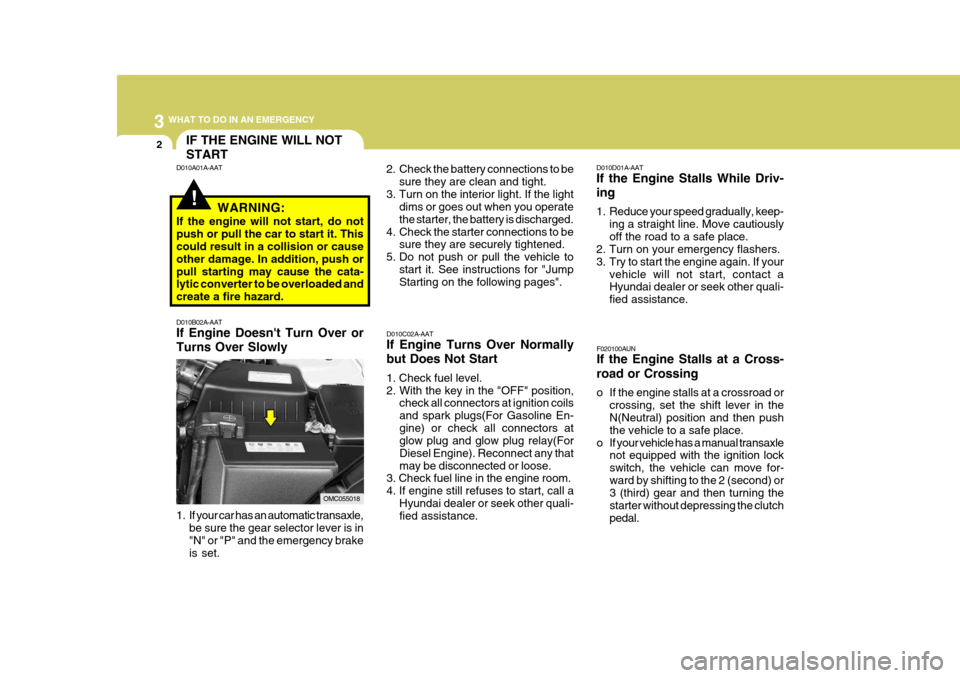
D010B02A-AAT If Engine Doesn't Turn Over or Turns Over Slowly
1. If your car has an automatic transaxle,
be sure the gear selector lever is in "N" or "P" and the emergency brake is set. D010C02A-AAT If Engine Turns Over Normally but Does Not Start 1. Check fuel level. 2. With the key in the "OFF" position,
check all connectors at ignition coilsand spark plugs(For Gasoline En-gine) or check all connectors at glow plug and glow plug relay(For Diesel Engine). Reconnect any thatmay be disconnected or loose.
3. Check fuel line in the engine room.4. If engine still refuses to start, call a
Hyundai dealer or seek other quali- fied assistance. D010D01A-AAT If the Engine Stalls While Driv- ing
1. Reduce your speed gradually, keep-
ing a straight line. Move cautiously off the road to a safe place.
2. Turn on your emergency flashers.
3. Try to start the engine again. If your
vehicle will not start, contact a Hyundai dealer or seek other quali- fied assistance.
D010A01A-AAT
IF THE ENGINE WILL NOT START
WARNING:
If the engine will not start, do not push or pull the car to start it. This could result in a collision or cause other damage. In addition, push orpull starting may cause the cata- lytic converter to be overloaded and create a fire hazard.
OMC055018 2. Check the battery connections to be
sure they are clean and tight.
3. Turn on the interior light. If the light dims or goes out when you operate the starter, the battery is discharged.
4. Check the starter connections to be sure they are securely tightened.
5. Do not push or pull the vehicle to start it. See instructions for "Jump Starting on the following pages".
F020100AUN If the Engine Stalls at a Cross- road or Crossing
o If the engine stalls at a crossroad orcrossing, set the shift lever in the N(Neutral) position and then push the vehicle to a safe place.
o If your vehicle has a manual transaxle not equipped with the ignition lockswitch, the vehicle can move for-ward by shifting to the 2 (second) or 3 (third) gear and then turning the starter without depressing the clutchpedal.