Oil Hyundai Accent 2010 User Guide
[x] Cancel search | Manufacturer: HYUNDAI, Model Year: 2010, Model line: Accent, Model: Hyundai Accent 2010Pages: 284, PDF Size: 10.23 MB
Page 164 of 284
2 DRIVING YOUR HYUNDAI
2
C010A01A-AAT
WARNING: ENGINE EXHAUST CAN BE DANGEROUS!
Engine exhaust fumes can be extremely dangerous. If, at any time, you smell exhaust fumes inside the vehicle, open the windows immediately. o Do not inhale exhaust fumes. Exhaust fumes contain carbon monoxide, a colorless, odorless gas that can cause unconsciousness and death by asphyxiation. o Be sure the exhaust system does not leak. The exhaust system should be checked whenever the vehicle is raised to change the oil or for any other purpose. If you hear a change in the sound of the exhaust or if you drive over something that strikes the underneath sideof the car, have the exhaust system checked as soon as possible by your Hyundai dealer. o Do not run the engine in an enclosed area. Letting the engine idle in your garage, even with the garage door open, is a hazardous practice. Never run the engine in your garage any longer than it takes to start the engine and back the car out. o Avoid idling the engine for prolonged periods with people inside the car. If it is necessary to idle the engine for a prolonged period with people inside the car, be sure to do so only in an open area with the air intake set at "Fresh" and fan operating at one of the higher speeds so fresh air is drawn into the interior. If you must drive with the trunk lid/tail gate open because you are carrying objects that make this necessary: 1. Close all windows. 2. Open side vents. 3. Set the air intake control at "Fresh", the air flow control at "Floor" or "Face" and the fan at one of the higher speeds.
To assure proper operation of the ventilation system, be sure the ventilation air intakes located just in front of the windshield are kept clear of snow, ice, leaves or other obstructions.
!
Page 165 of 284
2
DRIVING YOUR HYUNDAI
3
2
DRIVING YOUR HYUNDAI
3
!
BEFORE STARTING THE EN- GINE
C020A03O-GAT Before you start the engine, you should always:
1. Look around the vehicle to be sure
there are no flat tires, puddles of oil, water or other indications of pos- sible trouble.
2. After entering the car, check to be sure the parking brake is engaged.
3. Check that all windows, and lights are clean.
4. Check that the interior and exterior
mirrors are clean and in position.
5. Check your seat, seatback and headrest to be sure they are in theirproper positions.
6. Lock all the doors.
7. Fasten your seat belt and be sure
that all other occupants have fas- tened theirs.
8. Turn off all lights and accessories
that are not needed.
9. When you turn the ignition switch to "ON", check that all appropriatewarning lights are operating andthat you have sufficient fuel.
10.Check the operation of warning
lights and all bulbs when key is inthe "ON" position. WARNING:
(Diesel Engine)
To ensure that sufficient vacuum exists within the brake system dur-ing cold weather start-up condi- tions, it is necessary to run the engine at idle for several secondsafter starting the engine.TO START THE ENGINE
C030A01A-GAT COMBINATION IGNITION SWITCH
o If your Hyundai is equipped with a manual transaxle, place the shift lever in neutral and depress the clutch pedal fully.
o If your Hyundai has an automatic
transaxle, place the shift lever in "P"(park).
o To start the engine, insert the igni- tion key and turn it to the "START"position. Release it as soon as the engine starts. Do not hold the key inthe "START" position for more than 15 seconds.
NOTE: For safety, the engine will not start if the shift lever is not in "P" or "N" position (Automatic transaxle).
!WARNING:
o Always wear appropriate shoes when operating your vehicle. Unsuitable shoes (high heels, skiboots, etc.) may interfere with your ability to use the brake and accel- erator pedal, and the clutch (ifinstalled).
o When you intend to park or stop
the vehicle with the engine on, becareful not to depress the accel- erator pedal for a long period of time. It may overheat the engine orexhaust system and cause fire.
Page 184 of 284

2 DRIVING YOUR HYUNDAI
22
C160H01A-AAT Use Approved Anti-Freeze in Window Washer System To keep the water in the window washer system from freezing, add an approvedanti-freeze solution in accordance with instructions on the container. Window washer anti-freeze is available fromHyundai dealers and most auto parts outlets. Do not use engine coolant or other types of anti-freeze as thesemay damage the finish. C160I01A-AAT Don't Let Your Parking Brake Freeze Under some conditions your parking brake can freeze in the engaged posi- tion. This is most likely to happen when there is an accumulation of snowor ice around or near the rear brakes or if the brakes are wet. If there is a risk the parking brake may freeze, apply itonly temporarily while you put the gear selector lever in "P" (automatic) or in first or reverse gear (manual transaxle)and block the rear wheels so the car cannot roll. Then release the parking brake.
C160G01A-GAT To Keep Locks from Freezing To keep the locks from freezing, squirt an approved de-icer fluid or glycerine into the key opening. If a lock is cov- ered with ice, squirt it with an approved de-icing fluid to remove the ice. If thelock is frozen internally, you may be able to thaw it out by using a heated key. Handle the heated key with careto avoid injury. NOTE: The proper temperature for using the immobilizer key is from -40°C(-40°F) to 80°C(176°F). If you heat the immobilizer key over 80°C (176°F) to open the frozen lock, itmay cause damage to the transpon- der in its head.
C160F02A-AAT Check Spark Plugs and Ignition System Inspect your spark plugs and replace them if necessary. Also check allignition wiring and components to be sure they are not cracked, worn or damaged in any way.
C160D01A-AAT Check Battery and Cables Winter puts additional burdens on the battery system. Visually inspect thebattery and cables as described in Section 6. The level of charge in your battery can be checked by your Hyun-dai dealer or a service station. C160E01A-AAT Change to "Winter Weight" Oil if Necessary In some climates it is recommended that a lower viscosity "winter weight"oil be used during cold weather. See Section 9 for recommendations. If you aren't sure what weight oil you shoulduse, consult your Hyundai dealer.
Page 185 of 284
2
DRIVING YOUR HYUNDAI
23
2
DRIVING YOUR HYUNDAI
23HIGHER SPEED MOTORING
C160K01A-AAT Carry Emergency Equipment Depending on the severity of the weather where you drive your car, you should carry appropriate emergencyequipment. Some of the items you may want to carry include tire chains, tow straps or chains, flashlight, emer-gency flares, sand, a shovel, jumper cables, a window scraper, gloves, ground cloth, coveralls, a blanket, etc.
C160J01A-AAT Don't Let Ice and Snow Accumu- late Underneath Under some conditions, snow and ice can build up under the fenders andinterfere with the steering. When driv- ing in severe winter conditions where this may happen, you should periodi-cally check underneath the car to be sure the movement of the front wheels and the steering components is notobstructed.
C170A01A-AAT Pre-Trip Inspections 1. Tires: Adjust the tire inflation pressures to specification. Low tire inflation pres-sures will result in overheating and possible failure of the tires. Avoid using worn or damaged tireswhich may result in reduced traction or tire failure. NOTE: Never exceed the maximum tire in- flation pressure shown on the tires.
2. Fuel, engine coolant and
engine oil:
High speed travel consumes more fuel than urban motoring. Do not forget tocheck both engine coolant and engine oil. 3. Drive belt: A loose or damaged drive belt may result in overheating of the engine.USE OF LIGHTS
C180A01A-AAT Check your lights regularly for correct operation and always keep them clean. When driving during the day in condi- tions of poor visibility, it is helpful todrive with headlights on low beam. This enables you to be seen as well as to see.
Page 192 of 284
3 WHAT TO DO IN AN EMERGENCY
2
!
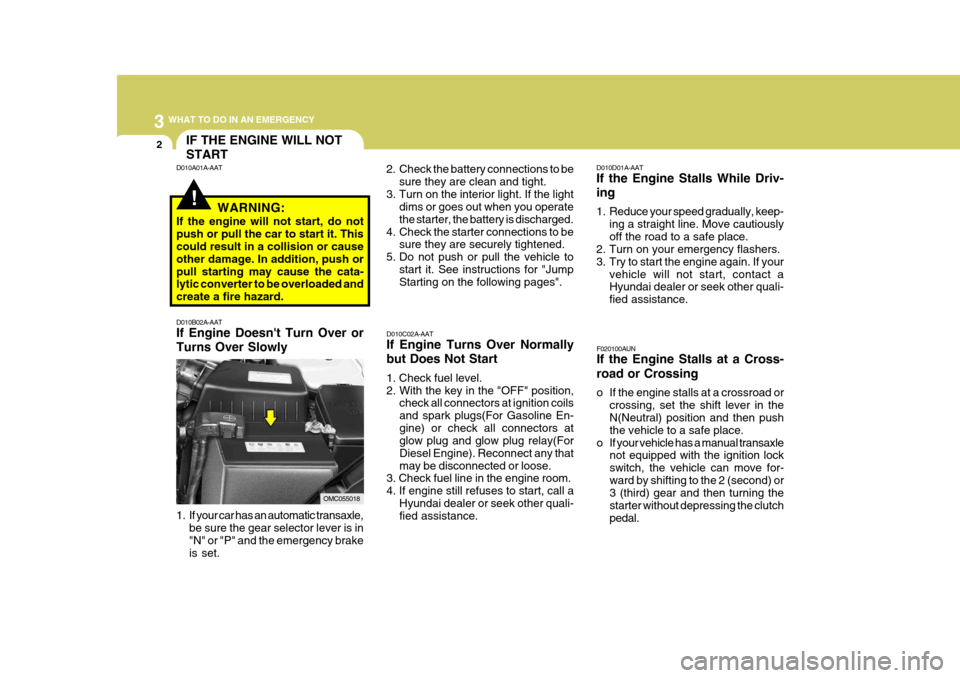
D010B02A-AAT If Engine Doesn't Turn Over or Turns Over Slowly
1. If your car has an automatic transaxle,
be sure the gear selector lever is in "N" or "P" and the emergency brake is set. D010C02A-AAT If Engine Turns Over Normally but Does Not Start 1. Check fuel level. 2. With the key in the "OFF" position,
check all connectors at ignition coilsand spark plugs(For Gasoline En-gine) or check all connectors at glow plug and glow plug relay(For Diesel Engine). Reconnect any thatmay be disconnected or loose.
3. Check fuel line in the engine room.4. If engine still refuses to start, call a
Hyundai dealer or seek other quali- fied assistance. D010D01A-AAT If the Engine Stalls While Driv- ing
1. Reduce your speed gradually, keep-
ing a straight line. Move cautiously off the road to a safe place.
2. Turn on your emergency flashers.
3. Try to start the engine again. If your
vehicle will not start, contact a Hyundai dealer or seek other quali- fied assistance.
D010A01A-AAT
IF THE ENGINE WILL NOT START
WARNING:
If the engine will not start, do not push or pull the car to start it. This could result in a collision or cause other damage. In addition, push orpull starting may cause the cata- lytic converter to be overloaded and create a fire hazard.
OMC055018 2. Check the battery connections to be
sure they are clean and tight.
3. Turn on the interior light. If the light dims or goes out when you operate the starter, the battery is discharged.
4. Check the starter connections to be sure they are securely tightened.
5. Do not push or pull the vehicle to start it. See instructions for "Jump Starting on the following pages".
F020100AUN If the Engine Stalls at a Cross- road or Crossing
o If the engine stalls at a crossroad orcrossing, set the shift lever in the N(Neutral) position and then push the vehicle to a safe place.
o If your vehicle has a manual transaxle not equipped with the ignition lockswitch, the vehicle can move for-ward by shifting to the 2 (second) or 3 (third) gear and then turning the starter without depressing the clutchpedal.
Page 213 of 284
44CORROSION PREVENTION AND APPEARANCE CARE
6CLEANING THE INTERIOR
E040B01A-AAT To Clean the Leather Upholstery (If Installed) In the normal course of use, leather upholstered surfaces will, like anymaterial, pick-up dust and dirt. This dust and dirt must be cleaned off or it may work into the surface of the leather,causing damage. Fine leather needs care, and should be cleaned when necessary. Washing leather thoroughly with soap and water will keep your leather lustrous, beauti-ful and ensure you have many years of wear. Take a piece of cheese cloth and usingany mild soap and lukewarm water, work up a good lather. Thoroughly wash the leather. Wipe clean with aslightly damp cloth and dry with soft cloth. Do this as often as the leather becomes soiled.
E040A01A-AAT To Clean the Vinyl Upholstery To clean the vinyl upholstery, first re- move loose dirt and dust with a vacuumcleaner. Then apply a solution of mild soap or detergent and water using a clean sponge or soft cloth. Allow this tostay on the surface to loosen the dirt, then wipe with a clean damp sponge or cloth. If all the dirt stains are not re-moved, repeat this procedure until the upholstery is clean. Do not use gaso- line, solvent, paint thinner or otherstrong cleaners.
E030D01A-AAT When to Wax Again You should polish and wax the car again when water no longer beads ona clean surface but spreads out over a larger area. E030E01A-AAT Maintaining Bumpers Special precautions must be observed to preserve the appearance of the bumpers on your Hyundai. They are:
o Be careful not to spill battery elec-
trolyte or hydraulic brake fluid on the bumpers. If you do, wash it off im-mediately with clear water.
o Be gentle when cleaning the bumper
surfaces. They are made of softplastic and the surface can be dam- aged if mistreated. Do not use abra- sive cleaners. Use warm water andmild soap or car-washing solution.
o Do not expose the bumpers to high
temperatures. For example, if youhave your car repainted, do not leave the bumpers on the car if the car is going to be placed in a high-temperature paint booth.
Page 214 of 284

4
CORROSION PREVENTION AND APPEARANCE CARE
7
4
CORROSION PREVENTION AND APPEARANCE CARE
7
E040E01A-AAT Cleaning the Windows You may use any household window cleaner on the windows. However, when cleaning the inside of the rear window be careful not to damage therear window defroster wiring.
E040D01A-AAT Cleaning the Seat Belts To clean the seat belts, use a cloth or sponge with mild soap or detergentand warm water. Do not use strong detergents, dye, bleach or abrasive materials on the seat belts as this mayweaken the fabric. While cleaning the belts, inspect them for excessive wear, cuts, fraying orother signs of damage and replace them if necessary.
E040C01A-AAT Cleaning the Carpets Use a foam-type carpet cleaner. Clean- ers of this type are available in aerosolcans in liquid form or powder. Read the instructions and follow them exactly. Using a vacuum cleaner with the ap-propriate attachment, remove as much dirt from the carpets as possible. Apply the foam following the manufacturer'sdirections, then rub in overlapping circles. Do not add water. These clean- ers work best when the carpet is keptas dry as possible.
During tanning operations, sufficientoils are incorporated through process-ing that none need be applied during the life of the leather. Oil applied to the finished surface will in no way help theleather and may do more harm than good. Varnishes and furniture polishes should never be used under any con-ditions.
!
CAUTION:
When cleaning leather products (steering wheel, seats etc.), use neu- tral detergents or low alcohol con-tent solutions. If you use high alco- hol content solutions or acid/alka- line detergents, the color of the leathermay fade or the surface may get stripped off.
Page 217 of 284
5VEHICLE MAINTENANCE REQUIREMENTS
2MAINTENANCE INTERVALS
F010C01A-GAT
Specified Scheduled Procedures
These are the procedures such as
inspections, adjustments and replace- ments that are listed in the mainte-nance charts starting on page 5-4. These procedures must be performed at the intervals shown in the mainte-nance schedule to assure that your warranty remains in effect. Although it is strongly recommended that they beperformed by the factory-trained or distributor-trained technicians at your Hyundai dealer, these procedures maybe performed at any qualified service facility. F010D01A-GAT
General Checks
These are the regular checks you should perform when you drive your Hyundai or you fill the fuel tank. A list of these items will be found on page6-5.
F010A01A-GAT Service Requirements To assure that you receive the great- est number of kilometers of satisfying operation from your Hyundai, certain maintenance procedures must beperformed. Although careful design and engineering have reduced these to a minimum, those that are requiredare of the utmost importance.It is your responsibility to have thesemaintenance procedures performed to comply with the terms of the war- ranties covering your new Hyundai.The Service Passport supplied with your new vehicle provides further in- formation about these warranties.
F010B01A-AAT
Maintenance Requirements
The maintenance required for your
Hyundai can be divided into three main areas:
o Specified scheduled procedures
o General checks
o Do-it-yourself maintenance It is suggested that genuine Hyundai
service parts be used for any requiredrepairs or replacements. Other parts of equivalent quality such as engine oil, engine coolant, manual or autotransaxle oil, brake fluid and so on which are not supplied by Hyundai Motor Company or its distributor maybe used without affecting your war- ranty coverage but you should always be sure these are equivalent to thequality of the original Hyundai parts. Your Service Passport provides fur- ther information about your warrantycoverage.
Page 219 of 284
5VEHICLE MAINTENANCE REQUIREMENTS
4SCHEDULED MAINTENANCE
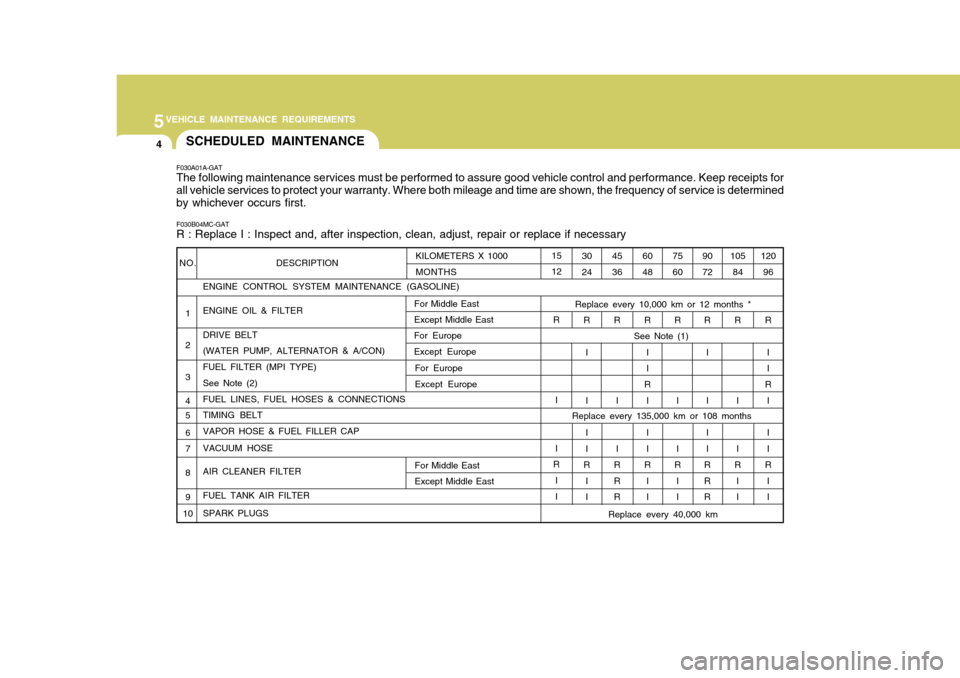
F030A01A-GAT The following maintenance services must be performed to assure good vehicle control and performance. Keep receipts for
all vehicle services to protect your warranty. Where both mileage and time are shown, the frequency of service is determinedby whichever occurs first. F030B04MC-GAT R : Replace I : Inspect and, after inspection, clean, adjust, repair or replace if necessary
ENGINE CONTROL SYSTEM MAINTENANCE (GASOLINE) ENGINE OIL & FILTERDRIVE BELT (WATER PUMP, ALTERNATOR & A/CON) FUEL FILTER (MPI TYPE) See Note (2) FUEL LINES, FUEL HOSES & CONNECTIONS TIMING BELT VAPOR HOSE & FUEL FILLER CAP VACUUM HOSE AIR CLEANER FILTER FUEL TANK AIR FILTER SPARK PLUGS
NO. DESCRIPTION10584
R
I I
R
I I 120
96
R II
R I I I
R
I I
9072
R I I I I
RR R
7560
R
I I
R
I I
6048
R II
R I I I
R
I I
4536
R
I I
R R R
3024
R I I I I
R
I I
1512
R
I I
R
I I
KILOMETERS X 1000MONTHS
Replace every 40,000 km
For Middle East Except Middle East
Replace every 10,000 km or 12 months *For Middle East Except Middle East
For Europe Except Europe
Replace every 135,000 km or 108 months
1 23 4 5 6 7 8 9
10 For Europe Except Europe
See Note (1)
Page 220 of 284

5
VEHICLE MAINTENANCE REQUIREMENTS
5
F030D04MC-GAT R :Replace I : Inspect and, after Inspection, clean, adjust, repair or replace if necessary
ENGINE CONTROL SYSTEM MAINTENANCE (DIESEL) ENGINE OIL & FILTER See Note (1)AIR CLEANER FILTER
FUEL FILTER CARTRIDGESee Note (2)
DRIVE BELT (FOR P/STR'G PUMP, ALTERNATOR & A/CON)FUEL LINES, FUEL HOSE & CONNECTIONS
NO. DESCRIPTION
1 23
4 5 120
96
I
R R
I105 84
I I90 72R I
R
I75 60
I I60 48 I
RR
I45 36
R
I30 24 II
R
I
1512
I IKILOMETERS X 1000 MONTHS
Note : (1) Every 500 km or before starting a long trip : "I" (2) This interval depends on fuel quality. It is applicable only when using a qualified fuel, "EN 590 or equivalent". If the die sel
fuel specifications don't meet the European standards EN 590, replace it more frequently. Consult an authorized Hyundai dealer for details.In case of low engine power or fuel pressure decrease of the fuel filter, replace fuel filter immediately regardless of maintenance schedule.
(3) At first, inspect at 80,000 km or 48 months : after that, inspect every 20,000 km or 12 months.
For Europe Except Europe Replace every 10,000 km or 12 months
For Europe Except Europe
Replace every 20,000 km or 12 months
Note : * Driving in summer season temperature over 40°C (104°F - SAUDI, UAE, OMAN, KUWAIT, BAHRAIN, QATAR, IRAN,YEMEN
ETC) or driving over 170 km/h must conform the severe driving condition.
(1) At first, inspect at 90,000 km or 72 months : after that, inspect every 30,000 km or 24 months. (2) In case of hard starting or abnormal fuel pressure, replace the fuel filter immediately regardless of maintenance schedule.
See Note (3)