coolant temperature Hyundai Accent 2010 User Guide
[x] Cancel search | Manufacturer: HYUNDAI, Model Year: 2010, Model line: Accent, Model: Hyundai Accent 2010Pages: 284, PDF Size: 10.23 MB
Page 242 of 284
6 DO-IT-YOURSELF MAINTENANCE
16
!!WARNING:
The cooling fan is controlled by en- gine coolant temperature and may sometimes operate even when the engine is not running. Use extremecaution when working near the blades of the cooling fan, so that you are not injured by a rotating fan blade. As theengine coolant temperature decreas- es, the fan will automatically shut off. This is a normal condition. WARNING (
Diesel only):
Never work on injection system withengine running or within 30 seconds after shutting off engine. High pres- sure pump, rail, injectors and highpressure pipes are subjected to high pressure even after the engine has been switched off. The fuel jet pro-duced by fuel leaks may cause seri- ous injury, if it contacts with the body. People using pacemakersshould not move closer than 30cm to the ECU or wiring harness within the engine room with the engine run-ning, since the high currents in the Common Rail system produce con- siderable magnetic fields.
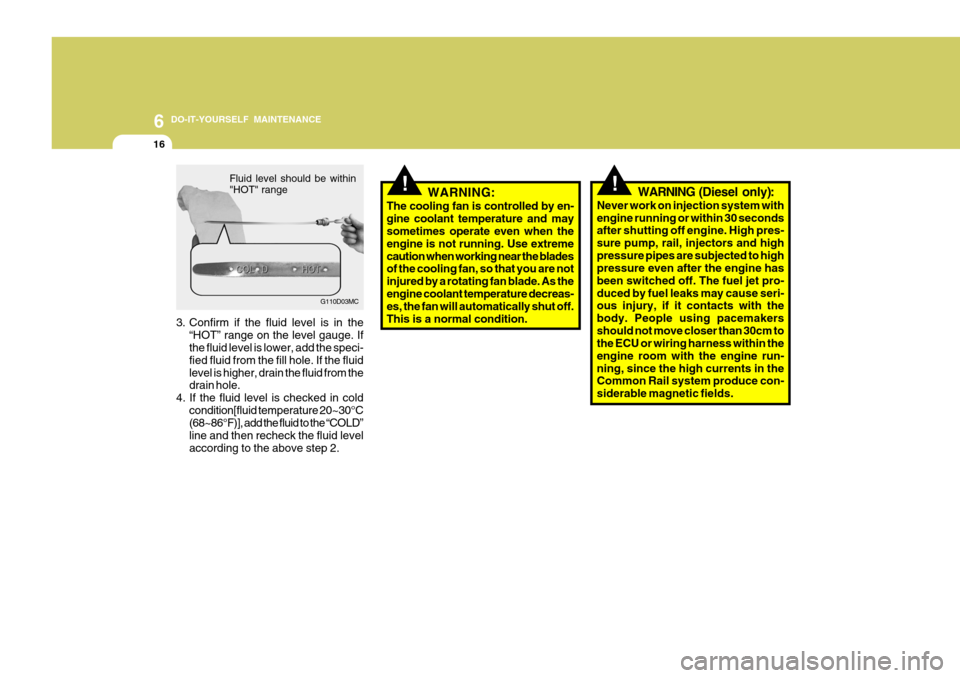
G110D03MC
Fluid level should be within "HOT" range
3. Confirm if the fluid level is in the “HOT” range on the level gauge. If the fluid level is lower, add the speci- fied fluid from the fill hole. If the fluidlevel is higher, drain the fluid from the drain hole.
4. If the fluid level is checked in cold
condition[fluid temperature 20~30°C(68~86°F)], add the fluid to the “COLD” line and then recheck the fluid levelaccording to the above step 2.
Page 250 of 284
6 DO-IT-YOURSELF MAINTENANCE
24
o When lifting a plastic-cased bat-
tery, excessive pressure on the case may cause battery acid to leak, resulting in personal injury.Lift with a battery carrier or with your hands on opposite corners.
o Never attempt to charge the bat-
tery when the battery cables areconnected.
o The electrical ignition system
works with high voltage.Never touch these components with the engine running or the ignition switched on.
CHECKING ELECTRIC COOLING FANS
!
G220B01A-AAT Checking Engine Cooling Fan The engine cooling fan should come on automatically if the engine coolant tem-perature is high. G220C01TB-GAT Checking Condenser Cooling Fan When the air conditioning is in opera- tion, the condenser cooling fan comeson automatically to be controlled by ECU.G220A01A-AAT
WARNING:
The cooling fan is controlled by en- gine coolant temperature and may sometimes operate even when the engine is not running. Use extremecaution when working near the blades of the cooling fan, so that you are not injured by a rotating fanblade. As the engine coolant temper- ature decreases the fan will automat- ically shut off. This is a normal con-dition.
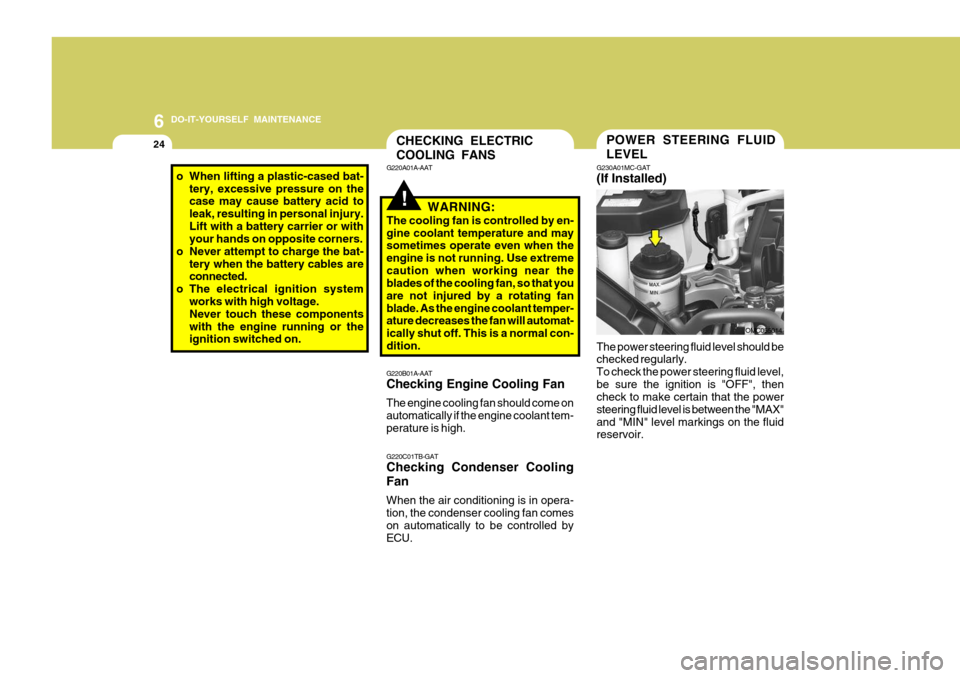
POWER STEERING FLUID LEVEL
G230A01MC-GAT (If Installed) The power steering fluid level should be checked regularly. To check the power steering fluid level,be sure the ignition is "OFF", then check to make certain that the power steering fluid level is between the "MAX"and "MIN" level markings on the fluid reservoir. OMC055014
Page 266 of 284
7EMISSION CONTROL SYSTEMS
2EMISSION CONTROL SYSTEM
H010A01A-GAT
(If Installed)
Your Hyundai is equipped with an
emission control system to meet all requirements of the Emission prohibi- tion rules of your province. There are three emission control sys-
tems which are as follows.
1) Crankcase emission control sys- tem
2) Evaporative emission control sys-
tem
3) Exhaust emission control system
In order to assure the proper function
of the emission control systems, it is recommended that you have your car inspected and maintained by an au- thorized Hyundai dealer in accordancewith the maintenance schedule in this manual. H010B01A-AAT
1. Crankcase Emission Control
System
The positive crankcase ventilation
system is employed to prevent airpollution caused by blow-by gases being emitted from the crankcase.This system supplies fresh air to the crankcase through the air intake hose. Inside the crankcase, the fresh airmixes with blow-by gases, which then pass through the PCV valve and into the induction system.
H010C02E-GAT
2. Evaporative Emission
Control System
The Evaporative Emission Control
System is designed to prevent fuelvapors from escaping into the atmo-sphere. Canister
Fuel vapors generated inside the fuel
tank are absorbed and stored in the canister. When the engine is running, the fuel vapors absorbed in the can-ister are drawn into the induction sys-tem through the purge control sole- noid valve. Purge Control Solenoid Valve (PCSV)
The purge control solenoid valve is
controlled by the Engine Control Mod- ule (ECM); when the engine coolant temperature is low during idling, the PCSV closes so that evaporated fuelis not taken into the engine. After the engine warms-up during ordinary driv- ing, the PCSV opens so as to intro-duce evaporated fuel to the engine. H010D01A-AAT
3. Exhaust Emission Control
System
The exhaust emission control system is a highly effective system which controls exhaust emission while main-taining good vehicle performance.
Page 282 of 284

10
INDEX
3
E Electronic Stability Program ...................................... 2-14
Emission Contro l System ............................................ 7-2
Engine Before starting the engine ....................................... 2-3
Compartment ........................................................... 6-2
Coolant ................................................................... 6-10
If the engine overheats ............................................. 3-4
Number ..................................................................... 8-3
Oil ............................................................................. 6-6 Starting ..................................................................... 2-5
Emergency Commodity ............................................. 3-12
Engine Exhaust Can Be Dangerous ............................ 2-2
F Floor Mat Anchor ..................................................... 1-101
Fog Light
Front ....................................................................... 1-83
Rear ........................................................................ 1-84
Front Seats Adjustable front seats ............................................. 1-17
Adjusting seat forward and rearward .......................1-17
Adjusting seatback angle ....................................... 1-17
Headrest ................................................................. 1-18
Seat warmer ........................................................... 1-20
Fuel Capacity ................................................................... 9-2
Gauge ..................................................................... 1-69
Recommendations .................................................... 1-2 Fuel Filler Lid
Remote release ...................................................... 1-97
Fuses ........................................................................ 6-20
Fuse Panel description .............................................. 6-35
G General Checks ........................................................... 6-5
Glove Box ................................................................. 1-91
H Hazard Warning System ............................................ 1-82
Headlight Aiming Adjustment..................................... 6-26
Headlight Leveling Device S ystem ............................1-82
Heating and Cooling Control ....................................1-105
Heating and Ventilation ............................................ 1-106
Air flow control ...................................................... 1-107
Air intake control .................................................. 1-106
Bi-level heati ng ..................................................... 1-110
Defrosting/Defogging ............................................. 1-110
Fan speed control ................................................. 1-106
Temperature control .............................................. 1-109
High-Mounted Rear Stop Light................................... 1-95
Hood Release ............................................................ 1-96
Horn ......................................................................... 1-104
I Immobilizer System ..................................................... 1-6
Instrument Cluster and Indicator Lights ..................... 1-56
Interior Light Interior light ............................................................. 1-90