fuel Hyundai Accent 2010 Owner's Guide
[x] Cancel search | Manufacturer: HYUNDAI, Model Year: 2010, Model line: Accent, Model: Hyundai Accent 2010Pages: 284, PDF Size: 10.23 MB
Page 195 of 284
3
WHAT TO DO IN AN EMERGENCY
5SPARE TIRE
!!WARNING (Diesel Only):
Never work on injection system with engine running or within 30 sec- onds after shutting off engine. High pressure pump, rail, injectors andhigh pressure pipes are subject to high pressure even after the engine stopped. The fuel jet produced byfuel leaks may cause serious in- jury, if it touch the body. People using pacemakers should not movethan 30cm closer to the ECU or wiring harness within the engine room while engine is running, sincethe high currents in the Common Rail system produce considerable magnetic fields. WARNING:
Do not remove the radiator cap whenthe engine is hot. This may result incoolant being blown out of the open- ing and cause serious burns.
6. If you cannot find the cause of the overheating, wait until the engine temperature has returned to nor-mal. Then, if the engine coolant has been lost, carefully add coolant to the reservoir (Page 6-11) to bring thefluid level in the reservoir up to the halfway mark.
7. Proceed with caution, keeping alert
for further signs of overheating. Ifoverheating happens again, call a Hyundai dealer for assistance.
!
5. If the water pump drive belt is broken
or coolant is leaking out, stop the engine immediately and call the near- est Hyundai dealer for assistance. CAUTION:
Serious loss of engine coolant indi- cates there is a leak in the coolingsystem and this should be checked as soon as possible by a Hyundai dealer.
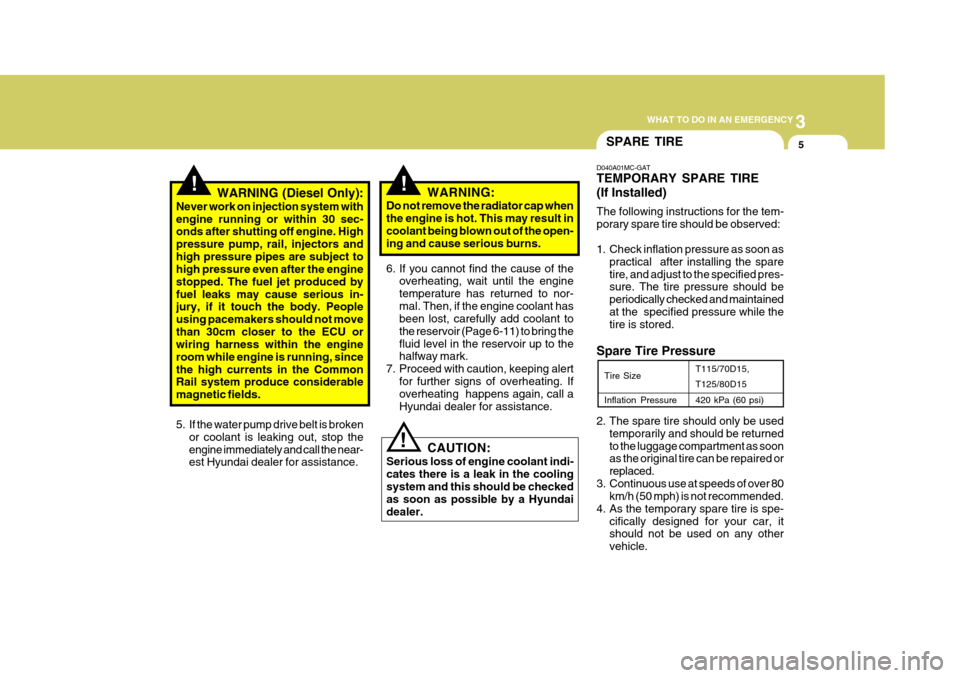
Inflation Pressure
Tire Size
T115/70D15, T125/80D15 420 kPa (60 psi)
2. The spare tire should only be used temporarily and should be returned to the luggage compartment as soon as the original tire can be repaired or replaced.
3. Continuous use at speeds of over 80 km/h (50 mph) is not recommended.
4. As the temporary spare tire is spe-
cifically designed for your car, it should not be used on any other vehicle.
D040A01MC-GAT TEMPORARY SPARE TIRE (If Installed) The following instructions for the tem- porary spare tire should be observed:
1. Check inflation pressure as soon as
practical after installing the spare tire, and adjust to the specified pres- sure. The tire pressure should be periodically checked and maintainedat the specified pressure while the tire is stored.
Spare Tire Pressure
Page 217 of 284
5VEHICLE MAINTENANCE REQUIREMENTS
2MAINTENANCE INTERVALS
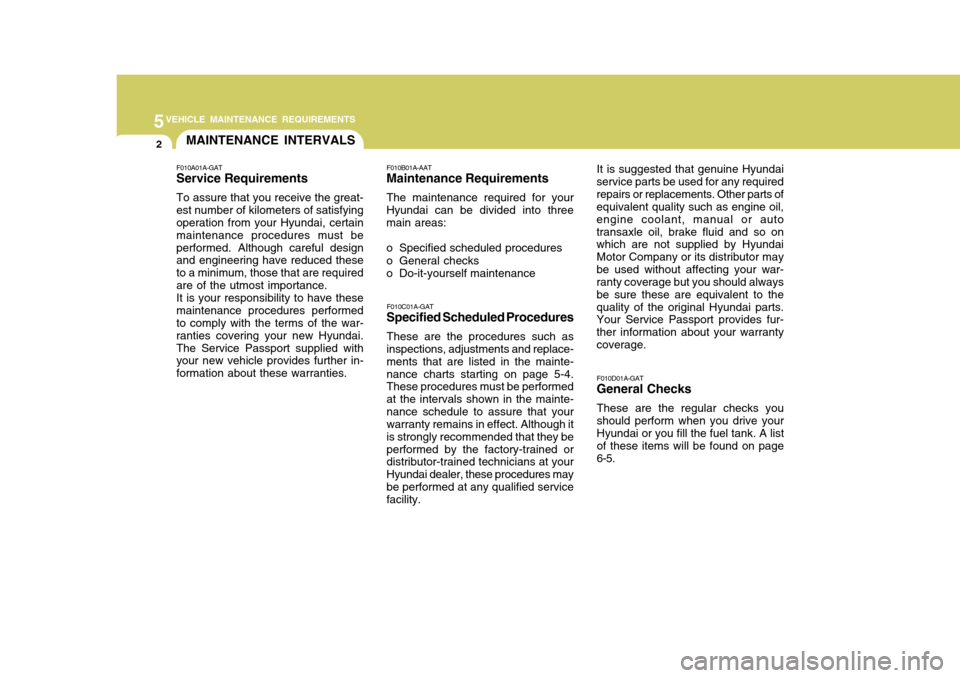
F010C01A-GAT
Specified Scheduled Procedures
These are the procedures such as
inspections, adjustments and replace- ments that are listed in the mainte-nance charts starting on page 5-4. These procedures must be performed at the intervals shown in the mainte-nance schedule to assure that your warranty remains in effect. Although it is strongly recommended that they beperformed by the factory-trained or distributor-trained technicians at your Hyundai dealer, these procedures maybe performed at any qualified service facility. F010D01A-GAT
General Checks
These are the regular checks you should perform when you drive your Hyundai or you fill the fuel tank. A list of these items will be found on page6-5.
F010A01A-GAT Service Requirements To assure that you receive the great- est number of kilometers of satisfying operation from your Hyundai, certain maintenance procedures must beperformed. Although careful design and engineering have reduced these to a minimum, those that are requiredare of the utmost importance.It is your responsibility to have thesemaintenance procedures performed to comply with the terms of the war- ranties covering your new Hyundai.The Service Passport supplied with your new vehicle provides further in- formation about these warranties.
F010B01A-AAT
Maintenance Requirements
The maintenance required for your
Hyundai can be divided into three main areas:
o Specified scheduled procedures
o General checks
o Do-it-yourself maintenance It is suggested that genuine Hyundai
service parts be used for any requiredrepairs or replacements. Other parts of equivalent quality such as engine oil, engine coolant, manual or autotransaxle oil, brake fluid and so on which are not supplied by Hyundai Motor Company or its distributor maybe used without affecting your war- ranty coverage but you should always be sure these are equivalent to thequality of the original Hyundai parts. Your Service Passport provides fur- ther information about your warrantycoverage.
Page 219 of 284
5VEHICLE MAINTENANCE REQUIREMENTS
4SCHEDULED MAINTENANCE
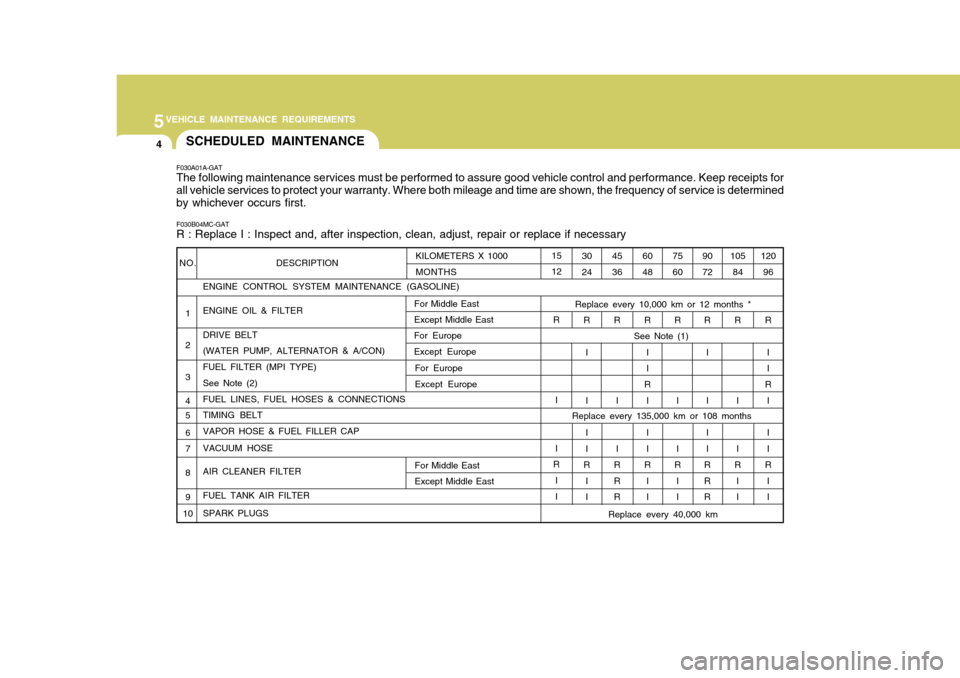
F030A01A-GAT The following maintenance services must be performed to assure good vehicle control and performance. Keep receipts for
all vehicle services to protect your warranty. Where both mileage and time are shown, the frequency of service is determinedby whichever occurs first. F030B04MC-GAT R : Replace I : Inspect and, after inspection, clean, adjust, repair or replace if necessary
ENGINE CONTROL SYSTEM MAINTENANCE (GASOLINE) ENGINE OIL & FILTERDRIVE BELT (WATER PUMP, ALTERNATOR & A/CON) FUEL FILTER (MPI TYPE) See Note (2) FUEL LINES, FUEL HOSES & CONNECTIONS TIMING BELT VAPOR HOSE & FUEL FILLER CAP VACUUM HOSE AIR CLEANER FILTER FUEL TANK AIR FILTER SPARK PLUGS
NO. DESCRIPTION10584
R
I I
R
I I 120
96
R II
R I I I
R
I I
9072
R I I I I
RR R
7560
R
I I
R
I I
6048
R II
R I I I
R
I I
4536
R
I I
R R R
3024
R I I I I
R
I I
1512
R
I I
R
I I
KILOMETERS X 1000MONTHS
Replace every 40,000 km
For Middle East Except Middle East
Replace every 10,000 km or 12 months *For Middle East Except Middle East
For Europe Except Europe
Replace every 135,000 km or 108 months
1 23 4 5 6 7 8 9
10 For Europe Except Europe
See Note (1)
Page 220 of 284
5
VEHICLE MAINTENANCE REQUIREMENTS
5
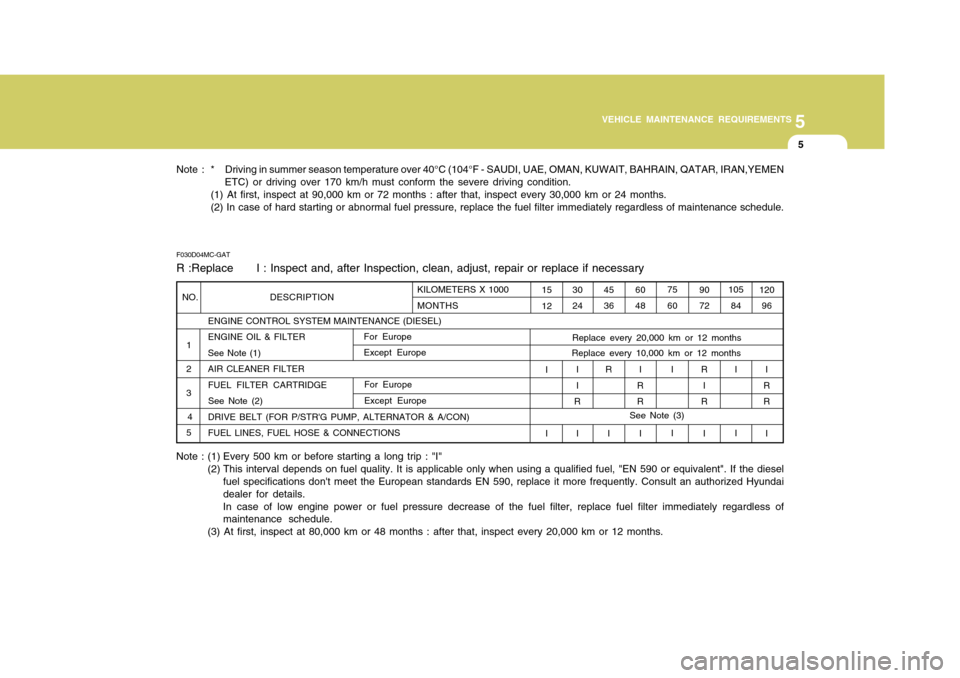
F030D04MC-GAT R :Replace I : Inspect and, after Inspection, clean, adjust, repair or replace if necessary
ENGINE CONTROL SYSTEM MAINTENANCE (DIESEL) ENGINE OIL & FILTER See Note (1)AIR CLEANER FILTER
FUEL FILTER CARTRIDGESee Note (2)
DRIVE BELT (FOR P/STR'G PUMP, ALTERNATOR & A/CON)FUEL LINES, FUEL HOSE & CONNECTIONS
NO. DESCRIPTION
1 23
4 5 120
96
I
R R
I105 84
I I90 72R I
R
I75 60
I I60 48 I
RR
I45 36
R
I30 24 II
R
I
1512
I IKILOMETERS X 1000 MONTHS
Note : (1) Every 500 km or before starting a long trip : "I" (2) This interval depends on fuel quality. It is applicable only when using a qualified fuel, "EN 590 or equivalent". If the die sel
fuel specifications don't meet the European standards EN 590, replace it more frequently. Consult an authorized Hyundai dealer for details.In case of low engine power or fuel pressure decrease of the fuel filter, replace fuel filter immediately regardless of maintenance schedule.
(3) At first, inspect at 80,000 km or 48 months : after that, inspect every 20,000 km or 12 months.
For Europe Except Europe Replace every 10,000 km or 12 months
For Europe Except Europe
Replace every 20,000 km or 12 months
Note : * Driving in summer season temperature over 40°C (104°F - SAUDI, UAE, OMAN, KUWAIT, BAHRAIN, QATAR, IRAN,YEMEN
ETC) or driving over 170 km/h must conform the severe driving condition.
(1) At first, inspect at 90,000 km or 72 months : after that, inspect every 30,000 km or 24 months. (2) In case of hard starting or abnormal fuel pressure, replace the fuel filter immediately regardless of maintenance schedule.
See Note (3)
Page 223 of 284
5VEHICLE MAINTENANCE REQUIREMENTS
8
!
EXPLANATION OF SCHED- ULED MAINTENANCE ITEMS
F060M01A-AAT
o Engine Oil and Filter The engine oil and filter should be changed at the intervals specified in the maintenance schedule. If the car is being driven in severe conditions,more frequent oil and filter changes are required. F060B01A-AAT
o Drive Belts Inspect all drive belts for evidence of cuts, cracks, excessive wear or oil saturation and replace if necessary. Drive belts should be checked period-ically for proper tension and adjusted as necessary. F060C01A-AAT
o Fuel Filter
A clogged filter can limit the speed at
which the vehicle may be driven, dam-age the emission system and cause hard starting. If an excessive amountof foreign matter accumulates in the fuel tank, the filter may require re- placement more frequently. After installing a new filter, run the
engine for several minutes, and checkfor leaks at the connections. Fuel fil- ters should be installed by trained technicians. F060D01TB-GAT
o Fuel Lines, Fuel Hoses and
Connections
Check the fuel lines, fuel hoses and connections for leakage and damage. Have a trained technician replace any damaged or leaking parts immedi-ately.
WARNING (Diesel only):
Never work on injection system with
engine running or within 30 sec-onds after shutting off engine. High pressure pump, rail, injectors and high pressure pipes are subjectedto high pressure even after the en- gine has been switched off. The fuel jet produced by fuel leaks maycause serious injury, if it contacts with the body. People using pace- makers should not move closerthan 30cm to the ECU or wiring harness within the engine room with the engine running, since the highcurrents in the Common Rail sys- tem produce considerable magnetic fields.
Page 224 of 284
5
VEHICLE MAINTENANCE REQUIREMENTS
9
F060H01A-AAT
o Air Cleaner Filter A Genuine Hyundai air cleaner filter is
recommended when the filter is re- placed. F060J01A-AAT
o Spark Plugs (For Gasoline Engine)
Make sure to install new spark plugs of the correct heat range. F070C01A-AAT o Coolant The coolant should be changed at the intervals specified in the mainte- nance schedule.
F060E01MC-AAT
o Timing Belt (Gasoline)
Inspect all parts related to the timing
belt for damage and deformation.Replace any damaged parts immedi- ately.
F060G01A-AAT
o Vapor Hose and Fuel Filler Cap
The vapor hose and fuel filler cap
should be inspected at those intervalsspecified in the maintenance sched-ule. Make sure that a new vapor hose or fuel filler cap is correctly replaced. F060F01A-AAT
o Vacuum, Crankcase Ventila-
tion Hoses
Inspect the surface of hoses for evi-
dence of heat and/or mechanical dam-age. Hard and brittle rubber, cracking, tears, cuts, abrasions, and excessiveswelling indicate deterioration. Partic- ular attention should be paid to exam- ine those hose surfaces nearest tohigh heat sources, such as the ex- haust manifold.
Inspect the hose routing to assure
that the hoses do not come in contactwith any heat source, sharp edges or moving component which might causeheat damage or mechanical wear. Inspect all hose connections, such as clamps and couplings, to make surethey are secure, and that no leaks are present. Hoses should be replaced immediately if there is any evidenceof deterioration or damage. F070B01A-GAT o Cooling System Check the cooling system part, such as radiator, coolant reservoir, hoses and connections for leakage and dam- age. Replace any damaged parts.
Page 227 of 284
Engine Compartment .................................................... 6-2
General Checks ........................................................... 6-5
Maintenance Precautions ............................................. 6-6
Checking the Engine Oil ............................................... 6-6
Checking and Changing the Engine Coolant ...............6-10
Changing the Air Cleaner Filte r ....................................6-12
Checking the Transaxle Oil (Manual ) ..........................6-14
Checking the Transaxle Fluid (Automatic)..................6-15
Checking the B rakes ................................................... 6-17
Checking the Clutch Fluid ............................................ 6-18
Air Conditioning Care ................................................... 6-18
Changing the Climate Control Air Filter........................ 6-19
Checking and Replacing Fuses .................................. 6-20
Checking the Battery ................................................... 6-22
Power Steering Fluid Level .......................................... 6-24
Removal of Water from the Fuel Filter .........................6-25
Headlight Aiming Adjustment ....................................... 6-26
Replacement of Light Bulbs ......................................... 6-27
Bulb Wattage ............................................................... 6-34
Fuse Panel Description ............................................... 6-35
DO-IT-YOURSELF MAINTENANCE
6
6
Page 230 of 284
6 DO-IT-YOURSELF MAINTENANCE
4
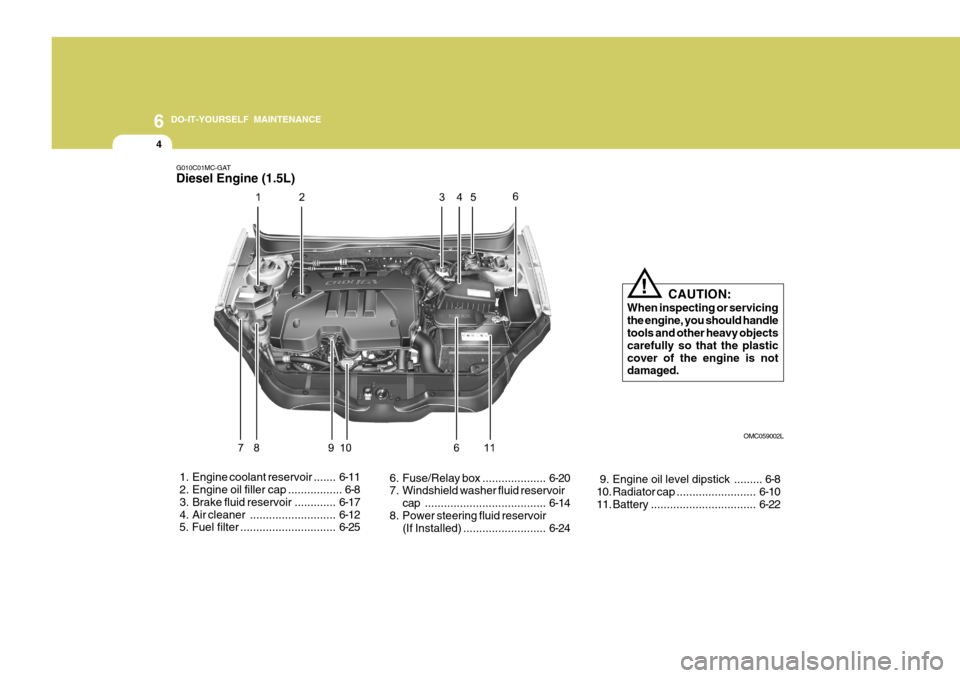
G010C01MC-GAT Diesel Engine (1.5L)
OMC059002L
1. Engine coolant reservoir ....... 6-11
2. Engine oil filler cap................. 6-8
3. Brake fluid reservoir ............. 6-17
4. Air cleaner ........................... 6-12
5. Fuel filter .............................. 6-25 6. Fuse/Relay box ....................
6-20
7. Windshield washer fluid reservoir
cap ...................................... 6-14
8. Power steering fluid reservoir (If Installed) .......................... 6-24 9. Engine oil level dipstick ......... 6-8
10. Radiator
cap ......................... 6-10
11. Battery ................................. 6-22
CAUTION:
When inspecting or servicingthe engine, you should handletools and other heavy objects carefully so that the plastic cover of the engine is not damaged.
!
Page 242 of 284
6 DO-IT-YOURSELF MAINTENANCE
16
!!WARNING:
The cooling fan is controlled by en- gine coolant temperature and may sometimes operate even when the engine is not running. Use extremecaution when working near the blades of the cooling fan, so that you are not injured by a rotating fan blade. As theengine coolant temperature decreas- es, the fan will automatically shut off. This is a normal condition. WARNING (
Diesel only):
Never work on injection system withengine running or within 30 seconds after shutting off engine. High pres- sure pump, rail, injectors and highpressure pipes are subjected to high pressure even after the engine has been switched off. The fuel jet pro-duced by fuel leaks may cause seri- ous injury, if it contacts with the body. People using pacemakersshould not move closer than 30cm to the ECU or wiring harness within the engine room with the engine run-ning, since the high currents in the Common Rail system produce con- siderable magnetic fields.
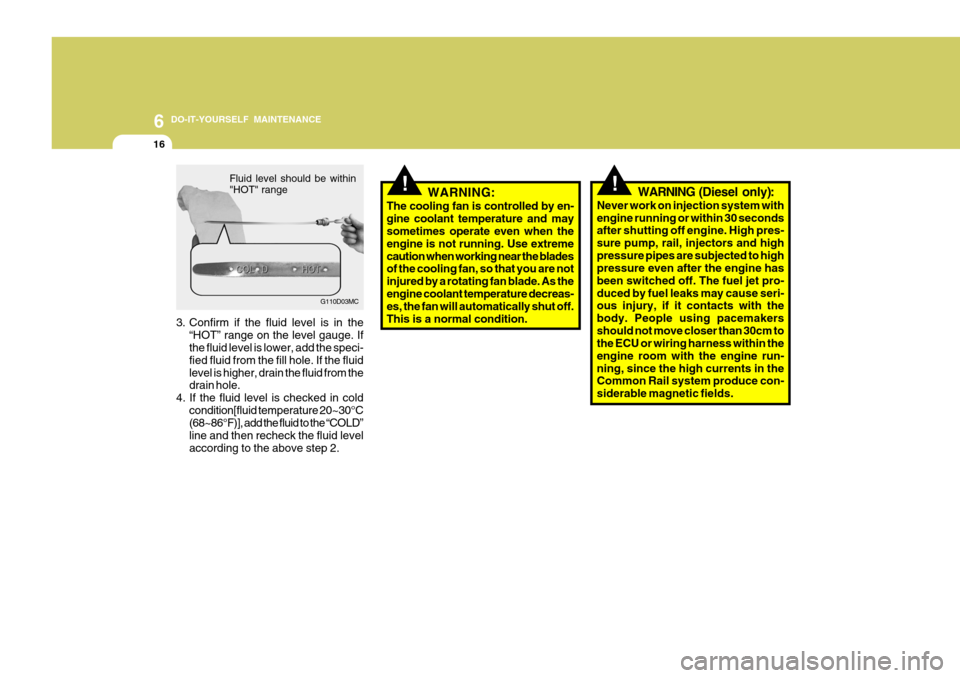
G110D03MC
Fluid level should be within "HOT" range
3. Confirm if the fluid level is in the “HOT” range on the level gauge. If the fluid level is lower, add the speci- fied fluid from the fill hole. If the fluidlevel is higher, drain the fluid from the drain hole.
4. If the fluid level is checked in cold
condition[fluid temperature 20~30°C(68~86°F)], add the fluid to the “COLD” line and then recheck the fluid levelaccording to the above step 2.
Page 251 of 284
6
DO-IT-YOURSELF MAINTENANCE
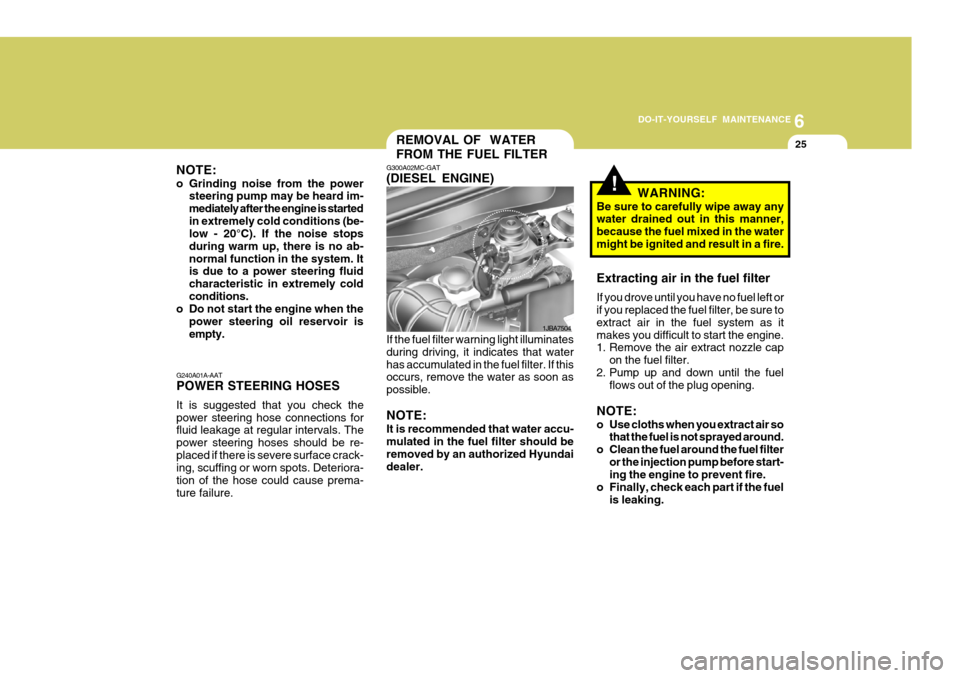
25REMOVAL OF WATER FROM THE FUEL FILTER
1JBA7504
G240A01A-AAT POWER STEERING HOSES It is suggested that you check the power steering hose connections for fluid leakage at regular intervals. The power steering hoses should be re-placed if there is severe surface crack- ing, scuffing or worn spots. Deteriora- tion of the hose could cause prema-ture failure. G300A02MC-GAT (DIESEL ENGINE) If the fuel filter warning light illuminates during driving, it indicates that waterhas accumulated in the fuel filter. If this occurs, remove the water as soon as possible. NOTE: It is recommended that water accu- mulated in the fuel filter should be removed by an authorized Hyundaidealer.
NOTE:
o Grinding noise from the power
steering pump may be heard im- mediately after the engine is startedin extremely cold conditions (be- low - 20°C). If the noise stops during warm up, there is no ab-normal function in the system. It is due to a power steering fluid characteristic in extremely coldconditions.
o Do not start the engine when the
power steering oil reservoir isempty.
!WARNING:
Be sure to carefully wipe away any water drained out in this manner, because the fuel mixed in the watermight be ignited and result in a fire. Extracting air in the fuel filter If you drove until you have no fuel left or if you replaced the fuel filter, be sure to extract air in the fuel system as itmakes you difficult to start the engine.
1. Remove the air extract nozzle cap on the fuel filter.
2. Pump up and down until the fuel
flows out of the plug opening.
NOTE:
o Use cloths when you extract air so that the fuel is not sprayed around.
o Clean the fuel around the fuel filter or the injection pump before start- ing the engine to prevent fire.
o Finally, check each part if the fuel is leaking.