Engine o Hyundai Accent 2010 Repair Manual
[x] Cancel search | Manufacturer: HYUNDAI, Model Year: 2010, Model line: Accent, Model: Hyundai Accent 2010Pages: 284, PDF Size: 10.23 MB
Page 194 of 284
3 WHAT TO DO IN AN EMERGENCY
4
!
IF THE ENGINE OVERHEATS
D030A02TB-AAT If your temperature gauge indicates overheating, you experience a loss of power, or hear loud pinging or knock- ing, the engine is probably too hot. Ifthis happens to you, you should:
1. Pull off the road and stop as soon as it is safe to do so.
2. Place the gear selector lever in "P"
(automatic), or neutral (manual transaxle) and set the parking brake. If the air conditioning is on, turn it off.
3. If engine coolant is running out un- der the car or steam is coming outfrom underneath the hood, stop theengine. Do not open the hood until the engine coolant has stopped running or the steaming has stopped.If there is no visible loss of engine coolant and no steam, leave the engine running and check to be surethe engine cooling fan is operating. If the fan is not running, turn the engine off.
5. Start the engine in the car with the
discharged battery using the nor-mal starting procedure. After the engine starts, leave the jumper cables connected and let the enginerun at fast idle or about 2,000 rpm for several minutes.
6. Carefully remove the jumper cables in the reverse order of attachment.
If you do not know why your battery became discharged (because the lights were left on, etc.), have the charging system checked by your Hyundaidealer. 4. Check to see if the water pump drive
belt is missing. If it is not missing,check to see that it is tight. If the drive belt seems to be satisfactory, check for coolant leaking from theradiator, hoses or under the car. (If the air conditioning had been in use, it is normal for cold water to bedraining from it when you stop).
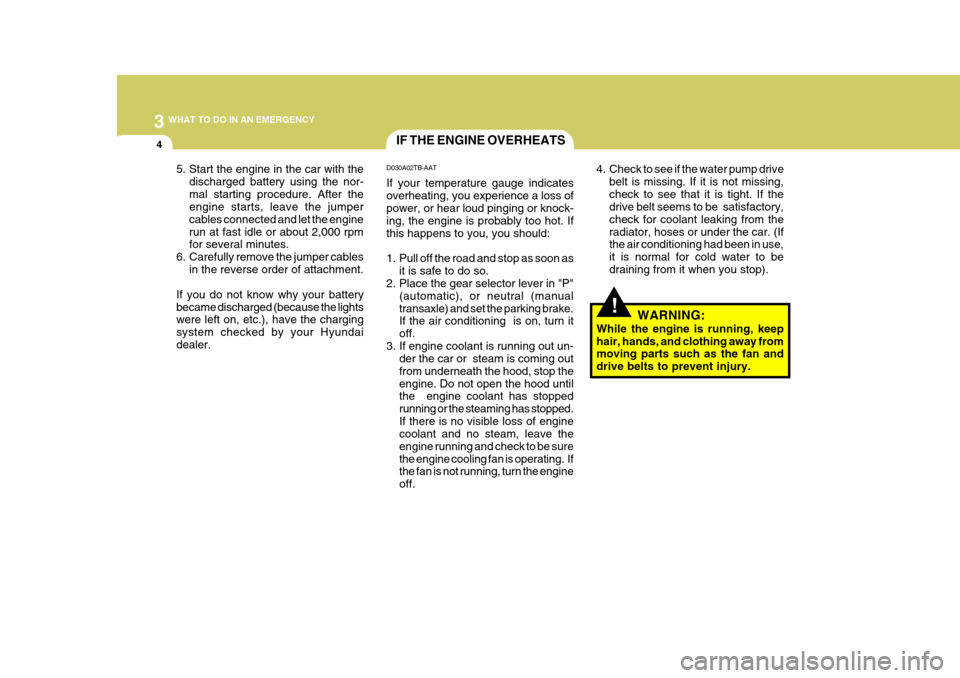
WARNING:
While the engine is running, keephair, hands, and clothing away from moving parts such as the fan and drive belts to prevent injury.
Page 195 of 284
3
WHAT TO DO IN AN EMERGENCY
5SPARE TIRE
!!WARNING (Diesel Only):
Never work on injection system with engine running or within 30 sec- onds after shutting off engine. High pressure pump, rail, injectors andhigh pressure pipes are subject to high pressure even after the engine stopped. The fuel jet produced byfuel leaks may cause serious in- jury, if it touch the body. People using pacemakers should not movethan 30cm closer to the ECU or wiring harness within the engine room while engine is running, sincethe high currents in the Common Rail system produce considerable magnetic fields. WARNING:
Do not remove the radiator cap whenthe engine is hot. This may result incoolant being blown out of the open- ing and cause serious burns.
6. If you cannot find the cause of the overheating, wait until the engine temperature has returned to nor-mal. Then, if the engine coolant has been lost, carefully add coolant to the reservoir (Page 6-11) to bring thefluid level in the reservoir up to the halfway mark.
7. Proceed with caution, keeping alert
for further signs of overheating. Ifoverheating happens again, call a Hyundai dealer for assistance.
!
5. If the water pump drive belt is broken
or coolant is leaking out, stop the engine immediately and call the near- est Hyundai dealer for assistance. CAUTION:
Serious loss of engine coolant indi- cates there is a leak in the coolingsystem and this should be checked as soon as possible by a Hyundai dealer.
Inflation Pressure
Tire Size
T115/70D15, T125/80D15 420 kPa (60 psi)
2. The spare tire should only be used temporarily and should be returned to the luggage compartment as soon as the original tire can be repaired or replaced.
3. Continuous use at speeds of over 80 km/h (50 mph) is not recommended.
4. As the temporary spare tire is spe-
cifically designed for your car, it should not be used on any other vehicle.
D040A01MC-GAT TEMPORARY SPARE TIRE (If Installed) The following instructions for the tem- porary spare tire should be observed:
1. Check inflation pressure as soon as
practical after installing the spare tire, and adjust to the specified pres- sure. The tire pressure should be periodically checked and maintainedat the specified pressure while the tire is stored.
Spare Tire Pressure
Page 203 of 284
3
WHAT TO DO IN AN EMERGENCY
13
First Aid Kit The first aid kit is located in the trunk. There are some items such as scis- sors, bandage and adhesive tape and etc. in the kit to give first aid to aninjured person. Tire Pressure Gauge (If Installed) You can easily check the tire pressure with a tire pressure gauge that is found in OVM tool bag. Tires normally lose some air in day-to-day use, and youmay have to add a few pounds of air periodically and it is not usually a sign of a leaking tire, but of normal wear.Always check tire pressure when the tires are cold because tire pressure increases with temperature. To check the tire pressure, take the following steps; 1. Unscrew the inflation valve cap that
is located on the rim of the tire.
2. Press and hold the gauge against the tire valve. Some air will escape asyou begin and more will escape if youdon't press the gauge in firmly.
3. A firm non-leaking push will activate
the gauge.
4. Read the tire pressure on the gauge to know whether the tire pressure islow or high.
5. Adjust the tire pressures to the speci- fied pressure. See page 3-5.
6. Reinstall the inflation valve cap.IF YOUR VEHICLE MUST BE TOWED
D080A01O-GAT If your vehicle has to be towed, it should be done by your Hyundai dealer or a commercial tow truck service. This will help assure that your vehicle is notdamaged in towing. Also, professionals are generally aware of local laws gov- erning towing. In any case, rather thanrisk damage to your car, it is suggested that you show this information to the tow truck operator. Be sure that a safetychain system is used and that all local laws are observed. It is recommended that your vehicle betowed with a wheel lift and dollies or flatbed equipment with all the wheels off the ground.
! CAUTION:
o Your vehicle can be damaged if towed incorrectly!
o Be sure the transaxle is in neutral.
o When the engine will not start, be sure the steering is unlocked byplacing the key in the "ACC" posi-tion.
Page 205 of 284
3
WHAT TO DO IN AN EMERGENCY
15
!
D080B03MC
o Automatic Transaxle:
Be sure to use a towing dolly under the front wheels.
CAUTION:
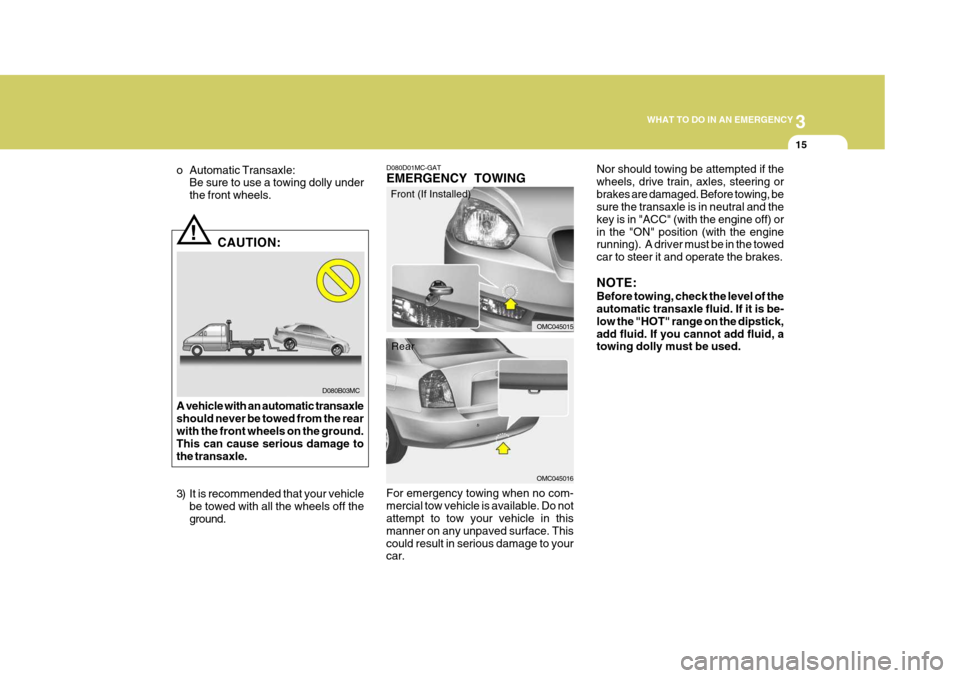
A vehicle with an automatic transaxleshould never be towed from the rearwith the front wheels on the ground. This can cause serious damage to the transaxle.
3) It is recommended that your vehicle be towed with all the wheels off the ground.
D080D01MC-GAT EMERGENCY TOWING
For emergency towing when no com- mercial tow vehicle is available. Do not attempt to tow your vehicle in this manner on any unpaved surface. Thiscould result in serious damage to your car.
OMC045016
OMC045015
Front (If Installed)
Rear Nor should towing be attempted if the wheels, drive train, axles, steering orbrakes are damaged. Before towing, be sure the transaxle is in neutral and the key is in "ACC" (with the engine off) orin the "ON" position (with the engine running). A driver must be in the towed car to steer it and operate the brakes. NOTE: Before towing, check the level of the automatic transaxle fluid. If it is be- low the "HOT" range on the dipstick,add fluid. If you cannot add fluid, a towing dolly must be used.
Page 212 of 284
4
CORROSION PREVENTION AND APPEARANCE CARE
5
4
CORROSION PREVENTION AND APPEARANCE CARE
5
E030B01A-AAT Spot Cleaning Don't use gasoline, strong solvents or corrosive cleaning agents. These candamage the finish of the car. To re- move road tar, use turpentine on a clean, soft cloth or commercially avail-able bug and tar remover. Be gentle. To remove dead insects or tree sap, use warm water and mild soap or car-washing solution. Soak the spot and rub gently. If the paint has lost its luster, use a commercial car-cleaningpolish. E030C01A-AAT Polishing and Waxing Always wash and dry the car before polishing or waxing or using a combi- nation cleaner and wax. Use a good quality commercial product and followthe manufacturer's directions on the container. Polish and wax the bright trim pieces as well as the paint.
! CAUTION:
OJB037800
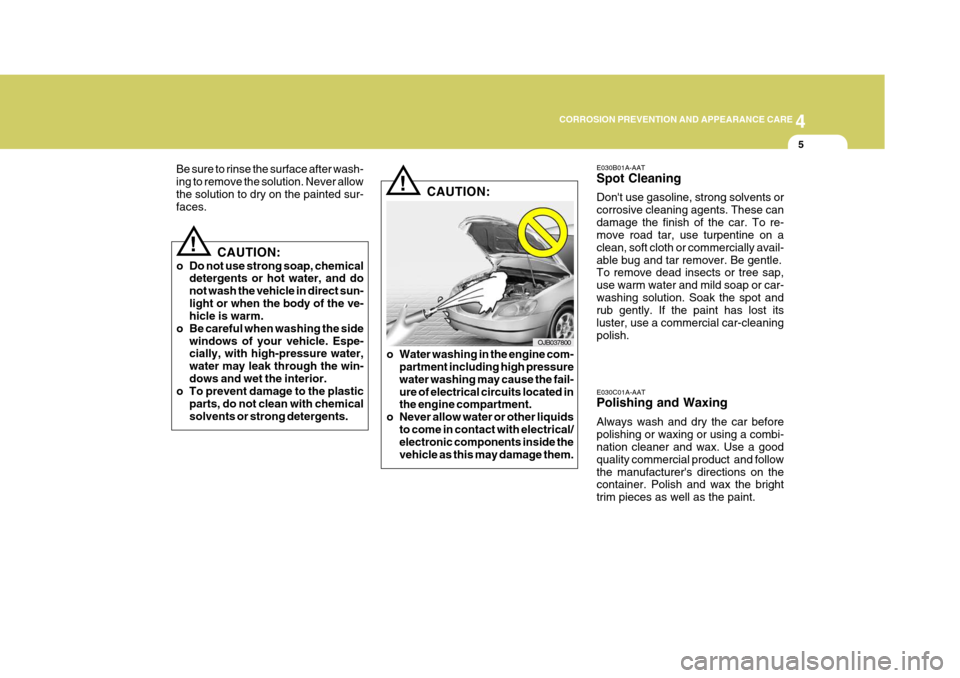
o Water washing in the engine com- partment including high pressure water washing may cause the fail-ure of electrical circuits located in the engine compartment.
o Never allow water or other liquids
to come in contact with electrical/electronic components inside the vehicle as this may damage them.
! CAUTION:
o Do not use strong soap, chemical detergents or hot water, and do not wash the vehicle in direct sun-light or when the body of the ve- hicle is warm.
o Be careful when washing the side
windows of your vehicle. Espe-cially, with high-pressure water, water may leak through the win-dows and wet the interior.
o To prevent damage to the plastic
parts, do not clean with chemicalsolvents or strong detergents.
Be sure to rinse the surface after wash-ing to remove the solution. Never allowthe solution to dry on the painted sur- faces.
Page 217 of 284
5VEHICLE MAINTENANCE REQUIREMENTS
2MAINTENANCE INTERVALS
F010C01A-GAT
Specified Scheduled Procedures
These are the procedures such as
inspections, adjustments and replace- ments that are listed in the mainte-nance charts starting on page 5-4. These procedures must be performed at the intervals shown in the mainte-nance schedule to assure that your warranty remains in effect. Although it is strongly recommended that they beperformed by the factory-trained or distributor-trained technicians at your Hyundai dealer, these procedures maybe performed at any qualified service facility. F010D01A-GAT
General Checks
These are the regular checks you should perform when you drive your Hyundai or you fill the fuel tank. A list of these items will be found on page6-5.
F010A01A-GAT Service Requirements To assure that you receive the great- est number of kilometers of satisfying operation from your Hyundai, certain maintenance procedures must beperformed. Although careful design and engineering have reduced these to a minimum, those that are requiredare of the utmost importance.It is your responsibility to have thesemaintenance procedures performed to comply with the terms of the war- ranties covering your new Hyundai.The Service Passport supplied with your new vehicle provides further in- formation about these warranties.
F010B01A-AAT
Maintenance Requirements
The maintenance required for your
Hyundai can be divided into three main areas:
o Specified scheduled procedures
o General checks
o Do-it-yourself maintenance It is suggested that genuine Hyundai
service parts be used for any requiredrepairs or replacements. Other parts of equivalent quality such as engine oil, engine coolant, manual or autotransaxle oil, brake fluid and so on which are not supplied by Hyundai Motor Company or its distributor maybe used without affecting your war- ranty coverage but you should always be sure these are equivalent to thequality of the original Hyundai parts. Your Service Passport provides fur- ther information about your warrantycoverage.
Page 219 of 284
5VEHICLE MAINTENANCE REQUIREMENTS
4SCHEDULED MAINTENANCE
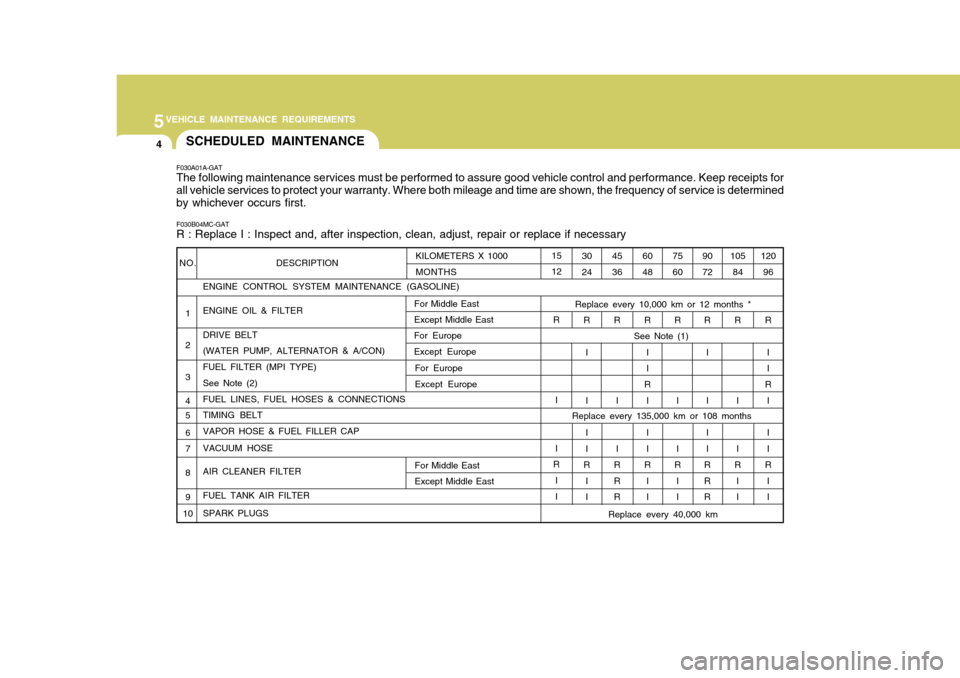
F030A01A-GAT The following maintenance services must be performed to assure good vehicle control and performance. Keep receipts for
all vehicle services to protect your warranty. Where both mileage and time are shown, the frequency of service is determinedby whichever occurs first. F030B04MC-GAT R : Replace I : Inspect and, after inspection, clean, adjust, repair or replace if necessary
ENGINE CONTROL SYSTEM MAINTENANCE (GASOLINE) ENGINE OIL & FILTERDRIVE BELT (WATER PUMP, ALTERNATOR & A/CON) FUEL FILTER (MPI TYPE) See Note (2) FUEL LINES, FUEL HOSES & CONNECTIONS TIMING BELT VAPOR HOSE & FUEL FILLER CAP VACUUM HOSE AIR CLEANER FILTER FUEL TANK AIR FILTER SPARK PLUGS
NO. DESCRIPTION10584
R
I I
R
I I 120
96
R II
R I I I
R
I I
9072
R I I I I
RR R
7560
R
I I
R
I I
6048
R II
R I I I
R
I I
4536
R
I I
R R R
3024
R I I I I
R
I I
1512
R
I I
R
I I
KILOMETERS X 1000MONTHS
Replace every 40,000 km
For Middle East Except Middle East
Replace every 10,000 km or 12 months *For Middle East Except Middle East
For Europe Except Europe
Replace every 135,000 km or 108 months
1 23 4 5 6 7 8 9
10 For Europe Except Europe
See Note (1)
Page 220 of 284
5
VEHICLE MAINTENANCE REQUIREMENTS
5
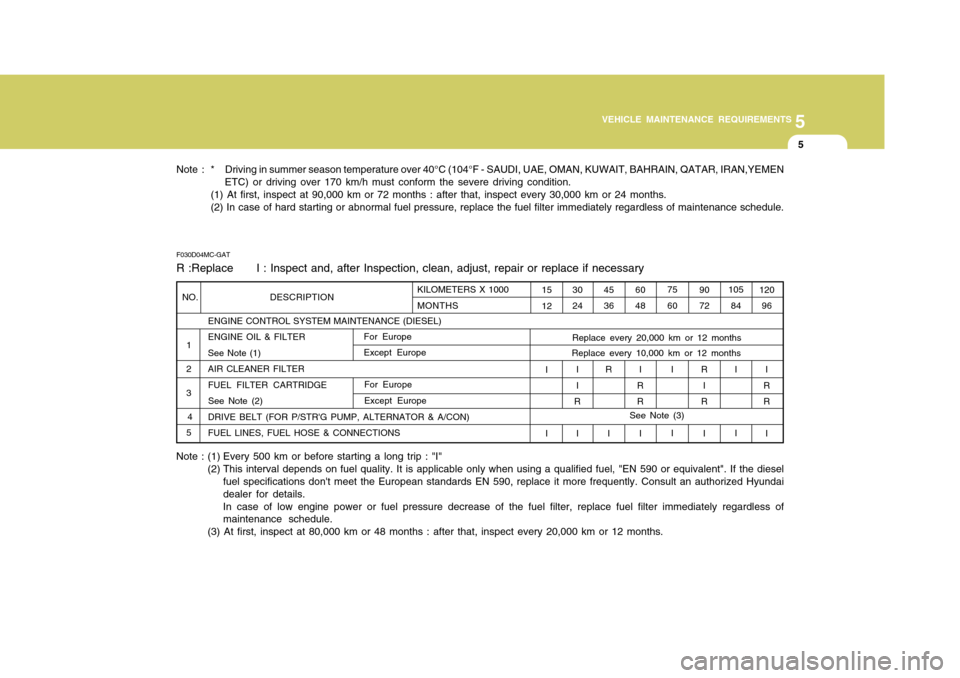
F030D04MC-GAT R :Replace I : Inspect and, after Inspection, clean, adjust, repair or replace if necessary
ENGINE CONTROL SYSTEM MAINTENANCE (DIESEL) ENGINE OIL & FILTER See Note (1)AIR CLEANER FILTER
FUEL FILTER CARTRIDGESee Note (2)
DRIVE BELT (FOR P/STR'G PUMP, ALTERNATOR & A/CON)FUEL LINES, FUEL HOSE & CONNECTIONS
NO. DESCRIPTION
1 23
4 5 120
96
I
R R
I105 84
I I90 72R I
R
I75 60
I I60 48 I
RR
I45 36
R
I30 24 II
R
I
1512
I IKILOMETERS X 1000 MONTHS
Note : (1) Every 500 km or before starting a long trip : "I" (2) This interval depends on fuel quality. It is applicable only when using a qualified fuel, "EN 590 or equivalent". If the die sel
fuel specifications don't meet the European standards EN 590, replace it more frequently. Consult an authorized Hyundai dealer for details.In case of low engine power or fuel pressure decrease of the fuel filter, replace fuel filter immediately regardless of maintenance schedule.
(3) At first, inspect at 80,000 km or 48 months : after that, inspect every 20,000 km or 12 months.
For Europe Except Europe Replace every 10,000 km or 12 months
For Europe Except Europe
Replace every 20,000 km or 12 months
Note : * Driving in summer season temperature over 40°C (104°F - SAUDI, UAE, OMAN, KUWAIT, BAHRAIN, QATAR, IRAN,YEMEN
ETC) or driving over 170 km/h must conform the severe driving condition.
(1) At first, inspect at 90,000 km or 72 months : after that, inspect every 30,000 km or 24 months. (2) In case of hard starting or abnormal fuel pressure, replace the fuel filter immediately regardless of maintenance schedule.
See Note (3)
Page 221 of 284
5VEHICLE MAINTENANCE REQUIREMENTS
6
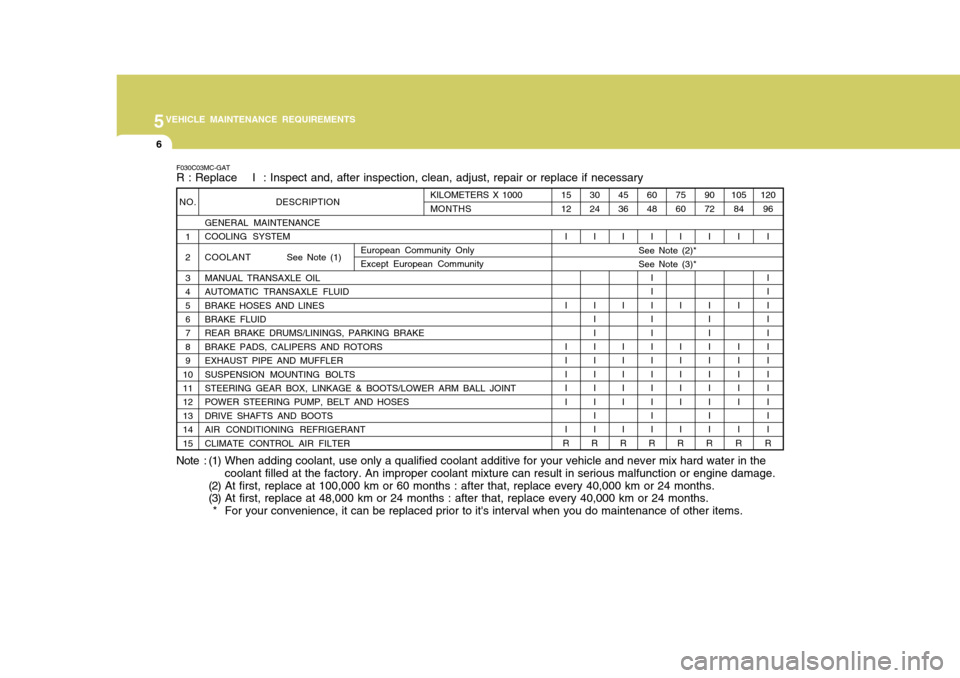
F030C03MC-GAT R : Replace I : Inspect and, after inspection, clean, adjust, repair or replace if necessary
Note : (1) When adding coolant, use only a qualified coolant additive for your vehicle and never mix hard water in the coolant filled at the factory. An improper coolant mixture can result in serious malfunction or engine damage.
(2) At first, replace at 100,000 km or 60 months : after that, replace every 40,000 km or 24 months.
(3) At first, replace at 48,000 km or 24 months : after that, replace every 40,000 km or 24 months.
* For your convenience, it can be replaced prior to it's interval when you do maintenance of other items.
NO.
1 23 45 6 789
10 11 12131415 DESCRIPTION
GENERAL MAINTENANCECOOLING SYSTEM COOLANT See Note (1)
MANUAL TRANSAXLE OIL AUTOMATIC TRANSAXLE FLUIDBRAKE HOSES AND LINES BRAKE FLUID REAR BRAKE DRUMS/LININGS, PARKING BRAKEBRAKE PADS, CALIPERS AND ROTORSEXHAUST PIPE AND MUFFLERSUSPENSION MOUNTING BOLTS STEERING GEAR BOX, LINKAGE & BOOTS/LOWER ARM BALL JOINT POWER STEERING PUMP, BELT AND HOSESDRIVE SHAFTS AND BOOTSAIR CONDITIONING REFRIGERANTCLIMATE CONTROL AIR FILTER
120 96
I I IIII I IIII I I
R
105
84
I I I IIII I
R
90 72
I I II I IIII I I
R
7560
I I I IIII I
R
60 48
I I IIII I IIII I I
R
4536
I I I IIII I
R
30 24
I I II I IIII I I
R
1512
I I I IIII I
R
KILOMETERS X 1000 MONTHS
See Note (2)* See Note (3)*European Community Only Except European Community
Page 222 of 284
5
VEHICLE MAINTENANCE REQUIREMENTS
7
ENGINE OIL AND FILTER (
GASOLINE)
ENGINE OIL AND FILTER (DIESEL) AIR CLEANER FILTERSPARK PLUGS
TIMING BELT (GASOLINE)
BRAKE PADS, CALIPERS AND ROTORSREAR BRAKE DRUMS/LININGS, PARKING BRAKE
STEERING GEAR BOX, LINKAGE & BOOTS/LOWER ARM BALL JOINT
DRIVE SHAFTS AND BOOTS MANUAL TRANSAXLE OILAUTOMATIC TRANSAXLE FLUID CLIMATE CONTROL AIR FILTER R R R R R
II I I
R R R
European Community Only Except European Community
MAINTENANCE ITEM
EVERY 5,000 KM OR 6 MONTHS EVERY 7,500 KM OR 6 MONTHSEVERY 10,000 KM OR 6 MONTHS EVERY 5,000 KM OR 6 MONTHS MORE FREQUENTLYMORE FREQUENTLY EVERY 90,000 KM OR 72 MONTHS MORE FREQUENTLY MORE FREQUENTLY MORE FREQUENTLY EVERY 15,000 KM OR 12 MONTHS EVERY 120,000 KMEVERY 90,000 KM EVERY 100,000 KM MORE FREQUENTLY A, B, C, D, E, F, G, H, I, K A, B, C, D, E, F, G, H, I, K C, E B, H B, C, D, E, F, G, I C, D, G, H C, D, G, H C, D, E, F C, D, E, F A, C, D, E, F, G, H, I, J A, C, E, F, G, H, I C, E
MAINTENANCE INTERVALS
DRIVING
CONDITION
MAINTENANCE
OPERATION
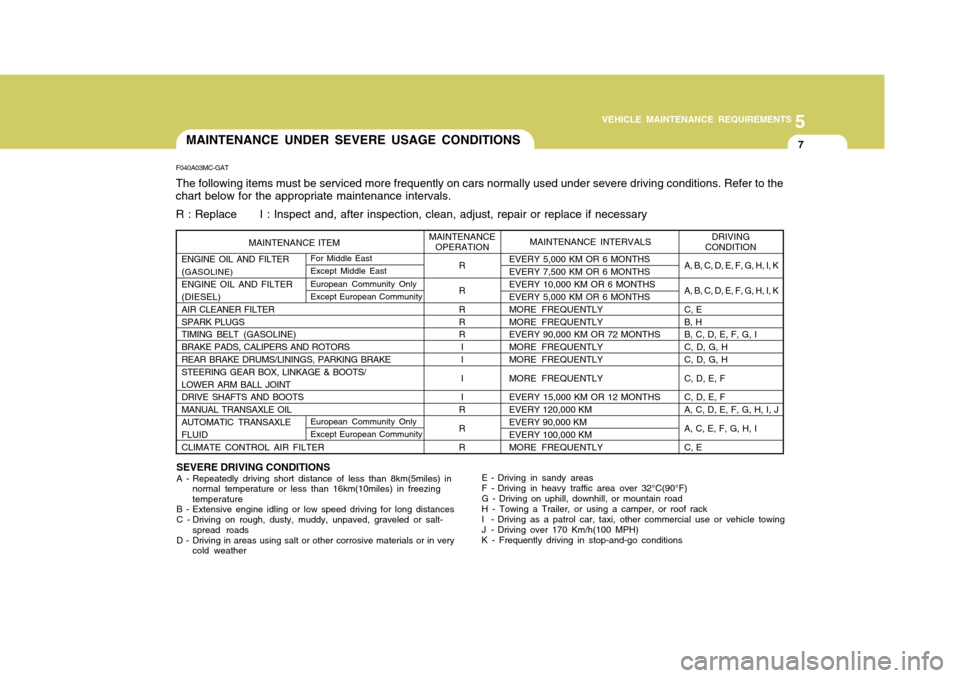
MAINTENANCE UNDER SEVERE USAGE CONDITIONS
F040A03MC-GAT The following items must be serviced more frequently on cars normally used under severe driving conditions. Refer to the
chart below for the appropriate maintenance intervals.
R : Replace I : Inspect and, after inspection, clean, adjust, repair or replace if necessary
European Community Only Except European Community
SEVERE DRIVING CONDITIONSA - Repeatedly driving short distance of less than 8km(5miles) in normal temperature or less than 16km(10miles) in freezing temperature
B - Extensive engine idling or low speed driving for long distances
C - Driving on rough, dusty, muddy, unpaved, graveled or salt- spread roads
D - Driving in areas using salt or other corrosive materials or in very cold weather E - Driving in sandy areas
F - Driving in heavy traffic area over 32°C(90°F)G - Driving on uphill, downhill, or mountain roadH - Towing a Trailer, or using a camper, or roof rack
I - Driving as a patrol car, taxi, other commercial use or vehicle towing
J - Driving over 170 Km/h(100 MPH)K - Frequently driving in stop-and-go conditions
For Middle East Except Middle East