fuel cap Hyundai Accent 2010 Owner's Manual
[x] Cancel search | Manufacturer: HYUNDAI, Model Year: 2010, Model line: Accent, Model: Hyundai Accent 2010Pages: 284, PDF Size: 10.23 MB
Page 77 of 284
1
FEATURES OF YOUR HYUNDAI
65
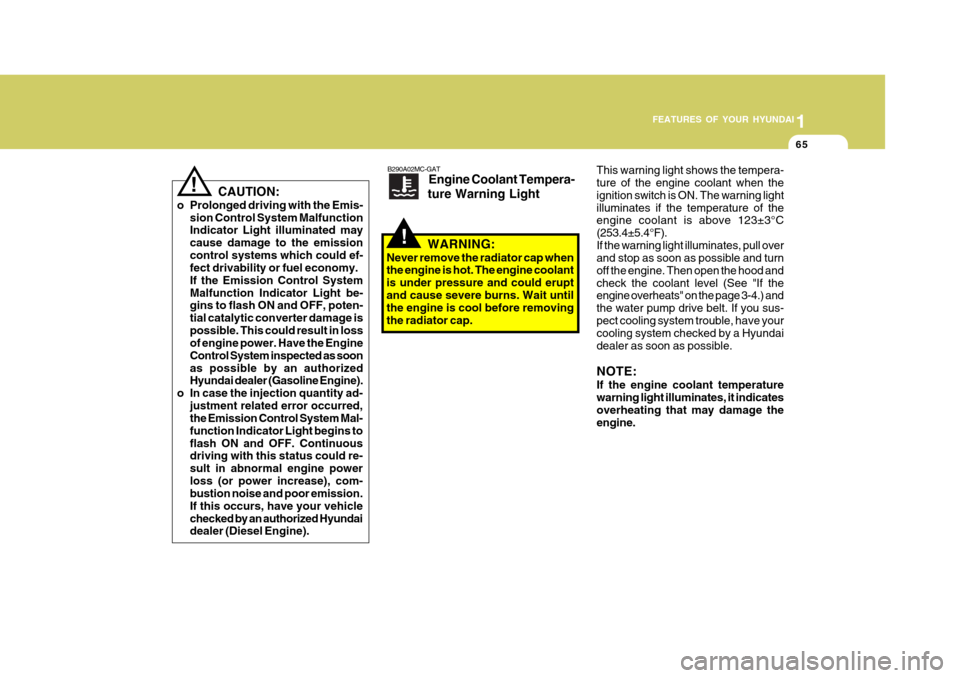
B290A02MC-GAT
Engine Coolant Tempera-
ture Warning Light
WARNING:
Never remove the radiator cap when the engine is hot. The engine coolant is under pressure and could eruptand cause severe burns. Wait until the engine is cool before removing the radiator cap.
!
This warning light shows the tempera- ture of the engine coolant when the ignition switch is ON. The warning lightilluminates if the temperature of the engine coolant is above 123±3°C (253.4±5.4°F).If the warning light illuminates, pull over and stop as soon as possible and turn off the engine. Then open the hood andcheck the coolant level (See "If the engine overheats" on the page 3-4.) and the water pump drive belt. If you sus-pect cooling system trouble, have your cooling system checked by a Hyundai dealer as soon as possible. NOTE: If the engine coolant temperature warning light illuminates, it indicatesoverheating that may damage the engine.
CAUTION:
o Prolonged driving with the Emis- sion Control System MalfunctionIndicator Light illuminated may cause damage to the emissioncontrol systems which could ef- fect drivability or fuel economy. If the Emission Control SystemMalfunction Indicator Light be- gins to flash ON and OFF, poten- tial catalytic converter damage ispossible. This could result in loss of engine power. Have the Engine Control System inspected as soonas possible by an authorized Hyundai dealer (Gasoline Engine).
o In case the injection quantity ad- justment related error occurred,the Emission Control System Mal- function Indicator Light begins toflash ON and OFF. Continuous driving with this status could re- sult in abnormal engine powerloss (or power increase), com- bustion noise and poor emission. If this occurs, have your vehiclechecked by an authorized Hyundai dealer (Diesel Engine).
!
Page 81 of 284
1
FEATURES OF YOUR HYUNDAI
69
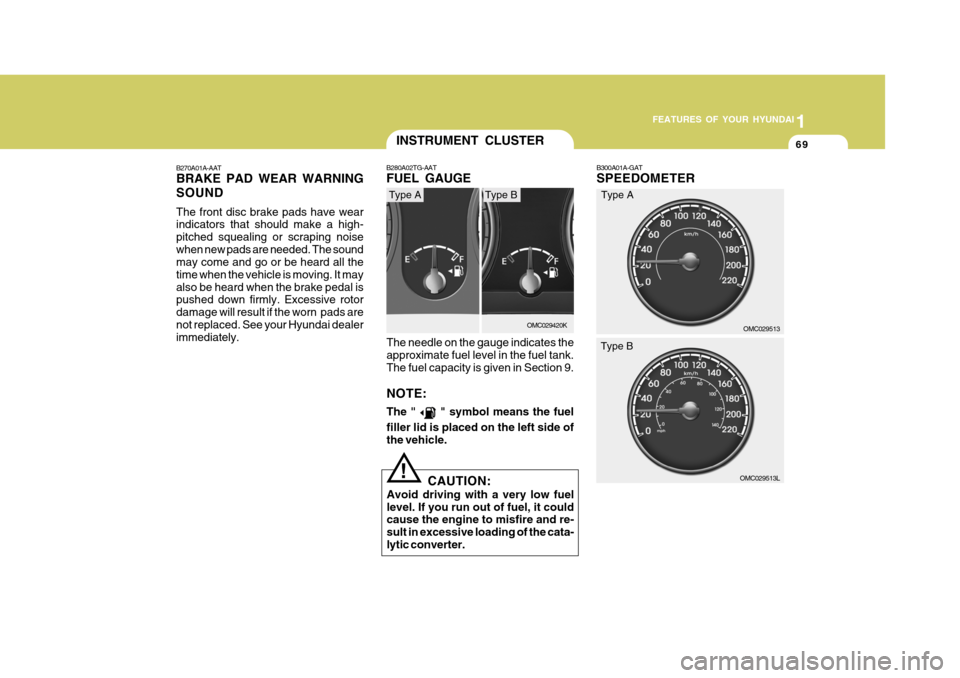
B300A01A-GAT SPEEDOMETER
OMC029513
OMC029513L
Type A
Type B
B270A01A-AAT BRAKE PAD WEAR WARNING SOUND The front disc brake pads have wear indicators that should make a high- pitched squealing or scraping noisewhen new pads are needed. The sound may come and go or be heard all the time when the vehicle is moving. It mayalso be heard when the brake pedal is pushed down firmly. Excessive rotor damage will result if the worn pads arenot replaced. See your Hyundai dealer immediately.
INSTRUMENT CLUSTER
The needle on the gauge indicates the approximate fuel level in the fuel tank. The fuel capacity is given in Section 9. NOTE: The "
" symbol means the fuel
filler lid is placed on the left side of the vehicle.
B280A02TG-AAT FUEL GAUGE
OMC029420K
Type AType B
CAUTION:
Avoid driving with a very low fuel level. If you run out of fuel, it could cause the engine to misfire and re- sult in excessive loading of the cata-lytic converter.
!
Page 110 of 284
1FEATURES OF YOUR HYUNDAI
98
If you must re-enter the vehicle, you should once again elimi- nate potentially dangerous staticelectricity discharge by touch- ing a metal part of the vehicle, away from the fuel filler neck,nozzle or other gasoline source.
- When using a portable fuel con-
tainer be sure to place the con-tainer on the ground prior to refueling. Static electricity dis- charge from the container canignite fuel vapors causing a fire. Once refueling has begun, con- tact with the vehicle should bemaintained until the filling is complete. Use only portable fuel containers designed to carry andstore gasoline.
- Do not use cellular phones
around a gas station or whilerefueling any vehicle. Electric current and/or electronic inter- ference from cellular phones canpotentially ignite fuel vapors causing a fire. If you must use your cellular phone use it in aplace away from the gas station.- Read and follow all warningsposted at the gas station facility.
- Before refueling, note the loca- tion of the Emergency Gasoline Shut-Off, if available, at the gas station facility.
- Before touching the fuel nozzle or fuel filler cap, you shouldeliminate potentially dangerousstatic electricity discharge by touching another metal part of the front of the vehicle, a safedistance away from the fuel filler neck, nozzle, or other gas source.
- Do not get back into a vehicle once you have begun refueling.Do not touch, rub or slide againstany item or fabric (polyester, satin, nylon, etc.) capable of pro- ducing static electricity. Staticelectricity discharge can ignite fuel vapors resulting in explo- sion.
WARNING:
o Fuel vapors are dangerous. Be- fore refueling, always stop the en- gine and never allow sparks or open flames near the filler area. If you need to replace the filler cap,use a genuine Hyundai replace- ment part. If you open the fuel filler cap dur-ing high ambient temperatures, a slight "pressure sound" may be heard. This is normal and not acause for concern. Whenever you open the fuel filler cap, turn it slowly.
o Automotive fuels are flammable/ explosive materials. When refuel-ing, please note the followingguidelines carefully. Failure to follow these guidelines may re- sult in severe personal injury, se-vere burns or death by fire or explosion.!
Page 111 of 284
1
FEATURES OF YOUR HYUNDAI
99
- When refueling always shut the
engine off. Sparks produced by electrical components related tothe engine can ignite fuel va- pors causing a fire. Always in- sure that the engine is OFF be-fore and during refueling. Once refueling is complete, check to make sure the fuel filler cap anddoor are securely closed, before starting the engine.
- Do not light any fire around a gas station. DO NOT use matchesor a lighter and DO NOT SMOKE or leave a lit cigarette in yourvehicle while at a gas station especially during refueling. Au- tomotive fuel is highly flammableand can, when ignited, result in explosion by flames.
- If a fire breaks out during refuel- ing, leave the vicinity of the ve-hicle, and immediately contact the manager of the gas stationor contact the police and local fire department. Follow any safety instructions they provide.
!
TRUNK LID/TAIL GATE
B540A01MC-GAT
WARNING:
The trunk lid or the tail gate should always be kept completely closed while the vehicle is in motion. If it is left open or ajar, poisonous exhaustgases may enter the car resulting in serious illiness or death to the occu- pants. See additional warnings con-cerning exhaust gases on page 2-2. Trunk Lid (4 Door)
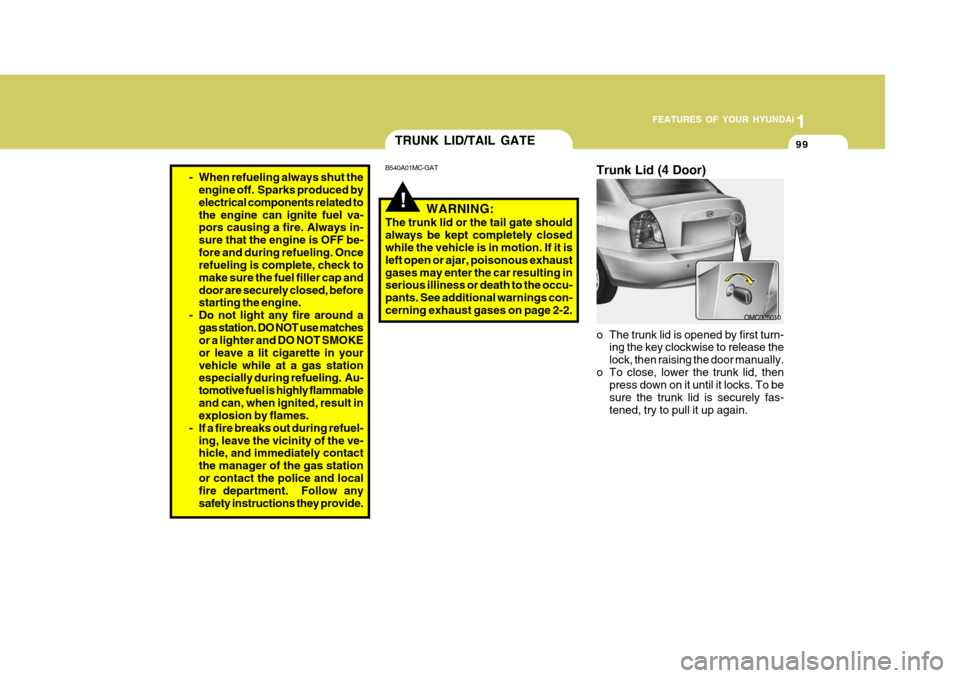
o The trunk lid is opened by first turn-
ing the key clockwise to release the lock, then raising the door manually.
o To close, lower the trunk lid, then press down on it until it locks. To besure the trunk lid is securely fas-tened, try to pull it up again.
OMC025010
Page 195 of 284
3
WHAT TO DO IN AN EMERGENCY
5SPARE TIRE
!!WARNING (Diesel Only):
Never work on injection system with engine running or within 30 sec- onds after shutting off engine. High pressure pump, rail, injectors andhigh pressure pipes are subject to high pressure even after the engine stopped. The fuel jet produced byfuel leaks may cause serious in- jury, if it touch the body. People using pacemakers should not movethan 30cm closer to the ECU or wiring harness within the engine room while engine is running, sincethe high currents in the Common Rail system produce considerable magnetic fields. WARNING:
Do not remove the radiator cap whenthe engine is hot. This may result incoolant being blown out of the open- ing and cause serious burns.
6. If you cannot find the cause of the overheating, wait until the engine temperature has returned to nor-mal. Then, if the engine coolant has been lost, carefully add coolant to the reservoir (Page 6-11) to bring thefluid level in the reservoir up to the halfway mark.
7. Proceed with caution, keeping alert
for further signs of overheating. Ifoverheating happens again, call a Hyundai dealer for assistance.
!
5. If the water pump drive belt is broken
or coolant is leaking out, stop the engine immediately and call the near- est Hyundai dealer for assistance. CAUTION:
Serious loss of engine coolant indi- cates there is a leak in the coolingsystem and this should be checked as soon as possible by a Hyundai dealer.
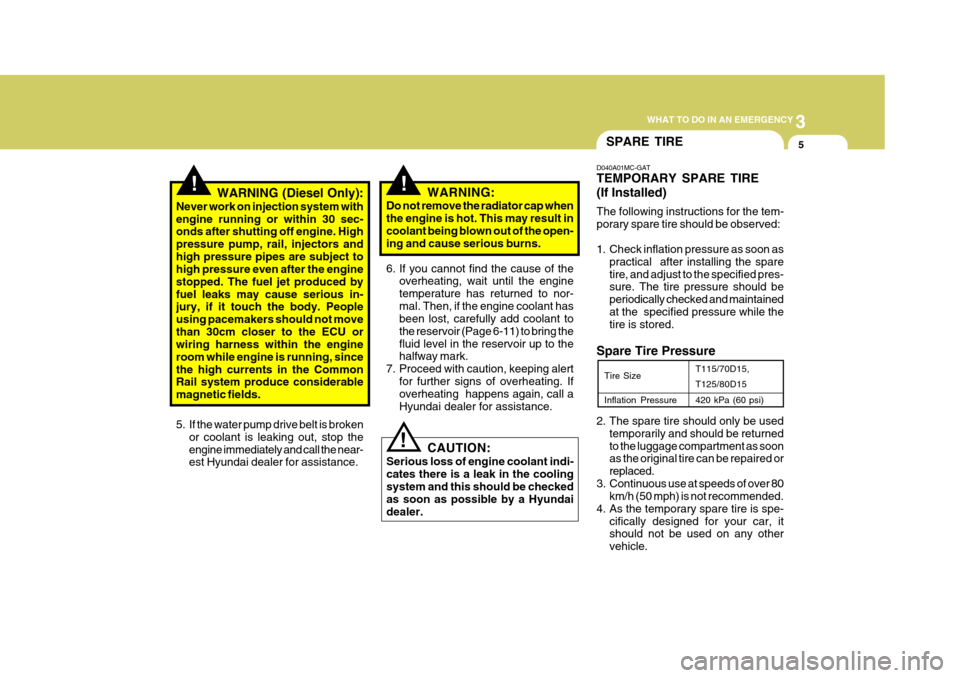
Inflation Pressure
Tire Size
T115/70D15, T125/80D15 420 kPa (60 psi)
2. The spare tire should only be used temporarily and should be returned to the luggage compartment as soon as the original tire can be repaired or replaced.
3. Continuous use at speeds of over 80 km/h (50 mph) is not recommended.
4. As the temporary spare tire is spe-
cifically designed for your car, it should not be used on any other vehicle.
D040A01MC-GAT TEMPORARY SPARE TIRE (If Installed) The following instructions for the tem- porary spare tire should be observed:
1. Check inflation pressure as soon as
practical after installing the spare tire, and adjust to the specified pres- sure. The tire pressure should be periodically checked and maintainedat the specified pressure while the tire is stored.
Spare Tire Pressure
Page 219 of 284
5VEHICLE MAINTENANCE REQUIREMENTS
4SCHEDULED MAINTENANCE
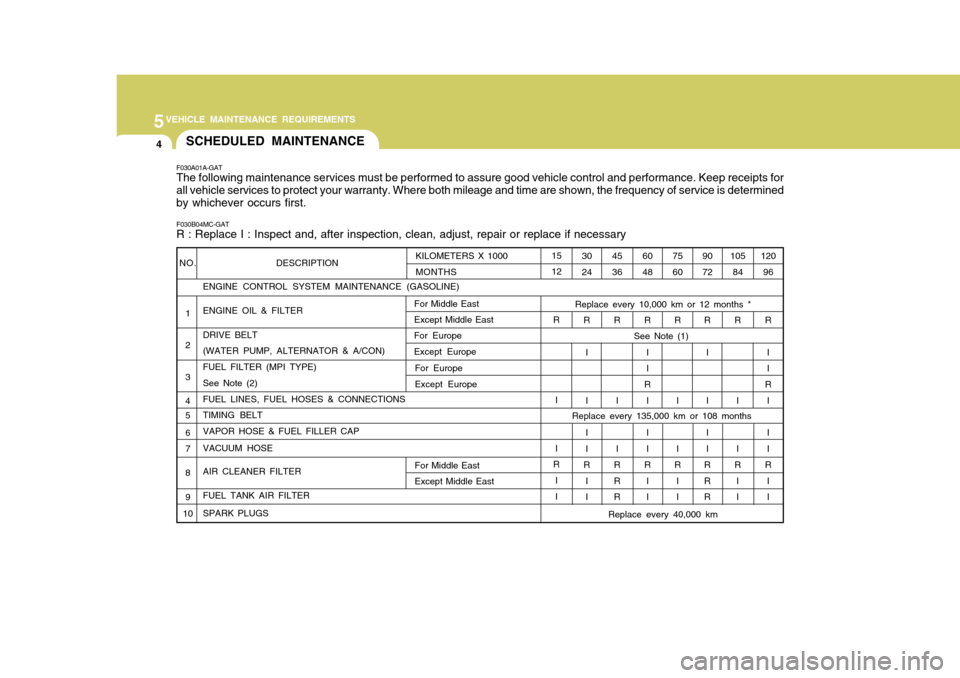
F030A01A-GAT The following maintenance services must be performed to assure good vehicle control and performance. Keep receipts for
all vehicle services to protect your warranty. Where both mileage and time are shown, the frequency of service is determinedby whichever occurs first. F030B04MC-GAT R : Replace I : Inspect and, after inspection, clean, adjust, repair or replace if necessary
ENGINE CONTROL SYSTEM MAINTENANCE (GASOLINE) ENGINE OIL & FILTERDRIVE BELT (WATER PUMP, ALTERNATOR & A/CON) FUEL FILTER (MPI TYPE) See Note (2) FUEL LINES, FUEL HOSES & CONNECTIONS TIMING BELT VAPOR HOSE & FUEL FILLER CAP VACUUM HOSE AIR CLEANER FILTER FUEL TANK AIR FILTER SPARK PLUGS
NO. DESCRIPTION10584
R
I I
R
I I 120
96
R II
R I I I
R
I I
9072
R I I I I
RR R
7560
R
I I
R
I I
6048
R II
R I I I
R
I I
4536
R
I I
R R R
3024
R I I I I
R
I I
1512
R
I I
R
I I
KILOMETERS X 1000MONTHS
Replace every 40,000 km
For Middle East Except Middle East
Replace every 10,000 km or 12 months *For Middle East Except Middle East
For Europe Except Europe
Replace every 135,000 km or 108 months
1 23 4 5 6 7 8 9
10 For Europe Except Europe
See Note (1)
Page 224 of 284

5
VEHICLE MAINTENANCE REQUIREMENTS
9
F060H01A-AAT
o Air Cleaner Filter A Genuine Hyundai air cleaner filter is
recommended when the filter is re- placed. F060J01A-AAT
o Spark Plugs (For Gasoline Engine)
Make sure to install new spark plugs of the correct heat range. F070C01A-AAT o Coolant The coolant should be changed at the intervals specified in the mainte- nance schedule.
F060E01MC-AAT
o Timing Belt (Gasoline)
Inspect all parts related to the timing
belt for damage and deformation.Replace any damaged parts immedi- ately.
F060G01A-AAT
o Vapor Hose and Fuel Filler Cap
The vapor hose and fuel filler cap
should be inspected at those intervalsspecified in the maintenance sched-ule. Make sure that a new vapor hose or fuel filler cap is correctly replaced. F060F01A-AAT
o Vacuum, Crankcase Ventila-
tion Hoses
Inspect the surface of hoses for evi-
dence of heat and/or mechanical dam-age. Hard and brittle rubber, cracking, tears, cuts, abrasions, and excessiveswelling indicate deterioration. Partic- ular attention should be paid to exam- ine those hose surfaces nearest tohigh heat sources, such as the ex- haust manifold.
Inspect the hose routing to assure
that the hoses do not come in contactwith any heat source, sharp edges or moving component which might causeheat damage or mechanical wear. Inspect all hose connections, such as clamps and couplings, to make surethey are secure, and that no leaks are present. Hoses should be replaced immediately if there is any evidenceof deterioration or damage. F070B01A-GAT o Cooling System Check the cooling system part, such as radiator, coolant reservoir, hoses and connections for leakage and dam- age. Replace any damaged parts.
Page 230 of 284
6 DO-IT-YOURSELF MAINTENANCE
4
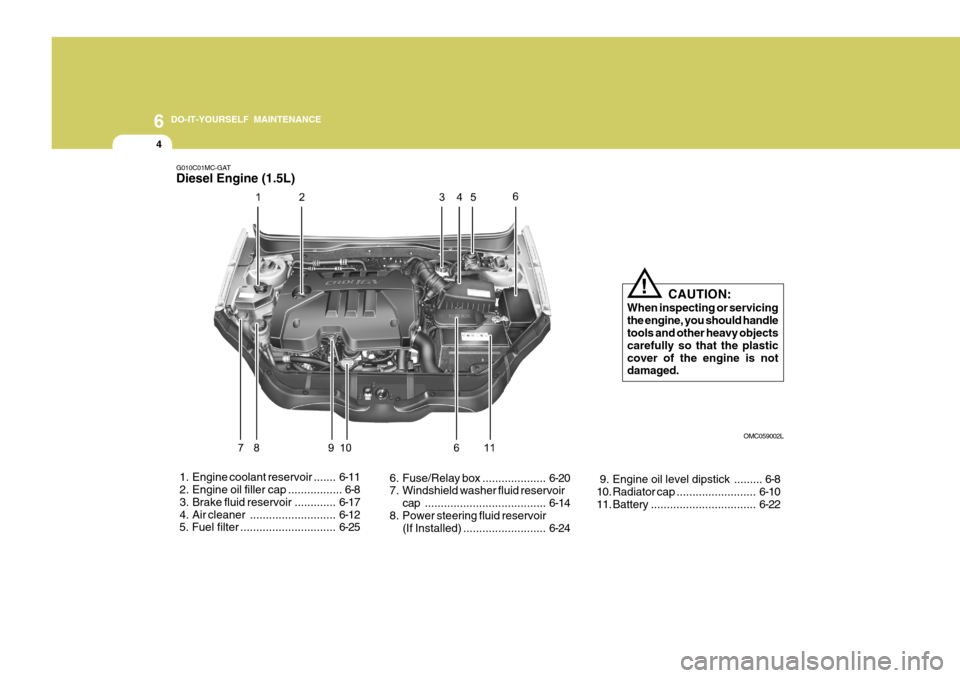
G010C01MC-GAT Diesel Engine (1.5L)
OMC059002L
1. Engine coolant reservoir ....... 6-11
2. Engine oil filler cap................. 6-8
3. Brake fluid reservoir ............. 6-17
4. Air cleaner ........................... 6-12
5. Fuel filter .............................. 6-25 6. Fuse/Relay box ....................
6-20
7. Windshield washer fluid reservoir
cap ...................................... 6-14
8. Power steering fluid reservoir (If Installed) .......................... 6-24 9. Engine oil level dipstick ......... 6-8
10. Radiator
cap ......................... 6-10
11. Battery ................................. 6-22
CAUTION:
When inspecting or servicingthe engine, you should handletools and other heavy objects carefully so that the plastic cover of the engine is not damaged.
!
Page 251 of 284
6
DO-IT-YOURSELF MAINTENANCE
25REMOVAL OF WATER FROM THE FUEL FILTER
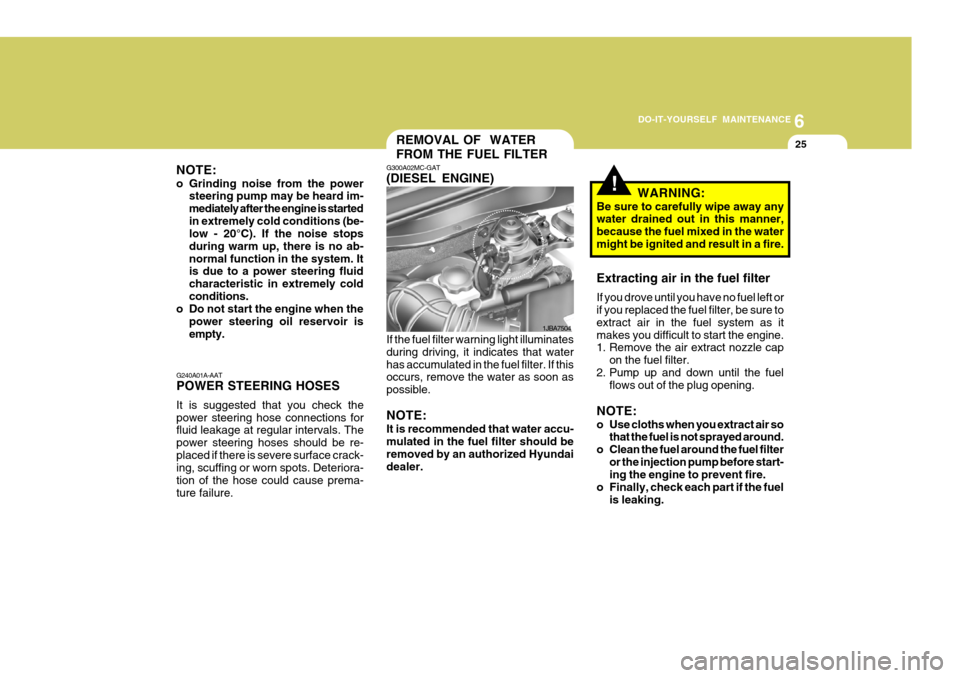
1JBA7504
G240A01A-AAT POWER STEERING HOSES It is suggested that you check the power steering hose connections for fluid leakage at regular intervals. The power steering hoses should be re-placed if there is severe surface crack- ing, scuffing or worn spots. Deteriora- tion of the hose could cause prema-ture failure. G300A02MC-GAT (DIESEL ENGINE) If the fuel filter warning light illuminates during driving, it indicates that waterhas accumulated in the fuel filter. If this occurs, remove the water as soon as possible. NOTE: It is recommended that water accu- mulated in the fuel filter should be removed by an authorized Hyundaidealer.
NOTE:
o Grinding noise from the power
steering pump may be heard im- mediately after the engine is startedin extremely cold conditions (be- low - 20°C). If the noise stops during warm up, there is no ab-normal function in the system. It is due to a power steering fluid characteristic in extremely coldconditions.
o Do not start the engine when the
power steering oil reservoir isempty.
!WARNING:
Be sure to carefully wipe away any water drained out in this manner, because the fuel mixed in the watermight be ignited and result in a fire. Extracting air in the fuel filter If you drove until you have no fuel left or if you replaced the fuel filter, be sure to extract air in the fuel system as itmakes you difficult to start the engine.
1. Remove the air extract nozzle cap on the fuel filter.
2. Pump up and down until the fuel
flows out of the plug opening.
NOTE:
o Use cloths when you extract air so that the fuel is not sprayed around.
o Clean the fuel around the fuel filter or the injection pump before start- ing the engine to prevent fire.
o Finally, check each part if the fuel is leaking.
Page 266 of 284

7EMISSION CONTROL SYSTEMS
2EMISSION CONTROL SYSTEM
H010A01A-GAT
(If Installed)
Your Hyundai is equipped with an
emission control system to meet all requirements of the Emission prohibi- tion rules of your province. There are three emission control sys-
tems which are as follows.
1) Crankcase emission control sys- tem
2) Evaporative emission control sys-
tem
3) Exhaust emission control system
In order to assure the proper function
of the emission control systems, it is recommended that you have your car inspected and maintained by an au- thorized Hyundai dealer in accordancewith the maintenance schedule in this manual. H010B01A-AAT
1. Crankcase Emission Control
System
The positive crankcase ventilation
system is employed to prevent airpollution caused by blow-by gases being emitted from the crankcase.This system supplies fresh air to the crankcase through the air intake hose. Inside the crankcase, the fresh airmixes with blow-by gases, which then pass through the PCV valve and into the induction system.
H010C02E-GAT
2. Evaporative Emission
Control System
The Evaporative Emission Control
System is designed to prevent fuelvapors from escaping into the atmo-sphere. Canister
Fuel vapors generated inside the fuel
tank are absorbed and stored in the canister. When the engine is running, the fuel vapors absorbed in the can-ister are drawn into the induction sys-tem through the purge control sole- noid valve. Purge Control Solenoid Valve (PCSV)
The purge control solenoid valve is
controlled by the Engine Control Mod- ule (ECM); when the engine coolant temperature is low during idling, the PCSV closes so that evaporated fuelis not taken into the engine. After the engine warms-up during ordinary driv- ing, the PCSV opens so as to intro-duce evaporated fuel to the engine. H010D01A-AAT
3. Exhaust Emission Control
System
The exhaust emission control system is a highly effective system which controls exhaust emission while main-taining good vehicle performance.