engine coolant Hyundai Accent 2011 Owner's Guide
[x] Cancel search | Manufacturer: HYUNDAI, Model Year: 2011, Model line: Accent, Model: Hyundai Accent 2011Pages: 282, PDF Size: 14.82 MB
Page 239 of 282
6
DO-IT-YOURSELF MAINTENANCE
21
!
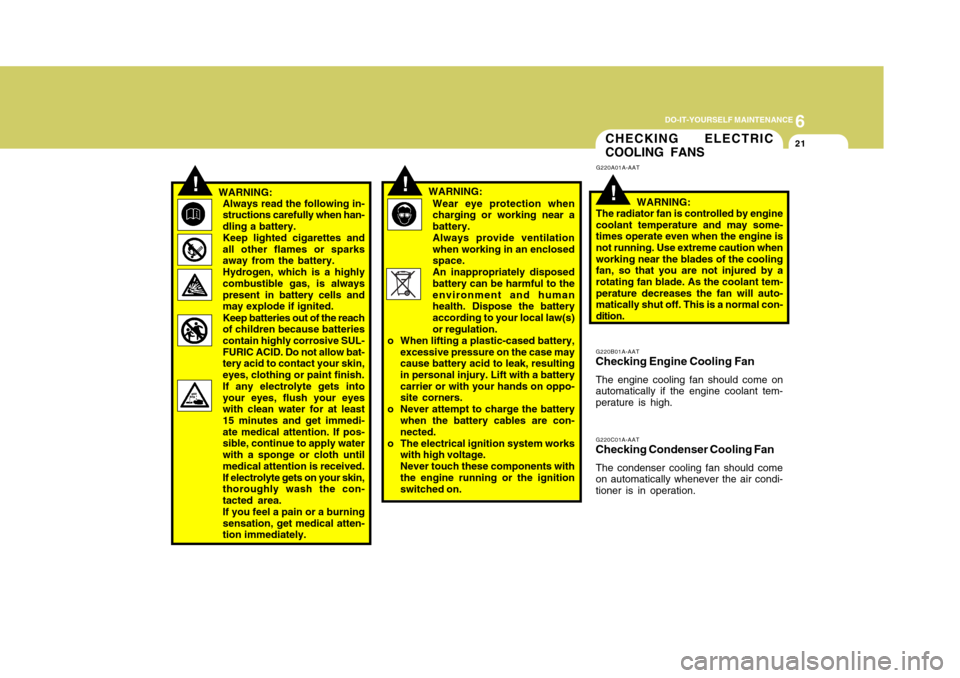
G220A01A-AAT
G220B01A-AATChecking Engine Cooling FanThe engine cooling fan should come on
automatically if the engine coolant tem-
perature is high.WARNING:
The radiator fan is controlled by engine
coolant temperature and may some-
times operate even when the engine is
not running. Use extreme caution when
working near the blades of the cooling
fan, so that you are not injured by a
rotating fan blade. As the coolant tem-
perature decreases the fan will auto-
matically shut off. This is a normal con-
dition.G220C01A-AATChecking Condenser Cooling FanThe condenser cooling fan should come
on automatically whenever the air condi-
tioner is in operation.CHECKING ELECTRIC
COOLING FANS
!
Wear eye protection when
charging or working near a
battery.
Always provide ventilation
when working in an enclosed
space.
An inappropriately disposed
battery can be harmful to the
environment and human
health. Dispose the battery
according to your local law(s)
or regulation.
o When lifting a plastic-cased battery,
excessive pressure on the case may
cause battery acid to leak, resulting
in personal injury. Lift with a battery
carrier or with your hands on oppo-
site corners.
o Never attempt to charge the battery
when the battery cables are con-
nected.
o The electrical ignition system works
with high voltage.
Never touch these components with
the engine running or the ignition
switched on.
WARNING:
Always read the following in-
structions carefully when han-
dling a battery.
Keep lighted cigarettes and
all other flames or sparks
away from the battery.
Hydrogen, which is a highly
combustible gas, is always
present in battery cells and
may explode if ignited.
Keep batteries out of the reach
of children because batteries
contain highly corrosive SUL-
FURIC ACID. Do not allow bat-
tery acid to contact your skin,
eyes, clothing or paint finish.
If any electrolyte gets into
your eyes, flush your eyes
with clean water for at least
15 minutes and get immedi-
ate medical attention. If pos-
sible, continue to apply water
with a sponge or cloth until
medical attention is received.
If electrolyte gets on your skin,
thoroughly wash the con-
tacted area.
If you feel a pain or a burning
sensation, get medical atten-
tion immediately.
!
WARNING:
Page 252 of 282
7
EMISSION CONTROL SYSTEMS2
EMISSION CONTROL SYSTEM
CanisterFuel vapors generated inside the fuel
tank are absorbed and stored in the
onboard canister. When the engine is
running, the fuel vapors absorbed in the
canister are drawn into the induction sys-
tem through the purge control solenoid
valve.Purge Control Solenoid Valve (PCSV)The purge control solenoid valve is con-
trolled by the Engine Control Module
(ECM); when the engine coolant tem-
perature is low during idling, the PCSV
closes so that evaporated fuel is not taken
into the engine. After the engine warms-
up during ordinary driving, the PCSV
opens to introduce evaporated fuel to the
engine.
H010B01A-AAT1. Crankcase Emission Control
SystemThe positive crankcase ventilation sys-
tem is employed to prevent air pollution
caused by blow-by gases being emitted
from the crankcase. This system supplies
filtered fresh air to the crankcase through
the air intake hose. Inside the crankcase,
the fresh air mixes with blow-by gases,
then passes through the PCV valve into
the induction system.
H010A01A-AATYour Hyundai is equipped with an emis-
sion control system to meet all require-
ments of the U.S. Environmental Protec-
tion Agency or California Air Resources
Board.
There are three emission control systems
which are as follows.
1) Crankcase Emission Control System
2) Evaporative Emission Control System
3) Exhaust Emission Control System
In order to ensure the proper function of
the emission control systems, it is recom-
mended that you have your car inspected
and maintained by an authorized Hyundai
dealer in accordance with the mainte-
nance schedule in this manual.
H010C01S-AAT2. Evaporative Emission Control (In-
cluding ORVR: Onboard Refuel-
ing Vapor Recovery) SystemThe Evaporative Emission Control Sys-
tem is designed to prevent fuel vapors
from escaping into the atmosphere.
(The ORVR system is designed to allow
the vapors from the fuel tank to be loaded
into a canister while refueling at the gas
station, preventing the escape of fuel
vapors into the atmosphere.)
Page 276 of 282
9
VEHICLE SPECIFICATIONS4
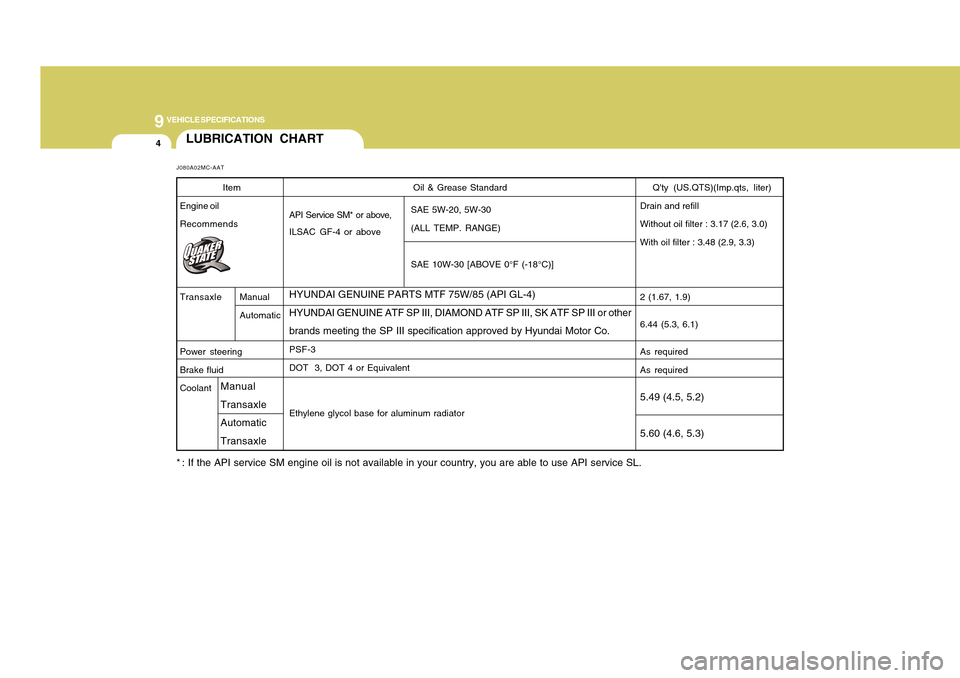
Oil & Grease Standard
API Service SM* or above,
ILSAC GF-4 or above
HYUNDAI GENUINE PARTS MTF 75W/85 (API GL-4)
HYUNDAI GENUINE ATF SP III, DIAMOND ATF SP III, SK ATF SP III or other
brands meeting the SP III specification approved by Hyundai Motor Co.PSF-3
DOT 3, DOT 4 or Equivalent
Ethylene glycol base for aluminum radiatorSAE 5W-20, 5W-30
(ALL TEMP. RANGE)
SAE 10W-30 [ABOVE 0°F (-18°C)]
LUBRICATION CHART
Item
Engine oil
Recommends
TransaxleManual
Automatic
Power steering
Brake fluid
CoolantManual
Transaxle
Automatic
Transaxle
J080A02MC-AAT
Q'ty (US.QTS)(Imp.qts, liter)
Drain and refill
Without oil filter : 3.17 (2.6, 3.0)
With oil filter : 3.48 (2.9, 3.3)
2 (1.67, 1.9)
6.44 (5.3, 6.1)
As required
As required
5.49 (4.5, 5.2)
5.60 (4.6, 5.3)
* : If the API service SM engine oil is not available in your country, you are able to use API service SL.
Page 279 of 282
10
INDEX
3
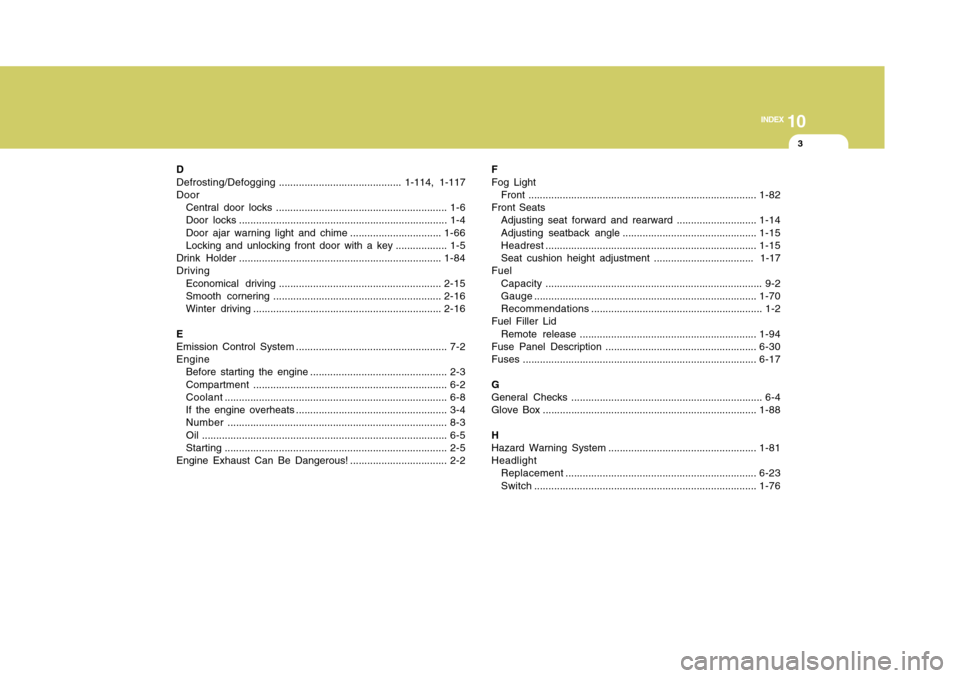
D
Defrosting/Defogging........................................... 1-114, 1-117
Door
Central door locks ............................................................ 1-6
Door locks ......................................................................... 1-4
Door ajar warning light and chime ................................1-66
Locking and unlocking front door with a key .................. 1-5
Drink Holder .......................................................................1-84
Driving
Economical driving .........................................................2-15
Smooth cornering ...........................................................2-16
Winter driving ..................................................................2-16
E
Emission Control System ..................................................... 7-2
Engine
Before starting the engine ................................................ 2-3
Compartment.................................................................... 6-2
Coolant .............................................................................. 6-8
If the engine overheats ..................................................... 3-4
Number............................................................................. 8-3
Oil ...................................................................................... 6-5
Starting.............................................................................. 2-5
Engine Exhaust Can Be Dangerous! .................................. 2-2F
Fog Light
Front ................................................................................1-82
Front Seats
Adjusting seat forward and rearward ............................1-14
Adjusting seatback angle ...............................................1-15
Headrest..........................................................................1-15
Seat cushion height adjustment ................................... 1-17
Fuel
Capacity............................................................................ 9-2
Gauge..............................................................................1-70
Recommendations............................................................ 1-2
Fuel Filler Lid
Remote release ..............................................................1-94
Fuse Panel Description .....................................................6-30
Fuses..................................................................................6-17
G
General Checks ................................................................... 6-4
Glove Box ...........................................................................1-88
H
Hazard Warning System ....................................................1-81
Headlight
Replacement...................................................................6-23
Switch..............................................................................1-76