malfunction Hyundai Accent 2011 Owner's Guide
[x] Cancel search | Manufacturer: HYUNDAI, Model Year: 2011, Model line: Accent, Model: Hyundai Accent 2011Pages: 282, PDF Size: 14.82 MB
Page 186 of 282
3
WHAT TO DO IN AN EMERGENCY
5
!!
WARNING:
While the engine is running, keep hands,
long hair and clothing away from mov-
ing parts such as the fan and drive belts
to prevent injury.
5. If the water pump drive belt is broken
or coolant is leaking out, stop the en-
gine immediately and call the nearest
Hyundai dealer for assistance.
WARNING:
Do not remove the radiator cap when
the engine is hot. This may result in
coolant being blown out of the opening
and cause serious burns.
!
6. If you cannot find the cause of the
overheating, wait until the engine tem-
perature has returned to normal. Then,
if coolant has been lost, carefully add
water to the reservoir (Page 6-8) to
bring the fluid level in the reservoir up
to the halfway mark.
7. Proceed with caution, keeping alert for
further signs of overheating. If over-
heating happens again, call a Hyundai
dealer for assistance.
CAUTION:
Serious loss of coolant indicates there
is a leak in the cooling system and this
should be checked as soon as possible
by a Hyundai dealer.
TIRE PRESSURE MONITOR-
ING SYSTEM (TPMS)
C320A01TG C320A01MC-AAT
(If Installed)
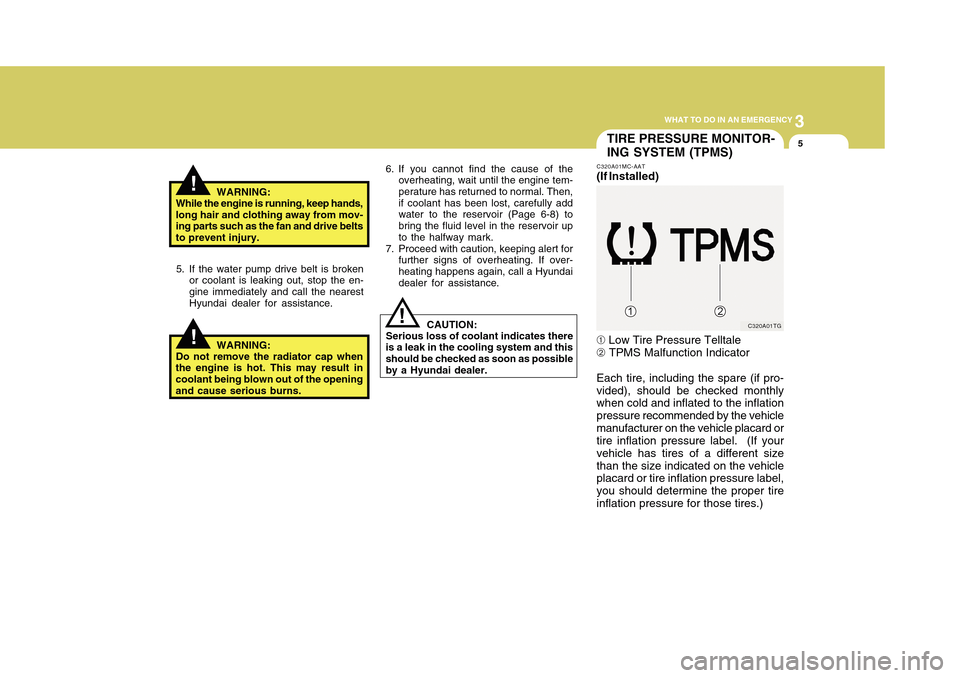
➀ Low Tire Pressure Telltale
➁ TPMS Malfunction Indicator
Each tire, including the spare (if pro-
vided), should be checked monthly
when cold and inflated to the inflation
pressure recommended by the vehicle
manufacturer on the vehicle placard or
tire inflation pressure label. (If your
vehicle has tires of a different size
than the size indicated on the vehicle
placard or tire inflation pressure label,
you should determine the proper tire
inflation pressure for those tires.)
Page 187 of 282
36WHAT TO DO IN AN EMERGENCY
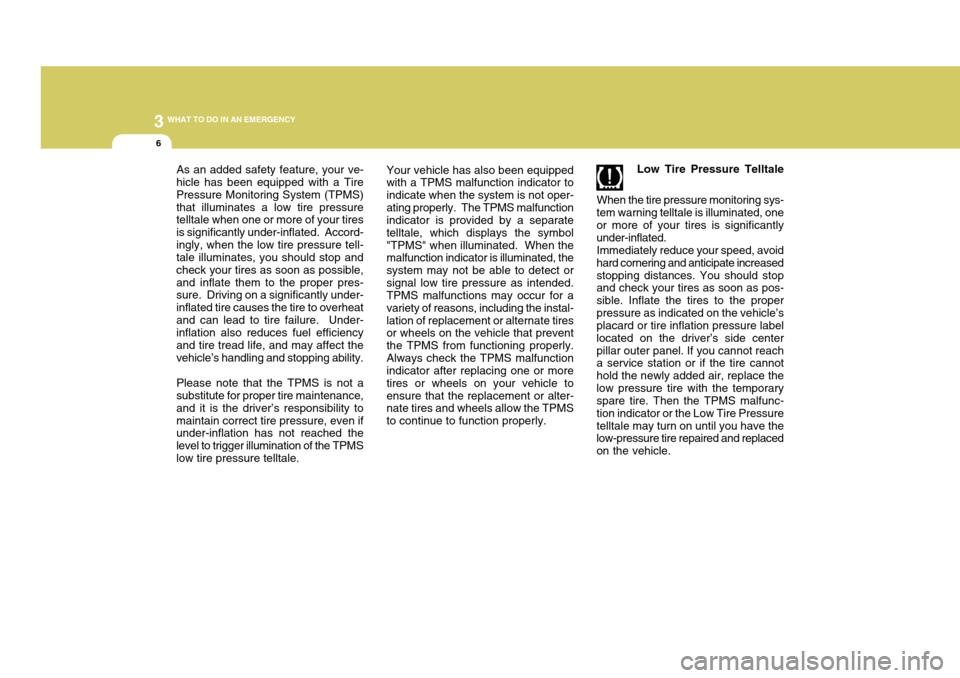
Low Tire Pressure Telltale
When the tire pressure monitoring sys-
tem warning telltale is illuminated, one
or more of your tires is significantly
under-inflated.
Immediately reduce your speed, avoid
hard cornering and anticipate increased
stopping distances. You should stop
and check your tires as soon as pos-
sible. Inflate the tires to the proper
pressure as indicated on the vehicle’s
placard or tire inflation pressure label
located on the driver’s side center
pillar outer panel. If you cannot reach
a service station or if the tire cannot
hold the newly added air, replace the
low pressure tire with the temporary
spare tire. Then the TPMS malfunc-
tion indicator or the Low Tire Pressure
telltale may turn on until you have the
low-pressure tire repaired and replaced
on the vehicle.
As an added safety feature, your ve-
hicle has been equipped with a Tire
Pressure Monitoring System (TPMS)
that illuminates a low tire pressure
telltale when one or more of your tires
is significantly under-inflated. Accord-
ingly, when the low tire pressure tell-
tale illuminates, you should stop and
check your tires as soon as possible,
and inflate them to the proper pres-
sure. Driving on a significantly under-
inflated tire causes the tire to overheat
and can lead to tire failure. Under-
inflation also reduces fuel efficiency
and tire tread life, and may affect the
vehicle’s handling and stopping ability.
Please note that the TPMS is not a
substitute for proper tire maintenance,
and it is the driver’s responsibility to
maintain correct tire pressure, even if
under-inflation has not reached the
level to trigger illumination of the TPMS
low tire pressure telltale.Your vehicle has also been equipped
with a TPMS malfunction indicator to
indicate when the system is not oper-
ating properly. The TPMS malfunction
indicator is provided by a separate
telltale, which displays the symbol
"TPMS" when illuminated. When the
malfunction indicator is illuminated, the
system may not be able to detect or
signal low tire pressure as intended.
TPMS malfunctions may occur for a
variety of reasons, including the instal-
lation of replacement or alternate tires
or wheels on the vehicle that prevent
the TPMS from functioning properly.
Always check the TPMS malfunction
indicator after replacing one or more
tires or wheels on your vehicle to
ensure that the replacement or alter-
nate tires and wheels allow the TPMS
to continue to function properly.
Page 188 of 282
3
WHAT TO DO IN AN EMERGENCY
7
!
CAUTION:
In winter or cold weather, the low
tire pressure telltale may be illumi-
nated if the tire pressure was ad-
justed to the recommended tire in-
flation pressure in warm weather. It
does not mean your TPMS is mal-
functioning because the decreased
temperature leads to a proportional
lowering of tire pressure.
When you drive your vehicle from a
warm area to a cold area or from a
cold area to a warm area, or the
outside temperature is greatly
higher or lower, you should check
the tire inflation pressure and ad-
just the tires to the recommended
tire inflation pressure.
WARNING:
Significantly low tire pressure
makes the vehicle unstable and can
contribute to loss of vehicle control
and increased braking distances.
Continued driving on low pressure
tires will cause the tires to overheat
and fail.
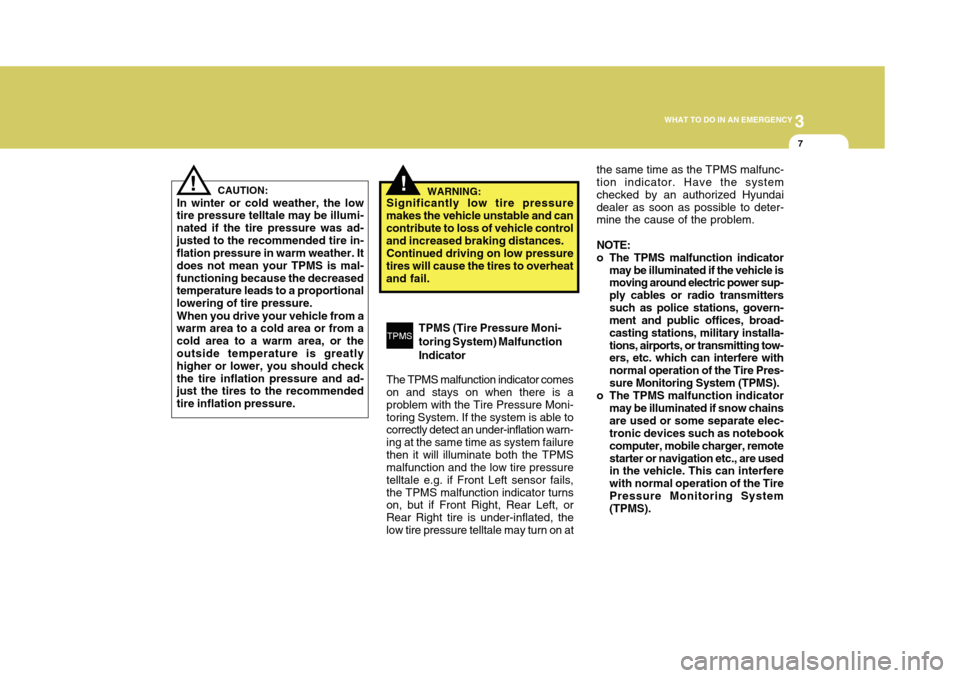
TPMS (Tire Pressure Moni-
toring System) Malfunction
Indicator
The TPMS malfunction indicator comes
on and stays on when there is a
problem with the Tire Pressure Moni-
toring System. If the system is able to
correctly detect an under-inflation warn-
ing at the same time as system failure
then it will illuminate both the TPMS
malfunction and the low tire pressure
telltale e.g. if Front Left sensor fails,
the TPMS malfunction indicator turns
on, but if Front Right, Rear Left, or
Rear Right tire is under-inflated, the
low tire pressure telltale may turn on at
!
the same time as the TPMS malfunc-
tion indicator. Have the system
checked by an authorized Hyundai
dealer as soon as possible to deter-
mine the cause of the problem.
NOTE:
o The TPMS malfunction indicator
may be illuminated if the vehicle is
moving around electric power sup-
ply cables or radio transmitters
such as police stations, govern-
ment and public offices, broad-
casting stations, military installa-
tions, airports, or transmitting tow-
ers, etc. which can interfere with
normal operation of the Tire Pres-
sure Monitoring System (TPMS).
o The TPMS malfunction indicator
may be illuminated if snow chains
are used or some separate elec-
tronic devices such as notebook
computer, mobile charger, remote
starter or navigation etc., are used
in the vehicle. This can interfere
with normal operation of the Tire
Pressure Monitoring System
(TPMS).
Page 189 of 282
38WHAT TO DO IN AN EMERGENCYo If there is a failed tire sensor, it is
possible for the TPMS to tempo-
rarily learn a replacement sensor
if closely driven to another ve-
hicle that is also equipped with
TPMS. In rare cases, this may
temporarily delay the TPMS mal-
function indicator from turning
on.
Changing a tire with TPMS
If you have a flat tire, the Low Tire
Pressure telltale will turn on. Have the
flat tire repaired by an authorized
Hyundai dealer as soon as possible or
replace the flat tire with the temporary
spare tire.
NOTE:
NEVER use a puncture-repairing
agent to repair and/or inflate a low
pressure tire. If used, you will have
to replace the tire pressure sensor.Each wheel is equipped with a tire
pressure sensor mounted inside the
tire behind the valve stem. You must
use TPMS specific wheels. It is rec-
ommended that you always have your
tires serviced by an authorized Hyundai
dealer as soon as possible.
After you replace the low pressure tire
with the spare tire, the TPMS malfunc-
tion indicator or the Low Tire Pressure
telltale may illuminate after restarting
and about 20 minutes of continuous
driving.
Once the low pressure tire is re-in-
flated to the recommended pressure
and installed on the vehicle, the TPMS
malfunction indicator and the low tire
pressure telltale will be extinguished.
If the low pressure and TPMS mal-
function indicators are not extinguished
after about 20 minutes of continuous
driving, please visit an authorized
Hyundai dealer.
You may not be able to identify a low
tire by simply looking at it. Always use
a good quality tire pressure gauge to
measure the tire's inflation pressure.Please note that a tire that is hot (from
being driven) will have a higher pres-
sure measurement than a tire that is
cold (from sitting stationary for at least
3 hours and driven less than 1 mile
during that 3 hour period). Allow the
tire to cool before measuring the infla-
tion pressure.
Always be sure the tire is cold before
inflating to the recommended pres-
sure.
A cold tire means the vehicle has been
sitting for 3 hours and driven for less
than 1 mile in that 3 hour period.
Page 211 of 282
5
VEHICLE MAINTENANCE REQUIREMENTS
3
SCHEDULED MAINTE-
NANCE REQUIREMENTSF020A02A-AATo Inspection should be performed any
time a malfunction is experienced or
suspected.
o Receipts for all emission control sys-
tem services should be retained to
demonstrate compliance with condi-
tions of the emissions system war-
ranty.
o After 120 months or 150,000 miles
(240,000 km), continue to follow the
prescribed maintenance intervals.
o For severe usage maintenance re-
quirements, see page 5-6 of this sec-
tion.
F010F01A-AATA Few Tipso Whenever you have your Hyundai
serviced, keep copies of the service
records in your glove box. This will
help ensure that you can document
that the required procedures have been
performed to keep your warranties in
effect. This is especially important
when service is not performed by an
authorized Hyundai dealer.
o If you choose to do your own mainte-
nance and repairs, you may find it
helpful to have an official Hyundai
Shop Manual. A copy of this publica-
tion may be purchased at your Hyundai
dealer's parts department.
Page 213 of 282
5
VEHICLE MAINTENANCE REQUIREMENTS
5
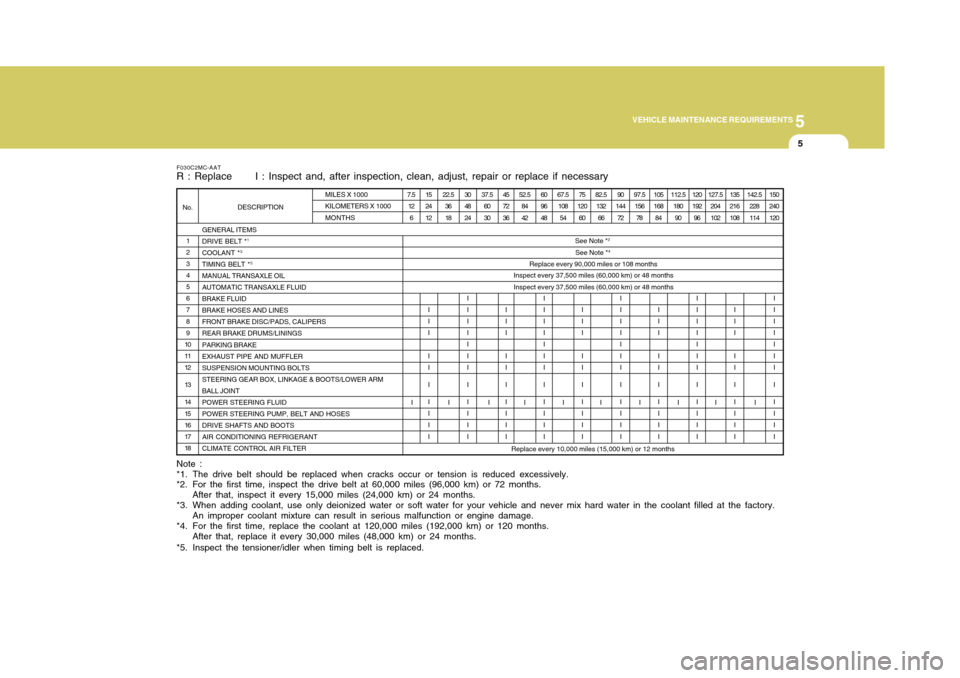
GENERAL ITEMS
DRIVE BELT *
1
COOLANT *
3
TIMING BELT *
5
MANUAL TRANSAXLE OIL
AUTOMATIC TRANSAXLE FLUID
BRAKE FLUID
BRAKE HOSES AND LINES
FRONT BRAKE DISC/PADS, CALIPERS
REAR BRAKE DRUMS/LININGS
PARKING BRAKE
EXHAUST PIPE AND MUFFLER
SUSPENSION MOUNTING BOLTS
STEERING GEAR BOX, LINKAGE & BOOTS/LOWER ARM
BALL JOINT
POWER STEERING FLUID
POWER STEERING PUMP, BELT AND HOSES
DRIVE SHAFTS AND BOOTS
AIR CONDITIONING REFRIGERANT
CLIMATE CONTROL AIR FILTER 1
2
3
4
5
6
7
8
9
10
11
12
13
14
15
16
17
18 No.DESCRIPTIONMILES X 1000
KILOMETERS X 1000
MONTHS7.5
12
615
24
12
I
I
I
I
I
I
I
I
I
I22.5
36
1830
48
24
I
I
I
I
I
I
I
I
I
I
I
I37.5
60
3045
72
36
I
I
I
I
I
I
I
I
I
I52.5
84
4260
96
48
I
I
I
I
I
I
I
I
I
I
I
I67.5
108
5475
120
60
I
I
I
I
I
I
I
I
I
I82.5
132
6690
144
72
I
I
I
I
I
I
I
I
I
I
I
I97.5
156
78105
168
84
I
I
I
I
I
I
I
I
I
I112.5
180
90120
192
96
I
I
I
I
I
I
I
I
I
I
I
I127.5
204
102135
216
108
I
I
I
I
I
I
I
I
I
I142.5
228
114150
240
120
I
I
I
I
I
I
I
I
I
I
I
I
Replace every 10,000 miles (15,000 km) or 12 months
Note :
*1. The drive belt should be replaced when cracks occur or tension is reduced excessively.
*2. For the first time, inspect the drive belt at 60,000 miles (96,000 km) or 72 months.
After that, inspect it every 15,000 miles (24,000 km) or 24 months.
*3. When adding coolant, use only deionized water or soft water for your vehicle and never mix hard water in the coolant filled at the factory.
An improper coolant mixture can result in serious malfunction or engine damage.
*4. For the first time, replace the coolant at 120,000 miles (192,000 km) or 120 months.
After that, replace it every 30,000 miles (48,000 km) or 24 months.
*5. Inspect the tensioner/idler when timing belt is replaced.F030C2MC-AATR : Replace I : Inspect and, after inspection, clean, adjust, repair or replace if necessary
See Note *
4
Replace every 90,000 miles or 108 monthsSee Note *
2
Inspect every 37,500 miles (60,000 km) or 48 months
Inspect every 37,500 miles (60,000 km) or 48 months
II II I I I I I I
Page 226 of 282
6
DO-IT-YOURSELF MAINTENANCE8
CHECKING AND CHANGING
THE ENGINE COOLANT!
G050A01TG-AAT
WARNING:
Do not remove the radiator cap when
the engine is hot. When the engine is
hot, the engine coolant is under pres-
sure and may erupt through the open-
ing if the cap is removed. You could be
seriously burned if you do not observe
this precaution. Do not remove the ra-
diator cap until the radiator is cool to
the touch.
NOTE:
It is recommended that the engine cool-
ant should be changed by an authorized
Hyundai dealer.
G050B01A-AATRecommended Engine CoolantWhen adding coolant, use only deion-
ized water or soft water for your vehicle
and never mix hard water in the coolant
filled at the factory. An improper coolant
mixture can result in serious malfunction
or engine damage.
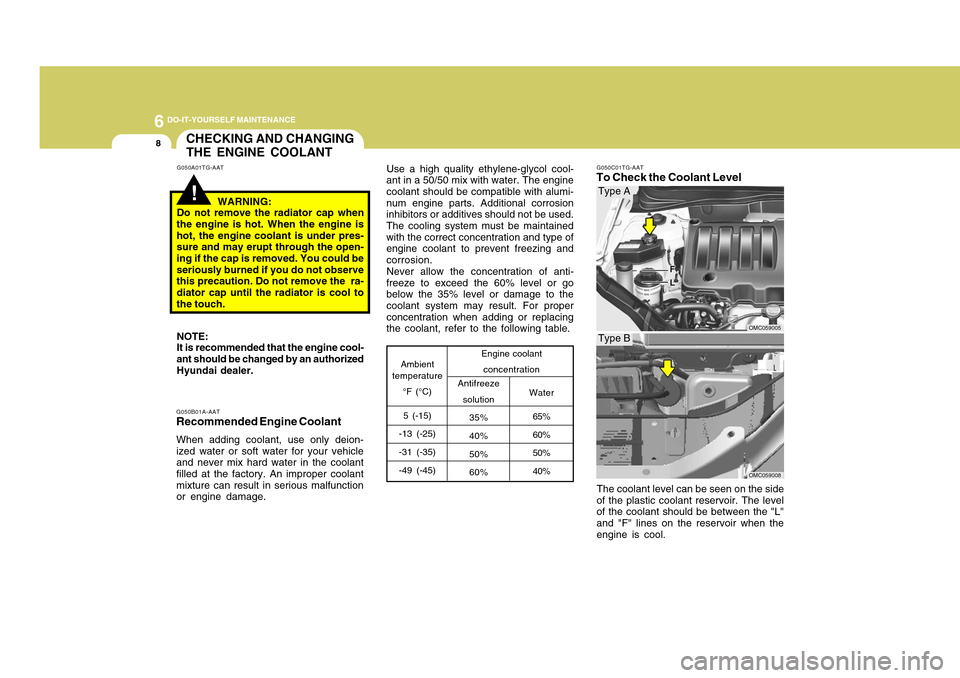
G050C01TG-AATTo Check the Coolant LevelThe coolant level can be seen on the side
of the plastic coolant reservoir. The level
of the coolant should be between the "L"
and "F" lines on the reservoir when the
engine is cool.
OMC059008
Type B
OMC059005
Type A
Water
65%
60%
50%
40% Antifreeze
solution
35%
40%
50%
60% Ambient
temperature
°F (°C)
5 (-15)
-13 (-25)
-31 (-35)
-49 (-45)Engine coolant
concentration
Use a high quality ethylene-glycol cool-
ant in a 50/50 mix with water. The engine
coolant should be compatible with alumi-
num engine parts. Additional corrosion
inhibitors or additives should not be used.
The cooling system must be maintained
with the correct concentration and type of
engine coolant to prevent freezing and
corrosion.
Never allow the concentration of anti-
freeze to exceed the 60% level or go
below the 35% level or damage to the
coolant system may result. For proper
concentration when adding or replacing
the coolant, refer to the following table.