belt Hyundai Accent 2011 Service Manual
[x] Cancel search | Manufacturer: HYUNDAI, Model Year: 2011, Model line: Accent, Model: Hyundai Accent 2011Pages: 282, PDF Size: 14.82 MB
Page 70 of 282
1
FEATURES OF YOUR HYUNDAI
591
FEATURES OF YOUR HYUNDAI
59
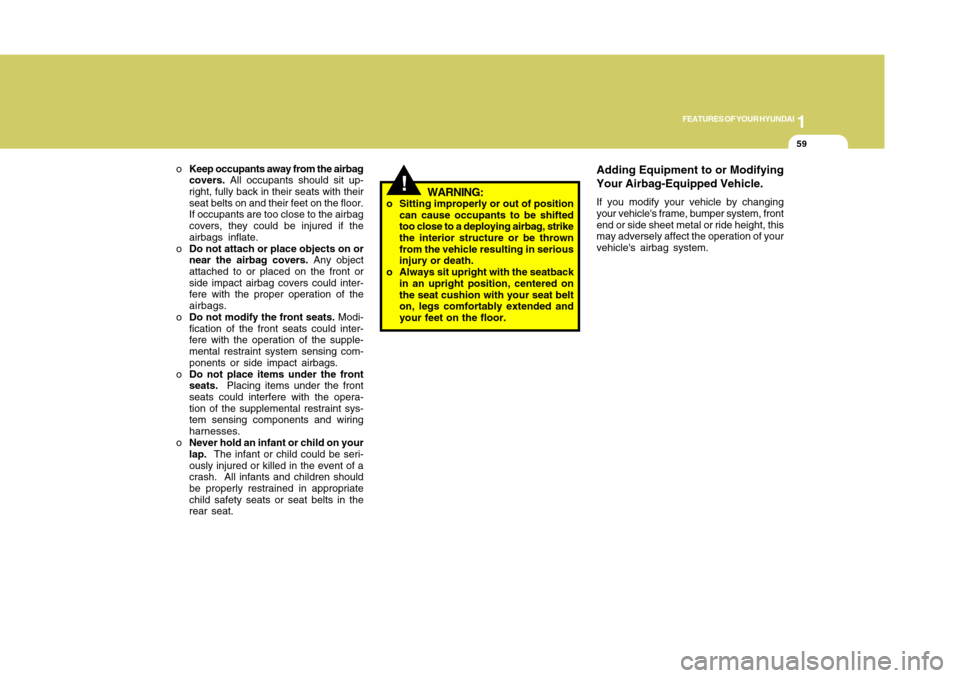
!
WARNING:
o Sitting improperly or out of position
can cause occupants to be shifted
too close to a deploying airbag, strike
the interior structure or be thrown
from the vehicle resulting in serious
injury or death.
o Always sit upright with the seatback
in an upright position, centered on
the seat cushion with your seat belt
on, legs comfortably extended and
your feet on the floor. oKeep occupants away from the airbag
covers. All occupants should sit up-
right, fully back in their seats with their
seat belts on and their feet on the floor.
If occupants are too close to the airbag
covers, they could be injured if the
airbags inflate.
oDo not attach or place objects on or
near the airbag covers. Any object
attached to or placed on the front or
side impact airbag covers could inter-
fere with the proper operation of the
airbags.
oDo not modify the front seats. Modi-
fication of the front seats could inter-
fere with the operation of the supple-
mental restraint system sensing com-
ponents or side impact airbags.
oDo not place items under the front
seats. Placing items under the front
seats could interfere with the opera-
tion of the supplemental restraint sys-
tem sensing components and wiring
harnesses.
oNever hold an infant or child on your
lap. The infant or child could be seri-
ously injured or killed in the event of a
crash. All infants and children should
be properly restrained in appropriate
child safety seats or seat belts in the
rear seat.
Adding Equipment to or Modifying
Your Airbag-Equipped Vehicle.If you modify your vehicle by changing
your vehicle's frame, bumper system, front
end or side sheet metal or ride height, this
may adversely affect the operation of your
vehicle's airbag system.
Page 72 of 282
1
FEATURES OF YOUR HYUNDAI
611
FEATURES OF YOUR HYUNDAI
61
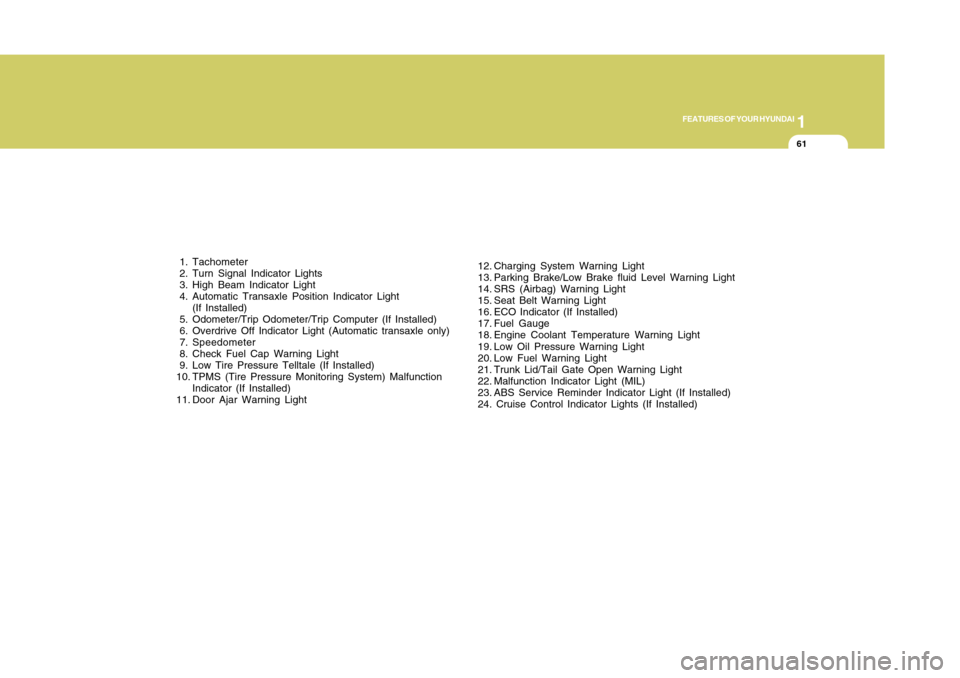
1. Tachometer
2. Turn Signal Indicator Lights
3. High Beam Indicator Light
4. Automatic Transaxle Position Indicator Light
(If Installed)
5. Odometer/Trip Odometer/Trip Computer (If Installed)
6. Overdrive Off Indicator Light (Automatic transaxle only)
7. Speedometer
8. Check Fuel Cap Warning Light
9. Low Tire Pressure Telltale (If Installed)
10. TPMS (Tire Pressure Monitoring System) Malfunction
Indicator (If Installed)
11. Door Ajar Warning Light12. Charging System Warning Light
13. Parking Brake/Low Brake fluid Level Warning Light
14. SRS (Airbag) Warning Light
15. Seat Belt Warning Light
16. ECO Indicator (If Installed)
17. Fuel Gauge
18. Engine Coolant Temperature Warning Light
19. Low Oil Pressure Warning Light
20. Low Fuel Warning Light
21. Trunk Lid/Tail Gate Open Warning Light
22. Malfunction Indicator Light (MIL)
23. ABS Service Reminder Indicator Light (If Installed)
24. Cruise Control Indicator Lights (If Installed)
Page 74 of 282
1
FEATURES OF YOUR HYUNDAI
631
FEATURES OF YOUR HYUNDAI
63
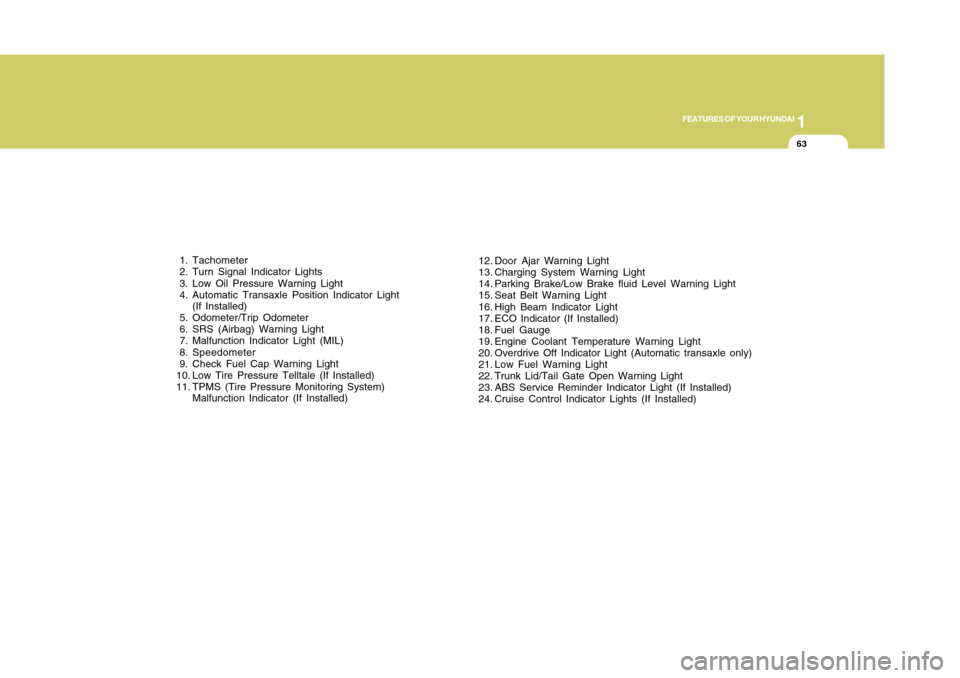
12. Door Ajar Warning Light
13. Charging System Warning Light
14. Parking Brake/Low Brake fluid Level Warning Light
15. Seat Belt Warning Light
16. High Beam Indicator Light
17. ECO Indicator (If Installed)
18. Fuel Gauge
19. Engine Coolant Temperature Warning Light
20. Overdrive Off Indicator Light (Automatic transaxle only)
21. Low Fuel Warning Light
22. Trunk Lid/Tail Gate Open Warning Light
23. ABS Service Reminder Indicator Light (If Installed)
24. Cruise Control Indicator Lights (If Installed) 1. Tachometer
2. Turn Signal Indicator Lights
3. Low Oil Pressure Warning Light
4. Automatic Transaxle Position Indicator Light
(If Installed)
5. Odometer/Trip Odometer
6. SRS (Airbag) Warning Light
7. Malfunction Indicator Light (MIL)
8. Speedometer
9. Check Fuel Cap Warning Light
10. Low Tire Pressure Telltale (If Installed)
11. TPMS (Tire Pressure Monitoring System)
Malfunction Indicator (If Installed)
Page 78 of 282
1
FEATURES OF YOUR HYUNDAI
671
FEATURES OF YOUR HYUNDAI
67
B260N01MC-AAT
Malfunction Indicator Light
This light illuminates when there is a
malfunction of an exhaust gas related
component and the system is not func-
tioning properly. This light will also illumi-
nate when the ignition key is turned to the
"ON" position, and will go out in a few
seconds after the engine is started. If it
illuminates while driving, or does not illumi-
nate when the ignition key is turned to the
"ON" position, take your car to your nearest
authorized Hyundai dealer and have the
system checked.
!
CAUTION:
Prolonged driving with the Emission
Control System Malfunction Indicator
Light illuminated may cause damage to
the emission control systems which
could effect drivability or fuel economy.
If the Emission Control System Malfunc-
tion Indicator Light begins to flash ON
and OFF, potential catalytic converter
damage is possible. This could result in
loss of engine power. Have the Engine
Control System inspected as soon as
possible by an authorized Hyundai
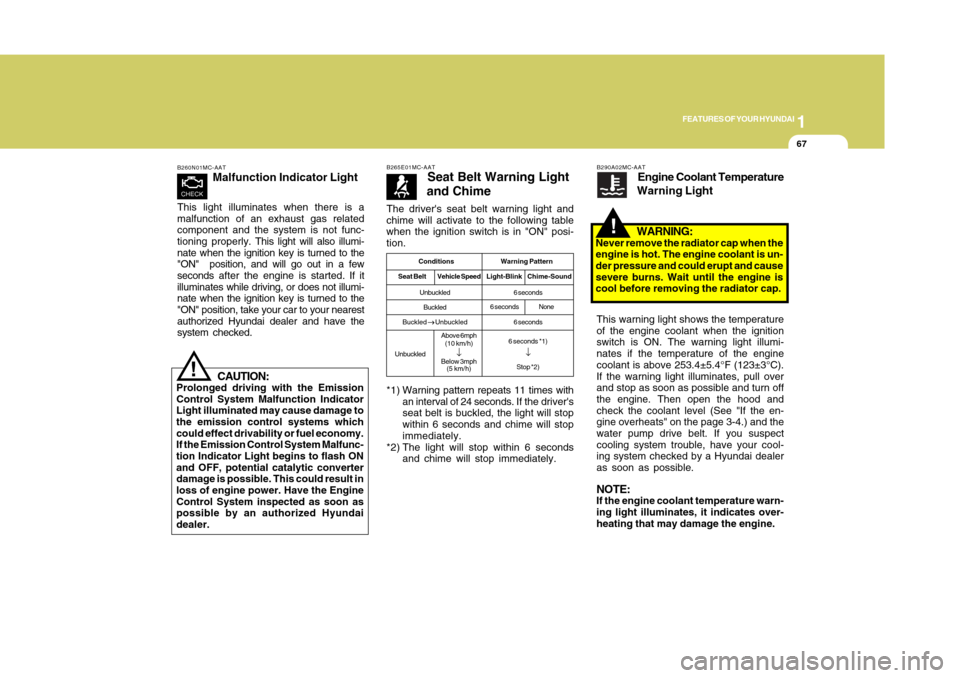
dealer.The driver's seat belt warning light and
chime will activate to the following table
when the ignition switch is in "ON" posi-
tion.
B265E01MC-AAT
Seat Belt Warning Light
and Chime
*1) Warning pattern repeats 11 times with
an interval of 24 seconds. If the driver's
seat belt is buckled, the light will stop
within 6 seconds and chime will stop
immediately.
*2) The light will stop within 6 seconds
and chime will stop immediately.
Conditions Warning Pattern
Seat BeltVehicle SpeedLight-Blink Chime-SoundUnbuckled
Buckled
Buckled
→ →→ →
→ Unbuckled
UnbuckledAbove 6mph
(10 km/h)
↓
Below 3mph
(5 km/h)6 seconds
6 seconds
6 seconds *1)
↓Stop *2)
6 secondsNone
B290A02MC-AAT
Engine Coolant Temperature
Warning Light
WARNING:
Never remove the radiator cap when the
engine is hot. The engine coolant is un-
der pressure and could erupt and cause
severe burns. Wait until the engine is
cool before removing the radiator cap.
!
This warning light shows the temperature
of the engine coolant when the ignition
switch is ON. The warning light illumi-
nates if the temperature of the engine
coolant is above 253.4±5.4°F (123±3°C).
If the warning light illuminates, pull over
and stop as soon as possible and turn off
the engine. Then open the hood and
check the coolant level (See "If the en-
gine overheats" on the page 3-4.) and the
water pump drive belt. If you suspect
cooling system trouble, have your cool-
ing system checked by a Hyundai dealer
as soon as possible.NOTE:If the engine coolant temperature warn-
ing light illuminates, it indicates over-
heating that may damage the engine.
Page 159 of 282
3
DRIVING YOUR HYUNDAI
2
!
BEFORE STARTING THE
ENGINEC020A03A-AATBefore you start the engine, you should
always:
1. Look around the vehicle to be sure
there are no flat tires, puddles of oil or
water or other indications of possible
trouble.
2. After entering the car, check to be
sure the parking brake is engaged.
3. Check that all windows, and lights are
clean.
4. Check that the interior and exterior
mirrors are clean and in position.
5. Check your seat, seatback and head-
rest to be sure they are in their proper
positions.
6. Lock all the doors.
7. Fasten your seat belt and be sure that
all other occupants have fastened
theirs.
8. Turn off all lights and accessories that
are not needed.
9. When you turn the ignition switch to
"ON", check that all appropriate warn-
ing lights are operating and that you
have sufficient fuel.
10. Check the operation of warning lights
and all bulbs when key is in the "ON"
position.
CALIFORNIA PROPOSITION
65 WARNING:
Engine exhaust and a wide variety of
automobile components and parts, in-
cluding components found in the inte-
rior furnishings in a vehicle, contain or
emit chemicals known to the State of
California to cause cancer and birth
defects and reproductive harm. In addi-
tion, certain fluids contained in vehicles
and certain products of component
wear contain or emit chemicals known
to the State of California to cause can-
cer and birth defects or other reproduc-
tive harm.
!
WARNING:
o Always wear appropriate shoes
when operating your vehicle. Unsuit-
able shoes (high heels, ski boots,
etc.) may interfere with your ability
to use the brake and accelerator
pedal, and the clutch (if installed).
o All passengers must be properly
belted whenever the vehicle is mov-
ing. Refer to pages: 1-22 through 1-
31 for more information on their
proper use.
o Always check the surrounding ar-
eas near your vehicle for people,
especially children, before putting a
car into 'drive'.
o When you intend to park or stop the
vehicle with the engine on, be careful
not to depress the accelerator pedal
for a long period of time. It may over-
heat the engine or exhaust system
and cause fire.
Page 161 of 282
5
DRIVING YOUR HYUNDAI
2
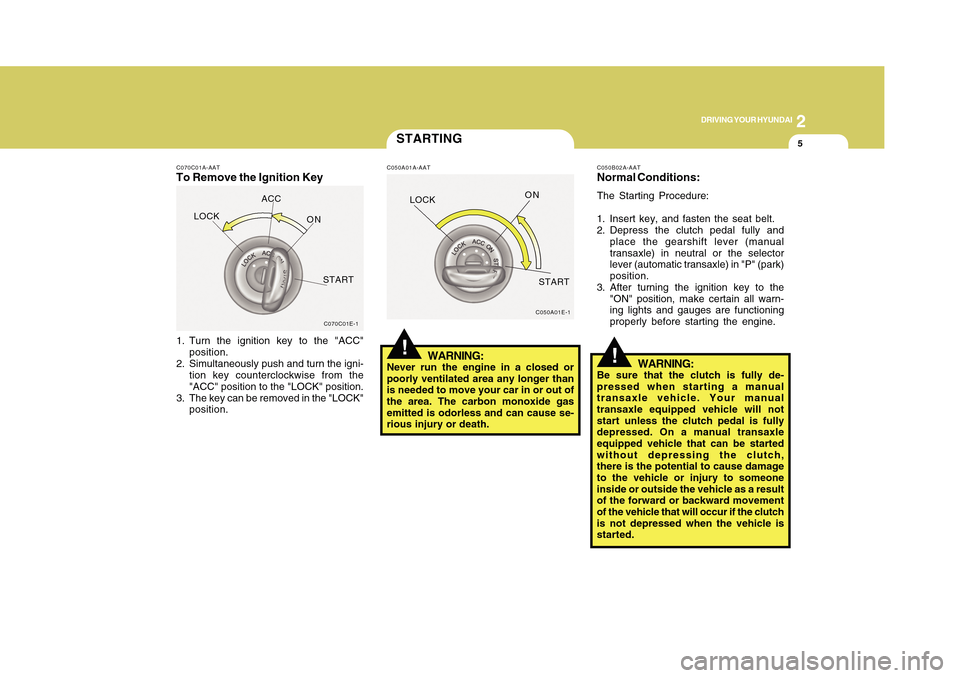
C070C01A-AATTo Remove the Ignition Key1. Turn the ignition key to the "ACC"
position.
2. Simultaneously push and turn the igni-
tion key counterclockwise from the
"ACC" position to the "LOCK" position.
3. The key can be removed in the "LOCK"
position.
C070C01E-1
LOCKACC
ON
START
STARTINGC050A01A-AAT
WARNING:
Never run the engine in a closed or
poorly ventilated area any longer than
is needed to move your car in or out of
the area. The carbon monoxide gas
emitted is odorless and can cause se-
rious injury or death.
C050A01E-1
!LOCKON
START
C050B02A-AATNormal Conditions:The Starting Procedure:
1. Insert key, and fasten the seat belt.
2. Depress the clutch pedal fully and
place the gearshift lever (manual
transaxle) in neutral or the selector
lever (automatic transaxle) in "P" (park)
position.
3. After turning the ignition key to the
"ON" position, make certain all warn-
ing lights and gauges are functioning
properly before starting the engine.
WARNING:
Be sure that the clutch is fully de-
pressed when starting a manual
transaxle vehicle. Your manual
transaxle equipped vehicle will not
start unless the clutch pedal is fully
depressed. On a manual transaxle
equipped vehicle that can be started
without depressing the clutch,
there is the potential to cause damage
to the vehicle or injury to someone
inside or outside the vehicle as a result
of the forward or backward movement
of the vehicle that will occur if the clutch
is not depressed when the vehicle is
started.
!
Page 164 of 282
2
DRIVING YOUR HYUNDAI8
!
o Exercise extreme caution when driv-
ing on a slippery surface. Be espe-
cially careful when braking, accelerat-
ing or shifting gears. On a slippery
surface, an abrupt change in vehicle
speed can cause the drive wheels to
lose traction and the vehicle to go out
of control.
WARNING:
o Always buckle-up! In a collision, an
unbelted occupant is significantly
more likely to be seriously injured or
killed than a properly belted occu-
pant.
o Avoid high speeds when cornering
or turning.
o Do not make quick steering wheel
movements, such as sharp lane
changes or fast, sharp turns.
o The risk of rollover is greatly in-
creased if you lose control of your
vehicle at highway speeds.
o Loss of control often occurs if two or
more wheels drop off the roadway
and the driver oversteers to reenter
the roadway.
o In the event your vehicle leaves the
roadway, do not steer sharply. In-
stead, slow down before pulling back
into the travel lanes.
o Never exceed posted speed limits.
C070D03O-AATGood Driving Practiceso Never take the car out of gear and
coast down a hill. This is extremely
hazardous. Always leave the car in
gear.
o Don't "ride" the brakes. This can cause
them to overheat and malfunction. In-
stead, when you are driving down a
long hill, slow down and shift to a lower
gear. When you do this, engine brak-
ing will help slow the car.
o Slow down before shifting to a lower
gear. This will help avoid over-revving
the engine, which can cause damage.
o Slow down when you encounter cross
winds. This gives you much better
control of your car.
o Be sure the car is completely stopped
before you attempt to shift into reverse.
The transaxle can be damaged if you
do not. To shift into reverse, depress
the clutch, move the shift lever to neu-
tral, wait three seconds, then shift to
the reverse position.
Page 168 of 282
2
DRIVING YOUR HYUNDAI
12
WARNING:
o Always buckle-up! In a collision, an
unbelted occupant is significantly
more likely to be seriously injured or
killed than a properly belted occu-
pant.
o Avoid high speeds when cornering
or turning.
o Do not make quick steering wheel
movements, such as sharp lane
changes or fast, sharp turns.
o The risk of rollover is greatly in-
creased if you lose control of your
vehicle at highway speeds.
o Loss of control often occurs if two or
more wheels drop off the roadway
and the driver oversteers to reenter
the roadway.
o In the event your vehicle leaves the
roadway, do not steer sharply. In-
stead, slow down before pulling back
into the travel lanes.
o Never exceed posted speed limits.
!
o Exercise extreme caution when driv-
ing on a slippery surface. Be espe-
cially careful when braking, accelerat-
ing or shifting gears. On a slippery
surface, an abrupt change in vehicle
speed can cause the drive wheels to
lose traction and the vehicle to go out
of control.
o Optimum vehicle performance and
economy is obtained by smoothly de-
pressing and releasing the accelera-
tor pedal.
o Turn the overdrive switch on for good
fuel economy and smooth driving. If
engine braking is needed in the "D"
range or if repeated upshifting and
downshifting between the 3rd and 4th
gear is needed when climbing a gentle
slope, it is recommended that the over-
drive switch be turned off. Turn the
overdrive switch back on immediately
afterward.
C090N07A-AATGood Driving Practiceso Never move the gear selector lever
from "P" or "N" to any other position
with the accelerator pedal depressed.
o Never move the gear selector lever
into "P" when the vehicle is in motion.
o Be sure the car is completely stopped
before you attempt to shift into "R" or
"D".
o Never take the car out of gear and
coast down a hill. This may be ex-
tremely hazardous. Always leave the
car in gear when moving.
o Do not "ride" the brakes. This can
cause them to overheat and malfunc-
tion. Instead, when you are driving
down a long hill, slow down and shift
to a lower gear. When you do this,
engine braking will help slow the car.
o Slow down before shifting to a lower
gear. Otherwise, the lower gear may
not be engaged.
o Always use the parking brake. Do not
depend on placing the transaxle in "P"
to keep the car from moving.
Page 175 of 282
19
DRIVING YOUR HYUNDAI
2
!
!
USE OF LIGHTSC180A01A-AATCheck your lights regularly for correct
operation and always keep them clean.
When driving during the day in conditions
of poor visibility, it is helpful to drive with
headlights on low beam. This enables
you to be seen, as well as to see.
HIGHER SPEED MOTORINGC170A02A-AATPre-Trip Inspections1. Tires:
Adjust the tire inflation pressures for high-
way driving. Low tire inflation pressures
will result in overheating and possible
failure of the tires.
Avoid using worn or damaged tires which
may result in reduced traction or tire fail-
ure.NOTE:Never exceed the maximum tire infla-
tion pressure shown on the tires.
WARNING:
o Underinflated or overinflated tires
can cause poor handling, loss of ve-
hicle control, and sudden tire failure
leading to accidents, injuries, and
even death. Always check tires are
properly inflated before driving. Refer
to pages 2-20 and 8-3 for proper tire
pressures and further information.2. Fuel, engine coolant and engine oil:
High speed travel consumes more fuel
than urban motoring. Do not forget to
check both engine coolant and engine
oil.
3. Drive belt:
A loose or damaged drive belt may result
in overheating of the engine. o Driving on tires with no or insuffi-
cient tread is dangerous. Worn-out
tires can result in loss of vehicle
control, collisions, injury, and even
death. Worn-out tires should be re-
placed as soon as possible and
should never be used for driving.
Always check tire tread before driv-
ing your car. Refer to 8-12 for further
information and tread limits.
WARNING:
Page 185 of 282
34WHAT TO DO IN AN EMERGENCY
IF THE ENGINE OVERHEATSD030A02A-AATIf your temperature gauge indicates over-
heating, you experience a loss of power,
or hear loud pinging or knocking, the
engine is probably too hot. If this hap-
pens, you should:
1. Pull off the road and stop as soon as
it is safe to do so.
2. Place the gear selector lever in "P"
(automatic), or neutral (manual
transaxle) and set the parking brake. If
the air conditioner is on, turn it off.
3. If coolant is running out under the car
or steam is coming out from under-
neath the hood, stop the engine. Do
not open the hood until the coolant
has stopped running or the steaming
has stopped. If there is no visible loss
of coolant and no steam, leave the
engine running and check to be sure
the engine cooling fan is operating. If
the fan is not running, turn the engine
off.
4. Check to see if the water pump drive
belt is missing. If it is not missing,
check to see that it is tight. If the drive
belt seems to be satisfactory, check for
coolant leaking from the radiator, hoses
or under the car. (If the air conditioner
had been in use, it is normal for cold
water to be draining from it when you
stop). 3. Attach the clamps of the jumper cable
in the exact location shown on the
previous page. First, attach one clamp
of the jumper cable to the positive (+)
post or cable of the discharged battery.
Then attach the other end of the same
cable to the positive (+) post or cable
of the booster battery. Next, using the
other cable, attach one clamp to the
negative (-) post or cable of the booster
battery. Then attach the other end of
that cable to a solid metal part of the
engine away from the battery. Do not
connect the cable to any moving part.
4. Start the engine in the car with the
booster battery and let it run for a few
minutes. This will help to assure that
the booster battery is fully charged.
During the jumping operation, run the
engine in this vehicle at about 2000
rpm.
5. Start the engine in the car with the
discharged battery using the normal
starting procedure. After the engine
starts, leave the jumper cables con-
nected and let the engine run at fast
idle or about 2000 rpm for several
minutes.
6. Carefully remove the jumper cables in
the reverse order of attachment.If you do not know why your battery be-
came discharged (because the lights were
left on, etc.), have the charging system
checked by your Hyundai dealer.