air conditioning Hyundai Accent 2011 Owner's Manual
[x] Cancel search | Manufacturer: HYUNDAI, Model Year: 2011, Model line: Accent, Model: Hyundai Accent 2011Pages: 282, PDF Size: 14.82 MB
Page 9 of 282
F9
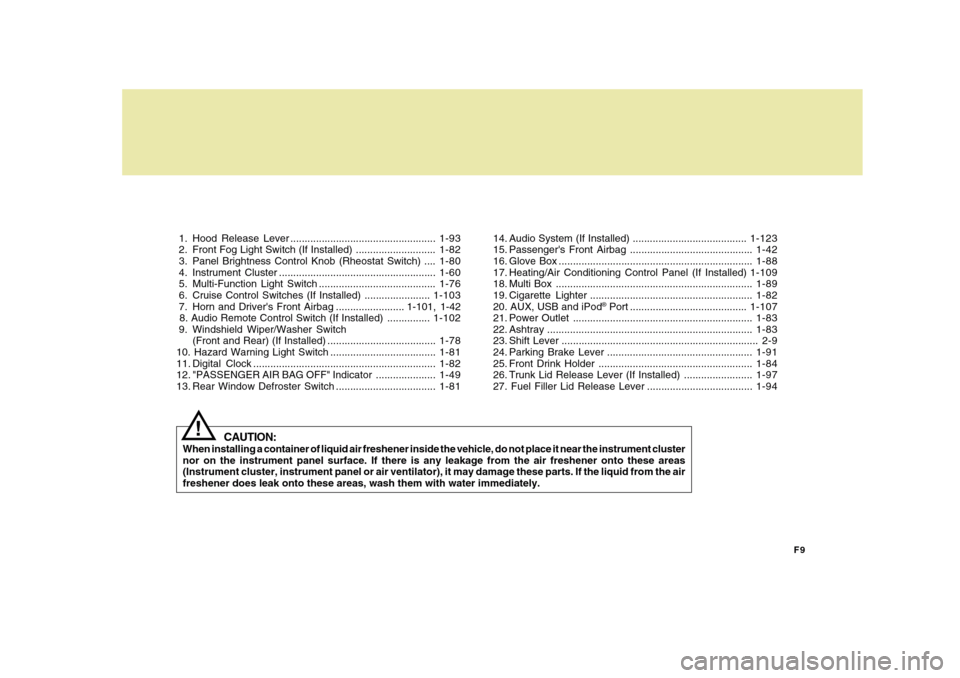
1. Hood Release Lever ...................................................1-93
2. Front Fog Light Switch (If Installed) ............................1-82
3. Panel Brightness Control Knob (Rheostat Switch) ....1-80
4. Instrument Cluster .......................................................1-60
5. Multi-Function Light Switch .........................................1-76
6. Cruise Control Switches (If Installed) .......................1-103
7. Horn and Driver's Front Airbag ........................ 1-101, 1-42
8. Audio Remote Control Switch (If Installed) ...............1-102
9. Windshield Wiper/Washer Switch
(Front and Rear) (If Installed) ......................................1-78
10. Hazard Warning Light Switch .....................................1-81
11. Digital Clock ................................................................1-82
12. "PASSENGER AIR BAG OFF" Indicator .....................1-49
13. Rear Window Defroster Switch ...................................1-8114. Audio System (If Installed) ........................................1-123
15. Passenger's Front Airbag ...........................................1-42
16. Glove Box ....................................................................1-88
17. Heating/Air Conditioning Control Panel (If Installed)1-109
18. Multi Box .....................................................................1-89
19. Cigarette Lighter .........................................................1-82
20. AUX, USB and iPod
® Port .........................................1-107
21. Power Outlet ...............................................................1-83
22. Ashtray........................................................................1-83
23. Shift Lever ..................................................................... 2-9
24. Parking Brake Lever ...................................................1-91
25. Front Drink Holder ......................................................1-84
26. Trunk Lid Release Lever (If Installed) ........................1-97
27. Fuel Filler Lid Release Lever .....................................1-94
CAUTION:
When installing a container of liquid air freshener inside the vehicle, do not place it near the instrument cluster
nor on the instrument panel surface. If there is any leakage from the air freshener onto these areas
(Instrument cluster, instrument panel or air ventilator), it may damage these parts. If the liquid from the air
freshener does leak onto these areas, wash them with water immediately.
!
Page 120 of 282
1
FEATURES OF YOUR HYUNDAI
1091
FEATURES OF YOUR HYUNDAI
109
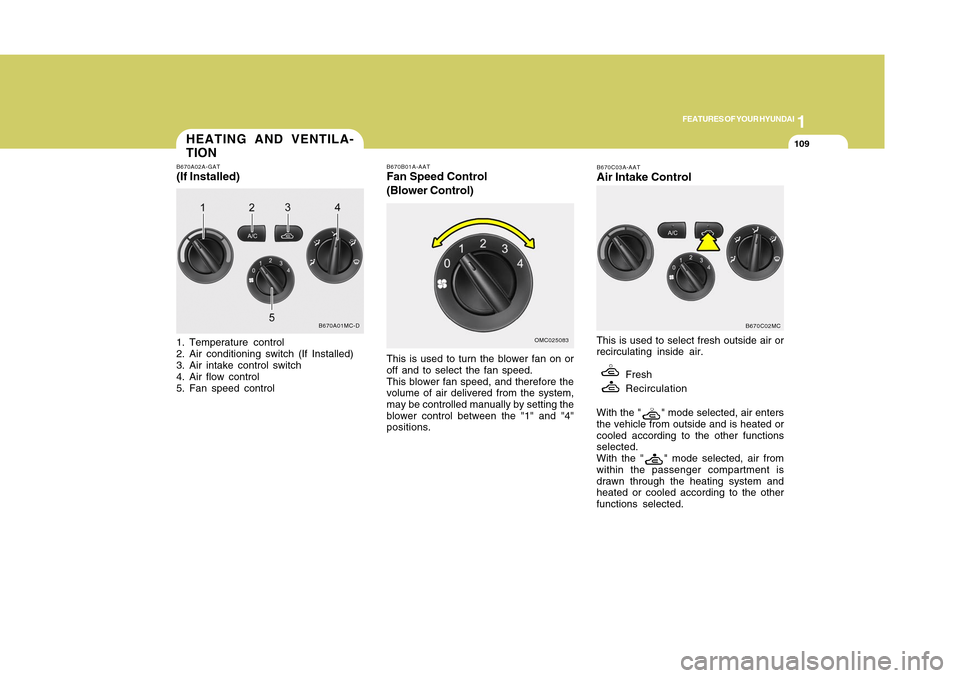
1. Temperature control
2. Air conditioning switch (If Installed)
3. Air intake control switch
4. Air flow control
5. Fan speed control
B670B01A-AATFan Speed Control
(Blower Control)This is used to turn the blower fan on or
off and to select the fan speed.
This blower fan speed, and therefore the
volume of air delivered from the system,
may be controlled manually by setting the
blower control between the "1" and "4"
positions.
B670A01MC-D
OMC025083B670C03A-AAT
Air Intake Control
B670C02MC
This is used to select fresh outside air or
recirculating inside air.
Fresh
Recirculation
With the "
" mode selected, air enters
the vehicle from outside and is heated or
cooled according to the other functions
selected.
With the "" mode selected, air from
within the passenger compartment is
drawn through the heating system and
heated or cooled according to the other
functions selected.
HEATING AND VENTILA-
TIONB670A02A-GAT(If Installed)
Page 121 of 282
1FEATURES OF YOUR HYUNDAI
110
NOTE:It should be noted that prolonged opera-
tion of the intake air system in "
"
mode will give rise to misting of the
windshield and side windows and the air
within the passenger compartment will
become stale. In addition prolonged use
of the air conditioning with the ""
mode selected may result in the air within
the passenger compartment becoming
excessively dry.
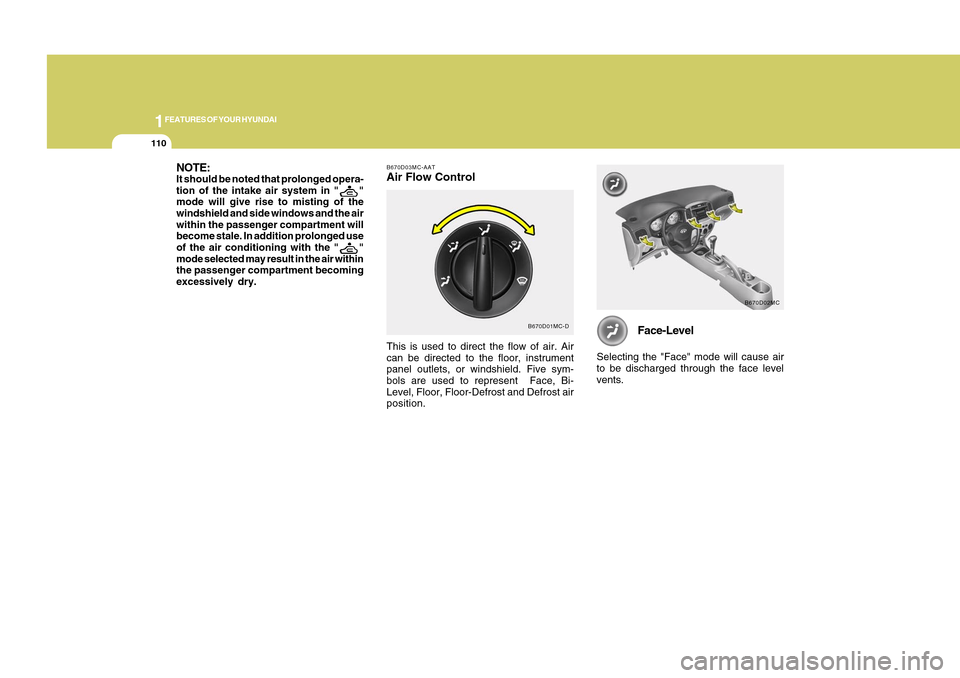
B670D03MC-AATAir Flow ControlThis is used to direct the flow of air. Air
can be directed to the floor, instrument
panel outlets, or windshield. Five sym-
bols are used to represent Face, Bi-
Level, Floor, Floor-Defrost and Defrost air
position.
B670D01MC-D
Face-Level
Selecting the "Face" mode will cause air
to be discharged through the face level
vents.
B670D02MC
Page 126 of 282
1
FEATURES OF YOUR HYUNDAI
1151
FEATURES OF YOUR HYUNDAI
115
AIR CONDITIONING SYSTEM
B740A01MC-D B740A01A-AAT
(If Installed)
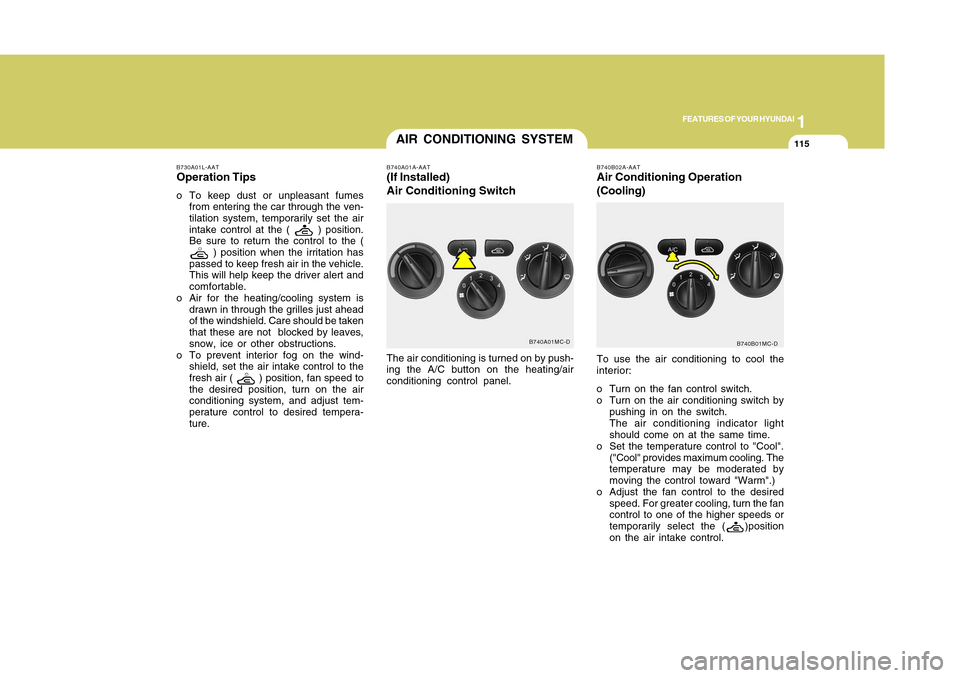
Air Conditioning SwitchThe air conditioning is turned on by push-
ing the A/C button on the heating/air
conditioning control panel.
B740B02A-AATAir Conditioning Operation
(Cooling)To use the air conditioning to cool the
interior:
o Turn on the fan control switch.
o Turn on the air conditioning switch by
pushing in on the switch.
The air conditioning indicator light
should come on at the same time.
o Set the temperature control to "Cool".
("Cool" provides maximum cooling. The
temperature may be moderated by
moving the control toward "Warm".)
o Adjust the fan control to the desired
speed. For greater cooling, turn the fan
control to one of the higher speeds or
temporarily select the (
)position
on the air intake control.B740B01MC-D B730A01L-AAT
Operation Tipso To keep dust or unpleasant fumes
from entering the car through the ven-
tilation system, temporarily set the air
intake control at the (
) position.
Be sure to return the control to the (
) position when the irritation has
passed to keep fresh air in the vehicle.
This will help keep the driver alert and
comfortable.
o Air for the heating/cooling system is
drawn in through the grilles just ahead
of the windshield. Care should be taken
that these are not blocked by leaves,
snow, ice or other obstructions.
o To prevent interior fog on the wind-
shield, set the air intake control to the
fresh air (
) position, fan speed to
the desired position, turn on the air
conditioning system, and adjust tem-
perature control to desired tempera-
ture.
Page 127 of 282
1FEATURES OF YOUR HYUNDAI
116
B740D01A-AATOperation Tipso If the interior of the car is hot when you
first get in, open the windows for a few
minutes to expel the hot air.
o When you are using the air condition-
ing system, keep all windows closed to
keep hot air out.
o When moving slowly, as in heavy traf-
fic, shift to a lower gear.
This increases engine speed, which in
turn increases the speed of the air
conditioning compressor.
o On steep grades, turn the air condi-
tioning off to avoid the possibility of the
engine overheating.
o During winter months or in periods
when the air conditioning is not used
regularly, run the air conditioning once
every month for a few minutes.
This will help circulate the lubricants
and keep your system in peak operat-
ing condition.
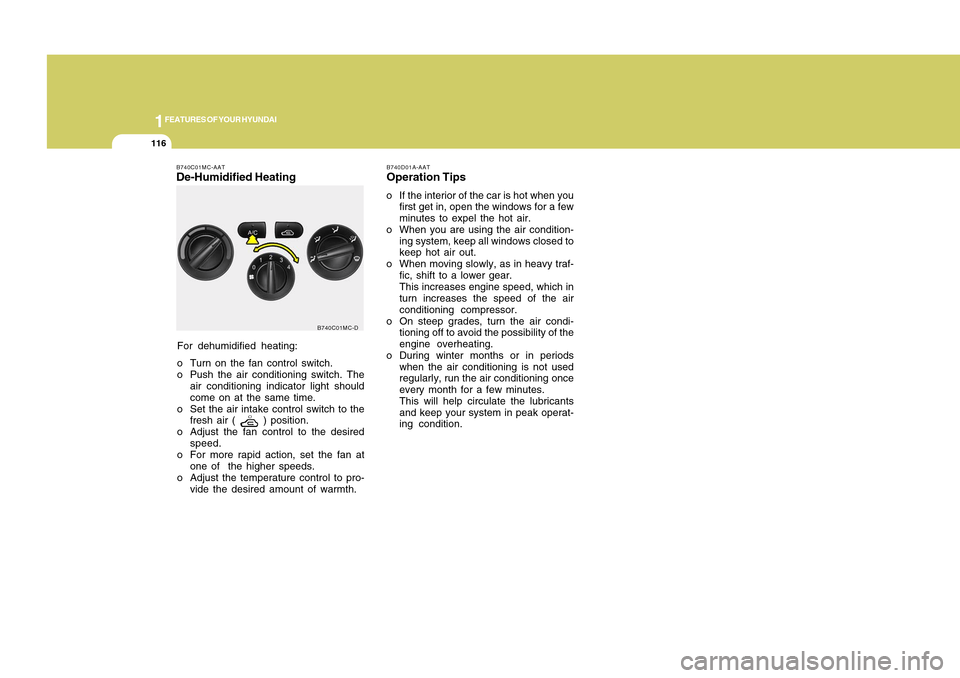
For dehumidified heating:
o Turn on the fan control switch.
o Push the air conditioning switch. The
air conditioning indicator light should
come on at the same time.
o Set the air intake control switch to the
fresh air (
) position.
o Adjust the fan control to the desired
speed.
o For more rapid action, set the fan at
one of the higher speeds.
o Adjust the temperature control to pro-
vide the desired amount of warmth.
B740C01MC-AATDe-Humidified Heating
B740C01MC-D
Page 138 of 282
1127127
DRIVING YOUR HYUNDAI
1
11. SCAN Play ButtonPlays first 10 seconds of each song in the
DISC. To cancel the mode, press the key
once again.12. FOLDER ButtonFolder up/down operation.
o Folder is moved up or down from cur-
rently playing and folder name be-
comes displayed.
o Press enter key to play the
selectedfolder.
o If the enter key is not pressed with in 5
seconds, then the previous folder name
will be displayed again.
NOTE:o To assure Proper operation of the
unit, keep the vehicle interior tem-
perature within a nomal range by
using the vehicle’s air conditioning
or heating system.
o When replacing the fuse, replace it
with a fuse having the correct capac-
ity.
o All stored bookmarks are all erased
when the car battery is disconnected
or power to the vehocle is lost. if this
occurs, the bookmarks will have to
be reset.
o This equipment is designed to be
used only in a 12 volt DC battery
system with negative ground.
o This unit is made of precision parts.
Do not attempt to disassemble or
adjust any parts.
o when driving your vehicle, be sure to
keep the volume of the unit set low
enough to allow you to hear sounds
coming from the outside.
o Do not expose this equipment (in-
cluding the speakers and CD) to water
or excessive moisture.
!
CAUTION:
o Do not insert warped or poor quality
discs into the CD player as damage
to the unit may occur.
o Do not insert anything like coins into
the player slot as damage to the unit
may occur.
o Do not place beverages close to the
audio system. The playback mecha-
nism may be damaged if you spill
them.
o Do not strike or allow anything to
impact the audio system, damage to
the system mechanisms could oc-
cur.
o Off-road or rough sunface driving
may cause the compact disc to skip.
Do not use the compact disc when
driving in such conditions as dam-
age to the compact disc face could
occur.
o Do not attempt to grab or pull the
compact disc out while the disc is
being pulled into the audio unit by the
self-loading mechanism. Damage to
the audio unit and compact disc could
occur.
Page 150 of 282
1139139
DRIVING YOUR HYUNDAI
1
10. SCAN Play ButtonScans each song in the USB device for
10 seconds each. To cancel the mode,
press the button once again.11. FOLDER ButtonFolder up/down operation.
o Folder is moved up or down from
currently playing and folder name be-
comes displayed.
o Press enter key to play the
selectedfolder.
o If the enter key is not pressed with in
5 seconds, then the previous folder
name will be displayed again.
NOTE:o To assure Proper operation of the
unit, keep the vehicle tnterior tem-
perature within a nomal range by
using the vehicle’s air conditioning
or heating system.
o When replacing the fuse, replace it
with a fuse having the correct capac-
ity.
o All stored bookmarks are all erased
when the car battery is disconnected
or power to the vehocle is lost. if this
occurs, the bookmarks will have to
be reset.
o This equipment is designed to be
used only in a 12 volt DC battery
system with negative ground.
o This unit is made of precision parts.
Do not attempt to dosassemble or
adjust any parts.
o when driving your vehicle, be sure
to keep the volume of the unit set low
enough to allow you to hear sounds
coming from the outside.
o Do not expose this equipment (in-
cluding the speakers and CD) to water
or excessive moisture.
!
CAUTION:
o Do not insert warped or poor quality
discs into the CD player as damage
to the unit may occur.
o Do not insert anything like coins into
the player slot as damage to the unit
may occur.
o Do not place beverages close to the
audio system. The playback mecha-
nism may be damaged if you spill
them.
o Do not strike or allow anything to
impact the audio system, damage to
the system mechanisms could oc-
cur.
o Off-road or rough sunface driving
may cause the compact disc to skip.
Do not use the compact disc when
driving in such conditions as dam-
age to the compact disc face could
occur.
o Do not attempt to grab or pull the
compact disc out while the disc is
being pulled into the audio unit by the
self-loading mechanism. Damage to
the audio unit and compact disc could
occur.
Page 172 of 282
2
DRIVING YOUR HYUNDAI
16
WINTER DRIVINGC160A01A-AATThe more severe weather conditions of
winter result in greater wear and other
problems. To minimize the problems of
winter driving, you should follow these
suggestions: o Travel lightly. Don't carry unnecessary
weight in your car. Weight reduces fuel
economy.
o Don't let the engine idle longer than
necessary. If you are waiting (and not
in traffic), turn off your engine and
restart only when you're ready to go.
o Remember, your Hyundai does not
require extended warm-up. After the
engine has started, allow the engine to
run for 10 to 20 seconds prior to plac-
ing the vehicle in gear. In very cold
weather, however, give your engine a
slightly longer warm-up period.
o Don't "lug" or "over-rev" the engine.
Lugging is driving too slowly in too
high a gear resulting in the engine
bucking. If this happens, shift to a lower
gear. Over-revving is racing the en-
gine beyond its safe limit. This can be
avoided by shifting at the recommend-
ed speeds.
o Use your air conditioning sparingly.
The air conditioning system is oper-
ated by engine power so your fuel
economy is reduced when you use it.
SMOOTH CORNERINGC150A01A-AATAvoid braking or gear changing in cor-
ners, especially when roads are wet. Ide-
ally, corners should always be taken
under gentle acceleration. If you follow
these suggestions, tire wear will be held
to a minimum.
Page 213 of 282
5
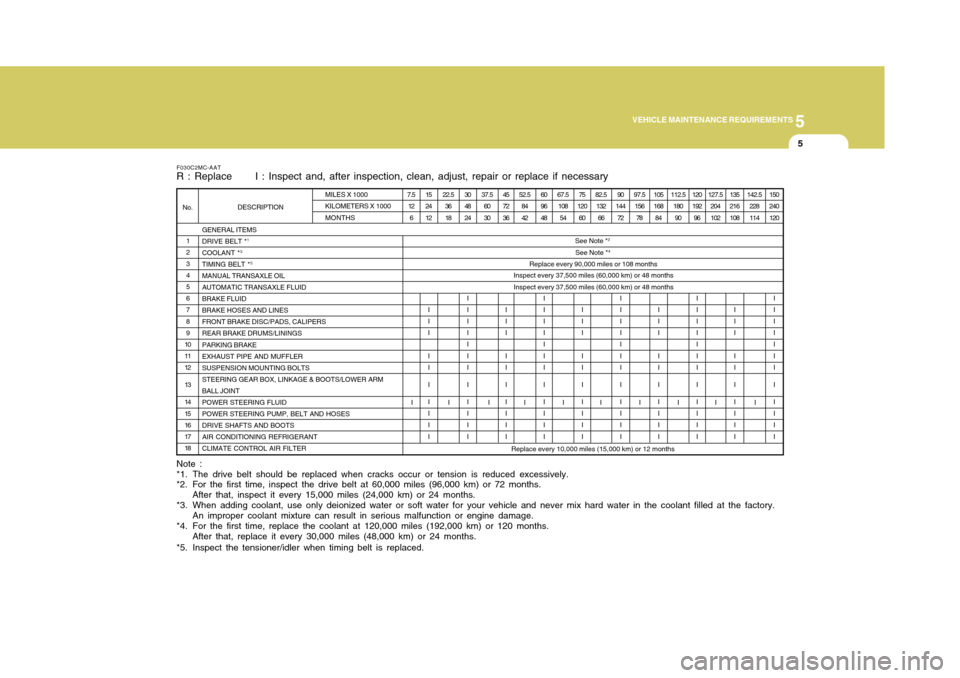
VEHICLE MAINTENANCE REQUIREMENTS
5
GENERAL ITEMS
DRIVE BELT *
1
COOLANT *
3
TIMING BELT *
5
MANUAL TRANSAXLE OIL
AUTOMATIC TRANSAXLE FLUID
BRAKE FLUID
BRAKE HOSES AND LINES
FRONT BRAKE DISC/PADS, CALIPERS
REAR BRAKE DRUMS/LININGS
PARKING BRAKE
EXHAUST PIPE AND MUFFLER
SUSPENSION MOUNTING BOLTS
STEERING GEAR BOX, LINKAGE & BOOTS/LOWER ARM
BALL JOINT
POWER STEERING FLUID
POWER STEERING PUMP, BELT AND HOSES
DRIVE SHAFTS AND BOOTS
AIR CONDITIONING REFRIGERANT
CLIMATE CONTROL AIR FILTER 1
2
3
4
5
6
7
8
9
10
11
12
13
14
15
16
17
18 No.DESCRIPTIONMILES X 1000
KILOMETERS X 1000
MONTHS7.5
12
615
24
12
I
I
I
I
I
I
I
I
I
I22.5
36
1830
48
24
I
I
I
I
I
I
I
I
I
I
I
I37.5
60
3045
72
36
I
I
I
I
I
I
I
I
I
I52.5
84
4260
96
48
I
I
I
I
I
I
I
I
I
I
I
I67.5
108
5475
120
60
I
I
I
I
I
I
I
I
I
I82.5
132
6690
144
72
I
I
I
I
I
I
I
I
I
I
I
I97.5
156
78105
168
84
I
I
I
I
I
I
I
I
I
I112.5
180
90120
192
96
I
I
I
I
I
I
I
I
I
I
I
I127.5
204
102135
216
108
I
I
I
I
I
I
I
I
I
I142.5
228
114150
240
120
I
I
I
I
I
I
I
I
I
I
I
I
Replace every 10,000 miles (15,000 km) or 12 months
Note :
*1. The drive belt should be replaced when cracks occur or tension is reduced excessively.
*2. For the first time, inspect the drive belt at 60,000 miles (96,000 km) or 72 months.
After that, inspect it every 15,000 miles (24,000 km) or 24 months.
*3. When adding coolant, use only deionized water or soft water for your vehicle and never mix hard water in the coolant filled at the factory.
An improper coolant mixture can result in serious malfunction or engine damage.
*4. For the first time, replace the coolant at 120,000 miles (192,000 km) or 120 months.
After that, replace it every 30,000 miles (48,000 km) or 24 months.
*5. Inspect the tensioner/idler when timing belt is replaced.F030C2MC-AATR : Replace I : Inspect and, after inspection, clean, adjust, repair or replace if necessary
See Note *
4
Replace every 90,000 miles or 108 monthsSee Note *
2
Inspect every 37,500 miles (60,000 km) or 48 months
Inspect every 37,500 miles (60,000 km) or 48 months
II II I I I I I I
Page 217 of 282
5
VEHICLE MAINTENANCE REQUIREMENTS
9
F070M01A-AATo Steering Gear Box, Linkage &
Boots/Lower Arm Ball JointWith the vehicle stopped and engine off,
check for excessive free-play in the steer-
ing wheel. Check the linkage for bends or
damage. Check the dust boots and ball
joints for deterioration, cracks, or dam-
age. Replace any damaged parts.
F070L01A-AATo Suspension Mounting BoltsCheck the suspension connections for
looseness or damage. Retighten to the
specified torque.F070K01A-AATo Exhaust Pipe and MufflerVisually inspect the exhaust pipes, muf-
fler and hangers for cracks, deterioration,
or damage. Start the engine and listen
carefully for any exhaust gas leakage.
Tighten connections or replace parts as
necessary.F070J01A-AATo Front Brake Disc/Pads, CalipersCheck the pads for excessive wear, discs
for run out and wear, and calipers for fluid
leakage.
F070Q01A-AATo Air Conditioning RefrigerantCheck the air conditioning lines and con-
nections for leakage and damage. Check
air conditioning performance according
to the relevant shop manual if necessary.F070P01A-AATo Driveshafts and BootsCheck the drive shafts, boots and clamps
for cracks, deterioration, or damage. Re-
place any damaged parts and, if neces-
sary, repack the grease.
F070N01A-AATo Power Steering Pump, Belt and
HosesCheck the power steering pump and
hoses for leakage and damage. Replace
any damaged or leaking parts immedi-
ately. Inspect the power steering belt for
evidence of cuts, cracks, excessive wear,
oiliness and proper tension. Replace or
adjust it if necessary.