boot Hyundai Accent 2011 Owner's Manual
[x] Cancel search | Manufacturer: HYUNDAI, Model Year: 2011, Model line: Accent, Model: Hyundai Accent 2011Pages: 282, PDF Size: 14.82 MB
Page 159 of 282
3
DRIVING YOUR HYUNDAI
2
!
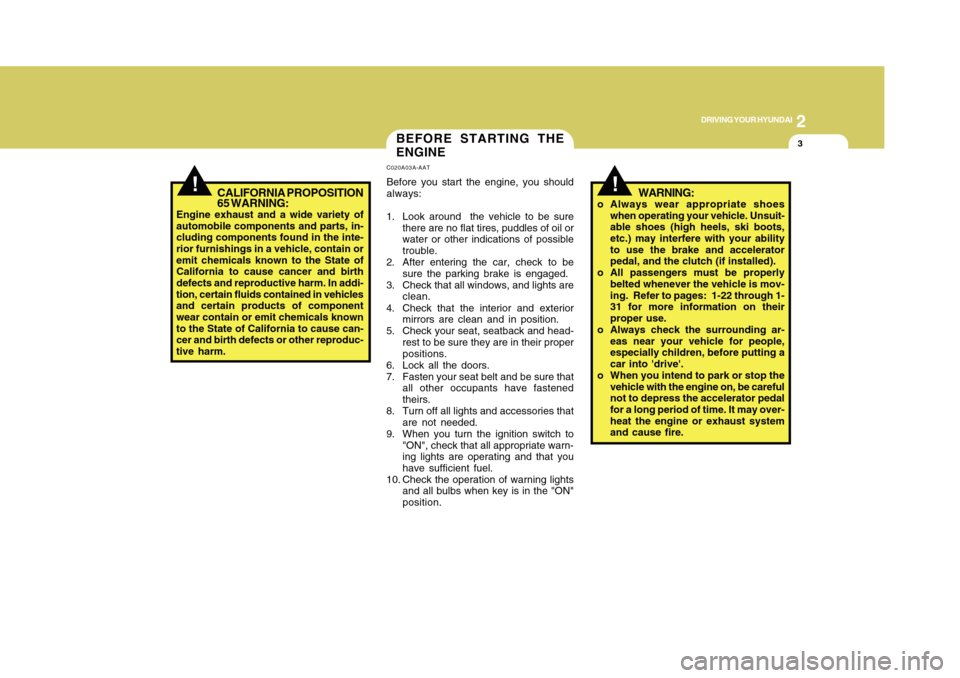
BEFORE STARTING THE
ENGINEC020A03A-AATBefore you start the engine, you should
always:
1. Look around the vehicle to be sure
there are no flat tires, puddles of oil or
water or other indications of possible
trouble.
2. After entering the car, check to be
sure the parking brake is engaged.
3. Check that all windows, and lights are
clean.
4. Check that the interior and exterior
mirrors are clean and in position.
5. Check your seat, seatback and head-
rest to be sure they are in their proper
positions.
6. Lock all the doors.
7. Fasten your seat belt and be sure that
all other occupants have fastened
theirs.
8. Turn off all lights and accessories that
are not needed.
9. When you turn the ignition switch to
"ON", check that all appropriate warn-
ing lights are operating and that you
have sufficient fuel.
10. Check the operation of warning lights
and all bulbs when key is in the "ON"
position.
CALIFORNIA PROPOSITION
65 WARNING:
Engine exhaust and a wide variety of
automobile components and parts, in-
cluding components found in the inte-
rior furnishings in a vehicle, contain or
emit chemicals known to the State of
California to cause cancer and birth
defects and reproductive harm. In addi-
tion, certain fluids contained in vehicles
and certain products of component
wear contain or emit chemicals known
to the State of California to cause can-
cer and birth defects or other reproduc-
tive harm.
!
WARNING:
o Always wear appropriate shoes
when operating your vehicle. Unsuit-
able shoes (high heels, ski boots,
etc.) may interfere with your ability
to use the brake and accelerator
pedal, and the clutch (if installed).
o All passengers must be properly
belted whenever the vehicle is mov-
ing. Refer to pages: 1-22 through 1-
31 for more information on their
proper use.
o Always check the surrounding ar-
eas near your vehicle for people,
especially children, before putting a
car into 'drive'.
o When you intend to park or stop the
vehicle with the engine on, be careful
not to depress the accelerator pedal
for a long period of time. It may over-
heat the engine or exhaust system
and cause fire.
Page 207 of 282
44
CORROSION PREVENTION AND APPEARANCE CARE6
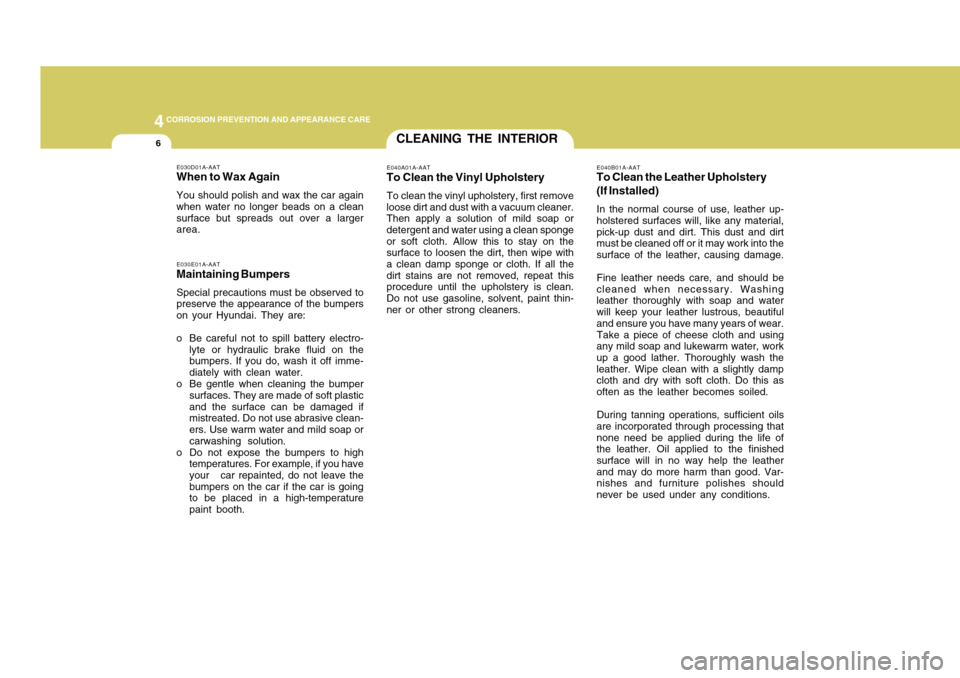
E040A01A-AATTo Clean the Vinyl UpholsteryTo clean the vinyl upholstery, first remove
loose dirt and dust with a vacuum cleaner.
Then apply a solution of mild soap or
detergent and water using a clean sponge
or soft cloth. Allow this to stay on the
surface to loosen the dirt, then wipe with
a clean damp sponge or cloth. If all the
dirt stains are not removed, repeat this
procedure until the upholstery is clean.
Do not use gasoline, solvent, paint thin-
ner or other strong cleaners.CLEANING THE INTERIOR
E030D01A-AATWhen to Wax AgainYou should polish and wax the car again
when water no longer beads on a clean
surface but spreads out over a larger
area.E030E01A-AATMaintaining BumpersSpecial precautions must be observed to
preserve the appearance of the bumpers
on your Hyundai. They are:
o Be careful not to spill battery electro-
lyte or hydraulic brake fluid on the
bumpers. If you do, wash it off imme-
diately with clean water.
o Be gentle when cleaning the bumper
surfaces. They are made of soft plastic
and the surface can be damaged if
mistreated. Do not use abrasive clean-
ers. Use warm water and mild soap or
carwashing solution.
o Do not expose the bumpers to high
temperatures. For example, if you have
your car repainted, do not leave the
bumpers on the car if the car is going
to be placed in a high-temperature
paint booth.
E040B01A-AATTo Clean the Leather Upholstery
(If Installed)In the normal course of use, leather up-
holstered surfaces will, like any material,
pick-up dust and dirt. This dust and dirt
must be cleaned off or it may work into the
surface of the leather, causing damage.
Fine leather needs care, and should be
cleaned when necessary. Washing
leather thoroughly with soap and water
will keep your leather lustrous, beautiful
and ensure you have many years of wear.
Take a piece of cheese cloth and using
any mild soap and lukewarm water, work
up a good lather. Thoroughly wash the
leather. Wipe clean with a slightly damp
cloth and dry with soft cloth. Do this as
often as the leather becomes soiled.
During tanning operations, sufficient oils
are incorporated through processing that
none need be applied during the life of
the leather. Oil applied to the finished
surface will in no way help the leather
and may do more harm than good. Var-
nishes and furniture polishes should
never be used under any conditions.
Page 213 of 282
5
VEHICLE MAINTENANCE REQUIREMENTS
5
GENERAL ITEMS
DRIVE BELT *
1
COOLANT *
3
TIMING BELT *
5
MANUAL TRANSAXLE OIL
AUTOMATIC TRANSAXLE FLUID
BRAKE FLUID
BRAKE HOSES AND LINES
FRONT BRAKE DISC/PADS, CALIPERS
REAR BRAKE DRUMS/LININGS
PARKING BRAKE
EXHAUST PIPE AND MUFFLER
SUSPENSION MOUNTING BOLTS
STEERING GEAR BOX, LINKAGE & BOOTS/LOWER ARM
BALL JOINT
POWER STEERING FLUID
POWER STEERING PUMP, BELT AND HOSES
DRIVE SHAFTS AND BOOTS
AIR CONDITIONING REFRIGERANT
CLIMATE CONTROL AIR FILTER 1
2
3
4
5
6
7
8
9
10
11
12
13
14
15
16
17
18 No.DESCRIPTIONMILES X 1000
KILOMETERS X 1000
MONTHS7.5
12
615
24
12
I
I
I
I
I
I
I
I
I
I22.5
36
1830
48
24
I
I
I
I
I
I
I
I
I
I
I
I37.5
60
3045
72
36
I
I
I
I
I
I
I
I
I
I52.5
84
4260
96
48
I
I
I
I
I
I
I
I
I
I
I
I67.5
108
5475
120
60
I
I
I
I
I
I
I
I
I
I82.5
132
6690
144
72
I
I
I
I
I
I
I
I
I
I
I
I97.5
156
78105
168
84
I
I
I
I
I
I
I
I
I
I112.5
180
90120
192
96
I
I
I
I
I
I
I
I
I
I
I
I127.5
204
102135
216
108
I
I
I
I
I
I
I
I
I
I142.5
228
114150
240
120
I
I
I
I
I
I
I
I
I
I
I
I
Replace every 10,000 miles (15,000 km) or 12 months
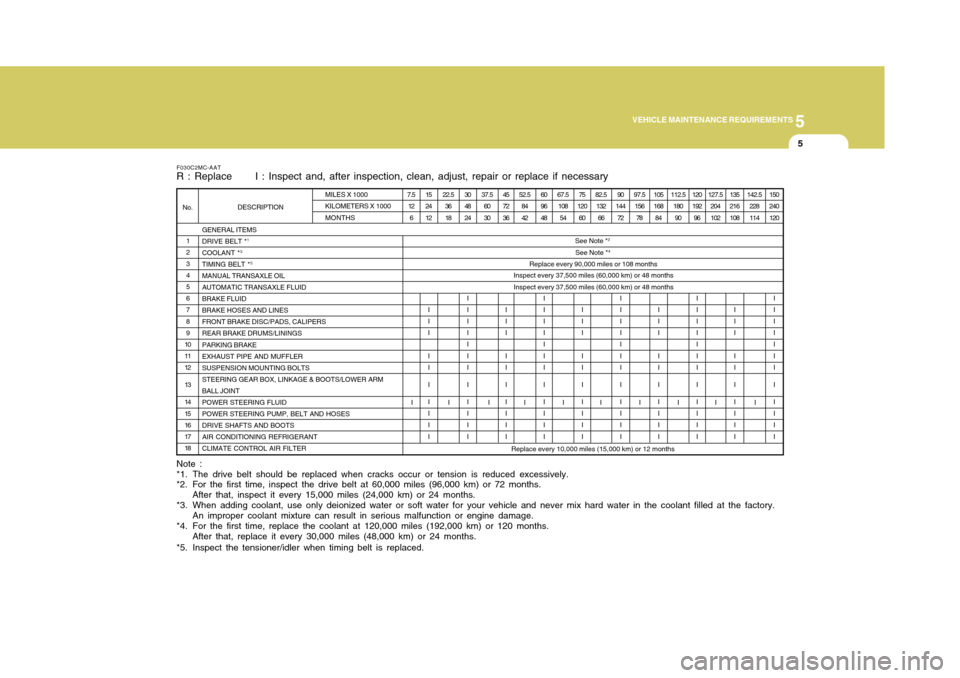
Note :
*1. The drive belt should be replaced when cracks occur or tension is reduced excessively.
*2. For the first time, inspect the drive belt at 60,000 miles (96,000 km) or 72 months.
After that, inspect it every 15,000 miles (24,000 km) or 24 months.
*3. When adding coolant, use only deionized water or soft water for your vehicle and never mix hard water in the coolant filled at the factory.
An improper coolant mixture can result in serious malfunction or engine damage.
*4. For the first time, replace the coolant at 120,000 miles (192,000 km) or 120 months.
After that, replace it every 30,000 miles (48,000 km) or 24 months.
*5. Inspect the tensioner/idler when timing belt is replaced.F030C2MC-AATR : Replace I : Inspect and, after inspection, clean, adjust, repair or replace if necessary
See Note *
4
Replace every 90,000 miles or 108 monthsSee Note *
2
Inspect every 37,500 miles (60,000 km) or 48 months
Inspect every 37,500 miles (60,000 km) or 48 months
II II I I I I I I
Page 214 of 282
5
VEHICLE MAINTENANCE REQUIREMENTS6
DRIVING
CONDITION MAINTENANCE
INTERVALS
ENGINE OIL AND FILTER
AIR CLEANER FILTER
SPARK PLUGS
FRONT BRAKE DISC/PADS, CALIPERS
REAR BRAKE DRUMS/LININGS
PARKING BRAKE
STEERING GEAR BOX, LINKAGE
& BOOTS/LOWER ARM BALL JOINT
DRIVESHAFTS AND BOOTS
TIMING BELT
MANUAL TRANSAXLE OIL
AUTOMATIC TRANSAXLE FLUID
CLIMATE CONTROL AIR FILTER
R
R
R
I
I
I
I
I
R
R
R
R MAINTENANCE
OPERATION MAINTENANCE ITEM
EVERY 3,750 MILES (6,000 KM) OR 6 MONTHS
MORE FREQUENTLY
MORE FREQUENTLY
MORE FREQUENTLY
MORE FREQUENTLY
MORE FREQUENTLY
MORE FREQUENTLY
EVERY 7,500 MILES (12,000 KM) OR 6 MONTHS
EVERY 60,000 MILES OR 72 MONTHS
EVERY 80,000 MILES (120,000 KM)
EVERY 60,000 MILES (96,000 KM)
MORE FREQUENTLY
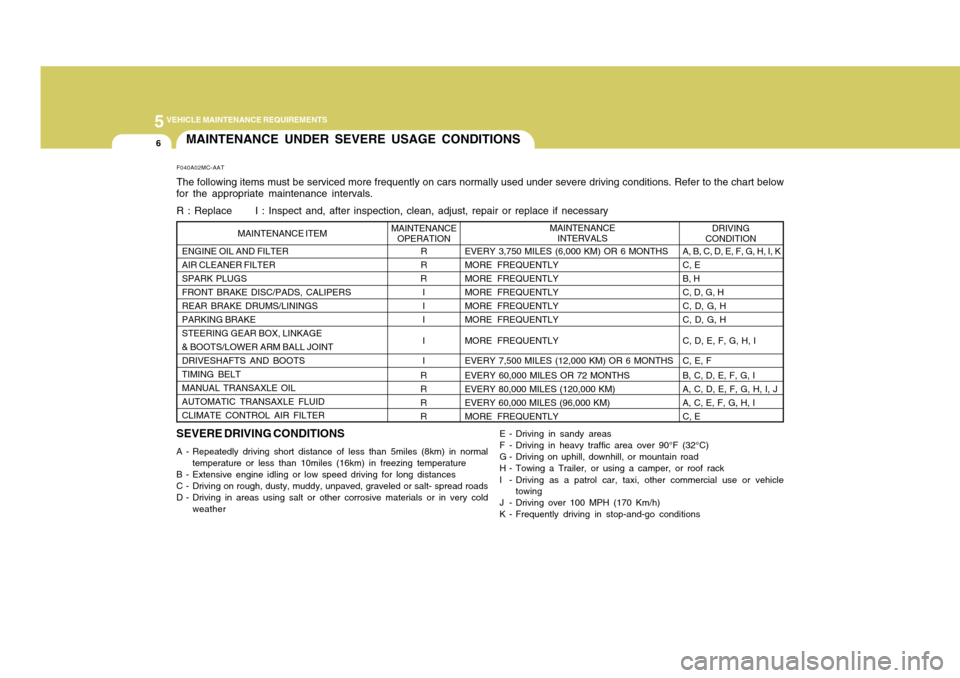
SEVERE DRIVING CONDITIONSA - Repeatedly driving short distance of less than 5miles (8km) in normal
temperature or less than 10miles (16km) in freezing temperature
B - Extensive engine idling or low speed driving for long distances
C - Driving on rough, dusty, muddy, unpaved, graveled or salt- spread roads
D - Driving in areas using salt or other corrosive materials or in very cold
weatherE - Driving in sandy areas
F - Driving in heavy traffic area over 90°F (32°C)
G - Driving on uphill, downhill, or mountain road
H - Towing a Trailer, or using a camper, or roof rack
I - Driving as a patrol car, taxi, other commercial use or vehicle
towing
J - Driving over 100 MPH (170 Km/h)
K - Frequently driving in stop-and-go conditionsA, B, C, D, E, F, G, H, I, K
C, E
B, H
C, D, G, H
C, D, G, H
C, D, G, H
C, D, E, F, G, H, I
C, E, F
B, C, D, E, F, G, I
A, C, D, E, F, G, H, I, J
A, C, E, F, G, H, I
C, EMAINTENANCE UNDER SEVERE USAGE CONDITIONSF040A02MC-AATThe following items must be serviced more frequently on cars normally used under severe driving conditions. Refer to the chart below
for the appropriate maintenance intervals.
R : Replace I : Inspect and, after inspection, clean, adjust, repair or replace if necessary
Page 217 of 282
5
VEHICLE MAINTENANCE REQUIREMENTS
9
F070M01A-AATo Steering Gear Box, Linkage &
Boots/Lower Arm Ball JointWith the vehicle stopped and engine off,
check for excessive free-play in the steer-
ing wheel. Check the linkage for bends or
damage. Check the dust boots and ball
joints for deterioration, cracks, or dam-
age. Replace any damaged parts.
F070L01A-AATo Suspension Mounting BoltsCheck the suspension connections for
looseness or damage. Retighten to the
specified torque.F070K01A-AATo Exhaust Pipe and MufflerVisually inspect the exhaust pipes, muf-
fler and hangers for cracks, deterioration,
or damage. Start the engine and listen
carefully for any exhaust gas leakage.
Tighten connections or replace parts as
necessary.F070J01A-AATo Front Brake Disc/Pads, CalipersCheck the pads for excessive wear, discs
for run out and wear, and calipers for fluid
leakage.
F070Q01A-AATo Air Conditioning RefrigerantCheck the air conditioning lines and con-
nections for leakage and damage. Check
air conditioning performance according
to the relevant shop manual if necessary.F070P01A-AATo Driveshafts and BootsCheck the drive shafts, boots and clamps
for cracks, deterioration, or damage. Re-
place any damaged parts and, if neces-
sary, repack the grease.
F070N01A-AATo Power Steering Pump, Belt and
HosesCheck the power steering pump and
hoses for leakage and damage. Replace
any damaged or leaking parts immedi-
ately. Inspect the power steering belt for
evidence of cuts, cracks, excessive wear,
oiliness and proper tension. Replace or
adjust it if necessary.