lock Hyundai Accent 2013 User Guide
[x] Cancel search | Manufacturer: HYUNDAI, Model Year: 2013, Model line: Accent, Model: Hyundai Accent 2013Pages: 402, PDF Size: 8.49 MB
Page 28 of 402
Safety features of your vehicle
10 3
WARNING
When you return the rear seatback
to its upright position after being
folded down:
Be careful not to damage the seat
belt webbing or buckle. Do not
allow the seat belt webbing or
buckle to get caught or pinched in
the rear seat. Ensure that the seat-
back is completely locked into its
upright position by pushing on the
top of the seatback. Otherwise, in
an accident or sudden stop, the
seat could fold down and allow
cargo to enter the passenger com-
partment, which could result in
serious injury or death.
CAUTION- Rear seat belts
When returning the rear seatbacks
to the upright position, remember
to return the rear shoulder belts to
their proper position. Routing the
seat belt webbing through the rear
seat belt guides will help keep the
belts from being trapped behind or
under the seats.
CAUTION - Damaging rear
seat belt buckles
When you fold the rear seatback or
put luggage on the rear seat cush-
ion, insert the buckle in the pocket
between the rear seatback and
cushion. Doing so can prevent the
buckle from being damaged by the
rear seatback or luggage.
WARNING - Cargo loading
Make sure the engine is off, the
automatic transaxle is in P (Park) or
the manual transaxle is in 1st, and
the parking brake is applied when-
ever loading or unloading cargo.
Failure to take these steps may
allow the vehicle to move if shift
lever is inadvertently moved to
another position.
WARNING- Cargo
Cargo should always be secured to
prevent it from being thrown about
the vehicle in a collision and caus-
ing injury to the vehicle occupants.
Special care of objects should be
taken when placing them in the rear
seats, since those may hit the front
seat occupants in a frontal colli-
sion.
Page 31 of 402
313
Safety features of your vehicle
Lap/shoulder belt
To fasten your seat belt:
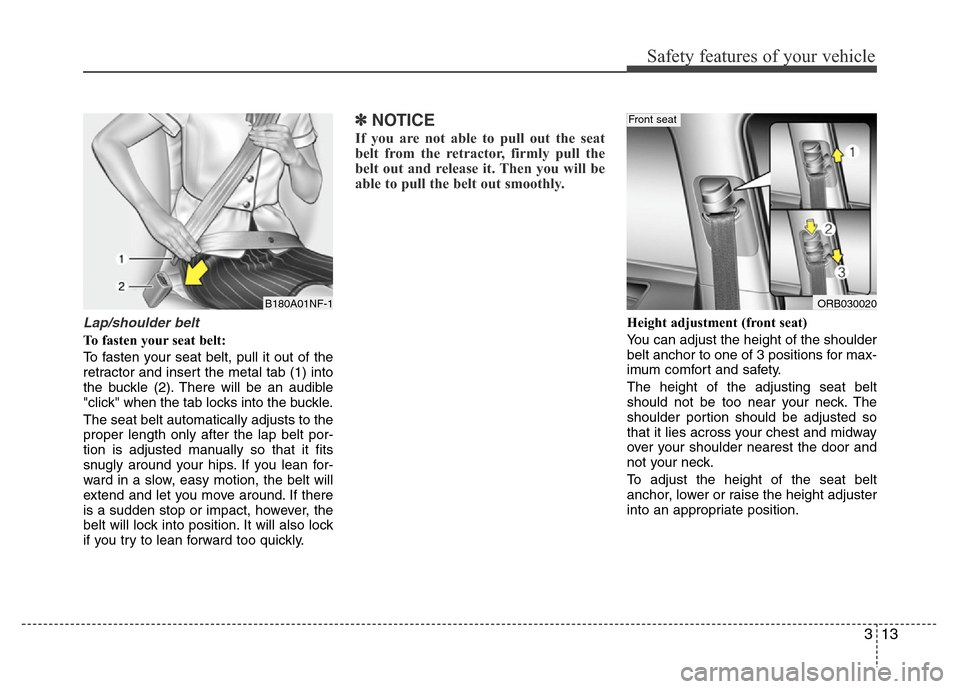
To fasten your seat belt, pull it out of the
retractor and insert the metal tab (1) into
the buckle (2). There will be an audible
"click" when the tab locks into the buckle.
The seat belt automatically adjusts to the
proper length only after the lap belt por-
tion is adjusted manually so that it fits
snugly around your hips. If you lean for-
ward in a slow, easy motion, the belt will
extend and let you move around. If there
is a sudden stop or impact, however, the
belt will lock into position. It will also lock
if you try to lean forward too quickly.
✽NOTICE
If you are not able to pull out the seat
belt from the retractor, firmly pull the
belt out and release it. Then you will be
able to pull the belt out smoothly.
Height adjustment (front seat)
You can adjust the height of the shoulder
belt anchor to one of 3 positions for max-
imum comfort and safety.
The height of the adjusting seat belt
should not be too near your neck. The
shoulder portion should be adjusted so
that it lies across your chest and midway
over your shoulder nearest the door and
not your neck.
To adjust the height of the seat belt
anchor, lower or raise the height adjuster
into an appropriate position.
ORB030020
Front seat
B180A01NF-1
Page 32 of 402
Safety features of your vehicle
14 3
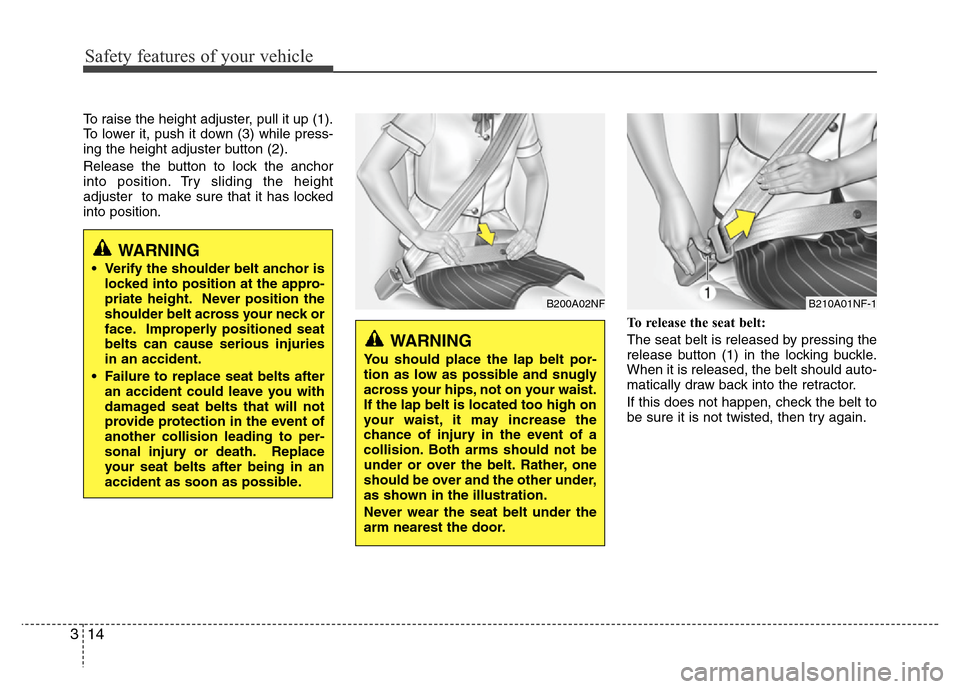
To raise the height adjuster, pull it up (1).
To lower it, push it down (3) while press-
ing the height adjuster button (2).
Release the button to lock the anchor
into position. Try sliding the height
adjuster to make sure that it has locked
into position.
To release the seat belt:
The seat belt is released by pressing the
release button (1) in the locking buckle.
When it is released, the belt should auto-
matically draw back into the retractor.
If this does not happen, check the belt to
be sure it is not twisted, then try again.
B200A02NF
WARNING
You should place the lap belt por-
tion as low as possible and snugly
across your hips, not on your waist.
If the lap belt is located too high on
your waist, it may increase the
chance of injury in the event of a
collision. Both arms should not be
under or over the belt. Rather, one
should be over and the other under,
as shown in the illustration.
Never wear the seat belt under the
arm nearest the door.
WARNING
• Verify the shoulder belt anchor is
locked into position at the appro-
priate height. Never position the
shoulder belt across your neck or
face. Improperly positioned seat
belts can cause serious injuries
in an accident.
• Failure to replace seat belts after
an accident could leave you with
damaged seat belts that will not
provide protection in the event of
another collision leading to per-
sonal injury or death. Replace
your seat belts after being in an
accident as soon as possible.
B210A01NF-1
Page 33 of 402
315
Safety features of your vehicle
3 Point rear center belt (if equipped)
To fasten the rear center belt
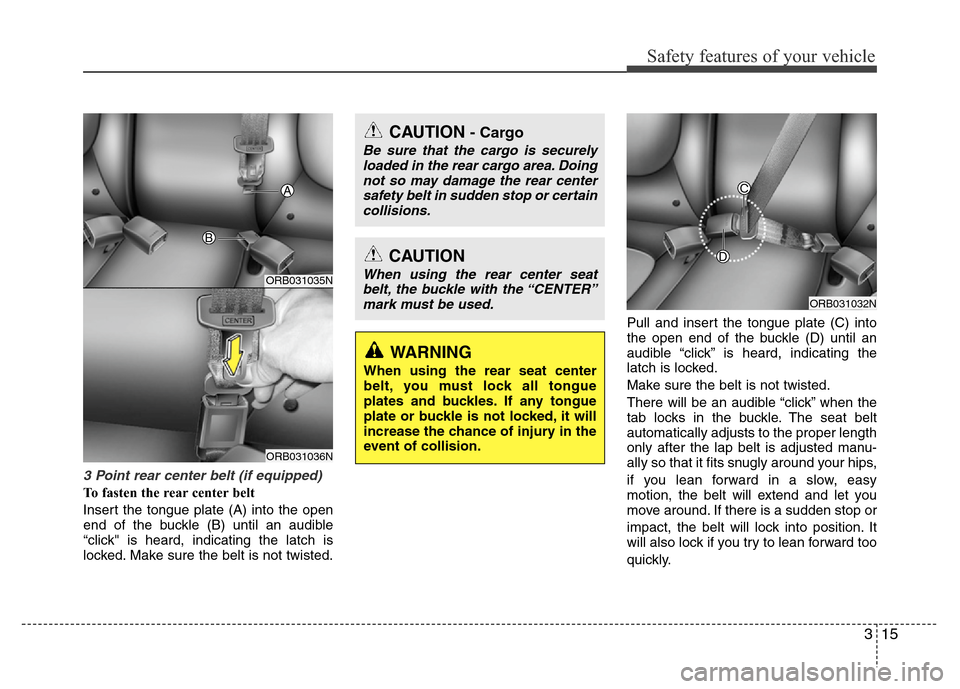
Insert the tongue plate (A) into the open
end of the buckle (B) until an audible
“click" is heard, indicating the latch is
locked. Make sure the belt is not twisted.Pull and insert the tongue plate (C) into
the open end of the buckle (D) until an
audible “click” is heard, indicating the
latch is locked.
Make sure the belt is not twisted.
There will be an audible “click” when the
tab locks in the buckle. The seat belt
automatically adjusts to the proper length
only after the lap belt is adjusted manu-
ally so that it fits snugly around your hips,
if you lean forward in a slow, easy
motion, the belt will extend and let you
move around. If there is a sudden stop or
impact, the belt will lock into position. It
will also lock if you try to lean forward too
quickly.
ORB031035N
ORB031036N
A
B
CAUTION- Cargo
Be sure that the cargo is securely
loaded in the rear cargo area. Doing
not so may damage the rear center
safety belt in sudden stop or certain
collisions.
CAUTION
When using the rear center seat
belt, the buckle with the “CENTER”
mark must be used.
WARNING
When using the rear seat center
belt, you must lock all tongue
plates and buckles. If any tongue
plate or buckle is not locked, it will
increase the chance of injury in the
event of collision.
ORB031032N
D
C
Page 34 of 402
Safety features of your vehicle
16 3
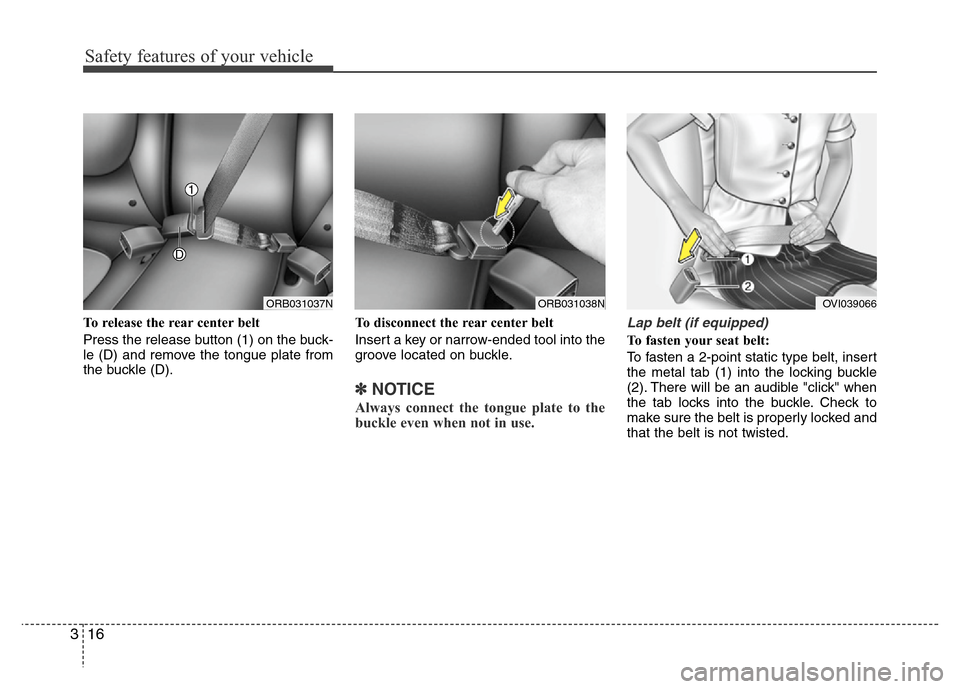
To release the rear center belt
Press the release button (1) on the buck-
le (D) and remove the tongue plate from
the buckle (D).To disconnect the rear center belt
Insert a key or narrow-ended tool into the
groove located on buckle.
✽NOTICE
Always connect the tongue plate to the
buckle even when not in use.
Lap belt (if equipped)
To fasten your seat belt:
To fasten a 2-point static type belt, insert
the metal tab (1) into the locking buckle
(2). There will be an audible "click" when
the tab locks into the buckle. Check to
make sure the belt is properly locked and
that the belt is not twisted.
OVI039066ORB031037N
D
1
ORB031038N
Page 35 of 402
317
Safety features of your vehicle
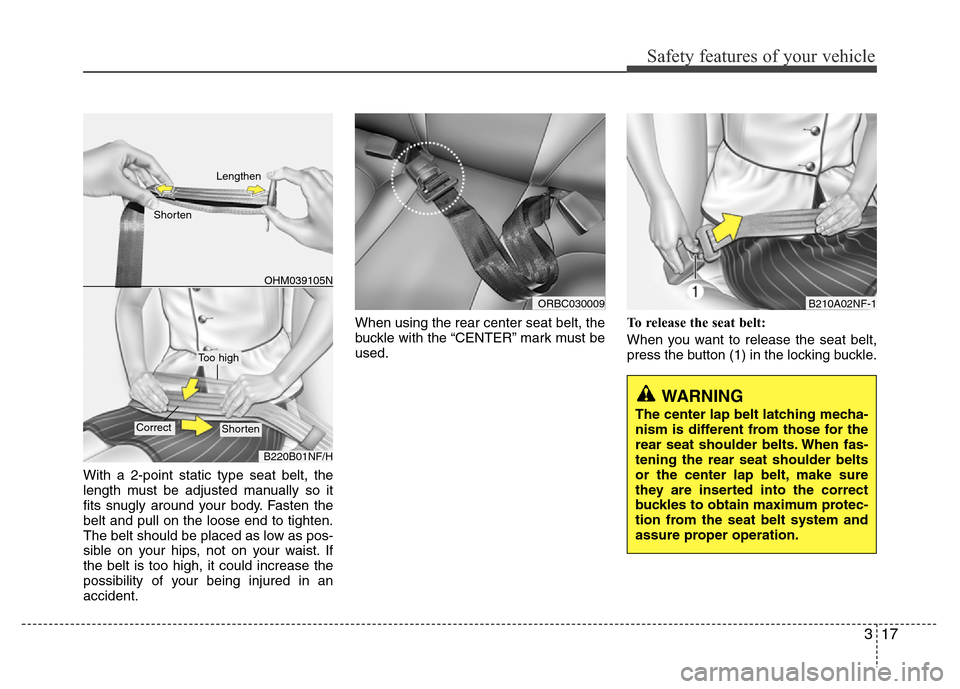
With a 2-point static type seat belt, the
length must be adjusted manually so it
fits snugly around your body. Fasten the
belt and pull on the loose end to tighten.
The belt should be placed as low as pos-
sible on your hips, not on your waist. If
the belt is too high, it could increase the
possibility of your being injured in an
accident.When using the rear center seat belt, the
buckle with the “CENTER” mark must be
used.To release the seat belt:
When you want to release the seat belt,
press the button (1) in the locking buckle.
OHM039105N
B220B01NF/H
Too high
ShortenCorrect
Lengthen
Shorten
ORBC030009B210A02NF-1
WARNING
The center lap belt latching mecha-
nism is different from those for the
rear seat shoulder belts. When fas-
tening the rear seat shoulder belts
or the center lap belt, make sure
they are inserted into the correct
buckles to obtain maximum protec-
tion from the seat belt system and
assure proper operation.
Page 36 of 402
Safety features of your vehicle
18 3
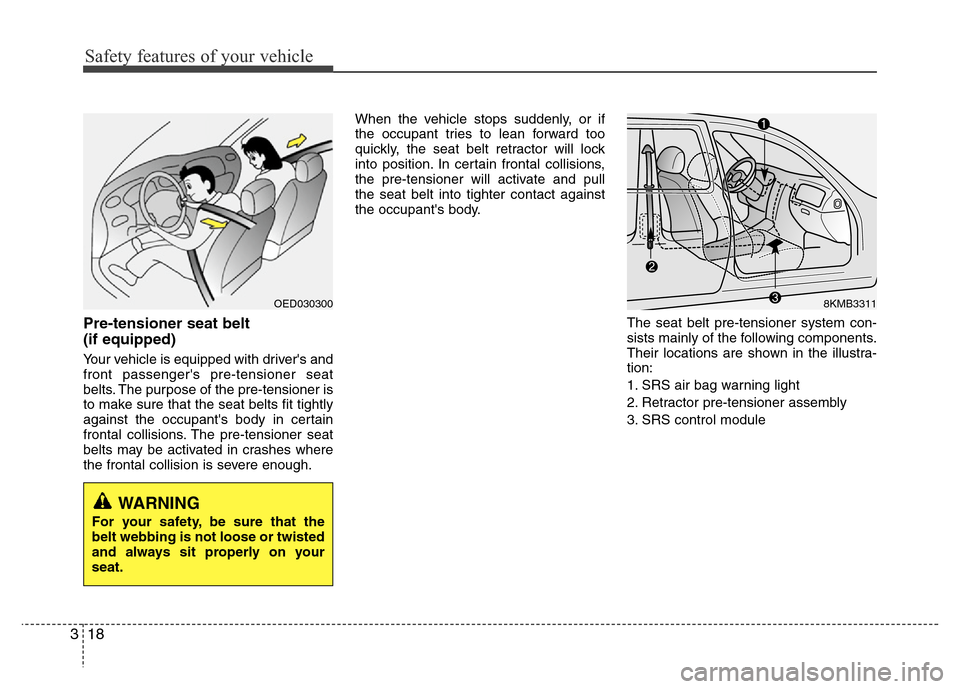
Pre-tensioner seat belt
(if equipped)
Your vehicle is equipped with driver's and
front passenger's pre-tensioner seat
belts. The purpose of the pre-tensioner is
to make sure that the seat belts fit tightly
against the occupant's body in certain
frontal collisions. The pre-tensioner seat
belts may be activated in crashes where
the frontal collision is severe enough.When the vehicle stops suddenly, or if
the occupant tries to lean forward too
quickly, the seat belt retractor will lock
into position. In certain frontal collisions,
the pre-tensioner will activate and pull
the seat belt into tighter contact against
the occupant's body.
The seat belt pre-tensioner system con-
sists mainly of the following components.
Their locations are shown in the illustra-
tion:
1. SRS air bag warning light
2. Retractor pre-tensioner assembly
3. SRS control module
OED030300
WARNING
For your safety, be sure that the
belt webbing is not loose or twisted
and always sit properly on your
seat.
8KMB3311
Page 43 of 402
325
Safety features of your vehicle
WARNING
To reduce the chance of serious or
fatal injuries:
• Children of all ages are safer
when restrained in the rear seat.
A child riding in the front passen-
ger seat can be forcefully struck
by an inflating air bag resulting in
serious or fatal injuries.
• Always follow the child restraint
system manufacturer’s instruc-
tions for installation and use of
the child restraint.
• Always make sure the child seat
is secured properly in the car and
your child is securely restrained
in the child seat.
• Never hold a child in your arms or
lap when riding in a vehicle. The
violent forces created during a
crash will tear the child from your
arms and throw the child against
the car’s interior.
• Never put a seat belt over your-
self and a child. During a crash,
the belt could press deep into the
child causing serious internal
injuries.
(Continued)
(Continued)
• Never leave children unattended
in a vehicle – not even for a short
time. The car can heat up very
quickly, resulting in serious
injuries to children inside. Even
very young children may inadver-
tently cause the vehicle to move,
entangle themselves in the win-
dows, or lock themselves or oth-
ers inside the vehicle.
• Never allow two children, or any
two persons, to use the same
seat belt.
• Children often squirm and repo-
sition themselves improperly.
Never let a child ride with the
shoulder belt under their arm or
behind their back. Always proper-
ly position and secure children in
the rear seat.
• Never allow a child to stand-up or
kneel on the seat or floor of a
moving vehicle. During a colli-
sion or sudden stop, the child
can be violently thrown against
the vehicle’s interior, resulting in
serious injury.
(Continued)(Continued)
• Never use an infant carrier or a
child safety seat that "hooks"
over a seatback, it may not pro-
vide adequate security in an acci-
dent.
• Seat belts can become very hot,
especially when the car is parked
in direct sunlight. Always check
seat belt buckles before fasten-
ing them over a child.
• After an accident, have an author-
ized HYUNDAI dealer check the
child restraint system, seat belt,
tether anchor and lower anchor.
• If there is not enough space to
place the child restraint system
because of the driver's seat,
install the child restraint system
in the rear right seat.
Page 46 of 402
Safety features of your vehicle
28 3
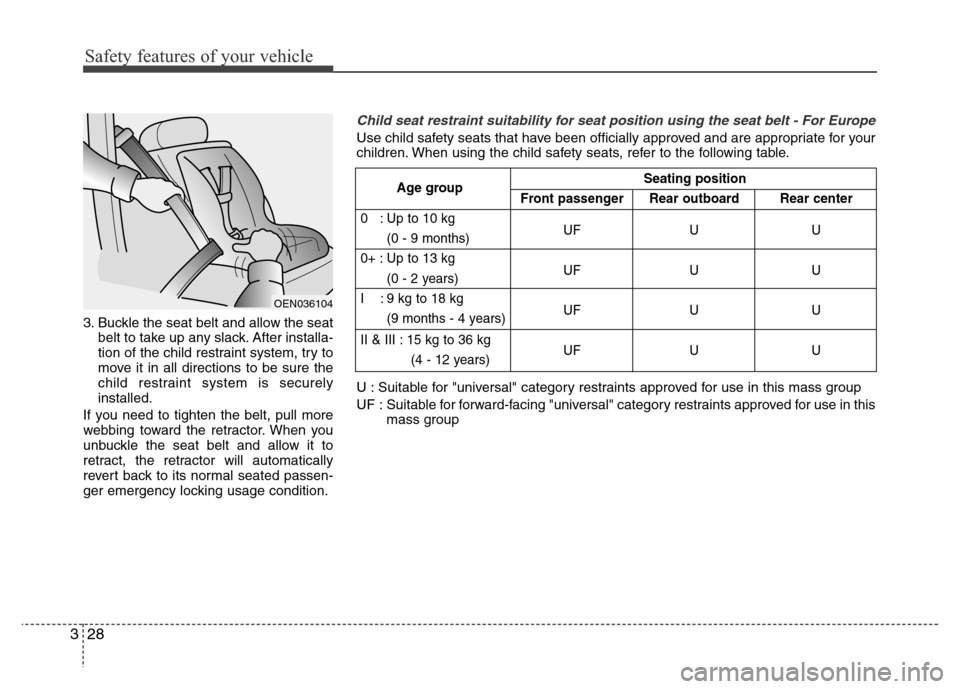
3. Buckle the seat belt and allow the seat
belt to take up any slack. After installa-
tion of the child restraint system, try to
move it in all directions to be sure the
child restraint system is securely
installed.
If you need to tighten the belt, pull more
webbing toward the retractor. When you
unbuckle the seat belt and allow it to
retract, the retractor will automatically
revert back to its normal seated passen-
ger emergency locking usage condition.
OEN036104
Child seat restraint suitability for seat position using the seat belt - For Europe
Use child safety seats that have been officially approved and are appropriate for your
children. When using the child safety seats, refer to the following table.
Age groupSeating position
Front passenger Rear outboard Rear center
0 : Up to 10 kg
UF U U
(0 - 9 months)
0+ : Up to 13 kg
UF U U
(0 - 2 years)
I : 9 kg to 18 kg
UF U U
(9 months - 4 years)
II & III : 15 kg to 36 kg
UF U U
(4 - 12 years)
U : Suitable for "universal" category restraints approved for use in this mass group
UF : Suitable for forward-facing "universal" category restraints approved for use in this
mass group
Page 54 of 402
Safety features of your vehicle
36 3
Noise and smoke
When the air bags inflate, they make a
loud noise and they leave smoke and
powder in the air inside of the vehicle.
This is normal and is a result of the igni-
tion of the air bag inflator. After the air
bag inflates, you may feel substantial dis-
comfort in breathing due to the contact of
your chest with both the seat belt and the
air bag, as well as from breathing the
smoke and powder.Open your doors
and/or windows as soon as possible
after impact in order to reduce dis-
comfort and prevent prolonged expo-
sure to the smoke and powder.
Though the smoke and powder are non-
toxic, they may cause irritation to the skin
(eyes, nose and throat, etc). If this is the
case, wash and rinse with cold water
immediately and consult a doctor if the
symptom persists.
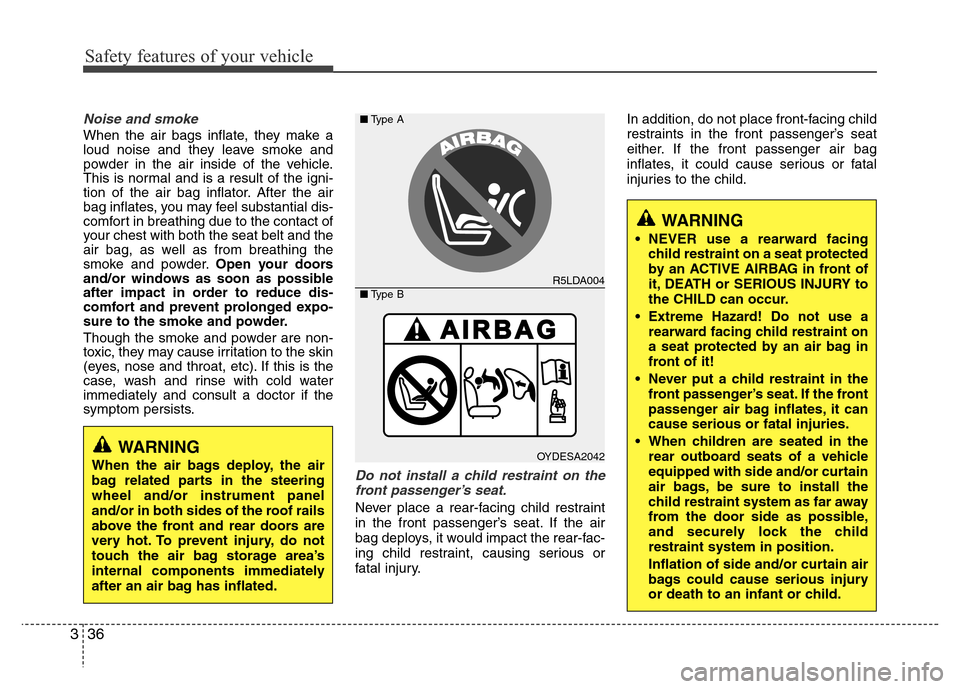
Do not install a child restraint on the
front passenger’s seat.
Never place a rear-facing child restraint
in the front passenger’s seat. If the air
bag deploys, it would impact the rear-fac-
ing child restraint, causing serious or
fatal injury.In addition, do not place front-facing child
restraints in the front passenger’s seat
either. If the front passenger air bag
inflates, it could cause serious or fatal
injuries to the child.
WARNING
When the air bags deploy, the air
bag related parts in the steering
wheel and/or instrument panel
and/or in both sides of the roof rails
above the front and rear doors are
very hot. To prevent injury, do not
touch the air bag storage area’s
internal components immediately
after an air bag has inflated.
WARNING
• NEVER use a rearward facing
child restraint on a seat protected
by an ACTIVE AIRBAG in front of
it, DEATH or SERIOUS INJURY to
the CHILD can occur.
• Extreme Hazard! Do not use a
rearward facing child restraint on
a seat protected by an air bag in
front of it!
• Never put a child restraint in the
front passenger’s seat. If the front
passenger air bag inflates, it can
cause serious or fatal injuries.
• When children are seated in the
rear outboard seats of a vehicle
equipped with side and/or curtain
air bags, be sure to install the
child restraint system as far away
from the door side as possible,
and securely lock the child
restraint system in position.
Inflation of side and/or curtain air
bags could cause serious injury
or death to an infant or child.
R5LDA004
OYDESA2042 ■Type A
■Type B