ESP Hyundai Accent 2013 Service Manual
[x] Cancel search | Manufacturer: HYUNDAI, Model Year: 2013, Model line: Accent, Model: Hyundai Accent 2013Pages: 402, PDF Size: 8.49 MB
Page 351 of 402
Maintenance
60 7
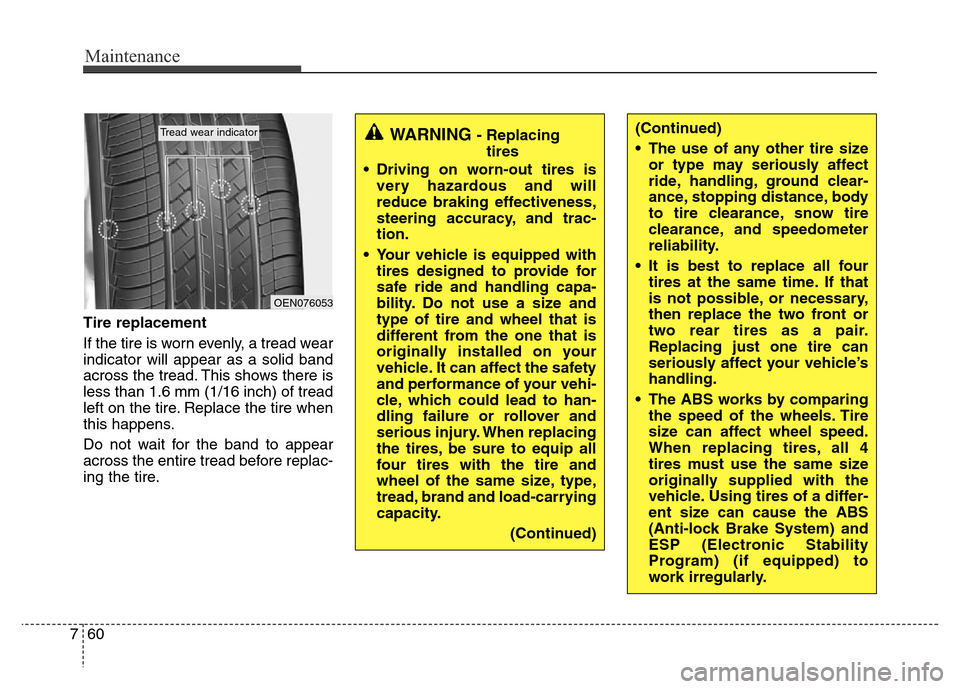
Tire replacement
If the tire is worn evenly, a tread wear
indicator will appear as a solid band
across the tread. This shows there is
less than 1.6 mm (1/16 inch) of tread
left on the tire. Replace the tire when
this happens.
Do not wait for the band to appear
across the entire tread before replac-
ing the tire.
OEN076053
Tread wear indicator(Continued)
• The use of any other tire size
or type may seriously affect
ride, handling, ground clear-
ance, stopping distance, body
to tire clearance, snow tire
clearance, and speedometer
reliability.
• It is best to replace all four
tires at the same time. If that
is not possible, or necessary,
then replace the two front or
two rear tires as a pair.
Replacing just one tire can
seriously affect your vehicle’s
handling.
• The ABS works by comparing
the speed of the wheels. Tire
size can affect wheel speed.
When replacing tires, all 4
tires must use the same size
originally supplied with the
vehicle. Using tires of a differ-
ent size can cause the ABS
(Anti-lock Brake System) and
ESP (Electronic Stability
Program) (if equipped) to
work irregularly.WARNING - Replacing
tires
• Driving on worn-out tires is
very hazardous and will
reduce braking effectiveness,
steering accuracy, and trac-
tion.
• Your vehicle is equipped with
tires designed to provide for
safe ride and handling capa-
bility. Do not use a size and
type of tire and wheel that is
different from the one that is
originally installed on your
vehicle. It can affect the safety
and performance of your vehi-
cle, which could lead to han-
dling failure or rollover and
serious injury. When replacing
the tires, be sure to equip all
four tires with the tire and
wheel of the same size, type,
tread, brand and load-carrying
capacity.
(Continued)
Page 353 of 402
Maintenance
62 7
2. Tire size designation
A tire’s sidewall is marked with a tire
size designation. You will need this
information when selecting replace-
ment tires for your car. The following
explains what the letters and num-
bers in the tire size designation
mean.
Example tire size designation:
(These numbers are provided as an
example only; your tire size designa-
tor could vary depending on your
vehicle.)
195/50R16 83H
195 - Tire width in millimeters.
50 - Aspect ratio. The tire’s section
height as a percentage of its
width.
R - Tire construction code (Radial).
16 - Rim diameter in inches.
83 - Load Index, a numerical code
associated with the maximum
load the tire can carry.
H - Speed Rating Symbol. See the
speed rating chart in this section
for additional information.
Wheel size designation
Wheels are also marked with impor-
tant information that you need if you
ever have to replace one. The follow-
ing explains what the letters and
numbers in the wheel size designa-
tion mean.
Example wheel size designation:
6.0JX16
6.0 - Rim width in inches.
J - Rim contour designation.
16 - Rim diameter in inches.
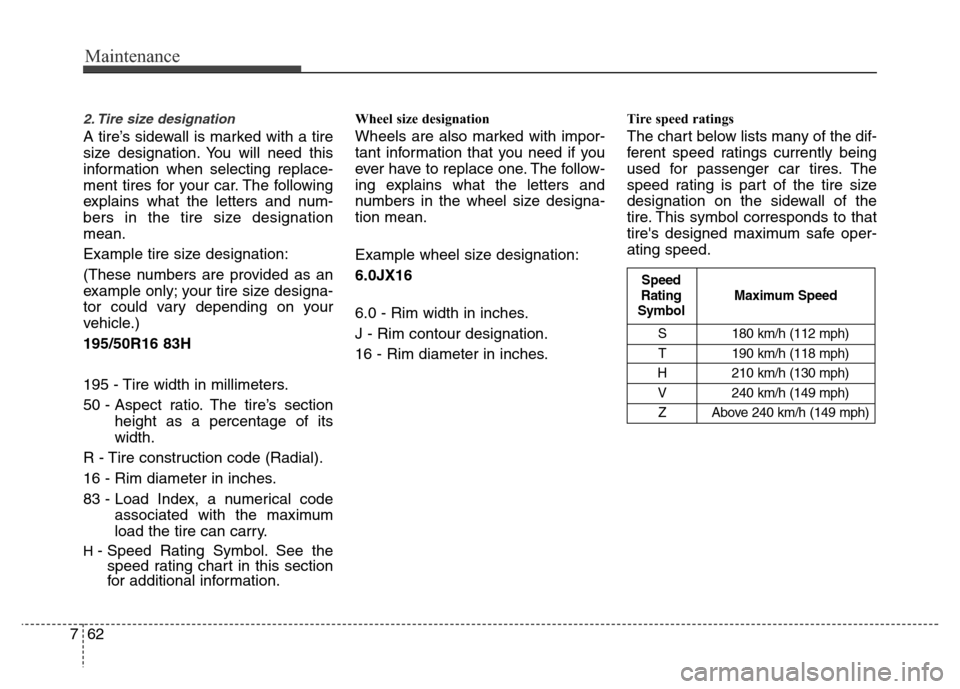
Tire speed ratings
The chart below lists many of the dif-
ferent speed ratings currently being
used for passenger car tires. The
speed rating is part of the tire size
designation on the sidewall of the
tire. This symbol corresponds to that
tire's designed maximum safe oper-
ating speed.
S 180 km/h (112 mph)
T 190 km/h (118 mph)
H 210 km/h (130 mph)
V 240 km/h (149 mph)
Z Above 240 km/h (149 mph)
Maximum Speed Speed
Rating
Symbol
Page 355 of 402
Maintenance
64 7
6. Maximum load rating
This number indicates the maximum
load in kilograms and pounds that
can be carried by the tire. When
replacing the tires on the vehicle,
always use a tire that has the same
load rating as the factory installed
tire.
7. Uniform tire quality grading
Quality grades can be found where
applicable on the tire sidewall
between tread shoulder and maxi-
mum section width.
For example:
TREADWEAR 200
TRACTION AA
TEMPERATURE A
Tread wear
The tread wear grade is a compara-
tive rating based on the wear rate of
the tire when tested under controlled
conditions on a specified govern-
ment test course. For example, a tire
graded 150 would wear one-and-a-
half times (1½) as well on the gov-
ernment course as a tire graded 100.
The relative performance of tires
depends upon the actual conditions
of their use, however, and may
depart significantly from the norm
due to variations in driving habits,
service practices and differences in
road characteristics and climate.
These grades are molded on the
side-walls of passenger vehicle tires.
The tires available as standard or
optional equipment on your vehicle
may vary with respect to grade.
Traction - AA, A, B & C
The traction grades, from highest to
lowest, are AA, A, B and C. Those
grades represent the tire’s ability to
stop on wet pavement as measured
under controlled conditions on spec-
ified government test surfaces of
asphalt and concrete. A tire marked
C may have poor traction perform-
ance.
WARNING
The traction grade assigned to
this tire is based on straight-
ahead braking traction tests,
and does not include accelera-
tion, cornering, hydroplaning,
or peak traction characteristics.
Page 365 of 402
Maintenance
74 7
DescriptionSymbolFuse ratingProtected component
IG1IG110A
ATM Shift Lock Control Module, EPS Control Module, Tire Pressure Monitoring Module,
Electro Chromic Mirror, SBR Control Module, Seat Belt Reminder Indicator, Rear Parking
Assist Buzzer, Stop Lamp Switch(Gasoline), Rheostat, Fuel Filter Warning Sensor (Diesel),
Rear Parking Assist Sensor Side LH/RH, Rear Parking Assist Sensor Center LH/RH
ABS10AABS Control Module, ESP Control Module, ESP Off Switch, E/R Fuse & Relay Box
(Multipurpose Check Connector)
B/UP LAMPB/UP
LAMP10ABack-Up Lamp Switch
ECU10AECM, Mass Air Flow Sensor (Diesel), Smart Key Control Module
4SPARE4SPARE10A-
HAZARD15AHazard Relay, Hazard Switch
1PDM25ASmart Key Control Module
SUNROOF15ASunroof Motor
2PDM10ASmart Key Control Module, Start/Stop Button Switch
TCU15ATCM (Diesel), Pulse Generator 'A'/'B', Vehicle Speed Sensor, Transaxle Range Switch
5SPARE5SPARE15A-
IG2IG210ABCM, Power Window Relay, Smart Key Control Module, A/C Control Module, Instrument
Cluster, Sunroof Motor, Head Lamp Leveling Device Switch, Head Lamp LH/RH
WIPER FRT25AMultifunction Switch, Front Wiper Motor
DR LOCK20ADoor Lock/Unlock Relay, Tail Gate Unlock Relay, Driver Door Lock Actuator
Page 366 of 402
775
Maintenance
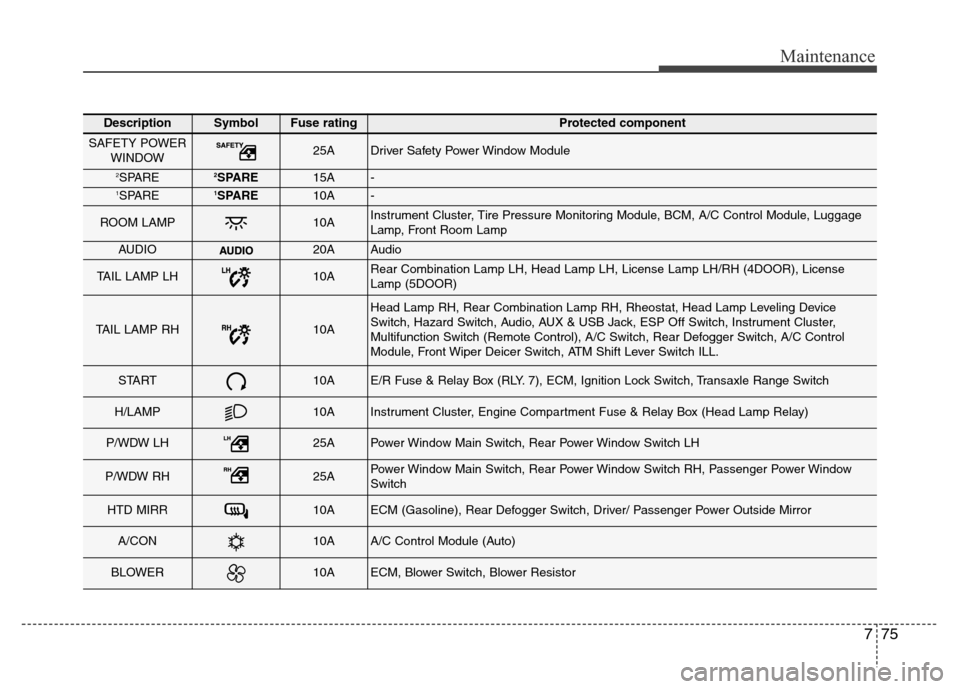
DescriptionSymbolFuse ratingProtected component
SAFETY POWER
WINDOW25ADriver Safety Power Window Module
2SPARE2SPARE15A-1SPARE1SPARE10A-
ROOM LAMP10AInstrument Cluster, Tire Pressure Monitoring Module, BCM, A/C Control Module, Luggage
Lamp, Front Room Lamp
AUDIO20AAudio
TAIL LAMP LH10ARear Combination Lamp LH, Head Lamp LH, License Lamp LH/RH (4DOOR), License
Lamp (5DOOR)
TAIL LAMP RH10A
Head Lamp RH, Rear Combination Lamp RH, Rheostat, Head Lamp Leveling Device
Switch, Hazard Switch, Audio, AUX & USB Jack, ESP Off Switch, Instrument Cluster,
Multifunction Switch (Remote Control), A/C Switch, Rear Defogger Switch, A/C Control
Module, Front Wiper Deicer Switch, ATM Shift Lever Switch ILL.
START10AE/R Fuse & Relay Box (RLY. 7), ECM, Ignition Lock Switch, Transaxle Range Switch
H/LAMP10AInstrument Cluster, Engine Compartment Fuse & Relay Box (Head Lamp Relay)
P/WDW LH25APower Window Main Switch, Rear Power Window Switch LH
P/WDW RH25APower Window Main Switch, Rear Power Window Switch RH, Passenger Power Window
Switch
HTD MIRR10AECM (Gasoline), Rear Defogger Switch, Driver/ Passenger Power Outside Mirror
A/CON10AA/C Control Module (Auto)
BLOWER10AECM, Blower Switch, Blower Resistor
Page 367 of 402
Maintenance
76 7
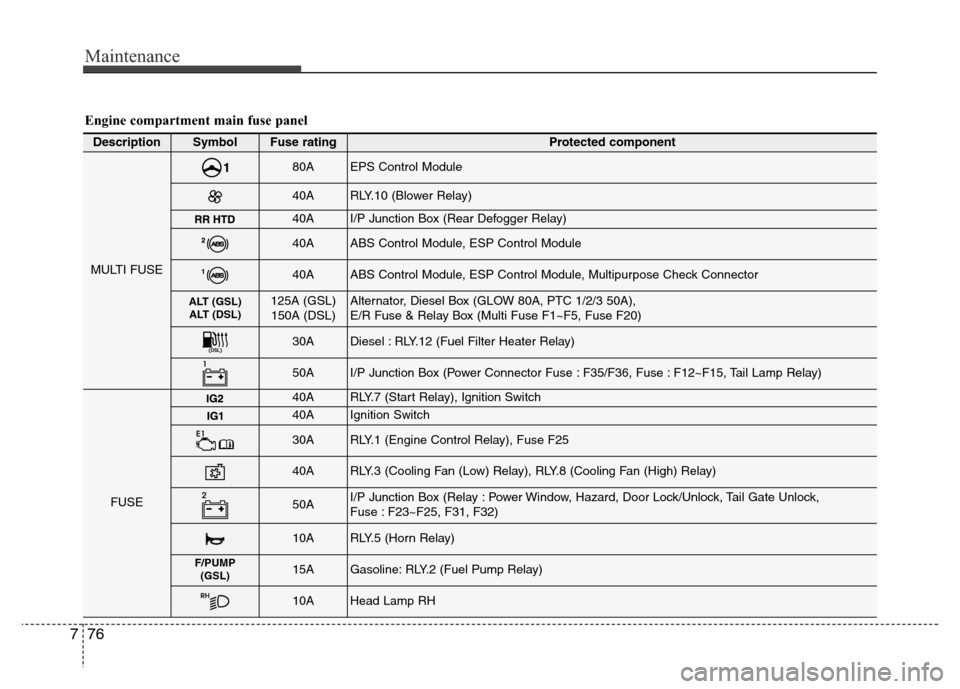
DescriptionSymbolFuse ratingProtected component
MULTI FUSE
80AEPS Control Module
40ARLY.10 (Blower Relay)
40AI/P Junction Box (Rear Defogger Relay)
40AABS Control Module, ESP Control Module
40AABS Control Module, ESP Control Module, Multipurpose Check Connector
ALT (GSL)
ALT (DSL)125A (GSL)
150A (DSL)Alternator, Diesel Box (GLOW 80A, PTC 1/2/3 50A),
E/R Fuse & Relay Box (Multi Fuse F1~F5, Fuse F20)
30ADiesel : RLY.12 (Fuel Filter Heater Relay)
50AI/P Junction Box (Power Connector Fuse : F35/F36, Fuse : F12~F15, Tail Lamp Relay)
FUSE
40ARLY.7 (Start Relay), Ignition Switch
40AIgnition Switch
30ARLY.1 (Engine Control Relay), Fuse F25
40ARLY.3 (Cooling Fan (Low) Relay), RLY.8 (Cooling Fan (High) Relay)
50AI/P Junction Box (Relay : Power Window, Hazard, Door Lock/Unlock, Tail Gate Unlock,
Fuse : F23~F25, F31, F32)
10ARLY.5 (Horn Relay)
F/PUMP
(GSL)15AGasoline: RLY.2 (Fuel Pump Relay)
10AHead Lamp RH
Engine compartment main fuse panel
Page 369 of 402
Maintenance
78 7
LIGHT BULBS
Use only the bulbs of the specified
wattage.
✽NOTICE
After heavy, driving rain or washing,
headlight and taillight lenses could
appear frosty. This condition is caused by
the temperature difference between the
lamp inside and outside. This is similar
to the condensation on your windows
inside your vehicle during the rain and
doesn’t indicate a problem with your
vehicle. If the water leaks into the lamp
bulb circuitry, have the vehicle checked
by an authorized HYUNDAI dealer.WARNING - Working on
the lights
Prior to working on the light, firmly
apply the parking brake, ensure
that the ignition switch is turned to
the LOCK position and turn off the
lights to avoid sudden movement
of the vehicle and burning your fin-
gers or receiving an electric shock.
CAUTION
Be sure to replace the burned-out
bulb with one of the same wattage
rating. Otherwise, it may cause
damage to the fuse or electric
wiring system.
CAUTION
• If you don’t have necessary tools,
the correct bulbs and the expert-
ise, consult an authorized
HYUNDAI dealer. In many cases, it
is difficult to replace vehicle light
bulbs because other parts of the
vehicle must be removed before
you can get to the bulb. This is
especially true if you have to
remove the headlight assembly to
get to the bulb(s). Removing/
installing the headlight assembly
can result in damage to the vehi-
cle.
• Do not install additional bulb or
LED. If you install that, the lamp
may not be operated properly and
fuse box or electric wiring system
may have problem.
Page 374 of 402
783
Maintenance
4. Remove the bulb-socket from the
housing by turning the socket counter
clockwise until the tabs on the socket
align with the slots on the housing.
5. Install the new bulb-socket into the
housing by aligning the tabs on the
socket with the slots in the housing.
Push the socket into the housing and
turn the socket clockwise.
6. Connect the power connector to the
socket.
7. Reinstall the front bumper under cover.
Headlight aiming
1. Inflate the tires to the specified pres-
sure and remove any loads from the
vehicle except the driver, spare tire,
and tools.2. The vehicle should be placed on a flat
floor.
3. Draw vertical lines (Vertical lines pass-
ing through respective head lamp cen-
ters) and a horizontal line (Horizontal
line passing through center of head
lamps) on the screen.
4. With the head lamp and battery in nor-
mal condition, aim the head lamps so
the brightest portion falls on the hori-
zontal and vertical lines.
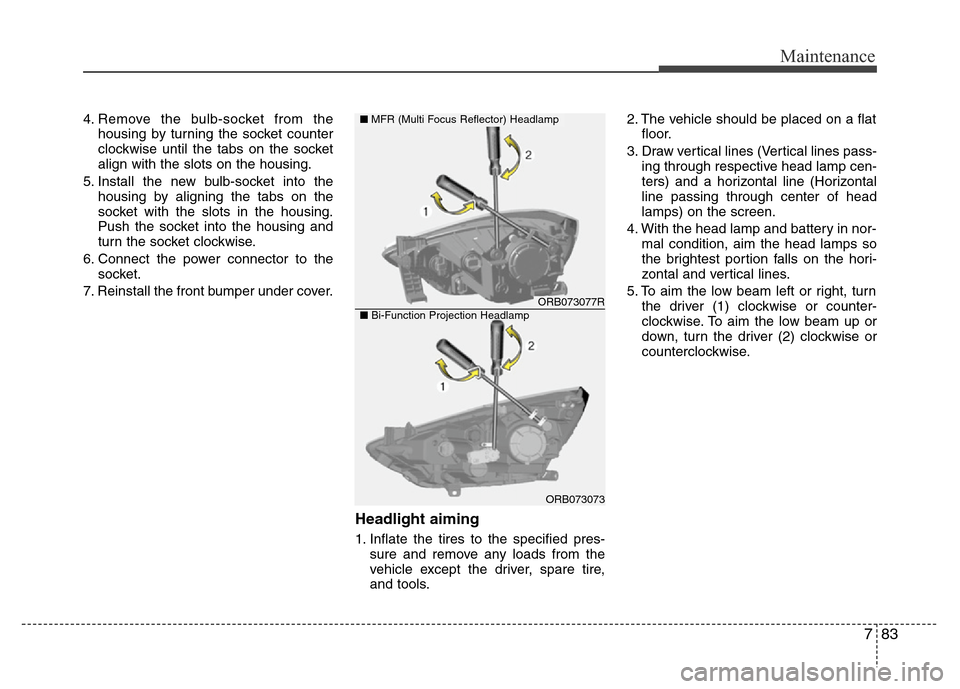
5. To aim the low beam left or right, turn
the driver (1) clockwise or counter-
clockwise. To aim the low beam up or
down, turn the driver (2) clockwise or
counterclockwise.
ORB073077R
ORB073073
■MFR (Multi Focus Reflector) Headlamp
■Bi-Function Projection Headlamp
Page 384 of 402
793
Maintenance
Exterior care
Exterior general caution
It is very important to follow the label
directions when using any chemical
cleaner or polish. Read all warning and
caution statements that appear on the
label.
Finish maintenance
Washing
To help protect your vehicle’s finish from
rust and deterioration, wash it thoroughly
and frequently at least once a month with
lukewarm or cold water.
If you use your vehicle for off-road driv-
ing, you should wash it after each off-
road trip. Pay special attention to the
removal of any accumulation of salt, dirt,
mud, and other foreign materials. Make
sure the drain holes in the lower edges of
the doors and rocker panels are kept
clear and clean.
Insects, tar, tree sap, bird droppings,
industrial pollution and similar deposits
can damage your vehicle’s finish if not
removed immediately.
Even prompt washing with plain water
may not completely remove all these
deposits. A mild soap, safe for use on
painted surfaces, may be used.
After washing, rinse the vehicle thor-
oughly with lukewarm or cold water. Do
not allow soap to dry on the finish.
APPEARANCE CARE
CAUTION
• Do not use strong soap, chemical
detergents or hot water, and do
not wash the vehicle in direct
sunlight or when the body of the
vehicle is warm.
• Be careful when washing the side
windows of your vehicle.
Especially, with high-pressure
water, water may leak through the
windows and wet the interior.
• To prevent damage to the plastic
parts, do not clean with chemical
solvents or strong detergents.
WARNING - Wet brakes
After washing the vehicle, test the
brakes while driving slowly to see if
they have been affected by water. If
braking performance is impaired,
dry the brakes by applying them
lightly while maintaining a slow for-
ward speed.
Page 390 of 402
799
Maintenance
EMISSION CONTROL SYSTEM (IF EQUIPPED)
The emission control system of your
vehicle is covered by a written limited
warranty. Please see the warranty infor-
mation contained in the Service Passport
in your vehicle.
Your vehicle is equipped with an emis-
sion control system to meet all applicable
emission regulations.
There are three emission control sys-
tems, as follows.
(1) Crankcase emission control system
(2) Evaporative emission control system
(3) Exhaust emission control system
In order to assure the proper function of
the emission control systems, it is rec-
ommended that you have your car
inspected and maintained by an author-
ized HYUNDAI dealer in accordance with
the maintenance schedule in this manu-
al.Caution for the Inspection and
Maintenance Test (With Electronic
Stability Program (ESP) system)
• To prevent the vehicle from misfir-
ing during dynamometer testing,
turn the Electronic Stability
Program (ESP) system off by press-
ing the ESP switch.
• After dynamometer testing is com-
pleted, turn the ESP system back on
by pressing the ESP switch again.1. Crankcase emission control
system
The positive crankcase ventilation sys-
tem is employed to prevent air pollution
caused by blow-by gases being emitted
from the crankcase. This system supplies
fresh filtered air to the crankcase through
the air intake hose. Inside the crankcase,
the fresh air mixes with blow-by gases,
which then pass through the PCV valve
into the induction system.
2. Evaporative emission control
system
The Evaporative Emission Control
System is designed to prevent fuel
vapors from escaping into the atmos-
phere.