door Hyundai Accent 2013 Service Manual
[x] Cancel search | Manufacturer: HYUNDAI, Model Year: 2013, Model line: Accent, Model: Hyundai Accent 2013Pages: 402, PDF Size: 8.49 MB
Page 232 of 402
Driving your vehicle
12 5
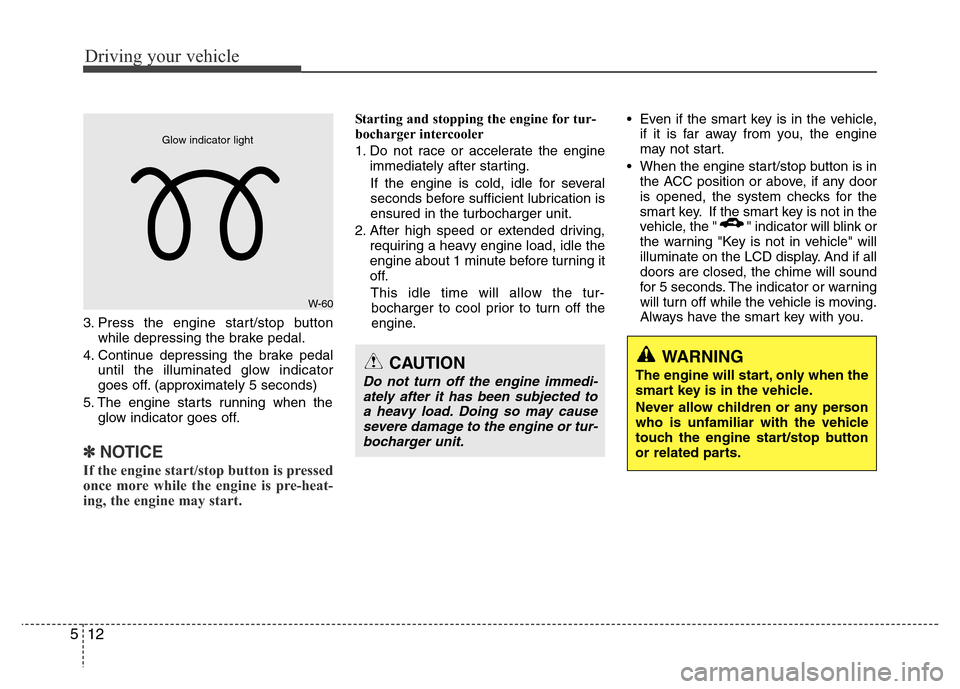
3. Press the engine start/stop button
while depressing the brake pedal.
4. Continue depressing the brake pedal
until the illuminated glow indicator
goes off. (approximately 5 seconds)
5. The engine starts running when the
glow indicator goes off.
✽ NOTICE
If the engine start/stop button is pressed
once more while the engine is pre-heat-
ing, the engine may start.
Starting and stopping the engine for tur-
bocharger intercooler
1. Do not race or accelerate the engine
immediately after starting.
If the engine is cold, idle for several
seconds before sufficient lubrication is
ensured in the turbocharger unit.
2. After high speed or extended driving,
requiring a heavy engine load, idle the
engine about 1 minute before turning it
off.
This idle time will allow the tur-
bocharger to cool prior to turn off the
engine.• Even if the smart key is in the vehicle,
if it is far away from you, the engine
may not start.
• When the engine start/stop button is in
the ACC position or above, if any door
is opened, the system checks for the
smart key. If the smart key is not in the
vehicle, the " " indicator will blink or
the warning "Key is not in vehicle" will
illuminate on the LCD display. And if all
doors are closed, the chime will sound
for 5 seconds. The indicator or warning
will turn off while the vehicle is moving.
Always have the smart key with you.
WARNING
The engine will start, only when the
smart key is in the vehicle.
Never allow children or any person
who is unfamiliar with the vehicle
touch the engine start/stop button
or related parts.CAUTION
Do not turn off the engine immedi-
ately after it has been subjected to
a heavy load. Doing so may cause
severe damage to the engine or tur-
bocharger unit.
W-60
Glow indicator light
Page 265 of 402
545
Driving your vehicle
This section contains many time-tested,
important trailering tips and safety rules.
Many of these are important for your
safety and that of your passengers.
Please read this section carefully before
you pull a trailer.
Load-pulling components such as the
engine, transaxle, wheel assemblies, and
tires are forced to work harder against
the load of the added weight. The engine
is required to operate at relatively higher
speeds and under greater loads. This
additional burden generates extra heat.
The trailer also adds considerably to
wind resistance, increasing the pulling
requirements.
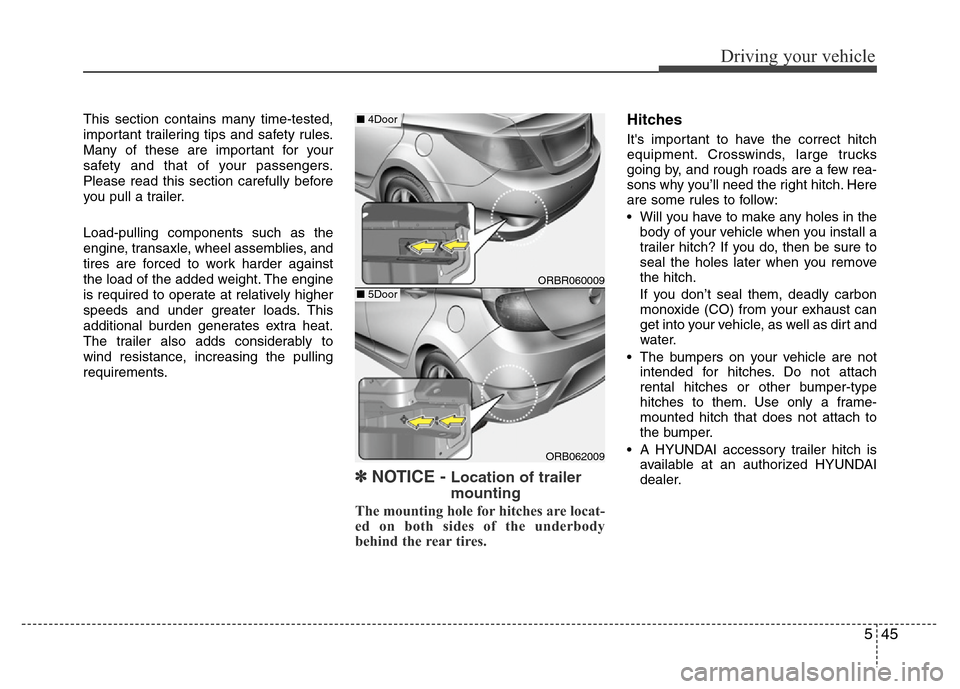
✽NOTICE - Location of trailer
mounting
The mounting hole for hitches are locat-
ed on both sides of the underbody
behind the rear tires.
Hitches
It's important to have the correct hitch
equipment. Crosswinds, large trucks
going by, and rough roads are a few rea-
sons why you’ll need the right hitch. Here
are some rules to follow:
• Will you have to make any holes in the
body of your vehicle when you install a
trailer hitch? If you do, then be sure to
seal the holes later when you remove
the hitch.
If you don’t seal them, deadly carbon
monoxide (CO) from your exhaust can
get into your vehicle, as well as dirt and
water.
• The bumpers on your vehicle are not
intended for hitches. Do not attach
rental hitches or other bumper-type
hitches to them. Use only a frame-
mounted hitch that does not attach to
the bumper.
• A HYUNDAI accessory trailer hitch is
available at an authorized HYUNDAI
dealer.
ORBR060009
ORB062009
■4Door
■5Door
Page 271 of 402
551
Driving your vehicle
If you do decide to pull a trailer
Here are some important points if you
decide to pull a trailer:
• Consider using a sway control. You can
ask a hitch dealer about sway control.
• Do not do any towing with your car dur-
ing its first 2,000 km (1,200 miles) in
order to allow the engine to properly
break in. Failure to heed this caution
may result in serious engine or
transaxle damage.
• When towing a trailer, be sure to con-
sult an authorized HYUNDAI dealer for
further information on additional
requirements such as a towing kit, etc.
• Always drive your vehicle at a moder-
ate speed (less than 100 km/h (60
mph)).
• On a long uphill grade, do not exceed
70 km/h (45 mph) or the posted towing
speed limit, whichever is lower.
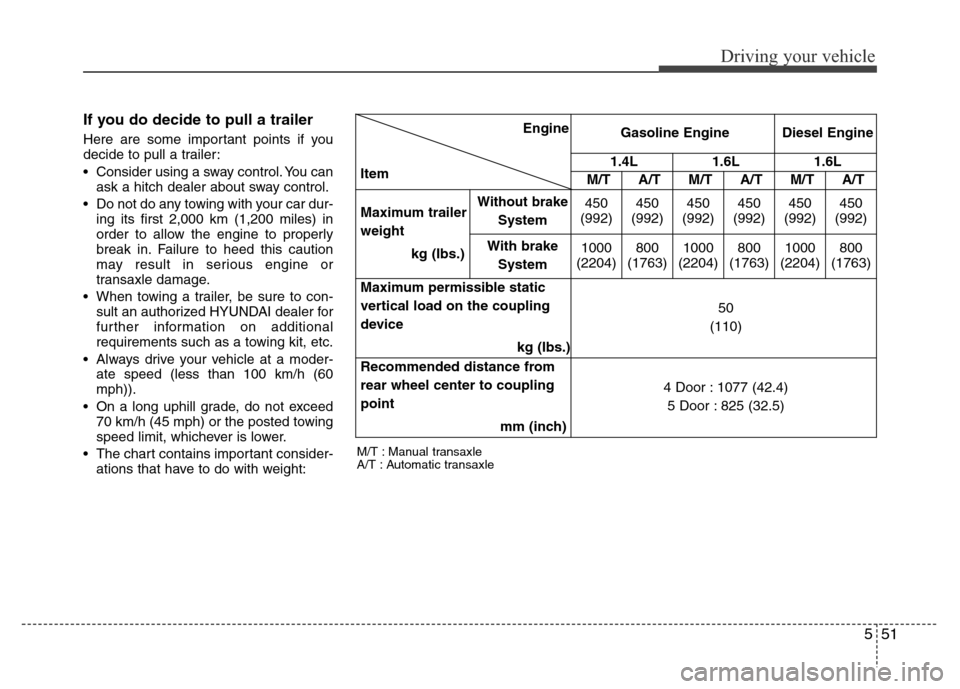
• The chart contains important consider-
ations that have to do with weight:
M/T : Manual transaxle
A/T : Automatic transaxle
Engine
ItemGasoline EngineDiesel Engine
1.4L1.6L1.6L
M/T A/T
M/TA/TM/TA/T
Maximum trailer
weight
kg (Ibs.)
Without brake
System450
(992)450
(992)
450
(992)450
(992)450
(992)450
(992)
With brake
System1000
(2204)800
(1763)
1000
(2204)800
(1763)1000
(2204)800
(1763)
Maximum permissible static
vertical load on the coupling
device
kg (Ibs.)50
(110)
Recommended distance from
rear wheel center to coupling
point
mm (inch)4 Door : 1077 (42.4)
5 Door : 825 (32.5)
Page 273 of 402
553
Driving your vehicle
This section will guide you in the proper
loading of your vehicle, to keep your
loaded vehicle weight within its design
rating capability. Properly loading your
vehicle will provide maximum return of
the vehicle design performance. Before
loading your vehicle, familiarize yourself
with the following terms for determining
your vehicle's weight ratings, from the
vehicle's specifications and the certifica-
tion label:
Base curb weight
This is the weight of the vehicle including
a full tank of fuel and all standard equip-
ment. It does not include passengers,
cargo, or optional equipment.
Vehicle curb weight
This is the weight of your new vehicle
when you picked it up from your dealer
plus any aftermarket equipment.
Cargo weight
This figure includes all weight added to
the Base Curb Weight, including cargo
and optional equipment.
GAW (Gross axle weight)
This is the total weight placed on each
axle (front and rear) - including vehicle
curb weight and all payload.
GAWR (Gross axle weight rating)
This is the maximum allowable weight
that can be carried by a single axle (front
or rear). These numbers are shown on
the certification label.
The total load on each axle must never
exceed its GAWR.
GVW (Gross vehicle weight)
This is the Base Curb Weight plus actual
Cargo Weight plus passengers.
GVWR (Gross vehicle weight rat-
ing)
This is the maximum allowable weight of
the fully loaded vehicle (including all
options, equipment, passengers and
cargo). The GVWR is shown on the cer-
tification label located on the driver’s (or
front passenger’s) door sill.
Overloading
VEHICLE WEIGHT
WARNING - Vehicle weight
The gross axle weight rating
(GAWR) and the gross vehicle
weight rating (GVWR) for your vehi-
cle are on the certification label
attached to the driver's (or front
passenger’s) door. Exceeding
these ratings can cause an acci-
dent or vehicle damage. You can
calculate the weight of your load by
weighing the items (and people)
before putting them in the vehicle.
Be careful not to overload your
vehicle.
Page 298 of 402
77
Maintenance
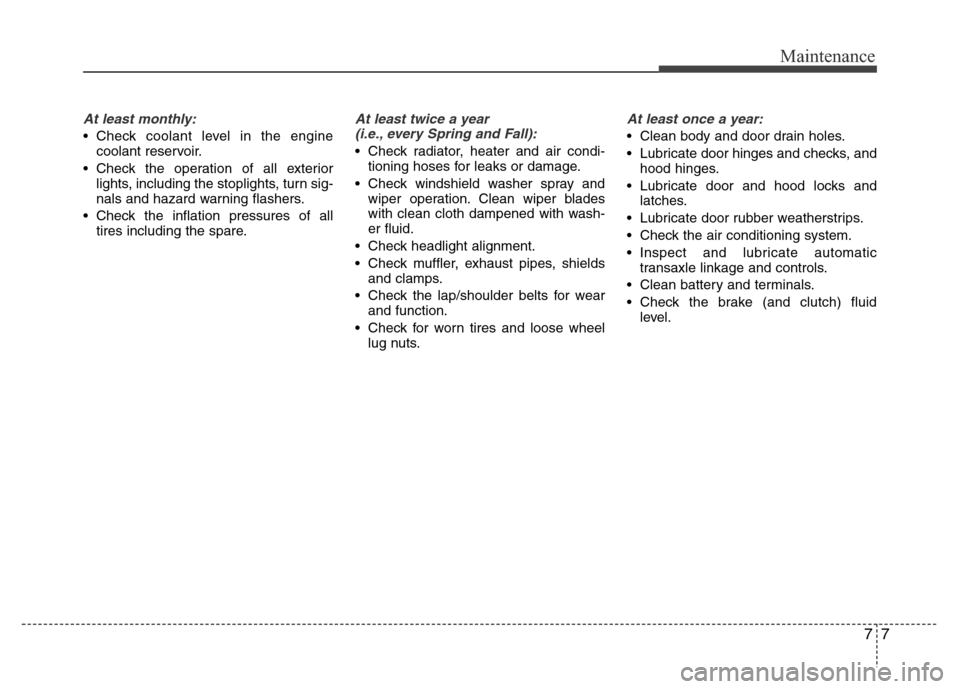
At least monthly:
• Check coolant level in the engine
coolant reservoir.
• Check the operation of all exterior
lights, including the stoplights, turn sig-
nals and hazard warning flashers.
• Check the inflation pressures of all
tires including the spare.
At least twice a year
(i.e., every Spring and Fall):
• Check radiator, heater and air condi-
tioning hoses for leaks or damage.
• Check windshield washer spray and
wiper operation. Clean wiper blades
with clean cloth dampened with wash-
er fluid.
• Check headlight alignment.
• Check muffler, exhaust pipes, shields
and clamps.
• Check the lap/shoulder belts for wear
and function.
• Check for worn tires and loose wheel
lug nuts.
At least once a year:
• Clean body and door drain holes.
• Lubricate door hinges and checks, and
hood hinges.
• Lubricate door and hood locks and
latches.
• Lubricate door rubber weatherstrips.
• Check the air conditioning system.
• Inspect and lubricate automatic
transaxle linkage and controls.
• Clean battery and terminals.
• Check the brake (and clutch) fluid
level.
Page 344 of 402
753
Maintenance
WARNING
Separating the battery from the
vehicle should be done in an
authorized HYUNDAI dealer.
(Continued)
If you feel a pain or a burn-
ing sensation, get medical
attention immediately.
Wear eye protection when
charging or working near a
battery. Always provide
ventilation when working in
an enclosed space.
An inappropriately dis-
posed battery can be harm-
ful to the environment and
human health. Dispose the
battery according to your
local law(s) or regulation.
• When lifting a plastic-cased bat-
tery, excessive pressure on the
case may cause battery acid to
leak, resulting in personal injury.
Lift with a battery carrier or with
your hands on opposite corners.
• Never attempt to recharge the
battery when the battery cables
are connected.
(Continued)(Continued)
• The electrical ignition system
works with high voltage. Never
touch these components with the
engine running or the ignition
switched on.
Failure to follow the above warn-
ings can result in serious bodily
injury or death.CAUTION
• When you don’t use the vehicle
for a long time in the low temper-
ature area, separate the battery
and keep it indoors.
• Always charge the battery fully to
prevent the battery case dam-
aged in low temperature area.
• If you connect unauthorized elec-
tronic devices to the battery, the
battery may be discharged. Never
use unauthorized devices.
• Make sure the battery cap is
closed. If the battery cap is not
closed securely, it can malfunc-
tion because the electric compo-
nents are exposed to moisture.
Pb
Page 356 of 402
765
Maintenance
Temperature -A, B & C
The temperature grades are A (the
highest), B, and C, representing the
tire’s resistance to the generation of
heat and its ability to dissipate heat
when tested under controlled condi-
tions on a specified indoor laboratory
test wheel. Sustained high tempera-
ture can cause the material of the tire
to degenerate and reduce tire life,
and excessive temperature can lead
to sudden tire failure. Grades B and
A represent higher levels of perform-
ance on the laboratory test wheel
than the minimum required by law.Low aspect ratio tire (if equipped)
Low aspect ratio tires, whose aspect
ratio is lower than 50, are provided
for sporty looks.
Because the low aspect ratio tires
are optimized for handling and brak-
ing, it may be more uncomfortable to
ride in and there is more noise com-
pare with normal tires.
WARNING - Tire
temperature
The temperature grade for this
tire is established for a tire that
is properly inflated and not
overloaded. Excessive speed,
underinflation, or excessive
loading, either separately or in
combination, can cause heat
build-up and possible sudden
tire failure. This can cause loss
of vehicle control and serious
injury or death.
CAUTION
Because the sidewall of the low
aspect ratio tire is shorter than
the normal, the wheel and tire of
the low aspect ratio tire is easi-
er to be damaged. So, follow the
instructions below.
- When driving on a rough road
or off road, drive cautiously
because tires and wheels may
be damaged. And after driving,
inspect tires and wheels.
- When passing over a pothole,
speed bump, manhole, or curb
stone, drive slowly so that the
tires and wheels are not dam-
aged.
(Continued)CAUTION
• It is not easy to recognize the
tire damage with your own
eyes. But if there is the slight-
est hint of tire damage, even
though you cannot see the tire
damage with your own eyes,
have the tire checked or
replaced because the tire
damage may cause air leak-
age from the tire.
• If the tire is damaged by driv-
ing on a rough road, off road,
pothole, manhole, or curb
stone, it will not be covered by
the warranty.
• You can find out the tire infor-
mation on the tire sidewall.
(Continued)
- If the tire is impacted, we rec-
ommend that you inspect the
tire condition or contact an
authorized HYUNDAI dealer.
- To prevent damage to the tire,
inspect the tire condition and
pressure every 3,000km.
Page 365 of 402
Maintenance
74 7
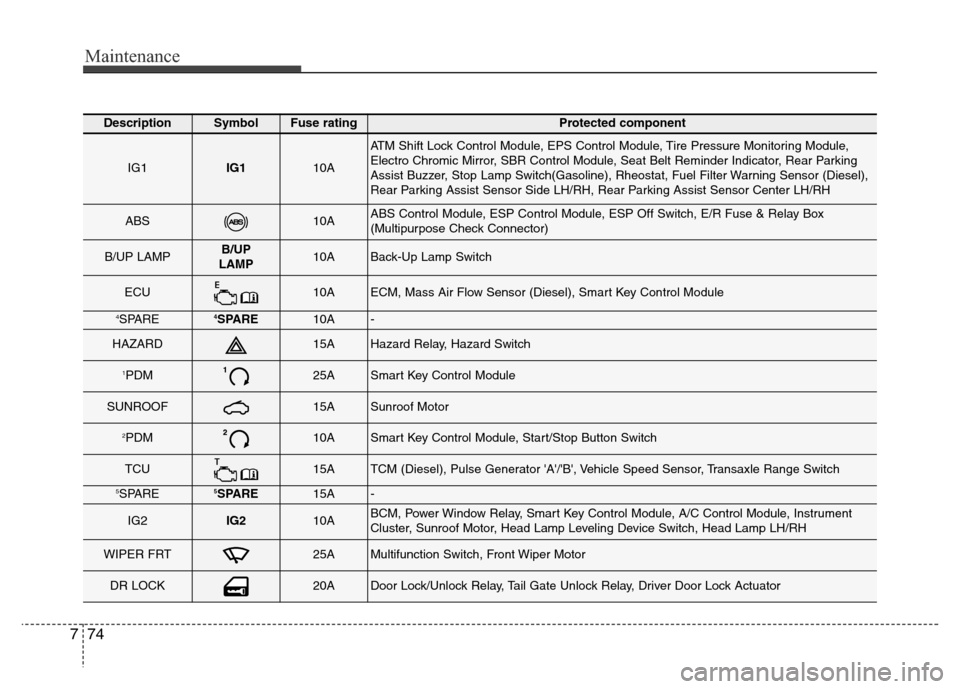
DescriptionSymbolFuse ratingProtected component
IG1IG110A
ATM Shift Lock Control Module, EPS Control Module, Tire Pressure Monitoring Module,
Electro Chromic Mirror, SBR Control Module, Seat Belt Reminder Indicator, Rear Parking
Assist Buzzer, Stop Lamp Switch(Gasoline), Rheostat, Fuel Filter Warning Sensor (Diesel),
Rear Parking Assist Sensor Side LH/RH, Rear Parking Assist Sensor Center LH/RH
ABS10AABS Control Module, ESP Control Module, ESP Off Switch, E/R Fuse & Relay Box
(Multipurpose Check Connector)
B/UP LAMPB/UP
LAMP10ABack-Up Lamp Switch
ECU10AECM, Mass Air Flow Sensor (Diesel), Smart Key Control Module
4SPARE4SPARE10A-
HAZARD15AHazard Relay, Hazard Switch
1PDM25ASmart Key Control Module
SUNROOF15ASunroof Motor
2PDM10ASmart Key Control Module, Start/Stop Button Switch
TCU15ATCM (Diesel), Pulse Generator 'A'/'B', Vehicle Speed Sensor, Transaxle Range Switch
5SPARE5SPARE15A-
IG2IG210ABCM, Power Window Relay, Smart Key Control Module, A/C Control Module, Instrument
Cluster, Sunroof Motor, Head Lamp Leveling Device Switch, Head Lamp LH/RH
WIPER FRT25AMultifunction Switch, Front Wiper Motor
DR LOCK20ADoor Lock/Unlock Relay, Tail Gate Unlock Relay, Driver Door Lock Actuator
Page 366 of 402
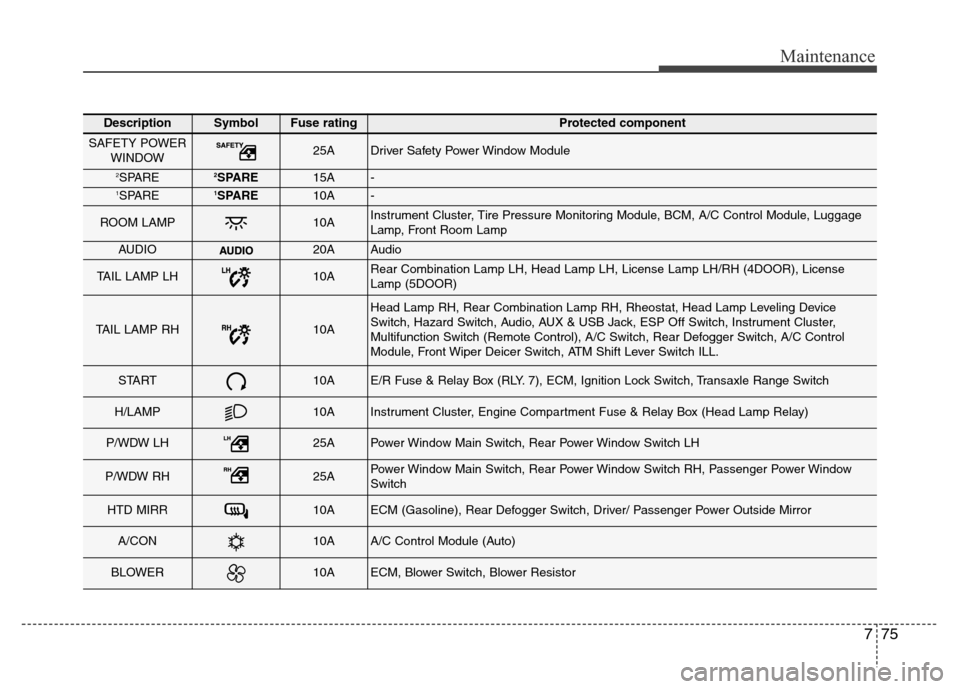
775
Maintenance
DescriptionSymbolFuse ratingProtected component
SAFETY POWER
WINDOW25ADriver Safety Power Window Module
2SPARE2SPARE15A-1SPARE1SPARE10A-
ROOM LAMP10AInstrument Cluster, Tire Pressure Monitoring Module, BCM, A/C Control Module, Luggage
Lamp, Front Room Lamp
AUDIO20AAudio
TAIL LAMP LH10ARear Combination Lamp LH, Head Lamp LH, License Lamp LH/RH (4DOOR), License
Lamp (5DOOR)
TAIL LAMP RH10A
Head Lamp RH, Rear Combination Lamp RH, Rheostat, Head Lamp Leveling Device
Switch, Hazard Switch, Audio, AUX & USB Jack, ESP Off Switch, Instrument Cluster,
Multifunction Switch (Remote Control), A/C Switch, Rear Defogger Switch, A/C Control
Module, Front Wiper Deicer Switch, ATM Shift Lever Switch ILL.
START10AE/R Fuse & Relay Box (RLY. 7), ECM, Ignition Lock Switch, Transaxle Range Switch
H/LAMP10AInstrument Cluster, Engine Compartment Fuse & Relay Box (Head Lamp Relay)
P/WDW LH25APower Window Main Switch, Rear Power Window Switch LH
P/WDW RH25APower Window Main Switch, Rear Power Window Switch RH, Passenger Power Window
Switch
HTD MIRR10AECM (Gasoline), Rear Defogger Switch, Driver/ Passenger Power Outside Mirror
A/CON10AA/C Control Module (Auto)
BLOWER10AECM, Blower Switch, Blower Resistor
Page 367 of 402
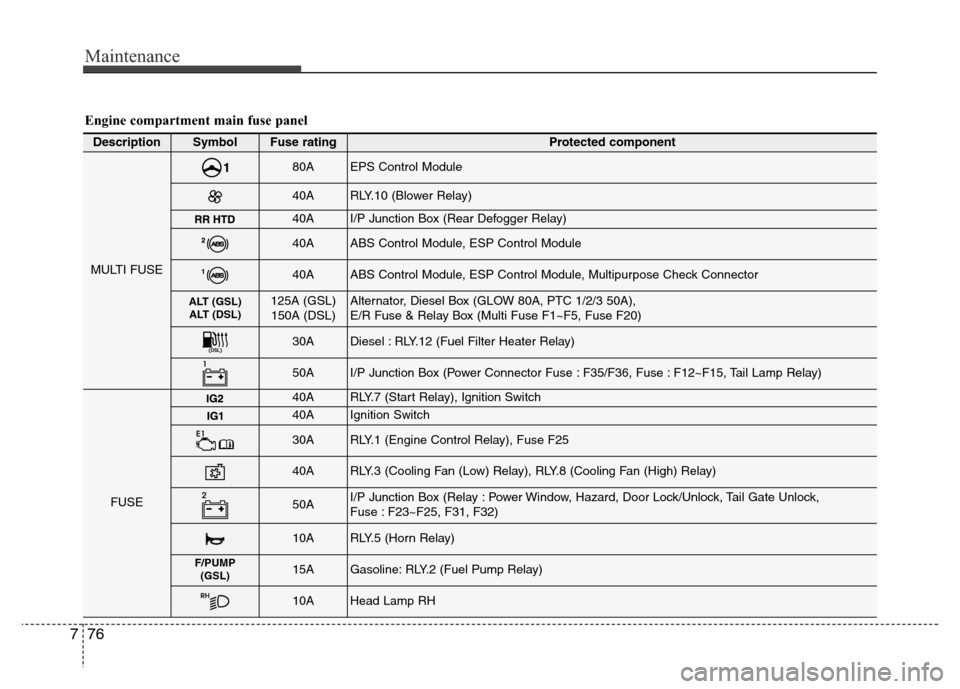
Maintenance
76 7
DescriptionSymbolFuse ratingProtected component
MULTI FUSE
80AEPS Control Module
40ARLY.10 (Blower Relay)
40AI/P Junction Box (Rear Defogger Relay)
40AABS Control Module, ESP Control Module
40AABS Control Module, ESP Control Module, Multipurpose Check Connector
ALT (GSL)
ALT (DSL)125A (GSL)
150A (DSL)Alternator, Diesel Box (GLOW 80A, PTC 1/2/3 50A),
E/R Fuse & Relay Box (Multi Fuse F1~F5, Fuse F20)
30ADiesel : RLY.12 (Fuel Filter Heater Relay)
50AI/P Junction Box (Power Connector Fuse : F35/F36, Fuse : F12~F15, Tail Lamp Relay)
FUSE
40ARLY.7 (Start Relay), Ignition Switch
40AIgnition Switch
30ARLY.1 (Engine Control Relay), Fuse F25
40ARLY.3 (Cooling Fan (Low) Relay), RLY.8 (Cooling Fan (High) Relay)
50AI/P Junction Box (Relay : Power Window, Hazard, Door Lock/Unlock, Tail Gate Unlock,
Fuse : F23~F25, F31, F32)
10ARLY.5 (Horn Relay)
F/PUMP
(GSL)15AGasoline: RLY.2 (Fuel Pump Relay)
10AHead Lamp RH
Engine compartment main fuse panel