Automatic Hyundai Accent 2016 Owners Manual
[x] Cancel search | Manufacturer: HYUNDAI, Model Year: 2016, Model line: Accent, Model: Hyundai Accent 2016Pages: 456, PDF Size: 16.41 MB
Page 363 of 456
75
Maintenance
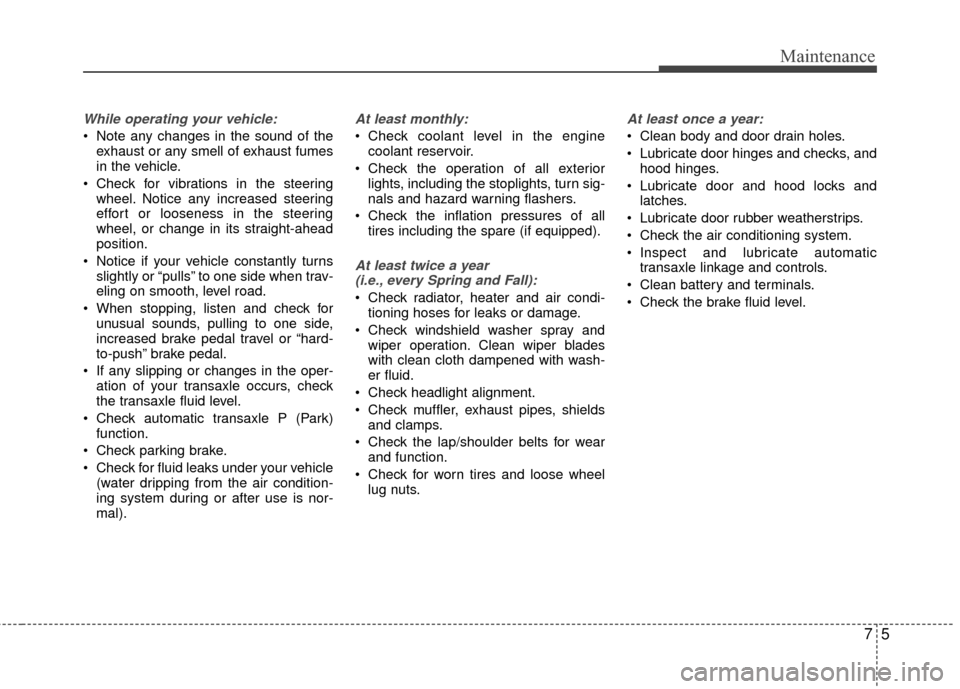
While operating your vehicle:
Note any changes in the sound of theexhaust or any smell of exhaust fumes
in the vehicle.
Check for vibrations in the steering wheel. Notice any increased steering
effort or looseness in the steering
wheel, or change in its straight-ahead
position.
Notice if your vehicle constantly turns slightly or “pulls” to one side when trav-
eling on smooth, level road.
When stopping, listen and check for unusual sounds, pulling to one side,
increased brake pedal travel or “hard-
to-push” brake pedal.
If any slipping or changes in the oper- ation of your transaxle occurs, check
the transaxle fluid level.
Check automatic transaxle P (Park) function.
Check parking brake.
Check for fluid leaks under your vehicle (water dripping from the air condition-
ing system during or after use is nor-
mal).
At least monthly:
Check coolant level in the enginecoolant reservoir.
Check the operation of all exterior lights, including the stoplights, turn sig-
nals and hazard warning flashers.
Check the inflation pressures of all tires including the spare (if equipped).
At least twice a year (i.e., every Spring and Fall):
Check radiator, heater and air condi- tioning hoses for leaks or damage.
Check windshield washer spray and wiper operation. Clean wiper blades
with clean cloth dampened with wash-
er fluid.
Check headlight alignment.
Check muffler, exhaust pipes, shields and clamps.
Check the lap/shoulder belts for wear and function.
Check for worn tires and loose wheel lug nuts.
At least once a year:
Clean body and door drain holes.
Lubricate door hinges and checks, andhood hinges.
Lubricate door and hood locks and latches.
Lubricate door rubber weatherstrips.
Check the air conditioning system.
Inspect and lubricate automatic transaxle linkage and controls.
Clean battery and terminals.
Check the brake fluid level.
Page 375 of 456
717
Maintenance
NORMAL MAINTENANCE SCHEDULE (CONT.)
No check, No service required
❑Automatic transaxle fluid (if equipped)
Page 376 of 456
Maintenance
18
7
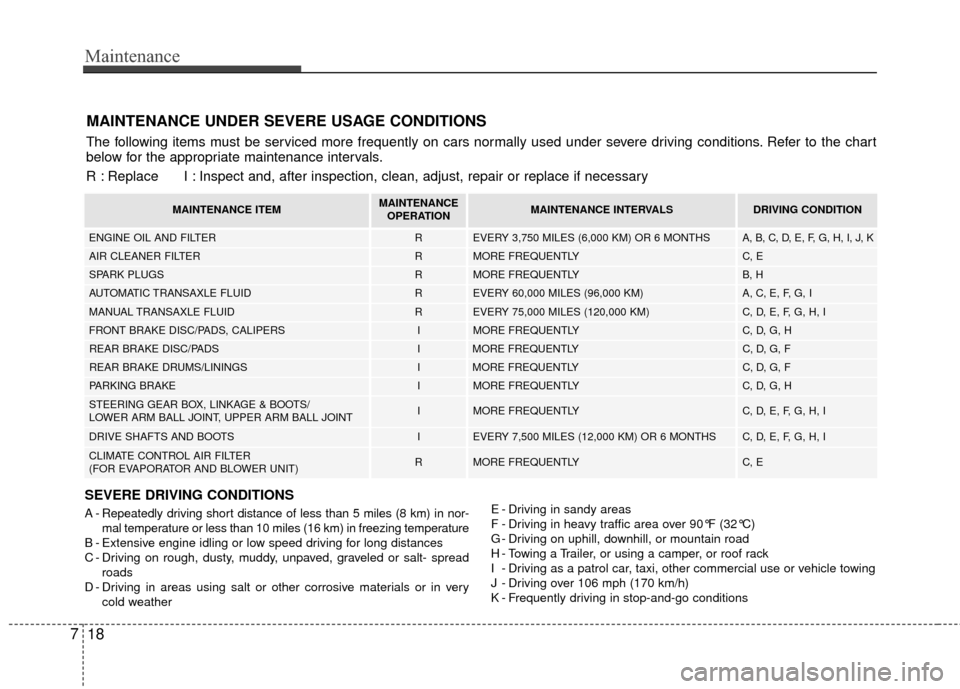
MAINTENANCE UNDER SEVERE USAGE CONDITIONS
SEVERE DRIVING CONDITIONS
A - Repeatedly driving short distance of less than 5 miles (8 km) in nor-
mal temperature or less than 10 miles (16 km) in freezing temperature
B - Extensive engine idling or low speed driving for long distances
C - Driving on rough, dusty, muddy, unpaved, graveled or salt- spread roads
D - Driving in areas using salt or other corrosive materials or in very cold weather E - Driving in sandy areas
F - Driving in heavy traffic area over 90°F (32°C)
G - Driving on uphill, downhill, or mountain road
H - Towing a Trailer, or using a camper, or roof rack
I - Driving as a patrol car, taxi, other commercial use or vehicle towing
J - Driving over 106 mph (170 km/h)
K - Frequently driving in stop-and-go conditions
The following items must be serviced more frequently on cars normally used under severe driving conditions. Refer to the chart
below for the appropriate maintenance intervals.
R : Replace I : Inspect and, after inspection, clean, adjust, repair or replace if neces\
sary
MAINTENANCE ITEMMAINTENANCE
OPERATIONMAINTENANCE INTERVALSDRIVING CONDITION
ENGINE OIL AND FILTERREVERY 3,750 MILES (6,000 KM) OR 6 MONTHSA, B, C, D, E, F, G, H, I, J, K
AIR CLEANER FILTERRMORE FREQUENTLYC, E
SPARK PLUGSRMORE FREQUENTLYB, H
AUTOMATIC TRANSAXLE FLUIDREVERY 60,000 MILES (96,000 KM) A, C, E, F, G, I
MANUAL TRANSAXLE FLUIDREVERY 75,000 MILES (120,000 KM) C, D, E, F, G, H, I
FRONT BRAKE DISC/PADS, CALIPERSIMORE FREQUENTLYC, D, G, H
REAR BRAKE DISC/PADSIMORE FREQUENTLYC, D, G, F
REAR BRAKE DRUMS/LININGSIMORE FREQUENTLYC, D, G, F
PARKING BRAKEIMORE FREQUENTLYC, D, G, H
STEERING GEAR BOX, LINKAGE & BOOTS/
LOWER ARM BALL JOINT, UPPER ARM BALL JOINTIMORE FREQUENTLYC, D, E, F, G, H, I
DRIVE SHAFTS AND BOOTSIEVERY 7,500 MILES (12,000 KM) OR 6 MONTHSC, D, E, F, G, H, I
CLIMATE CONTROL AIR FILTER
(FOR EVAPORATOR AND BLOWER UNIT)RMORE FREQUENTLYC, E
Page 378 of 456
Maintenance
20
7
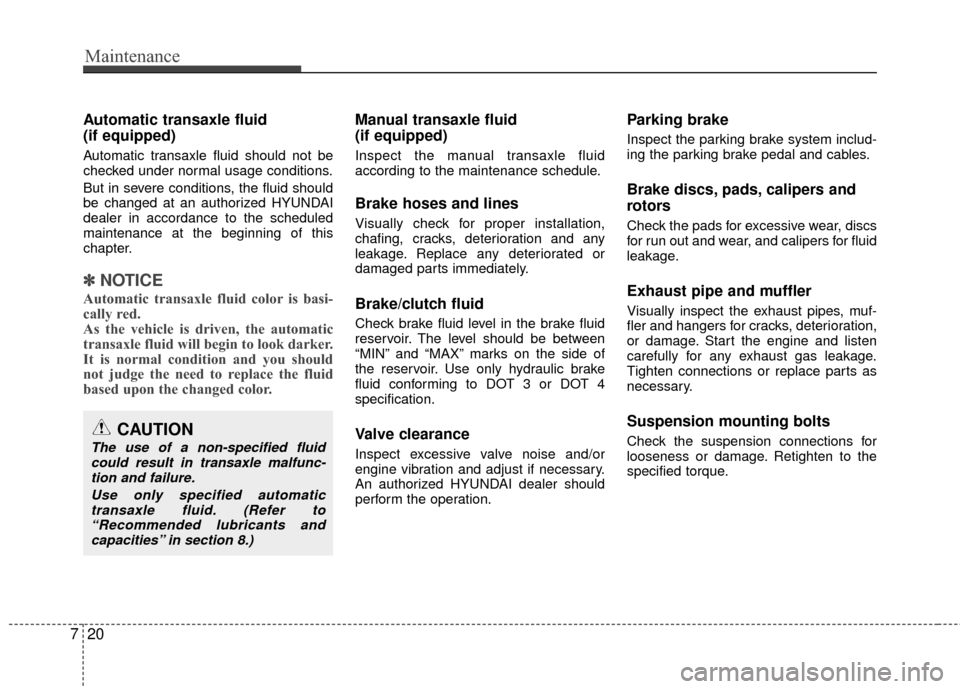
Automatic transaxle fluid
(if equipped)
Automatic transaxle fluid should not be
checked under normal usage conditions.
But in severe conditions, the fluid should
be changed at an authorized HYUNDAI
dealer in accordance to the scheduled
maintenance at the beginning of this
chapter.
✽ ✽
NOTICE
Automatic transaxle fluid color is basi-
cally red.
As the vehicle is driven, the automatic
transaxle fluid will begin to look darker.
It is normal condition and you should
not judge the need to replace the fluid
based upon the changed color.
Manual transaxle fluid
(if equipped)
Inspect the manual transaxle fluid
according to the maintenance schedule.
Brake hoses and lines
Visually check for proper installation,
chafing, cracks, deterioration and any
leakage. Replace any deteriorated or
damaged parts immediately.
Brake/clutch fluid
Check brake fluid level in the brake fluid
reservoir. The level should be between
“MIN” and “MAX” marks on the side of
the reservoir. Use only hydraulic brake
fluid conforming to DOT 3 or DOT 4
specification.
Valve clearance
Inspect excessive valve noise and/or
engine vibration and adjust if necessary.
An authorized HYUNDAI dealer should
perform the operation.
Parking brake
Inspect the parking brake system includ-
ing the parking brake pedal and cables.
Brake discs, pads, calipers and
rotors
Check the pads for excessive wear, discs
for run out and wear, and calipers for fluid
leakage.
Exhaust pipe and muffler
Visually inspect the exhaust pipes, muf-
fler and hangers for cracks, deterioration,
or damage. Start the engine and listen
carefully for any exhaust gas leakage.
Tighten connections or replace parts as
necessary.
Suspension mounting bolts
Check the suspension connections for
looseness or damage. Retighten to the
specified torque.CAUTION
The use of a non-specified fluid
could result in transaxle malfunc-tion and failure.
Use only specified automatictransaxle fluid. (Refer to“Recommended lubricants andcapacities” in section 8.)
Page 382 of 456
Maintenance
24
7
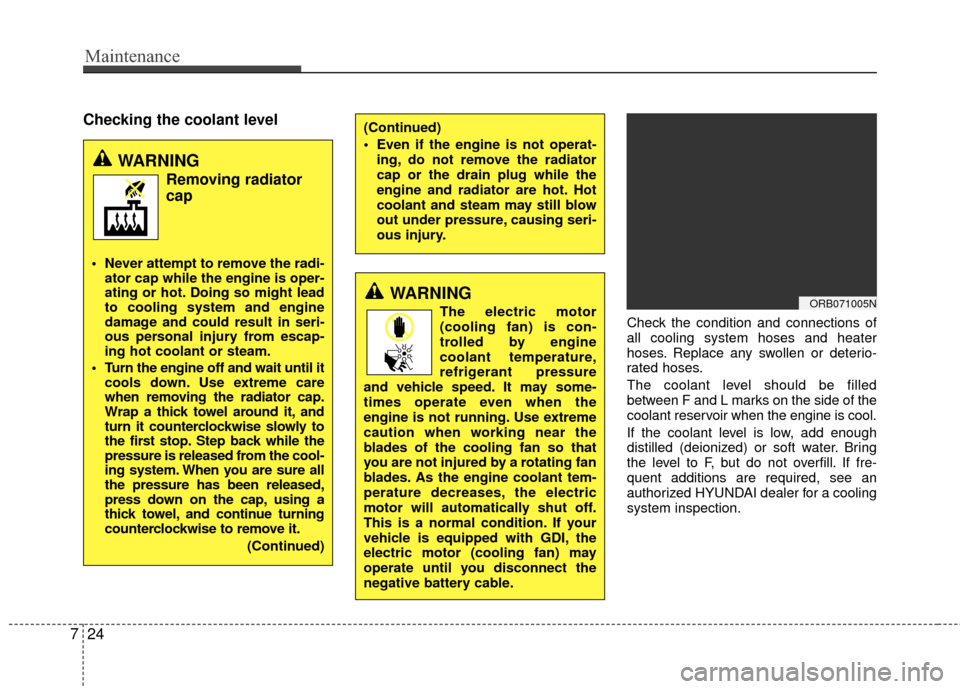
Checking the coolant level
Check the condition and connections of
all cooling system hoses and heater
hoses. Replace any swollen or deterio-
rated hoses.
The coolant level should be filled
between F and L marks on the side of the
coolant reservoir when the engine is cool.
If the coolant level is low, add enough
distilled (deionized) or soft water. Bring
the level to F, but do not overfill. If fre-
quent additions are required, see an
authorized HYUNDAI dealer for a cooling
system inspection.
ORB071005N
(Continued)
Even if the engine is not operat-
ing, do not remove the radiator
cap or the drain plug while the
engine and radiator are hot. Hot
coolant and steam may still blow
out under pressure, causing seri-
ous injury.
WARNING
Removing radiator
cap
Never attempt to remove the radi-ator cap while the engine is oper-
ating or hot. Doing so might lead
to cooling system and engine
damage and could result in seri-
ous personal injury from escap-
ing hot coolant or steam.
Turn the engine off and wait until it cools down. Use extreme care
when removing the radiator cap.
Wrap a thick towel around it, and
turn it counterclockwise slowly to
the first stop. Step back while the
pressure is released from the cool-
ing system. When you are sure all
the pressure has been released,
press down on the cap, using a
thick towel, and continue turning
counterclockwise to remove it.
(Continued)
WARNING
The electric motor
(cooling fan) is con-
trolled by engine
coolant temperature,
refrigerant pressure
and vehicle speed. It may some-
times operate even when the
engine is not running. Use extreme
caution when working near the
blades of the cooling fan so that
you are not injured by a rotating fan
blades. As the engine coolant tem-
perature decreases, the electric
motor will automatically shut off.
This is a normal condition. If your
vehicle is equipped with GDI, the
electric motor (cooling fan) may
operate until you disconnect the
negative battery cable.
Page 405 of 456
747
Maintenance
Tire terminology and definitions
Air Pressure: The amount of air
inside the tire pressing outward on
the tire. Air pressure is expressed in
pounds per square inch (psi) or kilo-
pascal (kPa).
Accessory Weight: This means the
combined weight of optional acces-
sories. Some examples of optional
accessories are, automatic
transaxle, power seats, and air con-
ditioning.
Aspect Ratio : The relationship of a
tire's height to its width.
Belt: A rubber coated layer of cords
that is located between the plies and
the tread. Cords may be made from
steel or other reinforcing materials.
Bead: The tire bead contains steel
wires wrapped by steel cords that
hold the tire onto the rim.
Bias Ply Tire : A pneumatic tire in
which the plies are laid at alternate
angles less than 90 degrees to the
centerline of the tread. Cold Tire Pressure: The amount of
air pressure in a tire, measured in
pounds per square inch (psi) or kilo-
pascals (kPa) before a tire has built
up heat from driving.
Curb Weight: This means the weight
of a motor vehicle with standard and
optional equipment including the
maximum capacity of fuel, oil and
coolant, but without passengers and
cargo.
DOT Markings: A code molded into
the sidewall of a tire signifying that
the tire is in compliance with the U.S.
Department of Transportation motor
vehicle safety standards. The DOT
code includes the Tire Identification
Number (TIN), an alphanumeric des-
ignator which can also identify the
tire manufacturer, production plant,
brand and date of production.
GVWR: Gross Vehicle Weight Rating
GAWR FRT: Gross Axle Weight
Rating for the Front Axle.
GAWR RR: Gross Axle Weight
Rating for the Rear axle.(Continued)
If the tire is impacted, inspect the tire condition or contact anauthorized HYUNDAI dealer.
To prevent damage to the tire, inspect the tire condition andpressure every 1,800miles(3,000km).
CAUTION
It is not easy to recognize the tire damage with your owneyes. But if there is the slight-est hint of tire damage, eventhough you cannot see the tiredamage with your own eyes,have the tire checked orreplaced because the tiredamage may cause air leak-age from the tire.
If the tire is damaged by driv- ing on a rough road, off road,pothole, manhole, or curbstone, it will not be covered bythe warranty.
You can find out the tire infor- mation on the tire sidewall.
Page 442 of 456
Specifications, Consumer information, Reporting safety defeccts
48
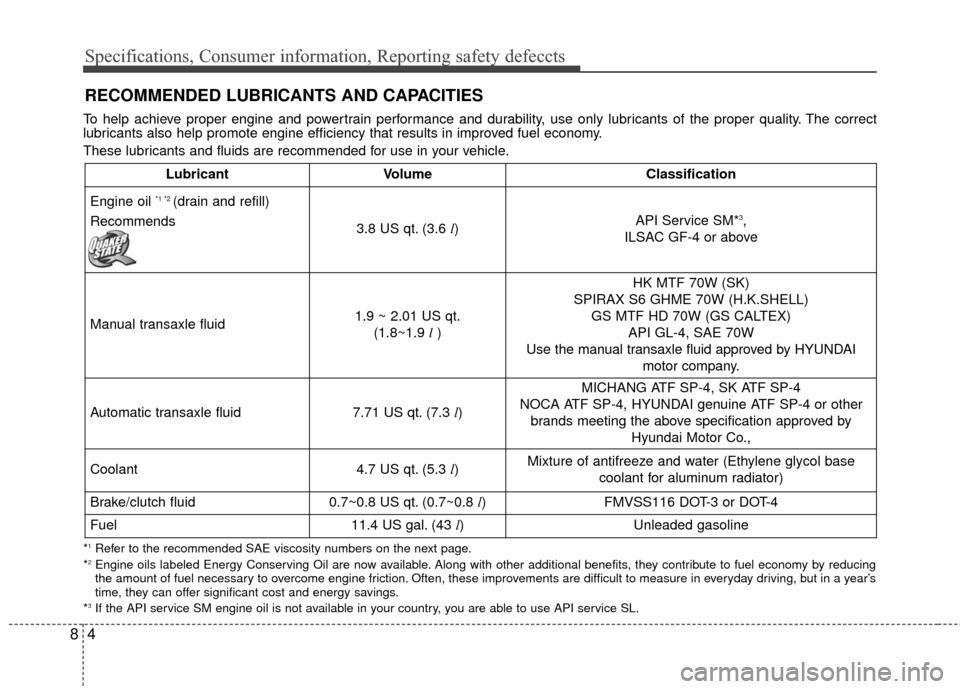
RECOMMENDED LUBRICANTS AND CAPACITIES
To help achieve proper engine and powertrain performance and durability, use only lubricants of the proper quality. The correct
lubricants also help promote engine efficiency that results in improved fuel economy.
These lubricants and fluids are recommended for use in your vehicle.
*1Refer to the recommended SAE viscosity numbers on the next page.
*2Engine oils labeled Energy Conserving Oil are now available. Along with other additional benefits, they contribute to fuel econo my by reducing
the amount of fuel necessary to overcome engine friction. Often, these improvements are difficult to measure in everyday driving, but in a year’s
time, they can offer significant cost and energy savings.
*
3If the API service SM engine oil is not available in your country, you are able to use API service SL.
LubricantVolumeClassification
Engine oil *1 *2 (drain and refill)
Recommends
3.8 US qt. (3.6 l)API Service SM*3,
ILSAC GF-4 or above
Manual transaxle fluid1.9 ~ 2.01 US qt. (1.8~1.9 l)
HK MTF 70W (SK)
SPIRAX S6 GHME 70W (H.K.SHELL) GS MTF HD 70W (GS CALTEX) API GL-4, SAE 70W
Use the manual transaxle fluid approved by HYUNDAI motor company.
Automatic transaxle fluid7.71 US qt. (7.3 l)
MICHANG ATF SP-4, SK ATF SP-4
NOCA ATF SP-4, HYUNDAI genuine ATF SP-4 or other brands meeting the above specification approved by Hyundai Motor Co.,
Coolant 4.7 US qt. (5.3 l)Mixture of antifreeze and water (Ethylene glycol base
coolant for aluminum radiator)
Brake/clutch fluid0.7~0.8 US qt. (0.7~0.8 l)FMVSS116 DOT-3 or DOT-4
Fuel11.4 US gal. (43 l)Unleaded gasoline
Page 449 of 456

Index
2I
Active ECO system··················\
··················\
···· ·5-32
Air bag warning label ··················\
··················\
·· ·3-60
Air bag warning light ··················\
··················\
·· ·3-37
Air bags ··················\
··················\
··················\
·3-34
Air bag warning label ··················\
················· ·3-60
Air bag warning light ··················\
················· ·3-37
Curtain air bag ··················\
··················\
······· ·3-51
Driver's and passenger's front air bag ·················3-46
Occupant detection system ··················\
············3-40
Side impact air bag ··················\
··················\
·· ·3-50
SRS components and functions ··················\
······3-37
Air cleaner ··················\
··················\
··············· ·7-28
Antenna (Roof) ··················\
··················\
········· ·4-97
Anti-lock brake system (ABS) ··················\
···········5-19
Appearance care ··················\
··················\
·········7-70
Exterior care ··················\
··················\
········· ·7-70
Interior care ··················\
··················\
·········· ·7-74
Armrest(front) ··················\
··················\
·············3-6
Audio system ··················\
··················\
············ ·4-97
Roof antenna ··················\
··················\
········· ·4-97
Steering wheel audio control ··················\
·········4-98
Automatic climate control system ··················\
·······4-76
Air conditioning ··················\
··················\
····· ·4-82
Automatic heating and air conditioning ···············4-77
Manual heating and air conditioning ··················4-78
Automatic transaxle Manual shift mode ·················5-12
Automatic transaxle ··················\
··················\
···· ·5-10Aux, USB and iPod
®port
··················\
··············· ·4-94
Base curb weight··················\
··················\
·········5-48
Battery ··················\
··················\
··················\
·· ·7-34
Battery saver function ··················\
··················\
·· ·4-53
Before driving ··················\
··················\
············ ·5-3
Bottle holders, see cup holders ··················\
··········4-90
Brake system ··················\
··················\
············ ·5-16
Anti-lock brake system (ABS) ··················\
·······5-19
Electronic stability control (ESC) ··················\
····5-21
Hill-start assist control ··················\
················ ·5-27
Parking brake ··················\
··················\
·········5-17
Power brakes ··················\
··················\
········· ·5-16
Vehicle stability management ··················\
········5-26
Brakes/clutch fluid ··················\
··················\
····· ·7-26
Bulb replacement ··················\
··················\
······· ·7-61
Bulb wattage ··················\
··················\
·············· ·8-2
California perchlorate notice ··················\
·············7-79
Capacities (Lubricants) ··················\
··················\
·· ·8-4
Care Exterior care ··················\
··················\
········· ·7-71
Interior care ··················\
··················\
·········· ·7-75
Tire care ··················\
··················\
·············· ·7-37A
B
C
Page 456 of 456

I9
Index
Tires and wheels··················\
··················\
···········8-3
Towing ··················\
··················\
··················\
· ·6-32
Towing capacity ··················\
··················\
········· ·5-44
Transaxle Automatic transaxle ··················\
··················\
· ·5-10
Manual transaxle ··················\
··················\
·······5-7
Trip computer ··················\
··················\
··········· ·4-39
Trunk ··················\
··················\
··················\
··· ·4-12
Vehicle break-in process ··················\
··················\
·1-5
Vehicle capacity weight ··················\
··················\
·5-43
Vehicle certification label ··················\
··················\
8-6
Vehicle curb weight ··················\
··················\
···· ·5-48
Vehicle data collection and event data recorders ·········1-6
Vehicle identification number (VIN) ··················\
·····8-6
Vehicle load limit ··················\
··················\
······· ·5-43
Cargo capacity ··················\
··················\
······· ·5-44
Certification label ··················\
··················\
··· ·5-46
Seating capacity ··················\
··················\
····· ·5-44
Steps For Determining Correct Load Limit ··········5-44
Tire and loading information label ··················\
···5-43
Towing capacity ··················\
··················\
····· ·5-44
Vehicle capacity weight ··················\
···············5-43
Vehicle stability management ··················\
············5-26
Vehicle weight ··················\
··················\
·········· ·5-48
Base curb weight ··················\
··················\
···· ·5-48Cargo weight
··················\
··················\
········· ·5-48
GAW (Gross axle weight) ··················\
·············5-48
GAWR (Gross axle weight rating) ··················\
···5-48
GVW (Gross vehicle weight) ··················\
·········5-48
GVWR (Gross vehicle weight rating) ·················5-48
Vehicle curb weight ··················\
··················\
· ·5-48
Volume/weight ··················\
··················\
············ ·8-3
Warning and indicators ··················\
··················\
·4-44
Washer fluid ··················\
··················\
··············7-26
Weight/volume ··················\
··················\
············ ·8-3
Wheel alignment and tire balance ··················\
·······7-39
Wheel replacement ··················\
··················\
····· ·7-42
W
indows ··················\
··················\
················· ·4-16
Auto down window ··················\
··················\
· ·4-18
Auto up/down window ··················\
··············· ·4-18
Power window lock button ··················\
···········4-19
Windshield defrosting and defogging ··················\
···4-83
Automatic ventilation ··················\
················ ·4-86
Defogging logic ··················\
··················\
····· ·4-85
Winter driving ··················\
··················\
··········· ·5-39
Snow tires ··················\
··················\
············ ·5-39
Tire chains ··················\
··················\
············ ·5-40
Wiper blades ··················\
··················\
··············7-31
Wipers and washers ··················\
··················\
···· ·4-59
V
W