cooling Hyundai Accent 2016 User Guide
[x] Cancel search | Manufacturer: HYUNDAI, Model Year: 2016, Model line: Accent, Model: Hyundai Accent 2016Pages: 456, PDF Size: 16.41 MB
Page 377 of 456
719
Maintenance
EXPLANATION OF SCHEDULED MAINTENANCE ITEMS
Engine oil and filter
The engine oil and filter should be
changed at the intervals specified in the
maintenance schedule. If the car is being
driven in severe conditions, more fre-
quent oil and filter changes are required.
Drive belts
Inspect all drive belts for evidence of cuts,
cracks, excessive wear or oil saturation
and replace if necessary. Drive belts
should be checked periodically for proper
tension and adjusted as necessary.
Fuel filter
A clogged filter can limit the speed at
which the vehicle may be driven, damage
the emission system and cause multiple
issues such as hard starting. If an exces-
sive amount of foreign matter accumu-
lates in the fuel tank, the filter may
require replacement more frequently.
After installing a new filter, run the engine for
several minutes, and check for leaks at the
connections. Fuel filters should be installed
by an authorized HYUNDAI dealer.
Fuel lines, fuel hoses and con-
nections
Check the fuel lines, fuel hoses and con-
nections for leakage and damage. Have an
authorized HYUNDAI dealer replace any
damaged or leaking parts immediately.
Vapor hose and fuel filler cap
The vapor hose and fuel filler cap should
be inspected at those intervals specified
in the maintenance schedule. Make sure
that a new vapor hose or fuel filler cap is
correctly replaced.
Vacuum crankcase ventilation
hoses
Inspect the surface of hoses for evidence
of heat and/or mechanical damage. Hard
and brittle rubber, cracking, tears, cuts,
abrasions, and excessive swelling indi-
cate deterioration. Particular attention
should be paid to examine those hose
surfaces nearest to high heat sources,
such as the exhaust manifold.
Inspect the hose routing to assure that
the hoses do not come in contact with
any heat source, sharp edges or moving
component which might cause heat dam-
age or mechanical wear.Inspect all hose connections, such as
clamps and couplings, to make sure they
are secure, and that no leaks are pres-
ent. Hoses should be replaced immedi-
ately if there is any evidence of deterio-
ration or damage.
Air cleaner filter
A Genuine HYUNDAI air cleaner filter is
recommended when the filter is replaced.
Spark plugs
Make sure to install new spark plugs of
the correct heat range.
Cooling system
Check cooling system components, such
as radiator, coolant reservoir, hoses and
connections for leakage and damage.
Replace any damaged parts.
Coolant
The coolant should be changed at the
intervals specified in the maintenance
schedule.
Page 381 of 456
723
Maintenance
Changing the engine oil and filter
Have engine oil and filter changed by an
authorized HYUNDAI dealer according to
the Maintenance Schedule at the begin-
ning of this section.The high-pressure cooling system has a
reservoir filled with year-round antifreeze
coolant. The reservoir is filled at the factory.
Check the antifreeze protection and
coolant level at least once a year, at the
beginning of the winter season, and
before traveling to a colder climate.
ENGINE COOLANT
CALIFORNIA PROPOSI-
TION 65 WARNING
Engine oil contains chemicals
known to the State of California to
cause cancer, birth defects, and
reproductive harm.
Used engine oil may cause irrita-
tion or cancer of the skin if left in
contact with the skin for prolonged
periods of time. Used engine oil
contains chemicals that have
caused cancer in laboratory ani-
mals. Always protect your skin by
washing your hands thoroughly
with soap and warm water as soon
as possible after handling used oil.
Page 382 of 456
Maintenance
24
7
Checking the coolant level
Check the condition and connections of
all cooling system hoses and heater
hoses. Replace any swollen or deterio-
rated hoses.
The coolant level should be filled
between F and L marks on the side of the
coolant reservoir when the engine is cool.
If the coolant level is low, add enough
distilled (deionized) or soft water. Bring
the level to F, but do not overfill. If fre-
quent additions are required, see an
authorized HYUNDAI dealer for a cooling
system inspection.
ORB071005N
(Continued)
Even if the engine is not operat-
ing, do not remove the radiator
cap or the drain plug while the
engine and radiator are hot. Hot
coolant and steam may still blow
out under pressure, causing seri-
ous injury.
WARNING
Removing radiator
cap
Never attempt to remove the radi-ator cap while the engine is oper-
ating or hot. Doing so might lead
to cooling system and engine
damage and could result in seri-
ous personal injury from escap-
ing hot coolant or steam.
Turn the engine off and wait until it cools down. Use extreme care
when removing the radiator cap.
Wrap a thick towel around it, and
turn it counterclockwise slowly to
the first stop. Step back while the
pressure is released from the cool-
ing system. When you are sure all
the pressure has been released,
press down on the cap, using a
thick towel, and continue turning
counterclockwise to remove it.
(Continued)
WARNING
The electric motor
(cooling fan) is con-
trolled by engine
coolant temperature,
refrigerant pressure
and vehicle speed. It may some-
times operate even when the
engine is not running. Use extreme
caution when working near the
blades of the cooling fan so that
you are not injured by a rotating fan
blades. As the engine coolant tem-
perature decreases, the electric
motor will automatically shut off.
This is a normal condition. If your
vehicle is equipped with GDI, the
electric motor (cooling fan) may
operate until you disconnect the
negative battery cable.
Page 418 of 456
Maintenance
7
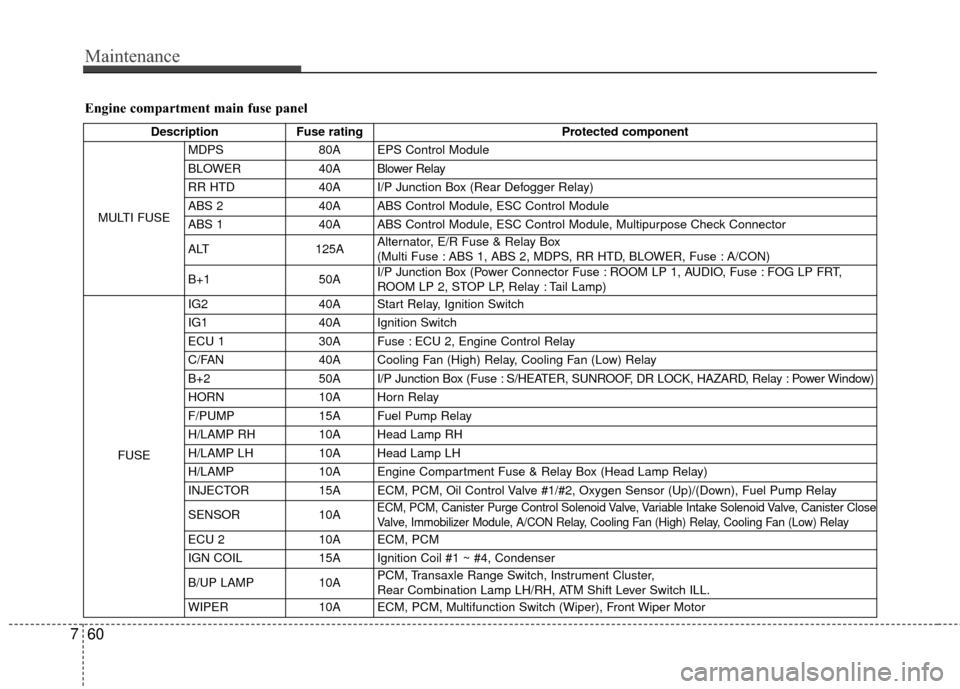
Engine compartment main fuse panel
DescriptionFuse rating Protected component
MULTI FUSE MDPS
80A EPS Control Module
BLOWER 40A Blower Relay
RR HTD 40A I/P Junction Box (Rear Defogger Relay)
ABS 2 40A ABS Control Module, ESC Control Module
ABS 1 40A ABS Control Module, ESC Control Module, Multipurpose Check Connector
ALT 125AAlternator, E/R Fuse & Relay Box
(Multi Fuse : ABS 1, ABS 2, MDPS, RR HTD, BLOWER, Fuse : A/CON)
B+1 50AI/P Junction Box (Power Connector Fuse : ROOM LP 1, AUDIO, Fuse : FOG LP FRT,
ROOM LP 2, STOP LP, Relay : Tail Lamp)
FUSE
IG240AStart Relay, Ignition Switch
IG140AIgnition Switch
ECU 1 30A Fuse : ECU 2, Engine Control Relay
C/FAN 40A Cooling Fan (High) Relay, Cooling Fan (Low) Relay
B+2 50A I/P Junction Box (Fuse : S/HEATER, SUNROOF, DR LOCK, HAZARD, Relay : Power Window)
HORN 10A Horn Relay
F/PUMP 15A Fuel Pump Relay
H/LAMP RH 10A Head Lamp RH
H/LAMP LH 10A Head Lamp LH
H/LAMP 10A Engine Compartment Fuse & Relay Box (Head Lamp Relay)
INJECTOR 15A ECM, PCM, Oil Control Valve #1/#2, Oxygen Sensor (Up)/(Down), Fuel Pump Relay
SENSOR 10A
ECM, PCM, Canister Purge Control Solenoid Valve, Variable Intake Solenoid Valve, Canister Close
Valve, Immobilizer Module, A/CON Relay, Cooling Fan (High) Relay, Cooling Fan (Low) Relay
ECU 210A ECM, PCM
IGN COIL 15A Ignition Coil #1 ~ #4, Condenser
B/UP LAMP 10APCM, Transaxle Range Switch, Instrument Cluster,
Rear Combination Lamp LH/RH, ATM Shift Lever Switch ILL.
WIPER 10A ECM, PCM, Multifunction Switch (Wiper), Front Wiper Motor
60
Page 450 of 456

I3
Index
Cargo capacity··················\
··················\
·········· ·5-44
Cargo weight ··················\
··················\
············ ·5-48
Center console storage ··················\
··················\
· ·4-87
Central door lock switch ··················\
··················\
·4-9
Certification label ··················\
··················\
······· ·5-46
Certification label ··················\
··················\
·········8-6
Chains Tire chains ··················\
··················\
············ ·5-40
Changing tires ··················\
··················\
··········· ·6-18
Checking tire inflation pressure ··················\
·········7-38
Child restraint system ··················\
··················\
·· ·3-26
Lower anchor ··················\
··················\
·········3-32
Seat belt ··················\
··················\
··············· ·3-27
Tether anchor system ··················\
················· ·3-30
Child-protector rear door lock ··················\
···········4-11
Climate control air filter ··················\
················· ·4-75
Climate control air filter ··················\
················· ·7-28
Clock (Digital) ··················\
··················\
·········· ·4-92
Clothes hanger ··················\
··················\
·········· ·4-92
Combined instrument, see instrument cluster ···········4-36
Compact spare tire ··················\
··················\
······ ·6-23
Compact spare tire replacement ··················\
·········7-42
Coolant ··················\
··················\
··················\
· ·7-23
Cooling fluid, see engine coolant ··················\
·······7-23
Crankcase emission control system ··················\
·····7-76
Cruise control system ··················\
··················\
·· ·5-28
Cup holder ··················\
··················\
··············· ·4-90
Curtain air bag ··················\
··················\
·········· ·3-51Dashboard illumination,
see instrument panel illumination ··················\
····4-37
Dashboard, see instrument cluster ··················\
·······4-36
Defogging (Windshield) ··················\
················· ·4-83
Defogging logic (Windshield) ··················\
···········4-85
Defroster (Rear window) ··················\
················ ·4-66
Defrosting (Windshield) ··················\
················· ·4-83
Digital clock ··················\
··················\
··············4-92
Dimensions ··················\
··················\
·················8-2
Display illumination, see instrument panel illumination
·4-37
Displays, see instrument cluster ··················\
·········4-36
Door locks ··················\
··················\
················· ·4-7
Central door lock switch ··················\
··············· ·4-9
Child-protector rear door lock ··················\
········4-11
Drinks holders, see cup holders ··················\
·········4-90
Driver's 3-point seat belt ··················\
················· ·3-16
Driver's and passenger's front air bag ··················\
···3-46
Driving at night ··················\
··················\
········· ·5-36
Driving in flooded areas ··················\
················· ·5-37
Driving in the rain ··················\
··················\
······ ·5-37
Economical operation ··················\
··················\
·· ·5-33
Electric power steering ··················\
··················\
· ·4-30
Electronic stability control (ESC) ··················\
·······5-21
D
E